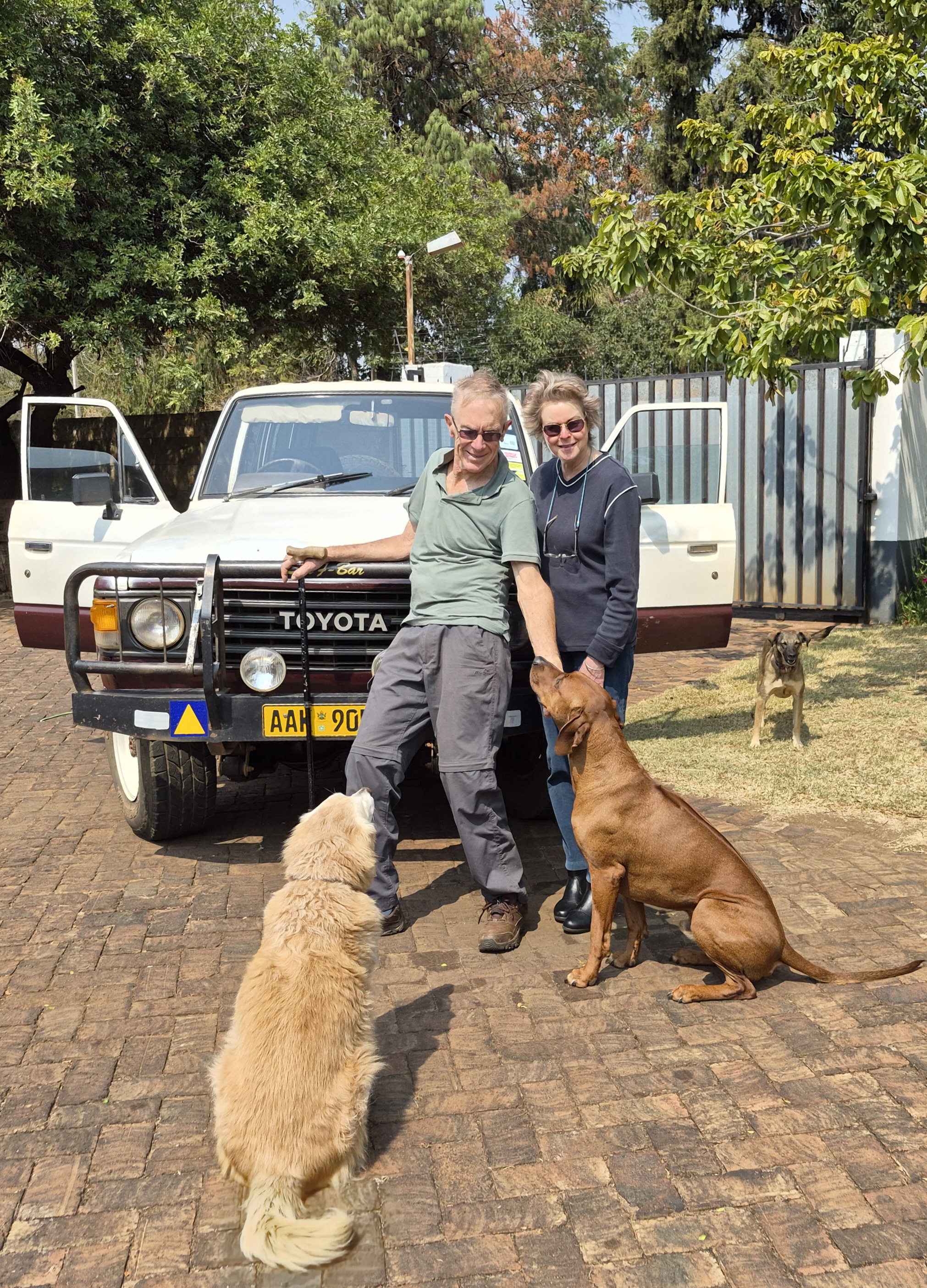
The family (L to R) – Cruiser, Tia with her back to the camera, me, Marianne, Themba and Tara.
Maybe it’s the age I’ve reached when you try not to look forward to the future and the inevitable decline and would rather concentrate on nostalgia of years past. I have to admit that I’ve become sentimental about my old Toyota Land Cruiser. Yes, Marianne is also sentimental about her but for different reasons – she likes the respect she gets from Honda Fits! They definitely don’t cut her up.
We have decided to sell the old girl and the old Mazda pickup and get a second hand Japanese import, a Nissan X-Trail. It makes sense – the Cruiser (we never had a name for her – she was just “the Cruiser”) is used for little more than shopping and the Mazda is used only to keep the battery charged. I can import an automatic vehicle every five years duty-free on my disability allowance and the Ford pickup is 10 years old so we can get the Nissan for pretty much the sale of the Cruiser and Mazda. The Nissan is nine years old
I bought the Cruiser in the mid 2000s – I think. I needed a vehicle for my paragliding trips and I wanted to improve my mechanic skills which up until that stage had been limited to oil changes and brake maintenance. The Cruiser fit the bill on all counts. Being a station-wagon, a 1989 HJ60 model, she could carry lots of kit and people in reasonable comfort and she was certainly in need of some TLC. I ended up learning a lot more than I’d intended to.
The engine, a 2HZ 3.98 litre diesel was in poor shape so the bonnet went up and out it came. The cylinder head was overhauled with valves being reseated and lapped-in. The head was skimmed, new cylinder liners purchased and put in by what was, I was assured, a reliable machine shop. Then it all went back together courtesy of a how-to-do it book copied off a friend and lots of asking around – remember the days before Google? I did buy a lot of tools and Jenni, my Rhodesian Ridgeback, helped by getting in the way when I was under the vehicle.
Made for the purpose – dogs, people and mud. L to R: Zak enjoying the scenery, Florian driving, Kharma in her rightful place on the back seat and Ute holding Tiger. One of the few times the 4×4 facility was actually used!
She started a bit rough, but after the timing was sorted out and feeling rather pleased with myself I took her for a drive on the farm. It was the rainy season and I needed to test my idea that one couldn’t get a Land Cruiser stuck so I went down a road that I knew was particularly muddy. Nervous moments were had as I realized there was a good reason that the tractors avoided that area in the rainy season. I retreated more than a little cowed and covered in mud and disengaged the four wheel drive.
Just when I was getting pleased with myself (about 2,000 km later) the engine stopped. Something was badly wrong so the cylinder head was removed again and the damage assessed. The machine shop that I was assured was good hadn’t bothered to tell me that the cylinder liners I’d bought were too small and every single one was cracked around the rim, except for the sixth which had been pulled down onto the crankshaft. It took two years for my sense of humour to recover enough to start the search for another engine. It turned out to be a fortuitous wait.
I asked Mark in the 4×4 Club to ask around for a replacement engine. Some time later he contacted me: “I have someone wanting to sell two engines that came from Dubai” he said. “One is a 2H like yours, the other is a 12HT which is the same engine but turbo charged”. I dithered and decided on the 2H which was the cheaper of the two. “It’s already sold” he replied. So I stumped up the cash for the turbo version. It was a good choice.
Once Mark had fitted the engine – he’s a better mechanic than me and there were a few modifications that I was prepared to let someone else do – the adventures began. There was a trip to Ghona-re-Zhou in the south east of Zimbabwe. Several to Mana Pools Game Reserve on the Zambezi and lots to Nyanga. Being a big station wagon there was always plenty of room for friends, dogs and paragliders and she could go almost anywhere. The big diesel would reassuringly rumble from Harare to Nyanga in the eastern highlands without having to change gear for any hills and she could easily stay on the speed limit. There is one hill near Juliasdale that I would really look forward to. A steep descent to a 90 degree right hand bend followed by a long curving uphill. No problem, put the foot down and purr up to the top without a gear change.
She also had some extras added after the engine was replaced. I had her resprayed to a two tone white and maroon. A bull bar was added to the front on a new heavy steel bumper – fortunately I never needed to find out how well they worked. A heavy steel rear bumper was attached and a long range fuel tank replaced the original. That was well put to use. Spot lights were added as the original lights were poor. Back then it was still ok to drive at night. Now we avoid it if at all possible.
On the weekends I’d often go out flying model radio-controlled aircraft or my paraglider and I’d leave the ‘Cruiser by the back door whilst I had lunch and got ready. If the door was open Jenni knew she was coming and would climb in and wait. It could be more than two hours but she was as patient as she was determined. After Jenni there was Zak and Kharma – also Rhodesian Ridgebacks. Once I had to keep them in the ‘Cruiser whilst aircraft took off at the airfield where we flew. Zak showed his displeasure by chewing a seatbelt.
I haven’t driven her for quite a few years now – as my disability has increased my feet have become too slow on the pedals. Marianne does drive her and likes the sense of respect she gets from other vehicles, especially Honda Fits but I think I have already mentioned that. Anyway, tomorrow she goes to her new owner in Kariba who has promised to look after her. Doing the final checks this afternoon and pumping up the tyres I couldn’t resist one last listen to that big diesel. She started easily as always. I couldn’t get my right foot to the accelerator pedal so I used the hand throttle. I gave it a good pull and the engine roared and as it slowed there was that beautiful turbocharger whistle. Perfect! I know one shouldn’t get sentimental about vehicles but I guess it’s the memories they invoke. Farewell old friend.
Earlier this year the Zimbabwe government decided to update the list of goods that required an import licence when brought into the country for commercial purposes. There is a fair bit of latitude on goods imported for personal use. The resulting document is the Control of Goods (Import and Export) (Commerce) (Amendment) Regulations, 2026 (No.15). The rationale behind the update is to put it simply trade protection, stimulation of local businesses and the saving of foreign currencies (they could start on the latter by not stealing so much themselves). There is a condensation of the rationale here but for those who insist on reading the original document you can download it here.
The document is mostly mundane but there are a few items that are quite unusual. Let’s start with the toilet paper.
Yes, we are protecting the local toilet paper industry. I cannot say I’ve had much in the way of first hand experience of using local toilet paper but I strongly suspect that the occasional roll of single ply that I’ve experienced in toilets attached to customers’ waiting rooms has been the local stuff. In this household it’s strictly multi ply.
Most serious toilet paper is double ply though I have come across triple ply. Single ply is in its own league. Whilst not useless there are challenges involved. Using it single is not an option for obvious reasons so it is sensible to double it up. Even that is risky so fold again to get four layers – economising is not wise. By now you might have realized that it would be cheaper to have used regular double ply in the first place. Will local manufacturers step up to the plate and produce decent quality now that they are protected? We’ll see.
Then we come to the nukes. Yes, you read that correctly.
I have to admit I have no idea what they mean by this. We have no locally produced nuclear reactors and no money to import one either. The government is heavily in debt and looking to China to help us out with our “$34 billion infrastructure challenge” in exchange for mineral deals. So I guess we won’t be needing import licences for “Parts of nuclear reactors” either.
Then we go from the absurd to vague – “other”.
Other what? Again this is more than a bit vague and gives the customs officials overseeing the import more than a bit of latitude. It appears in a few other places in the document as well. That could be intentional.
Some of it is quite reasonable – no importation of second-hand underwear at all. Not sure why anyone would want to wear used undies even if they had been washed. What will hurt is the importation of bales of second-hand clothes that is big business. It’s all very well encouraging people to “buy Zimbabwean” but if they cannot afford new clothes, as is evidently the case, what are their options?
The document is by no means an exhaustive list of items requiring an import licence. Last year I imported coir pith, from Sri Lanka, that we used in the nursery as a medium in which the seedlings are grown. It required in import licence and the requirements for that were onerous but I’ve done it for 11 years so it was tedious but expected. I do have to wonder how many people will not be familiar with the import requirements and will arrive at the border posts with items in commercial quantities that now require a licence only to have them impounded. I am fairly certain that nuclear reactors, tariff code 8401.10.00, won’t be among them.
My brother, Duncan, arrived from the UK on Good Friday for a three week holiday. Originally he’d booked on Emirates the day before the Gulf war started but took up the offer of a full refund rather than take a chance. Asked what he thought of his flight on Rwandair he replied that it was just fine and the planes were relatively new. I am not sure how he justifies a holiday given that he’s retired. Maybe it’s our weather that’s so attractive – which it is when compared with the English weather. I was especially pleased to see him as he’d brought me a mixed pack of cheeses which can be found in Zimbabwe but are notoriously expensive. Oh, yes, we do get along well too. Our sibling rivalries of our teenage years are long past.
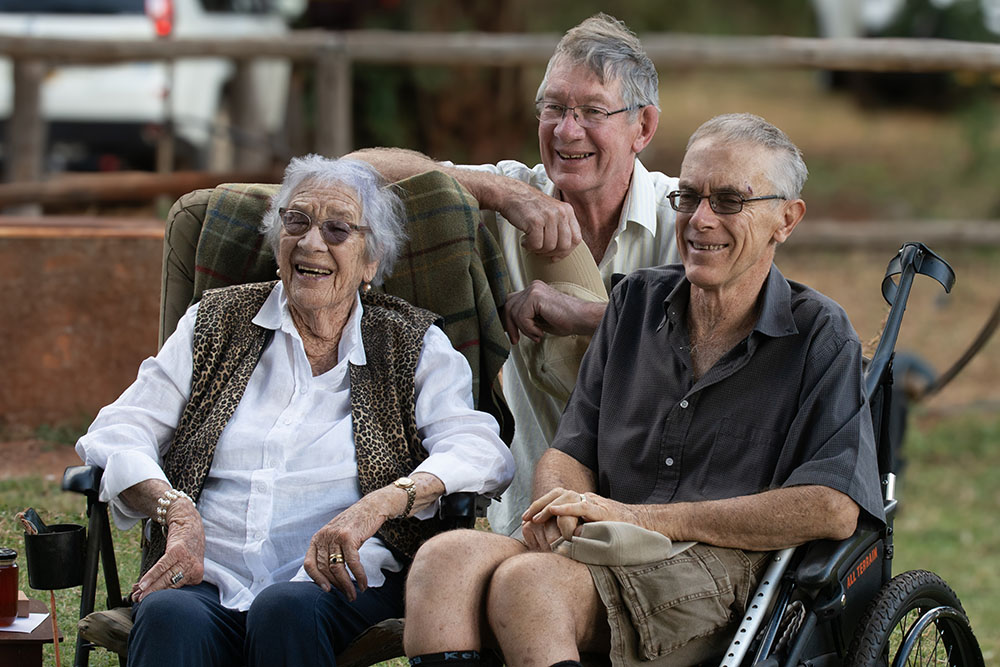
Left to right: my aunt Helen (97), brother Duncan (70), self (66).
The following day was my aunt, on my mother’s side, 97th birthday party. She’s doing well for her age and still lives by herself albeit with a carer. Unlike me she doesn’t need to use a wheelchair, just two walking sticks. I also walk with two sticks but on occasions such as this find a wheelchair easier. Most of her family were in attendance as nobody can be certain how much longer she’ll be around.
My mother’s side of the family seemed to either live a long time – brother Anthony to 94, Helen 97 so far – or not. My mother died of melanoma at 67 and her other brother Steven died at 72 from prostate cancer. Not much is known about my father’s family. He was an only child and no father is listed on his birth certificate. A scandal in our family – quelle horreur! Us siblings were delighted and my sister Diana, who died at 62 from breast cancer, noticed this and asked my mother about it but the curtains came down. The man whose surname my father inherited died on the Somme in 1918 and my father was born in 1925. It’s not that my mother was prudish but she was born in 1925 and some things were not up for discussion. She once asked me if I would consider marrying a woman who’d lived with someone else. I replied that I’d be seriously restricting my choice if I were to apply that criterion. She looked thoughtful for a moment then said: “Yes, I suppose so”.
She was a strong woman my mother. My father was murdered in 1978 and bled to death outside the front door within three metres of her (she was on the other side) and she could do nothing to help. It was near the peak of the Rhodesian bush war and civilians were fair targets for the combatants/terrorists of Robert Mugabe’s ZANLA and Joshua Nkomo’s ZIPRA. Understandably she didn’t talk much about it but did say that flying on the air force helicopter into Umtali (as Mutare was known then) she recalled that the countryside being beautiful by the light of the full moon.
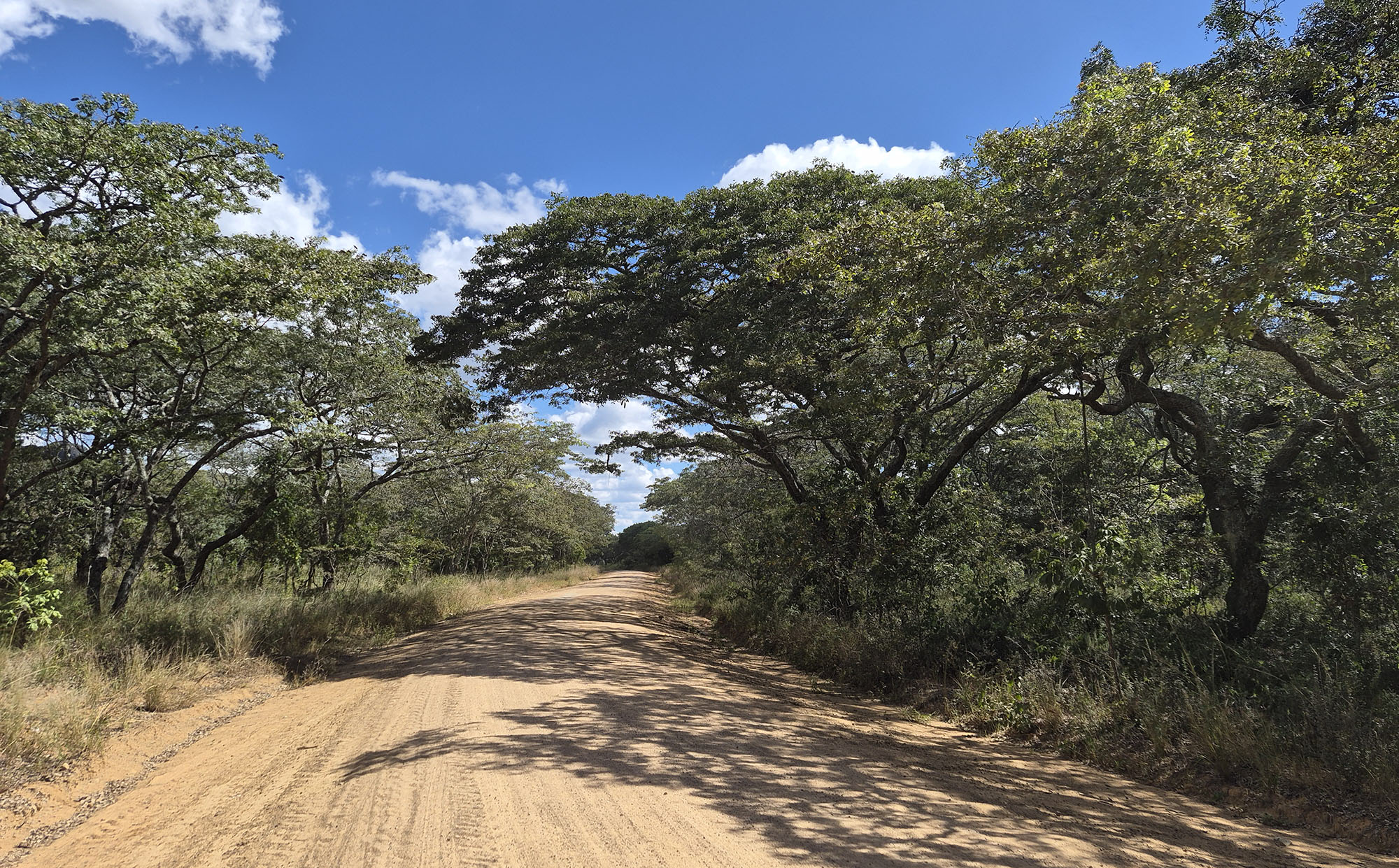
The quintessential Zimbabwe bush scene – a sandy road, miombo bush.
We decided to take a trip to the Eastern Highlands of Zimbabwe. The district of Nyanga, where our parents had met in the early 1950s, was to be the first port-of-call, but Duncan wanted to call in and visit Kerry Stanger, near the small town of Rusape, who has a crowned eagle nesting in her garden. Some of her fantastic photos can be found here. Her husband John farms a variety of crops including tobacco and pecan nuts and is looking to put in chili peppers for export to China. Unusually for the area, he has managed to keep a fair proportion of his original farm and as a title deed holder is looking to invest in a solar farm with a Dutch company. He also has a dairy!
I couldn’t access the observation point where Kerry takes her photos of the chick that she calls JJ. He/she was not cooperating so they didn’t get a clear view anyway. We did enjoy the views of the unspoilt countryside of granite rock outcrops or “kopjes”, grasslands and bush-veld.
Straight on to Nyanga village, right to Troutbeck Hotel and up to World’s View.
The road from Rusape to Nyanga was quiet and all the potholes had been filled – with sand. It was a pleasant trip and we even saw a black mamba snake crossing the road. Fortunately it was close to a police roadblock and I was going slow enough to easily avoid it. This was a relatively small one at about 1.5m but they can often get to 3m or more. Duncan got out of the car to try and get a photo. He seemed to think that they would only attack if cornered. That maybe, but as Africa’s largest venomous snake I was pleased that it had quickly moved off.
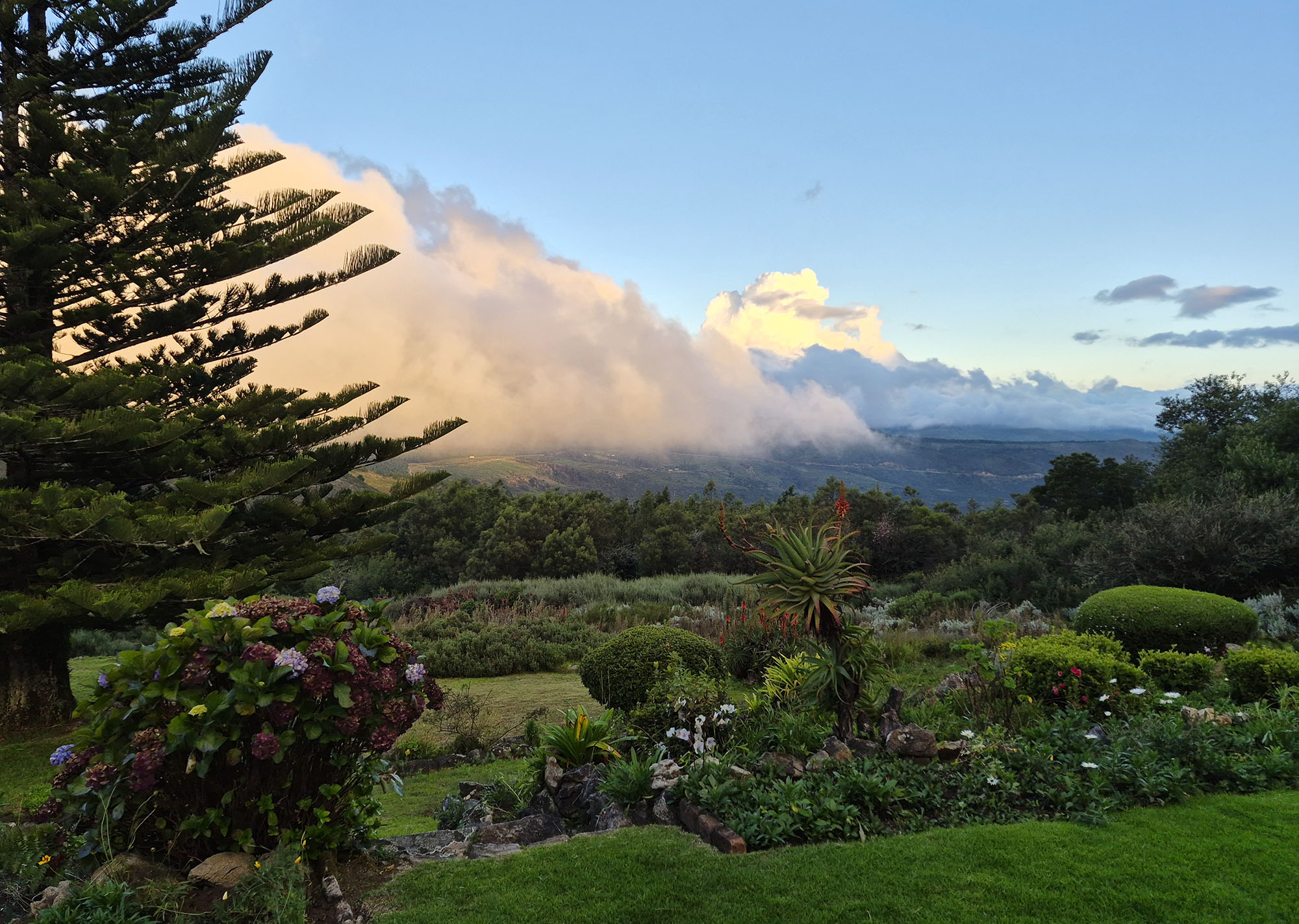
The evening view from Venus Cottage where we stayed
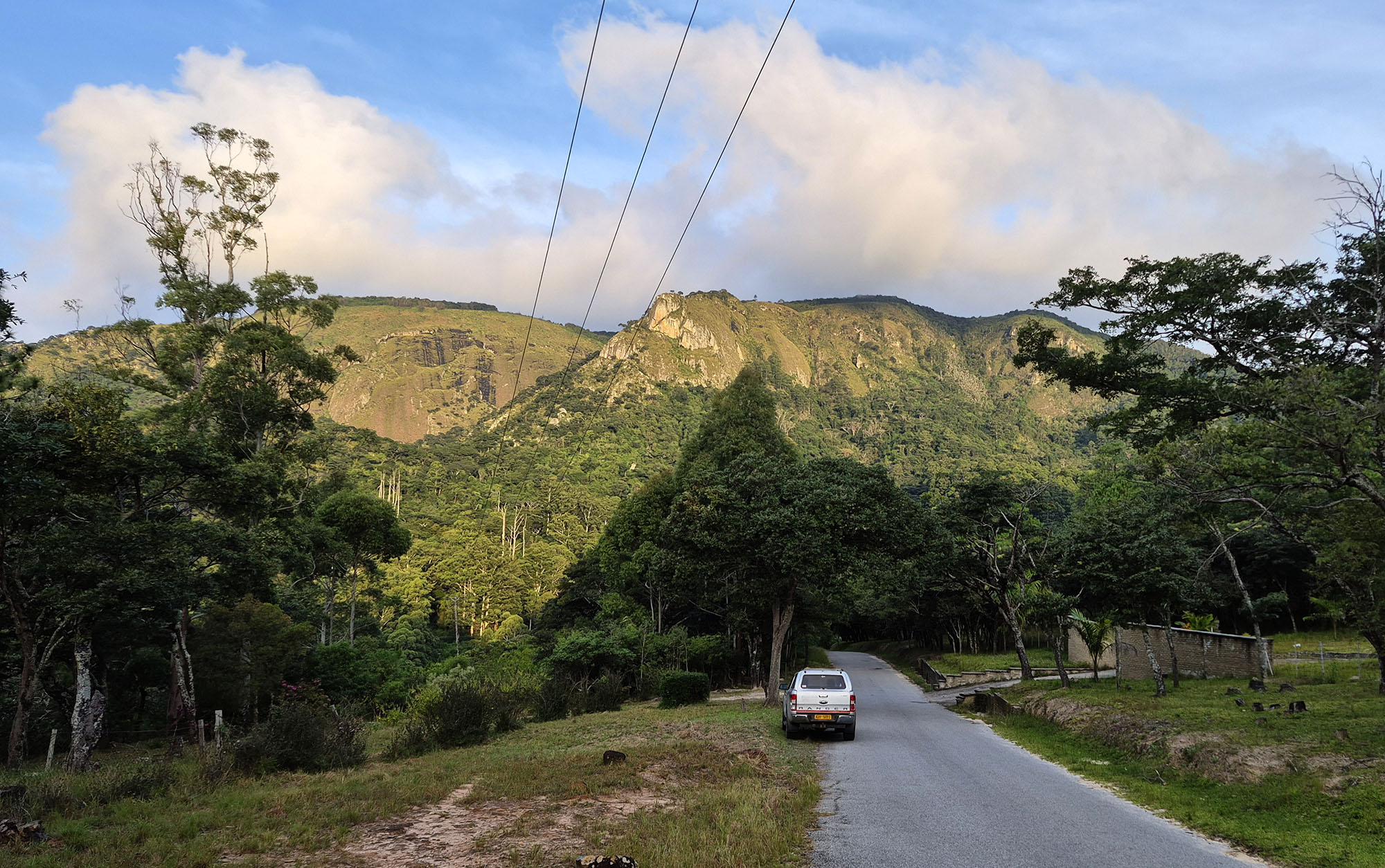
The road from Troutbeck Hotel up to the Connemara lakes is in very poor shape. We arrived at Venus Cottage where we were staying just in time to capture the setting sun reflecting in the clouds covering Mt Nyangani, Zimbabwe’s highest peak. It was getting cold enough for a fleece (for me at least) and the fire was lit.
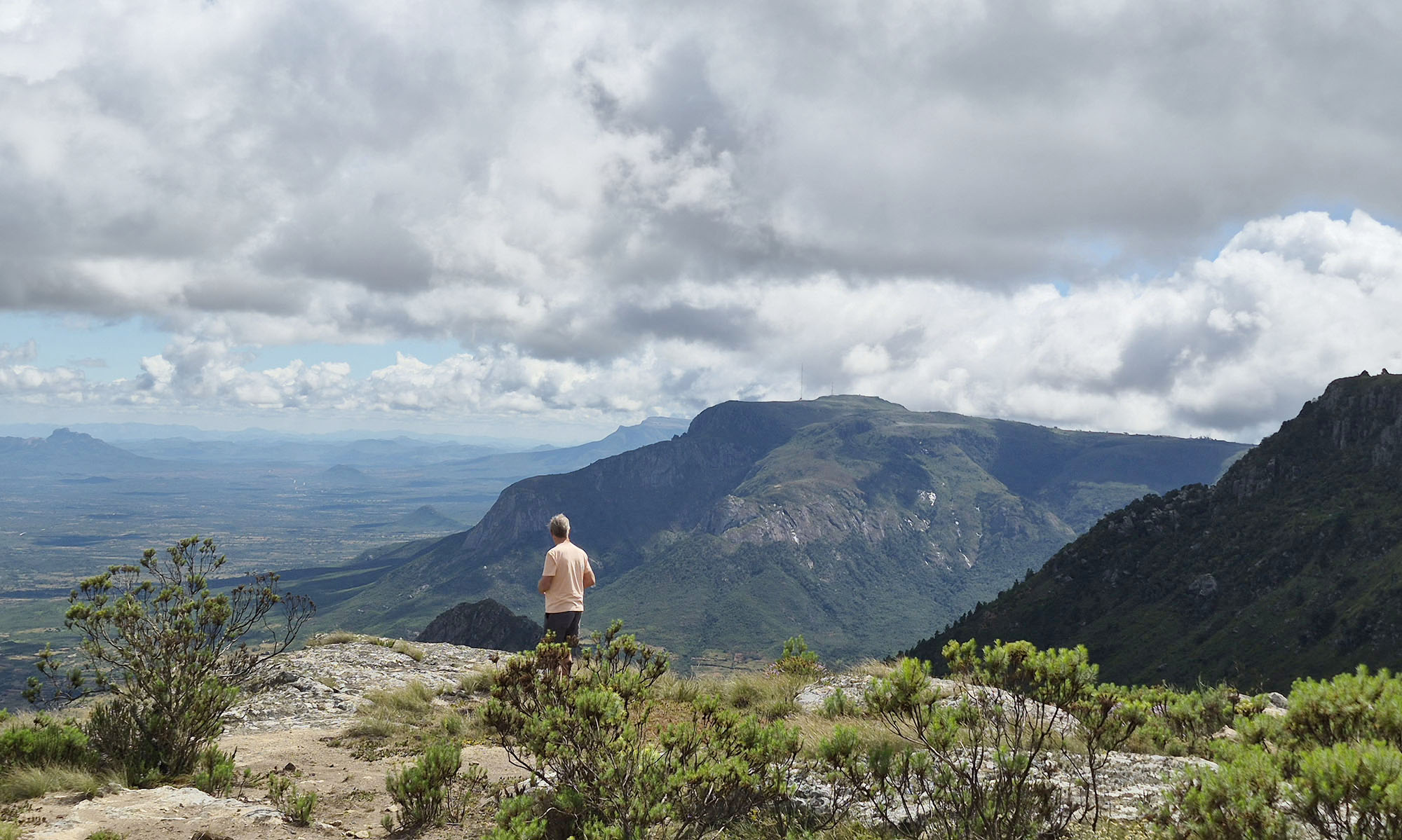
The World’s View range: background – Nyangui, middle ground – Rukotsu, right – World’s View
After my mother died in 1992 I moved back from the Chinhoyi (central west) area of Zimbabwe, where I was working on a flower farm, to her cottage in the mining village of Penhalonga on the Mozambique border about an hour south of Nyanga. I was keen to try to earn a living doing freelance programming for the agricultural sector. After a couple of years and merely subsisting I closed shop and moved to formal employment near Harare. I did however get hooked on paragliding whilst in Penhalonga.
Gary and his family lived at the top of the Penhalonga valley, close to the Mozambique border. One day he called past the cottage and said “I am going paragliding, come along, you might be interested”. On the local training hill I watched him lay out his wing, inflate it and step off the slope into the air. I was entranced. “I just have to do that!” I thought. I duly did a course and bought my own wing.
We had three flying sites in the area; Penhalonga, the Honde Valley to the north and then World’s View further north again. The World’s View takeoff, to the right of the picture above, faces west and when the wind blows from that direction can deliver extraordinary flying.
Not long after I learnt to fly I went with Barry, who’d taught me to fly, and others to World’s View. It looked good so we launched into what we found out later was convergence* and conditions were extraordinary. We didn’t have to look for thermals – the lift was everywhere, smooth and strong. We were carrying variometers (an instrument with audio and visual rate-of-climb and sink indicators and an altimeter) so we knew both how fast we were climbing and how high we were. At 1,000m above takeoff the terrain below looked completely flat. Barry had to go back to Harare so we landed and I went home to Penhalonga. We had many good flights at this site but none that quite matched that day. My love of paragliding never dimmed and I went on to fly in South Africa, France and the USA where I famously had to be rescued by a US Navy marines helicopter! *Convergence in meteorological terms is when two airmasses converge and the air is forced up. Conditions can be fantastic for soaring in dry weather but in summer storms often develop along the convergence line.
The view from the plot that my mother bought in the early 1950s. The mountains in the distance are in Mozambique.
The following day we took a trip to the plot that my mother had bought not long after my parents were married. The intention was that one day they’d retire there and relax and enjoy the view, which is fantastic. It was not to be. My father was murdered as a result of the bush war in 1978 and my mother died in 1992. She left the plot to both myself and Bridget Galloway (Hamilton) whose parents mine befriended in the area in the 1950s. I realized that I was never going to develop the land so sold my share to Bridget some years ago. She has built a very rustic cottage and lives there by herself with no apparent need for any sort of security – not even a fence around the cottage.
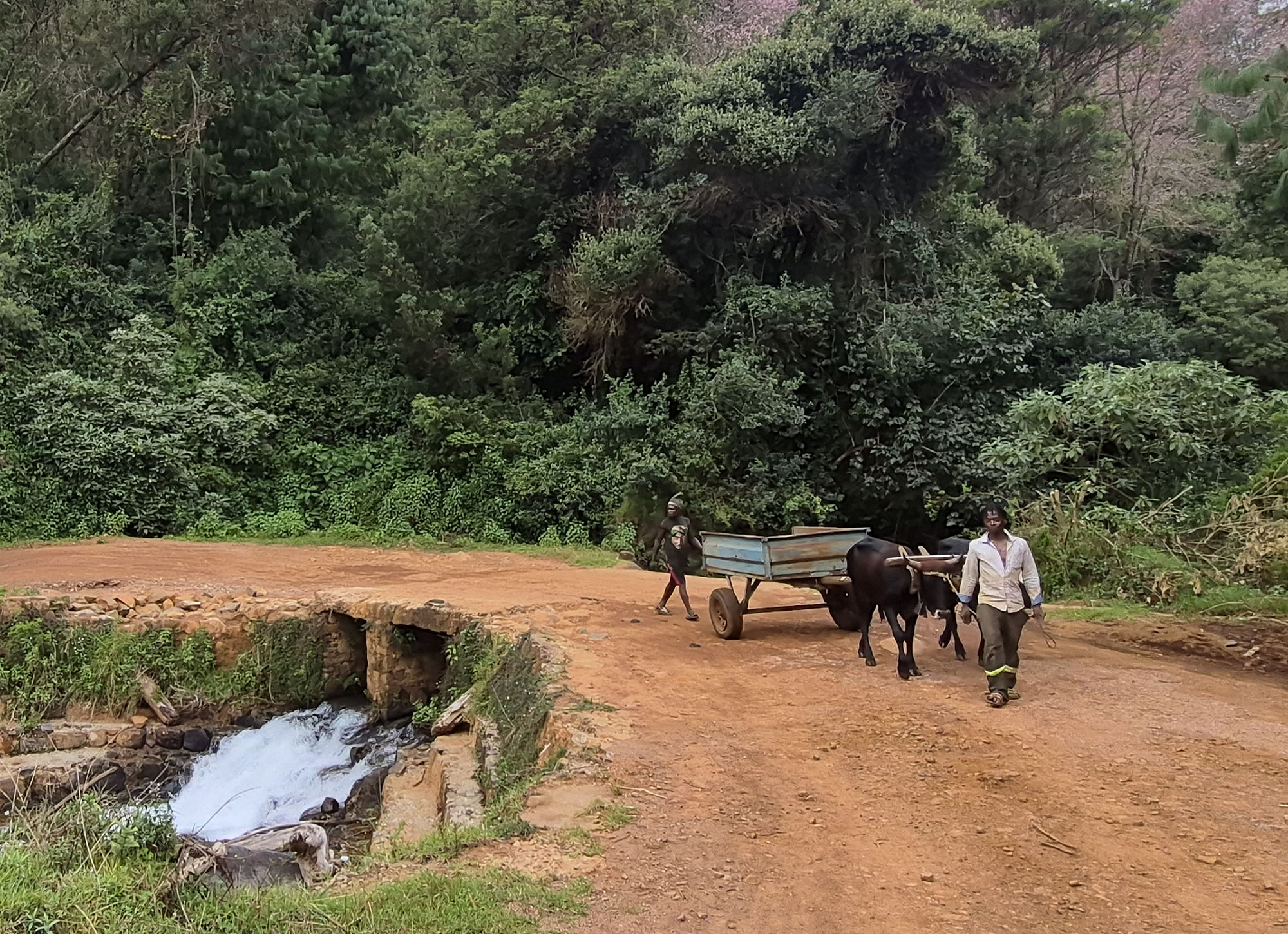
The road to the plot was awful. It took us an hour to cover the 13km and in two places we used four-wheel-drive. It probably wasn’t necessary but it made life easier. Bridget had told me earlier when I’d asked about the condition of it (she was working elsewhere when we arrived) that in March heavy rains had made the road impassable for three weeks. When at school in Mutare we used to make monthly trips to the plot and even then the road wasn’t great but still passable to any vehicle with reasonable clearance.
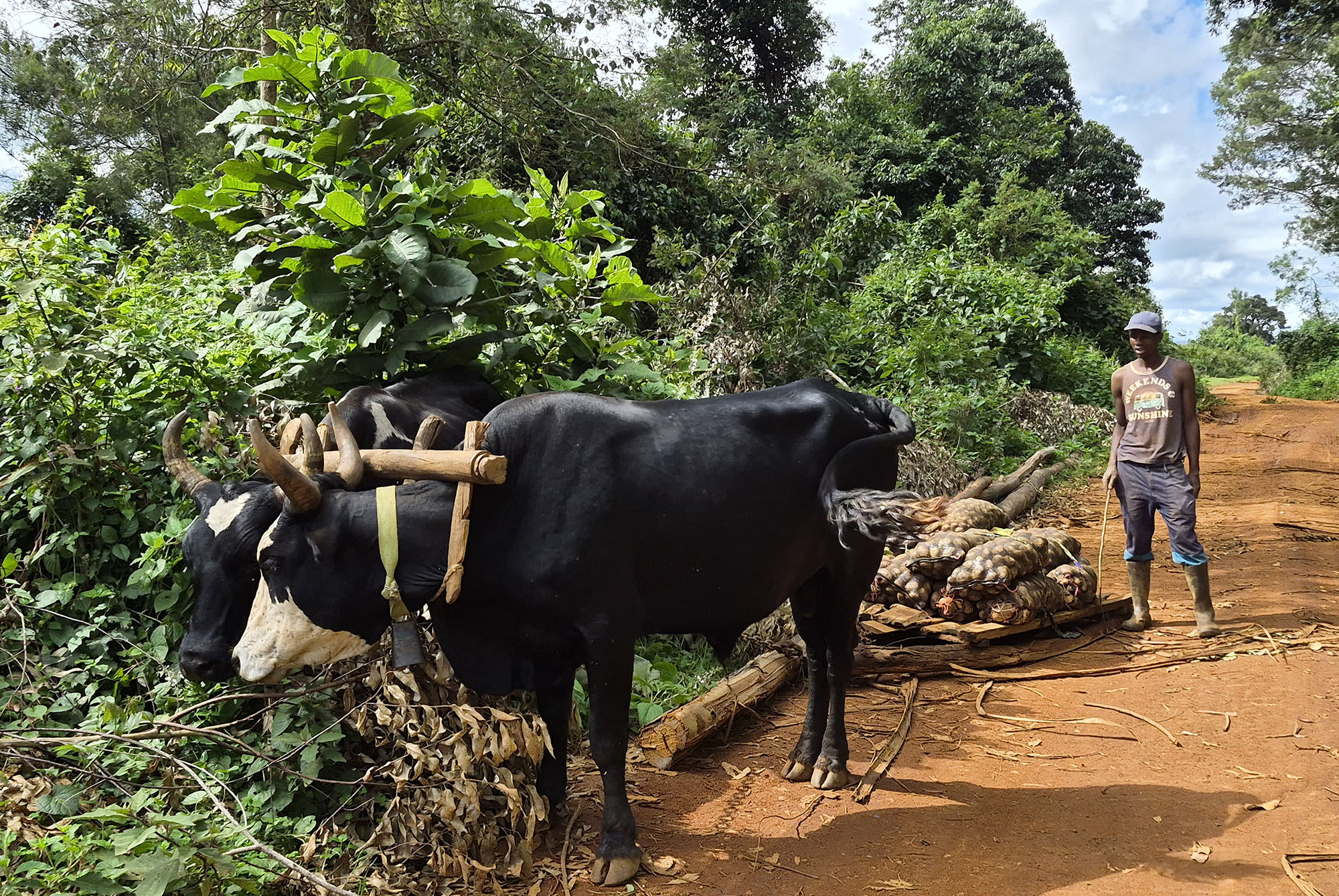
A bit of rudimentary transport taking a breather whilst we were blocked by a truck loaded poles. No doubt it could have negotiated the road when other transport found it impassable. The oxen looked in good condition.
On the way back from the plot we had to wait twenty minutes for a logging truck to finish loading with poles. Duncan, being an ex truck driver in the UK went to speak to the driver. He marveled how the truck managed to negotiate some of the tighter corners on the road and even had turned around.
Sometimes it’s easier to negotiate the tight bends with something more appropriate even if it doesn’t carry much.
We called in at the Troutbeck Resort on the way to see Barry (the one who taught me to paraglide) who was working there helping refurbish a conference room – he’s a professional carpenter. We reminisced about our paragliding days over tea and beers and came to the conclusion that our paragliding days were over – neither of us could afford a bad landing – but hell, we’d had a lot of fun. I still fly a paramotor on occasion but it doesn’t really compare with the thrill of catching a thermal and feeling the glider pitch into the lift and the variometer start to squeal. So far as I know there is nobody flying paragliders in the country. The World’s View takeoff is overgrown as is the Honde valley takeoff to the south. There is another site on the Zambezi Valley north of Harare and I had amazing cross country flights there but access was problematic even then.
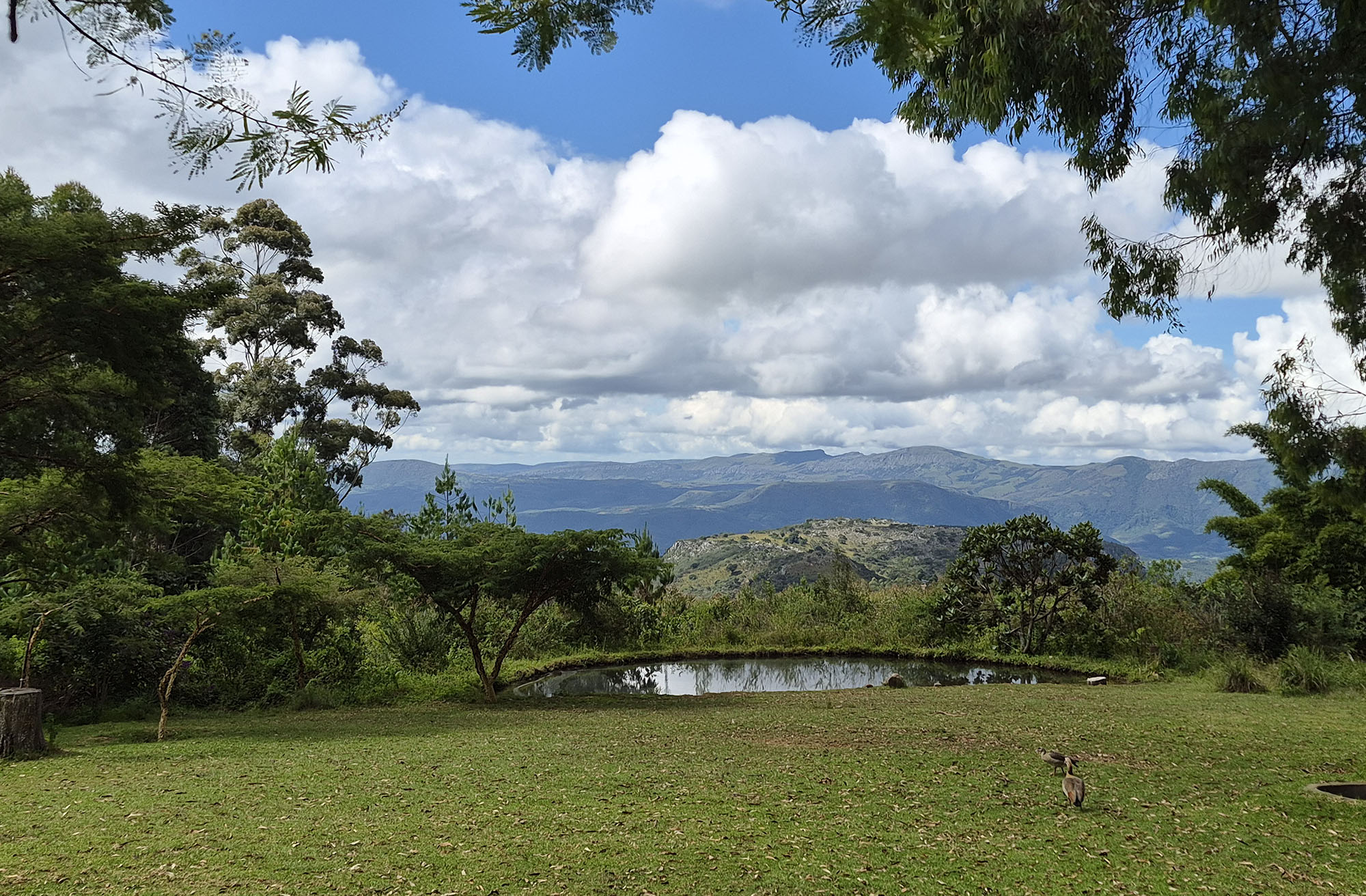
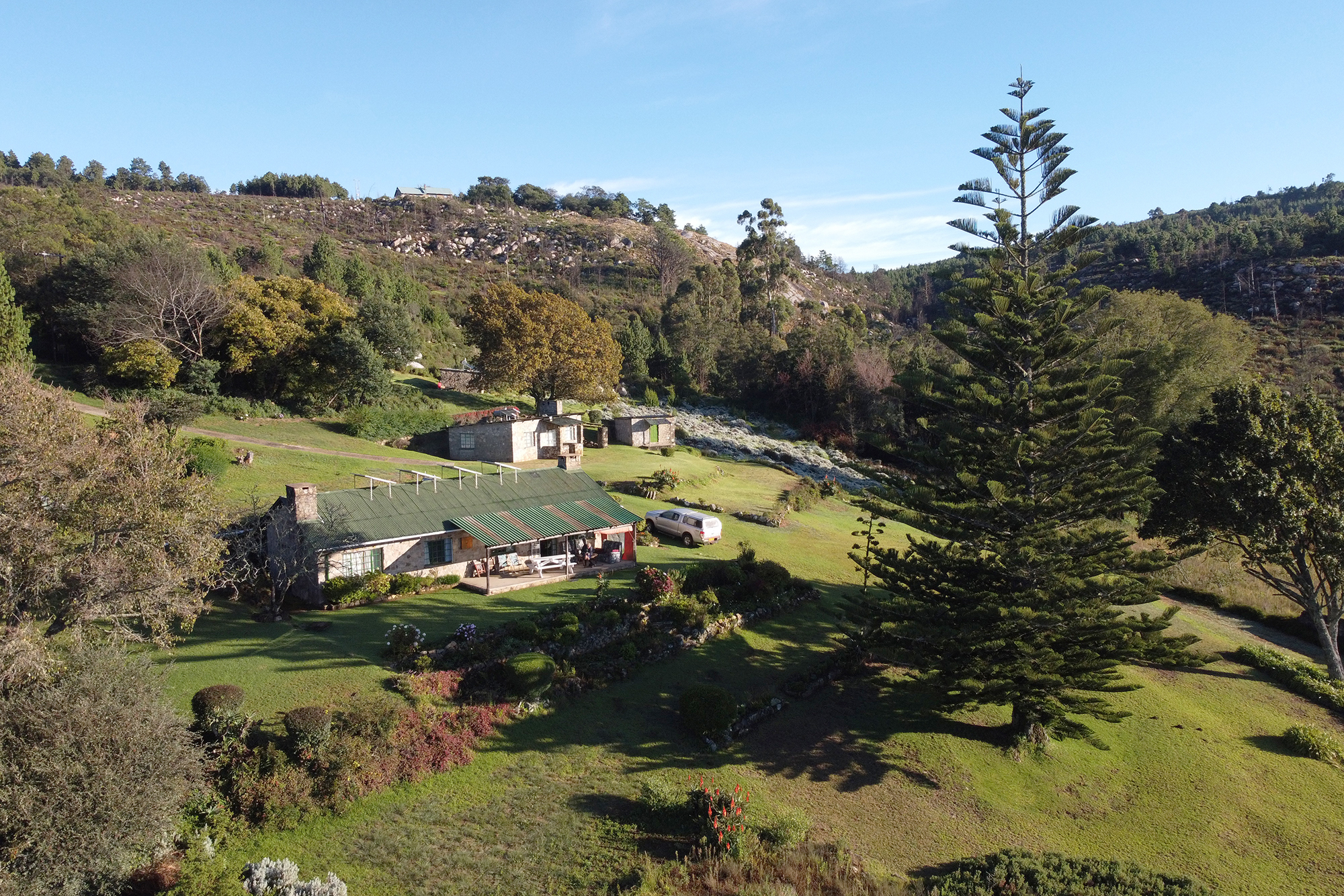
Venus Cottage where we stayed, looking west. It’s comfortable and has been refurbished since we last stayed there.
The next day we left the cottage and headed back south to Mutare. On the way there we stopped off to see Sue in the Imbeza valley where she lives on a smallholding. Together with my mother, she was one of the founder teachers of Hillcrest Primary School closer to Mutare. She also lost her husband in the war in the Cashel valley south of Mutare where they were farming. Farmers were especially vulnerable and Tim was ambushed near the farm apparently in a case of mistaken identity. One of his sons found out many years later that the target was another farmer following behind him.
My brother Duncan and Sue. She’s a spry 80 year-old, still living by herself.
Then it was on to Mutare to meet up with Gary (the one who introduced me to paragliding) and his family. After a pleasant afternoon chatting and catching up (they don’t often come up to Harare) we headed into the nearby Bvumba mountains to the White Horse Inn for the night. On the way we passed through the centre of the city and I was pleasantly surprised at how clean it was.
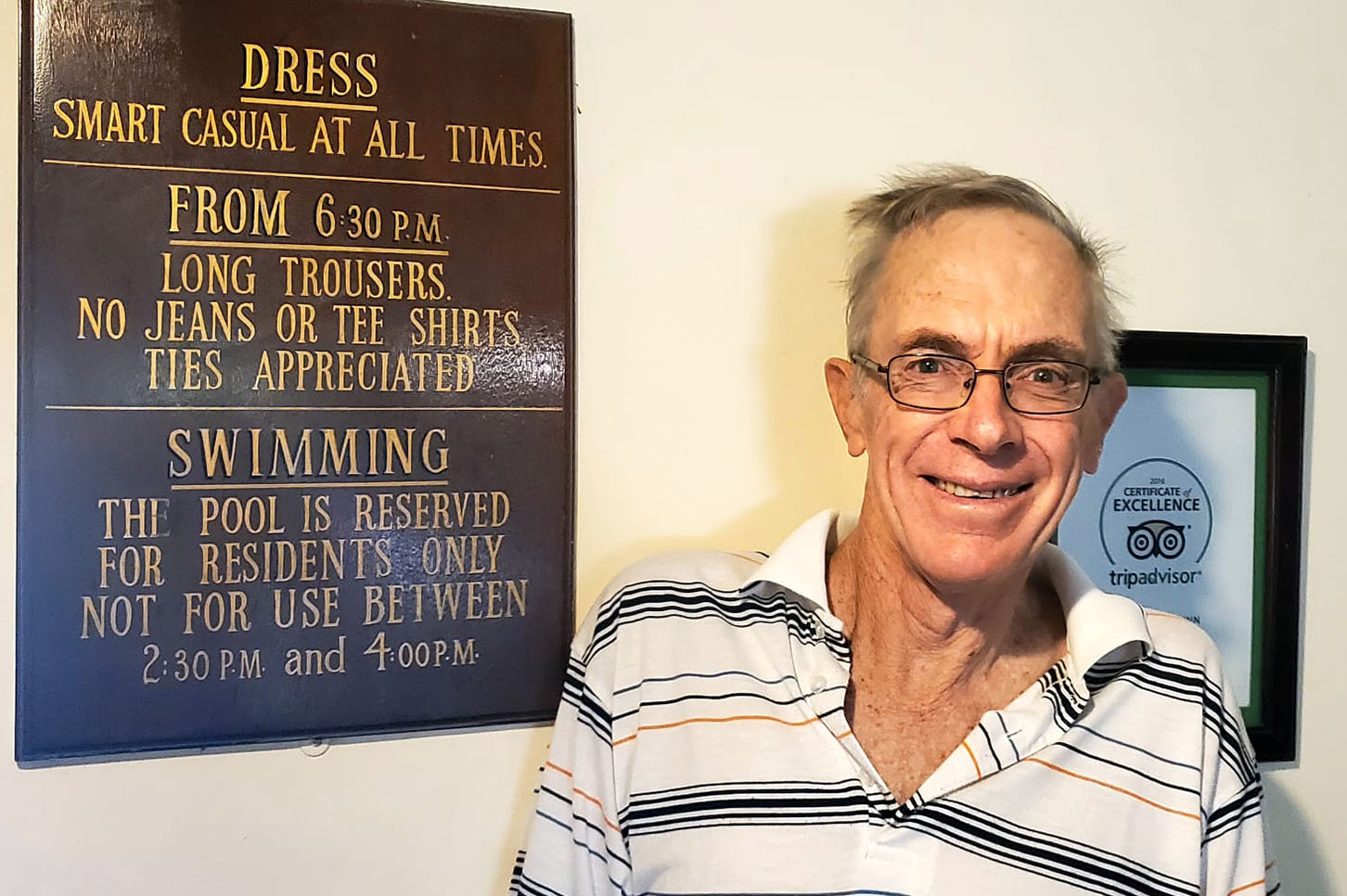
Approaching the White Horse Inn in the Bvumba mountains close to MutareSorry no tie – me flouting the dress code. Marianne (my wife) recounted how many years ago the then manager, David Graham, had given her partner a tie to wear for the dining room as he wasn’t carrying one. They are much more relaxed now – we did ask – even shorts are permitted!
The decor of the inn is still very much as it was 50 years ago. Duncan sent photos to an old school mate who’d lived in the area and said it hadn’t changed since his youth. The staff were very pleasant, the food good even if the service was a little slow and the rooms comfortable. It scores a well-deserved 4.3 stars on Trip Advisor.
The next morning the mist was down as befitting the name Bvumba which refers to the “misty mountains” so we had a relaxed breakfast and started down the hill to Mutare.
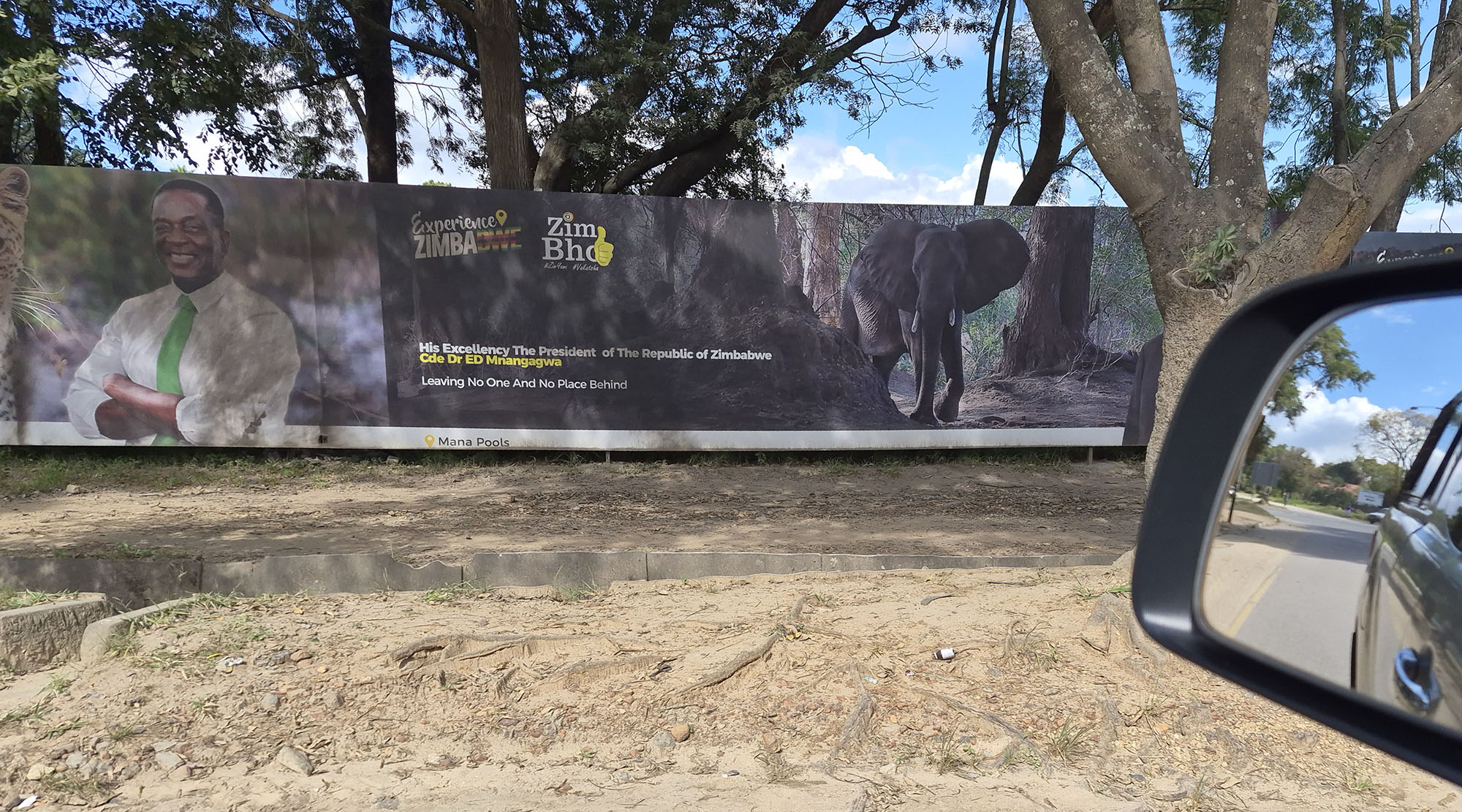
“No one and no place left behind” says the slogan on the banner on the sports ground fence in Mutare. That’s Zimbabwe’s president. E.D. Mnangagwa on the left. The slogan is more than a bit ironic considering that a third of the population faces food insecurity but the ruling party (ZANU-PF) wants to increase the president’s term beyond the stipulated two of five years each. There’s a referendum coming up on this issue so the slogans abound as does the intimidation. Everyone expects the result to be fixed in favour of changing the constitution.
The drive back to Harare was uneventful with none of the heavy trucks forming nearly impossible to overtake informal convoys. Duncan drove like a good Zimbabwean driver – overtaking on solid white lines, pushing into small gaps in the left lane and cutting in front of a car in oncoming traffic in Harare. He needs to work on the speeding bit though. He kept to the 120 km/h limit all the way and even used cruise control so he only qualifies for a provisional licence! It was a good trip with plenty of time to reminisce about our distant youth and catch up with old friends.
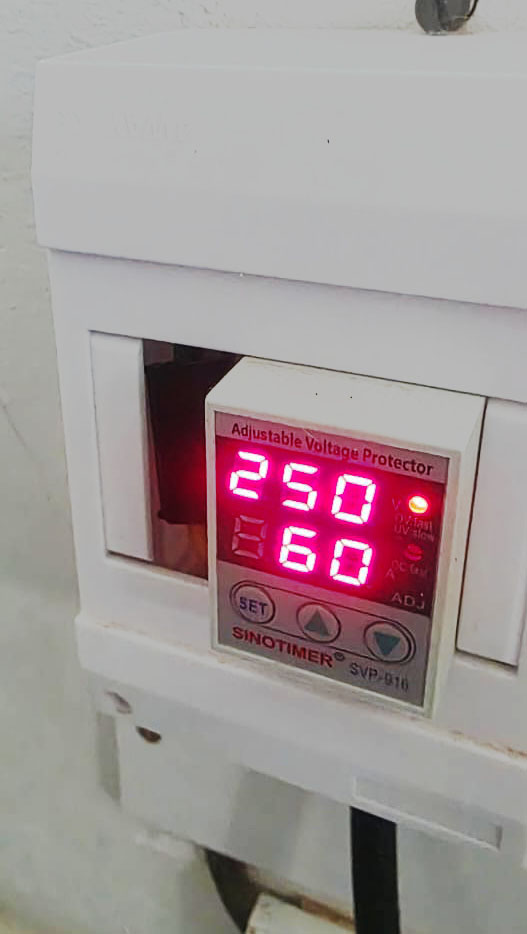
The unstabilized power is frequently unusable. Just after this photo it spiked to 260 volts.
It became evident soon after we installed the solar panels and inverter that we were going to have to do something about the terrible power quality. Most of Zimbabwe has erratic power supplies. Called “load shedding” it’s really just a statement about the government’s ineptitude in supplying power to the nation. The national supplier, ZETDC (Zimbabwe Electricity Transmission and Distribution Company) is a subsidiary of Zimbabwe Electricity Supply Authority (ZESA) and is the sole distributor of power. Other subsidiaries, also government companies, are responsible for sourcing power. It’s a mess and a major driver of the private sector embracing solar power. We have a friend who works for a company that installs industrial sized solar systems and she tells us that they cannot keep up.
Our problem is not power supply per se, but a wildly fluctuating voltage. We have been told that we are on the same part of the power grid as a “person of influence”, i.e. a political fat cat, so we don’t often get intentional power cuts though faults are not uncommon especially during the rainy season.
We installed the voltage protection unit (VPU) pictured above to protect the solar inverter from the voltage which we have seen anywhere from 280 volts down to 160 volts. It simply disconnects the supply outside of the safe range of 190 volts to 240 volts. During the day the supply is often above this range and at night it falls below. We can hear the VPU switching on and off in the evening and the lights flicking as the inverter takes over. Most of the time it is merely tedious but on occasion the voltage goes low for so long that the solar battery goes flat and the lights go off. Especially in cloudy weather when the solar battery never fully charges.
Over the years I have acquired a reasonable collection of woodworking and other power tools. These are in the spare garage next to the cottage in the garden and most can run off the cottage solar system. The planer/thicknesser and it’s accompanying dust collector cannot as they draw too much power so must run off the mains supply and the voltage fluctuations would destroy the motors very quickly. The planer is a very useful machine and because I am so dependent on it very little happens in the woodworking sphere these days.
Whilst I knew that voltage regulation units (VRUs) that supply a constant voltage existed, I had researched them on the internet and found that they tended to be large and very expensive. I asked my friend Barry, who is a professional carpenter, what his solution would be. He has liquidated his company he has no large machines but I thought he might know someone who did. It turned out that he and his partner had just installed a relatively small VRU in a flat that they’d bought and were available locally for less than US$1,000. So I got hold of the company and started asking questions, lots of them.
Having ascertained that I would need a 15kVA regulator and that the warranty would be valid for a year they couldn’t give me a clear answer as to whether it would be valid, or what would happen to the unit, if the voltage went outside the maximum rated supply of 250 volts. Asking around led me to another hardware outlet but they were only interested in selling the VRU and had little backup and simply wouldn’t answer the voltage range issue. A chance conversation with one of my cousins and with an electrician that he knows led me to call Richard of ElectroTronics and he answered all my questions.
ElectroTronics is based in the Southerton industrial area of Harare. Once a bustling hub of industry it’s a lot quieter than I remembered (I had no reason to go there for quite a few years) but was surprisingly clean. The roads were mostly good though the one past ElectroTronics was in very poor shape.
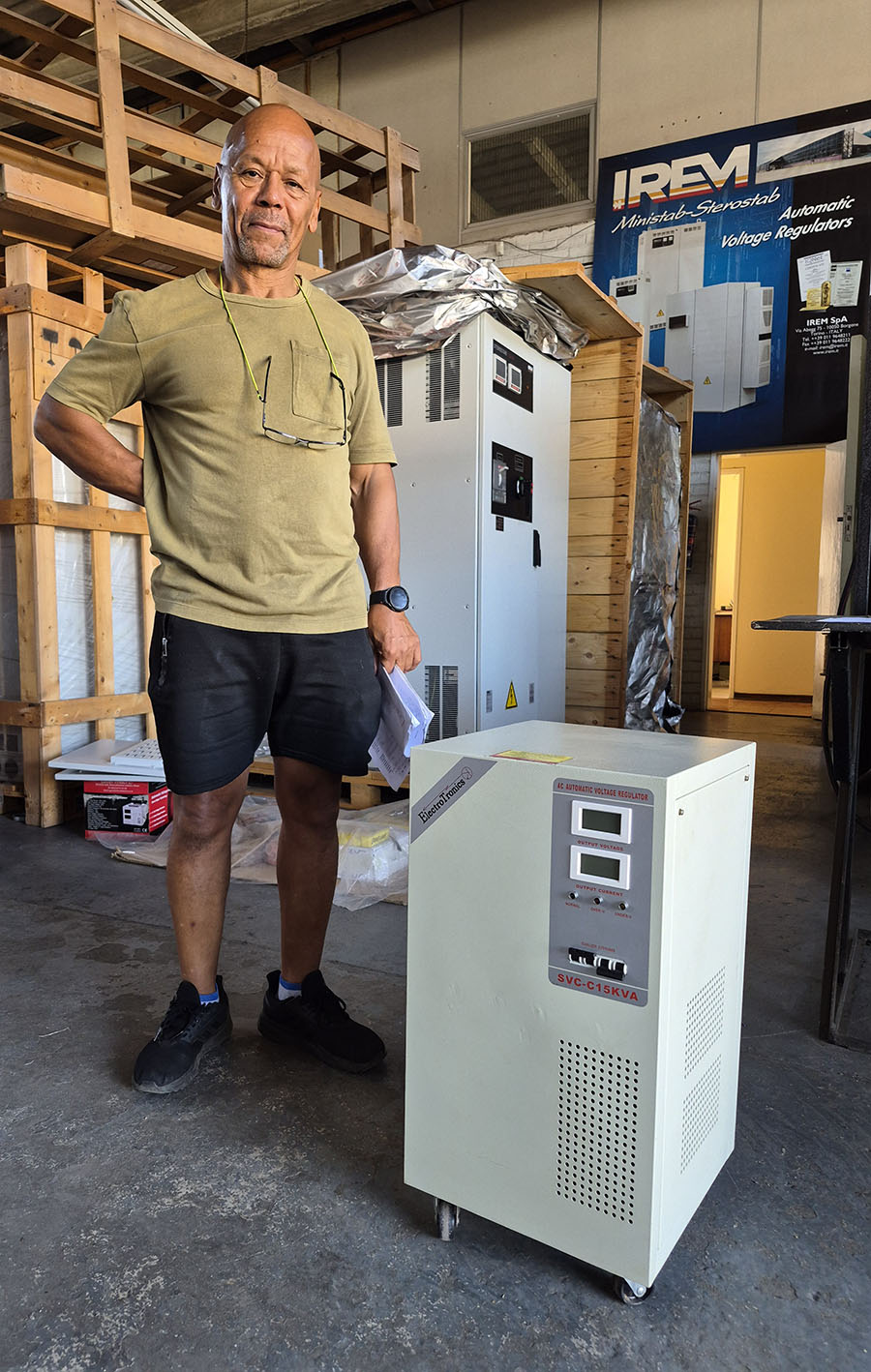
Richard, owner of ElectroTronics in his warehouse
Richard is a very trim man, not looking at all like his 70 years and he assured us that he’d been in the business nearly 50 years. His small warehouse was impressively well stocked, indicating an active business, and he happily gave of his time explaining the principles of VRUs. The one we’d opted for was essentially a variable transformer. “Of course they are made in China” he responded to my inevitable question. “I could sell you that Italian-made one for 18 times the price but these work just fine” he added (we paid $900). He has sold VRUs to all manner of customers including hospitals, laboratories and factories. The biggest was 1,000 kVA. “I back up and repair everything I sell and if it’s a genuine part failure I will honour it outside the warranty”.
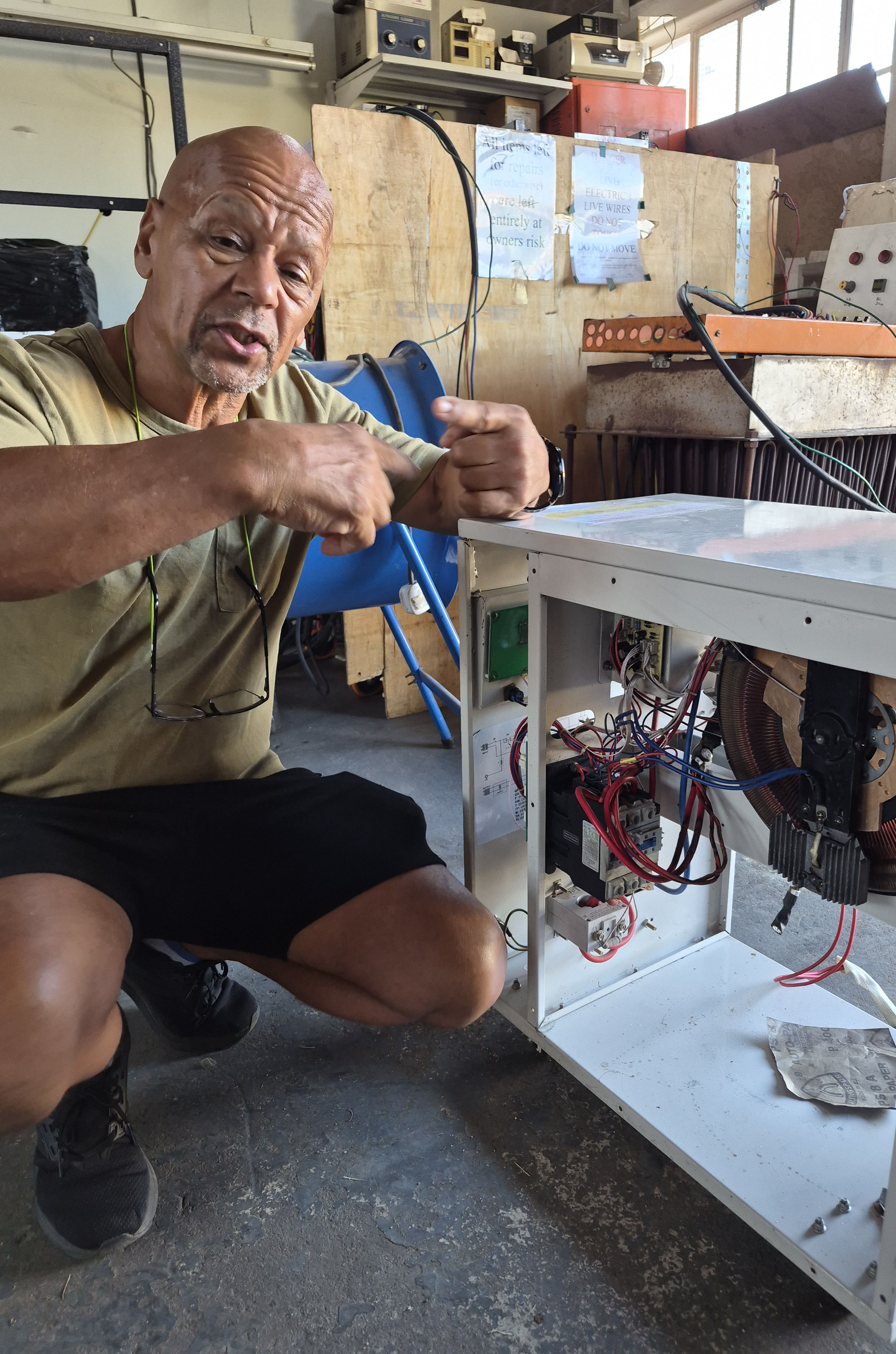
Richard showing off the finer details of a servo driven AVR – yes it was being repaired.
Having got the AVR home my brother Duncan noticed some cosmetic damage to the case. I sent in pictures to Richard and asked if it would jeopardize the warranty. He apologized, said no, and the machine was replaced that afternoon. I was VERY impressed!
The AVR is installed in our kitchen (the only place where it can be easily placed to supply regulated/stabilized power to the whole property) and my woodworking machines work just fine! However, a VRU can obviously only work when there’s power and the next day there was none. Fortunately a WhatsApp message to the local faults department led to a prompt replacement of the problem fuse in the nearby sub-station. We’re back in business!
A wheelbarrow of ornamental maize – a lot of genetics happened in there!
Rob Jarvis, then the manager of ART farm, gave me some cobs of ornamental maize (sometimes known as Indian corn to the Americans) some years ago. I was fascinated by all the colours and saw photographic potential. I grew a small plot of them in our garden two years ago and got the photos I wanted. The cobs were harvested, seeds sorted by colour and stored in an airtight container. There must have been weevils on the seed because they quickly got stuck into the seed. A spell in the freezer sorted them out and left the seed none the worse for wear and another plot was planted this year. The seeds were planted in rows of the same colour for what is called a “look see” experiment i.e. to see if a properly designed experiment is warranted. I have not the space for an experiment of this magnitude but was curious to see what would transpire.
Initially I was hoping to run a comparative taste test of the immature cobs but I soon realized that this would not be feasible due to the lack of uniformity in their maturity. Sorting them by colour whilst on the plant was also a non-starter. So I settled for harvesting at near full maturity before the rats caused too much damage and seeing what colour patterns I could identify.
I am no geneticist and my semester’s course at university on fundamental genetics was a very long time ago so I will share my observations and musings. After all, Barbara McClintock, who spent a lifetime studying the genetics of maize kernel colours and won numerous awards culminating in a Nobel Prize, ascertained that maize genetics is vastly complicated.
Some nomenclature: tassel – the male flower on top of the plant that sheds the pollen. Each pollen granule carries a single set of chromosomes that must combine with a single set of chromosomes carried by the ovule which will result in a kernel/seed developing. silk – the structures in the ear (female) that will collect pollen from the tassel and cause a seed/kernel to develop. There is one per ovule. cob/ear – the female flower that bears the seeds/kernels gene – a gene is a section of DNA that contains a specific instruction for an organism. This instruction provides information about it will develop, function or grow. recessive gene – a recessive gene requires 2 copies to be present in order to be expressed. If a recessive gene is inherited alongside a dominant gene, the recessive gene will be ‘masked’, but if it is inherited with another recessive copy, it will be expressed. e.g. A blue eyed person must have 2 blue genes present (one from each parent). dominant gene – if a gene is dominant, there only has to be one copy present in the pair for it to be expressed e.g. if a brown eyed human passes on a brown eye gene to a child it will override any blue eye gene present and the child will have brown eyes. monoecious – only one plant is necessary to set seed/fruit as in maize – a plant carries both male and female flowers. They can self-pollinate or cross-pollinate with another plant. imperfect flowers – as in maize which has both male and female flowers (separate) that need to pollinate. perfect flowers – have both male and female reproductive structures in one flower.
Plants usually yield pairs of cobs, one larger than the other. These cobs are all pairs from single plants.
Commercial maize plants are much more uniform in their yields for obvious reasons and inevitably bear two cobs. Sometimes there are three but the third is too small to be significant. In this trial most plants did not even produce two cobs but where they did there were interesting characteristics. Colours from any pair of cobs from a plant were very similar, even so far as distribution on the cob – see the pair of cobs in the bottom right row above that have mainly yellow and white seeds at their tips. This may even have extended to the number of seeds set (top left) but could just mean that the silks that weren’t pollinated due to mistiming with pollen shedding. Most cobs were not reasonably full i.e. had few seeds to the end of the cob. Commercially produced maize looks more like the cobs on the bottom right pair.
To me this suggests that somehow the colours of the cobs on a single plant can be linked. Having searched the internet this is suggested as being indicative of plants self-pollinating i.e. the cob is pollinated by the tassel on the same plant. So far as I have observed silks don’t emerge at the same time so self-pollination is unlikely to be the cause.
Most seed colours sown did not yield cobs of uniform colour. Is this due to the complex nature of maize genetics or something more prosaic such as cross-pollination with plants grown from other coloured seed?Cobs from white seeds were predominately white and yellow.
Interestingly, commercial maize is either yellow or white. In this part of the world white maize is favoured for human consumption and yellow for livestock. Yellow maize has higher carotenoid content which gives it the yellow colour and higher vitamin A precursor (beta carotene) than white and it causes yellower eggs and poultry skin. I think yellow has more flavour than the white which is often consumed here in the refined form as a staple carbohydrate. Corn on the cob is a popular snack in this part of the world and is sold by the roadside in the early summer. This often comes from illegal plantations in the areas close to streams in the suburbs and vacant plots.
Cobs sown from grey seed yielded predominately grey seed and, with one exception, no red
Does this imply that plants grown from grey seed are more homogenous than others or that they are more likely to self-pollinate or that the grey gene is dominant over other colours? This was also observed in cobs sown from red seed – there were a large number of red kernel cobs which were often entirely shades of red (as in the top right pair in the top picture). To me this suggests that the red gene is dominant.
Other peole have milled the coloured maize and eaten it. While most commented that it was tasty, the thicker seed coat (pericarp) than commercial maize make it a niche crop and it will mostly remain what it is – ornamental.
I have yet to decide what to do with the wheelbarrow of cobs that were harvested. I don’t have the means to mill the kernels and try a few internet recipes. It was an interesting little experiment but that’s about it and they will likely be consigned to the compost heap. Or just maybe I’ll try sowing a single coloured seed, say red, and see what happens…
Memory’s a funny thing. I woke up one morning recently and told Marianne I’d just remembered the punch line of an old joke; “It’s a knick knack Patty Wack, give the frog a loan”. She smiled and said “But there’s more to it than that” and added “he’s old man is a Rolling Stone”. Of course I had to see if I could find the original on the internet and called up the faithful Google search engine which Google assures me heavily uses AI.
Just entering “Patty Wack” came up with one suggested search for the correct joke even correcting for my alternative spelling of “Wack”. Quite impressive, there aren’t too many patty wacks out there.
Not bad for a start but on reading the original joke I discovered that a knick knack is a critical part. So I thought I’d include it in the search. Just by itself and Google didn’t come up with any alternative searches that would have led me to the joke.
Searching on “knick knack patty” was surprisingly successful with an accurate search term as the third item. Not too many other suggestions though it seemed to suggest that I might have meant Paddy not Patty.
The most successful search term was “knick knack patty wack frog” which brought the joke up to the top of the list for suggested searches but I thought that I was giving rather a lot of information out to start with so decided to up the task difficulty a bit.
The punch line of the joke, you can look up the whole thing here, is: “It’s a knick knack Patty Whack give the frog a loan, his old man is a Rolling Stone” where the Rolling Stone is referencing Mick Jagger. I decided to see if the AI would associate Mick Jagger with a frog joke and entered “Mick Jagger frog loan joke”. Nope, not a single other search was suggested – clearly I was being very specific. Curiously “Mick Jagger frog” did suggest another more specific search as the first item. Can’t think why Angie got in there. Yes, I can remember the song! We all used to crowd into a prep room in the school hostel on Saturday night and watch Top of the Pops on a black and white television. Mick doing his best emotional bit in a big floppy hat. “Angie. A-aaaaaangie. Can’t say we never tried”.
Perhaps a case of less is more?
There are of course many variants of AI to be found all over the internet. Perhaps one of the best known is ChatGPT. I have used it a bit when stuck on my programming projects and it’s been useful in suggesting solutions. I did get to use it today on another project and was really impressed.
My business is in trouble. Two weeks ago I was within a few days of running my bank account dry. It was time to see where the problem was. It didn’t take a lot of doing. I am selling my seedlings for less than they cost me to produce. My bookkeeper commented that my salaries and wages were too high a proportion of my overall costs but there is little that I can do about it now – nobody is going to accept a wage cut. I wondered if I could put the business into administration (yes, I Googled what that entails) and be closed down. I didn’t see how I could sell a business that is not a going concern.
There are at least five other commercial nurseries in Harare that I know of. My foreman on occasion phones them to see what they are charging. The biggest is charging substantially less than I am and I have no idea how they do it. I also know what they are growing as we use the same seed supplier and I am friendly with one of the staff there. It’s mainly tomatoes and lots of them. This makes me think they are supplying the farmers who grow for a well-known fast food company. It was time to see if I could get in on the action.
Zimbabwe being what it is, it was not difficult to find out who the procurement officer of the above-mentioned fast food chain is. Marianne, being more adept at marketing than me (not difficult – there are disadvantages of a science degree), helped me put together the approach email. The reply was non-committal. A different approach was needed but at least we had not been rebuffed.
Given our lack of marketing skills we decided to ask Maria. She’s a formidable communicator and the driving force behind HIFA (Harare International Festival of the Arts) that ran for several years and was the arts and entertainment highlight of the year. She agreed to draft something.
While I was mulling over what Maria had put together Marianne was chatting to her sister in Cape Town who has a tour company for older women . Mandy suggested we get ChatGPT to draft something as she uses it quite a lot and was impressed. She did mention that it was a good idea to be polite when asking it for assistance! So I logged in and made my request. The response is too long to reproduce here but I was very impressed. It was just what I was looking for with all the right marketing language. So tomorrow I will send off another email to see if I can get access to the produce suppliers. Nothing ventured. There will be a few adjustments to the original text – “Warm regards” will be replaced with “Regards” which I consider a bit less familiar.
I can of course remember back in the 1980s when AI stood for artificial insemination. One of my housemates at university was doing an animal science degree and they had been harvesting semen from a bull. He wondered aloud if an orgasm for a bull was as much fun as it was for a human. Someone else chipped in that it was physiologically identical, the difference being that the bull could not remember what was so pleasant.
Looking up artificial insemination on the internet (yes Google AI) I saw that it is widely practiced for women who cannot get pregnant the natural way. While there doesn’t appear to be human AI on offer in Zimbabwe (but plenty of livestock options) there are a couple of sites advertising IVF (in vitro fertilization). Most of us older folk can remember that Louise Brown was the first example of this “test tube baby” process. As one fellow student commented all those years ago: “The worst thing about being a test-tube baby is you know for sure that your old man’s a wanker”. If you don’t know what that means try a Google AI search!
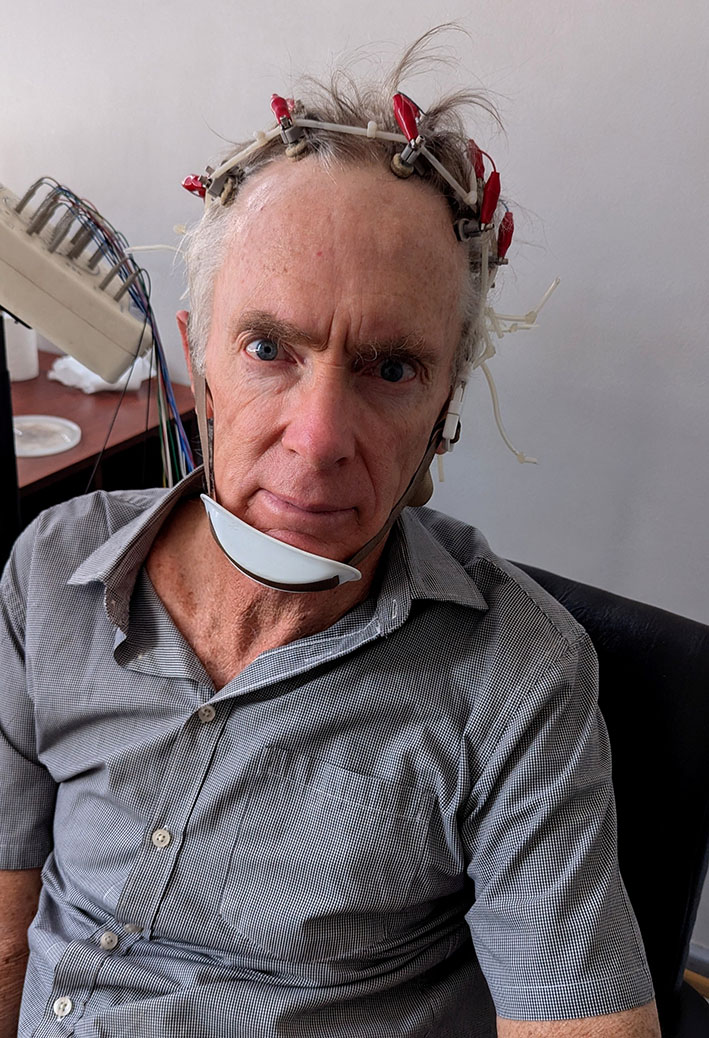
I have to marvel at the irony: there was I, having just had the electrical output of my brain recorded by EEG and there was no electricity to operate the lifts to take me back down the three floors to the building’s exit. Of course there were stairs but as a disabled person I find them a challenge. Some challenges I enjoy – others just have to be endured – so ignoring a staff member’s suggestion that I wait out the outage, which could be minutes but more likely will be hours, I start down the stairs.
The drive into town is remarkable by it’s ordinariness – no stupid overtaking or creating extra turning lanes at the lights. It’s moderately heavy but flowing. I have memorized the route – it’s not difficult, King George Avenue through Avondale, over what was North Avenue (I couldn’t be bothered with learning the Mugabe era name changes) then second left into Baines Avenue and look for number 60.
Baines Avenue is about as grubby as expected with street vendors, dust and rubbish. I take in the Canadian Embassy across the street (most other embassies are further out of town) but don’t have time to do more than glance before a self-appointed parking attendant asks me where I want to go and waves me into an empty parking bay some 30m from my destination. He is missing teeth, untidy but pleasant. I ask his name and forget it but know that he’ll be there when I come out, hoping for a tip.
It’s a short walk past the vendors’ wares of fruit in season, toilet paper bundles and sticky drinks. There are pineapples and papaya (pawpaw in the local parlance) and bags of ready-to-go peas in the pod with a chili pepper in each bag. The foyer of number 60 is clean and I ask my way to the lifts. Arriving on the third floor I have to pay attention to the PVC tiles that have lifted and are loose. The doctor’s rooms are clean and well-maintained.
Doctor G the neurologist, is a pleasant, very slender, small man in his 50s. We discuss my epilepsy which was initially diagnosed as POCD (post operative cognitive dysfunction) after a lower spine operation some three-and-a-half years ago. The diagnosis was changed to temporal lobe epilepsy when the seizures continued after the two year limit. I decided to see a consultant physician with an interest in epilepsy who starts me on a course of lamotrigine which is the medication of choice for this type of seizure – focal onset aware (or simple partial). An EEG was done which the physician assured me indicated that the medication was working. The seizures became focal onset impaired awareness (or complex partial) and the medication was increased. The seizures changed their nature again. They were the typical “petit mal” seizure, which are preceded by an aura where I can sense a strange taste or smell or hear a woman talking following which I go into a state of “absence”, where I am aware of my surroundings but cannot remember what they are. Now they become a partial complex seizure which last longer. A full suite of tests is ordered. All are normal save for the MRI which shows that the right temporal lobe of my brain is smaller than the left. It’s not progressive. The medication dose is upped again. The seizures, such as they are, change again.
One day at work I cannot remember how to walk down the stairs from my office which is a major problem for me as a disabled person who has to think about every step. Dr G is fascinated and tells me what it’s called (no I cannot remember that either!). These seizures or episodes are no longer momentary – this one lasts several hours and I’m only aware that there’s been a problem when I stand up from the table on the verandah and realize my mind is clear. I mention that I am making a lot of silly errors in the programming that I do for my work software. Dr G misunderstands and thinks that I have taught myself programming recently (I learnt at university) and comments: “At least you can still learn something new – I have never learnt to swim. Years ago my son said to me – Dad it’s easy, you just have to float. My reply was – if it’s so easy why do so many people drown?”. I like this man.
Dr G comments that the lamotrigine is not working as it should but before changing the medication he recommends doing another EEG. I remark that it sounds a lot better than the neurosurgeon who referred me to him whose parting words to me were – “of course the only permanent solution is surgery”. I tell this to Dr G, he smiles and says “that procedure requires very precise measurements”.
The EEG technician is available so we do the EEG right away. I am required to keep my eyes shut for most of the hour. I don’t fall asleep because the chair is so uncomfortable. I ask him how long it will take to analyse the results. “A while” he replies. “There are 360 pages to go through”.
The staircase takes a while to negotiate. Fortunately someone offers to help and I ask her to take one of my walking sticks down so I can use one hand on the railing.
The informal parking attendant is hovering near my pickup truck. Next to my truck a person has his laptop out on the boot of a car and is listening to a smartly dressed gent in a black suit talking intently on his cellphone. The car-watcher reminds me as I get into my truck that he’s hungry. It’s not very subtle but I don’t mind and give him $2.
The drive back home is as uneventful as the one into town.
Replacing a borehole motor in a borehole that ran dry
That the borehole motor was burnt was obvious. The metal casing was blue, there was oil in the water and it wasn’t pumping water. But the reason? The borehole in question has given me endless trouble. It has gone through more than a few motors over the years. We thought we’d finally got it solved last year when it became evident that the old steel borehole casing had rusted away and was collapsing and dumping mud into the pump. It was re-lined with a PVC liner, the pump and motor replaced and I thought our worries were over for the foreseeable future. I was wrong.
Marianne suggested I try contacting Allan, listed on my phone as “Borehole Repair Recommended”. When I described the problem he was straight forward – “Is the pump protected against running dry?” When I answered in the negative he said “That’s your problem. The pump controller you have installed does recognize when the pump is dry but it doesn’t work that well and the pump inevitably cooks. At this time of year (it’s winter and the dry season) the water levels drop and the pumps inevitably run dry. Get yourself a smart controller with liquid level detection and your problems will be over”.
There’s a irrigation equipment supplier close to my business so I paid them a visit to get a new motor and whilst there asked if they had an intelligent controller. Whilst perusing the manual I noticed Nathan, a plumber, who’d done the plumbing on our new on-suite bathroom, was also there. When he heard what I was looking for he recommended going to a nearby hardware store for the controller – “I have personal experience with them and I know they work” he added. I took his advice and installed the new pump and controller and, after decoding the bad Chinese English in the manual, managed to get everything working.
A mere two weeks later Fabian (one of the foremen who does the maintenance amongst other tasks) came to me with a long face and reported that another borehole had stopped working. I told him to get the pump and motor up and sure enough, the motor had all of the characteristics of being burnt. Another trip to the supplier, more cash changed hands, and this time I came away with a replacement motor and two intelligent controllers – including one for the third borehole that I was hoping to preempt the motor burning out.
It all seemed straight forward at first – after all we’ve had plenty of practice at getting borehole pumps and motors up and changed. This one was no different but the intelligent controller just wouldn’t cooperate. The motor drew current like it was working but nothing else happened. Allan was mystified – “I’ve never had a problem like that” so I just had to take a deep breath and book one of his teams to come out this Friday and have a look.
Driving back from work at lunch time I took a more scenic route than usual past the old Mount Pleasant golf course. It hasn’t been used for that purpose for many years now and is largely over grown. It’s not prime development land being low lying and very wet in the rainy season so is untouched – for now. Houses adjoining the area seem to have good ground water and sprinklers were merrily whirring over verdant verges oblivious to (or ignoring) the Harare City Council’s directive that it’s illegal to do so for, make no mistake, Harare is running dry.
Harare’s main water supply is Lake Chivero to the south-west of the city. It is downstream and it doesn’t take a lot of imagination to grasp the scale of the pollution. It’s nothing new, as an eight year-old child I attended a sailing school on the reservoir and can remember a deep revulsion of the state of the water. It recently made headlines when four rhino and various other animals at a lakeside national park were killed by the polluted water. Very little of the available water in the lake now makes it’s way into the Harare water supply. It requires pumping and there’s seldom power to do that and the water purification works have long ago fallen into disrepair. So in true Zimbabwean fashion we’ve had to “make a plan” – usually in the form of having a borehole drilled. That of course is no guarantee that it will not be dry (and most are) but for those of us lucky enough it can be a massive relief and money saver. The unlucky majority have to rely on the burgeoning water supply business and at US$50 for 5,000 litres it isn’t cheap. Water tankers are ubiquitous on the streets and come in all shapes and sizes. Some are made for the purpose but most are just plastic tanks strapped onto disheveled trucks. They source their water from outside the city limits.
Nathan is succinct – “Harare will run dry in five years at the most”. We are luckier than most in having a working borehole but it is not prolific. Tested at 1,000 litres per hour we don’t push our luck and the lawn dies off in the dry season. This year we’ve pumped the swimming pool dry (it’s filled with rainwater runoff collected off the roof) so that we can get the leaks fixed and the pool tiled. Grey water from the kitchen and shower is collected and used on the garden too. We keep our fingers crossed and try to balance having a nice garden without having to recourse to buying in water.
That there is no interest on the part of the government in changing the situation is best summarized in a conversation I had with Anton, my personal trainer, at a nearby gym. His wife, also a person trainer, used to have the Egyptian ambassador as a client. She, the ambassador, told Anton’s wife that Egypt had offered to completely rebuild the water treatment works at Lake Chivero. It would have been a gift from Egypt to Zimbabwe. The Zimbabwean government turned it down; there was nothing in it for them. The ambassador commented that she’d worked in a number of African countries but had never encountered one in which the government cared less for it’s people.
Storms develop south of the local microlight club where we fly model aircraft
“Nah, it’s a ZANU-PF problem, they must sort it out themselves” Fabian responded when I asked him if he was going to join today’s protest march in the centre of Harare. Fabian was a non-combatant porter in Robert Mugbe’s ZANLA army as a young man in Zimbabwe/Rhodesia’s bush war which ended in 1980. He has little time for the ZANU-PF political party that Mugabe founded.
The current Zimbabwean president, Emerson Mnangagwa, is looking to extend his presidency to a third term of five years. Zimbabwe’s constitution forbids this and protests have been planned for today which will be spearheaded by Blessed Geza who was a ZANLA veteran. Not surprisingly this has led to accusations of treason from Mnangagwa even though demonstrations are allowed under the constitution. While a lot of Zimbabweans are thoroughly fed-up with an inept and kleptocratic government the cynics are saying that it’s just a changing of the guard – a different herd of snouts to the trough.
Last week saw amoured cars and troop carriers on the streets in an attempt to intimidate would-be protestors. There were road blocks manned by police stopping traffic going into town though yesterday evening, when I came back from the airfield, the one on the main road in had packed up.
The organizers of the protest were clear in their instructions to the general public; stay out of the city centre though this may have been disinformation by the government. Schools are shut today and most businesses are closed or working with reduced staff. There was very little traffic about when we went out to walk the dogs on ART farm. My business is working on essential staff only as we really didn’t know what to expect.
There were videos on social media this morning of protestors starting to march into town. They must have been aware that the last time this happened it all turned nasty when the army opened fire killing six. This is not like Turkey at the moment where thousands of students are gathering every evening to protest the collapse of the country’s democracy. They only have to put up with tear gas.
On the way back home I stopped at a local hardware store to get a jerrycan for my paramotor fuel. “Have a nice day” the cheerful teller girl said as I was leaving. “Yes”, I replied, “and tomorrow we’ll have a new government” giving her a large wink. She giggled, “So, what are you doing here then?” was her response.
It did rain last night. In some areas the storms were violent but here it was just 14mm of rain. Enough to make us thankful for the 4×4 capability of my truck on the very sticky ART farm roads.
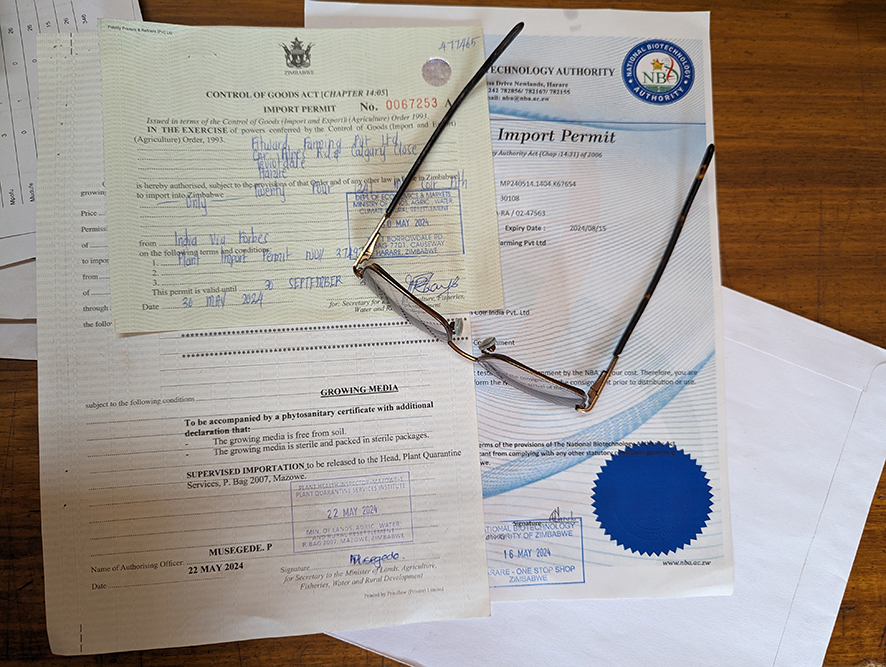
Just part of the paperwork necessary to import the coir pith essential to my business
It’s not something I look forward to but the coir pith on which my nursery depends for growing seedlings is essential for a good product. Yes, another substrate – composted pine bark – is available locally but last time I tried it some 20% of my seedlings died from the disease it carried. So about once a year I just have to grit my teeth and jump through the bureaucratic hoops. To be fair it IS becoming a bit easier as more of the government agencies involved get online and organized.
First off is the Agricultural Marketing Authority. I have no idea what they do but membership is essential and nothing else is achievable without it. Fortunately it’s doable online. Then it was on to the National Biotechnology Authority to get a permit that acknowledged the import was free of GMOs. The Indian supplier had given me a certificate stating as much and though it didn’t look very authoritative to me, it was sufficient and upon receipt of the required payment the local certificate was duly issued.
I have done the Ministry of Agriculture for the importation permits before and found it beyond tedious so sent Fabian, one of my senior staff, down there with some smaller US dollar note and instructions to “do whatever it takes” to get the first certificate. It cost him five dollars to put in the application whilst the official concerned was “on lunch break” and then all I could do was wait.
Fortunately the container was being delayed en route from Sri Lanka. I have no idea why it had to go via Colombo but I guess getting a full cargo of containers to warrant a ship going into the port of Beira in Mozambique takes some organizing. That was just as well as the first permit took two weeks, the date stamp indicated it had been sitting on an office desk for one of those weeks, and the second permit took another 10 days. That also required a sweetener of a few dollars.
By this stage I’d already paid the port and transport fees, all US dollars, and the race was on to get the local documentation to the border post near Mutare in the east of Zimbabwe before the truck from Beira got there. If we were late demurrage would be charged and I’d experienced that to my cost before. Fortunately my local shipping agent seems to know a lot of people and he got the money there just in time.
Then it was just a case of waiting for the truck to arrive and organizing a forklift to offload the pallets. It was three weeks late and in the interim I’d had to buy two pallets from another local supplier who’d marked up his prices 100% (he vehemently denied this even when I told him I new what it cost) but at least it’s over for about another year.
Now that the final accounts are in I can see that the costs were close to last year. The total for 24 tonnes of coir was US$19,650 which works out to 81.8c per kg. For some strange reason my bank needed to pay for the coir in Euros, I have no idea why but I do know that payment had to go through a South African bank. The rest was all payable in US dollars, none of the Zimbabwean kind thank you very much.
Yes, Zimbabwe is still trying to get its own currency up and running. It’s called the ZiG which is not the name of a cartoon character’s best buddy but is short for “Zimbabwe Gold”. It’s apparently linked to gold bullion of which the Reserve Bank is holding. Nobody is actually sure if this is the case but the official rate is around 13.8 to the US dollar.
When the ZiG was first introduced the obvious happened; currency traders spotted a good thing and the rate soon began to run. The government got tough and threatened a US$10,000 fine for any company or person not using the official rate – by law you have to accept either the ZiG or the US dollar if that’s how a customer wants to pay, the one exception being fuel traders who are not obliged to accept ZiG. Fortunately for my business most customers are uninterested in using local currency and choose to pay in US dollars, usually using cash. The local currency received has been entirely electronic – I’m not sure if this is by design – and I have yet to see any local notes. It is certainly not difficult to get US dollar notes out of my local bank and even small denominations are often brand new and in their 100 notes wrappers.
The country’s roads are in a disastrous state at the moment, bearing witness to years of neglect, but there’s a regional conference of the SADC (Southern African Development Community) in August so there’s been an orgy of road repair in Harare during the last few months. Construction teams have been called back to Harare from the outlying projects to concentrate on the local roads. Chaos has ensued as roads are closed and heavy traffic routed through the suburbs.
Some actions are unsurprising, others beggar belief. People living along the main route to the new Chinese-built parliament house where it’s all going to happen have been offered free water, delivered by tanker, to help make their gardens look pretty for visiting dignitaries.
The new dual carriageway to the parliament is being lined with kerb stones that make sure that there is nowhere to pull off the road if one has a breakdown. A local farmer, who lives on the route, pointed this out to one of the construction teams and was assured that it was a temporary arrangement and all the kerb stones would be removed after the conference. We’ll see.
A new bridge has gone in over a small river. They haven’t finished casting all the concrete and I’m told it takes a month to cure but the conference is in less than a month. Interesting.
An obvious question is where has the government suddenly found all the money? Are the construction companies actually being paid and what currency are they using? A friend is heavily involved in the landscaping of the new parliament and Marianne tells me she is being paid in US dollars and is doing quite well from it but rumours abound as to whether the others involved have been paid. I have heard that one company was owed some US$200 million which seems a bit much but many years ago I was told that a normal road costs US$ 1 million per kilometer to construct so perhaps it’s possible. Whatever the truth is you can bet the government will do whatever it takes to get the roads done and put up a paper-thin facade for the visiting dignitaries.
The nations hospitals would certainly like a bit of money themselves; currently several of the bigger ones are owed in excess of ZiG11 billion – a lot of money in any currency.













No nukes please – local ones excepted!
5 07 2026Earlier this year the Zimbabwe government decided to update the list of goods that required an import licence when brought into the country for commercial purposes. There is a fair bit of latitude on goods imported for personal use. The resulting document is the Control of Goods (Import and Export) (Commerce) (Amendment) Regulations, 2026 (No.15). The rationale behind the update is to put it simply trade protection, stimulation of local businesses and the saving of foreign currencies (they could start on the latter by not stealing so much themselves). There is a condensation of the rationale here but for those who insist on reading the original document you can download it here.
The document is mostly mundane but there are a few items that are quite unusual. Let’s start with the toilet paper.
Yes, we are protecting the local toilet paper industry. I cannot say I’ve had much in the way of first hand experience of using local toilet paper but I strongly suspect that the occasional roll of single ply that I’ve experienced in toilets attached to customers’ waiting rooms has been the local stuff. In this household it’s strictly multi ply.
Most serious toilet paper is double ply though I have come across triple ply. Single ply is in its own league. Whilst not useless there are challenges involved. Using it single is not an option for obvious reasons so it is sensible to double it up. Even that is risky so fold again to get four layers – economising is not wise. By now you might have realized that it would be cheaper to have used regular double ply in the first place. Will local manufacturers step up to the plate and produce decent quality now that they are protected? We’ll see.
Then we come to the nukes. Yes, you read that correctly.
I have to admit I have no idea what they mean by this. We have no locally produced nuclear reactors and no money to import one either. The government is heavily in debt and looking to China to help us out with our “$34 billion infrastructure challenge” in exchange for mineral deals. So I guess we won’t be needing import licences for “Parts of nuclear reactors” either.
Then we go from the absurd to vague – “other”.
Other what? Again this is more than a bit vague and gives the customs officials overseeing the import more than a bit of latitude. It appears in a few other places in the document as well. That could be intentional.
Some of it is quite reasonable – no importation of second-hand underwear at all. Not sure why anyone would want to wear used undies even if they had been washed. What will hurt is the importation of bales of second-hand clothes that is big business. It’s all very well encouraging people to “buy Zimbabwean” but if they cannot afford new clothes, as is evidently the case, what are their options?
The document is by no means an exhaustive list of items requiring an import licence. Last year I imported coir pith, from Sri Lanka, that we used in the nursery as a medium in which the seedlings are grown. It required in import licence and the requirements for that were onerous but I’ve done it for 11 years so it was tedious but expected. I do have to wonder how many people will not be familiar with the import requirements and will arrive at the border posts with items in commercial quantities that now require a licence only to have them impounded. I am fairly certain that nuclear reactors, tariff code 8401.10.00, won’t be among them.
Comments : 1 Comment »
Tags: blog, Business, import licences, life, nuclear reactors, second hand clothes, support local business
Categories : Blogroll, Business, Social commentary