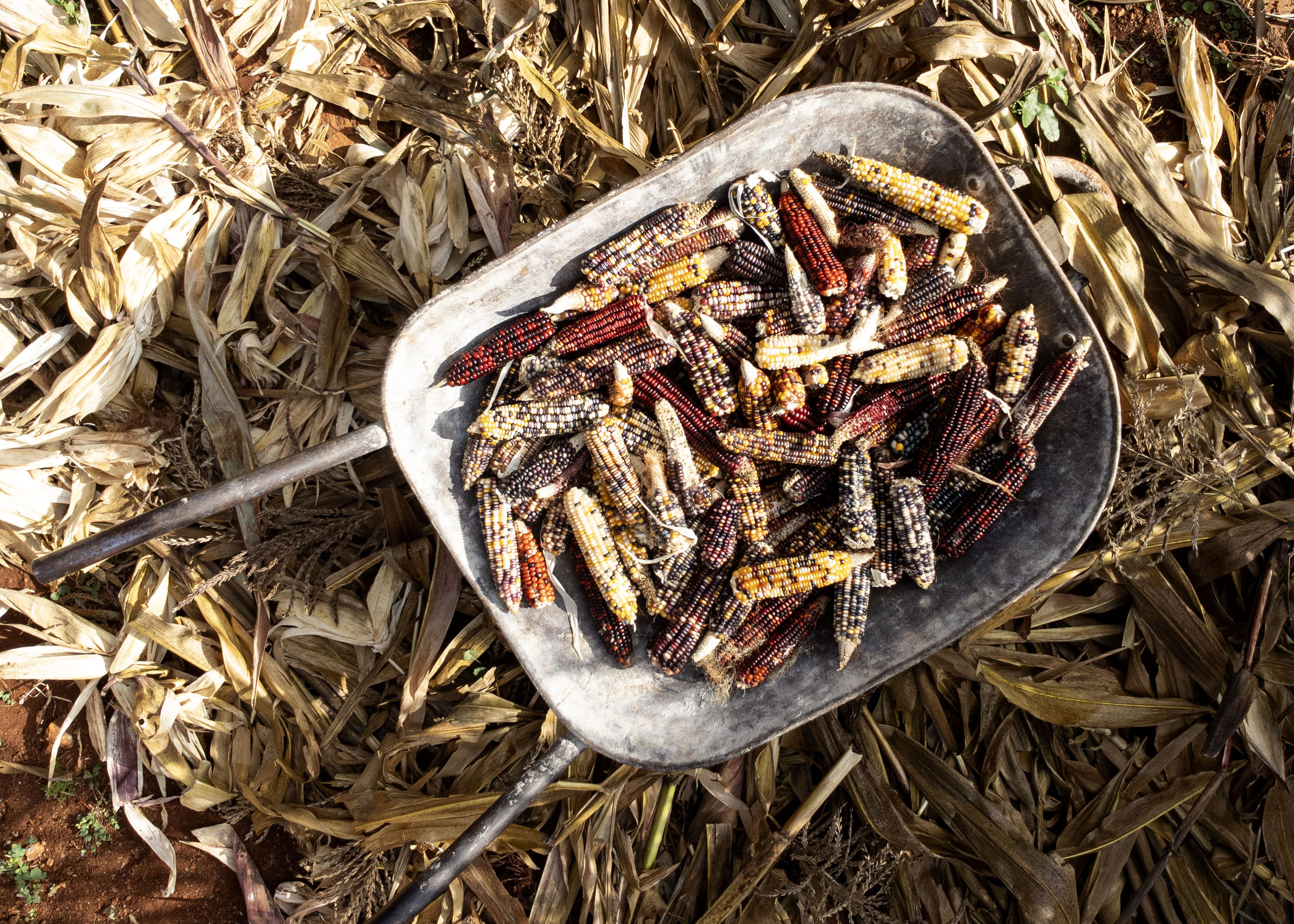
Rob Jarvis, then the manager of ART farm, gave me some cobs of ornamental maize (sometimes known as Indian corn to the Americans) some years ago. I was fascinated by all the colours and saw photographic potential. I grew a small plot of them in our garden two years ago and got the photos I wanted. The cobs were harvested, seeds sorted by colour and stored in an airtight container. There must have been weevils on the seed because they quickly got stuck into the seed. A spell in the freezer sorted them out and left the seed none the worse for wear and another plot was planted this year. The seeds were planted in rows of the same colour for what is called a “look see” experiment i.e. to see if a properly designed experiment is warranted. I have not the space for an experiment of this magnitude but was curious to see what would transpire.
Initially I was hoping to run a comparative taste test of the immature cobs but I soon realized that this would not be feasible due to the lack of uniformity in their maturity. Sorting them by colour whilst on the plant was also a non-starter. So I settled for harvesting at near full maturity before the rats caused too much damage and seeing what colour patterns I could identify.
I am no geneticist and my semester’s course at university on fundamental genetics was a very long time ago so I will share my observations and musings. After all, Barbara McClintock, who spent a lifetime studying the genetics of maize kernel colours and won numerous awards culminating in a Nobel Prize, ascertained that maize genetics is vastly complicated.
Some nomenclature:
tassel – the male flower on top of the plant that sheds the pollen. Each pollen granule carries a single set of chromosomes that must combine with a single set of chromosomes carried by the ovule which will result in a kernel/seed developing.
silk – the structures in the ear (female) that will collect pollen from the tassel and cause a seed/kernel to develop. There is one per ovule.
cob/ear – the female flower that bears the seeds/kernels
gene – a gene is a section of DNA that contains a specific instruction for an organism. This instruction provides information about it will develop, function or grow.
recessive gene – a recessive gene requires 2 copies to be present in order to be expressed. If a recessive gene is inherited alongside a dominant gene, the recessive gene will be ‘masked’, but if it is inherited with another recessive copy, it will be expressed. e.g. A blue eyed person must have 2 blue genes present (one from each parent).
dominant gene – if a gene is dominant, there only has to be one copy present in the pair for it to be expressed e.g. if a brown eyed human passes on a brown eye gene to a child it will override any blue eye gene present and the child will have brown eyes.
monoecious – only one plant is necessary to set seed/fruit as in maize – a plant carries both male and female flowers. They can self-pollinate or cross-pollinate with another plant.
imperfect flowers – as in maize which has both male and female flowers (separate) that need to pollinate.
perfect flowers – have both male and female reproductive structures in one flower.
Bedtime reading – to understand the biology of maize and some fundamental genomics
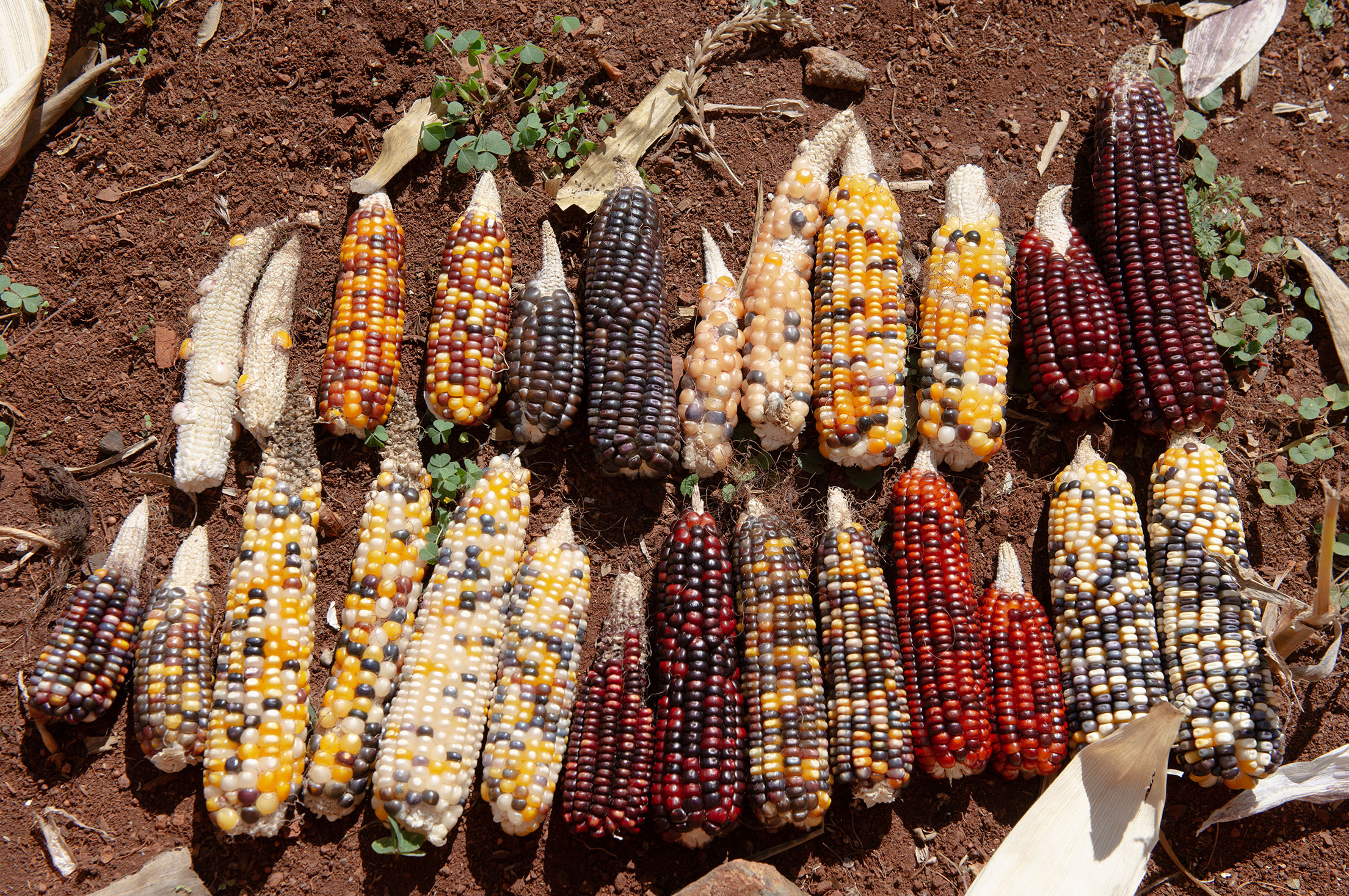
Commercial maize plants are much more uniform in their yields for obvious reasons and inevitably bear two cobs. Sometimes there are three but the third is too small to be significant. In this trial most plants did not even produce two cobs but where they did there were interesting characteristics. Colours from any pair of cobs from a plant were very similar, even so far as distribution on the cob – see the pair of cobs in the bottom right row above that have mainly yellow and white seeds at their tips. This may even have extended to the number of seeds set (top left) but could just mean that the silks that weren’t pollinated due to mistiming with pollen shedding. Most cobs were not reasonably full i.e. had few seeds to the end of the cob. Commercially produced maize looks more like the cobs on the bottom right pair.
To me this suggests that somehow the colours of the cobs on a single plant can be linked. Having searched the internet this is suggested as being indicative of plants self-pollinating i.e. the cob is pollinated by the tassel on the same plant. So far as I have observed silks don’t emerge at the same time so self-pollination is unlikely to be the cause.
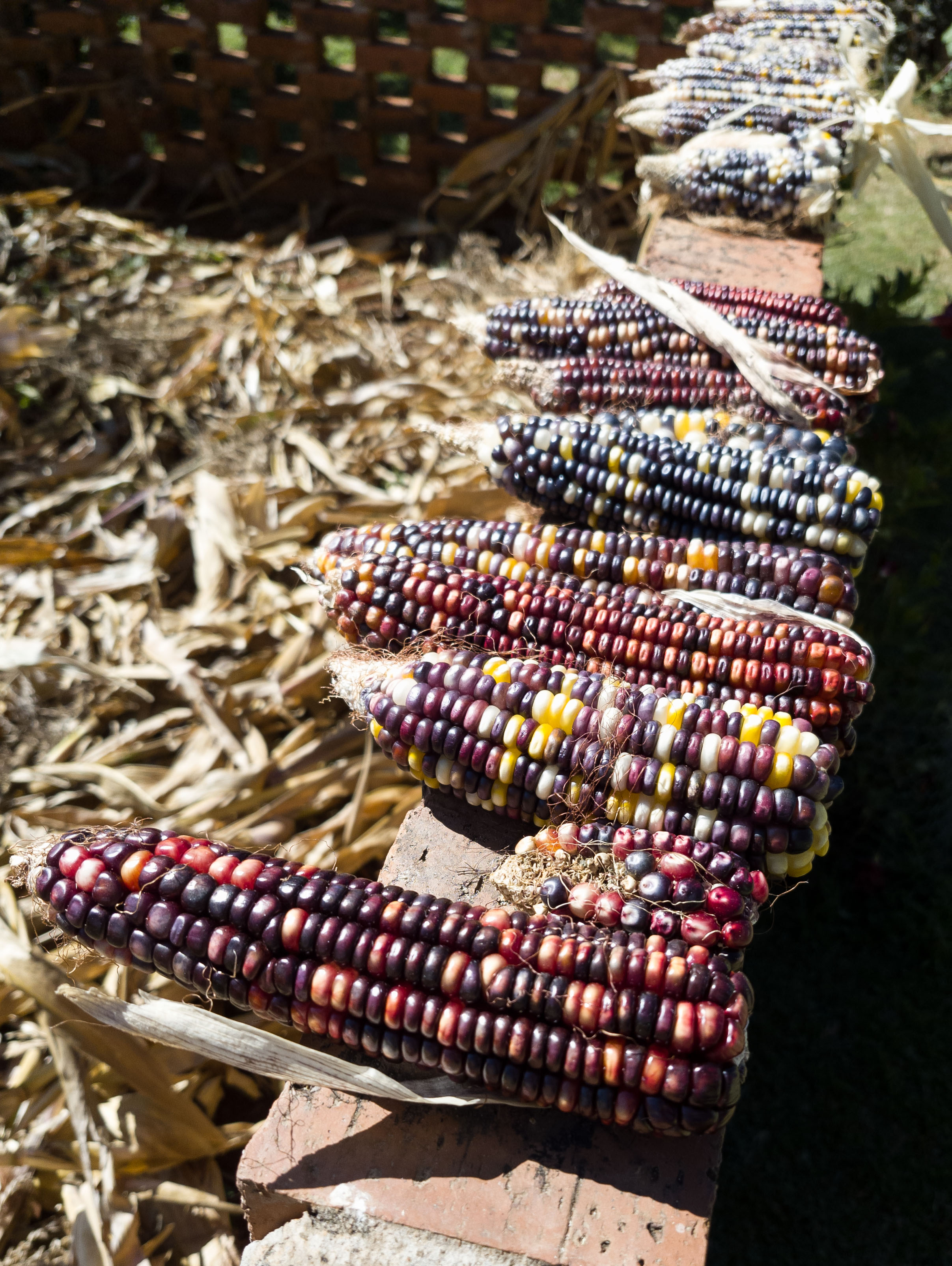
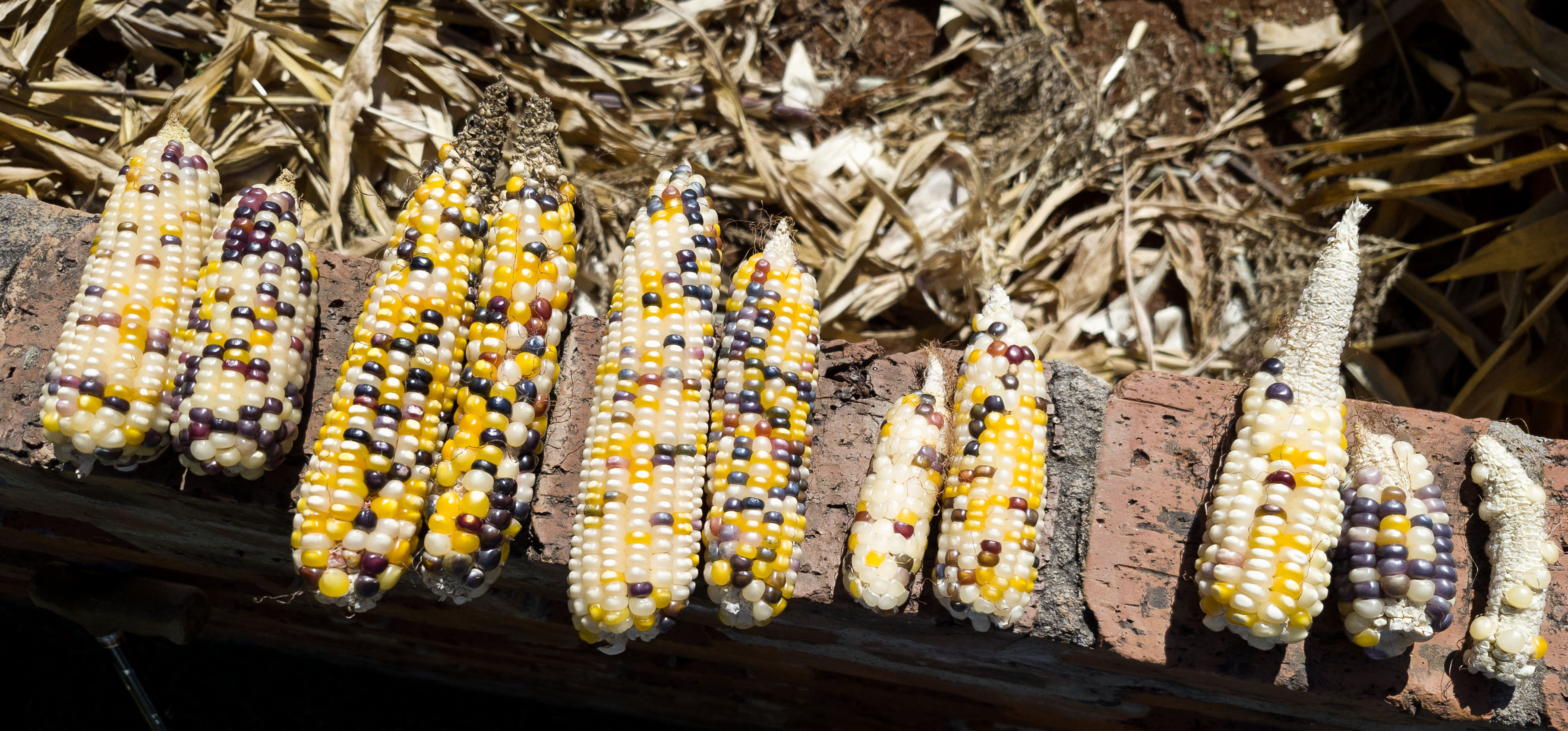
Interestingly, commercial maize is either yellow or white. In this part of the world white maize is favoured for human consumption and yellow for livestock. Yellow maize has higher carotenoid content which gives it the yellow colour and higher vitamin A precursor (beta carotene) than white and it causes yellower eggs and poultry skin. I think yellow has more flavour than the white which is often consumed here in the refined form as a staple carbohydrate. Corn on the cob is a popular snack in this part of the world and is sold by the roadside in the early summer. This often comes from illegal plantations in the areas close to streams in the suburbs and vacant plots.
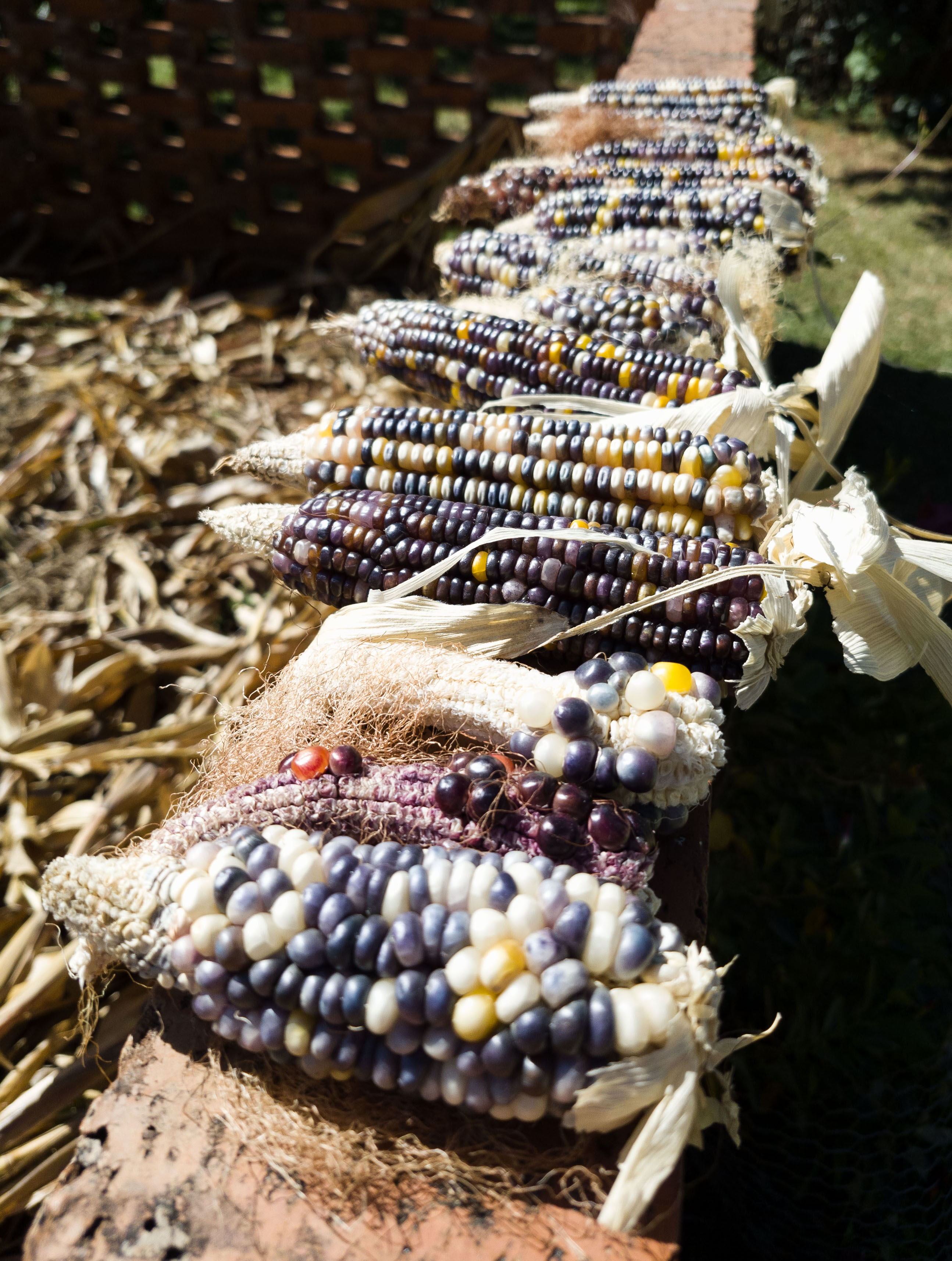
Does this imply that plants grown from grey seed are more homogenous than others or that they are more likely to self-pollinate or that the grey gene is dominant over other colours? This was also observed in cobs sown from red seed – there were a large number of red kernel cobs which were often entirely shades of red (as in the top right pair in the top picture). To me this suggests that the red gene is dominant.
Other peole have milled the coloured maize and eaten it. While most commented that it was tasty, the thicker seed coat (pericarp) than commercial maize make it a niche crop and it will mostly remain what it is – ornamental.
I have yet to decide what to do with the wheelbarrow of cobs that were harvested. I don’t have the means to mill the kernels and try a few internet recipes. It was an interesting little experiment but that’s about it and they will likely be consigned to the compost heap. Or just maybe I’ll try sowing a single coloured seed, say red, and see what happens…


Taming the voltage
1 05 2026It became evident soon after we installed the solar panels and inverter that we were going to have to do something about the terrible power quality. Most of Zimbabwe has erratic power supplies. Called “load shedding” it’s really just a statement about the government’s ineptitude in supplying power to the nation. The national supplier, ZETDC (Zimbabwe Electricity Transmission and Distribution Company) is a subsidiary of Zimbabwe Electricity Supply Authority (ZESA) and is the sole distributor of power. Other subsidiaries, also government companies, are responsible for sourcing power. It’s a mess and a major driver of the private sector embracing solar power. We have a friend who works for a company that installs industrial sized solar systems and she tells us that they cannot keep up.
Our problem is not power supply per se, but a wildly fluctuating voltage. We have been told that we are on the same part of the power grid as a “person of influence”, i.e. a political fat cat, so we don’t often get intentional power cuts though faults are not uncommon especially during the rainy season.
We installed the voltage protection unit (VPU) pictured above to protect the solar inverter from the voltage which we have seen anywhere from 280 volts down to 160 volts. It simply disconnects the supply outside of the safe range of 190 volts to 240 volts. During the day the supply is often above this range and at night it falls below. We can hear the VPU switching on and off in the evening and the lights flicking as the inverter takes over. Most of the time it is merely tedious but on occasion the voltage goes low for so long that the solar battery goes flat and the lights go off. Especially in cloudy weather when the solar battery never fully charges.
Over the years I have acquired a reasonable collection of woodworking and other power tools. These are in the spare garage next to the cottage in the garden and most can run off the cottage solar system. The planer/thicknesser and it’s accompanying dust collector cannot as they draw too much power so must run off the mains supply and the voltage fluctuations would destroy the motors very quickly. The planer is a very useful machine and because I am so dependent on it very little happens in the woodworking sphere these days.
Whilst I knew that voltage regulation units (VRUs) that supply a constant voltage existed, I had researched them on the internet and found that they tended to be large and very expensive. I asked my friend Barry, who is a professional carpenter, what his solution would be. He has liquidated his company he has no large machines but I thought he might know someone who did. It turned out that he and his partner had just installed a relatively small VRU in a flat that they’d bought and were available locally for less than US$1,000. So I got hold of the company and started asking questions, lots of them.
Having ascertained that I would need a 15kVA regulator and that the warranty would be valid for a year they couldn’t give me a clear answer as to whether it would be valid, or what would happen to the unit, if the voltage went outside the maximum rated supply of 250 volts. Asking around led me to another hardware outlet but they were only interested in selling the VRU and had little backup and simply wouldn’t answer the voltage range issue. A chance conversation with one of my cousins and with an electrician that he knows led me to call Richard of ElectroTronics and he answered all my questions.
ElectroTronics is based in the Southerton industrial area of Harare. Once a bustling hub of industry it’s a lot quieter than I remembered (I had no reason to go there for quite a few years) but was surprisingly clean. The roads were mostly good though the one past ElectroTronics was in very poor shape.
Richard is a very trim man, not looking at all like his 70 years and he assured us that he’d been in the business nearly 50 years. His small warehouse was impressively well stocked, indicating an active business, and he happily gave of his time explaining the principles of VRUs. The one we’d opted for was essentially a variable transformer. “Of course they are made in China” he responded to my inevitable question. “I could sell you that Italian-made one for 18 times the price but these work just fine” he added (we paid $900). He has sold VRUs to all manner of customers including hospitals, laboratories and factories. The biggest was 1,000 kVA. “I back up and repair everything I sell and if it’s a genuine part failure I will honour it outside the warranty”.
Having got the AVR home my brother Duncan noticed some cosmetic damage to the case. I sent in pictures to Richard and asked if it would jeopardize the warranty. He apologized, said no, and the machine was replaced that afternoon. I was VERY impressed!
The AVR is installed in our kitchen (the only place where it can be easily placed to supply regulated/stabilized power to the whole property) and my woodworking machines work just fine! However, a VRU can obviously only work when there’s power and the next day there was none. Fortunately a WhatsApp message to the local faults department led to a prompt replacement of the problem fuse in the nearby sub-station. We’re back in business!
Comments : Leave a Comment »
Tags: ElectroTronics, renewable-energy, solar, solar power, Technology, travel, Volatage Stabilizer, voltage, Voltage Regulator Unit, ZESA, ZETDC
Categories : Blogroll, Business, Economics, Environment, Industry, News & Various, Social commentary, Technology