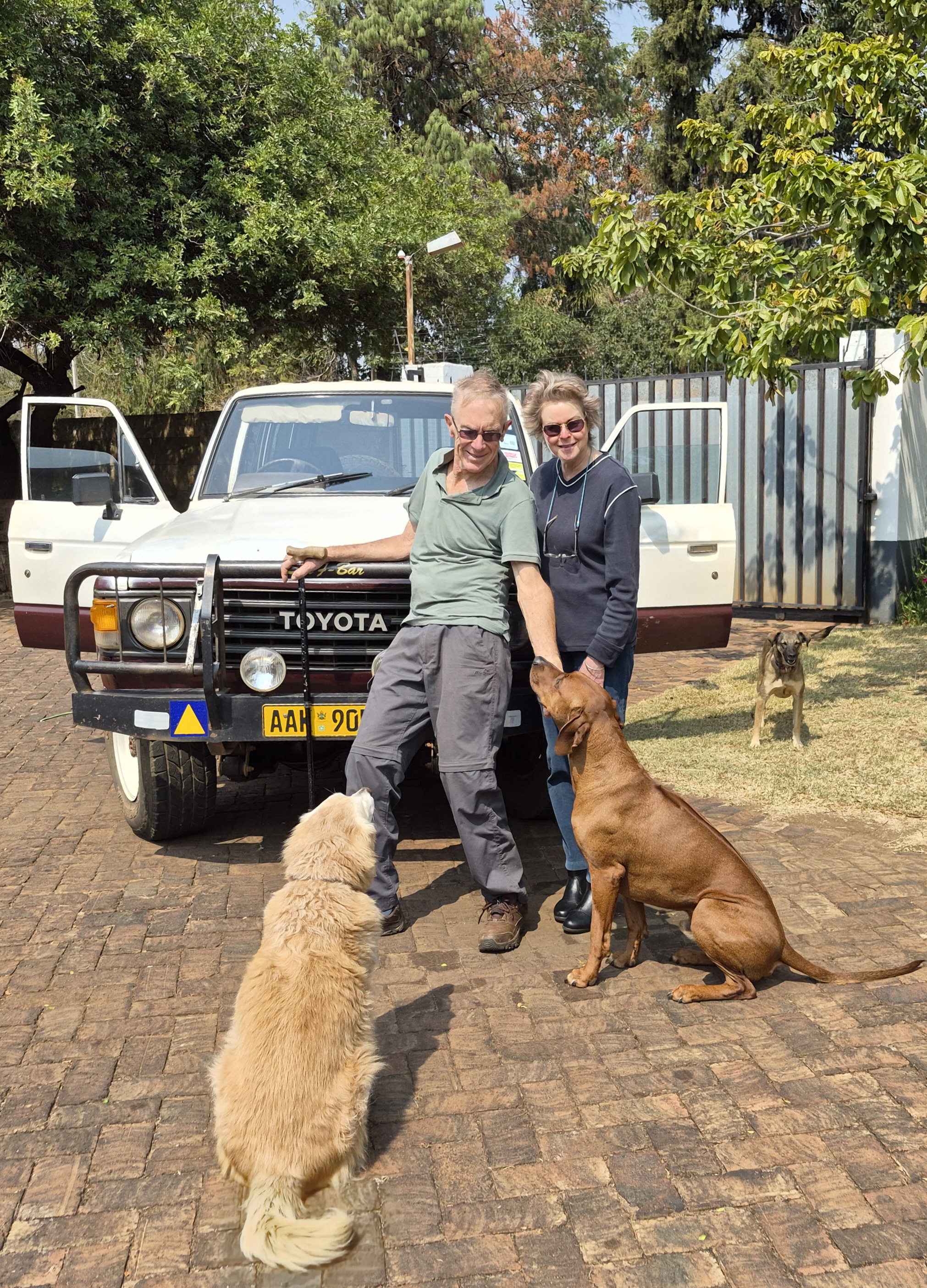
Maybe it’s the age I’ve reached when you try not to look forward to the future and the inevitable decline and would rather concentrate on nostalgia of years past. I have to admit that I’ve become sentimental about my old Toyota Land Cruiser. Yes, Marianne is also sentimental about her but for different reasons – she likes the respect she gets from Honda Fits! They definitely don’t cut her up.
We have decided to sell the old girl and the old Mazda pickup and get a second hand Japanese import, a Nissan X-Trail. It makes sense – the Cruiser (we never had a name for her – she was just “the Cruiser”) is used for little more than shopping and the Mazda is used only to keep the battery charged. I can import an automatic vehicle every five years duty-free on my disability allowance and the Ford pickup is 10 years old so we can get the Nissan for pretty much the sale of the Cruiser and Mazda. The Nissan is nine years old
I bought the Cruiser in the mid 2000s – I think. I needed a vehicle for my paragliding trips and I wanted to improve my mechanic skills which up until that stage had been limited to oil changes and brake maintenance. The Cruiser fit the bill on all counts. Being a station-wagon, a 1989 HJ60 model, she could carry lots of kit and people in reasonable comfort and she was certainly in need of some TLC. I ended up learning a lot more than I’d intended to.
The engine, a 2HZ 3.98 litre diesel was in poor shape so the bonnet went up and out it came. The cylinder head was overhauled with valves being reseated and lapped-in. The head was skimmed, new cylinder liners purchased and put in by what was, I was assured, a reliable machine shop. Then it all went back together courtesy of a how-to-do it book copied off a friend and lots of asking around – remember the days before Google? I did buy a lot of tools and Jenni, my Rhodesian Ridgeback, helped by getting in the way when I was under the vehicle.

She started a bit rough, but after the timing was sorted out and feeling rather pleased with myself I took her for a drive on the farm. It was the rainy season and I needed to test my idea that one couldn’t get a Land Cruiser stuck so I went down a road that I knew was particularly muddy. Nervous moments were had as I realized there was a good reason that the tractors avoided that area in the rainy season. I retreated more than a little cowed and covered in mud and disengaged the four wheel drive.
Just when I was getting pleased with myself (about 2,000 km later) the engine stopped. Something was badly wrong so the cylinder head was removed again and the damage assessed. The machine shop that I was assured was good hadn’t bothered to tell me that the cylinder liners I’d bought were too small and every single one was cracked around the rim, except for the sixth which had been pulled down onto the crankshaft. It took two years for my sense of humour to recover enough to start the search for another engine. It turned out to be a fortuitous wait.
I asked Mark in the 4×4 Club to ask around for a replacement engine. Some time later he contacted me: “I have someone wanting to sell two engines that came from Dubai” he said. “One is a 2H like yours, the other is a 12HT which is the same engine but turbo charged”. I dithered and decided on the 2H which was the cheaper of the two. “It’s already sold” he replied. So I stumped up the cash for the turbo version. It was a good choice.
Once Mark had fitted the engine – he’s a better mechanic than me and there were a few modifications that I was prepared to let someone else do – the adventures began. There was a trip to Ghona-re-Zhou in the south east of Zimbabwe. Several to Mana Pools Game Reserve on the Zambezi and lots to Nyanga. Being a big station wagon there was always plenty of room for friends, dogs and paragliders and she could go almost anywhere. The big diesel would reassuringly rumble from Harare to Nyanga in the eastern highlands without having to change gear for any hills and she could easily stay on the speed limit. There is one hill near Juliasdale that I would really look forward to. A steep descent to a 90 degree right hand bend followed by a long curving uphill. No problem, put the foot down and purr up to the top without a gear change.
She also had some extras added after the engine was replaced. I had her resprayed to a two tone white and maroon. A bull bar was added to the front on a new heavy steel bumper – fortunately I never needed to find out how well they worked. A heavy steel rear bumper was attached and a long range fuel tank replaced the original. That was well put to use. Spot lights were added as the original lights were poor. Back then it was still ok to drive at night. Now we avoid it if at all possible.
On the weekends I’d often go out flying model radio-controlled aircraft or my paraglider and I’d leave the ‘Cruiser by the back door whilst I had lunch and got ready. If the door was open Jenni knew she was coming and would climb in and wait. It could be more than two hours but she was as patient as she was determined. After Jenni there was Zak and Kharma – also Rhodesian Ridgebacks. Once I had to keep them in the ‘Cruiser whilst aircraft took off at the airfield where we flew. Zak showed his displeasure by chewing a seatbelt.
I haven’t driven her for quite a few years now – as my disability has increased my feet have become too slow on the pedals. Marianne does drive her and likes the sense of respect she gets from other vehicles, especially Honda Fits but I think I have already mentioned that. Anyway, tomorrow she goes to her new owner in Kariba who has promised to look after her. Doing the final checks this afternoon and pumping up the tyres I couldn’t resist one last listen to that big diesel. She started easily as always. I couldn’t get my right foot to the accelerator pedal so I used the hand throttle. I gave it a good pull and the engine roared and as it slowed there was that beautiful turbocharger whistle. Perfect! I know one shouldn’t get sentimental about vehicles but I guess it’s the memories they invoke. Farewell old friend.

 Zimbabwe Absurdity
Criminal ethics
30 05 2025“Boss, come and have a look at this” Mapeno, the gardener exclaimed, clearly excited. He held up two expensive day packs. “Where did you find them?” I responded. “Over here right by the gate” came the reply. “Are you sure they don’t belong to the builders?” I asked. “No, I already checked with them”. I wasn’t surprised, they didn’t look like the sort of day packs a Zimbabwean builder could afford.
I was just about to go to work so he brought them over to my truck and we started to go through them. Diaries with copious notes on what looked like engineering projects, a wallet with South African gun licences, credit cards and no cash. Two South African passports (one full) in one pack in the name of a male and another in the second pack with a woman’s name and photo. This was obviously stolen property but why had it come over the wall into our property? And how was I going to contact the owners?
Fortunately the diaries had contact phone numbers in them albeit different ones. I tried both – one did nothing and the other was unreachable. Maybe I could contact the South African Embassy and give them the passports and then the owners would likely go there and then be able to contact me. I was on the way to work when I realized that WhatsApp works everywhere irrespective of phone number so I entered the unreachable number and called. It was quickly answered. “Is this Mr M and are you missing a couple of day packs?” I said. “Yes we are – did you find any passports?”. I answered that we’d found three and asked what they’d lost. A laptop and US$2,000 was the response. “It was just stuff, the passports are the most important things, at least we can get back home tomorrow” he added.
They had stopped for breakfast at a café at a local shopping centre and left the laptop and day packs on the back seat of the pickup in plain view. As they sat down to breakfast thieves smashed the back window, grabbed the packs and computer and got away in a waiting car.
“While this is not Jo’burg you still have to switch on. Thieves hang out in car parks just waiting for that sort of opportunity” I commented.
“Yes, we know that now” he replied. “Please send me your address so that I can come and pick up our stuff”.
I wasn’t there when they arrived but our maid phoned me to confirm who they were and wrote down the registration number of their pickup truck. I did wonder why the thieves bothered to “return” the day packs and their contents – a distinctly curious form of criminal ethics. If I were they I’d have kept the rather smart packs and dumped the contents into the nearest ditch.
Crime in Cape Town is an altogether different league. One could easily be lulled into a false sense of security by the first world shopping centres, immaculate roads and civilised driving standards (traffic lights are actually respected) contrary to Zimbabwe. Tourism is booming – the driver we used from the airport told us that in December 2024, 1.6 million tourists came through the airport – tourists we met on Table Mountain commented on how cheap Cape Town is. People are positive about their future and investing and developing in agriculture – rare attitudes in Zimbabwe.
Visiting Oaklands Estate near Wellington in the Western Cape was a case in point. David, a friend of my cousin, bought the abandoned racehorse stud in 2009 before occupying it in 2011. The derelict buildings have been renovated into tourist accommodation and the old stables will once again house a stud. Hillsides are being planted to proteas for their flowers for export. Other stables have been converted into a conference centre and come the tourist season the accommodation is full. I asked David if his positive outlook was down to living in the Western Cape. He answered “Pretty much. You can still avoid the corruption bullshit if you want to”. The Western Cape is relatively well run compared with the other provinces in South Africa. It is under the control of the Democratic Alliance with Alan Winde as the premier.
While Oaklands Estate is far enough out of Cape Town to not be overly attractive to criminals, the township of Guguletu is an epicentre of crime. The taxi driver was quite clear on this: “If you are a person of colour” – he tapped his own light brown skin – “or a white, you stay out of there” – he gestured to the left of the motorway. It was a maze of corrugated iron shacks, broken fencing, goats, rubbish and bizarrely – satellite dishes on nearly every dwelling I could see. We asked him about the white tourist who’d been killed there earlier in the year. “Actually there were two who went in there” he responded “but one survived”. “You see that road up there?” he gestured with his right hand to a road sweeping a curve over the motorway into the township. “There was traffic backed up on the other side of this road so both asked their traffic navigator apps for an alternative and it took them into Guguletu. One guy was robbed of his car and beaten up but got out to a hospital and survived. The other was a doctor and they shot him. Dead. You don’t mess with the gangs in there – they run the place.” I mused that they were probably not the type that would return high quality day packs over a suburban wall in the expectation that they would be returned to their owners.
We arrived at the airport and said goodbye to Mario. It was time to head back to Harare. I got chatting to the porter who was assisting us whilst Marianne filled in forms to get VAT back. I asked him where he lived. “Oh, Guguletu” he replied. When I asked him how he coped with the gangs and crime he shrugged “God looks after me”.
Comments : Leave a Comment »
Tags: africa, Cape Town, crime, Guguletu, South Africa, Table Mountain, travel
Categories : Agriculture, Economics, Environment, horticulture, Social commentary, Travel