My brother, Duncan, arrived from the UK on Good Friday for a three week holiday. Originally he’d booked on Emirates the day before the Gulf war started but took up the offer of a full refund rather than take a chance. Asked what he thought of his flight on Rwandair he replied that it was just fine and the planes were relatively new. I am not sure how he justifies a holiday given that he’s retired. Maybe it’s our weather that’s so attractive – which it is when compared with the English weather. I was especially pleased to see him as he’d brought me a mixed pack of cheeses which can be found in Zimbabwe but are notoriously expensive. Oh, yes, we do get along well too. Our sibling rivalries of our teenage years are long past.
Left to right: my aunt Helen (97), brother Duncan (70), self (66).
The following day was my aunt, on my mother’s side, 97th birthday party. She’s doing well for her age and still lives by herself albeit with a carer. Unlike me she doesn’t need to use a wheelchair, just two walking sticks. I also walk with two sticks but on occasions such as this find a wheelchair easier. Most of her family were in attendance as nobody can be certain how much longer she’ll be around.
My mother’s side of the family seemed to either live a long time – brother Anthony to 94, Helen 97 so far – or not. My mother died of melanoma at 67 and her other brother Steven died at 72 from prostate cancer. Not much is known about my father’s family. He was an only child and no father is listed on his birth certificate. A scandal in our family – quelle horreur! Us siblings were delighted and my sister Diana, who died at 62 from breast cancer, noticed this and asked my mother about it but the curtains came down. The man whose surname my father inherited died on the Somme in 1918 and my father was born in 1925. It’s not that my mother was prudish but she was born in 1925 and some things were not up for discussion. She once asked me if I would consider marrying a woman who’d lived with someone else. I replied that I’d be seriously restricting my choice if I were to apply that criterion. She looked thoughtful for a moment then said: “Yes, I suppose so”.
She was a strong woman my mother. My father was murdered in 1978 and bled to death outside the front door within three metres of her (she was on the other side) and she could do nothing to help. It was near the peak of the Rhodesian bush war and civilians were fair targets for the combatants/terrorists of Robert Mugabe’s ZANLA and Joshua Nkomo’s ZIPRA. Understandably she didn’t talk much about it but did say that flying on the air force helicopter into Umtali (as Mutare was known then) she recalled that the countryside being beautiful by the light of the full moon.
The quintessential Zimbabwe bush scene – a sandy road, miombo bush.
We decided to take a trip to the Eastern Highlands of Zimbabwe. The district of Nyanga, where our parents had met in the early 1950s, was to be the first port-of-call, but Duncan wanted to call in and visit Kerry Stanger, near the small town of Rusape, who has a crowned eagle nesting in her garden. Some of her fantastic photos can be found here. Her husband John farms a variety of crops including tobacco and pecan nuts and is looking to put in chili peppers for export to China. Unusually for the area, he has managed to keep a fair proportion of his original farm and as a title deed holder is looking to invest in a solar farm with a Dutch company. He also has a dairy!
I couldn’t access the observation point where Kerry takes her photos of the chick that she calls JJ. He/she was not cooperating so they didn’t get a clear view anyway. We did enjoy the views of the unspoilt countryside of granite rock outcrops or “kopjes”, grasslands and bush-veld.
Straight on to Nyanga village, right to Troutbeck Hotel and up to World’s View.
The road from Rusape to Nyanga was quiet and all the potholes had been filled – with sand. It was a pleasant trip and we even saw a black mamba snake crossing the road. Fortunately it was close to a police roadblock and I was going slow enough to easily avoid it. This was a relatively small one at about 1.5m but they can often get to 3m or more. Duncan got out of the car to try and get a photo. He seemed to think that they would only attack if cornered. That maybe, but as Africa’s largest venomous snake I was pleased that it had quickly moved off.
The evening view from Venus Cottage where we stayed
The road from Troutbeck Hotel up to the Connemara lakes is in very poor shape. We arrived at Venus Cottage where we were staying just in time to capture the setting sun reflecting in the clouds covering Mt Nyangani, Zimbabwe’s highest peak. It was getting cold enough for a fleece (for me at least) and the fire was lit.
The World’s View range: background – Nyangui, middle ground – Rukotsu, right – World’s View
After my mother died in 1992 I moved back from the Chinhoyi (central west) area of Zimbabwe, where I was working on a flower farm, to her cottage in the mining village of Penhalonga on the Mozambique border about an hour south of Nyanga. I was keen to try to earn a living doing freelance programming for the agricultural sector. After a couple of years and merely subsisting I closed shop and moved to formal employment near Harare. I did however get hooked on paragliding whilst in Penhalonga.
Gary and his family lived at the top of the Penhalonga valley, close to the Mozambique border. One day he called past the cottage and said “I am going paragliding, come along, you might be interested”. On the local training hill I watched him lay out his wing, inflate it and step off the slope into the air. I was entranced. “I just have to do that!” I thought. I duly did a course and bought my own wing.
We had three flying sites in the area; Penhalonga, the Honde Valley to the north and then World’s View further north again. The World’s View takeoff, to the right of the picture above, faces west and when the wind blows from that direction can deliver extraordinary flying.
Not long after I learnt to fly I went with Barry, who’d taught me to fly, and others to World’s View. It looked good so we launched into what we found out later was convergence* and conditions were extraordinary. We didn’t have to look for thermals – the lift was everywhere, smooth and strong. We were carrying variometers (an instrument with audio and visual rate-of-climb and sink indicators and an altimeter) so we knew both how fast we were climbing and how high we were. At 1,000m above takeoff the terrain below looked completely flat. Barry had to go back to Harare so we landed and I went home to Penhalonga. We had many good flights at this site but none that quite matched that day. My love of paragliding never dimmed and I went on to fly in South Africa, France and the USA where I famously had to be rescued by a US Navy marines helicopter! *Convergence in meteorological terms is when two airmasses converge and the air is forced up. Conditions can be fantastic for soaring in dry weather but in summer storms often develop along the convergence line.
The view from the plot that my mother bought in the early 1950s. The mountains in the distance are in Mozambique.
The following day we took a trip to the plot that my mother had bought not long after my parents were married. The intention was that one day they’d retire there and relax and enjoy the view, which is fantastic. It was not to be. My father was murdered as a result of the bush war in 1978 and my mother died in 1992. She left the plot to both myself and Bridget Galloway (Hamilton) whose parents mine befriended in the area in the 1950s. I realized that I was never going to develop the land so sold my share to Bridget some years ago. She has built a very rustic cottage and lives there by herself with no apparent need for any sort of security – not even a fence around the cottage.
The road to the plot was awful. It took us an hour to cover the 13km and in two places we used four-wheel-drive. It probably wasn’t necessary but it made life easier. Bridget had told me earlier when I’d asked about the condition of it (she was working elsewhere when we arrived) that in March heavy rains had made the road impassable for three weeks. When at school in Mutare we used to make monthly trips to the plot and even then the road wasn’t great but still passable to any vehicle with reasonable clearance.
A bit of rudimentary transport taking a breather whilst we were blocked by a truck loaded poles. No doubt it could have negotiated the road when other transport found it impassable. The oxen looked in good condition.
On the way back from the plot we had to wait twenty minutes for a logging truck to finish loading with poles. Duncan, being an ex truck driver in the UK went to speak to the driver. He marveled how the truck managed to negotiate some of the tighter corners on the road and even had turned around.
Sometimes it’s easier to negotiate the tight bends with something more appropriate even if it doesn’t carry much.
We called in at the Troutbeck Resort on the way to see Barry (the one who taught me to paraglide) who was working there helping refurbish a conference room – he’s a professional carpenter. We reminisced about our paragliding days over tea and beers and came to the conclusion that our paragliding days were over – neither of us could afford a bad landing – but hell, we’d had a lot of fun. I still fly a paramotor on occasion but it doesn’t really compare with the thrill of catching a thermal and feeling the glider pitch into the lift and the variometer start to squeal. So far as I know there is nobody flying paragliders in the country. The World’s View takeoff is overgrown as is the Honde valley takeoff to the south. There is another site on the Zambezi Valley north of Harare and I had amazing cross country flights there but access was problematic even then.
Venus Cottage where we stayed, looking west. It’s comfortable and has been refurbished since we last stayed there.
The next day we left the cottage and headed back south to Mutare. On the way there we stopped off to see Sue in the Imbeza valley where she lives on a smallholding. Together with my mother, she was one of the founder teachers of Hillcrest Primary School closer to Mutare. She also lost her husband in the war in the Cashel valley south of Mutare where they were farming. Farmers were especially vulnerable and Tim was ambushed near the farm apparently in a case of mistaken identity. One of his sons found out many years later that the target was another farmer following behind him.
My brother Duncan and Sue. She’s a spry 80 year-old, still living by herself.
Then it was on to Mutare to meet up with Gary (the one who introduced me to paragliding) and his family. After a pleasant afternoon chatting and catching up (they don’t often come up to Harare) we headed into the nearby Bvumba mountains to the White Horse Inn for the night. On the way we passed through the centre of the city and I was pleasantly surprised at how clean it was.
Approaching the White Horse Inn in the Bvumba mountains close to MutareSorry no tie – me flouting the dress code. Marianne (my wife) recounted how many years ago the then manager, David Graham, had given her partner a tie to wear for the dining room as he wasn’t carrying one. They are much more relaxed now – we did ask – even shorts are permitted!
The decor of the inn is still very much as it was 50 years ago. Duncan sent photos to an old school mate who’d lived in the area and said it hadn’t changed since his youth. The staff were very pleasant, the food good even if the service was a little slow and the rooms comfortable. It scores a well-deserved 4.3 stars on Trip Advisor.
The next morning the mist was down as befitting the name Bvumba which refers to the “misty mountains” so we had a relaxed breakfast and started down the hill to Mutare.
“No one and no place left behind” says the slogan on the banner on the sports ground fence in Mutare. That’s Zimbabwe’s president. E.D. Mnangagwa on the left. The slogan is more than a bit ironic considering that a third of the population faces food insecurity but the ruling party (ZANU-PF) wants to increase the president’s term beyond the stipulated two of five years each. There’s a referendum coming up on this issue so the slogans abound as does the intimidation. Everyone expects the result to be fixed in favour of changing the constitution.
The drive back to Harare was uneventful with none of the heavy trucks forming nearly impossible to overtake informal convoys. Duncan drove like a good Zimbabwean driver – overtaking on solid white lines, pushing into small gaps in the left lane and cutting in front of a car in oncoming traffic in Harare. He needs to work on the speeding bit though. He kept to the 120 km/h limit all the way and even used cruise control so he only qualifies for a provisional licence! It was a good trip with plenty of time to reminisce about our distant youth and catch up with old friends.
The watch has seen better days – it’s a lot like me in that respect. I don’t usually wear it these days. As a time piece I use my cell phone which is a bit irritating though not as bad as the watch. It swings down to the outside of my arm so I have to use my right hand to rotate it back so that I can see the time. Added to that is the need for my right hand to hold onto my walking stick – it’s easier to use the cellphone. I am wearing the watch today for nostalgic reasons – not to remind me that tomorrow I’ll be 66. I’m not looking forward to it.
Most people in the civilized world retire at the end of 65. Some are forced to, like my old boss who now lives in Australia. He’s lucky in that his wife has a successful psychology business so he’s doing the bookkeeping and is busy. My brother chose to retire at 70 from being a truck driver in the UK. Apparently he’s busier than ever though is vague on what “busy” entails. There seem to be a lot more photos on our family WhatsApp group (they are definitely improving) and we get rainfall figures to nearest 10th of a millimetre thanks to a new weather system he’s installed at his house. I don’t know anyone in Zimbabwe who’s retired at 65. I won’t be.
I took the decision earlier in the week to tell my staff that they were on notice that I would be closing my seedling company at the end of the year. It’s been losing money for quite some time now but it had finally got to the stage where I couldn’t pretend to myself that somehow it would keep going and I could stay in my comfort zone. The bank account is dangerously low, in no small part to an unwise decision to purchase a container of the coir pith that we use as a growing medium, again based on the misguided belief that somehow we could keep going for another year.
When making the announcement to the labour force my senior foreman reminded me that there were only six weeks to the end of the year and I needed to give three months notice. I told the labour that they would get paid everything owed to them but given the precarious state of the company’s finances they would just have to wait until I could sell off the coir pith and get outstanding debtor’s payments in. They were uncomfortable with the idea so I suggested we get the National Employment Council (NEC) representative, who mediates in employment issues, in to discuss the issue.
On Thursday the NEC lady arrived to talk to the labour force at exactly noon. In a previous discussion she’d advised me that she would try to get the staff to agree to a mutual settlement based on the fact that they’d been paid well over the required legal minimum wage and we’d all benefit. Not surprisingly they stuck to their guns and said they wanted the full payout.
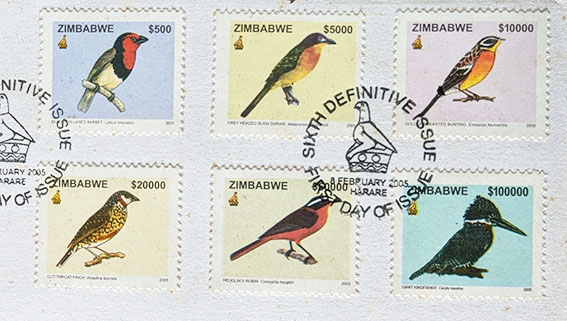
Way back in 2005 when a stamp could be worth $100,00…
Laying off staff in Zimbabwe is not a cheap exercise, especially if they’ve been employed for a long time as have mine. Fortunately I’d paid them off in 2004 when the Zimbabwe dollar was in meltdown and they were signed back on as contract workers for a further three years before becoming permanent employees again. This meant that the loss of employment compensation, one month’s salary per year of employment, would “only” be calculated for 18 years. Add the required gratuity, a more complex but less expensive (for me) calculation, and the amount per person would come to over US$3,000.
I told the NEC rep that there was simply no way that I could pay the approximately US$36,000 at the end of the year on top of the required three months salary per person. She emphasized that it was a legal requirement. I explained that even if I could sell off the meagre company assets it would not cover the bill and could anyway not be done in the time frame. We were at an impasse. She said she’d talk to her boss.
The next morning I came to a decision: as I was going to have to pay an extra six weeks wages at the end of the year I might as well close the company at the end of February ’26 and at least get some work out of the labour force. It would also buy me time to sell off the coir import (due to arrive in about two week’s time) and get in outstanding debts. The extra time is unlikely to make any money for the company given the record of the past few years but at least I could breathe a little easier.
So in the time left before I turn 66 I’m going to try and forget the stresses of closing down a business that I’ve run for 26 years, mostly successfully, and do things that I enjoy.
If the weather holds, it’s supposed to rain this afternoon but doesn’t look like it will happen, I’ll go to the local polo grounds to fly my FPV (first person view) drone. I’m not much good but it’s fun flying through the car park surrounded by trees. There will be other model plane fliers there if I need help. Then I’ll head back home for a late tea and a supper of salmon (yes, just about anything is available for a price in Zimbabwe).
Tomorrow morning we’ll be up at 10 to five to go walk the dogs and I will be 66.
My family has a bit of a chequered history when it comes to longevity. My mother’s family seems to live a long time or much less – there’s no middle ground. My mother died at 67 from cancer, he elder brother in his 70’s from another type of cancer and her oldest brother, Anthony, at 94 from old age. My father was an only child and was murdered at 53. His father is unknown and I have no idea what his mother’s age was when she died. My sister died four years ago at 62.
My mother’s younger sister turned 95 on the 4th of April and is in rude health. She still lives by herself (though has domestic servants and a tenant who rents a flat in part of the house) and gets around just fine on two walking sticks, though she doesn’t drive. Her mind is still super-sharp.
Yesterday we had a general gathering at her house to celebrate her birthday. It was a sizeable gathering and the weather co-operated, just. On arriving home Marianne, who’d had emergency work issues to deal with, told me that there had been 38mm of rain which is unusual for April.
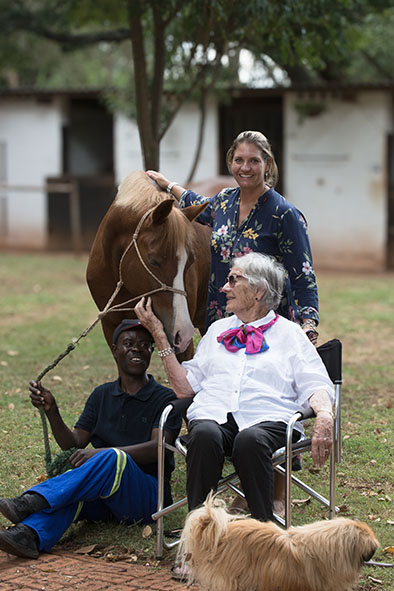
Helen has always been passionate about her horses. That’s Kylie, a grandchild standing.
I wouldn’t mind living to 95 if I could be as independent as my aunt; it’s not going to happen. Another 30 years, hmm, I don’t think I want that – just getting up out of a chair requires me to take unnatural concentration. When it comes to the end of her life my aunt confessed to Janine, her daughter, that she wants to “wake up dead”. Don’t we all.


 Zimbabwe Absurdity
Entertaining my brother
6 05 2026My brother, Duncan, arrived from the UK on Good Friday for a three week holiday. Originally he’d booked on Emirates the day before the Gulf war started but took up the offer of a full refund rather than take a chance. Asked what he thought of his flight on Rwandair he replied that it was just fine and the planes were relatively new. I am not sure how he justifies a holiday given that he’s retired. Maybe it’s our weather that’s so attractive – which it is when compared with the English weather. I was especially pleased to see him as he’d brought me a mixed pack of cheeses which can be found in Zimbabwe but are notoriously expensive. Oh, yes, we do get along well too. Our sibling rivalries of our teenage years are long past.
The following day was my aunt, on my mother’s side, 97th birthday party. She’s doing well for her age and still lives by herself albeit with a carer. Unlike me she doesn’t need to use a wheelchair, just two walking sticks. I also walk with two sticks but on occasions such as this find a wheelchair easier. Most of her family were in attendance as nobody can be certain how much longer she’ll be around.
My mother’s side of the family seemed to either live a long time – brother Anthony to 94, Helen 97 so far – or not. My mother died of melanoma at 67 and her other brother Steven died at 72 from prostate cancer. Not much is known about my father’s family. He was an only child and no father is listed on his birth certificate. A scandal in our family – quelle horreur! Us siblings were delighted and my sister Diana, who died at 62 from breast cancer, noticed this and asked my mother about it but the curtains came down. The man whose surname my father inherited died on the Somme in 1918 and my father was born in 1925. It’s not that my mother was prudish but she was born in 1925 and some things were not up for discussion. She once asked me if I would consider marrying a woman who’d lived with someone else. I replied that I’d be seriously restricting my choice if I were to apply that criterion. She looked thoughtful for a moment then said: “Yes, I suppose so”.
She was a strong woman my mother. My father was murdered in 1978 and bled to death outside the front door within three metres of her (she was on the other side) and she could do nothing to help. It was near the peak of the Rhodesian bush war and civilians were fair targets for the combatants/terrorists of Robert Mugabe’s ZANLA and Joshua Nkomo’s ZIPRA. Understandably she didn’t talk much about it but did say that flying on the air force helicopter into Umtali (as Mutare was known then) she recalled that the countryside being beautiful by the light of the full moon.
We decided to take a trip to the Eastern Highlands of Zimbabwe. The district of Nyanga, where our parents had met in the early 1950s, was to be the first port-of-call, but Duncan wanted to call in and visit Kerry Stanger, near the small town of Rusape, who has a crowned eagle nesting in her garden. Some of her fantastic photos can be found here. Her husband John farms a variety of crops including tobacco and pecan nuts and is looking to put in chili peppers for export to China. Unusually for the area, he has managed to keep a fair proportion of his original farm and as a title deed holder is looking to invest in a solar farm with a Dutch company. He also has a dairy!
I couldn’t access the observation point where Kerry takes her photos of the chick that she calls JJ. He/she was not cooperating so they didn’t get a clear view anyway. We did enjoy the views of the unspoilt countryside of granite rock outcrops or “kopjes”, grasslands and bush-veld.
The road from Rusape to Nyanga was quiet and all the potholes had been filled – with sand. It was a pleasant trip and we even saw a black mamba snake crossing the road. Fortunately it was close to a police roadblock and I was going slow enough to easily avoid it. This was a relatively small one at about 1.5m but they can often get to 3m or more. Duncan got out of the car to try and get a photo. He seemed to think that they would only attack if cornered. That maybe, but as Africa’s largest venomous snake I was pleased that it had quickly moved off.
The road from Troutbeck Hotel up to the Connemara lakes is in very poor shape. We arrived at Venus Cottage where we were staying just in time to capture the setting sun reflecting in the clouds covering Mt Nyangani, Zimbabwe’s highest peak. It was getting cold enough for a fleece (for me at least) and the fire was lit.
After my mother died in 1992 I moved back from the Chinhoyi (central west) area of Zimbabwe, where I was working on a flower farm, to her cottage in the mining village of Penhalonga on the Mozambique border about an hour south of Nyanga. I was keen to try to earn a living doing freelance programming for the agricultural sector. After a couple of years and merely subsisting I closed shop and moved to formal employment near Harare. I did however get hooked on paragliding whilst in Penhalonga.
Gary and his family lived at the top of the Penhalonga valley, close to the Mozambique border. One day he called past the cottage and said “I am going paragliding, come along, you might be interested”. On the local training hill I watched him lay out his wing, inflate it and step off the slope into the air. I was entranced. “I just have to do that!” I thought. I duly did a course and bought my own wing.
We had three flying sites in the area; Penhalonga, the Honde Valley to the north and then World’s View further north again. The World’s View takeoff, to the right of the picture above, faces west and when the wind blows from that direction can deliver extraordinary flying.
Not long after I learnt to fly I went with Barry, who’d taught me to fly, and others to World’s View. It looked good so we launched into what we found out later was convergence* and conditions were extraordinary. We didn’t have to look for thermals – the lift was everywhere, smooth and strong. We were carrying variometers (an instrument with audio and visual rate-of-climb and sink indicators and an altimeter) so we knew both how fast we were climbing and how high we were. At 1,000m above takeoff the terrain below looked completely flat. Barry had to go back to Harare so we landed and I went home to Penhalonga. We had many good flights at this site but none that quite matched that day. My love of paragliding never dimmed and I went on to fly in South Africa, France and the USA where I famously had to be rescued by a US Navy marines helicopter!
*Convergence in meteorological terms is when two airmasses converge and the air is forced up. Conditions can be fantastic for soaring in dry weather but in summer storms often develop along the convergence line.
The following day we took a trip to the plot that my mother had bought not long after my parents were married. The intention was that one day they’d retire there and relax and enjoy the view, which is fantastic. It was not to be. My father was murdered as a result of the bush war in 1978 and my mother died in 1992. She left the plot to both myself and Bridget Galloway (Hamilton) whose parents mine befriended in the area in the 1950s. I realized that I was never going to develop the land so sold my share to Bridget some years ago. She has built a very rustic cottage and lives there by herself with no apparent need for any sort of security – not even a fence around the cottage.
The road to the plot was awful. It took us an hour to cover the 13km and in two places we used four-wheel-drive. It probably wasn’t necessary but it made life easier. Bridget had told me earlier when I’d asked about the condition of it (she was working elsewhere when we arrived) that in March heavy rains had made the road impassable for three weeks. When at school in Mutare we used to make monthly trips to the plot and even then the road wasn’t great but still passable to any vehicle with reasonable clearance.
On the way back from the plot we had to wait twenty minutes for a logging truck to finish loading with poles. Duncan, being an ex truck driver in the UK went to speak to the driver. He marveled how the truck managed to negotiate some of the tighter corners on the road and even had turned around.
We called in at the Troutbeck Resort on the way to see Barry (the one who taught me to paraglide) who was working there helping refurbish a conference room – he’s a professional carpenter. We reminisced about our paragliding days over tea and beers and came to the conclusion that our paragliding days were over – neither of us could afford a bad landing – but hell, we’d had a lot of fun. I still fly a paramotor on occasion but it doesn’t really compare with the thrill of catching a thermal and feeling the glider pitch into the lift and the variometer start to squeal. So far as I know there is nobody flying paragliders in the country. The World’s View takeoff is overgrown as is the Honde valley takeoff to the south. There is another site on the Zambezi Valley north of Harare and I had amazing cross country flights there but access was problematic even then.
The next day we left the cottage and headed back south to Mutare. On the way there we stopped off to see Sue in the Imbeza valley where she lives on a smallholding. Together with my mother, she was one of the founder teachers of Hillcrest Primary School closer to Mutare. She also lost her husband in the war in the Cashel valley south of Mutare where they were farming. Farmers were especially vulnerable and Tim was ambushed near the farm apparently in a case of mistaken identity. One of his sons found out many years later that the target was another farmer following behind him.
Then it was on to Mutare to meet up with Gary (the one who introduced me to paragliding) and his family. After a pleasant afternoon chatting and catching up (they don’t often come up to Harare) we headed into the nearby Bvumba mountains to the White Horse Inn for the night. On the way we passed through the centre of the city and I was pleasantly surprised at how clean it was.
The decor of the inn is still very much as it was 50 years ago. Duncan sent photos to an old school mate who’d lived in the area and said it hadn’t changed since his youth. The staff were very pleasant, the food good even if the service was a little slow and the rooms comfortable. It scores a well-deserved 4.3 stars on Trip Advisor.
The next morning the mist was down as befitting the name Bvumba which refers to the “misty mountains” so we had a relaxed breakfast and started down the hill to Mutare.
The drive back to Harare was uneventful with none of the heavy trucks forming nearly impossible to overtake informal convoys. Duncan drove like a good Zimbabwean driver – overtaking on solid white lines, pushing into small gaps in the left lane and cutting in front of a car in oncoming traffic in Harare. He needs to work on the speeding bit though. He kept to the 120 km/h limit all the way and even used cruise control so he only qualifies for a provisional licence! It was a good trip with plenty of time to reminisce about our distant youth and catch up with old friends.
Comments : 3 Comments »
Tags: books, Bvumba mountains, family, life, Mutare, Nyanga, paragliding, Penhalonga, Robert Mugabe, tobacco farming, travel, Troutbeck Resort, White Horse Inn, writing
Categories : Blogroll, Environment, family, History, News & Various, photography, Social commentary, Travel