Entertaining my brother

6 05 2026

My brother, Duncan, arrived from the UK on Good Friday for a three week holiday. Originally he’d booked on Emirates the day before the Gulf war started but took up the offer of a full refund rather than take a chance. Asked what he thought of his flight on Rwandair he replied that it was just fine and the planes were relatively new. I am not sure how he justifies a holiday given that he’s retired. Maybe it’s our weather that’s so attractive – which it is when compared with the English weather. I was especially pleased to see him as he’d brought me a mixed pack of cheeses which can be found in Zimbabwe but are notoriously expensive. Oh, yes, we do get along well too. Our sibling rivalries of our teenage years are long past.

Left to right: my aunt Helen (97), brother Duncan (70), self (66).

The following day was my aunt, on my mother’s side, 97th birthday party. She’s doing well for her age and still lives by herself albeit with a carer. Unlike me she doesn’t need to use a wheelchair, just two walking sticks. I also walk with two sticks but on occasions such as this find a wheelchair easier. Most of her family were in attendance as nobody can be certain how much longer she’ll be around.

My mother’s side of the family seemed to either live a long time – brother Anthony to 94, Helen 97 so far – or not. My mother died of melanoma at 67 and her other brother Steven died at 72 from prostate cancer. Not much is known about my father’s family. He was an only child and no father is listed on his birth certificate. A scandal in our family – quelle horreur! Us siblings were delighted and my sister Diana, who died at 62 from breast cancer, noticed this and asked my mother about it but the curtains came down. The man whose surname my father inherited died on the Somme in 1918 and my father was born in 1925. It’s not that my mother was prudish but she was born in 1925 and some things were not up for discussion. She once asked me if I would consider marrying a woman who’d lived with someone else. I replied that I’d be seriously restricting my choice if I were to apply that criterion. She looked thoughtful for a moment then said: “Yes, I suppose so”.

She was a strong woman my mother. My father was murdered in 1978 and bled to death outside the front door within three metres of her (she was on the other side) and she could do nothing to help. It was near the peak of the Rhodesian bush war and civilians were fair targets for the combatants/terrorists of Robert Mugabe’s ZANLA and Joshua Nkomo’s ZIPRA. Understandably she didn’t talk much about it but did say that flying on the air force helicopter into Umtali (as Mutare was known then) she recalled that the countryside being beautiful by the light of the full moon.

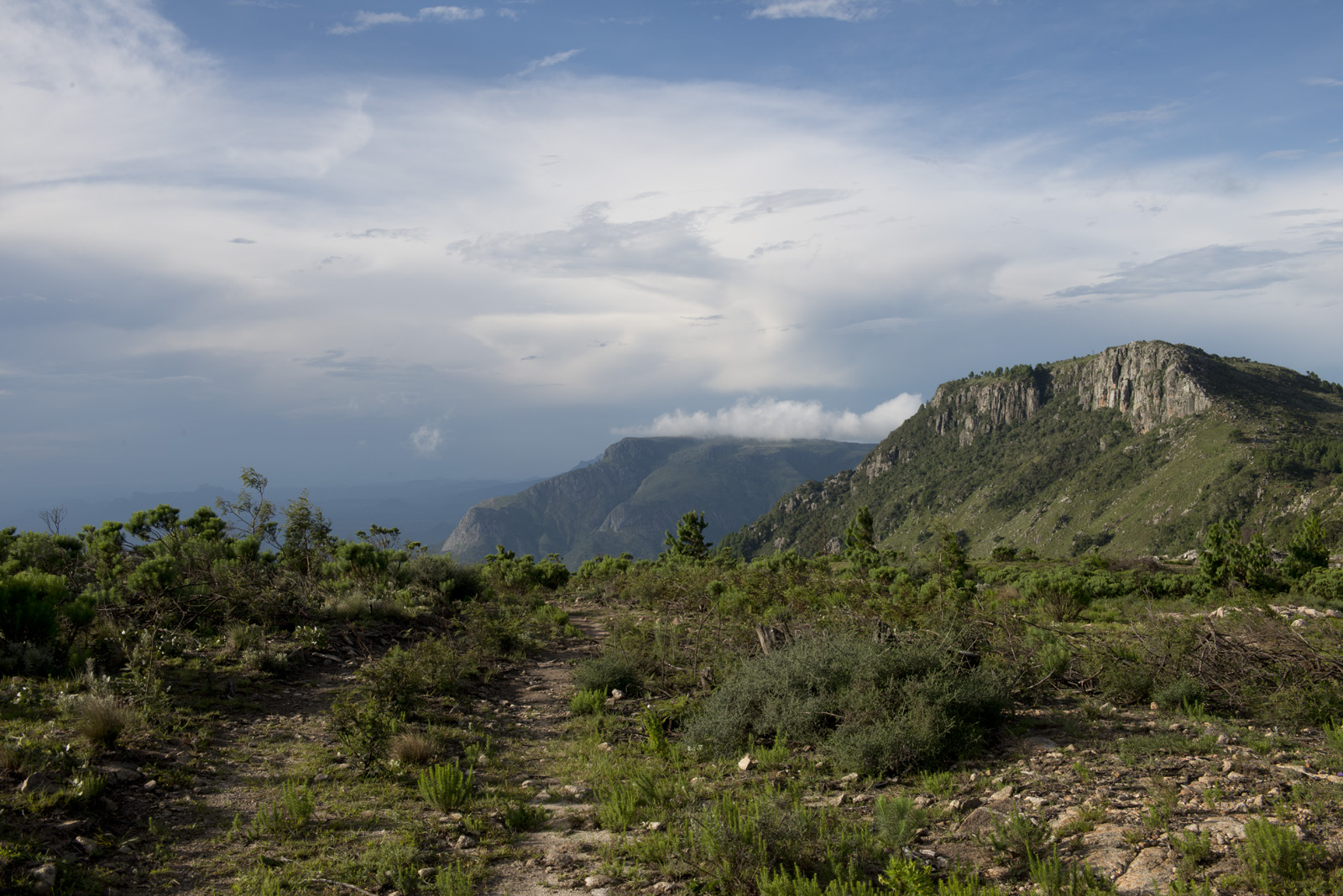
The quintessential Zimbabwe bush scene – a sandy road, miombo bush.

We decided to take a trip to the Eastern Highlands of Zimbabwe. The district of Nyanga, where our parents had met in the early 1950s, was to be the first port-of-call, but Duncan wanted to call in and visit Kerry Stanger, near the small town of Rusape, who has a crowned eagle nesting in her garden. Some of her fantastic photos can be found here. Her husband John farms a variety of crops including tobacco and pecan nuts and is looking to put in chili peppers for export to China. Unusually for the area, he has managed to keep a fair proportion of his original farm and as a title deed holder is looking to invest in a solar farm with a Dutch company. He also has a dairy!

I couldn’t access the observation point where Kerry takes her photos of the chick that she calls JJ. He/she was not cooperating so they didn’t get a clear view anyway. We did enjoy the views of the unspoilt countryside of granite rock outcrops or “kopjes”, grasslands and bush-veld.

Straight on to Nyanga village, right to Troutbeck Hotel and up to World’s View.

The road from Rusape to Nyanga was quiet and all the potholes had been filled – with sand. It was a pleasant trip and we even saw a black mamba snake crossing the road. Fortunately it was close to a police roadblock and I was going slow enough to easily avoid it. This was a relatively small one at about 1.5m but they can often get to 3m or more. Duncan got out of the car to try and get a photo. He seemed to think that they would only attack if cornered. That maybe, but as Africa’s largest venomous snake I was pleased that it had quickly moved off.

The evening view from Venus Cottage where we stayed

The road from Troutbeck Hotel up to the Connemara lakes is in very poor shape. We arrived at Venus Cottage where we were staying just in time to capture the setting sun reflecting in the clouds covering Mt Nyangani, Zimbabwe’s highest peak. It was getting cold enough for a fleece (for me at least) and the fire was lit.

The World’s View range: background – Nyangui, middle ground – Rukotsu, right – World’s View

After my mother died in 1992 I moved back from the Chinhoyi (central west) area of Zimbabwe, where I was working on a flower farm, to her cottage in the mining village of Penhalonga on the Mozambique border about an hour south of Nyanga. I was keen to try to earn a living doing freelance programming for the agricultural sector. After a couple of years and merely subsisting I closed shop and moved to formal employment near Harare. I did however get hooked on paragliding whilst in Penhalonga.

Gary and his family lived at the top of the Penhalonga valley, close to the Mozambique border. One day he called past the cottage and said “I am going paragliding, come along, you might be interested”. On the local training hill I watched him lay out his wing, inflate it and step off the slope into the air. I was entranced. “I just have to do that!” I thought. I duly did a course and bought my own wing.

We had three flying sites in the area; Penhalonga, the Honde Valley to the north and then World’s View further north again. The World’s View takeoff, to the right of the picture above, faces west and when the wind blows from that direction can deliver extraordinary flying.

Not long after I learnt to fly I went with Barry, who’d taught me to fly, and others to World’s View. It looked good so we launched into what we found out later was convergence* and conditions were extraordinary. We didn’t have to look for thermals – the lift was everywhere, smooth and strong. We were carrying variometers (an instrument with audio and visual rate-of-climb and sink indicators and an altimeter) so we knew both how fast we were climbing and how high we were. At 1,000m above takeoff the terrain below looked completely flat. Barry had to go back to Harare so we landed and I went home to Penhalonga. We had many good flights at this site but none that quite matched that day. My love of paragliding never dimmed and I went on to fly in South Africa, France and the USA where I famously had to be rescued by a US Navy marines helicopter!
*Convergence in meteorological terms is when two airmasses converge and the air is forced up. Conditions can be fantastic for soaring in dry weather but in summer storms often develop along the convergence line.

The view from the plot that my mother bought in the early 1950s. The mountains in the distance are in Mozambique.

The following day we took a trip to the plot that my mother had bought not long after my parents were married. The intention was that one day they’d retire there and relax and enjoy the view, which is fantastic. It was not to be. My father was murdered as a result of the bush war in 1978 and my mother died in 1992. She left the plot to both myself and Bridget Galloway (Hamilton) whose parents mine befriended in the area in the 1950s. I realized that I was never going to develop the land so sold my share to Bridget some years ago. She has built a very rustic cottage and lives there by herself with no apparent need for any sort of security – not even a fence around the cottage.

The road to the plot was awful. It took us an hour to cover the 13km and in two places we used four-wheel-drive. It probably wasn’t necessary but it made life easier. Bridget had told me earlier when I’d asked about the condition of it (she was working elsewhere when we arrived) that in March heavy rains had made the road impassable for three weeks. When at school in Mutare we used to make monthly trips to the plot and even then the road wasn’t great but still passable to any vehicle with reasonable clearance.

A bit of rudimentary transport taking a breather whilst we were blocked by a truck loaded poles. No doubt it could have negotiated the road when other transport found it impassable. The oxen looked in good condition.

On the way back from the plot we had to wait twenty minutes for a logging truck to finish loading with poles. Duncan, being an ex truck driver in the UK went to speak to the driver. He marveled how the truck managed to negotiate some of the tighter corners on the road and even had turned around.

Sometimes it’s easier to negotiate the tight bends with something more appropriate even if it doesn’t carry much.

We called in at the Troutbeck Resort on the way to see Barry (the one who taught me to paraglide) who was working there helping refurbish a conference room – he’s a professional carpenter. We reminisced about our paragliding days over tea and beers and came to the conclusion that our paragliding days were over – neither of us could afford a bad landing – but hell, we’d had a lot of fun. I still fly a paramotor on occasion but it doesn’t really compare with the thrill of catching a thermal and feeling the glider pitch into the lift and the variometer start to squeal. So far as I know there is nobody flying paragliders in the country. The World’s View takeoff is overgrown as is the Honde valley takeoff to the south. There is another site on the Zambezi Valley north of Harare and I had amazing cross country flights there but access was problematic even then.

Venus Cottage where we stayed, looking west. It’s comfortable and has been refurbished since we last stayed there.

The next day we left the cottage and headed back south to Mutare. On the way there we stopped off to see Sue in the Imbeza valley where she lives on a smallholding. Together with my mother, she was one of the founder teachers of Hillcrest Primary School closer to Mutare. She also lost her husband in the war in the Cashel valley south of Mutare where they were farming. Farmers were especially vulnerable and Tim was ambushed near the farm apparently in a case of mistaken identity. One of his sons found out many years later that the target was another farmer following behind him.

My brother Duncan and Sue. She’s a spry 80 year-old, still living by herself.

Then it was on to Mutare to meet up with Gary (the one who introduced me to paragliding) and his family. After a pleasant afternoon chatting and catching up (they don’t often come up to Harare) we headed into the nearby Bvumba mountains to the White Horse Inn for the night. On the way we passed through the centre of the city and I was pleasantly surprised at how clean it was.

Approaching the White Horse Inn in the Bvumba mountains close to Mutare
Sorry no tie – me flouting the dress code. Marianne (my wife) recounted how many years ago the then manager, David Graham, had given her partner a tie to wear for the dining room as he wasn’t carrying one. They are much more relaxed now – we did ask – even shorts are permitted!

The decor of the inn is still very much as it was 50 years ago. Duncan sent photos to an old school mate who’d lived in the area and said it hadn’t changed since his youth. The staff were very pleasant, the food good even if the service was a little slow and the rooms comfortable. It scores a well-deserved 4.3 stars on Trip Advisor.

The next morning the mist was down as befitting the name Bvumba which refers to the “misty mountains” so we had a relaxed breakfast and started down the hill to Mutare.

“No one and no place left behind” says the slogan on the banner on the sports ground fence in Mutare. That’s Zimbabwe’s president. E.D. Mnangagwa on the left. The slogan is more than a bit ironic considering that a third of the population faces food insecurity but the ruling party (ZANU-PF) wants to increase the president’s term beyond the stipulated two of five years each. There’s a referendum coming up on this issue so the slogans abound as does the intimidation. Everyone expects the result to be fixed in favour of changing the constitution.

The drive back to Harare was uneventful with none of the heavy trucks forming nearly impossible to overtake informal convoys. Duncan drove like a good Zimbabwean driver – overtaking on solid white lines, pushing into small gaps in the left lane and cutting in front of a car in oncoming traffic in Harare. He needs to work on the speeding bit though. He kept to the 120 km/h limit all the way and even used cruise control so he only qualifies for a provisional licence! It was a good trip with plenty of time to reminisce about our distant youth and catch up with old friends.


60 and the bottle of wine

15 12 2019

A fine red wine blend

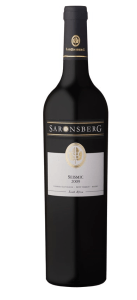
Marianne bought the bottle of South African Saronsberg Seismic 2009 red wine about 3 years ago; she had fond memories of it and thought it would be a good wine to put aside for a major celebration. The first occasion we earmarked was Mugabe’s death but when it came it seemed a bit of an anti-climax. He’d become irrelevant and it certainly didn’t create a beacon of hope. The current Zimbabwean president, ED Mnangagwa has seen to extinguishing that one before it could get going. So we moved the goalposts to the day when we would have paid off the bond on the house.

We decided to buy a house in 2016. Like anyone who’s ever rented a house long term you soon realize that you are just putting a lot of money into someone else’s pocket. There were other reasons to invest in a house. In Zimbabwe there is little if any sense in putting money into a savings account. If the government doesn’t steal it, inflation will make it worthless. Banking on the local currency crashing yet again, we decided to pool our hard-earned foreign currency savings,  borrow as much as we possibly could, and buy a house. After 6 months of despondent searching we settled with a house with “potential” (a real estate euphemism for needing a lot of work) and moved into town from the farm where I’d been renting.

The asking price was US$225,000 which we considered fair as the house was filthy and needed a lot of work but had a decent 2 bed-roomed cottage on the property that we reckoned we could easily rent out and help pay off the bond. We could also move into it when a bit older and rent out the main house for retirement income. We could only get a bond for $75,000 of the asking price as both of us were over 50 and we had to pay it off over 10 years. It sounds like a lot but I was banking on the currency losing it’s value as it had in 2008 when people had paid off multi-thousand dollar bonds for the equivalent of a few US cents. I was determined not to lose out again as prior to the 2008 currency crash I’d dithered about buying a house and lost out on a bargain.

Luckily the loan contract stated that the money was valued as US dollars or the dominant local currency of the day. At the time there were a number of legal currencies in Zimbabwe including the US dollar, South African rand, British pound and the local currency called the RTGS dollar if it was in electronic format or the Bond dollar if in cash notes. The latter were officially valued at 1:1 with the US dollar but very quickly started to trade at much less on the black market. Although the bank accounts were officially valued in US dollars it was soon evident that they were valued in local dollars (the reserve bank had made off with the US dollars) and nowhere near 1:1. From the point of view of paying off the house, that suited us just fine and in September I borrowed $14,000 of local money off my own company (it was about US$1,000 at the time) and paid off the bond. Somehow it didn’t feel sufficient enough of an achievement to open the bottle of wine. So we set the new goal as my 60th birthday.

I wouldn’t say that the 10 years since I posted Reflections on the first half have passed quickly but they have been eventful. In December 2016 I married Marianne, whom I met through friends who boarded my dogs whilst I was undergoing neck surgery to stop the rot caused by 2 previous surgeries that had gone badly. We moved in together some time later and I bought her a dog to help with the bonding process. It must have worked as we celebrated our third anniversary recently.

I also bought a new pickup. That’s probably not a big deal to many people who read this but it is the first new car I have ever bought and it was a necessity. My disability had been deteriorating noticeably and on at least 2 occasions I’d missed the brake in my old Mazda pickup. I’d recovered the situation without more than damaged nerves but at some stage there were going to be tears and dents. As a physically disabled person I can import a vehicle duty free with the proviso that it is automatic and of course I had to get a letter from a medical specialist stating the nature of my disability and that I needed an automatic vehicle (some vehicles are assembled in Zimbabwe but they are all manual). I chose to go through a private importer (rather than an official Ford dealer) as they were familiar with the system. Money was paid and after a considerable delay the vehicle arrived, complete with a hand-operated foot brake to ease the drama of stopping. It certainly is a pleasure to drive though not hugely economic on fuel use.

My brother, Duncan, came out from the UK to help celebrate my 60th birthday in the middle of November. Unfortunately my sister, who lives in the north-western USA, couldn’t make it but gave me a present of 3 nights in a cottage in Nyanga in the eastern highlands of Zimbabwe. We gathered some friends, filled up some containers with diesel (it’s still critically short) and headed off for the 4 hour drive. Whilst stopped at a traffic light in the dormitory town of Ruwa some 20km out of Harare we were enveloped by a cloud of blue smoke. By the time Duncan got out to check it had dispersed but it was definitely ours. The truck computer didn’t indicate any faults but we stopped at the next town and changed the fuel filter, which was dirty. The power loss didn’t improve so in the absence of any warning lights on the dashboard we continued to Nyanga.

The cottage, named Rocky Glen, was at the end of a road in a tree plantation. It was very comfortably furnished and the staff ensured that the log fire burned all day and most of the night which irked a bit as it was not remotely cold. It did add atmosphere for the Saronsberg wine which was very good. Nope, there’s no more 2009 vintage – I have checked their website!

In good Nyanga form it rained, though not so heavily that we couldn’t get out and do things which can be an issue in the rainy season. The road to the Gairezi River was surprisingly good, not least because it has been very dry in that part of the country too. The river was low and dirty from the overnight rain but Duncan was not put off and had a ritual swim. The rest of us watched as the clouds closed in and the rain started.
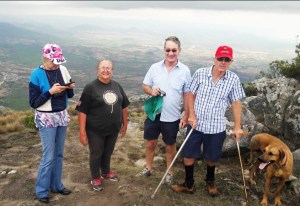
World’s View. L to R: Marianne, Maria Wilson, Duncan, self, Zak

The next day it was time to leave the quiet and solitude of the Nyanga mountains and head back to Harare and stress. First stop was the turbocharger repair workshop.

The news wasn’t good; a new turbocharger was required from South Africa and the currency was US dollars cash, and no paper trail. Whilst such deals are illegal in Zimbabwe one has to accept that for fully imported one-off items foreign currency will be required. I didn’t really have a choice as it was not a good idea to drive the vehicle and I cannot safely drive manual vehicles. A deposit was paid with precious dollars and in due course the vehicle was fixed after parting with yet more. As of writing this it hasn’t been ascertained what caused the turbocharger to fail but this particular engine is prone to having the turbo fail. Thanks Ford.

Fortunately there had been some rain whilst we were away so the swimming pool (also a makeshift reservoir for rain water collected off the roof) had risen a bit. The borehole has been failing since October and finally became useful only for drinking water in early November so the pool has been tapped for non-drinking water. Finally last Friday we had to buy in water as the pool was very low and the remaining water was more than somewhat dirty. Then the following day the rains returned and we’ve had a good week of some 140mm. The pool is back to two thirds full (about 40,000 litres) and we have 2 rain tanks totaling another 10,000 litres. We are self-sufficient for a while. Municipal water supply is erratic in Harare. We have not had municipal water since we moved in and those that do have it say it’s unusable for anything but watering plants. Lake Chivero, Harare’s main water source, is heavily polluted and the municipality has no money for water purification chemicals.

The Zimbabwe government doesn’t have much money for anything which is not surprising considering they stuff their pockets with whatever money they can lay their hands on. There has been a long running junior doctors strike that culminated in more than 400 being fired. They complained that they didn’t even get paid enough money to get to work and when they did get to work there was little if anything to work with. Those that can have left for other countries and the government has backed down and offered to reinstate the dismissed doctors no questions asked.  A very wealthy Zimbabwean businessman living in South Africa has offered to top up the doctors’ salaries with the local equivalent of US$310 per month but it’s not clear how many takers there have been.

It’s not just the healthcare system in a shambles. Air traffic controllers have also been on strike over poor pay conditions and unsafe equipment. Power supplies are still heavily restricted countrywide. The latter has got to the stage where the government is reportedly considering the nuclear power option.  That they are extremely complex to run doesn’t seem to bother them in the slightest – much more challenging than supplying a country with fuel at which they have proved themselves utterly incompetent. Hopefully the cost will keep an African Chernobyl at bay. In the meantime the national supply authority, ZESA, has hedged it’s bets and installed a solar power system in its head office building. Oh the irony.

So what’s it like being 60? Much the same as 59. I did get a set of hearing aids from my brother, courtesy of the National Health Service in the UK. His hearing profile is much the same as mine, though mine is a bit worse thanks to a more extended military service. He just has to pay £50 a piece to replace his “lost” ones. Do they work? Yes. I can now hear the workings of my electric toothbrush but they haven’t cured the persistent tinnitus as I hoped they might. I might be able to get them reprogrammed here but otherwise they will just have to do.

Bette Davis is credited with saying “Getting old is not for sissies”. I know 60 is the new 40 and all that but I think we need a different standard for Zimbabwe. Life here is just difficult regardless of age and of course makes one feel older. Some days I feel like I’m well into my eighth decade (I don’t like to think I’m already into my 7th). Partly it’s a structural issue – an artificial knee is giving a lot of trouble these days and it’s not helped by less than successful neck surgery in 2010 that has exacerbated my disability. Mostly it’s the dismal state of the economy which even our government has said will shrink by around 6% in 2020. The Economist, in its annual predicting the coming year supplement, has predicted it will shrink by around 23%. How can one make any plans in this sort of environment?

I asked Marianne recently if she would opt to stay in this country if we were financially secure. She said probably. I said I would seriously at moving to where I could do the things I really want to namely paragliding. I am now dependent on other people to take off – a critical part of the sport – and there’s only a few people I’d trust to do that. In fact there are about 2 and neither of them are available. One has stopped flying and the other is not interested in helping out – I am seen as baggage. Quite often there is just nobody around interested in going flying anyway – such is the dire state of the sport. France would be good, paragliding is big there and there would always be people around to help and yes, I can get by with the language. Dreams.

Most people at 60 have a retirement plan laid out. No chance of that in Zimbabwe for most people.   There is a national pension scheme but the pensions don’t remotely keep pace with inflation so we are putting as much money as we can into improving the property in the hope that one day we can sell it for real money. So here we stay.



The benighted country

9 06 2019

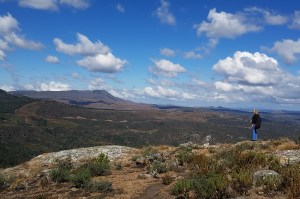
The benighted country under the Milky Way. Half the time there will be little or no lights at this time of night. That’s Jupiter middle top-left and the lights of the Troutbeck Hotel below the horizon.

There are now 8 hour power cuts every day. They usually alternate mornings and afternoon/evenings. The latter are more tedious for domestic issues, the former for work when we are doing most of the watering of the seedlings at the nursery. Power requirements are met with a diesel generator which is big enough to run pumps and office equipment but not the borehole motors which are some 450m away. Those have to wait for the mains power to come back on and run all night if necessary. So far there is enough “on time” from the mains for the boreholes to fill the main 125,000 litre reserve tank but that may not always be the case.
Diesel for the generator comes from a bulk tank that I filled a year ago but that is not going to last forever. Queues at the filling stations have been long and ubiquitous for those paying with the local currency. Got US dollars? No queuing necessary; just drive up to the pump. It’s not cheap at $1.36 per litre but my contact in the fuel industry says he can sell me bulk diesel for 89c per litre with a minimum delivery of 2,500 litres. Given that the unofficial exchange rate is 8.1 of the local dollars to one USD it makes sense to sit in a queue and pay with local money (it’s the equivalent of US60c a litre) if you have the time but one can queue for several hours with no guarantee that the fuel won’t run out.

Last weekend we decided to get out of the stress mire that is Harare and spend a few days in the cold mountain air of the Nyanga mountains in the eastern highlands of Zimbabwe with some friends from Mutare, also in the east. Some phone calls and social media research ascertained that the likelihood of fuel being available in the area was good, but not certain, so in the interests of sanity we dug into our reserves of real money, bypassed the queues at the local fuel station and filled up the pickup and a Jerry-can with diesel. It was worth it to get away. Ever hopeful, I packed a paraglider but the wind was not suitable so we spent the weekend sitting in the sunshine and just chilling out. It turned out to be a literal chilling out with a very sharp frost on the first morning we were there but the company was good and the log fire warm. Yes, the power cuts reached us but it did not matter too much and it turned out there was plenty of diesel available, for US dollars only, at the Troutbeck fuel station. Tourists were in short supply though the hotel seemed to be getting by on conferences. Marianne commented that it must be soul-destroying for the staff to spend the week waiting for weekend tourists who don’t arrive.

Mt Nyangani, Zimbabwe’s highest mountain, dominates the horizon. This was taken from the same spot as the starscape but facing further south. The weather was not as warm as it looks.

On Tuesday I was at the local bank to get my online banking password changed (I’d been locked out for too many wrong login attempts) and the bank official asked me how business was going. I replied that it was OK, my business was still afloat which was better than I’d expected at the beginning of the year but the outlook was still bleak with no promise of a rescue by a US dollar in the wings as had happened in 2009. She agreed with me. Any light that was in the tunnel is fading and it is unrealistic to expect any economic recovery with power cuts for 8 hours in 24. The night is indeed looking dark.


The river of my youth

13 06 2017

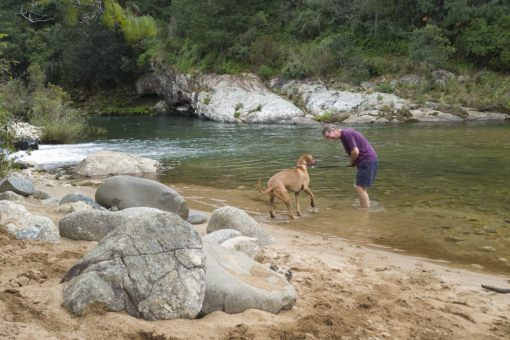
That’s my brother Duncan over from the UK having recently taken voluntary retrenchment. He is 4 years older than me but still has not grown up. He is trying to entice Zak, my Rhodesian Ridgeback, into the frigid but clear Gairezi (or Kairezi) River in the Eastern Highlands of Zimbabwe.

The Gairezi has always been cold and clear and my association with it goes back further than I can remember. It’s situated in the Nyanga area of eastern Zimbabwe where my father as a young man of 25 arrived fresh from war-torn Europe in 1948 looking for a life more promising than the one he’d left behind. As a young ex-serviceman from England he’d been overlooked for a place at university in favor of older ex-servicemen. Fed-up he shipped out to Southern Rhodesia as it was then. He had a diploma in forestry so ended up in Nyanga working for a local land owner. Having met my mother and married her in 1954 I was the 3rd-born in 1959 by which time they’d moved away from the wattle-pole cottage he’d built not far from where this photo was taken.

In my childhood it took us some 1.5 hrs over dusty, rutted and car sickness inducing roads to get back to the plot my mother had bought in 1960 near the valley edge of the Gairezi. The road is still bad – probably worse than those days. We averaged some 8 km/h from the tar road that goes past Troutbeck Hotel.

The Gairezi rises on the slopes of Mt Nyangani, Zimbabwe’s highest mountain. At 2592m ASL it’s not particularly high by world standards but plenty high enough to supply cold, clear water year round. We used to visit the river regularly in school holidays, picnic on the rock in the background and dive into the water. Local legend had it that it was impossible to touch the bottom of the pool below the rock. It was wrong. The last time I dived off it, many years ago, I hit rocks. Not hard but hard enough to get a fright. I didn’t swim this time but that’s because it was winter and not a warm day. Duncan of course did swim but he is English and by his standards it was “not bad once you get used to it”.

In my youth the river and its surrounds were undeveloped save for a fishing cottage in the upper reaches. It is now a bit more developed and there are two cottages available for hire and the proceeds go to the local community in an effort to keep the area pristine. There was no-one else around when we checked in and the cottages and campsite were looking a bit neglected. The appalling state of the road was certainly part of the problem, but Zimbabwe’s dismal economy and matching world image were likely a bigger contributor.

Zak, not that interested in the view.

The next day saw us mount an expedition on Rukotso, a high point on the World’s View escarpment – well off the beaten track even in good times. The road was so bad even a moderately fit person could have walked it quicker than we drove it but the view was well worth the bone-numbing drive. I’m not sure if Zak (pictured) appreciated the view but he was certainly keen to investigate the skeleton of a cow that had somehow managed to lodge itself very close to the precipitous edge. I have flown over this feature a number of times on my paraglider, usually in competitions that we held regularly in the early 2000s. Those are now just fond memories as we lost our membership to the international regulatory body because of non-payment of our subscription. We just couldn’t afford it any longer. South African pilots were no longer interested in competitions that didn’t help their international ranking and the local pilots have dispersed.

Looking north from Rukotso to Nyangui on the skyline

Who can remember using one of these?

I guess a few readers of this blog might recognise this old style phone in the cottage we rented. Very few will know just how it worked. It was on what was called a party line; several households shared the same line but only two parties could talk at any one time. This could be especially irritating if there were chatterboxes on the line and one had urgent business. Pressing the white button to check if the line was free would elicit an engaged tone. We had one like this on the forest estate where I grew up but it was only years later that I was shown how to break into a conversation by opening the base of the phone and pressing a solenoid switch. I only ever saw them in rural areas. This one didn’t work – there was a cellphone tower about 1km away.

One evening we decided to treat ourselves to dinner at the nearby Troutbeck hotel. It wasn’t a problem getting a table even though there was a conference on at the time. The meal was not good. It must be difficult to remain inspired with a lack of customers – 2 other hotels in the area have closed recently. The Inn on the Rupurara has recently closed and its sister hotel, Pine Tree Inn, is in the process of closing. No, the tourist trade is not looking good.

View south from the Vumba cottage. Tsetsera mountains on the right, Chimanimani mountains centre horizon. Mozambique on the left.

The following week we were south of Nyanga in the Vumba mountains. Despite going to school in the nearby town of Mutare I spent little time in this area despite it being just as scenic in its own way. With my sister-in-law and youngest nephew in tow we rented a cottage near to the majestic but very quiet Leopard Rock Hotel. Unlike Troutbeck Hotel the food was so good we went back for a second supper and were the sole guests on both occasions. The staff were charming and told us that a lot of the grounds and golf course staff have been laid off. Several staff we spoke to had quite respectable golf handicaps – they are allowed to play free as time allows which seems to be quite often.

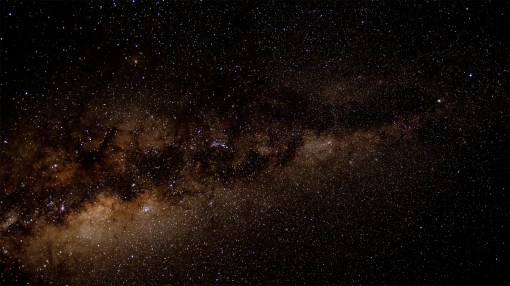
The Milky Way in the direction of Scorpius

The night skies were clear before the start of the dry season fires so I had a chance to try a bit of star photography.

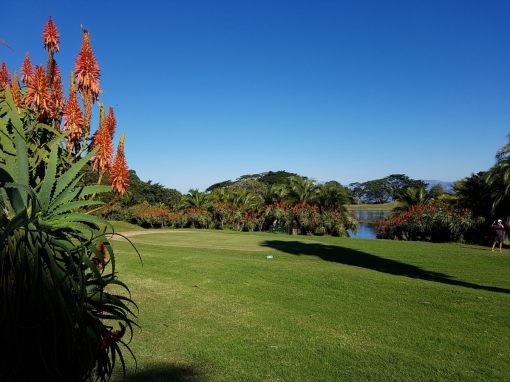
The 18 hole, world quality, golf course at Leopard Rock was deserted.

We also took a day to visit the house where we grew up on the forest estate north of Penhalonga. It wasn’t how either of us remembered it but that’s often the case when one has fond memories of a privileged childhood. The house was little changed and the huge fig tree we scrambled around in was still huge but the garden was not the labour of love my parents made it.

Back in Harare we managed to squeeze in an afternoon visit to the Wild is Life wildlife refuge near the Harare airport. They have a policy of reintroducing back to the wild as much of the game that comes their way as possible.

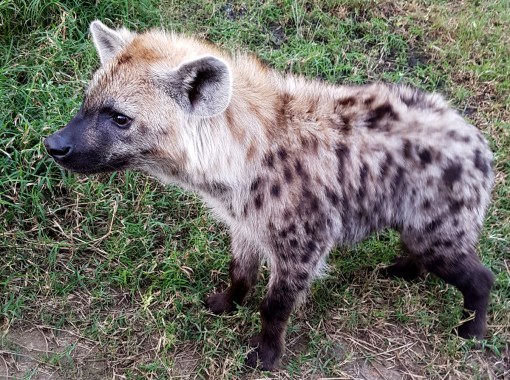
Harry the hyena, yes genuinely cute and very curious!

Some, such as Harry the hyena, will be forever captive.

Few people will ever see a pangolin in the wild. A wildlife guide I know who has been in the business for over 30 years has only seen 3 so I was fascinated to see one up close. Gentle creatures, they have only us to fear and like the rhinoceros’ horn their scales which make them so attractive to traders are made of keratin. So for the sake of the same material of which our fingernails are made they may well go extinct.

So take the time off to visit Wild is Life, it really is worth a visit and a little corner of hope in this sad country that I call home.

The pangolin. The world’s most trafficked mammal.

Bliss is – your own 2 litres of milk!


A good season (for rain)

16 02 2017

It’s been a good rainy season and nowhere more so than Nyanga in the eastern highlands of Zimbabwe.

worldsview

Pretty view but no flying

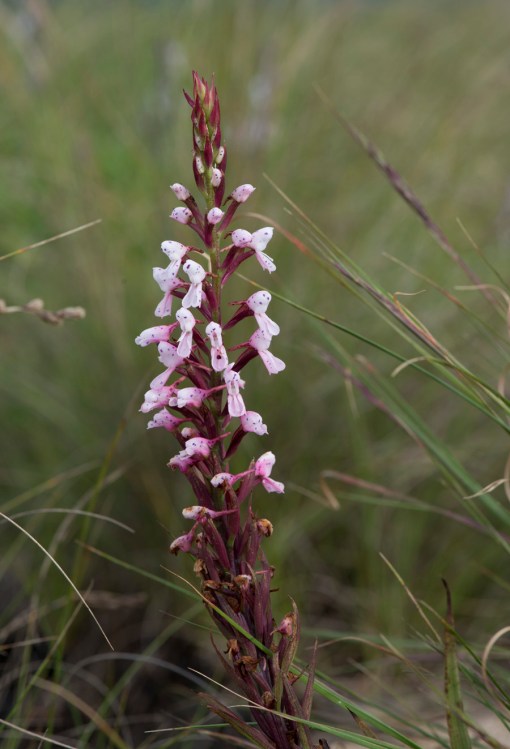
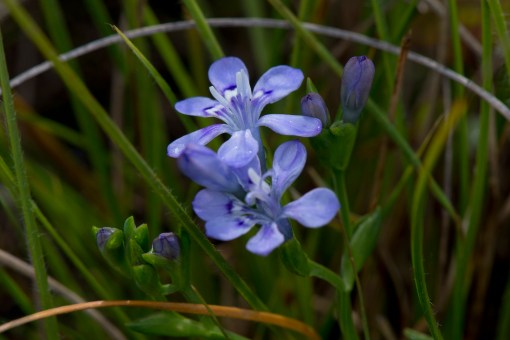
Home to Mt Nyangani, Zimbabwe’s highest mountain, it is a magnet for rain. In the season of 1980 I was a patient at Tsanga Lodge military rehabilitation centre and there was much delight when the season’s total topped 2000mm. I have no idea what it has been this season but it was certainly too wet over the past 3 days to try any paragliding. We did manage to get around a bit and there were flowers out and cattle that got a bit close for Zak’s liking.

zakandjune

Zak snuggles up


zaktop

Hmm, do those cattle need chasing?

pinkflower

Pink flower

Blue flower

Blue flower


Global Warming

6 11 2010

Early season storms in Zimbabwe can be ferocious; lots of lightening, wind and often hail without a lot of rain. This season’s storms have been unusually savage. Last night I was sitting on the verandah and I could hear the gust front approaching. It was not long before the power went off, came back on and then went off until around midday today.

The various global warming models have predicted that weather will become more extreme. Whether the ferocity of the recently experienced storms is anything to do with this would be very difficult to say but I cannot help but think that the appalling bush fires of the dry season are not helping the situation. Burnt veld of course is darker than grassed veld and therefore heats up a lot more.

In Zimbabwe dollar days we actually paid a carbon tax based on the size of the car engine of the vehicle we used. It had nothing to do with CO2 emissions or any sort of remedial action on the pollution – it was just another tax. It may even still exist for foreigners bringing their cars into the country but we found that the disc that had to be displayed on the windscreen as proof of payment was easily forged with a scanner and a bit of image processing so it did not last long. Maybe the Greeks could learn a thing or two about tax evasion from us!

Last weekend I took the Landcruiser up to Nyanga to get away from the heat and work. I did not give a lot of thought to the CO2 footprint I was generating. Paragliding was off the cards due to the storms around but I still managed to get a few good photos of flowers, this being the flower season. On the way back I went through the tail end of a storm near Juliasdale that had dumped a sizeable amount of hail on shade cloth covering a Hypericum crop and another near Ruwa that slowed traffic considerably.


Hiatus

20 08 2010

I have been uninspired since Jenni’s death. It’s not that I haven’t been writing, on the contrary, I filled 21 pages of my diary with my memories of her, but it’s private stuff that I won’t be posting here. I just can’t seem to find much to write about.

We actually managed to get a group of pilots together for the long weekend this month and head up to Nyanga. It was to be my first flying since the neck op in March and I was not at all sure that my right arm would cope as it is so much weaker than before. The Sunday we all went off to the Honde site (east facing) which is spectacular enough, overlooking the Honde Valley into Mozambique. I was too nervous to fly at midday but by the afternoon when I’d plucked up courage the wind had dropped to nearly nothing and it wasn’t worth the effort. Still, it was nice to chill with flying buddies in the evening and drink a beer and talk the usual pilot talk.

It was westerly on Monday and we waited around at World’s View. Pete and Manu offered to get me off the hill and after more than a bit of dithering on my part I got a clean, easy launch and headed out to find a thermal. The previous inexperienced pilot had missed all available thermals and sunk out to the “turkey patch” without ever getting above take off. I headed away from the takeoff and soon picked up a nice thermal that took me nearly 1000m above take off and the flight was on. It was quite emotional for me; Jenni should have been with me and a good friend, Trevor Ambrose had died suddenly early on Sunday morning in Harare. But I settled into the flight and enjoyed the smooth relatively strong climbs and landed 1.5hrs later at the National Parks grid into the park. A very slow flight but enjoyable..

Last week I had to go to Jo’burg for a follow up consultation with the surgeon who did my neck op. Setting the alarm at 04h15 I got to the airport by 05h30 only to find I was the first in the queue. I still managed to be last onto the plane which was fully booked.

I’d plenty of time to do my own thing so after sorting out a bit of business I looked up Cheryl whom I’d contacted about getting another Rhodesian Ridgeback dog. She’s a breeder in Edenvale and invited me around the next day to see a bitch she was thinking of rehoming due to some breeding difficulties with her – she was also being bullied by the other dogs. I knew I was being assessed but had taken the precaution of directing her to Jenni’s album on my Facebook page. We got on well and she introduced me to Kharma, a young, very gentle bitch who is a quite different build from Jenni but a similar temperament. It took a while but Cheryl eventually agreed that I could have Kharma (I’d pay for her to fly up to Harare – a road trip would be too risky).

I saw the doctor that afternoon and he pronounced himself satisfied with the result. I didn’t point out that the right arm was still not up to the functionality it had before the op.

On Tuesday I went past the Department of Livestock and Veterinary Services to see if I could get an import licence for Kharma. I’d been alerted that there was a ban on all animal and animal products into Zimbabwe from South Africa but an internet search revealed it was all about protecting local industry rather than preventing Rift Valley Fever getting in. There was a poster up on the wall informing all that there was a total ban on the import of animals and animal products from South Africa. But I asked anyway. No, there was no ban, it had been lifted. Yes! I was too elated to bother pointing the poster out.

I should have picked the permit up today but did not go that way. So it will have to be Monday. There is no rush, Kharma only flies up in 2 weeks – I think Cheryl is getting a bit possessive! That’s a good sign.


Els

5 04 2010

Now in her 74th year, Els is still a strikingly good looking woman. By her own admission she likes to talk but I suspected that she was also lonely and she’d certainly had an interesting life so I just sat back and listened. I’d taken a small present of a digital camera and a wind-up torch that Sybille had left over to her riding school on Saturday and I’d nothing else to do.

In the early 1970s she came out from Holland to what was then Rhodesia to stay with a friend in the Nyanga area and at a function met her future husband. Two months later they were married and moved onto his remote farm in Nyanga North, some 35km north of the village of the same name. A thoroughly resourceful woman she set about fixing up the run down homestead and raising a family in what she described as the happiest time of her life – her children had free range of the farm and she felt very comfortable out in the bush (“…the silence, oh the silence was marvellous!”).

My father and mother met in the same area also having come out from Europe (though some 20 years previously) so we enjoyed chatting about some of the characters in the area though they were a generation earlier than me. There was Major Mac (McIllwaine) who could always be found by the fire in the reception area of Troutbeck Hotel. Legend has it that the fire has never gone out and Els remembered that he could never remember her name either. There were also the Wyrley-Birches, one of the white pioneer families of the area in whose first house running water meant the stream through the middle of the house. My father (who’d known them well) once told me that when a favourite dog died Colonel Wyrley (as he was known) would have the dog skinned and the skin put on the back of  a chair in the lounge. I didn’t believe him, my father loved to tease, but I remember a particular visit as a teenager to their house below Mt Inyangani and sure enough, there was a retriever type skin on the back of a sofa!

As the war in Rhodesia escalated Els and her family had to move off their farm and her husband got a job at the Clairmont Estate near Juliasdale, south of Nyanga village. It all went tragically wrong one afternoon and he was murdered whilst checking up on a potato spraying operation in 1979. Ignoring family pleas to move back to Holland, Els moved to Harare where she established her riding school (she’d worked  and qualified at a riding school in Holland where she’d taught the current Queen Beatrix and has a photo of the young queen on a horse) and where she still is today. She mentioned to me that her eldest son, married with children and working in Holland, was coming back to Zimbabwe as Holland was in his opinion no place to raise children – he missed the space in Zimbabwe. Els grew up in a house which had no garden and she was not allowed to keep pets. We sat on her verandah and admired the tortoise lumbering across the lawn and the 80 m or so of garden to the gate that was out of site.

Yes, despite all it’s problems Zimbabwe can still be a great place to live – if you have a reliable income! Harare probably has one of the best climates of a capital city anywhere – it is seldom more than 35 degrees C and rarely goes below 10 and then only at night. Crime by South African standards is very low, most people are very friendly and there are still fascinating people like Els to talk to!


Nyanga Odyssey

26 10 2009

I am sitting typing this at 2200m in what is possibly the highest holiday cottage in Zimbabwe. It belongs to a mate who is only too happy to get people to use it. I am in the guest “house” which sits on a very steep edge of the World’s View escarpment and when the air is clear it is possible to see 100km quite easily. It was clear this morning but now it is very hazy again.

It is always cool up here, sometimes very cold, but that’s in winter. Now it’s the end of October, sometimes called the “suicide month” because of the oppressive heat at lower altitudes so it’s a relief to get up here. I left Harare and took a leisurely drive up, stopping to photograph some wild flowers by Headlands. It was an easy trip, the Landcruiser performed flawlessly with its “new” turbo charged engine – this was after all an excuse to test it within the warranty period. In Rusape I was stopped at a police roadblock and after the usual greetings the older policeman said “Have you just come from Salisbury?” grinning hugely (there was a momentary pause before “Salisbury” as he sought the long disused name). “No” I said, “I have come from Harare, it has not been Salisbury for some 30 years!”. For some reason this was a huge joke and I was bid safe travels.

Jenni on the World's View escarpment

Jenni on the World's View escarpment

Taking Jenni for a run yesterday evening she revelled in the cool air and spent a fair bit of time looking over her shoulder wondering why I was being so slow (a very bad road). The wind picked up and soon it was rather cold and last night was spent listening to the wind moan about the roof.

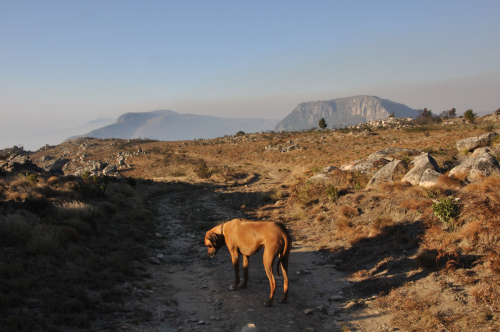
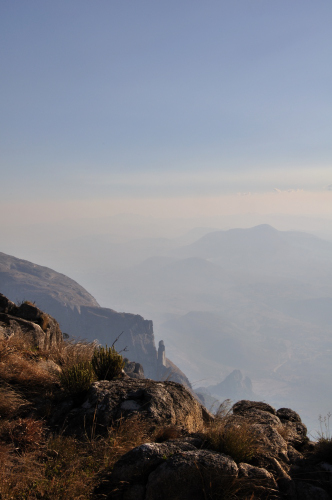
Behind the house to the south is a massive granite rock slope that drops off to the Nyanga village some 700m lower. It’s just begging for photos with boulders, lichen, aloes and at other times of year, flowers. I spent a happy hour or more this morning while the sun was still low, taking photos and daydreaming. Some company would have been nice (Jenni is an uncooperative model and let’s face it; a doggy expression is a doggy expression!).

Looking south towards Nyanga village

Looking south towards Nyanga village

The only property I own is a half share in a 10ha plot on the northern flank of Mt Nyangani, Zimbabwe’s highest mountain. My mother bought is for some 600 pounds in 1960 (way over priced) with the intention of using it as a retirement property (she apparently had more money than my father!). It became obvious that it was just too far out of the way to be practical and what with the deteriorating security situation the only investment they made was to plant a few thousand eucalypt trees of varying species.  I had not been there for several years so this morning I set off. It took and hour of appalling roads that have had no pretence of maintenance for the time I have been away. I was surprised to find the km long track down to the property quite passable for a high clearance vehicle. On the way I stopped to chat to a personable black man who has set himself up on the southern boundary. Cephas claims to have known my father and also remembered my mother visiting in her small white sedan. Thinking it good sense to have a good neighbour I bought 2 litres of honey off him – it smelt really good but I think I’ll resieve it when I get home to get the bee parts out!

The plot is now almost entirely covered by trees. Most are still the original and are now giants of some 50m or more. They are too big to harvest safely and even then the transport costs will eat up any profit margin for the timber. We scattered some of my parents ashes at the place where we used to picnic as a family so I was a bit emotional as I reflected on two lives that ended way too prematurely; my father murdered in 1978 and my mother from misdiagnosed melanoma in 1992. I have no idea what I will do with the property. The other partner lives in Europe, I have no progeny and I don’t see any chance of developing it any time soon; it will still be out on a limb no matter what the political situation of Zimbabwe.

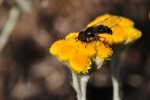
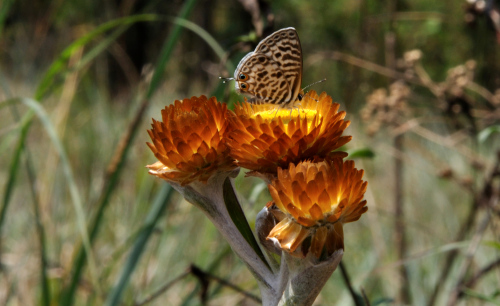
Butterfly on Helichrysum ("Everlasting")

Butterfly on Helichrysum ("Everlasting")

Part of the property where I am staying burned down last year. Derelict buildings are just loaded with photo opportunities and I have been watching the sun move down a rather photogenic wall while I type this. I must go and check it out.


Getting Away

26 05 2009

It’s been nearly two years since I logged a flight so I was rather nervous on takeoff. Still, the Honde is a forgiving site and with a bit of help I was soon airborne and able to enjoy the amazing vistas of the valley to the east and the Mozambique plains. It was even more important to get away to a stunning part of the country that I’d negelected for too long and enjoy the company of a group of great like-minded friends.