
That the borehole motor was burnt was obvious. The metal casing was blue, there was oil in the water and it wasn’t pumping water. But the reason? The borehole in question has given me endless trouble. It has gone through more than a few motors over the years. We thought we’d finally got it solved last year when it became evident that the old steel borehole casing had rusted away and was collapsing and dumping mud into the pump. It was re-lined with a PVC liner, the pump and motor replaced and I thought our worries were over for the foreseeable future. I was wrong.
Marianne suggested I try contacting Allan, listed on my phone as “Borehole Repair Recommended”. When I described the problem he was straight forward – “Is the pump protected against running dry?” When I answered in the negative he said “That’s your problem. The pump controller you have installed does recognize when the pump is dry but it doesn’t work that well and the pump inevitably cooks. At this time of year (it’s winter and the dry season) the water levels drop and the pumps inevitably run dry. Get yourself a smart controller with liquid level detection and your problems will be over”.
There’s a irrigation equipment supplier close to my business so I paid them a visit to get a new motor and whilst there asked if they had an intelligent controller. Whilst perusing the manual I noticed Nathan, a plumber, who’d done the plumbing on our new on-suite bathroom, was also there. When he heard what I was looking for he recommended going to a nearby hardware store for the controller – “I have personal experience with them and I know they work” he added. I took his advice and installed the new pump and controller and, after decoding the bad Chinese English in the manual, managed to get everything working.
A mere two weeks later Fabian (one of the foremen who does the maintenance amongst other tasks) came to me with a long face and reported that another borehole had stopped working. I told him to get the pump and motor up and sure enough, the motor had all of the characteristics of being burnt. Another trip to the supplier, more cash changed hands, and this time I came away with a replacement motor and two intelligent controllers – including one for the third borehole that I was hoping to preempt the motor burning out.
It all seemed straight forward at first – after all we’ve had plenty of practice at getting borehole pumps and motors up and changed. This one was no different but the intelligent controller just wouldn’t cooperate. The motor drew current like it was working but nothing else happened. Allan was mystified – “I’ve never had a problem like that” so I just had to take a deep breath and book one of his teams to come out this Friday and have a look.
Driving back from work at lunch time I took a more scenic route than usual past the old Mount Pleasant golf course. It hasn’t been used for that purpose for many years now and is largely over grown. It’s not prime development land being low lying and very wet in the rainy season so is untouched – for now. Houses adjoining the area seem to have good ground water and sprinklers were merrily whirring over verdant verges oblivious to (or ignoring) the Harare City Council’s directive that it’s illegal to do so for, make no mistake, Harare is running dry.
Harare’s main water supply is Lake Chivero to the south-west of the city. It is downstream and it doesn’t take a lot of imagination to grasp the scale of the pollution. It’s nothing new, as an eight year-old child I attended a sailing school on the reservoir and can remember a deep revulsion of the state of the water. It recently made headlines when four rhino and various other animals at a lakeside national park were killed by the polluted water. Very little of the available water in the lake now makes it’s way into the Harare water supply. It requires pumping and there’s seldom power to do that and the water purification works have long ago fallen into disrepair. So in true Zimbabwean fashion we’ve had to “make a plan” – usually in the form of having a borehole drilled. That of course is no guarantee that it will not be dry (and most are) but for those of us lucky enough it can be a massive relief and money saver. The unlucky majority have to rely on the burgeoning water supply business and at US$50 for 5,000 litres it isn’t cheap. Water tankers are ubiquitous on the streets and come in all shapes and sizes. Some are made for the purpose but most are just plastic tanks strapped onto disheveled trucks. They source their water from outside the city limits.
Nathan is succinct – “Harare will run dry in five years at the most”. We are luckier than most in having a working borehole but it is not prolific. Tested at 1,000 litres per hour we don’t push our luck and the lawn dies off in the dry season. This year we’ve pumped the swimming pool dry (it’s filled with rainwater runoff collected off the roof) so that we can get the leaks fixed and the pool tiled. Grey water from the kitchen and shower is collected and used on the garden too. We keep our fingers crossed and try to balance having a nice garden without having to recourse to buying in water.
That there is no interest on the part of the government in changing the situation is best summarized in a conversation I had with Anton, my personal trainer, at a nearby gym. His wife, also a person trainer, used to have the Egyptian ambassador as a client. She, the ambassador, told Anton’s wife that Egypt had offered to completely rebuild the water treatment works at Lake Chivero. It would have been a gift from Egypt to Zimbabwe. The Zimbabwean government turned it down; there was nothing in it for them. The ambassador commented that she’d worked in a number of African countries but had never encountered one in which the government cared less for it’s people.

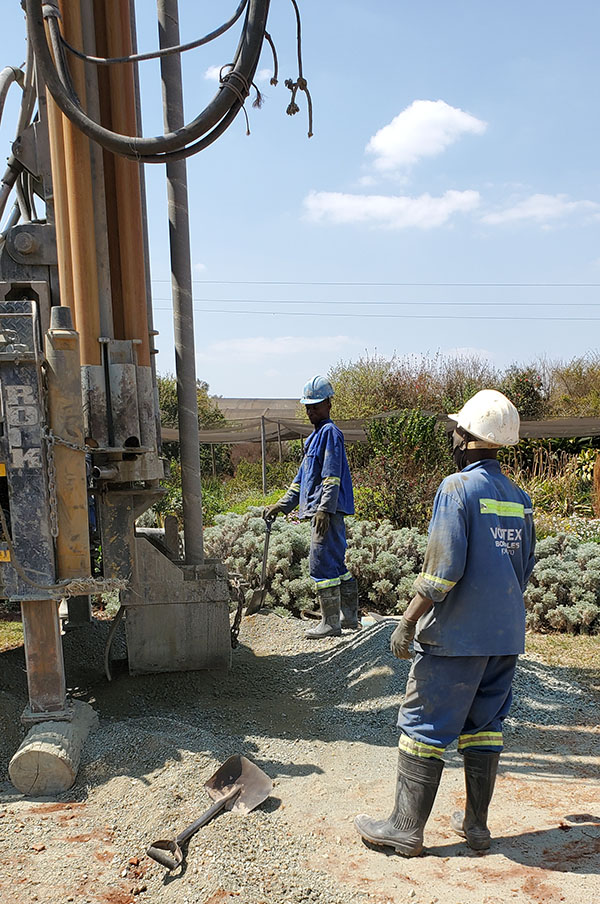


Running on empty – almost
31 10 2026Harare is running out of water. Municipal water supply in the suburbs is a best sporadic and a trickle. We leave a pipe from the lonely municipal supply tap into the swimming pool and it trickles in and just about keeps pace with evaporation. While it isn’t obviously polluted I wouldn’t be tempted to use it for anything except the pool and the garden.
Five years ago we got the water diviner in to site another borehole. The original hole had eventually run dry and buying in 5,000 litres of water twice a week was expensive. To be fair the diviner used both his bent brazing rods to divine then the science (electrodes and a sensor) and both indicated a new site which would not be prolific but should be reliable. The decision to go ahead was made and the drilling started. Breaks (water sources) were hit in three places around 40m and we told them to keep drilling. At 100m we called it a day – no more breaks had been found but what we had yielded at 1,000 litres per hour. Good enough for domestic purposes and keeping the flower beds and pots going. The lawn would have to look after itself.
The last two rainy seasons in Harare have been under the average despite being la Niña years. Parts of Zimbabwe did get heavy rains but they were very patchy. The borehole yield started to drop. We know this because the amps on the pump control box drops below six after an hour or so pumping, indicating the pump is starting to suck air.
We cannot just blame the sub-normal rains. There has been a lot of wetland development over the past several years. What rain falls now largely runs off instead of soaking in and replenishing the ground water. Whilst there are laws regulating development on wetlands they are now routinely flouted with the help of backhanders to the licensing authorities. It doesn’t help that there is now an official policy of condensing the urban population so formerly spacious one acre (and smaller) plots are being bought up and developed into high density cluster homes. Chinese are frequently behind this and will pay in cash – who in their right minds would refuse a suitcase of US$100 notes? Whilst the suburb in which we live has largely been spared, developers are starting to turn their attention to it and already construction has started on a plot five away from us.
We got into a routine of running the borehole for an hour in the morning and another in the afternoon. It seemed to cope. One morning last week I turned it on for an hour at breakfast time and then the gardener turned it on again without asking at 11. When I chanced to look at the amps when passing it read zero! Panic, the pump had run dry and over-heated the motor – it had cooked. A borehole specialist was called in. The good news was the motor was OK but the pipe in the hole had split due to being the wrong gauge and the power cable was too light for the power of the motor – 750W. It would all need replacing and in the meantime we only had the swimming pool as a supply.
Back in the early 1990s when working as a farm manager in the Chinhoyi area north west of Harare I was warned that a great way to start a nasty fight was to dispute water rights. Family, best friends – it could all turn nasty if water was at stake. Zimbabwe even has a water court to settle disputes and determine water rights.
The tenant in our cottage is not an easy person to get along with. We started out well so Marianne gave her a three year lease but since then she has become very demanding despite the lease agreement being specific on issues such as water usage. She is also a self-proclaimed expert on just about everything including solar power and, of course, boreholes. This means that I’ve been told that there’s plenty of water in the borehole, we won’t have to buy in water and the borehole will recover in the rains. This despite the presence of one of the strongest el Niños on record which inevitably means poor rains! Our relationship is fractious at best.
The borehole motor, pump and pipe (we used a smaller motor so the cable was still good to use) have been replaced and a smart controller installed that lets us calculate water flow into the hole – it’s about 80 litres an hour. It’s just a case of when it will run dry, not if. Then, like the majority of households in this city, we will have to rely on bought water of unknown quality – at the beginning of the year I spotted a water tanker filling from a roadside puddle. Quite where it will all come from I have no idea. Of course the current price of US$60 for 5,000 litres will soar and a sizeable proportion of those with good boreholes will continue to advertise it by watering the grass verges outside their property. The City Council has stated that this is illegal but who cares? Nobody seems to be checking and after all, they can be “persuaded” to turn a blind eye.
Comments : Leave a Comment »
Tags: Harare, el Nino, rains, climate change, la Nina, boreholes, domestic water, water quality, water
Categories : Blogroll, Environment, News & Various, Social commentary, weather