Dawn breaking on ART farm – it was colder than it looks!
The car thermometer read 10C but I was determined to get the photograph that I’d seen on several early morning trips to walk the dogs on ART farm on the northern boundary of Harare. There was nothing for it but to just put up with the cold. Yes, it’s winter here in the southern hemisphere and we expect it to get cold, with the occasional frost in low-lying areas, but this winter has been unusually warm during the day.
We get our rains in our summer and this last season was marked by an El Niño event in the south Pacific Ocean (unusually warm temperatures) which kept the Inter-tropical Convergence Zone (ITCZ), the source of most of our summer rain, well to the north over Kenya and Tanzania. Zimbabwe went dry and consequently hungry. Most of the staple crop of maize grown in the country is rain-dependent and there was widespread crop failure. Farmers desperate to sell their cattle while they were marketable, swamped the abattoirs who eventually refused to buy any more. I’m told by my commercial farmer customers that what maize has been grown has been subject to widespread theft.
Droughts are nothing new in this part of the world – in 1992 when I was living in the east of the country we had a similar one and I took the photo below near where I was living. The next year the rains returned and the grazing recovered.
Not the sort of temperatures we expect to have in what is usually the coldest time of the year
From my business’ point of view I am not complaining – the warmer temperatures help us to get the seedlings through the nursery quicker and reduce costs. We really do need the prospect of a good wet season though as we rely entirely on boreholes for our water supply and despite the La Niña event of 2020 to 2022 we didn’t get the good rains the rest of the country experienced so they will need replenishing.
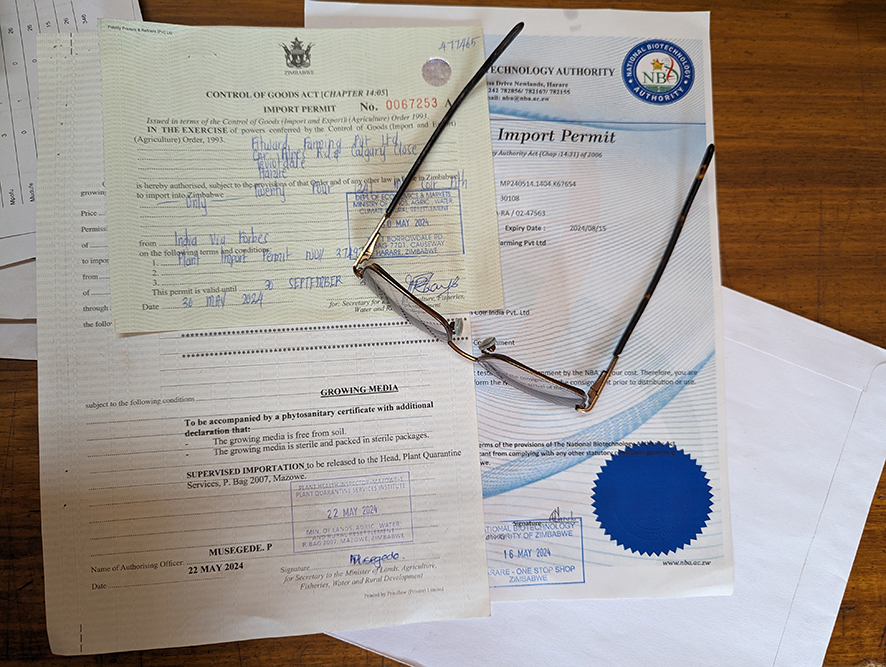
Just part of the paperwork necessary to import the coir pith essential to my business
It’s not something I look forward to but the coir pith on which my nursery depends for growing seedlings is essential for a good product. Yes, another substrate – composted pine bark – is available locally but last time I tried it some 20% of my seedlings died from the disease it carried. So about once a year I just have to grit my teeth and jump through the bureaucratic hoops. To be fair it IS becoming a bit easier as more of the government agencies involved get online and organized.
First off is the Agricultural Marketing Authority. I have no idea what they do but membership is essential and nothing else is achievable without it. Fortunately it’s doable online. Then it was on to the National Biotechnology Authority to get a permit that acknowledged the import was free of GMOs. The Indian supplier had given me a certificate stating as much and though it didn’t look very authoritative to me, it was sufficient and upon receipt of the required payment the local certificate was duly issued.
I have done the Ministry of Agriculture for the importation permits before and found it beyond tedious so sent Fabian, one of my senior staff, down there with some smaller US dollar note and instructions to “do whatever it takes” to get the first certificate. It cost him five dollars to put in the application whilst the official concerned was “on lunch break” and then all I could do was wait.
Fortunately the container was being delayed en route from Sri Lanka. I have no idea why it had to go via Colombo but I guess getting a full cargo of containers to warrant a ship going into the port of Beira in Mozambique takes some organizing. That was just as well as the first permit took two weeks, the date stamp indicated it had been sitting on an office desk for one of those weeks, and the second permit took another 10 days. That also required a sweetener of a few dollars.
By this stage I’d already paid the port and transport fees, all US dollars, and the race was on to get the local documentation to the border post near Mutare in the east of Zimbabwe before the truck from Beira got there. If we were late demurrage would be charged and I’d experienced that to my cost before. Fortunately my local shipping agent seems to know a lot of people and he got the money there just in time.
Then it was just a case of waiting for the truck to arrive and organizing a forklift to offload the pallets. It was three weeks late and in the interim I’d had to buy two pallets from another local supplier who’d marked up his prices 100% (he vehemently denied this even when I told him I new what it cost) but at least it’s over for about another year.
Now that the final accounts are in I can see that the costs were close to last year. The total for 24 tonnes of coir was US$19,650 which works out to 81.8c per kg. For some strange reason my bank needed to pay for the coir in Euros, I have no idea why but I do know that payment had to go through a South African bank. The rest was all payable in US dollars, none of the Zimbabwean kind thank you very much.
Yes, Zimbabwe is still trying to get its own currency up and running. It’s called the ZiG which is not the name of a cartoon character’s best buddy but is short for “Zimbabwe Gold”. It’s apparently linked to gold bullion of which the Reserve Bank is holding. Nobody is actually sure if this is the case but the official rate is around 13.8 to the US dollar.
When the ZiG was first introduced the obvious happened; currency traders spotted a good thing and the rate soon began to run. The government got tough and threatened a US$10,000 fine for any company or person not using the official rate – by law you have to accept either the ZiG or the US dollar if that’s how a customer wants to pay, the one exception being fuel traders who are not obliged to accept ZiG. Fortunately for my business most customers are uninterested in using local currency and choose to pay in US dollars, usually using cash. The local currency received has been entirely electronic – I’m not sure if this is by design – and I have yet to see any local notes. It is certainly not difficult to get US dollar notes out of my local bank and even small denominations are often brand new and in their 100 notes wrappers.
The country’s roads are in a disastrous state at the moment, bearing witness to years of neglect, but there’s a regional conference of the SADC (Southern African Development Community) in August so there’s been an orgy of road repair in Harare during the last few months. Construction teams have been called back to Harare from the outlying projects to concentrate on the local roads. Chaos has ensued as roads are closed and heavy traffic routed through the suburbs.
Some actions are unsurprising, others beggar belief. People living along the main route to the new Chinese-built parliament house where it’s all going to happen have been offered free water, delivered by tanker, to help make their gardens look pretty for visiting dignitaries.
The new dual carriageway to the parliament is being lined with kerb stones that make sure that there is nowhere to pull off the road if one has a breakdown. A local farmer, who lives on the route, pointed this out to one of the construction teams and was assured that it was a temporary arrangement and all the kerb stones would be removed after the conference. We’ll see.
A new bridge has gone in over a small river. They haven’t finished casting all the concrete and I’m told it takes a month to cure but the conference is in less than a month. Interesting.
An obvious question is where has the government suddenly found all the money? Are the construction companies actually being paid and what currency are they using? A friend is heavily involved in the landscaping of the new parliament and Marianne tells me she is being paid in US dollars and is doing quite well from it but rumours abound as to whether the others involved have been paid. I have heard that one company was owed some US$200 million which seems a bit much but many years ago I was told that a normal road costs US$ 1 million per kilometer to construct so perhaps it’s possible. Whatever the truth is you can bet the government will do whatever it takes to get the roads done and put up a paper-thin facade for the visiting dignitaries.
The nations hospitals would certainly like a bit of money themselves; currently several of the bigger ones are owed in excess of ZiG11 billion – a lot of money in any currency.
Caity and the Land Cruiser – the ‘Cruiser is older by 10 years!
The Land Cruiser is a HJ60 model and to quote Chatbot AI: “The Toyota Land Cruiser HJ60 is a model of the legendary Toyota Land Cruiser series. The HJ60 was part of the 60 series Land Cruisers produced by Toyota, which were known for their ruggedness, reliability and off road capabilities.”
“The HJ60 specifically was equipped with a 4.0 liter in line-six diesel engine, which was known for its durability and fuel efficiency. It was produced in the 1980s and was popular for its performance both on and off the road. The Land Cruiser HJ60 was well-regarded for its robust build quality, making a favorite among off-road enthusiasts and those looking for a dependable utility vehicle.”
“The Land Cruiser HJ60 has since gained a cult following from its classic design and reputation for being virtually indestructible. It remains a sought-after vehicle for those who appreciate its ruggedness and timeless appeal.”
I bought my HJ60 some 14 years ago wanting to learn more about vehicle mechanics and ended up with a lot more issues than I’d bargained for. It was soon evident that the engine needed a lot of attention so I copied a DIY manual from a friend and got to work. The engine came apart and the block was sent off to have new cylinder liners (the very hard steel tubes that line the cylinders) fitted. The block came back and after putting it all together, it was with a great deal of satisfaction that it all worked, albeit with some minor tuning.
It didn’t last long, about 2,000 km. The engine stopped suddenly and after taking the cylinder head off it was evident that the liners had been badly fitted – number six had broken and been smashed into the crankshaft and all the others had cracks around the top. So the Land Cruiser sat for two years waiting for my sense of humour to recover.
“I have two second-hand engines from Japan sitting in town, do you want one?” Mark said over the phone. “One is regularly aspirated and the other is the turbo-charged 12HT, but it’s a bit more expensive” he added. By the time I’d made up my mind only the turbo-charged model was left so I went for that.
It turned out to be a fortuitous bit of dithering on my part. Mark, who is a 4×4 enthusiast and competent mechanic, fitted the engine and I’ve had a great, powerful, vehicle ever since. She’s been fitted with a long range fuel tank, Honda Fit intimidating bull-bars and a good sound system and a two tone paint job. I haven’t driven her for some years as she has a manual gear-box and I lack the capacity to use a clutch but Marianne, my wife, loves driving her.
She no longer does long trips and recently we decided to send her off to a local mechanic, who likes older vehicles, for a good going-over. “What a marvelous vehicle” Adam enthused when he returned her. “If you ever think of selling her, please let me know”.
As a disabled person I can get an automatic vehicle duty-free every five years. My Ford pickup is now six years old so I can get another (it doesn’t have to be new) and I suggested to Marianne that we give it some thought. It makes no sense to keep three vehicles so we’d have to get rid of the ‘Cruiser. “I think we should offer her to Adam first”, Marianne said, “at least we’d know that she was going to a good home!”.
I went to a local second-hand car dealer nearby to discuss the logistics of getting in a vehicle on my disability rebate. I asked him if I would be able to sell my ‘Cruiser. When I mentioned that it was an HJ60 he said “Oh, you’ll have no trouble at all moving it. They are still very much in demand”.
Caity is not a professional model though having done several courses she certainly knows how to pose. I didn’t pay her; she wanted to borrow a drone of mine so we did a deal. Adam’s parting words when he dropped of the ‘Cruiser were, “There you go, she’s good for another 20 years!”. I am sure Caity will still be looking good in 20 years too.
My family has a bit of a chequered history when it comes to longevity. My mother’s family seems to live a long time or much less – there’s no middle ground. My mother died at 67 from cancer, he elder brother in his 70’s from another type of cancer and her oldest brother, Anthony, at 94 from old age. My father was an only child and was murdered at 53. His father is unknown and I have no idea what his mother’s age was when she died. My sister died four years ago at 62.
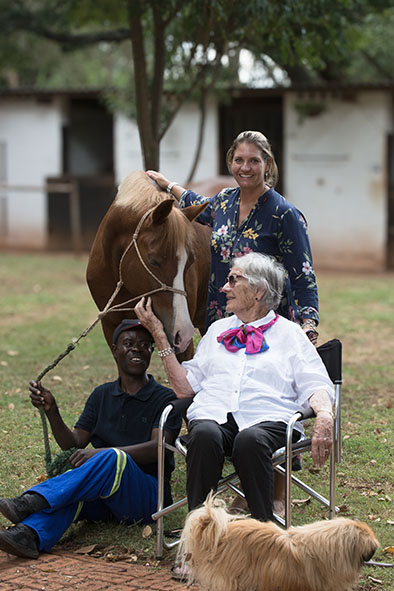
My mother’s younger sister turned 95 on the 4th of April and is in rude health. She still lives by herself (though has domestic servants and a tenant who rents a flat in part of the house) and gets around just fine on two walking sticks, though she doesn’t drive. Her mind is still super-sharp.
Yesterday we had a general gathering at her house to celebrate her birthday. It was a sizeable gathering and the weather co-operated, just. On arriving home Marianne, who’d had emergency work issues to deal with, told me that there had been 38mm of rain which is unusual for April.
Helen has always been passionate about her horses. That’s Kylie, a grandchild standing.
I wouldn’t mind living to 95 if I could be as independent as my aunt; it’s not going to happen. Another 30 years, hmm, I don’t think I want that – just getting up out of a chair requires me to take unnatural concentration. When it comes to the end of her life my aunt confessed to Janine, her daughter, that she wants to “wake up dead”. Don’t we all.
This is Claire. Claire is 78 and still teaching ballet. I am approaching 65 and not remotely as able as she is. Of course I have a few extra physical problems being a paraplegic that make me wonder just what life will be like when I get to 78. I am not looking forward to it though that’s easy to say from the safety of my age. 13 years ago 65 was too far away to be of much concern; that’s not to say I didn’t think about it, I just wasn’t able to envisage what life would be like.
Getting old in Zimbabwe is especially problematic. Nobody is going to look after you if you don’t have the money or children and that’s not a given. The state certainly won’t help. You’d better have made a plan and Marianne and I don’t really have one. We do have a two bedroom cottage in the garden which we rent out and when the time comes we’ll move in there and rent out our house. If, or when (if I live long enough), Marianne or I need care we are going to have to make an uncomfortable decision. I am sort of hoping that I will not live that long but talking about one’s death is easy until it actually looms. Given the state of the driving in Zimbabwe it might well happen sooner rather than later. This afternoon on the way to a function we had to take evasive action after an oncoming pickup truck decided to overtake into our lane.
Marianne went this week to see a potential customer for the medical insurance she sells. An elderly lady with glaucoma, she lives in a rented flat in a nearby retirement complex. The management had told her that she would have to give up her accommodation and move into the frail care section. She was incensed and in the end decided to move to her children in South Africa. At least she had the option.
Old age has a checkered relationship with my family. My father was murdered in the Rhodesian war at 52 (he broke the rules and paid the ultimate price) and my mother died at 67 from a misdiagnosed melanoma. My sister died at 62 but my aunt (mother’s sister) turns 95 next month and is bright as a button and still lives in her own house 25 minutes away with a couple of domestic servants to help her. Her oldest brother lived to be 94 and, while still mentally active, ended his days miserable in a care home in the UK. Her other brother died of cancer in his 70s.
Last year after a series of “seizures” I underwent a battery of medical tests. They showed nothing untoward and the physician held up my results of the neck scans on my blood vessels and remarked; “Well, whatever eventually kills you it won’t be your heart – you have the vascular system of a teenager!”. I wasn’t sure if I was pleased or not. A number of friends over the years have succumbed to heart disease and from what I have heard it’s not a bad way to go. Here one moment, gone the next. Dementia and it’s variations; now that DOES scare me! The seizures, episodes of confusion and disorientation, were eventually put down to post-operative cognitive dysfunction (POCD) which was likely caused by the heavy general anaesthetic I’d received whilst undergoing lower back surgery, as a result of the original war injury, two years ago. The physician told me it could last up to two years.
The two years is up next month and the seizures have continued unabated. They come in clusters every six or eight weeks and can be very worrying. After a particularly intense one where I asked Marianne what the name of one of our dogs was and then couldn’t remember where a computer shop was near a bank I use, I decided it was time to go back to the physician. He listened to my account of the seizures, asked questions, and then said “That sounds a lot like temporal lobe epilepsy and, given the fact that last year’s scans showed up no abnormalities, I don’t have any idea what could have caused it”. I have been prescribed medication but it will take some time to work up to the full dose and then see if it works. Worldwide there are an estimated 50 million sufferers of the condition.
My mobility is dismal. After university I cycled across France, Switzerland and Germany then back to the UK (see Reflections on the first half). Then I went traveling around the world. I needed a walking stick and I could carry my own backpack and was independent. Now I need two walking sticks and if I fall over I struggle to get up again without help. I am very glad I went traveling whilst I could. I have come to accept that I am going to need a wheelchair in the near future. I customer did send me some photos of an electric golf cart which he thought might be useful for me to get around in at work but I thought it over the top.
I was never very concerned about falling over until Karole came to visit me at work recently. She was in the St Giles rehabilitation centre at the same time I was – she’d fallen off a horse and sustained spinal injuries that left her with a disability similar to mine. Having spurned walking sticks for years she now uses one and recounted how getting into her car recently she’d fallen over and fractured a hip. She showed me the X-ray, it was spectacular. It’s made me much more cautious to the point of paranoia which is not helpful.
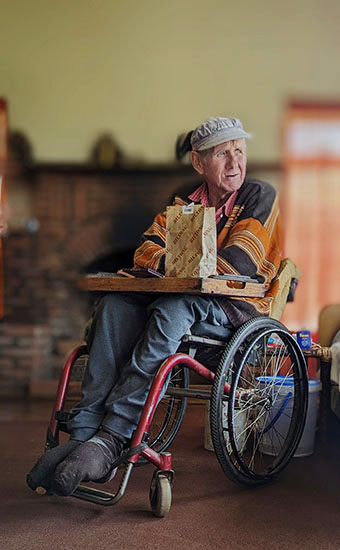
I also met Terry in St Giles. He’d been paralysed in a military parachuting accident and, unlike me, had totally lost the use of his legs. We became good friends and he used to tease me and say that I was just a “weekend para”.
Terry – my paraplegic friend
Also unlike Terry, I don’t suffer constant pain. Some days are bad though and I do remember the pain-free days, but in general I don’t have major issues. I do go to the gym four days a week, two under the supervision of a physiotherapist cum trainer, to try and slow down the rot but that’s all it does. For the moment I will rely on my dog Themba to keep me a bit younger.
“If you come back this way, please come and stay” were Hazel’s parting words as we got into the pickup. She was clearly lonely.
Hazel has been farming by herself for the last 14 years since her husband died. It’s a dairy farm some five km south of the small farming town of Chipinge in the south-east of Zimbabwe and the warm, wet climate is ideal for growing horticultural crops such as macadamia nuts and avocados. We had driven the six hours from Harare, stopping overnight in Mutare, so that I could take part in an avocado field day on a large horticultural estate organized by my business partner. Once the field day was over, I drove back through the town to where I’d left Marianne at Hazel’s farm where we’d booked in overnight.
Hazel’s garden reflecting the lush climate
After a delicious dinner we poured more wine and got down to serious chatting. Hazel and her husband had moved onto the farm in the mid 1970s, newly married and not much to their name. They braved out the Rhodesian (as Zimbabwe was known then) bush war, surviving a rocket attack on the farmhouse. A rocket burst in the room where Hazel was sheltering and the shrapnel peppered everything around her but left her unscathed. Gradually the house grew with a young family. Hazel’s husband, “Duff”, insisted that his children learn the local Ndau language and encouraged his son to explore the local bush with his black friend Johan, who is now Hazel’s senior foreman. “They were given free reign” Hazel said “with the express understanding that whatever they shot they had to eat”.
“Duff never really told me what he did during the war years” Hazel said, “just that they made use of his knowledge of local customs and the language”. Duff had known that they were on a list of targets though, and after independence in 1980 he got a call from the local police station and was informed that they’d arrested someone who had admitted being behind the attack on Duff and Hazel’s house. Duff spoke to the captive and asked him why they were attacked and the reply was just “Hey, it was war, let’s go and have a beer together sometime”.
I asked Hazel if dairy farming was profitable. “No, not really” she replied. The area where she farms does not have a lot of surface water so irrigated pastures are not feasible which requires her to supplement grazing with stock feed which is expensive. The milk she produces goes to a nearby factory as industrial milk. The factory also tests for fat content on which the price is based and she was more than a little suspicious of price manipulation as a result.
Hazel’s farm location
Noticing that Hazel’s farm was close to a safari area and the Mozambique border I asked if she saw much game. “Yes, we are on a migration route” she replied. “Just two weeks ago a local woman was gored by a buffalo. I don’t know if she survived”. Just prior to that two lions were seen, and fearing they’d start preying on local livestock the National Parks authorities decided to have them shot. Hazel asked why they couldn’t be darted and taken back to the Save Conservancy. She was told that unfortunately once they’d learnt a route they’d continue to use it. “It was so sad, they were beautiful young males with just a beginning of a mane” she said.
The next day we left after breakfast. The town of Chipinge has little to recommend it – there are three traffic lights of which only one works and that is mostly ignored, but it did have a fuel station with a brand name we recognized so took the opportunity to fill up with diesel. Then it was onto the winding road on the escarpment that joins up with the road to Chimanimani – a village to the north – and back on the busy road to Harare. We hope Hazel will look us up on her occasional visits to Harare.
The view from the Skyline road junction on the way to Chimanimani
I am starting this while waiting for guests to arrive for lunch – my wife is an inveterate entertainer so needs little excuse to get friends around and of course today is a holiday so that’s what we are doing. Not sure when I’ll get to finish…
It’s an el Niño year so rainfall has been erratic so far; a heavy fall in October and then nothing for six weeks so crops are not looking great for those who don’t have irrigation available. There is a lot of fuss and bother in the various weather groups on various social media platforms whenever rain is forecast and then much soul searching when it doesn’t happen. People forget that forecasting is far more accurate than a few years back, even in this part of the world, and that hey, we get droughts in southern Africa! We have had 3 good years in succession and are due a drought, so all is normal in that respect.
I guess I could be cynical and say that the incompetence and corruption that we see all around us are also just about normal for this part of the world too. The road to my work is being resurfaced as we speak, and we are delighted but I fear there is an ulterior motive. The President has an interest in a housing development out beyond my business, and I think that is a prime motivation. Just by chance it goes past a big rubbish tip project that one of his sons has taken over. It looks like it’s being run properly, now we just need to get the city council to collect our garbage on a regular basis. Roads elsewhere in the city are in a dismal state and it’s not uncommon for local communities to take up the challenge and fill in the potholes on their own initiative.
I have just read in an article in The Economist that Indonesia built 300,000km of roads in the last 10 years. It is of course a vast country, bigger than the USA, but there’s an example here that our government could follow.
Zimbabwe is still in the bizarre situation of having two currencies: our own dollar and the US dollar. The local dollar is treated with contempt by all except the government who have just brought out a proposed budget with LOTS of zeros involved (the street rate for conversion is around 7,000 local dollars to the US dollar – officially it’s 6,000). Various members of parliament refused to vote for the budget to pass unless, amongst other demands, they got new 4×4 Toyota Landcruisers so that they could get over bad roads to visit their constituents. Nobody pointed out that the roads were such a mess in the first place due to the inefficiency and corruption. Fortunately, there were other bad ideas in the proposed budget that were also ditched – an annual tax on houses over a value of US$100,000 being one of them. Who was going to do the valuation was never revealed and quite how they were going to get around bribing the evaluators was not discussed either.
My business plods along. It pays the bills and that’s about all. We are charging less than we were in 2014 largely due to the proliferation of small seedling nurseries around town whose quality is dismal and who almost certainly don’t pay tax and cut a lot of other corners, but we cannot compete with their prices. I suspect a lot of people either don’t know what a quality seedling is or don’t care. Our core customers are commercial farmers and I think most of them do appreciate our commitment to quality – well that’s what one told me last week!
Of greater concern is a building project encompassing two neighboring farms in the form of a giant wall. The farms have been “acquired” by Grace Mugabe, wife of the late president, and word is she wants to have a 700-house project built on the enclosed 400ha. The wall is quite something (it has been nicknamed The Great Wall of Pomona after the area) – it’s not visible from space but is from 5,000m altitude on Google Earth. It is 3m high, has a reinforced concrete core and a course of bricks on the outside and inside. I asked a constructor what it might cost, and he suggested US$300-400 per metre. Given that the whole structure is 9km long that’s at least $27 million! The enclosed area is a rough rectangle but the property on which my business is located is a triangle jutting into the northeast corner. The big question is: what will they do when they get to the triangle, will they go around (an extra 500m), or will the wall cut the triangle off? Grace Mugabe is close to the President so wields disproportionate power and probably could just take the property if she felt like it. Perhaps she will force my landlady to sell the property, so she gets the title deeds? We will find out within the next 3 months or so when the wall will get to our boundary.
Despite the poor performance of the Zimbabwe economy the building sector is booming. Likely it’s due to money laundering. Al Jazeera TV did a documentary series (“Gold Mafia” in 4 parts) on this and explained that gold was being exported illegally, mainly to Dubai, by politically well-connected fat cats who were then bringing the cash back with the tacit approval of the President who is taking a 15% cut. The money is then invested in construction projects. Indeed, the suburbs are thick with construction projects of various descriptions – apartments, shopping centres, restaurants – which are often approved without the consent of residents. One of my cousins is in a street which is fighting the proposed construction of a Chinese restaurant. The Chinese are our friends so it’s almost a given that they will get permission.
We are cursed in this country with a wealth of minerals, especially gold. It’s just about everywhere you care to dig. My brother came out from the UK in October and as part of our travels we took a trip through the village where my mother lived after my father’s death. It was established as a gold mining area at the end of the 19th century. The commercial scale miners have long since moved on but the small-scale miners are everywhere and the place is a rubbish tip. One can only but wonder about the mercury pollution and mining safety. Health and safety are not concepts they care about.
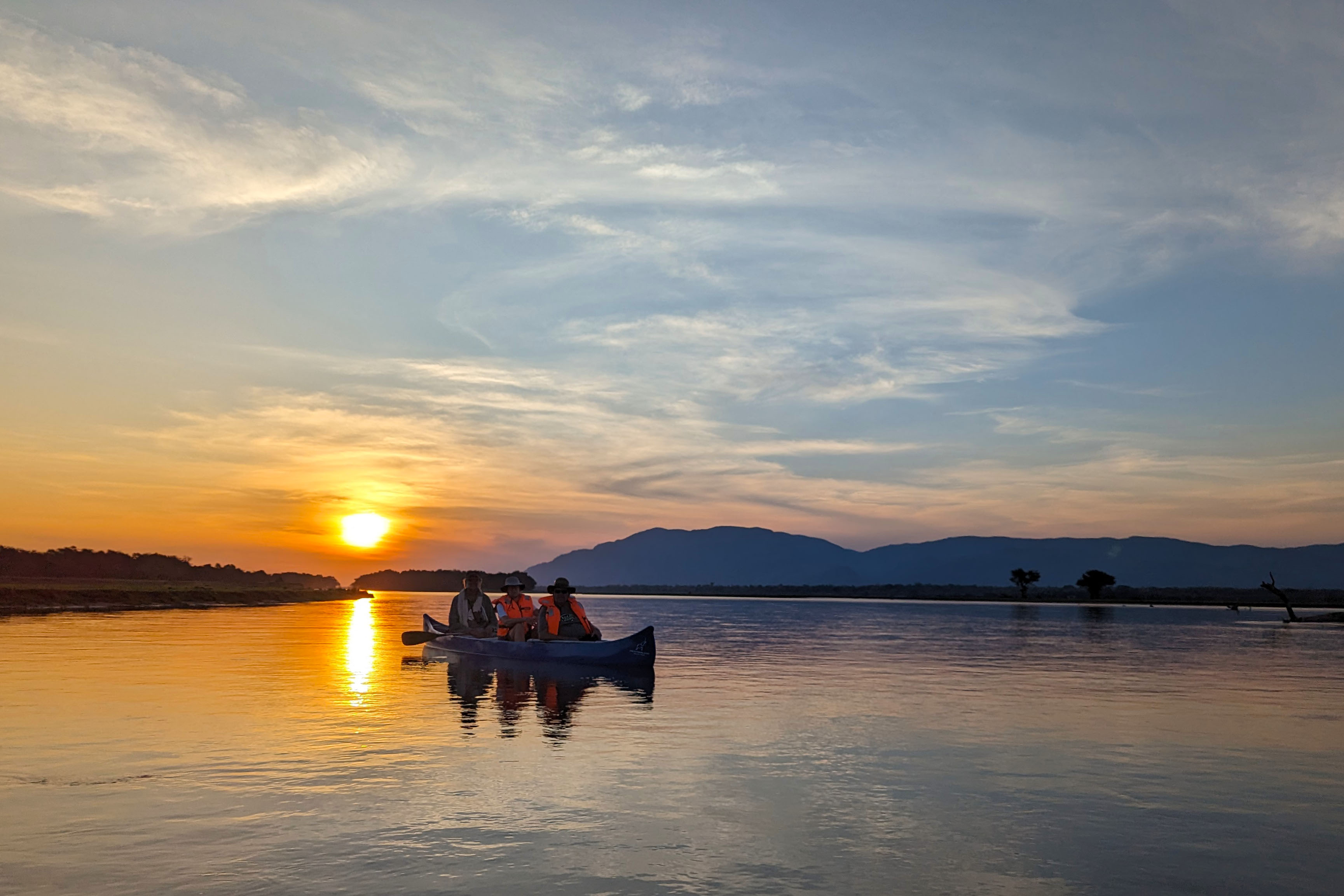
The countryside is still largely beautiful. We got invited to an old school friend’s safari camp on the Zambezi River in Mana Pools National Park. I guess it’s about 200km downstream of Kariba Dam. While the game was not as plentiful as it usually is at that time of year due to unseasonal rains, we still had a great time in a beautiful part of the country. Drifting down the Zambezi in canoes at sunset was memorable – crocs and hippos notwithstanding!
An evening drift down the Zambezi River
Earlier this year I had a bit of an “episode” early one morning. I can’t remember much about it but thought I should go to my doctor about it. She thought it was probably just what is known as Transient General Amnesia (TGA) but given my age thought it worth a spate of tests just in case it was something else. I had mentioned it to some friends of roughly my age and they both said they’d experienced it. Indeed, after much prodding, imaging and blood taking that conclusion was reached. The physician at the final consultation was impressed with the state of my health, structural issues notwithstanding, and commented; “Well, whatever kills you in the end it won’t be your heart!”. I wasn’t sure if that was good news or not – I am of the age now that how I “go” has become a subject of some importance and going quickly is the preferred option.
The degeneration of the structural issues necessitated a lower spine operation in April. It was deemed successful by the surgeon, but it necessitated 3 weeks of bed rest which have had a lasting effect on my mobility. The general anaesthetic also had a lasting effect in the form of POCD (post-operative cognitive dysfunction) which also causes episodes – a sense of disconnecting with the world which the physician said would eventually pass.
It’s New Year’s Eve now and fortunately it has stopped raining! Such is the erratic nature of the climate we find our selves in. The experts tell us it’s all symptomatic of climate change i.e. it’s becoming more extreme though I’d hesitate to attribute a few days of exceptional weather to that just yet.
So, what can we expect from the New Year? You have and election coming up, the Olympic Games are in Paris, the war will continue in Ukraine – the cynical French expression plus ca change, plus c’est la meme chose does come to mind!
It had to be a mistake, I couldn’t possibly owe the tax department (ZIMRA – Zimbabwe Revenue Authority) that amount. Even if I converted it to US dollars it would amount to an impossible figure – about 17,500 at the unofficial rate and 23,000 at the bank rate. I checked the email address – it was from a person with whom I’ve corresponded over the years. Then there was the wording; FINAL DEMAND. Where were the other demands? I did what any sensible person would have done and contacted my bookkeeper in a state of panic.
Alison was more than a bit puzzled but told me she couldn’t do anything without seeing how they’d got the figures. “Your are entitled to see what’s going on” she said. “Ask them for the ledger”
The last part of the ledger
The ledger was duly sent and the waters immediately became a lot murkier. It stated the figures were in US dollars and the numbers, if the currency was US dollars, were impossible. I sent it on to Alison. It was a while before she came back to me by which time my imagination had run riot. What if I really did owe 105 million dollars? I would have to buy it on the open market with my US dollars and would be left with no operating capital and nothing with which to pay wages. The company would be unlikely to survive.
Alison assured me that the figures on the ledger were Zimbabwe dollars and I probably did owe the 3,835,807 listed. She had no idea where the 105 million came from. “Ask them” she said. So I did.
The reply was abrupt; the 105 million was to be ignored (RTGS is another way of saying Zimbabwe dollars). The amount on the ledger was also incorrect as it didn’t account for some US$550 that I’d paid in presumptive tax (they are called Quarterly Payment Due or just QPD) which would have reduced the amount owed close to zero.
I speculated to Marianne that it was all just a bit of psychological bullying to get me to pay attention to the outstanding amount, then two days ago I bumped into Gary whose wife had had a strikingly similar experience.
Gary works for a seed company that occasionally uses my nursery to grow seedlings for various trials. They have a trial on ART Farm which is a neighbour to my nursery and I sometimes use it access my nursery so as to avoid the appalling direct road and take in a bit of soothing farm scenery on the way. Gary was having a look at one of their trials near the road so I stopped to chat.
We discussed various things then I related my experience with the tax authority. He said that Clare, his wife who works as a bookkeeper for a local church, had received a final letter of demand for payment from ZIMRA for an impossible amount about three months ago. She replied that as a church they were not liable for tax and any money made was given away to various charities and nothing more was heard. He agreed with me that as the government was desperate for money it was likely endorsing ZIMRA’s intimidation tactics to get in whatever money they could, maybe they were even giving a commission.
On getting to work I related the story to my senior foremen. They were decidedly cynical. “They are all on the take” opined Chingedzerai. “Yes”, added Fabian, “they see the rest of the government officials stealing and think that they should have some of the pie too. They see what they can bully you into paying and then split the extra between themselves”. It was obvious that they thought I was being naïve.
Marianne had been doing some questioning of her own and posted my problem on the local community WhatsApp group. Someone had responded with a name and phone number of a senior official at ZIMRA whom he thought would be able to help. I gave him a call and related my problem and asked if it was official ZIMRA policy to send out threatening demands based on nothing much at all. His indifference was striking; I should send him a copy of all the correspondence and documents and he’d forward it to the relevant manager. I duly sent him the copies but I am not expecting a reply.
It’s no secret that Zimbabwe is in deep financial trouble. Mismanagement, corruption and incompetence have seen our GDP plunge after the Mnangagwa government took power in a coup back in 2017.
At the time it was welcomed by the majority of the population who were relieved to be rid of the much hated and feared Mugabe regime but it was not long before the new government of E D Mnangagwa revealed its true colours of repression and corruption. Chingedzerai reminded me that the current administration has never bothered to investigate the estimated US$15 billion worth of diamonds that went unaccounted for from the Chiadzwa diamond fields in the east of the country in the latter part of the Mugabe era. More recently there was the gold smuggling exposé by al Jazeera that showed how top Zimbabwean officials were, with the highest approval, smuggling gold out of Zimbabwe and laundering the resulting cash. Indeed, for a country that is struggling financially, there is an eye-opening amount of property development around town. In the past this would have attracted the attention of ZIMRA who would have demanded to see the accounts of owners of expensive properties and made to account for the development. Now it’s easier, and more personally profitable, to send out threatening letters.
I paid wages on Tuesday. We chose the date years ago when getting cash from the bank at the end of the month meant enduring long queues and not getting the desired breakdown. Chingedzerai had heard the income tax limits had been increased and asked me to check on the internet before he entered the attendance and overtime figures on the computer. I was fairly sure it was only the Zimbabwe dollar tables that had changed but checked on the US dollar tables anyway (I have been paying my staff in the latter currency since August last year).
In Zimbabwe salaries are taxed monthly and the system is known by its acronym PAYE; Pay As You Earn. The rates are iniquitous. Wages are taxed from US$100 per month upwards! Given that the minimum agricultural wage starts at US$60 before any of the required allowances, most of my staff are taxed. Some do get age exemptions but the rest of them have to endure.
Such is the government’s demand for money that it has taken to taxing money transfers at 2% per transfer. It goes without saying that most transactions are cash though it’s not always possible. The government used to tax cash withdrawals from banks but gave up when it became evident that people were simply not depositing cash in order to avoid paying the tax.
Given the high cost of living and taxation in Zimbabwe one would assume that the majority of the population would be keen for a change of government. Indeed, given that we had a general and presidential election on Wednesday, one could be forgiven for thinking it imminent. With the recent exception of Zambia, southern African is not known for changing its governments and Zimbabwe is not about to become an exception too.
My foremen and I were all in agreement on this; the incumbent ZANU-PF party, which has maintained its grip on power since 1980 by means mostly foul, will certainly cheat its way to victory; only the level of the fiddle is not known. So far it’s been “limited” to delaying delivering voting papers to polling stations in regions known to be opposition strongholds, sending voters to polling stations where they found they weren’t registered, making sure one couldn’t check the online registration database and of course blatant intimidation. Few, if any, believe the logistical problems to be anything but deliberate. We remain cynical.
Frost and frosty breath – a rare cold morning this year
We live in the sub-tropics and experience a climate modified by altitude so rarely get very cold winters. They tend to be dry and dusty – the rains come from mid-November to March. While snow very occasionally occurs in Zimbabwe and is worth a photo opportunity frost is not at all uncommon, especially on the central watershed, but this year it has been rare. It has been a very mild winter so far with some daytime maxima reaching 280C and nighttime minima of 7 or more. So far there have been no overcast and cold days caused by cold fronts that come up from the Antarctic. What is going on and what does it mean for the rainy season?
Droughts are endemic to southern Africa and are most likely when an el Nino event appears off the Ecuador coast. This is a warm current and has a global effect on the weather; for us it’s drought. Usually.
Temperature variations off the Ecuadorian coast since 1982. Red is el Nino, blue la Nina.
A cooling of the sea surface is known as a la Nina and in this part of the world is characterised by wetter than normal years. The chart above indicates that the last three years have been wetter than normal though Harare did not experience this – in fact rainfall records at my business showed lower than average rainfall whereas other parts of the country did indeed experience a wetter than average summer. The memorable drought of 1992 is evident in that season’s el Nino event.
The ENSO forecast for ’23/’24 showing a very high probability of a el Nino event.
This el Nino event very likely means a drought for the coming summer. Harare, where I live, is increasingly dependent on boreholes to supply domestic water and over the years the average depth at which water can be found has steadily increased as water is extracted. With all the ongoing construction within the city area more and more water runs off into the streams and the ground water is replenished less. A drier then usual season is not good news.
Two years ago we took the plunge and had a deeper borehole drilled on our premises. We were lucky and found water. Though not in large quantity it has been sufficient for our needs since then. How it will be affected by what promises to be a dry few years remains to be seen. My commercial seedling nursery will be affected likewise. We wait in trepidation.









 Zimbabwe Absurdity
Taxed if you do, taxed if you don’t
26 08 2023It had to be a mistake, I couldn’t possibly owe the tax department (ZIMRA – Zimbabwe Revenue Authority) that amount. Even if I converted it to US dollars it would amount to an impossible figure – about 17,500 at the unofficial rate and 23,000 at the bank rate. I checked the email address – it was from a person with whom I’ve corresponded over the years. Then there was the wording; FINAL DEMAND. Where were the other demands? I did what any sensible person would have done and contacted my bookkeeper in a state of panic.
Alison was more than a bit puzzled but told me she couldn’t do anything without seeing how they’d got the figures. “Your are entitled to see what’s going on” she said. “Ask them for the ledger”
The ledger was duly sent and the waters immediately became a lot murkier. It stated the figures were in US dollars and the numbers, if the currency was US dollars, were impossible. I sent it on to Alison. It was a while before she came back to me by which time my imagination had run riot. What if I really did owe 105 million dollars? I would have to buy it on the open market with my US dollars and would be left with no operating capital and nothing with which to pay wages. The company would be unlikely to survive.
Alison assured me that the figures on the ledger were Zimbabwe dollars and I probably did owe the 3,835,807 listed. She had no idea where the 105 million came from. “Ask them” she said. So I did.
The reply was abrupt; the 105 million was to be ignored (RTGS is another way of saying Zimbabwe dollars). The amount on the ledger was also incorrect as it didn’t account for some US$550 that I’d paid in presumptive tax (they are called Quarterly Payment Due or just QPD) which would have reduced the amount owed close to zero.
I speculated to Marianne that it was all just a bit of psychological bullying to get me to pay attention to the outstanding amount, then two days ago I bumped into Gary whose wife had had a strikingly similar experience.
Gary works for a seed company that occasionally uses my nursery to grow seedlings for various trials. They have a trial on ART Farm which is a neighbour to my nursery and I sometimes use it access my nursery so as to avoid the appalling direct road and take in a bit of soothing farm scenery on the way. Gary was having a look at one of their trials near the road so I stopped to chat.
We discussed various things then I related my experience with the tax authority. He said that Clare, his wife who works as a bookkeeper for a local church, had received a final letter of demand for payment from ZIMRA for an impossible amount about three months ago. She replied that as a church they were not liable for tax and any money made was given away to various charities and nothing more was heard. He agreed with me that as the government was desperate for money it was likely endorsing ZIMRA’s intimidation tactics to get in whatever money they could, maybe they were even giving a commission.
On getting to work I related the story to my senior foremen. They were decidedly cynical. “They are all on the take” opined Chingedzerai. “Yes”, added Fabian, “they see the rest of the government officials stealing and think that they should have some of the pie too. They see what they can bully you into paying and then split the extra between themselves”. It was obvious that they thought I was being naïve.
Marianne had been doing some questioning of her own and posted my problem on the local community WhatsApp group. Someone had responded with a name and phone number of a senior official at ZIMRA whom he thought would be able to help. I gave him a call and related my problem and asked if it was official ZIMRA policy to send out threatening demands based on nothing much at all. His indifference was striking; I should send him a copy of all the correspondence and documents and he’d forward it to the relevant manager. I duly sent him the copies but I am not expecting a reply.
It’s no secret that Zimbabwe is in deep financial trouble. Mismanagement, corruption and incompetence have seen our GDP plunge after the Mnangagwa government took power in a coup back in 2017.
At the time it was welcomed by the majority of the population who were relieved to be rid of the much hated and feared Mugabe regime but it was not long before the new government of E D Mnangagwa revealed its true colours of repression and corruption. Chingedzerai reminded me that the current administration has never bothered to investigate the estimated US$15 billion worth of diamonds that went unaccounted for from the Chiadzwa diamond fields in the east of the country in the latter part of the Mugabe era. More recently there was the gold smuggling exposé by al Jazeera that showed how top Zimbabwean officials were, with the highest approval, smuggling gold out of Zimbabwe and laundering the resulting cash. Indeed, for a country that is struggling financially, there is an eye-opening amount of property development around town. In the past this would have attracted the attention of ZIMRA who would have demanded to see the accounts of owners of expensive properties and made to account for the development. Now it’s easier, and more personally profitable, to send out threatening letters.
I paid wages on Tuesday. We chose the date years ago when getting cash from the bank at the end of the month meant enduring long queues and not getting the desired breakdown. Chingedzerai had heard the income tax limits had been increased and asked me to check on the internet before he entered the attendance and overtime figures on the computer. I was fairly sure it was only the Zimbabwe dollar tables that had changed but checked on the US dollar tables anyway (I have been paying my staff in the latter currency since August last year).
In Zimbabwe salaries are taxed monthly and the system is known by its acronym PAYE; Pay As You Earn. The rates are iniquitous. Wages are taxed from US$100 per month upwards! Given that the minimum agricultural wage starts at US$60 before any of the required allowances, most of my staff are taxed. Some do get age exemptions but the rest of them have to endure.
Such is the government’s demand for money that it has taken to taxing money transfers at 2% per transfer. It goes without saying that most transactions are cash though it’s not always possible. The government used to tax cash withdrawals from banks but gave up when it became evident that people were simply not depositing cash in order to avoid paying the tax.
Given the high cost of living and taxation in Zimbabwe one would assume that the majority of the population would be keen for a change of government. Indeed, given that we had a general and presidential election on Wednesday, one could be forgiven for thinking it imminent. With the recent exception of Zambia, southern African is not known for changing its governments and Zimbabwe is not about to become an exception too.
My foremen and I were all in agreement on this; the incumbent ZANU-PF party, which has maintained its grip on power since 1980 by means mostly foul, will certainly cheat its way to victory; only the level of the fiddle is not known. So far it’s been “limited” to delaying delivering voting papers to polling stations in regions known to be opposition strongholds, sending voters to polling stations where they found they weren’t registered, making sure one couldn’t check the online registration database and of course blatant intimidation. Few, if any, believe the logistical problems to be anything but deliberate. We remain cynical.
Comments : 2 Comments »
Tags: corruption, general election, tax, ZIMRA
Categories : Blogroll, Economics, Social commentary