It had to be a mistake, I couldn’t possibly owe the tax department (ZIMRA – Zimbabwe Revenue Authority) that amount. Even if I converted it to US dollars it would amount to an impossible figure – about 17,500 at the unofficial rate and 23,000 at the bank rate. I checked the email address – it was from a person with whom I’ve corresponded over the years. Then there was the wording; FINAL DEMAND. Where were the other demands? I did what any sensible person would have done and contacted my bookkeeper in a state of panic.
Alison was more than a bit puzzled but told me she couldn’t do anything without seeing how they’d got the figures. “Your are entitled to see what’s going on” she said. “Ask them for the ledger”
The last part of the ledger
The ledger was duly sent and the waters immediately became a lot murkier. It stated the figures were in US dollars and the numbers, if the currency was US dollars, were impossible. I sent it on to Alison. It was a while before she came back to me by which time my imagination had run riot. What if I really did owe 105 million dollars? I would have to buy it on the open market with my US dollars and would be left with no operating capital and nothing with which to pay wages. The company would be unlikely to survive.
Alison assured me that the figures on the ledger were Zimbabwe dollars and I probably did owe the 3,835,807 listed. She had no idea where the 105 million came from. “Ask them” she said. So I did.
The reply was abrupt; the 105 million was to be ignored (RTGS is another way of saying Zimbabwe dollars). The amount on the ledger was also incorrect as it didn’t account for some US$550 that I’d paid in presumptive tax (they are called Quarterly Payment Due or just QPD) which would have reduced the amount owed close to zero.
I speculated to Marianne that it was all just a bit of psychological bullying to get me to pay attention to the outstanding amount, then two days ago I bumped into Gary whose wife had had a strikingly similar experience.
Gary works for a seed company that occasionally uses my nursery to grow seedlings for various trials. They have a trial on ART Farm which is a neighbour to my nursery and I sometimes use it access my nursery so as to avoid the appalling direct road and take in a bit of soothing farm scenery on the way. Gary was having a look at one of their trials near the road so I stopped to chat.
We discussed various things then I related my experience with the tax authority. He said that Clare, his wife who works as a bookkeeper for a local church, had received a final letter of demand for payment from ZIMRA for an impossible amount about three months ago. She replied that as a church they were not liable for tax and any money made was given away to various charities and nothing more was heard. He agreed with me that as the government was desperate for money it was likely endorsing ZIMRA’s intimidation tactics to get in whatever money they could, maybe they were even giving a commission.
On getting to work I related the story to my senior foremen. They were decidedly cynical. “They are all on the take” opined Chingedzerai. “Yes”, added Fabian, “they see the rest of the government officials stealing and think that they should have some of the pie too. They see what they can bully you into paying and then split the extra between themselves”. It was obvious that they thought I was being naïve.
Marianne had been doing some questioning of her own and posted my problem on the local community WhatsApp group. Someone had responded with a name and phone number of a senior official at ZIMRA whom he thought would be able to help. I gave him a call and related my problem and asked if it was official ZIMRA policy to send out threatening demands based on nothing much at all. His indifference was striking; I should send him a copy of all the correspondence and documents and he’d forward it to the relevant manager. I duly sent him the copies but I am not expecting a reply.
It’s no secret that Zimbabwe is in deep financial trouble. Mismanagement, corruption and incompetence have seen our GDP plunge after the Mnangagwa government took power in a coup back in 2017.
At the time it was welcomed by the majority of the population who were relieved to be rid of the much hated and feared Mugabe regime but it was not long before the new government of E D Mnangagwa revealed its true colours of repression and corruption. Chingedzerai reminded me that the current administration has never bothered to investigate the estimated US$15 billion worth of diamonds that went unaccounted for from the Chiadzwa diamond fields in the east of the country in the latter part of the Mugabe era. More recently there was the gold smuggling exposé by al Jazeera that showed how top Zimbabwean officials were, with the highest approval, smuggling gold out of Zimbabwe and laundering the resulting cash. Indeed, for a country that is struggling financially, there is an eye-opening amount of property development around town. In the past this would have attracted the attention of ZIMRA who would have demanded to see the accounts of owners of expensive properties and made to account for the development. Now it’s easier, and more personally profitable, to send out threatening letters.
I paid wages on Tuesday. We chose the date years ago when getting cash from the bank at the end of the month meant enduring long queues and not getting the desired breakdown. Chingedzerai had heard the income tax limits had been increased and asked me to check on the internet before he entered the attendance and overtime figures on the computer. I was fairly sure it was only the Zimbabwe dollar tables that had changed but checked on the US dollar tables anyway (I have been paying my staff in the latter currency since August last year).
In Zimbabwe salaries are taxed monthly and the system is known by its acronym PAYE; Pay As You Earn. The rates are iniquitous. Wages are taxed from US$100 per month upwards! Given that the minimum agricultural wage starts at US$60 before any of the required allowances, most of my staff are taxed. Some do get age exemptions but the rest of them have to endure.
Such is the government’s demand for money that it has taken to taxing money transfers at 2% per transfer. It goes without saying that most transactions are cash though it’s not always possible. The government used to tax cash withdrawals from banks but gave up when it became evident that people were simply not depositing cash in order to avoid paying the tax.
Given the high cost of living and taxation in Zimbabwe one would assume that the majority of the population would be keen for a change of government. Indeed, given that we had a general and presidential election on Wednesday, one could be forgiven for thinking it imminent. With the recent exception of Zambia, southern African is not known for changing its governments and Zimbabwe is not about to become an exception too.
My foremen and I were all in agreement on this; the incumbent ZANU-PF party, which has maintained its grip on power since 1980 by means mostly foul, will certainly cheat its way to victory; only the level of the fiddle is not known. So far it’s been “limited” to delaying delivering voting papers to polling stations in regions known to be opposition strongholds, sending voters to polling stations where they found they weren’t registered, making sure one couldn’t check the online registration database and of course blatant intimidation. Few, if any, believe the logistical problems to be anything but deliberate. We remain cynical.
Frost and frosty breath – a rare cold morning this year
We live in the sub-tropics and experience a climate modified by altitude so rarely get very cold winters. They tend to be dry and dusty – the rains come from mid-November to March. While snow very occasionally occurs in Zimbabwe and is worth a photo opportunity frost is not at all uncommon, especially on the central watershed, but this year it has been rare. It has been a very mild winter so far with some daytime maxima reaching 280C and nighttime minima of 7 or more. So far there have been no overcast and cold days caused by cold fronts that come up from the Antarctic. What is going on and what does it mean for the rainy season?
Droughts are endemic to southern Africa and are most likely when an el Nino event appears off the Ecuador coast. This is a warm current and has a global effect on the weather; for us it’s drought. Usually.
Temperature variations off the Ecuadorian coast since 1982. Red is el Nino, blue la Nina.
A cooling of the sea surface is known as a la Nina and in this part of the world is characterised by wetter than normal years. The chart above indicates that the last three years have been wetter than normal though Harare did not experience this – in fact rainfall records at my business showed lower than average rainfall whereas other parts of the country did indeed experience a wetter than average summer. The memorable drought of 1992 is evident in that season’s el Nino event.
The ENSO forecast for ’23/’24 showing a very high probability of a el Nino event.
This el Nino event very likely means a drought for the coming summer. Harare, where I live, is increasingly dependent on boreholes to supply domestic water and over the years the average depth at which water can be found has steadily increased as water is extracted. With all the ongoing construction within the city area more and more water runs off into the streams and the ground water is replenished less. A drier then usual season is not good news.
Two years ago we took the plunge and had a deeper borehole drilled on our premises. We were lucky and found water. Though not in large quantity it has been sufficient for our needs since then. How it will be affected by what promises to be a dry few years remains to be seen. My commercial seedling nursery will be affected likewise. We wait in trepidation.
The bundles of 500 notes in bank wrappers were commonly known as bricks in 2008. Now it’s 2023 and they’re back!
The senior foreman said the customer wanted to pay in Zimbabwe dollars, cash, were we going to accept them? We didn’t have much of a choice as it is legal tender so I said yes and asked how much it was. 67,000 he replied. I groaned knowing they would be in small denominations. The biggest, $50, is worth all of US2.2c so I knew there would be quite a few bundles but the majority were $20 notes. We filled a medium-sized box.
Quite a few were in bank-sealed plastic bags of 500 notes which were called “bricks” back in the hyper inflation days of 2008. We didn’t bother counting them then and didn’t bother now. Back in those days the government attempted to get around the problem by printing ever larger denomination notes (an example is in the picture). Our inflation now is not quite that bad but anyway, local currency notes have largely been superseded by electronic money. It’s very easy to add zeros onto electronic money.
The other currency in Zimbabwe that is also legal tender is the US dollar. Having nothing to do with the government it is by far the most preferred. Although the government tries to set the exchange rate and can prosecute those not using it there is an easy work-around. It goes like this: the official rate is 1,097 Zimbabwe dollars to US$1 and with a few exceptions, fuel being one of them, businesses have to quote their prices in the local currency. On the unofficial market the rate is currently around 2,200 to one US dollar depending on to whom one is talking. Businesses price their goods in the Zimbabwe dollar and then offer a fat discount if you want to pay in US dollars – this effectively brings the official rate up to the unofficial one and it’s completely legal. Many businesses don’t bother with the official rate and just quote the unofficial one. My business is one of them and so far there hasn’t been a comeback.
There is a sense on around town that the unofficial rate is running again and people are offloading their Zimbabwe dollars. I sent the driver into town the day following the above deposit to get rid of the cash. In reality it was about US$30 so didn’t go far but I managed to find a fertilizer company accepting them and topped up with a bit of electronic money in the form of a debit card we managed to get a meaningful amount of agricultural chemicals bought.
The government is of course also looking for a dependable currency and has hit on tax as the easiest way to get in US dollars. All US$ cash deposits are levied at 20% and the government reimburses the amount in Zimbabwe dollars – at the official rate! This means that in reality the recipient can be losing 10% or more of the deposit in real terms. Exporters are levied 40% of the amount remitted to their forex accounts. It gets better; 3% of all USD cash withdrawals from a bank are taxed. While one can still pay car licence fees and other government levies in the local currency the sense is that it cannot last.
The local Reserve Bank has an idea to shore up the local currency; digital tokens backed by gold. It won’t work – the population’s trust in the government has long since evaporated. There is nothing new about digital currency in Zimbabwe but my staff for one will only be interested in the greenback.
Zimbabwean medical technology can be surprisingly advanced – if you can afford it. This is a Holter ECG recorder.
“Enjoy getting the sensor off your chest” the nurse said and smirked. I didn’t share the humour and suspected this was why she said that shaving my chest before attaching the Holter ECG was unnecessary. At least she had a sense of humour.
I was strongly beginning to suspect the whole exercise was a waste of time and a not inconsiderable amount of money. The specialist physician who’d done the ECG and echo cardiogram had already said that all was normal as far as he could see and that only the MRI angiogram scheduled for the following week might show something. I left $810 poorer.
Last Friday morning at 4 a.m. I had to get up to go to the bathroom. When I got back to bed I asked Marianne what the bandage on my left ankle was for. It has been there four months for an ulcer. Not surprisingly she was concerned. The next three hours were a blank for me but apparently I repeatedly asked about the bandage and looked at my computer programming work and apparently recognized it. I have a vague recollection of asking who my doctor was and where the practice is located (which I have been visiting for years). When we visited the GP later that morning I asked Marianne to come with me just in case I missed something (not that I’d have had a choice!). We emerged 20 minutes later, blood sample taken and with a long list of tests to be done. It looked expensive.
Access to the Zimbabwe medical system requires a subscription to medical insurance and frequently quite large sums of cash as US dollars. The latter is often referred to as a “co-payment” which is another way of saying that “you pay us up front and then claim back from your medical aid/insurance company as we don’t have the patience to deal with their habitually late payments”.
First appointment was with a technician who was working out of his home with an EEG in his spare room/office. He told me that I most certainly had not experienced a Transient Ischemic Attack (TIA) otherwise known as a mini stroke and relieved me of $200. I noticed that he was fond of his dog so forgave him – mostly.
I haven’t seen the test results for the 72 hour Holter ECG yet but I guess they will arrive in due course. The record sheet that I had to fill in detailing any “out of the ordinary” experiences I left blank. There weren’t any.
Yesterday was the turn of a MRI-A (A is for angiogram) in my brain. I had to get there at 7.30 in the morning and forgoing my morning coffee – MRIs have a way of going on for a long time and I suspect the operators would have been unimpressed if I said I needed to use the toilet – I headed out early taking a big mental breath to deal with the morning traffic. It was all a non-event. I arrived early and one of the staff agreed that the traffic was unusually light. The MRI machine was new and made by Canon, the camera manufacturer. It only took 30 minutes then I was off to the Doppler ultra-sound of my neck vessels at another clinic occupied by the same company in another part of town.
They relieved me of $105 (yes, all fees were mentioned in advance and nobody mentioned the local currency – US dollars only) and then after a short wait it was into the examination room. I could just see the screen placed on the opposite wall for my convenience. The technician was not very communicative but did say he could see no problems. The machine made all the right heart noises too.
Now I have to go and see a specialist physician after the long Easter weekend. He will take $100 (he’s seen me before else he would take $200). He has a bit of a dour reputation but was also my physician for the back surgery a year ago and was very kind not charging for hospital visits once he knew I’d been injured in the Rhodesian bush war. “Because of people like you Mr Roberts, people like me got to go to medical school”.
I do have another off-shore medical aid scheme based in South Africa which will reimburse at least some of the costs. However they will only pay what the procedure or tests cost in South Africa which is often considerably less than in Zimbabwe. I’ll have to wait and see.
So what was it that I experienced? My sister-in-law Jane, who lives in the UK and is a better Googler than me, sent me this link which accurately describes it. It’s called TGA or transient global amnesia. It happens, it’s not serious and there’s nothing one can do about it.
On the way back from the gym this afternoon I drove past the local municipal clinic. Once a part of the primary medical care system designed as a first port of call for the average Zimbabwean citizen without access to medical insurance it is now nearly derelict. The gates don’t shut, there was one vehicle parked inside and not a soul to be seen. The last time it was used was for Covid vaccinations and that was sponsored by the WHO and other agencies.
Our weather has become increasingly erratic over the last 15 years or so. I put it down to climate change. Right now we are in the middle of a relatively normal rainy season. That means that the ITCZ (Inter-Tropical Convergence Zone) moves over the country and it rains – quite a lot. Most of our rains happen from mid November to the end of March which in Harare means some 700 to 800mm. The rain can be quite intense – we had 75mm (3 inches) in several hours last week which meant all the rivers around town were up and one of the reservoirs that supplies town was spilling. As a country we’ve had good rain for the last 3 years due to the la Niña effect though it has been quite variable over the country and Harare, which is in a high rainfall area, received less than average. We are due for a drought and I see that there is a el Niño predicted later in the year which is a reliable indicator.
There’s rain around as I type this and yesterday afternoon we had quite a storm with high winds and hail and of course the power went off. It’s still off but we are geared for this eventuality and have solar panels and two lithium batteries to get us through the night. Power outages for other reasons, mainly incompetence and over-use of Lake Kariba as a hydro source, are common so everyone who can has a solar backup plan. Solar water heating makes a lot of sense in our climate so we have three solar heaters, one for us, one for the cottage tenants and one on the domestic employee’s rooms. In the cloudless, hot days of August and September the water can easily boil.
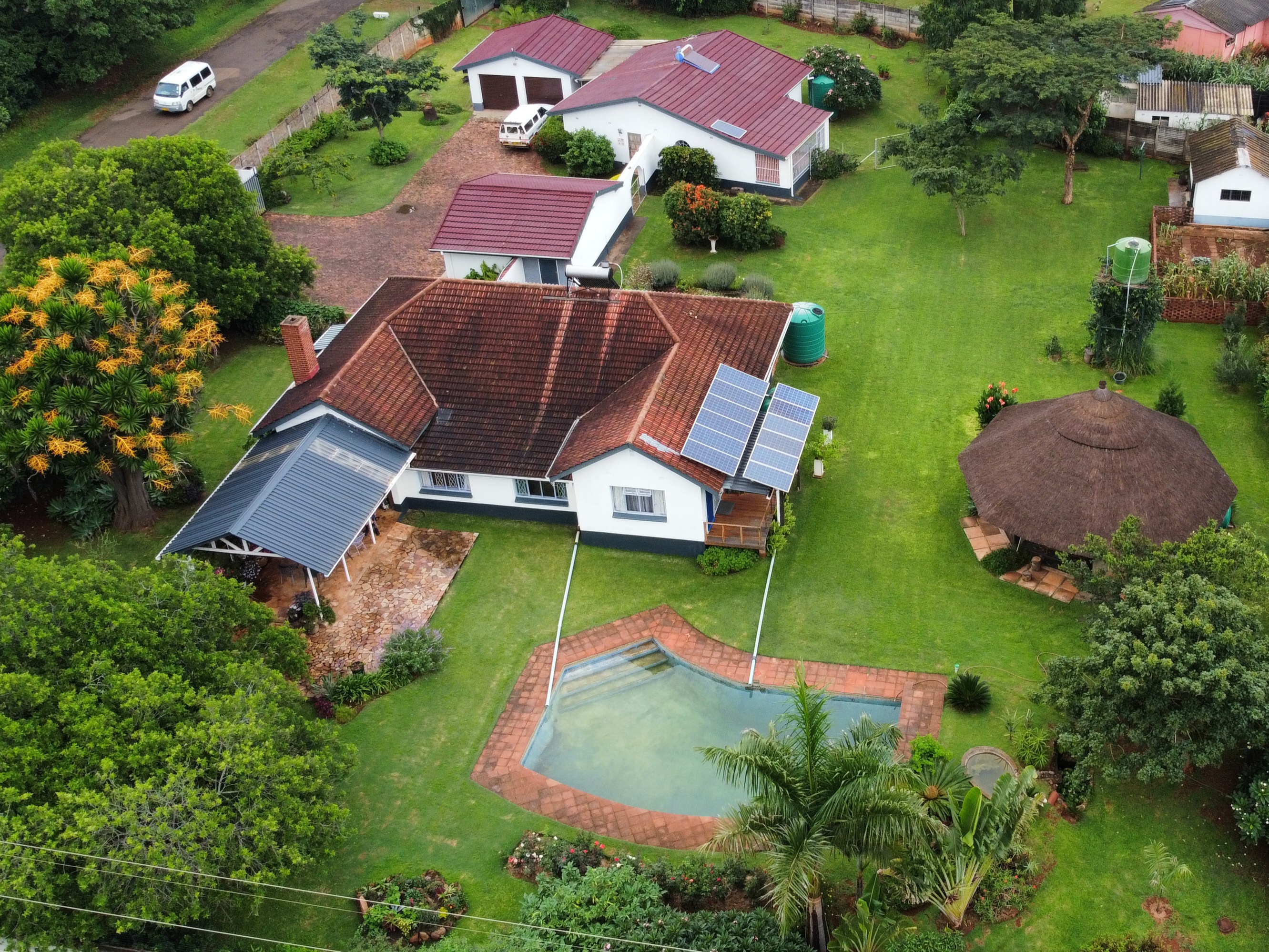
The complete Zimbabwean domestic survival system: visible are two solar water heaters, two solar panel systems and rainwater collection into tanks and a swimming pool.
I see your weather has been erratic too. Mt Washington in the north-east of the USA hit a record -70C a few days back and Europe had an unseasonably warm Christmas. It seems that California has had some heavy rains too; the default weather app on my new iPad is set to the Apple headquarters in Cupertino and they had flood warnings out recently.
Planned, and I use that word loosely, power outages are called “load shedding” in this part of the world. Towards the end of last year it was announced that Lake Kariba, which is our major source of hydro power, had got to it’s minimum level permitted for generation due to over-use by the Zimbabwe power authority and load shedding would become a daily occurrence. We have another major thermal power station at Hwange in the west of the country but it has become a byword for mismanagement and cannot take up the shortfall. We also import a lot of power from Mozambique and South Africa but have managed to get into a lot of debt so the aforementioned countries are fed-up and restricting our supply. South Africa has its own power supply issues (again due to mismanagement by the state-run utility) and is also imposing load shedding but at least it sticks to a schedule. In Zimbabwe the power generally goes off in the suburbs about 6.30 a.m. and comes back on around 10 p.m. Businesses are not exempt either and incur heavy costs due to diesel generators. It’s not unusual for some to run just on night shifts.
Our swimming pool was an early casualty of the power cuts. It’s essential to keep the filter running which the solar panels can do on a sunny day but those are rare in the rainy season so it’s more green than clear these days. Marianne was muttering about the cost of more chemicals to try and clear it. I pointed out that we could always fill it in but it wouldn’t be a cheap procedure and then we’d lose some 70,000 litres of stored water that would be very useful in a drought. We have decided to live with it being more green than not (it is covered over in winter when not in use).
The book you asked about is, I think, “The Shackled Continent” by Robert Guest who was an Africa correspondent for The Economist for a number of years. I found it fascinating and very insightful. Maybe I should read it again.
My business muddles along. I have a lot of outstanding debtors and it’s not so simple as insisting that they pay up front for their orders. I hate having to get nasty but it may eventually come to getting professional debt collectors in as I need to get the money to pay for imports of the coir “peat” raw material that we use to grow the seedlings. I obviously cannot use Zimbabwe dollars but fortunately I did invoice in US dollars which once again is becoming the currency du jour. The government is still trying desperately to keep the local dollar alive but with an official exchange rate of 740 to the US dollar compared with a “parallel”, i.e. street, rate of 1,100 to the dollar, it doesn’t have much of a chance. The local currency is still used, and has to be offered, as a payment method but most outlets make it very attractive to use the US$ by offering massive discounts . Government departments don’t do this so get paid almost entirely in local currency which means they are perpetually in financial difficulties – hence the disastrous state of the power supply, roads, rail links and anything else they are involved in. Am I making sense?
The government is also trying to stifle speculation on the currency markets by lending money at vast interest rates, 110% in November 2022, which makes doing business very difficult and one of the reasons that I use to explain why my business is so flat. The other is the proliferation of competition, often informal, which cut lots of corners allowing them to undercut my prices. Their quality is dismal but people either don’t care or see it as an acceptable consequence of the cheap prices. My prices haven’t changed in four years despite the rising costs of inputs in real (US dollar) terms. It doesn’t make for attractive business. Curiously the construction business is booming with cluster homes (small, single level apartments – several to a property) and other developments being built throughout the suburbs. Quite where the money is coming from I cannot ascertain – but in an economy as moribund as ours it’s almost certainly dirty.
Yes, us Zimbabweans are a resourceful lot and I guess in that respect Diana remained true to her heritage. My workroom/office is full of junk that I cannot throw away just in case I find a use for it in years to come. It must be a hold-over from the days when Zimbabwe was Rhodesia and under sanctions so nearly everything that could be was recycled. It’s probably an attitude of my generation rather than today’s “youngsters” – I drive past a municipal rubbish tip on the way to work and there’s never a shortage of trucks pulling in to offload. I suppose people do make a living out of recycling here though it’s not as fashionable as in the developed world. An elution plant (recycling gold from electronics) has recently been constructed at the former rubbish dump. It’s also not unusual to see carts being pushed around the suburbs and having one’s gate bell being rung by the owners looking for scrap metal.
I guess our “big” news for this year is that we’re going over to the UK in May to attend a rock concert! I’ve never been to one as standing for a long time in rowdy crowds is obviously not possible for me but this is Mike & The Mechanics who are not as popular as they used to be so seating is an option. Time to tick off the bucket list.
Then we are going to stay on the Cote d’Azur with an old girlfriend and her husband for four days. Apparently we’ll be quite close to St Tropez. Marianne is keen to go and see how the ultra-rich live but I may give it a miss. Really looking forward to it and we’re brushing up our rudimentary French in anticipation.
Well, on that positive note I’ll sign off and wish you all the best for this year. Forget the snow shoveling, go skiing and may it be exceptional.
Ciao
Andrew
Note: this is a genuine reply to a friend in Washington State U.S.A. who was a good friend to my sister Diana, and helped look after her in the terminal stage of her cancer three years ago.
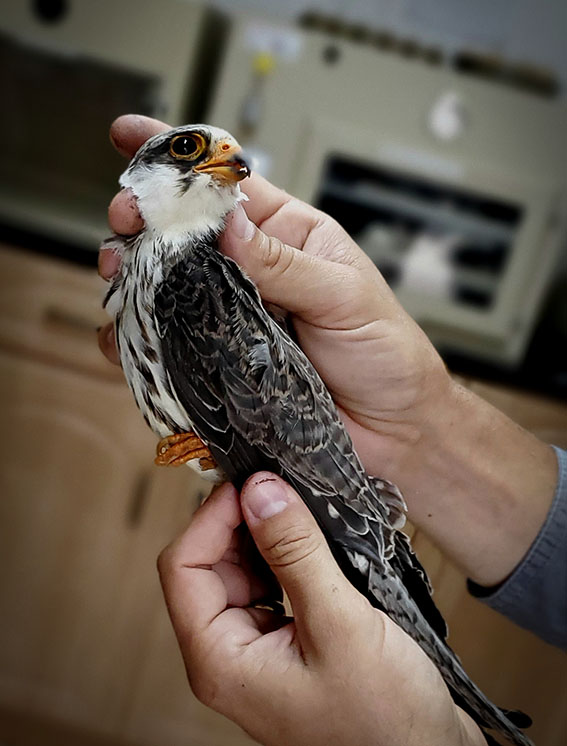
A female Amur falcon with a broken right wing is handled by the resident vet at Birds at 30
She was tragically beautiful and very frightened, fluttering in blind panic with a wing that just wouldn’t work to get her off the ground. Recognizing that the dogs would very likely kill her I reversed back up the track to where Marianne was following with the dogs. Quickly she loaded the dogs into the back of the truck and we took a cover off a mattress and Marianne soon had her trapped in the makeshift bag and the walk could resume.
Over breakfast I contacted various people known to take in injured birds and established that Birds at Thirty, a place I’d never heard of, was the place to take her. It was easy enough to find behind an imposing brick wall and massive gates some 10 minutes from where we live.
I thought I’d arrived at some luxury hotel but the visibly amused receptionist said no, it was the headquarters for Spar Zimbabwe (a local supermarket franchise). I was met by one of the bird park assistants and directed to the veterinary office.
Hilton examined her whilst I told him the circumstances of the find. Initially he was quite positive saying he didn’t think the break was too bad, then he changed his mind.
“She’s bleeding at the joint so it’s an open fracture I’m afraid. I’ll give her some strong antibiotics and strap it up and we’ll see what develops. We may have to get the wing removed.”
“What’s your policy in situations like these?” I asked.
“Well that depends on whether I think our visitors can learn from seeing a bird like this” he replied.
“So do you get quite a lot of school visits?”
He told me that the birds were originally a private collection and anyone was welcome to come and enjoy them (you need to book). They were certainly very much in evidence, swans on a small lake and peacocks strutting around. Schools visited regularly. And I had never heard of the place!
“It also depends on the wishes of the person who brings the bird in” he added.
“Well, I’ll leave that to you” I said, ducking responsibility.
“I don’t see much point in leaving it to spend the rest of its life in a cage” he warned me.
“Well, we’ll have tried” I responded. “Please let me know what you decide”. And I left to get on with my day.
Myself, Marianne and Themba (who photo-bombed the moment). Marianne’s wearing a cap and dark glasses because “my hair’s a mess and I haven’t got eye-shadow on”. I am wearing a cap to hide my bald spot.
On Tuesday Marianne asked me if I’d remembered it was my birthday today. I had totally forgotten about it. I won’t but that down to old age just yet but my memory isn’t great and I’ll explain that later.
I got to thinking last night that I was about to turn 63 which is 3 times 21 and what was I doing at 21 and 42? Oddly enough I have quite clear memories of my 21st.
I was in the car park at my university residence when and acquaintance by the nickname of Russian, who was actually of Polish descent, found out and asked me if I’d been kissed yet (he didn’t have to specify a woman). I made some non-committal reply whereupon his girlfriend, Colleen, stepped up and kissed me. It probably was my first kiss! Being a November baby meant that parties clashed with exams so my mother paid for a few of us to go out for dinner later in the year.
November is, of course, an historic month. Armistice Day marking the end of the First World War is on the 11th. This year I noticed a plethora of Facebook posts marking the occasion and reminding readers how we must no forget. I agree totally. Less well known in the wider world is that the Rhodesian government, led by one Ian Douglas Smith (who was a World War 2 fighter pilot in the RAF), made a Unilateral Declaration of Independence (UDI) from British rule on the 11th of November 1965 making Southern Rhodesia just Rhodesia which became Zimbabwe in 1980. International sanctions swiftly followed and we were on our own (with support from South Africa and Portugal) until 1980. Rhodesians were capable and highly industrious and for a while the country flourished.
Various Facebook sites on the 11th were swamped with ex-Rhodesians reminding me of this. They seem to have forgotten that by the end of the ensuing bush war in December 1979 we had long lost the support of Portugal and South Africa and came very close to a battle for the capital city, Salisbury (now Harare) which would have been a bloodbath. The following elections got us Robert Mugabe as a ruthless head-of-state and we all know how that eventually turned out. Thousands of people lost their lives in the bush war, my father included as an innocent civlilian, and I was partially paralysed in a military action. Really, did those who concocted the UDI not see the train wreck coming? What were they thinking? The UDI was arguably the worst decision in our history.
What was I doing 21 years ago? In 2001 the Mugabe regime was on the rampage, chasing white commercial farmers off their land, frequently destructively. Often farms were looted and abandoned of their agriculture, plunging the currency into a hyper-inflationary period that culminated in 100 trillion Zimbabwe dollar notes and inflation in October 2008 estimated at 4.3 million percent. Those who could left the country, New Zealand was particularly quick to see the potential of qualified Zimbabweans and welcomed them en masse. I do know that in 2001 I had a lot more disposable cash than I do know and I did around that time have a party for friends in a local restaurant. It was great fun. Maybe we just didn’t care about the impending financial disaster or more likely we just chose to ignore it for the night. I certainly wasn’t concerned about getting to 63 – that was far away.
Now 63 is here and I’m not impressed. But before I go down the route of losses and gains I owe an explanation of my terrible short-term memory. In April this year I had a lower back operation to repair and stabilize various vertebrae that had deteriorated as a consequence of the bullet that tore through that region in April 1979 (detailed description in Reflections on the first half). The operation was successful and the surgeon said the spine was not as messy as he was expecting but the anaesthetic has had lasting consequences on my memory. It even has a name; Post Operative Cognitive Dysfunction (POCD). While its occurrence in people my age is uncommon I appear to have been unlucky – I’ve had more than a few general anaesthetics in my life and none have had this effect. Effects range from forgetting conversations I’ve just had to full-blown bouts where I cannot control my thought processes and I cannot perceive the world around me. The POCD may last in younger people up to 6 months but in older people there can be permanent effects. Recently I decided to do something about this and give my brain some work to do.
When I first took over my business I quickly vowed to get rid of the pile of paper that accumulated on my desk at the end of each month and decided to write my own software package to deal with the administration side of the business. I duly went on a course to learn Visual Basic (VB) and got to work. It took several years but it does the job now. While these projects are never finished I more recently decided to write a wages package that my senior foreman could use and free me up from tedious and mistake ridden Excel spreadsheets. It works well but being written in an old version of VB has issues running on my relatively new laptop. So I rewrote it in a newer, and quite different version. On getting out of hospital I needed something to do whilst on bed rest so wrote a cash notes calculator for the old version. Being rather pleased with they way it worked I decided to write one in the new version, only to find to my complete amazement (and disquiet) that I’d already done it before going into hospital. I had zero recollection of writing the app or the code itself. So now I’m rewriting the original accounting software to give my brain exercise. It will be a long project.
My mobility has taken a considerable knock over the years. At university I used to cycle all around the campus and when I left I went on a cycle tour of France, Switzerland and Germany. At 42 I still cycled around the farm where I rented a cottage. This all came to an end, albeit slowly, when a South African surgeon did a less than stellar job of fixing the neck I’d fractured as a teen. Back in 2014, when I’d started tripping over my own feet, I winced mentally when the surgeon who finally fixed the mess said “Oh, that old man” when I told him who’d done the original surgery. Little did I know at the time there was a specialist orthopaedic spine unit which is part of the Vincent Pallotti Hospital in Cape Town. I have not been on a bicycle since. So the message to the reader is: if you really HAVE to go under the knife, DO YOUR HOMEWORK! When asking a local doctor for advice on who to see about the neck operation I accepted at face value what he told me. It was an expensive mistake.
So, in the last 21 years I have lost: hair (thanks to my mother’s genetics), mobility (already explained), hand and upper body strength also as part of the aforementioned, hearing (thanks to the military) for which I wear hearing aids – I love ’em and can enjoy music again and of course my eyesight is not what it used to be. I do wear bifocal glasses but only for flying a drone. I’ve had lifelong short sight for which I’ve variously worn glasses, then I had a flirtation with contact lenses and now I’m back to glasses which I take off for close work.
Gains: toys, rather a lot! Some years ago when it became apparent that paragliding was a dying sport in Zimbabwe I took up aero-modelling. It’s definitely second prize but at least I get to fly something. So now I have several drones (I took the photograph at the top of the page with one) and some fixed-wing models too. I particularly like electric gliders. For the real flight experience I have a paramotor (that’s a paraglider with a petrol driven motor) but I don’t get to fly that much as I need assistance with the setting up. Of course I’ve gained a marvelous wife which was something I never expected to happen at 21 or even 42. Nothing could have been further from my mind at 21 and well, at 42 I thought I’d be a batchelor for the rest of my days. Fortunately I was wrong.
As for the next 21 years, well, it’s best not to think about it too much. Maybe I won’t get there, after all, 84 will be getting on a bit. Perhaps the end will come like the proverbial “thief in the night”, but sadly few of us will be that lucky.
I won’t pretend the last 21 years have passed quickly but I don’t have a lot of memories to look back on. I guess that it’s time to make a few now so next May Marianne and I are going with a group of friends to a rock concert in Birmingham, U.K. It’s our first ever and hopefully it will be good. Mike & The Mechanics are by no means a current band but we still like their music.
On Tuesday after Marianne reminded me it was my birthday on the 17th she went shopping. She complained that she couldn’t find me a present; I really wasn’t concerned – I think presents should be bought when one sees them, not necessarily for an occasion. It did occur to me to get myself a present, perhaps a rescue dog from one of the over-flowing charities. But I wouldn’t have been able to choose just one and would like to have gone for an older dog. Old dogs are special so maybe I’ll sponsor one instead.
The Wonky Pig, myself and cousin PatHow the Wonky Pig got its name.Yes, it’s a bird as of course you guessed!
“He’s gorgeous!” enthused Caro by WhatsApp. It was not the response I was hoping for. I’d just sent her a photo of the pig sculpture in the pond outside the Harlow civic centre which I deemed awful and cousin Pat said was wonderful. The sculpture is officially titled “Boar” and is part of the sculpture collection of Harlow, a relatively new town some 30 minutes by train north of London. I prefer to call it the “Wonky Pig” as to me it looks like it’s on the verge of falling over – a bit like I do to a lot of people.
I’d enlisted Caro’s opinion as she’s qualified with a degree in fine art and should know about these things – i.e. is it good art? Of course liking art is in the eye of the beholder; it doesn’t make it good, at least not in my opinion. Cousin Pat was silent on the matter but I detected an aura of smugness. Further along the pond was a bird. Well, that’s what the plaque said but I’ll leave it to the reader to decide what it might be. The last sculpture in the pond was a copy of Rodin’s “Eve” which even I could appreciate.
We were coming to the end of our three week holiday in the UK having visited friends and relatives and were looking forward with a mix of trepidation to returning to the chaos of Zimbabwe. England works. Zimbabwe not so much. We’d experienced first hand the motorway driving which is the antithesis of Zimbabwean driving. We’d seen a show in London, done the tourist bit on a tour bus and caught up with old friends. The weather had been surprisingly good but we were also getting tired of living out of suitcases and were looking forward to getting back to our own space and the dogs.
Rain on the windscreen. Fortunately this was the only day we thought of doing other thingsThere are a lot more dogs about in the UK since we last visited in 2018. Is this the result of covid when people were looking for home companions?A headland on the Bristol channel near Porlock. Sunny and cool.Overlooking Porlock from the edge of Exmoor National ParkLynton townLynton and Lynmouth cliff railwayPorlock yacht mole
After the long night flight from Johannesburg we landed at Heathrow Terminal 5 and made our way into London. As a disabled person it was comforting to find that getting assistance was easy, something that we found throughout our trip.
Porlock was a three hour trip; train from London to Taunton, bus to Minehead and a short taxi ride to Porlock where we stayed not far from Meryl Harrison, an old friend of Marianne’s. Meryl is well known in in Zimbabwe for her single minded and courageous rescues of farm animals in the chaotic years surrounding the farm invasions in Zimbabwe. She was also instrumental in setting up the VAWZ animal charity. Now she lives in retirement in the country of her birth. She would prefer to live in Zimbabwe but cannot afford to. You can support her by buying her book Innocent Victims about the farm rescues.
Don, another friend of Marianne’s from long ago, had agreed to meet us in the area and take us exploring with his wife Rachel and three dogs. We took a drive up onto Exmoor nearby and onto the twin towns (or is it one?) of Lynton and Lynmouth. It’s famous for its funicular water-powered cliff railway that opened in 1890 and, yes, still works today.
There are two carriages on a cliff that take passengers up and down. Both have water tanks beneath them – clearly seen in the photo above. The descending carriage has a full tank and the ascending one an empty tank so gravity does the work.
Pubs in the area were of course also visited and being just out of tourist season we had no difficulty finding space for lunch. There was just one day that rain curbed our plans but other than that it was cool and clear. Autumn colours were just starting on the moor.
It’s not the London Eye by a long way but the ferris wheel at Weston-super-Mare is worth a rideThe beach at Weston-super-MareDistant cousin Malcom in full flowThe promenade – it’s clean!The waterfront at Weston-super-Mare – notable lack of tourists
Our next stop was Weston-super-Mare about and hour towards Bristol. Don kindly did a small diversion to drop us there where we’d found a convenient B&B close to the beachfront. We were glad to be there out of season so had no crowds to negotiate and didn’t even have to queue for the ferris wheel.
The first day we explored the nearby helicopter museum and the following day cousin Malcom came out from Bristol for an entertaining lunch.
G-LYNX and friendsI think Marianne has a secret desire to have been a helicopter pilotNoses forward. The shiny red one was part of the Queen’s Royal FlightHelicopters all look like they have faces. The one in the middle is a real toy for the kids. Others are big boys’ toys!That’s the business end of a Soviet era Hind D on the left.This reminds me of someone. Can’t think who.The helicopter museum at Weston-super-Mare
The Helicopter Museum is billed as having the biggest collection of helicopters anywhere in the world. I can believe it – they were really packed in. There was even a Vietnam veteran Bell Huey complete with armaments. I never flew in one in my military days though they were around. We deemed them unsuitable for the type of bush warfare we were fighting as they could be heard a long way out. Ironically I did get a casevac ride in a US Navy Huey in 2002 (see the Reflections on the first half post). They did have an Aerospatiale Alouette II which is the predecessor of the III. I spent many hours flying around the countryside in the latter. Though small they could carry four lightly armed troops, a pilot and a technician/gunner and were ideally suited to bush warfare.
Perhaps the star of the show was G-LYNX, the Westland Lynx that set the world speed record for a conventional helicopter in 1986 and it still stands to this day. Surprisingly the only major modification was to the rotor blades, the rest of the machine was pretty much standard. Of course there were some very early helicopters that had a much less distinguished career.
My brother Duncan picked us up on the third day and we made our way back to his home in Baschurch, Shropshire via an old school friend in Droitwich. Cathy was a sporting lass in her youth and held a number of athletics records. Once when playing cricket at our house she bowled to Duncan who hit the ball through a closed window and hit Cathy’s father Geoff on the head. Duncan blamed Cathy for her poor bowling.
Duncan and the rescue dogs. Winnie on the left, Sheba on the right
It was good to catch up with his family whom we’d last seen four years ago. His eldest son, Frazer, no longer lives at home but we did manage a dinner in the nearby town of Shrewsbury where we caught up with him and his partner.
The funeral of Queen Elizabeth was on whilst we were there. Yes, we did watch the pomp and ceremony for a while and yes, as a British citizen she was my head of state but there is only so much of that sort of thing I can watch so in the afternoon we did other things. We went off to a local garden centre where, amongst other attractions, they had a cunning system whereby a pound bought a little tub of fish food to feed their koi. Neat!
Get the customers to pay to feed the koi. Would you prefer to watch a funeral procession?
While we were there Duncan suggested a trip to the RAF Cosford museum. It’s vast so luckily we managed to get use of an electric mobility scooter for me.
Pithy and to the point.Experimental and fast. Reminds me of the Lockheed SR-71 BlackbirdThe venerable Hurricane. The workhorse of war, responsible for the majority of German aircraft shot down despite the more glamorous SpitfireGerman Me 262. Fortunately they didn’t make many of them.The plywood wonder – a MosquitoThe Sopwith Pup – another legendLeopard tankThe ill-fated BAC TSR-2The Vixen, successor to the VulcanThe legendary Vulcan on the left, a Lightening hanging in the middleRAF Cosford
The British do museums well and this one is an exceptional example and it’s free but beware, in the holiday season you may need to book.
As a child I was captivated by a “Boys’ Own Annual” story of the BAC TSR-2, an extraordinarily advanced (a perhaps overly ambitious design) multi-role attack/reconnaissance aircraft so I was particularly pleased to see a real one. We didn’t get to see the final hanger as it was time to go and rescue Marianne from her favorite pastime of shopping in Telford.
From Shropshire we went on to Shirebrook where Gordon and Judy Grierson live. They are also economic refugees from Zimbabwe. Several years ago they decided they could not afford to live in Zimbabwe any longer as they were both getting on in age so they decided to move to Englalnd where Gordon has two sons. They sold their property here for a decent price but getting they money out proved problematic so now they just get by and long for Zimbabwe.
Shirebrook is an unremarkable town with a lot of older folk and an amazing Indian restaurant. It does have a large garden centre nearby which we visited out of curiosity. We have nothing like it in Zimbabwe and I think there is potential for something along similar lines.
Notcutt garden centre – it’s vastThe kitsch was only to be outdone by more kitschLike all garden centres it did sell plants though the quality of these left a bit to be desired.I can only describe this as uber kitsch.Notcutt garden centre near Shirebrook
I was not overly-impressed with the quality of the plants but to be fair autumn in the UK is not prime gardening weather. There was much else that was only vaguely related to gardening – mead comes to mind.
From Shirebrook we caught a train to London where we’d promised ourselves three nights of entertainment and the tourist thing. Marianne had found a reasonably priced hotel close to Leicester Square in central London that was in walking distance of a theatre showing Moulin Rouge. We both decided that whilst the sets were magnificent and the dancing good, the acting left a bit to be desired. At half time Marianne decided a flute of champagne would be nice but balked at the 17 pounds price.
London Eye looking eastQuite some engineeringLondon Eye looking westHouses of ParliamentThe ShardLondon Bridge openingEdge of Leicester SquareLondon prices are high!London snapshots
The next day we went to the Imperial War Museum that I’d last visited in 1987. I was impressed back then but it’s undergone a substantial facelift since then and we saturated ourselves on the floor that dealt with World War II. It was very well done with lots of small placards that gave personal stories of often ordinary people on all sides of the conflict. It’s not something that one can really absorb in one session. There were a lot of school children around and I really felt the enormity of the event was lost on them – it was just a morning away from school.
Atrium of the IWM. Spitfire foreground, Hawker Harrier backgroundBombs, guns and stuffEntrance to the Imperial War Museum. The main guns of a battleship adorn the gardensKnow your enemy is a central dictum of warfare. Videos loop in the backgroundI think this is the shell of General Patton’s car15 inch naval gun as commonly fitted to British Royal Navy battleshipsThis speaks for itselfSnapshots from the Imperial War Museum
For me it was a crystal clear reason why we never want to go to this extreme again. By the end of the display I was more than a little depressed but the final straw was the video of bodies being bulldozed into mass graves in the German death camps. As a veteran of a vastly smaller conflict I have seen more than a few dead bodies but this made me feel ill.
The generation that fought in World War II is often referred to as the “greatest generation”. My father served in the RNVR as a sub-lieutenant and try as I may, I could not get him talk much about it. He said he did not see much action but was on historic ships; HMS Savage, HMS Jamaica and HMS Norfolk but was not onboard the latter at the time of it’s action against the Bismarck.
Peter Danby, who lived in my mother’s village of Penhalonga in the east of Zimbabwe, had been a commander in the Royal Navy and had been in an irregular unit (I never found out it’s name – perhaps a forerunner of the SBS?) that did hit-and-run raids on German shipping in the Greek archipelago. I commented that it must have been “exciting”. He replied “yes it was quite” and that was the end of the conversation. We owe it to the exceptional and oft understated bravery of this generation that a catastrophe of this magnitude never happens again.
The next day we did the tour bus thing and were lucky to get a good commentator. It was double-decker bus and I couldn’t manage the stairs so we had to be content with a street eye level view. A short cruise up the Thames took us passed all the major sights. Once again we were lucky with the weather and the grand finale on the London Eye was well worth the wait. The tour guide noted that in peak season the Eye can take 500,000 pounds a day. We were lucky and did not have to queue at all and the pods were perhaps half full.
En route to the London Eye we went past the Houses of Parliament and Buckingham Palace – the armed police presence was very noticeable. There were the obligatory guards on horses but I did wonder if they carried loaded weapons.
We did not of course “eat in” at night (the hotel did an uninspiring breakfast) and tried to find reasonably priced restaurants close to where we were staying. We had mixed success with the food quality but prices were all much the same – high. I told Marianne we hadn’t come on holiday to lose weight or save money and so we tucked in.
Then it was on to cousin Pat and finally home after three weeks away. It was a good holiday, thanks in no small part to Marianne’s organisation skills. We saw the people we wanted to see and saw sights that I wouldn’t have done by myself. Now we are back in stress land and plotting the next escape – more on that another time.
Taxed if you do, taxed if you don’t
26 08 2023It had to be a mistake, I couldn’t possibly owe the tax department (ZIMRA – Zimbabwe Revenue Authority) that amount. Even if I converted it to US dollars it would amount to an impossible figure – about 17,500 at the unofficial rate and 23,000 at the bank rate. I checked the email address – it was from a person with whom I’ve corresponded over the years. Then there was the wording; FINAL DEMAND. Where were the other demands? I did what any sensible person would have done and contacted my bookkeeper in a state of panic.
Alison was more than a bit puzzled but told me she couldn’t do anything without seeing how they’d got the figures. “Your are entitled to see what’s going on” she said. “Ask them for the ledger”
The ledger was duly sent and the waters immediately became a lot murkier. It stated the figures were in US dollars and the numbers, if the currency was US dollars, were impossible. I sent it on to Alison. It was a while before she came back to me by which time my imagination had run riot. What if I really did owe 105 million dollars? I would have to buy it on the open market with my US dollars and would be left with no operating capital and nothing with which to pay wages. The company would be unlikely to survive.
Alison assured me that the figures on the ledger were Zimbabwe dollars and I probably did owe the 3,835,807 listed. She had no idea where the 105 million came from. “Ask them” she said. So I did.
The reply was abrupt; the 105 million was to be ignored (RTGS is another way of saying Zimbabwe dollars). The amount on the ledger was also incorrect as it didn’t account for some US$550 that I’d paid in presumptive tax (they are called Quarterly Payment Due or just QPD) which would have reduced the amount owed close to zero.
I speculated to Marianne that it was all just a bit of psychological bullying to get me to pay attention to the outstanding amount, then two days ago I bumped into Gary whose wife had had a strikingly similar experience.
Gary works for a seed company that occasionally uses my nursery to grow seedlings for various trials. They have a trial on ART Farm which is a neighbour to my nursery and I sometimes use it access my nursery so as to avoid the appalling direct road and take in a bit of soothing farm scenery on the way. Gary was having a look at one of their trials near the road so I stopped to chat.
We discussed various things then I related my experience with the tax authority. He said that Clare, his wife who works as a bookkeeper for a local church, had received a final letter of demand for payment from ZIMRA for an impossible amount about three months ago. She replied that as a church they were not liable for tax and any money made was given away to various charities and nothing more was heard. He agreed with me that as the government was desperate for money it was likely endorsing ZIMRA’s intimidation tactics to get in whatever money they could, maybe they were even giving a commission.
On getting to work I related the story to my senior foremen. They were decidedly cynical. “They are all on the take” opined Chingedzerai. “Yes”, added Fabian, “they see the rest of the government officials stealing and think that they should have some of the pie too. They see what they can bully you into paying and then split the extra between themselves”. It was obvious that they thought I was being naïve.
Marianne had been doing some questioning of her own and posted my problem on the local community WhatsApp group. Someone had responded with a name and phone number of a senior official at ZIMRA whom he thought would be able to help. I gave him a call and related my problem and asked if it was official ZIMRA policy to send out threatening demands based on nothing much at all. His indifference was striking; I should send him a copy of all the correspondence and documents and he’d forward it to the relevant manager. I duly sent him the copies but I am not expecting a reply.
It’s no secret that Zimbabwe is in deep financial trouble. Mismanagement, corruption and incompetence have seen our GDP plunge after the Mnangagwa government took power in a coup back in 2017.
At the time it was welcomed by the majority of the population who were relieved to be rid of the much hated and feared Mugabe regime but it was not long before the new government of E D Mnangagwa revealed its true colours of repression and corruption. Chingedzerai reminded me that the current administration has never bothered to investigate the estimated US$15 billion worth of diamonds that went unaccounted for from the Chiadzwa diamond fields in the east of the country in the latter part of the Mugabe era. More recently there was the gold smuggling exposé by al Jazeera that showed how top Zimbabwean officials were, with the highest approval, smuggling gold out of Zimbabwe and laundering the resulting cash. Indeed, for a country that is struggling financially, there is an eye-opening amount of property development around town. In the past this would have attracted the attention of ZIMRA who would have demanded to see the accounts of owners of expensive properties and made to account for the development. Now it’s easier, and more personally profitable, to send out threatening letters.
I paid wages on Tuesday. We chose the date years ago when getting cash from the bank at the end of the month meant enduring long queues and not getting the desired breakdown. Chingedzerai had heard the income tax limits had been increased and asked me to check on the internet before he entered the attendance and overtime figures on the computer. I was fairly sure it was only the Zimbabwe dollar tables that had changed but checked on the US dollar tables anyway (I have been paying my staff in the latter currency since August last year).
In Zimbabwe salaries are taxed monthly and the system is known by its acronym PAYE; Pay As You Earn. The rates are iniquitous. Wages are taxed from US$100 per month upwards! Given that the minimum agricultural wage starts at US$60 before any of the required allowances, most of my staff are taxed. Some do get age exemptions but the rest of them have to endure.
Such is the government’s demand for money that it has taken to taxing money transfers at 2% per transfer. It goes without saying that most transactions are cash though it’s not always possible. The government used to tax cash withdrawals from banks but gave up when it became evident that people were simply not depositing cash in order to avoid paying the tax.
Given the high cost of living and taxation in Zimbabwe one would assume that the majority of the population would be keen for a change of government. Indeed, given that we had a general and presidential election on Wednesday, one could be forgiven for thinking it imminent. With the recent exception of Zambia, southern African is not known for changing its governments and Zimbabwe is not about to become an exception too.
My foremen and I were all in agreement on this; the incumbent ZANU-PF party, which has maintained its grip on power since 1980 by means mostly foul, will certainly cheat its way to victory; only the level of the fiddle is not known. So far it’s been “limited” to delaying delivering voting papers to polling stations in regions known to be opposition strongholds, sending voters to polling stations where they found they weren’t registered, making sure one couldn’t check the online registration database and of course blatant intimidation. Few, if any, believe the logistical problems to be anything but deliberate. We remain cynical.
Comments : 2 Comments »
Tags: corruption, general election, tax, ZIMRA
Categories : Blogroll, Economics, Social commentary