Mick Jagger, a frog and AI

27 10 2025

Memory’s a funny thing. I woke up one morning recently and told Marianne I’d just remembered the punch line of an old joke; “It’s a knick knack Patty Wack, give the frog a loan”. She smiled and said “But there’s more to it than that” and added “he’s old man is a Rolling Stone”. Of course I had to see if I could find the original on the internet and called up the faithful Google search engine which Google assures me heavily uses AI.

Just entering “Patty Wack” came up with one suggested search for the correct joke even correcting for my alternative spelling of “Wack”. Quite impressive, there aren’t too many patty wacks out there.

Not bad for a start but on reading the original joke I discovered that a knick knack is a critical part. So I thought I’d include it in the search. Just by itself and Google didn’t come up with any alternative searches that would have led me to the joke.

Searching on “knick knack patty” was surprisingly successful with an accurate search term as the third item. Not too many other suggestions though it seemed to suggest that I might have meant Paddy not Patty.

The most successful search term was “knick knack patty wack frog” which brought the joke up to the top of the list for suggested searches but I thought that I was giving rather a lot of information out to start with so decided to up the task difficulty a bit.

The punch line of the joke, you can look up the whole thing here, is: “It’s a knick knack Patty Whack give the frog a loan, his old man is a Rolling Stone” where the Rolling Stone is referencing Mick Jagger. I decided to see if the AI would associate Mick Jagger with a frog joke and entered “Mick Jagger frog loan joke”. Nope, not a single other search was suggested – clearly I was being very specific. Curiously “Mick Jagger frog” did suggest another more specific search as the first item. Can’t think why Angie got in there. Yes, I can remember the song! We all used to crowd into a prep room in the school hostel on Saturday night and watch Top of the Pops on a black and white television. Mick doing his best emotional bit in a big floppy hat. “Angie. A-aaaaaangie. Can’t say we never tried”.

Perhaps a case of less is more?

There are of course many variants of AI to be found all over the internet. Perhaps one of the best known is ChatGPT. I have used it a bit when stuck on my programming projects and it’s been useful in suggesting solutions. I did get to use it today on another project and was really impressed.

My business is in trouble. Two weeks ago I was within a few days of running my bank account dry. It was time to see where the problem was. It didn’t take a lot of doing. I am selling my seedlings for less than they cost me to produce. My bookkeeper commented that my salaries and wages were too high a proportion of my overall costs but there is little that I can do about it now – nobody is going to accept a wage cut. I wondered if I could put the business into administration (yes, I Googled what that entails) and be closed down. I didn’t see how I could sell a business that is not a going concern.

There are at least five other commercial nurseries in Harare that I know of. My foreman on occasion phones them to see what they are charging. The biggest is charging substantially less than I am and I have no idea how they do it. I also know what they are growing as we use the same seed supplier and I am friendly with one of the staff there. It’s mainly tomatoes and lots of them. This makes me think they are supplying the farmers who grow for a well-known fast food company. It was time to see if I could get in on the action.

Zimbabwe being what it is, it was not difficult to find out who the procurement officer of the above-mentioned fast food chain is. Marianne, being more adept at marketing than me (not difficult – there are disadvantages of a science degree), helped me put together the approach email. The reply was non-committal. A different approach was needed but at least we had not been rebuffed.

Given our lack of marketing skills we decided to ask Maria. She’s a formidable communicator and the driving force behind HIFA (Harare International Festival of the Arts) that ran for several years and was the arts and entertainment highlight of the year. She agreed to draft something.

While I was mulling over what Maria had put together Marianne was chatting to her sister in Cape Town who has a tour company for older women . Mandy suggested we get ChatGPT to draft something as she uses it quite a lot and was impressed. She did mention that it was a good idea to be polite when asking it for assistance! So I logged in and made my request. The response is too long to reproduce here but I was very impressed. It was just what I was looking for with all the right marketing language. So tomorrow I will send off another email to see if I can get access to the produce suppliers. Nothing ventured. There will be a few adjustments to the original text – “Warm regards” will be replaced with “Regards” which I consider a bit less familiar.

I can of course remember back in the 1980s when AI stood for artificial insemination. One of my housemates at university was doing an animal science degree and they had been harvesting semen from a bull. He wondered aloud if an orgasm for a bull was as much fun as it was for a human. Someone else chipped in that it was physiologically identical, the difference being that the bull could not remember what was so pleasant.

Looking up artificial insemination on the internet (yes Google AI) I saw that it is widely practiced for women who cannot get pregnant the natural way. While there doesn’t appear to be human AI on offer in Zimbabwe (but plenty of livestock options) there are a couple of sites advertising IVF (in vitro fertilization). Most of us older folk can remember that Louise Brown was the first example of this “test tube baby” process. As one fellow student commented all those years ago: “The worst thing about being a test-tube baby is you know for sure that your old man’s a wanker”. If you don’t know what that means try a Google AI search!


Brain waves – literally

28 09 2025
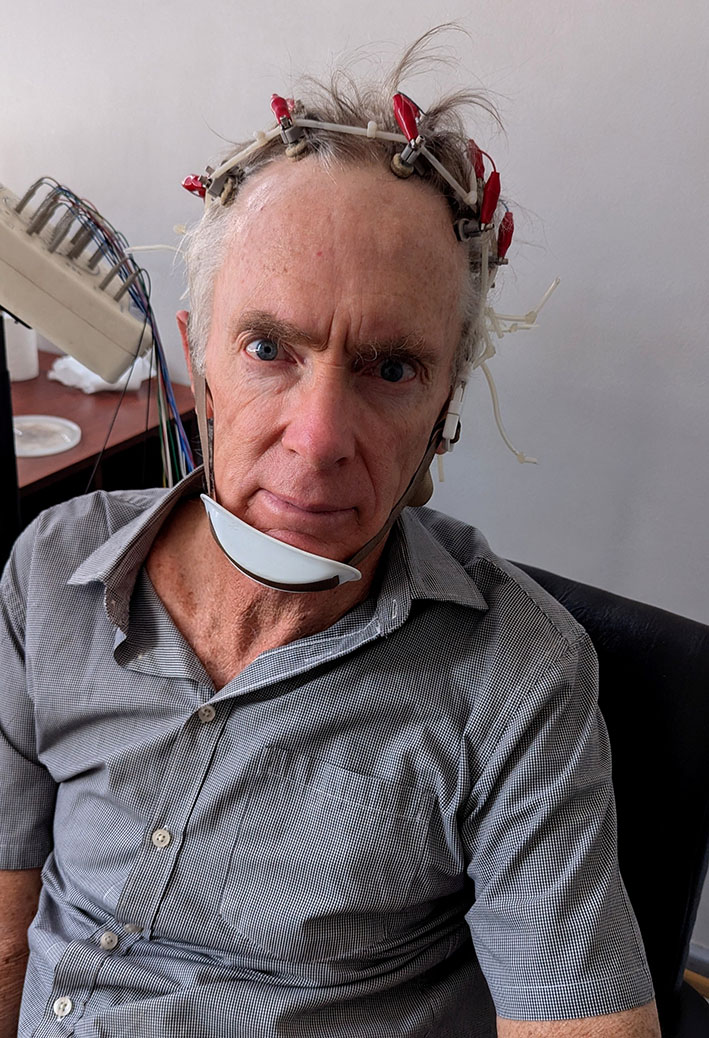
The author – all wired up

I have to marvel at the irony: there was I, having just had the electrical output of my brain recorded by EEG and there was no electricity to operate the lifts to take me back down the three floors to the building’s exit. Of course there were stairs but as a disabled person I find them a challenge. Some challenges I enjoy – others just have to be endured – so ignoring a staff member’s suggestion that I wait out the outage, which could be minutes but more likely will be hours, I start down the stairs.

The drive into town is remarkable by it’s ordinariness – no stupid overtaking or creating extra turning lanes at the lights. It’s moderately heavy but flowing. I have memorized the route – it’s not difficult, King George Avenue through Avondale, over what was North Avenue (I couldn’t be bothered with learning the Mugabe era name changes) then second left into Baines Avenue and look for number 60.

Baines Avenue is about as grubby as expected with street vendors, dust and rubbish. I take in the Canadian Embassy across the street (most other embassies are further out of town) but don’t have time to do more than glance before a self-appointed parking attendant asks me where I want to go and waves me into an empty parking bay some 30m from my destination. He is missing teeth, untidy but pleasant. I ask his name and forget it but know that he’ll be there when I come out, hoping for a tip.

It’s a short walk past the vendors’ wares of fruit in season, toilet paper bundles and sticky drinks. There are pineapples and papaya (pawpaw in the local parlance) and bags of ready-to-go peas in the pod with a chili pepper in each bag. The foyer of number 60 is clean and I ask my way to the lifts. Arriving on the third floor I have to pay attention to the PVC tiles that have lifted and are loose. The doctor’s rooms are clean and well-maintained.

Doctor G the neurologist, is a pleasant, very slender, small man in his 50s. We discuss my epilepsy which was initially diagnosed as POCD (post operative cognitive dysfunction) after a lower spine operation some three-and-a-half years ago. The diagnosis was changed to temporal lobe epilepsy when the seizures continued after the two year limit. I decided to see a consultant physician with an interest in epilepsy who starts me on a course of lamotrigine which is the medication of choice for this type of seizure – focal onset aware (or simple partial). An EEG was done which the physician assured me indicated that the medication was working. The seizures became focal onset impaired awareness (or complex partial) and the medication was increased. The seizures changed their nature again. They were the typical “petit mal” seizure, which are preceded by an aura where I can sense a strange taste or smell or hear a woman talking following which I go into a state of “absence”, where I am aware of my surroundings but cannot remember what they are. Now they become a partial complex seizure which last longer. A full suite of tests is ordered. All are normal save for the MRI which shows that the right temporal lobe of my brain is smaller than the left. It’s not progressive. The medication dose is upped again. The seizures, such as they are, change again.

One day at work I cannot remember how to walk down the stairs from my office which is a major problem for me as a disabled person who has to think about every step. Dr G is fascinated and tells me what it’s called (no I cannot remember that either!). These seizures or episodes are no longer momentary – this one lasts several hours and I’m only aware that there’s been a problem when I stand up from the table on the verandah and realize my mind is clear. I mention that I am making a lot of silly errors in the programming that I do for my work software. Dr G misunderstands and thinks that I have taught myself programming recently (I learnt at university) and comments: “At least you can still learn something new – I have never learnt to swim. Years ago my son said to me – Dad it’s easy, you just have to float. My reply was – if it’s so easy why do so many people drown?”. I like this man.

Dr G comments that the lamotrigine is not working as it should but before changing the medication he recommends doing another EEG. I remark that it sounds a lot better than the neurosurgeon who referred me to him whose parting words to me were – “of course the only permanent solution is surgery”. I tell this to Dr G, he smiles and says “that procedure requires very precise measurements”.

The EEG technician is available so we do the EEG right away. I am required to keep my eyes shut for most of the hour. I don’t fall asleep because the chair is so uncomfortable. I ask him how long it will take to analyse the results. “A while” he replies. “There are 360 pages to go through”.

The staircase takes a while to negotiate. Fortunately someone offers to help and I ask her to take one of my walking sticks down so I can use one hand on the railing.

The informal parking attendant is hovering near my pickup truck. Next to my truck a person has his laptop out on the boot of a car and is listening to a smartly dressed gent in a black suit talking intently on his cellphone. The car-watcher reminds me as I get into my truck that he’s hungry. It’s not very subtle but I don’t mind and give him $2.

The drive back home is as uneventful as the one into town.


Running dry

6 07 2025
Replacing a borehole motor in a borehole that ran dry

That the borehole motor was burnt was obvious. The metal casing was blue, there was oil in the water and it wasn’t pumping water. But the reason? The borehole in question has given me endless trouble. It has gone through more than a few motors over the years. We thought we’d finally got it solved last year when it became evident that the old steel borehole casing had rusted away and was collapsing and dumping mud into the pump. It was re-lined with a PVC liner, the pump and motor replaced and I thought our worries were over for the foreseeable future. I was wrong.

Marianne suggested I try contacting Allan, listed on my phone as “Borehole Repair Recommended”. When I described the problem he was straight forward – “Is the pump protected against running dry?” When I answered in the negative he said “That’s your problem. The pump controller you have installed does recognize when the pump is dry but it doesn’t work that well and the pump inevitably cooks. At this time of year (it’s winter and the dry season) the water levels drop and the pumps inevitably run dry. Get yourself a smart controller with liquid level detection and your problems will be over”.

There’s a irrigation equipment supplier close to my business so I paid them a visit to get a new motor and whilst there asked if they had an intelligent controller. Whilst perusing the manual I noticed Nathan, a plumber, who’d done the plumbing on our new on-suite bathroom, was also there. When he heard what I was looking for he recommended going to a nearby hardware store for the controller – “I have personal experience with them and I know they work” he added. I took his advice and installed the new pump and controller and, after decoding the bad Chinese English in the manual, managed to get everything working.

A mere two weeks later Fabian (one of the foremen who does the maintenance amongst other tasks) came to me with a long face and reported that another borehole had stopped working. I told him to get the pump and motor up and sure enough, the motor had all of the characteristics of being burnt. Another trip to the supplier, more cash changed hands, and this time I came away with a replacement motor and two intelligent controllers – including one for the third borehole that I was hoping to preempt the motor burning out.

It all seemed straight forward at first – after all we’ve had plenty of practice at getting borehole pumps and motors up and changed. This one was no different but the intelligent controller just wouldn’t cooperate. The motor drew current like it was working but nothing else happened. Allan was mystified – “I’ve never had a problem like that” so I just had to take a deep breath and book one of his teams to come out this Friday and have a look.

Driving back from work at lunch time I took a more scenic route than usual past the old Mount Pleasant golf course. It hasn’t been used for that purpose for many years now and is largely over grown. It’s not prime development land being low lying and very wet in the rainy season so is untouched – for now. Houses adjoining the area seem to have good ground water and sprinklers were merrily whirring over verdant verges oblivious to (or ignoring) the Harare City Council’s directive that it’s illegal to do so for, make no mistake, Harare is running dry.

Harare’s main water supply is Lake Chivero to the south-west of the city. It is downstream and it doesn’t take a lot of imagination to grasp the scale of the pollution. It’s nothing new, as an eight year-old child I attended a sailing school on the reservoir and can remember a deep revulsion of the state of the water. It recently made headlines when four rhino and various other animals at a lakeside national park were killed by the polluted water. Very little of the available water in the lake now makes it’s way into the Harare water supply. It requires pumping and there’s seldom power to do that and the water purification works have long ago fallen into disrepair. So in true Zimbabwean fashion we’ve had to “make a plan” – usually in the form of having a borehole drilled. That of course is no guarantee that it will not be dry (and most are) but for those of us lucky enough it can be a massive relief and money saver. The unlucky majority have to rely on the burgeoning water supply business and at US$50 for 5,000 litres it isn’t cheap. Water tankers are ubiquitous on the streets and come in all shapes and sizes. Some are made for the purpose but most are just plastic tanks strapped onto disheveled trucks. They source their water from outside the city limits.

Nathan is succinct – “Harare will run dry in five years at the most”. We are luckier than most in having a working borehole but it is not prolific. Tested at 1,000 litres per hour we don’t push our luck and the lawn dies off in the dry season. This year we’ve pumped the swimming pool dry (it’s filled with rainwater runoff collected off the roof) so that we can get the leaks fixed and the pool tiled. Grey water from the kitchen and shower is collected and used on the garden too. We keep our fingers crossed and try to balance having a nice garden without having to recourse to buying in water.

That there is no interest on the part of the government in changing the situation is best summarized in a conversation I had with Anton, my personal trainer, at a nearby gym. His wife, also a person trainer, used to have the Egyptian ambassador as a client. She, the ambassador, told Anton’s wife that Egypt had offered to completely rebuild the water treatment works at Lake Chivero. It would have been a gift from Egypt to Zimbabwe. The Zimbabwean government turned it down; there was nothing in it for them. The ambassador commented that she’d worked in a number of African countries but had never encountered one in which the government cared less for it’s people.


A storm approaching

31 03 2025
Storms develop south of the local microlight club where we fly model aircraft

“Nah, it’s a ZANU-PF problem, they must sort it out themselves” Fabian responded when I asked him if he was going to join today’s protest march in the centre of Harare. Fabian was a non-combatant porter in Robert Mugbe’s ZANLA army as a young man in Zimbabwe/Rhodesia’s bush war which ended in 1980. He has little time for the ZANU-PF political party that Mugabe founded.

The current Zimbabwean president, Emerson Mnangagwa, is looking to extend his presidency to a third term of five years. Zimbabwe’s constitution forbids this and protests have been planned for today which will be spearheaded by Blessed Geza who was a ZANLA veteran. Not surprisingly this has led to accusations of treason from Mnangagwa even though demonstrations are allowed under the constitution. While a lot of Zimbabweans are thoroughly fed-up with an inept and kleptocratic government the cynics are saying that it’s just a changing of the guard – a different herd of snouts to the trough.

Last week saw amoured cars and troop carriers on the streets in an attempt to intimidate would-be protestors. There were road blocks manned by police stopping traffic going into town though yesterday evening, when I came back from the airfield, the one on the main road in had packed up.

The organizers of the protest were clear in their instructions to the general public; stay out of the city centre though this may have been disinformation by the government. Schools are shut today and most businesses are closed or working with reduced staff. There was very little traffic about when we went out to walk the dogs on ART farm. My business is working on essential staff only as we really didn’t know what to expect.

There were videos on social media this morning of protestors starting to march into town. They must have been aware that the last time this happened it all turned nasty when the army opened fire killing six. This is not like Turkey at the moment where thousands of students are gathering every evening to protest the collapse of the country’s democracy. They only have to put up with tear gas.

On the way back home I stopped at a local hardware store to get a jerrycan for my paramotor fuel. “Have a nice day” the cheerful teller girl said as I was leaving. “Yes”, I replied, “and tomorrow we’ll have a new government” giving her a large wink. She giggled, “So, what are you doing here then?” was her response.

It did rain last night. In some areas the storms were violent but here it was just 14mm of rain. Enough to make us thankful for the 4×4 capability of my truck on the very sticky ART farm roads.


Getting it done

16 07 2024

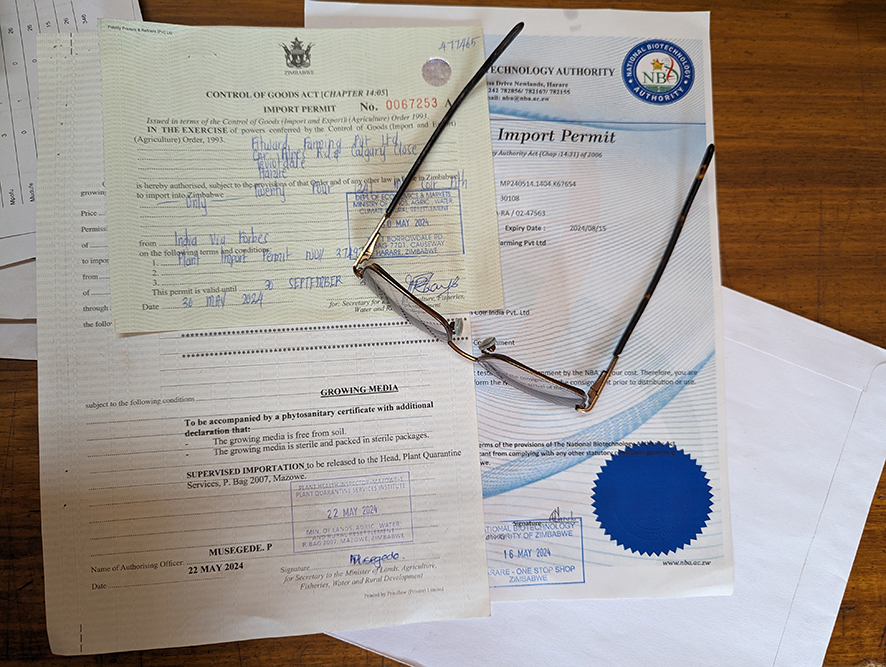
Just part of the paperwork necessary to import the coir pith essential to my business

It’s not something I look forward to but the coir pith on which my nursery depends for growing seedlings is essential for a good product. Yes, another substrate – composted pine bark – is available locally but last time I tried it some 20% of my seedlings died from the disease it carried. So about once a year I just have to grit my teeth and jump through the bureaucratic hoops. To be fair it IS becoming a bit easier as more of the government agencies involved get online and organized.

First off is the Agricultural Marketing Authority. I have no idea what they do but membership is essential and nothing else is achievable without it. Fortunately it’s doable online. Then it was on to the National Biotechnology Authority to get a permit that acknowledged the import was free of GMOs. The Indian supplier had given me a certificate stating as much and though it didn’t look very authoritative to me, it was sufficient and upon receipt of the required payment the local certificate was duly issued.

I have done the Ministry of Agriculture for the importation permits before and found it beyond tedious so sent Fabian, one of my senior staff, down there with some smaller US dollar note and instructions to “do whatever it takes” to get the first certificate. It cost him five dollars to put in the application whilst the official concerned was “on lunch break” and then all I could do was wait.

Fortunately the container was being delayed en route from Sri Lanka. I have no idea why it had to go via Colombo but I guess getting a full cargo of containers to warrant a ship going into the port of Beira in Mozambique takes some organizing. That was just as well as the first permit took two weeks, the date stamp indicated it had been sitting on an office desk for one of those weeks, and the second permit took another 10 days. That also required a sweetener of a few dollars.

By this stage I’d already paid the port and transport fees, all US dollars, and the race was on to get the local documentation to the border post near Mutare in the east of Zimbabwe before the truck from Beira got there. If we were late demurrage would be charged and I’d experienced that to my cost before. Fortunately my local shipping agent seems to know a lot of people and he got the money there just in time.

Then it was just a case of waiting for the truck to arrive and organizing a forklift to offload the pallets. It was three weeks late and in the interim I’d had to buy two pallets from another local supplier who’d marked up his prices 100% (he vehemently denied this even when I told him I new what it cost) but at least it’s over for about another year.

Now that the final accounts are in I can see that the costs were close to last year. The total for 24 tonnes of coir was US$19,650 which works out to 81.8c per kg. For some strange reason my bank needed to pay for the coir in Euros, I have no idea why but I do know that payment had to go through a South African bank. The rest was all payable in US dollars, none of the Zimbabwean kind thank you very much.

Yes, Zimbabwe is still trying to get its own currency up and running. It’s called the ZiG which is not the name of a cartoon character’s best buddy but is short for “Zimbabwe Gold”. It’s apparently linked to gold bullion of which the Reserve Bank is holding. Nobody is actually sure if this is the case but the official rate is around 13.8 to the US dollar.

When the ZiG was first introduced the obvious happened; currency traders spotted a good thing and the rate soon began to run. The government got tough and threatened a US$10,000 fine for any company or person not using the official rate – by law you have to accept either the ZiG or the US dollar if that’s how a customer wants to pay, the one exception being fuel traders who are not obliged to accept ZiG. Fortunately for my business most customers are uninterested in using local currency and choose to pay in US dollars, usually using cash. The local currency received has been entirely electronic – I’m not sure if this is by design – and I have yet to see any local notes. It is certainly not difficult to get US dollar notes out of my local bank and even small denominations are often brand new and in their 100 notes wrappers.

The country’s roads are in a disastrous state at the moment, bearing witness to years of neglect, but there’s a regional conference of the SADC (Southern African Development Community) in August so there’s been an orgy of road repair in Harare during the last few months. Construction teams have been called back to Harare from the outlying projects to concentrate on the local roads. Chaos has ensued as roads are closed and heavy traffic routed through the suburbs.

Some actions are unsurprising, others beggar belief. People living along the main route to the new Chinese-built parliament house where it’s all going to happen have been offered free water, delivered by tanker, to help make their gardens look pretty for visiting dignitaries.

The new dual carriageway to the parliament is being lined with kerb stones that make sure that there is nowhere to pull off the road if one has a breakdown. A local farmer, who lives on the route, pointed this out to one of the construction teams and was assured that it was a temporary arrangement and all the kerb stones would be removed after the conference. We’ll see.

A new bridge has gone in over a small river. They haven’t finished casting all the concrete and I’m told it takes a month to cure but the conference is in less than a month. Interesting.

An obvious question is where has the government suddenly found all the money? Are the construction companies actually being paid and what currency are they using? A friend is heavily involved in the landscaping of the new parliament and Marianne tells me she is being paid in US dollars and is doing quite well from it but rumours abound as to whether the others involved have been paid. I have heard that one company was owed some US$200 million which seems a bit much but many years ago I was told that a normal road costs US$ 1 million per kilometer to construct so perhaps it’s possible. Whatever the truth is you can bet the government will do whatever it takes to get the roads done and put up a paper-thin facade for the visiting dignitaries.

The nations hospitals would certainly like a bit of money themselves; currently several of the bigger ones are owed in excess of ZiG11 billion – a lot of money in any currency.


Caity and the ‘Cruiser

2 06 2024
Caity and the Land Cruiser – the ‘Cruiser is older by 10 years!

The Land Cruiser is a HJ60 model and to quote Chatbot AI: “The Toyota Land Cruiser HJ60 is a model of the legendary Toyota Land Cruiser series. The HJ60 was part of the 60 series Land Cruisers produced by Toyota, which were known for their ruggedness, reliability and off road capabilities.”

“The HJ60 specifically was equipped with a 4.0 liter in line-six diesel engine, which was known for its durability and fuel efficiency. It was produced in the 1980s and was popular for its performance both on and off the road. The Land Cruiser HJ60 was well-regarded for its robust build quality, making a favorite among off-road enthusiasts and those looking for a dependable utility vehicle.”

“The Land Cruiser HJ60 has since gained a cult following from its classic design and reputation for being virtually indestructible. It remains a sought-after vehicle for those who appreciate its ruggedness and timeless appeal.”

I bought my HJ60 some 14 years ago wanting to learn more about vehicle mechanics and ended up with a lot more issues than I’d bargained for. It was soon evident that the engine needed a lot of attention so I copied a DIY manual from a friend and got to work. The engine came apart and the block was sent off to have new cylinder liners (the very hard steel tubes that line the cylinders) fitted. The block came back and after putting it all together, it was with a great deal of satisfaction that it all worked, albeit with some minor tuning.

It didn’t last long, about 2,000 km. The engine stopped suddenly and after taking the cylinder head off it was evident that the liners had been badly fitted – number six had broken and been smashed into the crankshaft and all the others had cracks around the top. So the Land Cruiser sat for two years waiting for my sense of humour to recover.

“I have two second-hand engines from Japan sitting in town, do you want one?” Mark said over the phone. “One is regularly aspirated and the other is the turbo-charged 12HT, but it’s a bit more expensive” he added. By the time I’d made up my mind only the turbo-charged model was left so I went for that.

It turned out to be a fortuitous bit of dithering on my part. Mark, who is a 4×4 enthusiast and competent mechanic, fitted the engine and I’ve had a great, powerful, vehicle ever since. She’s been fitted with a long range fuel tank, Honda Fit intimidating bull-bars and a good sound system and a two tone paint job. I haven’t driven her for some years as she has a manual gear-box and I lack the capacity to use a clutch but Marianne, my wife, loves driving her.

She no longer does long trips and recently we decided to send her off to a local mechanic, who likes older vehicles, for a good going-over. “What a marvelous vehicle” Adam enthused when he returned her. “If you ever think of selling her, please let me know”.

As a disabled person I can get an automatic vehicle duty-free every five years. My Ford pickup is now six years old so I can get another (it doesn’t have to be new) and I suggested to Marianne that we give it some thought. It makes no sense to keep three vehicles so we’d have to get rid of the ‘Cruiser. “I think we should offer her to Adam first”, Marianne said, “at least we’d know that she was going to a good home!”.

I went to a local second-hand car dealer nearby to discuss the logistics of getting in a vehicle on my disability rebate. I asked him if I would be able to sell my ‘Cruiser. When I mentioned that it was an HJ60 he said “Oh, you’ll have no trouble at all moving it. They are still very much in demand”.

Caity is not a professional model though having done several courses she certainly knows how to pose. I didn’t pay her; she wanted to borrow a drone of mine so we did a deal. Adam’s parting words when he dropped of the ‘Cruiser were, “There you go, she’s good for another 20 years!”. I am sure Caity will still be looking good in 20 years too.


Getting old

25 03 2024

This is Claire. Claire is 78 and still teaching ballet. I am approaching 65 and not remotely as able as she is. Of course I have a few extra physical problems being a paraplegic that make me wonder just what life will be like when I get to 78. I am not looking forward to it though that’s easy to say from the safety of my age. 13 years ago 65 was too far away to be of much concern; that’s not to say I didn’t think about it, I just wasn’t able to envisage what life would be like.

Getting old in Zimbabwe is especially problematic. Nobody is going to look after you if you don’t have the money or children and that’s not a given. The state certainly won’t help. You’d better have made a plan and Marianne and I don’t really have one. We do have a two bedroom cottage in the garden which we rent out and when the time comes we’ll move in there and rent out our house. If, or when (if I live long enough), Marianne or I need care we are going to have to make an uncomfortable decision. I am sort of hoping that I will not live that long but talking about one’s death is easy until it actually looms. Given the state of the driving in Zimbabwe it might well happen sooner rather than later. This afternoon on the way to a function we had to take evasive action after an oncoming pickup truck decided to overtake into our lane.

Marianne went this week to see a potential customer for the medical insurance she sells. An elderly lady with glaucoma, she lives in a rented flat in a nearby retirement complex. The management had told her that she would have to give up her accommodation and move into the frail care section. She was incensed and in the end decided to move to her children in South Africa. At least she had the option.

Old age has a checkered relationship with my family. My father was murdered in the Rhodesian war at 52 (he broke the rules and paid the ultimate price) and my mother died at 67 from a misdiagnosed melanoma. My sister died at 62 but my aunt (mother’s sister) turns 95 next month and is bright as a button and still lives in her own house 25 minutes away with a couple of domestic servants to help her. Her oldest brother lived to be 94 and, while still mentally active, ended his days miserable in a care home in the UK. Her other brother died of cancer in his 70s.

Last year after a series of “seizures” I underwent a battery of medical tests. They showed nothing untoward and the physician held up my results of the neck scans on my blood vessels and remarked; “Well, whatever eventually kills you it won’t be your heart – you have the vascular system of a teenager!”. I wasn’t sure if I was pleased or not. A number of friends over the years have succumbed to heart disease and from what I have heard it’s not a bad way to go. Here one moment, gone the next. Dementia and it’s variations; now that DOES scare me! The seizures, episodes of confusion and disorientation, were eventually put down to post-operative cognitive dysfunction (POCD) which was likely caused by the heavy general anaesthetic I’d received whilst undergoing lower back surgery, as a result of the original war injury, two years ago. The physician told me it could last up to two years.

The two years is up next month and the seizures have continued unabated. They come in clusters every six or eight weeks and can be very worrying. After a particularly intense one where I asked Marianne what the name of one of our dogs was and then couldn’t remember where a computer shop was near a bank I use, I decided it was time to go back to the physician. He listened to my account of the seizures, asked questions, and then said “That sounds a lot like temporal lobe epilepsy and, given the fact that last year’s scans showed up no abnormalities, I don’t have any idea what could have caused it”. I have been prescribed medication but it will take some time to work up to the full dose and then see if it works. Worldwide there are an estimated 50 million sufferers of the condition.

My mobility is dismal. After university I cycled across France, Switzerland and Germany then back to the UK (see Reflections on the first half). Then I went traveling around the world. I needed a walking stick and I could carry my own backpack and was independent. Now I need two walking sticks and if I fall over I struggle to get up again without help. I am very glad I went traveling whilst I could. I have come to accept that I am going to need a wheelchair in the near future. I customer did send me some photos of an electric golf cart which he thought might be useful for me to get around in at work but I thought it over the top.

I was never very concerned about falling over until Karole came to visit me at work recently. She was in the St Giles rehabilitation centre at the same time I was – she’d fallen off a horse and sustained spinal injuries that left her with a disability similar to mine. Having spurned walking sticks for years she now uses one and recounted how getting into her car recently she’d fallen over and fractured a hip. She showed me the X-ray, it was spectacular. It’s made me much more cautious to the point of paranoia which is not helpful.

I also met Terry in St Giles. He’d been paralysed in a military parachuting accident and, unlike me, had totally lost the use of his legs. We became good friends and he used to tease me and say that I was just a “weekend para”.

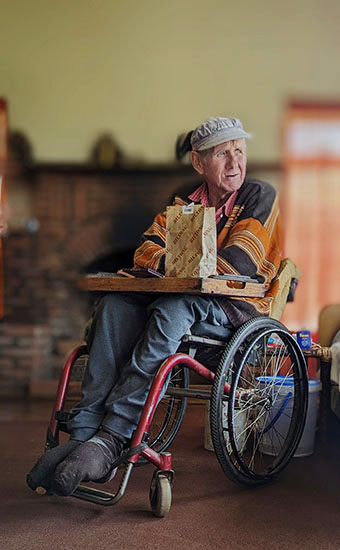
Terry – my paraplegic friend

Also unlike Terry, I don’t suffer constant pain. Some days are bad though and I do remember the pain-free days, but in general I don’t have major issues. I do go to the gym four days a week, two under the supervision of a physiotherapist cum trainer, to try and slow down the rot but that’s all it does. For the moment I will rely on my dog Themba to keep me a bit younger.

The young and the old


Letter to America – 2023

31 12 2023

26th December 2023

Hello Herman,

I am starting this while waiting for guests to arrive for lunch – my wife is an inveterate entertainer so needs little excuse to get friends around and of course today is a holiday so that’s what we are doing. Not sure when I’ll get to finish…

It’s an el Niño year so rainfall has been erratic so far; a heavy fall in October and then nothing for six weeks so crops are not looking great for those who don’t have irrigation available. There is a lot of fuss and bother in the various weather groups on various social media platforms whenever rain is forecast and then much soul searching when it doesn’t happen. People forget that forecasting is far more accurate than a few years back, even in this part of the world, and that hey, we get droughts in southern Africa! We have had 3 good years in succession and are due a drought, so all is normal in that respect.

I guess I could be cynical and say that the incompetence and corruption that we see all around us are also just about normal for this part of the world too. The road to my work is being resurfaced as we speak, and we are delighted but I fear there is an ulterior motive. The President has an interest in a housing development out beyond my business, and I think that is a prime motivation. Just by chance it goes past a big rubbish tip project that one of his sons has taken over. It looks like it’s being run properly, now we just need to get the city council to collect our garbage on a regular basis. Roads elsewhere in the city are in a dismal state and it’s not uncommon for local communities to take up the challenge and fill in the potholes on their own initiative.

I have just read in an article in The Economist that Indonesia built 300,000km of roads in the last 10 years. It is of course a vast country, bigger than the USA, but there’s an example here that our government could follow.

Zimbabwe is still in the bizarre situation of having two currencies: our own dollar and the US dollar. The local dollar is treated with contempt by all except the government who have just brought out a proposed budget with LOTS of zeros involved (the street rate for conversion is around 7,000 local dollars to the US dollar – officially it’s 6,000). Various members of parliament refused to vote for the budget to pass unless, amongst other demands, they got new 4×4 Toyota Landcruisers so that they could get over bad roads to visit their constituents. Nobody pointed out that the roads were such a mess in the first place due to the inefficiency and corruption. Fortunately, there were other bad ideas in the proposed budget that were also ditched – an annual tax on houses over a value of US$100,000 being one of them. Who was going to do the valuation was never revealed and quite how they were going to get around bribing the evaluators was not discussed either.

My business plods along. It pays the bills and that’s about all. We are charging less than we were in 2014 largely due to the proliferation of small seedling nurseries around town whose quality is dismal and who almost certainly don’t pay tax and cut a lot of other corners, but we cannot compete with their prices. I suspect a lot of people either don’t know what a quality seedling is or don’t care. Our core customers are commercial farmers and I think most of them do appreciate our commitment to quality – well that’s what one told me last week!

Of greater concern is a building project encompassing two neighboring farms in the form of a giant wall. The farms have been “acquired” by Grace Mugabe, wife of the late president, and word is she wants to have a 700-house project built on the enclosed 400ha. The wall is quite something (it has been nicknamed The Great Wall of Pomona after the area) – it’s not visible from space but is from 5,000m altitude on Google Earth. It is 3m high, has a reinforced concrete core and a course of bricks on the outside and inside. I asked a constructor what it might cost, and he suggested US$300-400 per metre. Given that the whole structure is 9km long that’s at least $27 million! The enclosed area is a rough rectangle but the property on which my business is located is a triangle jutting into the northeast corner. The big question is: what will they do when they get to the triangle, will they go around (an extra 500m), or will the wall cut the triangle off? Grace Mugabe is close to the President so wields disproportionate power and probably could just take the property if she felt like it. Perhaps she will force my landlady to sell the property, so she gets the title deeds? We will find out within the next 3 months or so when the wall will get to our boundary.

Despite the poor performance of the Zimbabwe economy the building sector is booming. Likely it’s due to money laundering. Al Jazeera TV did a documentary series (“Gold Mafia” in 4 parts) on this and explained that gold was being exported illegally, mainly to Dubai, by politically well-connected fat cats who were then bringing the cash back with the tacit approval of the President who is taking a 15% cut. The money is then invested in construction projects. Indeed, the suburbs are thick with construction projects of various descriptions – apartments, shopping centres, restaurants – which are often approved without the consent of residents. One of my cousins is in a street which is fighting the proposed construction of a Chinese restaurant. The Chinese are our friends so it’s almost a given that they will get permission.

We are cursed in this country with a wealth of minerals, especially gold. It’s just about everywhere you care to dig. My brother came out from the UK in October and as part of our travels we took a trip through the village where my mother lived after my father’s death. It was established as a gold mining area at the end of the 19th century. The commercial scale miners have long since moved on but the small-scale miners are everywhere and the place is a rubbish tip. One can only but wonder about the mercury pollution and mining safety. Health and safety are not concepts they care about.

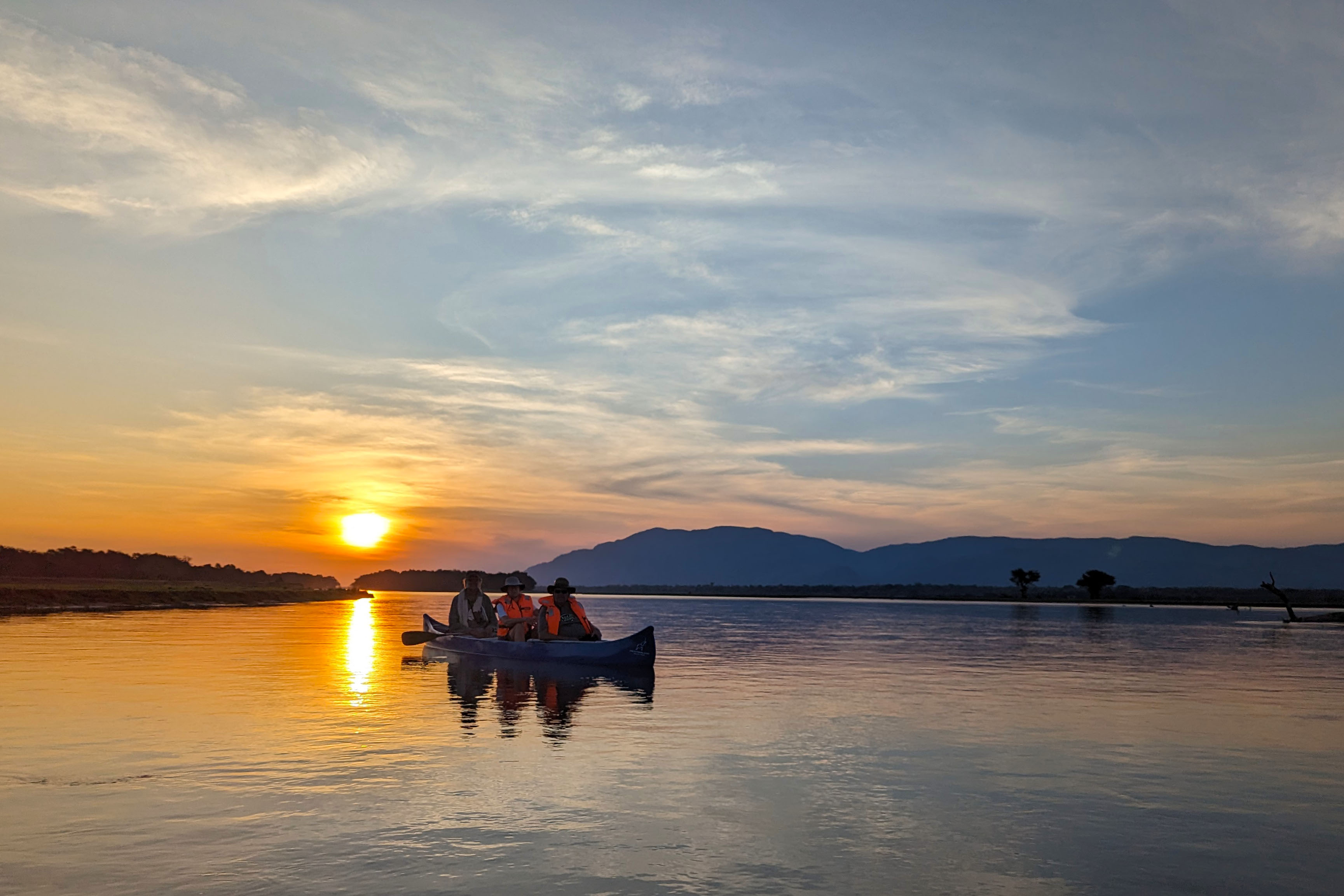
The countryside is still largely beautiful. We got invited to an old school friend’s safari camp on the Zambezi River in Mana Pools National Park. I guess it’s about 200km downstream of Kariba Dam. While the game was not as plentiful as it usually is at that time of year due to unseasonal rains, we still had a great time in a beautiful part of the country. Drifting down the Zambezi in canoes at sunset was memorable – crocs and hippos notwithstanding!

An evening drift down the Zambezi River

Earlier this year I had a bit of an “episode” early one morning. I can’t remember much about it but thought I should go to my doctor about it. She thought it was probably just what is known as Transient General Amnesia (TGA) but given my age thought it worth a spate of tests just in case it was something else. I had mentioned it to some friends of roughly my age and they both said they’d experienced it. Indeed, after much prodding, imaging and blood taking that conclusion was reached. The physician at the final consultation was impressed with the state of my health, structural issues notwithstanding, and commented; “Well, whatever kills you in the end it won’t be your heart!”. I wasn’t sure if that was good news or not – I am of the age now that how I “go” has become a subject of some importance and going quickly is the preferred option.

The degeneration of the structural issues necessitated a lower spine operation in April. It was deemed successful by the surgeon, but it necessitated 3 weeks of bed rest which have had a lasting effect on my mobility. The general anaesthetic also had a lasting effect in the form of POCD (post-operative cognitive dysfunction) which also causes episodes – a sense of disconnecting with the world which the physician said would eventually pass.

It’s New Year’s Eve now and fortunately it has stopped raining! Such is the erratic nature of the climate we find our selves in. The experts tell us it’s all symptomatic of climate change i.e. it’s becoming more extreme though I’d hesitate to attribute a few days of exceptional weather to that just yet.

So, what can we expect from the New Year? You have and election coming up, the Olympic Games are in Paris, the war will continue in Ukraine – the cynical French expression plus ca change, plus c’est la meme chose does come to mind!

Hope ’24 is a good year for you…

Andy


Taxed if you do, taxed if you don’t

26 08 2023

It had to be a mistake, I couldn’t possibly owe the tax department (ZIMRA – Zimbabwe Revenue Authority) that amount. Even if I converted it to US dollars it would amount to an impossible figure – about 17,500 at the unofficial rate and 23,000 at the bank rate. I checked the email address – it was from a person with whom I’ve corresponded over the years. Then there was the wording; FINAL DEMAND. Where were the other demands? I did what any sensible person would have done and contacted my bookkeeper in a state of panic.

Alison was more than a bit puzzled but told me she couldn’t do anything without seeing how they’d got the figures. “Your are entitled to see what’s going on” she said. “Ask them for the ledger”

The last part of the ledger

The ledger was duly sent and the waters immediately became a lot murkier. It stated the figures were in US dollars and the numbers, if the currency was US dollars, were impossible. I sent it on to Alison. It was a while before she came back to me by which time my imagination had run riot. What if I really did owe 105 million dollars? I would have to buy it on the open market with my US dollars and would be left with no operating capital and nothing with which to pay wages. The company would be unlikely to survive.

Alison assured me that the figures on the ledger were Zimbabwe dollars and I probably did owe the 3,835,807 listed. She had no idea where the 105 million came from. “Ask them” she said. So I did.

The reply was abrupt; the 105 million was to be ignored (RTGS is another way of saying Zimbabwe dollars). The amount on the ledger was also incorrect as it didn’t account for some US$550 that I’d paid in presumptive tax (they are called Quarterly Payment Due or just QPD) which would have reduced the amount owed close to zero.

I speculated to Marianne that it was all just a bit of psychological bullying to get me to pay attention to the outstanding amount, then two days ago I bumped into Gary whose wife had had a strikingly similar experience.

Gary works for a seed company that occasionally uses my nursery to grow seedlings for various trials. They have a trial on ART Farm which is a neighbour to my nursery and I sometimes use it access my nursery so as to avoid the appalling direct road and take in a bit of soothing farm scenery on the way. Gary was having a look at one of their trials near the road so I stopped to chat.

We discussed various things then I related my experience with the tax authority. He said that Clare, his wife who works as a bookkeeper for a local church, had received a final letter of demand for payment from ZIMRA for an impossible amount about three months ago. She replied that as a church they were not liable for tax and any money made was given away to various charities and nothing more was heard. He agreed with me that as the government was desperate for money it was likely endorsing ZIMRA’s intimidation tactics to get in whatever money they could, maybe they were even giving a commission.

On getting to work I related the story to my senior foremen. They were decidedly cynical. “They are all on the take” opined Chingedzerai. “Yes”, added Fabian, “they see the rest of the government officials stealing and think that they should have some of the pie too. They see what they can bully you into paying and then split the extra between themselves”. It was obvious that they thought I was being naïve.

Marianne had been doing some questioning of her own and posted my problem on the local community WhatsApp group. Someone had responded with a name and phone number of a senior official at ZIMRA whom he thought would be able to help. I gave him a call and related my problem and asked if it was official ZIMRA policy to send out threatening demands based on nothing much at all. His indifference was striking; I should send him a copy of all the correspondence and documents and he’d forward it to the relevant manager. I duly sent him the copies but I am not expecting a reply.

It’s no secret that Zimbabwe is in deep financial trouble. Mismanagement, corruption and incompetence have seen our GDP plunge after the Mnangagwa government took power in a coup back in 2017.

At the time it was welcomed by the majority of the population who were relieved to be rid of the much hated and feared Mugabe regime but it was not long before the new government of E D Mnangagwa revealed its true colours of repression and corruption. Chingedzerai reminded me that the current administration has never bothered to investigate the estimated US$15 billion worth of diamonds that went unaccounted for from the Chiadzwa diamond fields in the east of the country in the latter part of the Mugabe era. More recently there was the gold smuggling exposé by al Jazeera that showed how top Zimbabwean officials were, with the highest approval, smuggling gold out of Zimbabwe and laundering the resulting cash. Indeed, for a country that is struggling financially, there is an eye-opening amount of property development around town. In the past this would have attracted the attention of ZIMRA who would have demanded to see the accounts of owners of expensive properties and made to account for the development. Now it’s easier, and more personally profitable, to send out threatening letters.

I paid wages on Tuesday. We chose the date years ago when getting cash from the bank at the end of the month meant enduring long queues and not getting the desired breakdown. Chingedzerai had heard the income tax limits had been increased and asked me to check on the internet before he entered the attendance and overtime figures on the computer. I was fairly sure it was only the Zimbabwe dollar tables that had changed but checked on the US dollar tables anyway (I have been paying my staff in the latter currency since August last year).

In Zimbabwe salaries are taxed monthly and the system is known by its acronym PAYE; Pay As You Earn. The rates are iniquitous. Wages are taxed from US$100 per month upwards! Given that the minimum agricultural wage starts at US$60 before any of the required allowances, most of my staff are taxed. Some do get age exemptions but the rest of them have to endure.

Such is the government’s demand for money that it has taken to taxing money transfers at 2% per transfer. It goes without saying that most transactions are cash though it’s not always possible. The government used to tax cash withdrawals from banks but gave up when it became evident that people were simply not depositing cash in order to avoid paying the tax.

Given the high cost of living and taxation in Zimbabwe one would assume that the majority of the population would be keen for a change of government. Indeed, given that we had a general and presidential election on Wednesday, one could be forgiven for thinking it imminent. With the recent exception of Zambia, southern African is not known for changing its governments and Zimbabwe is not about to become an exception too.

My foremen and I were all in agreement on this; the incumbent ZANU-PF party, which has maintained its grip on power since 1980 by means mostly foul, will certainly cheat its way to victory; only the level of the fiddle is not known. So far it’s been “limited” to delaying delivering voting papers to polling stations in regions known to be opposition strongholds, sending voters to polling stations where they found they weren’t registered, making sure one couldn’t check the online registration database and of course blatant intimidation. Few, if any, believe the logistical problems to be anything but deliberate. We remain cynical.


Med-tech Zimbabwe style

5 04 2023
Zimbabwean medical technology can be surprisingly advanced – if you can afford it. This is a Holter ECG recorder.

“Enjoy getting the sensor off your chest” the nurse said and smirked. I didn’t share the humour and suspected this was why she said that shaving my chest before attaching the Holter ECG was unnecessary. At least she had a sense of humour.

I was strongly beginning to suspect the whole exercise was a waste of time and a not inconsiderable amount of money. The specialist physician who’d done the ECG and echo cardiogram had already said that all was normal as far as he could see and that only the MRI angiogram scheduled for the following week might show something. I left $810 poorer.

Last Friday morning at 4 a.m. I had to get up to go to the bathroom. When I got back to bed I asked Marianne what the bandage on my left ankle was for. It has been there four months for an ulcer. Not surprisingly she was concerned. The next three hours were a blank for me but apparently I repeatedly asked about the bandage and looked at my computer programming work and apparently recognized it. I have a vague recollection of asking who my doctor was and where the practice is located (which I have been visiting for years). When we visited the GP later that morning I asked Marianne to come with me just in case I missed something (not that I’d have had a choice!). We emerged 20 minutes later, blood sample taken and with a long list of tests to be done. It looked expensive.

Access to the Zimbabwe medical system requires a subscription to medical insurance and frequently quite large sums of cash as US dollars. The latter is often referred to as a “co-payment” which is another way of saying that “you pay us up front and then claim back from your medical aid/insurance company as we don’t have the patience to deal with their habitually late payments”.

First appointment was with a technician who was working out of his home with an EEG in his spare room/office. He told me that I most certainly had not experienced a Transient Ischemic Attack (TIA) otherwise known as a mini stroke and relieved me of $200. I noticed that he was fond of his dog so forgave him – mostly.

I haven’t seen the test results for the 72 hour Holter ECG yet but I guess they will arrive in due course. The record sheet that I had to fill in detailing any “out of the ordinary” experiences I left blank. There weren’t any.

Yesterday was the turn of a MRI-A (A is for angiogram) in my brain. I had to get there at 7.30 in the morning and forgoing my morning coffee – MRIs have a way of going on for a long time and I suspect the operators would have been unimpressed if I said I needed to use the toilet – I headed out early taking a big mental breath to deal with the morning traffic. It was all a non-event. I arrived early and one of the staff agreed that the traffic was unusually light. The MRI machine was new and made by Canon, the camera manufacturer. It only took 30 minutes then I was off to the Doppler ultra-sound of my neck vessels at another clinic occupied by the same company in another part of town.

They relieved me of $105 (yes, all fees were mentioned in advance and nobody mentioned the local currency – US dollars only) and then after a short wait it was into the examination room. I could just see the screen placed on the opposite wall for my convenience. The technician was not very communicative but did say he could see no problems. The machine made all the right heart noises too.

Now I have to go and see a specialist physician after the long Easter weekend. He will take $100 (he’s seen me before else he would take $200). He has a bit of a dour reputation but was also my physician for the back surgery a year ago and was very kind not charging for hospital visits once he knew I’d been injured in the Rhodesian bush war. “Because of people like you Mr Roberts, people like me got to go to medical school”.

I do have another off-shore medical aid scheme based in South Africa which will reimburse at least some of the costs. However they will only pay what the procedure or tests cost in South Africa which is often considerably less than in Zimbabwe. I’ll have to wait and see.

So what was it that I experienced? My sister-in-law Jane, who lives in the UK and is a better Googler than me, sent me this link which accurately describes it. It’s called TGA or transient global amnesia. It happens, it’s not serious and there’s nothing one can do about it.

On the way back from the gym this afternoon I drove past the local municipal clinic. Once a part of the primary medical care system designed as a first port of call for the average Zimbabwean citizen without access to medical insurance it is now nearly derelict. The gates don’t shut, there was one vehicle parked inside and not a soul to be seen. The last time it was used was for Covid vaccinations and that was sponsored by the WHO and other agencies.