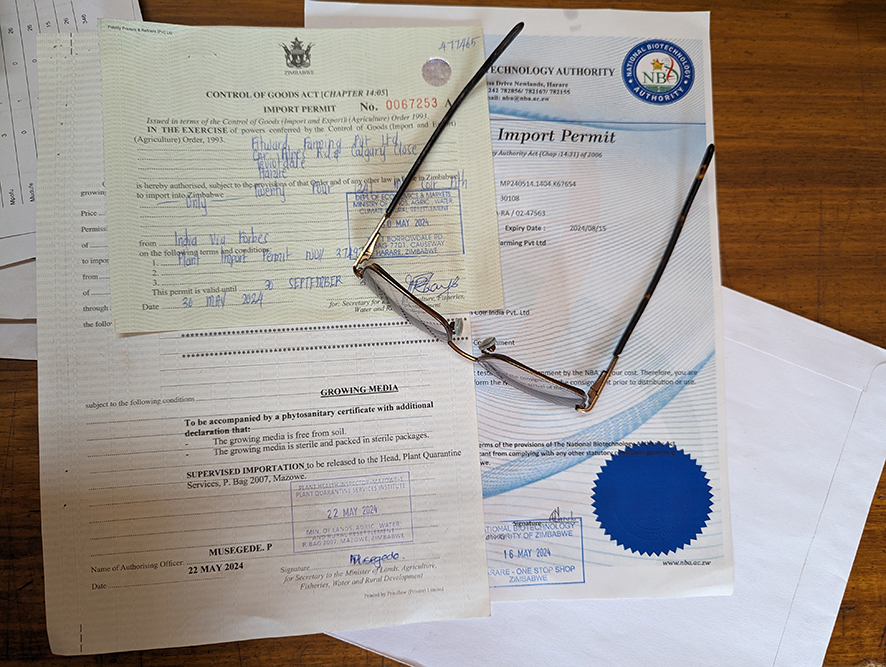
Just part of the paperwork necessary to import the coir pith essential to my business
It’s not something I look forward to but the coir pith on which my nursery depends for growing seedlings is essential for a good product. Yes, another substrate – composted pine bark – is available locally but last time I tried it some 20% of my seedlings died from the disease it carried. So about once a year I just have to grit my teeth and jump through the bureaucratic hoops. To be fair it IS becoming a bit easier as more of the government agencies involved get online and organized.
First off is the Agricultural Marketing Authority. I have no idea what they do but membership is essential and nothing else is achievable without it. Fortunately it’s doable online. Then it was on to the National Biotechnology Authority to get a permit that acknowledged the import was free of GMOs. The Indian supplier had given me a certificate stating as much and though it didn’t look very authoritative to me, it was sufficient and upon receipt of the required payment the local certificate was duly issued.
I have done the Ministry of Agriculture for the importation permits before and found it beyond tedious so sent Fabian, one of my senior staff, down there with some smaller US dollar note and instructions to “do whatever it takes” to get the first certificate. It cost him five dollars to put in the application whilst the official concerned was “on lunch break” and then all I could do was wait.
Fortunately the container was being delayed en route from Sri Lanka. I have no idea why it had to go via Colombo but I guess getting a full cargo of containers to warrant a ship going into the port of Beira in Mozambique takes some organizing. That was just as well as the first permit took two weeks, the date stamp indicated it had been sitting on an office desk for one of those weeks, and the second permit took another 10 days. That also required a sweetener of a few dollars.
By this stage I’d already paid the port and transport fees, all US dollars, and the race was on to get the local documentation to the border post near Mutare in the east of Zimbabwe before the truck from Beira got there. If we were late demurrage would be charged and I’d experienced that to my cost before. Fortunately my local shipping agent seems to know a lot of people and he got the money there just in time.
Then it was just a case of waiting for the truck to arrive and organizing a forklift to offload the pallets. It was three weeks late and in the interim I’d had to buy two pallets from another local supplier who’d marked up his prices 100% (he vehemently denied this even when I told him I new what it cost) but at least it’s over for about another year.
Now that the final accounts are in I can see that the costs were close to last year. The total for 24 tonnes of coir was US$19,650 which works out to 81.8c per kg. For some strange reason my bank needed to pay for the coir in Euros, I have no idea why but I do know that payment had to go through a South African bank. The rest was all payable in US dollars, none of the Zimbabwean kind thank you very much.
Yes, Zimbabwe is still trying to get its own currency up and running. It’s called the ZiG which is not the name of a cartoon character’s best buddy but is short for “Zimbabwe Gold”. It’s apparently linked to gold bullion of which the Reserve Bank is holding. Nobody is actually sure if this is the case but the official rate is around 13.8 to the US dollar.
When the ZiG was first introduced the obvious happened; currency traders spotted a good thing and the rate soon began to run. The government got tough and threatened a US$10,000 fine for any company or person not using the official rate – by law you have to accept either the ZiG or the US dollar if that’s how a customer wants to pay, the one exception being fuel traders who are not obliged to accept ZiG. Fortunately for my business most customers are uninterested in using local currency and choose to pay in US dollars, usually using cash. The local currency received has been entirely electronic – I’m not sure if this is by design – and I have yet to see any local notes. It is certainly not difficult to get US dollar notes out of my local bank and even small denominations are often brand new and in their 100 notes wrappers.
The country’s roads are in a disastrous state at the moment, bearing witness to years of neglect, but there’s a regional conference of the SADC (Southern African Development Community) in August so there’s been an orgy of road repair in Harare during the last few months. Construction teams have been called back to Harare from the outlying projects to concentrate on the local roads. Chaos has ensued as roads are closed and heavy traffic routed through the suburbs.
Some actions are unsurprising, others beggar belief. People living along the main route to the new Chinese-built parliament house where it’s all going to happen have been offered free water, delivered by tanker, to help make their gardens look pretty for visiting dignitaries.
The new dual carriageway to the parliament is being lined with kerb stones that make sure that there is nowhere to pull off the road if one has a breakdown. A local farmer, who lives on the route, pointed this out to one of the construction teams and was assured that it was a temporary arrangement and all the kerb stones would be removed after the conference. We’ll see.
A new bridge has gone in over a small river. They haven’t finished casting all the concrete and I’m told it takes a month to cure but the conference is in less than a month. Interesting.
An obvious question is where has the government suddenly found all the money? Are the construction companies actually being paid and what currency are they using? A friend is heavily involved in the landscaping of the new parliament and Marianne tells me she is being paid in US dollars and is doing quite well from it but rumours abound as to whether the others involved have been paid. I have heard that one company was owed some US$200 million which seems a bit much but many years ago I was told that a normal road costs US$ 1 million per kilometer to construct so perhaps it’s possible. Whatever the truth is you can bet the government will do whatever it takes to get the roads done and put up a paper-thin facade for the visiting dignitaries.
The nations hospitals would certainly like a bit of money themselves; currently several of the bigger ones are owed in excess of ZiG11 billion – a lot of money in any currency.







The end-of-summer garden
11 04 2021Aerial view of part of our property and house
It is the end of summer as I write this, the rains have come to and early end, and the garden is drying out and losing the vibrant green. The borehole has sadly not recharged enough to offset the previous 2 years of sub-normal rainfall so already we’ve had to start buying in water. This season’s rainfall was about average at just over 700mm so it’s been a good year for the garden.
We have 3 rainwater tanks of 5,000 litres each so for four months over the rainy season we were self-sufficient and the swimming pool has remained full thanks to the water harvesting system from the roof (blue pipes). We are being a bit optimistic by leaving the pipes in place but for the last 2 years we have had significant rain in April. Curiously we have had municipal water this month, albeit only a trickle, it’s been enough to keep the swimming pool topped up to the point where it can be filtered. It’s not to be relied upon as drinkable so it’s just as well that the borehole flow is good enough to supply drinking water.
That’s Zak lying next to the corner of the kitchen garden. He’s my three-legged Rhodesian ridgeback. You can find his blog here. That’s the remains of a cardboard box he’s lying next to – a dog toy. Not his, he’s so over that sort of thing, but Roxy or Tia’s. They are the others in the Roberts’ pack.
The solar panels we added and then upgraded a year after we moved in. It’s a total of 3,300 W which is more than sufficient to power anything we need during sunlight hours and the batteries can easily carry us through overnight if the day has been clear. The mains power supply is notoriously unreliable during the rains which is also the season of most cloud so we make sure we turn the mains on at night, to recharge the batteries, just in case. We use approximately US$1 a day of mains electricity.
The solar water heater is essential for any household in this climate. It’s so efficient that at this time of year the water frequently boils during the day. We do occasionally have to boost the heat with mains during overcast spells but it’s a comparatively rare occurrence – get one if you can.
Fuchsia on the verandah
Fuchsias, ferns and other shade loving plants thrive on the verandah which we added after moving in. The previous owners had zero interest in the garden and the verandah was just a concrete floor and some ugly walls which came down as soon as we had the money. In Zimbabwe we have fantastic weather (contrasted by an equally dismal economy) so it makes sense to spend as much time outside as possible.
Palms were an early acquisition to block out a very ugly electricity supply pylon. They have grown well and mostly fulfilled their purpose.
The veggie garden was also a new development on a vacant piece of the garden previously occupied by the remains of a car port. The garden shed was a car workshop. Veggie gardens are a bit of a luxury given that we have to buy water in and they don’t like waste water as we found out. Still it’s nice to go into the garden and select a succulent broccoli for supper
Mantis on a rose
Most of the roses came with us from the farm. Unfortunately they don’t always get the attention and water they need but can be spectacular.
A swimming pool was not on the list of essentials when were looking for a property. They are nice to have and I use ours regularly in the warmer months but they are a money sink in chemicals and this one leaks which is a pain. Despite lots of excavation and probing I’ve yet to find a leak. It will have a cover on it soon to reduce evaporation.
The avocado tree is a bone of contention. It doesn’t produce very good avocados and I have the means to top work (graft onto the existing tree) some really good quality cultivars. It means that it must be cut back and then for a few years will cast minimal shade. Marianne is allergic to avocados so she’s only in it for the shade but we have plenty of other trees that we planted after moving in (14 though we have cut down 6 that were in poor health) that are shaping up well.
View of the house looking north
Top amongst these is the Acacia (now Vachellia) abyssinica which has grown at least to 8m in the four years we have been here. We didn’t realize that it had been planted in the soak-away from the servants’ quarters and it grew so fast that it its second year it was knocked flat by a strong wind. A strong pole support for a year saw a full recovery and it’s already showing the flat top growth typical of its common name “Nyanga flat-topped acacia”.
The mulberry tree was inherited. It is prolific in production and growth. The latter is easily controlled by pruning and whilst I do really like mulberries, by the end of the season I’ve had enough. There’s only so many one can eat.
If it weren’t for the cottage we probably would not have bought the property. The main house was not in a good state and we gutted it of the lifting parquet flooring, repainted inside and out and re-tiled the bathrooms. The kitchen is still waiting. The house dates from 1960 and was built by a friend’s father and uncle. The cottage is relatively new and was built by the previous owners for their parents. It didn’t need much renovation and we lease it out. We will possibly use it when we retire and rent out the house. That’s a long way off, one doesn’t retire early (or on time by First World standards) in Zimbabwe unless one is financially secure and we are not.
Sabi Star or Impala Lily (it’s not a lily)
The kitchen garden is the site of an old garden shed in which was stored all nature of old engine oils and unknown substances. We tried using the soil but it had been poisoned so gave up and now everything is in pots or a custom-built flower bed of bricks. It’s home to kitchen herbs, lavender and an assortment of annual flowers.
I’ve always wanted a water feature and so the fish ponds were the result. They were stocked with some small gold fish types and various other fish that I sourced from my friend Gary in the border town of Mutare. There are even some sword-tails that can only have got there by mistake as I didn’t buy them. They are supposedly tropical fish but have proliferated in water that can get quite cold in winter.
A succulent of sorts
The fish ponds are surrounded mainly by aloes and other succulents that are hardy enough to survive with minimal watering. They’d better be hardy as they are not getting much water this coming year.
The main succulent garden (top picture) is situated in a part of the garden that has truly dismal soil. It’s full of aloes and other succulents that must do as they can to survive. Aloes are indigenous to Africa and the Arabian Peninsula so they should be OK. This year they have put on quite a show so far.
A showy cluster of aloe flowers
Sunbirds are nectar feeders and normally love aloe flowers but so far we have seen few. Maybe it’s because the garden has only become colourful relatively recently. We wait and hope.
Cosmos
Cosmos are also left to their own devices in the succulent garden. So far they have managed well. They survive well enough in the wild in the higher rainfall areas of Zimbabwe. Apparently they were introduced in horse feed to South Africa during the Anglo-Boer War. These were snaffled from an uncollected customer’s order at the nursery. One of the perks of being the boss.
Daisy-of-sorts
This is another uncollected order. It’s a daisy of sorts, we’ll see if it has what it takes to survive in the succulent garden.
Hoverfly on a daisy
Perhaps not surprisingly the insect life in the garden is not prolific and yes, I am frequently looking for photo opportunities. This daisy is something of a magnet for hover flies. Superficially resembling a bee it’s known as a bee mimic of which there are several. I do make an effort not to use “heavy” agro-chemicals on the garden to the point that the roses have suffered so I put it down to the newness of the garden.
The lawn is drying off and will in time go completely brown. It isn’t of course dead – come the next rains it will revive remarkably quickly. The kitchen garden will take a knock but be kept going by the waste water from the washing machine. Other ferns and things on the verandah will be kept alive no matter what. We’ll just have to hope the next rainy season is a good one and recharges the borehole but nothing is guaranteed in this part of the world – especially not the weather.
A gazania in the kitchen garden – fate uncertain.
The neighbours – I haven’t mentioned them. The one to the west has a husband who is a retired international cricket umpire. She makes ends meet by growing veggies for restaurants from the seedlings I supply her. We’ve never met the one to the north but I do have his phone number. I cannot show their gardens for privacy reasons but you’ll just have to take my word for it that there’s nothing illegal going on that I could see which was just about everything from the drone’s vantage point.
Comments : 6 Comments »
Tags: avocado, fuschia, mantis, rains, Zak
Categories : flowers, News & Various, photography, Social commentary