A storm approaching

31 03 2025
Storms develop south of the local microlight club where we fly model aircraft

“Nah, it’s a ZANU-PF problem, they must sort it out themselves” Fabian responded when I asked him if he was going to join today’s protest march in the centre of Harare. Fabian was a non-combatant porter in Robert Mugbe’s ZANLA army as a young man in Zimbabwe/Rhodesia’s bush war which ended in 1980. He has little time for the ZANU-PF political party that Mugabe founded.

The current Zimbabwean president, Emerson Mnangagwa, is looking to extend his presidency to a third term of five years. Zimbabwe’s constitution forbids this and protests have been planned for today which will be spearheaded by Blessed Geza who was a ZANLA veteran. Not surprisingly this has led to accusations of treason from Mnangagwa even though demonstrations are allowed under the constitution. While a lot of Zimbabweans are thoroughly fed-up with an inept and kleptocratic government the cynics are saying that it’s just a changing of the guard – a different herd of snouts to the trough.

Last week saw amoured cars and troop carriers on the streets in an attempt to intimidate would-be protestors. There were road blocks manned by police stopping traffic going into town though yesterday evening, when I came back from the airfield, the one on the main road in had packed up.

The organizers of the protest were clear in their instructions to the general public; stay out of the city centre though this may have been disinformation by the government. Schools are shut today and most businesses are closed or working with reduced staff. There was very little traffic about when we went out to walk the dogs on ART farm. My business is working on essential staff only as we really didn’t know what to expect.

There were videos on social media this morning of protestors starting to march into town. They must have been aware that the last time this happened it all turned nasty when the army opened fire killing six. This is not like Turkey at the moment where thousands of students are gathering every evening to protest the collapse of the country’s democracy. They only have to put up with tear gas.

On the way back home I stopped at a local hardware store to get a jerrycan for my paramotor fuel. “Have a nice day” the cheerful teller girl said as I was leaving. “Yes”, I replied, “and tomorrow we’ll have a new government” giving her a large wink. She giggled, “So, what are you doing here then?” was her response.

It did rain last night. In some areas the storms were violent but here it was just 14mm of rain. Enough to make us thankful for the 4×4 capability of my truck on the very sticky ART farm roads.


Whither the weather?

23 03 2025
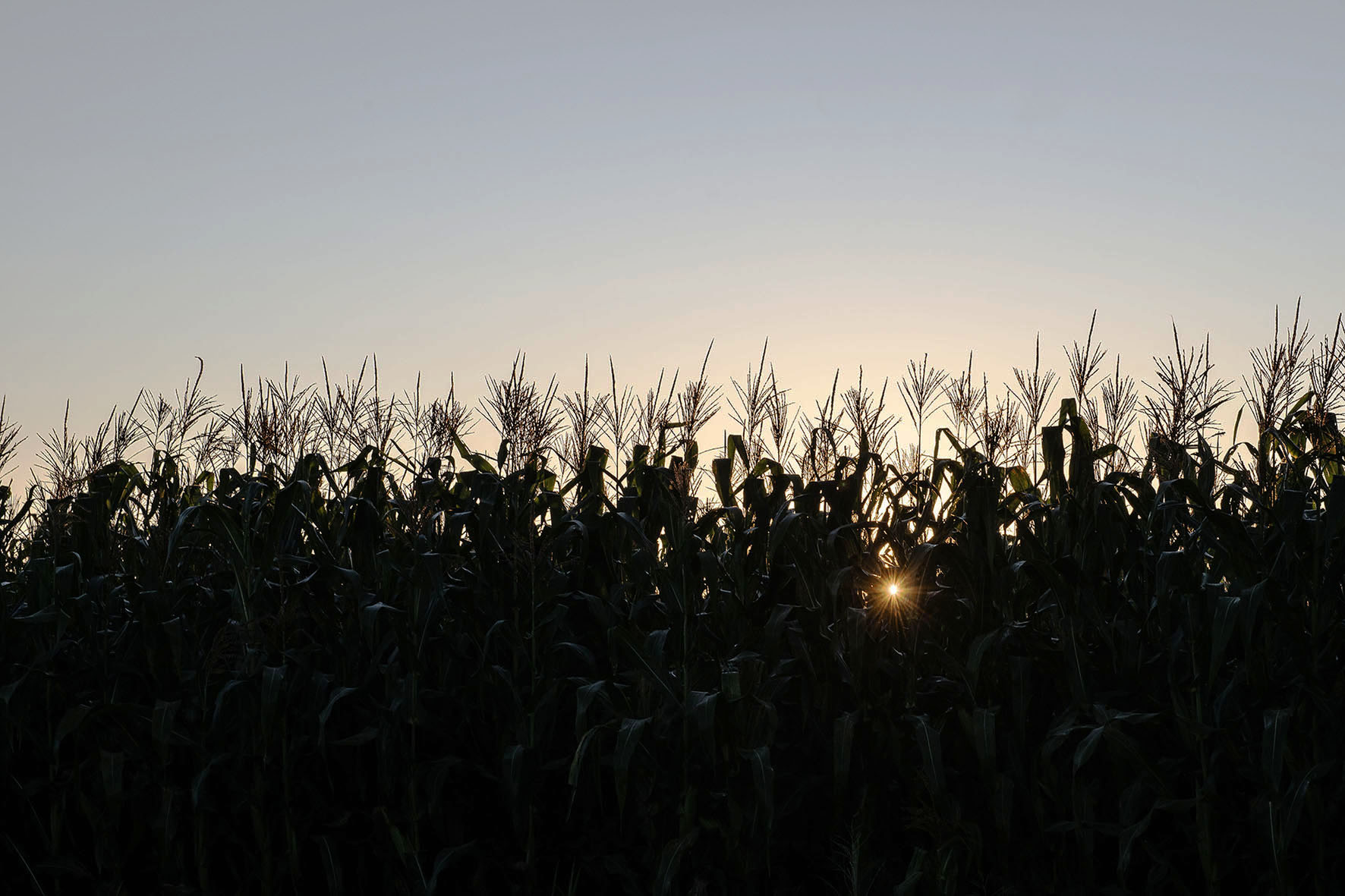
The sunrises over a decent crop of maize on ART farm. Not exceptional rains but enough.

It’s been a strange rainy season here in Zimbabwe. Our rains arrived pretty much on schedule in the middle of November but that’s about all that has been normal about them. The usually dry southern and south-western parts of the country have been inundated. The Bubye river, normally notable for it’s sand content has flooded. Lake Mutirikwe has actually spilled and the largest internal lake in the country (discounting Lake Kariba which is shared on the border with Zambia) VERY rarely spills. The Barotse Floodplain in western Zambia has lived up to its name and flooded and a Zambian-based colleague confirmed that most of that country has had good rains. That’s just as well, as it’s a major source of water for Lake Kariba which has been below generating capacity and has only been letting water downstream as part of an agreement with Mozambique on which Lake Cahora Bassa is situated.

The agricultural town of Chipinge is located in the south east of the country near the Mozambique border. Being on top of the escarpment on the edge of the Mozabique coastal plain, it gets a lot of rain. The climate is mild and the area is known for it’s avocado, banana, macadamia, coffee and other sub-tropical fruit farms. It’s also the home of the biggest tree in Zimbabwe, a red mahogany (Khaya anthotheca).

I was chatting to a potential customer from the area last week. Of course we discussed the rain. Up until December last year his farm had only received 200mm of rain. “Then it rained for three weeks solidly. Look, I’m not complaining but it was a bit intense. Now we’ve had 1,600mm!”

The rains here in Harare started pretty much as usual in mid-November but took a while to get going. The farmer on ART Farm where we walk the dogs in the morning took a chance by planting the commercial maize early but then had to keep it going with supplemental irrigation and even had to replant some lands when the irrigation couldn’t move fast enough. Elsewhere farmers were more lucky.

A decent crop of commercial maize. It’s seldom profitable and grown largely for political purposes – “Look, I’m doing my bit for the country”

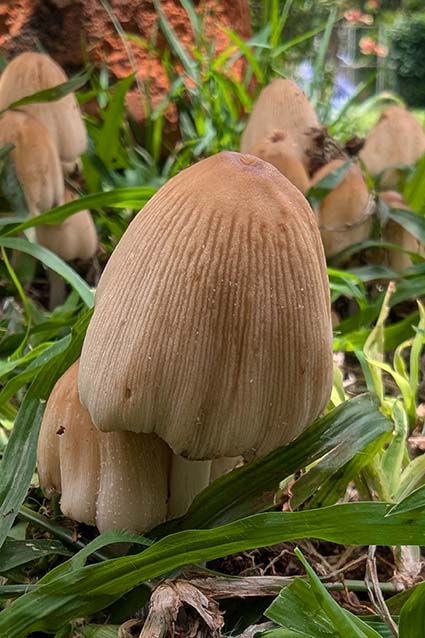
The rains have been regular enough to encourage fungi growth. Mushrooms have been regularly cropping up in our garden. Were they edible? I am not at all sure. As one wag put it; “All mushrooms are edible, but some only once”. I do have a book but am not at all an expert in identifying them and I wouldn’t trust Google Lens quite that far.

Probably not Chlorophyllum molybdites as it doesn’t have a green tinge. Bottom right is Agaricus bisporus, the common domestic mushroom, but it’s rather old.
Small and short-lived, these (unidentified fungi) regularly cropped up in the same place in the garden after a decent shower. By the next day they were gone .

Weather apps abound but they are notoriously inaccurate, at least in this part of the world. Marianne belongs to a WhatsApp group that shares rainfall information and the variations in rainfall just a few kilometers apart were often stark. Whilst it’s tempting to attribute this to inaccurate rain gauges and exaggeration tendencies, it cannot account for differences in excess of 100%. We’ve had 648mm to date, in a “normal” season we’d expect at least 750mm, whilst guests this afternoon said they’d had over 1000mm some 30km away to the east. Bill, the owner of the rain gauge that recorded this, did admit on being a bit skeptical as to its accuracy.

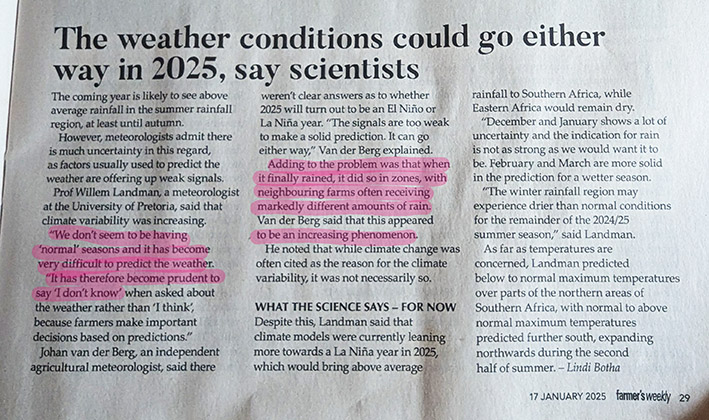
A January issue of the South African Farmer’s Weekly magazine echoes the inconsistency of rainfall over small distances and the increased difficulty in making accurate forecasts

I am not sure if the weather apps are more reliable elsewhere in the world but it wasn’t unusual to get a high probability forecast of rain to be greeted with a clear sky when it was forecasted to be raining. It did on occasion go the other way – heavy rain when the forecast was for clear skies.

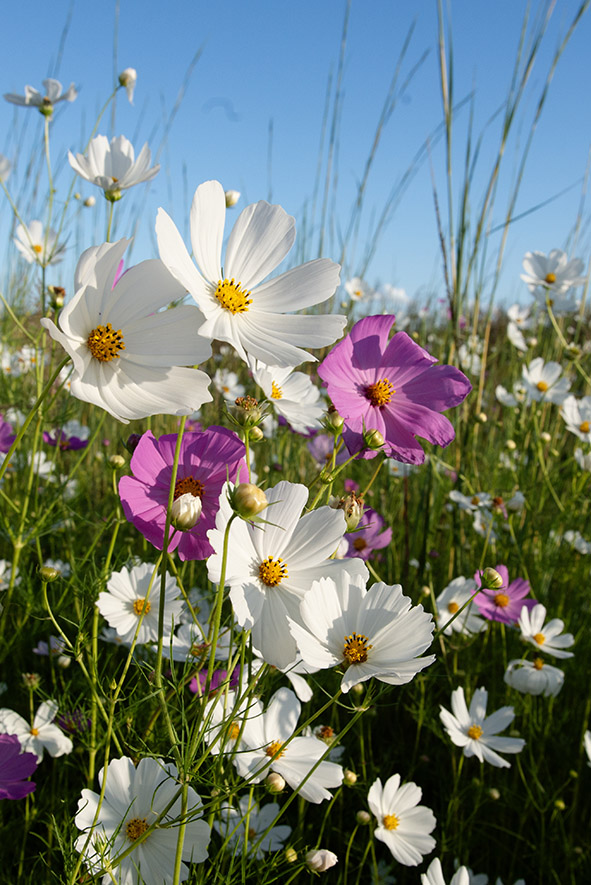
The grassland flowers have been spectacular this year. Admittedly the cosmos are usually spectacular so maybe it’s just my perspective. Every year I try to capture the intensity of the displays and inevitably am disappointed. Will give it another go next year!

Cosmos bipinnatus – possibly introduced in horse feed from Argentina around the time of the Anglo-Boer war in South Africa.

The yellow hibiscus below is indigenous to Africa, Yemen and India (and some sources say Australia) which makes me wonder if it goes all the way back to Gondwana, the super continent that began to break up some 180 million years ago in the early Jurassic.

Whilst not as intensely showy as the cosmos, the Hibiscus panduriformis is spectacular in its own way.

There is not a lot of information on the yellow hibiscus but it seems to be mostly nocturnal. The image above was taken at 6.20 a.m. and there is already a dead flower on the stem. From observing flowers by the road on the way to my work I know that by midday all flowers are gone. Apparently it’s relatively easily propagated from seed and cuttings so I might try establishing a few in the “wild” section of our garden.

As we approach the end of March we are unlikely to get much more in the way of significant rain though in April last year there was a 42mm on the 6th. This was unusual as it is normally a month of warm days and cool nights a plenty of sunshine. What most people would call perfect weather. We like a bit of rain with it too.


Getting legit

16 03 2025

She didn’t smile or even try when I greeted her with my cheery best “Good morning, how are you?”. I wasn’t too surprised; working in a windowless box in a government building in a dreary part of town would also have made me dour. I vowed to at least get her to smile before the session was over.

It was only when I went to renew my British passport before a visit to Cape Town in May that I thought to check up on my Zimbabwe passport that I knew was up for renewal this year. Oops, it had already expired. A phone call to a friend, whom I knew had renewed his Zimbabwe passport recently, and I was told it wasn’t too difficult at all and older folk like us even got to use the express queue. I didn’t even have to supply passport photos as it was all done “in house”. I waited until I had no more excuses then told Fabian, my company driver, that he was taking me into town.

It’s been a long time since I’ve been into the centre of Harare and I know that it’s run-down but it was still an education. The once pristine Harare Gardens are overgrown with weeds, the grass hasn’t been cut in ages and the children’s swings and roundabouts are falling over and in need of more than a bit of maintenance. Rubbish abounds.

We got to the entrance of Makombe House where passports are renewed and issued and other government business is done. We were stopped at the entrance amongst a crowd of touts, vendors of sticky treats and drinks, and other hopefuls. Fabian explained to the official in “control” of the melee that I was disabled and needed dropping off closer to the building and we were waved through.

I wandered into the first processing area I could see and looked lost. It wasn’t long before an official told me I was in the births registration area and was directed over to the passports queue. I joined what I thought to be the correct queue and was approached by another official who, after hearing what I needed, directed me to the Emergency Passports office. “Now we’re getting somewhere” I thought.

Fabian arrived from parking the pickup truck and provided valuable assistance. He went off to another office with the form I’d filled in and it soon emerged that I’d not brought all the necessary copies of documents; strangely they wanted to see a copy of my UK passport. It used to be illegal to have dual citizenship in Zimbabwe then a few years ago someone took their case to the constitutional court and it was found that it was not forbidden. Why they needed proof my dual citizenship I’m not sure. A hasty WhatsApp to Marianne and a photo of the relevant page arrived. I was charged 3 US$ for it to be printed out! Eventually all documents were deemed correct and I was shown through to the the windowless box for photographing and fingerprinting.

After trying and failing to get the fingerprint machine to record my prints, trying another office and succeeding we were back in the original box. Another official, slightly less dour, gave me a printout of my photo and personal details – which were wrong. I don’t have brown eyes or black hair. Well what little of the latter is still there is grey, as Fabian reminded me. I looked at the photo and said, in a loud voice, “Who IS this handsome person? I don’t recognize him!”. Both officials erupted in giggles which only got stronger when I added “So what is the joke?”. Mission successful.

A mere two-and-a-half hours after arriving I was finished. I turned down the offer of an emergency passport to be ready in 48 hours for an added US$100 and turned over a mere US$175 for the week later version. No-one asked if I wanted to pay in the local Zimbabwean currency.

On the way out of the car park we passed the original passport office. A colonial era building it was looking more than a little decrepit and didn’t look like it was being used for much. Curiously it still had the old Rhodesian coat of arms molding on the fascia and it had been painted in the not too distant past. We both chuckled at the irony.

The senior foreman at my work was not impressed at the cost of the passport. “They process a least 100 passports a day – what do they do with the 17,000 dollars? Look at the state of the roads and the general filth”. It’s just another symptom of the pervasive corruption that’s endemic in this country.


Progress? Well it’s all in the perspective

27 12 2024
ZiG – the notes that never were. There were 100 and 200 denominations too and unbelievably some coins!

Zimbabwe has two official currencies, the US dollar and the local dollar. The latter is officially called the Zimbabwe Gold or ZWG. It used to be called the ZiG (also Zimbabwe Gold as apparently it’s gold backed) but that’s no longer used by the government, perhaps it sounded too much like the cartoon character that it is. The general public still use the term “ZiG”.

That both currencies are legal means that one cannot refuse payment in either. This of course brings up the sticky issue of exchange rates. A visit to the Reserve Bank of Zimbabwe’s (RBZ) webpage is instructive. A one ounce gold coin is being sold for US$2,744 or ZWG70,723 which makes the exchange rate 25.77 (it’s tightly controlled). Last week I bought ZiG/ZWG at 34 to the US dollar off an informal dealer. Why? Because my business takes in so little ZiG and I wanted a cheaper way to pay off my electricity bill and there was no way I was going to pay US dollars for that appalling service!

Officially the ZiG month-on-month inflation is 11.7% (277% annually as calculated) and the US dollar inflation is 0.09%. Given that a US$ loan will cost 9.5% per annum that is very conservative. Interestingly, the US$ annual inflation is given as 3.28% but the ZiG annual inflation is not given – too embarrassingly high perhaps? Of course Zimbabwe has had problems with currency inflation in the past so it’s hardly surprising that they don’t want to repeat the 2008 debacle. The official ZiG to US$ exchange rate is enforced by punitive fines, in US$, so it was surprising that the RBZ suggested in October that they let the exchange rate run in order to maintain the public interest in the ZiG.

In 2008 we had a bad experience with Zimbabwe dollars…

Another way of stimulating interest in the ZiG – and I use the term loosely – is forcing the public to pay a percentage of their taxes in ZiG. The government excels at imposing taxes. There’s a 2% transfer tax on most currency payments and a 3% levy on withdrawing cash. Income tax starts at US$100 per month! Company tax is payable quarterly based on estimates and there are penalties for being inaccurate.

The ZiG, despite much fanfare at it’s introduction in April this year due to the ballooning devaluation of the previous currency, has never been issued in note form. This has insured that people use the banks as little as possible and keep whatever hard currency they have “under the mattress”. It’s not without risk of course – a recent fire at one of the big local markets destroyed a lot of people’s savings.

In an effort to streamline tax collection the local tax authority has implemented a system of tax compliance for retailers and wholesalers. They are now required to register with the authority (ZIMRA) and have a system whereby they are online to the authority and every sale is registered and a QR code is printed on the invoice at the till point/checkout. Yes, it actually does work – try pointing your smartphone camera at the example below. Fortunately everything my company sells is zero VAT rated (plants for cultivation) so it’s not a requirement for us.

A QR code verifies that the purchase is registered with the tax authority

The whole tax accounting system has been overhauled and now each registered company has just one account for both company tax and income tax. In the past there were two and managing the system was complicated. Now it’s so simple that I can almost understand it but prefer my bookkeeper to handle the returns. Progress? I guess it is in a way.

We haven’t made any progress in growing the economy. The budget speech by the Minister of Finance at the end of November is best described as entertaining. I quote; “The attainment of the projected 6% economic growth in 2025, will result in Zimbabwe being one of the fastest growing
economies in the region.”
This is despite “… the agriculture sector, which was initially projected to contract by -21%, is, now expected to contract by -15% on account of better than anticipated output on wheat and dairy.” It seems the Minister of Finance hadn’t read the RBZ figures because he says “…prices for goods and services have relatively been stable following the introduction of Zimbabwe Gold (ZiG) in April 2024. Month-on-month ZiG inflation declined by -2.4% in May 2024, and averaged 0.0% in the second quarter of the year.” The full speech can be downloaded here.


Georgina – a giraffe with paws

13 11 2024
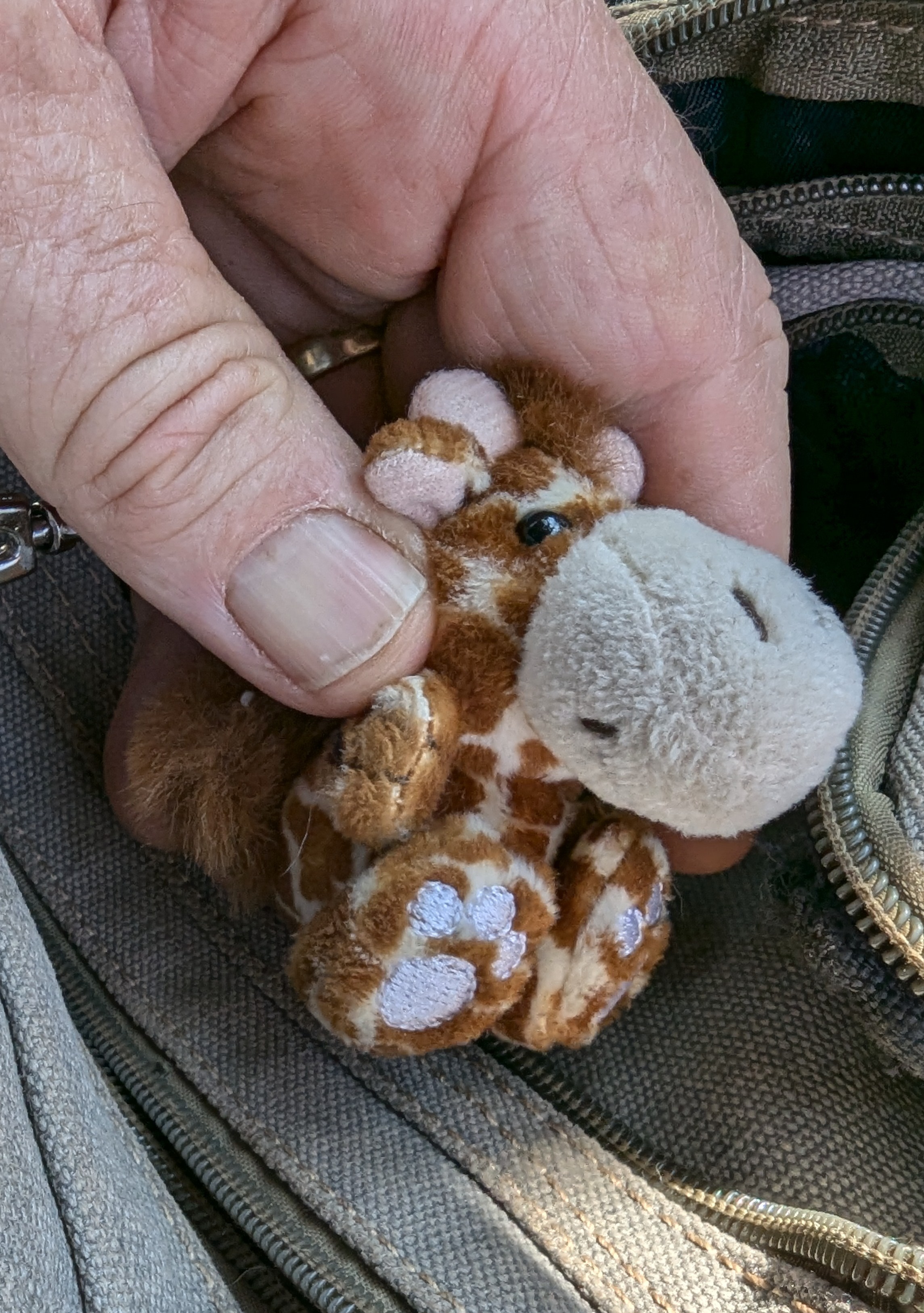
This is clearly a giraffe with paws

Marianne was delighted “They are still here, please pass me the credit card!”. She was back 10 minutes later with a selection of stuffed toy key-rings. On the way back through Jo’burg airport just over 2 weeks later she stocked up on some more. They all had paws too. There are nine hanging up in the dining room and they include two zebra, a rhino and an elephant – with paws.

I have to admit I do admire giraffes. Real ones that is. They are such elegant and graceful animals and can look after themselves surprisingly well. They key ring giraffe that Marianne gave me is not my first. I still have George my paragliding companion and mascot. He’s well-traveled and has flown on three different continents with me.

George in the high desert in California, 2002.

I was flying in the Owens Valley in California in 2002 when I “fell out of the sky” after having a major collapse of my wing in turbulence. Fortunately we were very high and I had plenty of time to throw my reserve but suffered a torn chest muscle and landed in very rough terrain. Other pilots came to my aid and after over-nighting in the mountains we had to get a ride out on a Navy helicopter. You can read all about it in detail here, but the most important bit was that George was there throughout, stoic and dependable.

George was also with me in Annecy, France when I went paragliding there in May 2004. I was waiting my turn on a takeoff when another pilot said in very broken English “I like your passenger”. I must have looked a bit blank until he pointed to George looking out of my harness backpack.

George, Nyanga 2015.

I don’t paraglide anymore, not because I don’t want to but because I need help in taking off and there’s no one else around to assist. I do have a paramotor though and get airborne in it far too infrequently though George doesn’t come along.

I have called the key ring giraffe Georgina and she is attached to the bag I carry around with my wallet and other stuff I cannot handle in my pockets. Yes, she has paws.


Rumours of rain

6 11 2024
Not a massively tall termite chimney but enough to start a rumour of rain

There is a common myth that circulates Zimbabwe at this time of year; if the termites are building bigger nest chimneys than usual then the coming rains are going to be good. Apparently the logic is that they want to keep their nests dry and so need the chimney to be above the water line. It’s more than a bit flawed thinking. A lot of nests are nowhere near any flood level, historical or otherwise.

This year the chimneys are perhaps a little more noticeable than usual but that might be my appalling memory (it’s genuinely bad as a result of a medical condition but that explanation doesn’t belong here). They certainly are not big by world standards – in Australia they are really big and their primary function is cooling of the nest. Maybe they have the same function in Zimbabwe but it hasn’t been particularly hot this year.

To be a successful farmer in Zimbabwe it pays not to rely on the vagaries of the weather and use a more reliable source of water. Hence irrigation is big business. That’s not to say that all farmers have the finance or the water source to irrigate and must rely, at least to some extent, on the rains.

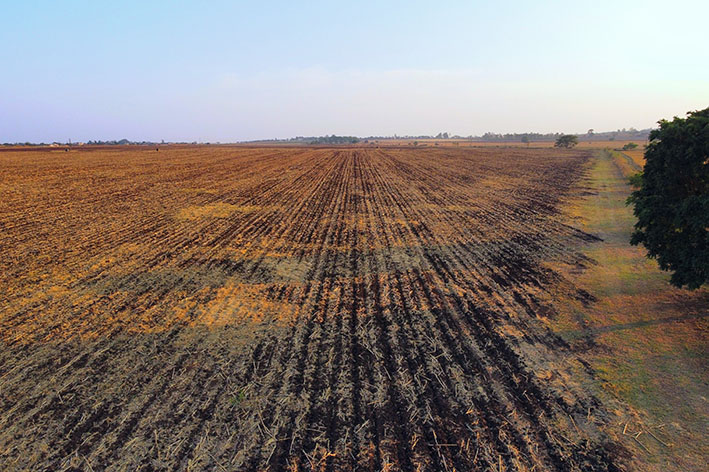
Land prepared and sown with soya beans – hopeful…

The farm where we walk the dogs prepared and sowed land some weeks back in anticipation of getting the soya bean crop off to an early start – essential in order to get a good yield. We do get some rains in October though the real season starts mid-November and whilst this year has not been an exception, not enough rain has fallen so far to get the crop germinated.

The medium-term forecast is not looking great

Last year was not a great one for rain. Crops failed, animals starved. At one point the abattoirs stopped taking any more cattle such was the desperation of poorer farmers who couldn’t afford supplemental feed over the dry season. El Niño was squarely to blame. That dissipated and was replaced by the much more favorable la Niña phenomenon which usually influences our weather to supply normal to above normal rains. Unfortunately it seems that la Niña has dissipated early and we are in for another, at best, erratic rainy season and yes, distribution can be more important than quantity. So much for the termite myth.


Old soldiers we

21 10 2024
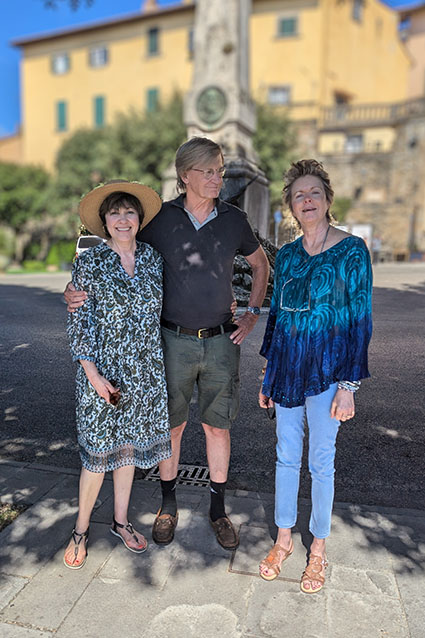
Left to right – Eugene, Roger and self

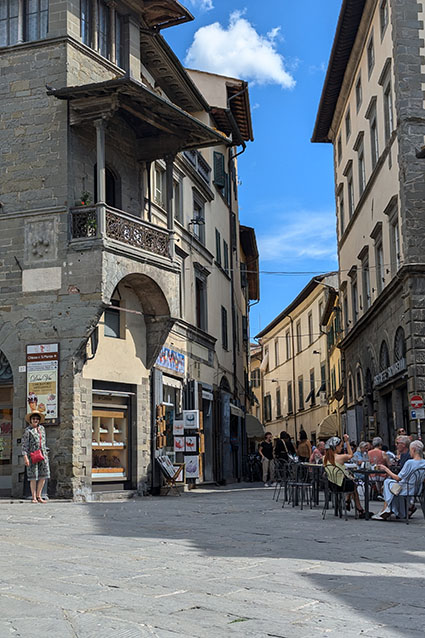
When Eugene said “Come and stay” it was an easy decision. Neither Marianne nor I had been to Italy and September is a good time of year to visit, not too hot and the tourist season is winding down, and it fit in with our plans to go to the UK to see family and friends.

I haven’t seen Eugene for 46 years but he’d contacted me via this blog so I was fairly sure I’d recognize him – I did. We’d shared a house whilst in the Rhodesian army doing basic training for SAS selection which he’d passed but I hadn’t. I went on to join the RLI (Rhodesian Light Infantry) where I was seriously injured and we’d lost touch over the years.

Yup, that’s me, the “early morning” shift

Eugene stays in a house his father bought after WW2 when he’d left the foreign service and started trading in property near Cortona in central Italy. Eugene has lived there for around 20 years and has been speaking Italian since he was 11 though the local population are reasonably conversant in English.

Eugene’s house

The house is up a road that even Zimbabweans would describe as bad, as it’s on private land, and we soon had to abandon the idea of driving our hire car up and down it after a tyre was knocked off its rim. Eugene’s cars coped with it admirably (it’s amazing where a Fiat 500 can go) and together with Roger, another of Eugene’s friends from his SAS days, we coped.

Cortona is a well touristed village that dates back to pre-Christian times (not in its current structure) though we were lucky enough to be visiting at the end of the tourist season so there were no oppressive crowds. I was very pleased to find an art gallery that actually had Salvador Dali prints and a sculpture and prints of Picasso. Naturally they were well out of my price range but it was nice to look and the young gallery attendant was very friendly and not at all tourist-jaded.

Mandy and the Fiat 500

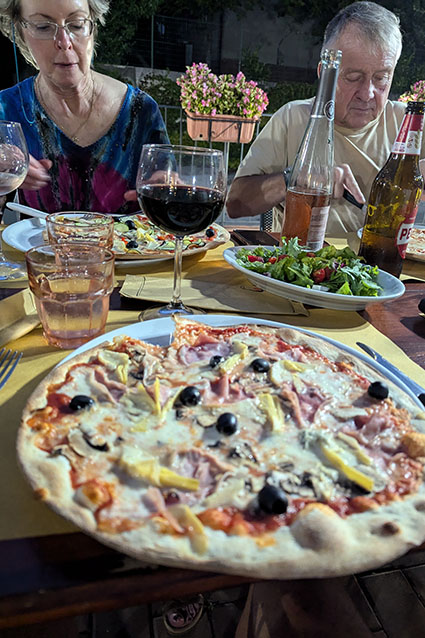
My brother Duncan had come over from the UK and Marianne’s sister Mandy joined us from Cape Town where her travel business is based. We did a lot of catching-up and sampled the local cuisine – yes Italians really do know how to make good pizzas!

What’s not to like about Italian food and drink?

From Italy it was back to England to visit a friend in Manchester then on to Shropshire where Duncan lives. The weather was surprisingly good for an English autumn and we managed an afternoon out to Powis Castle in nearby Welshpool in Wales. The countryside was green like only English countryside can be.

Powis Castle

Then it was on to Shirebrook to meet old friends who used to live just up the road from us in Harare. Gordon and Judy had to move to England after they could no longer afford to live in Zimbabwe. They get by but are not very happy (as I write this Gordon is in hospital). Fortunately they have a rather round little dog, Kita, whom they adore and a marvelous dog-walker Illy.

Illy and Kita

In Attleborough we met up with Meryl Harrison whose book, Innocent Victims, Marianne helped type up. Meryl is one extraordinary brave lady who rescued farm animals during the dark days, in the early 2000s, when Robert Mugabe’s thugs invaded white-owned farms. The owners were often forced out with just what they could carry and pets were left behind and Meryl and her team went about rescuing the animals.

L to R: Helen, Meryl Harrison, Marianne, self

All too soon we were back on the plane to Zimbabwe via a bitterly cold Johannesburg airport – 50C IN the terminal! Of course we got a rapturous welcome from the dogs when we got home, a little too rapturous from Themba for my liking…

The result of Themba’s greeting – still good to be home!


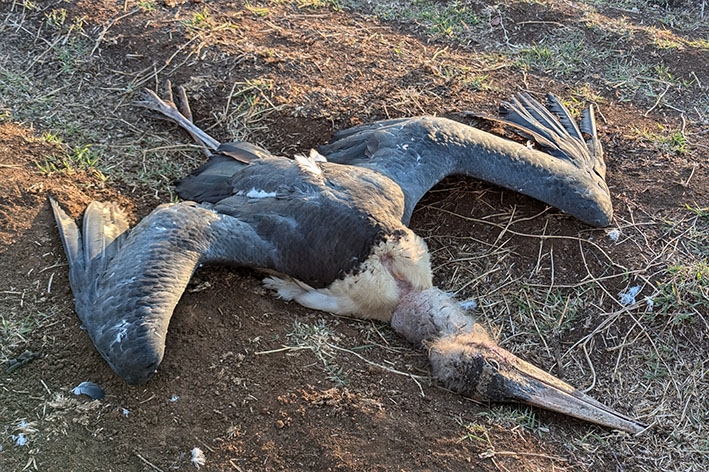
Marabou down

21 10 2024

They are not the world’s prettiest birds, as befits their role as a scavenger, but they are magnificent flyers. They have the largest wingspan of any land bird (up to 3.2m) and I often have the opportunity to marvel at their thermalling skills.

The local refuse tip is on the route to my work and I often spot them standing, sentinel-like, on the rubbish. Sometimes they are soaring, effortlessly and majestic, over the road in a stack of a dozen or more. There is water in a dam (small reservoir) on the neighbouring ART Farm where we walk our dogs and I occasionally see them congregated there, no doubt slaking their thirst after a good bit of scavenging on the refuse tip.

We came across the unfortunate bird above on this morning’s dog walk on ART Farm. He/she was very newly dead, the eyes still clear, with no clue as to the cause of death. There is a high voltage power line close by which may have been the culprit – we didn’t look closely. It’s the first marabou I have seen up close and I had to admire the perfect sculpturing of the wings – designed to soar. We’ll be walking in the area again soon but we are not expecting to see much left as there is a jackal or two that lives in the nearby wetland and it will undoubtedly do a bit of scavenging itself.


One degree

21 07 2024
Dawn breaking on ART farm – it was colder than it looks!

The car thermometer read 10C but I was determined to get the photograph that I’d seen on several early morning trips to walk the dogs on ART farm on the northern boundary of Harare. There was nothing for it but to just put up with the cold. Yes, it’s winter here in the southern hemisphere and we expect it to get cold, with the occasional frost in low-lying areas, but this winter has been unusually warm during the day.

We get our rains in our summer and this last season was marked by an El Niño event in the south Pacific Ocean (unusually warm temperatures) which kept the Inter-tropical Convergence Zone (ITCZ), the source of most of our summer rain, well to the north over Kenya and Tanzania. Zimbabwe went dry and consequently hungry. Most of the staple crop of maize grown in the country is rain-dependent and there was widespread crop failure. Farmers desperate to sell their cattle while they were marketable, swamped the abattoirs who eventually refused to buy any more. I’m told by my commercial farmer customers that what maize has been grown has been subject to widespread theft.

Droughts are nothing new in this part of the world – in 1992 when I was living in the east of the country we had a similar one and I took the photo below near where I was living. The next year the rains returned and the grazing recovered.

El Niño has relinquished its grip and been replaced by La Niña, which is characterized by cooling of the Pacific Ocean, which is good news for our weather pattern – we can expect a more normal rainy season this year. This unusually warm July is merely that, unusually warm due to the barrage of low pressure systems hitting the Cape in South Africa which draw warm air down from central Africa. La Niña has no effect on Zimbabwe’s winter temperatures.

From my business’ point of view I am not complaining – the warmer temperatures help us to get the seedlings through the nursery quicker and reduce costs. We really do need the prospect of a good wet season though as we rely entirely on boreholes for our water supply and despite the La Niña event of 2020 to 2022 we didn’t get the good rains the rest of the country experienced so they will need replenishing.


Getting it done

16 07 2024

Just part of the paperwork necessary to import the coir pith essential to my business

It’s not something I look forward to but the coir pith on which my nursery depends for growing seedlings is essential for a good product. Yes, another substrate – composted pine bark – is available locally but last time I tried it some 20% of my seedlings died from the disease it carried. So about once a year I just have to grit my teeth and jump through the bureaucratic hoops. To be fair it IS becoming a bit easier as more of the government agencies involved get online and organized.

First off is the Agricultural Marketing Authority. I have no idea what they do but membership is essential and nothing else is achievable without it. Fortunately it’s doable online. Then it was on to the National Biotechnology Authority to get a permit that acknowledged the import was free of GMOs. The Indian supplier had given me a certificate stating as much and though it didn’t look very authoritative to me, it was sufficient and upon receipt of the required payment the local certificate was duly issued.

I have done the Ministry of Agriculture for the importation permits before and found it beyond tedious so sent Fabian, one of my senior staff, down there with some smaller US dollar note and instructions to “do whatever it takes” to get the first certificate. It cost him five dollars to put in the application whilst the official concerned was “on lunch break” and then all I could do was wait.

Fortunately the container was being delayed en route from Sri Lanka. I have no idea why it had to go via Colombo but I guess getting a full cargo of containers to warrant a ship going into the port of Beira in Mozambique takes some organizing. That was just as well as the first permit took two weeks, the date stamp indicated it had been sitting on an office desk for one of those weeks, and the second permit took another 10 days. That also required a sweetener of a few dollars.

By this stage I’d already paid the port and transport fees, all US dollars, and the race was on to get the local documentation to the border post near Mutare in the east of Zimbabwe before the truck from Beira got there. If we were late demurrage would be charged and I’d experienced that to my cost before. Fortunately my local shipping agent seems to know a lot of people and he got the money there just in time.

Then it was just a case of waiting for the truck to arrive and organizing a forklift to offload the pallets. It was three weeks late and in the interim I’d had to buy two pallets from another local supplier who’d marked up his prices 100% (he vehemently denied this even when I told him I new what it cost) but at least it’s over for about another year.

Now that the final accounts are in I can see that the costs were close to last year. The total for 24 tonnes of coir was US$19,650 which works out to 81.8c per kg. For some strange reason my bank needed to pay for the coir in Euros, I have no idea why but I do know that payment had to go through a South African bank. The rest was all payable in US dollars, none of the Zimbabwean kind thank you very much.

Yes, Zimbabwe is still trying to get its own currency up and running. It’s called the ZiG which is not the name of a cartoon character’s best buddy but is short for “Zimbabwe Gold”. It’s apparently linked to gold bullion of which the Reserve Bank is holding. Nobody is actually sure if this is the case but the official rate is around 13.8 to the US dollar.

When the ZiG was first introduced the obvious happened; currency traders spotted a good thing and the rate soon began to run. The government got tough and threatened a US$10,000 fine for any company or person not using the official rate – by law you have to accept either the ZiG or the US dollar if that’s how a customer wants to pay, the one exception being fuel traders who are not obliged to accept ZiG. Fortunately for my business most customers are uninterested in using local currency and choose to pay in US dollars, usually using cash. The local currency received has been entirely electronic – I’m not sure if this is by design – and I have yet to see any local notes. It is certainly not difficult to get US dollar notes out of my local bank and even small denominations are often brand new and in their 100 notes wrappers.

The country’s roads are in a disastrous state at the moment, bearing witness to years of neglect, but there’s a regional conference of the SADC (Southern African Development Community) in August so there’s been an orgy of road repair in Harare during the last few months. Construction teams have been called back to Harare from the outlying projects to concentrate on the local roads. Chaos has ensued as roads are closed and heavy traffic routed through the suburbs.

Some actions are unsurprising, others beggar belief. People living along the main route to the new Chinese-built parliament house where it’s all going to happen have been offered free water, delivered by tanker, to help make their gardens look pretty for visiting dignitaries.

The new dual carriageway to the parliament is being lined with kerb stones that make sure that there is nowhere to pull off the road if one has a breakdown. A local farmer, who lives on the route, pointed this out to one of the construction teams and was assured that it was a temporary arrangement and all the kerb stones would be removed after the conference. We’ll see.

A new bridge has gone in over a small river. They haven’t finished casting all the concrete and I’m told it takes a month to cure but the conference is in less than a month. Interesting.

An obvious question is where has the government suddenly found all the money? Are the construction companies actually being paid and what currency are they using? A friend is heavily involved in the landscaping of the new parliament and Marianne tells me she is being paid in US dollars and is doing quite well from it but rumours abound as to whether the others involved have been paid. I have heard that one company was owed some US$200 million which seems a bit much but many years ago I was told that a normal road costs US$ 1 million per kilometer to construct so perhaps it’s possible. Whatever the truth is you can bet the government will do whatever it takes to get the roads done and put up a paper-thin facade for the visiting dignitaries.

The nations hospitals would certainly like a bit of money themselves; currently several of the bigger ones are owed in excess of ZiG11 billion – a lot of money in any currency.