“Boss, come and have a look at this” Mapeno, the gardener exclaimed, clearly excited. He held up two expensive day packs. “Where did you find them?” I responded. “Over here right by the gate” came the reply. “Are you sure they don’t belong to the builders?” I asked. “No, I already checked with them”. I wasn’t surprised, they didn’t look like the sort of day packs a Zimbabwean builder could afford.
I was just about to go to work so he brought them over to my truck and we started to go through them. Diaries with copious notes on what looked like engineering projects, a wallet with South African gun licences, credit cards and no cash. Two South African passports (one full) in one pack in the name of a male and another in the second pack with a woman’s name and photo. This was obviously stolen property but why had it come over the wall into our property? And how was I going to contact the owners?
Fortunately the diaries had contact phone numbers in them albeit different ones. I tried both – one did nothing and the other was unreachable. Maybe I could contact the South African Embassy and give them the passports and then the owners would likely go there and then be able to contact me. I was on the way to work when I realized that WhatsApp works everywhere irrespective of phone number so I entered the unreachable number and called. It was quickly answered. “Is this Mr M and are you missing a couple of day packs?” I said. “Yes we are – did you find any passports?”. I answered that we’d found three and asked what they’d lost. A laptop and US$2,000 was the response. “It was just stuff, the passports are the most important things, at least we can get back home tomorrow” he added.
They had stopped for breakfast at a café at a local shopping centre and left the laptop and day packs on the back seat of the pickup in plain view. As they sat down to breakfast thieves smashed the back window, grabbed the packs and computer and got away in a waiting car.
“While this is not Jo’burg you still have to switch on. Thieves hang out in car parks just waiting for that sort of opportunity” I commented.
“Yes, we know that now” he replied. “Please send me your address so that I can come and pick up our stuff”.
I wasn’t there when they arrived but our maid phoned me to confirm who they were and wrote down the registration number of their pickup truck. I did wonder why the thieves bothered to “return” the day packs and their contents – a distinctly curious form of criminal ethics. If I were they I’d have kept the rather smart packs and dumped the contents into the nearest ditch.
Crime in Cape Town is an altogether different league. One could easily be lulled into a false sense of security by the first world shopping centres, immaculate roads and civilised driving standards (traffic lights are actually respected) contrary to Zimbabwe. Tourism is booming – the driver we used from the airport told us that in December 2024, 1.6 million tourists came through the airport – tourists we met on Table Mountain commented on how cheap Cape Town is. People are positive about their future and investing and developing in agriculture – rare attitudes in Zimbabwe.
Visiting Oaklands Estate near Wellington in the Western Cape was a case in point. David, a friend of my cousin, bought the abandoned racehorse stud in 2009 before occupying it in 2011. The derelict buildings have been renovated into tourist accommodation and the old stables will once again house a stud. Hillsides are being planted to proteas for their flowers for export. Other stables have been converted into a conference centre and come the tourist season the accommodation is full. I asked David if his positive outlook was down to living in the Western Cape. He answered “Pretty much. You can still avoid the corruption bullshit if you want to”. The Western Cape is relatively well run compared with the other provinces in South Africa. It is under the control of the Democratic Alliance with Alan Winde as the premier.
Oaklands Estate close to Wellington in the Western Cape. Who could not be optimistic in this environment?
While Oaklands Estate is far enough out of Cape Town to not be overly attractive to criminals, the township of Guguletu is an epicentre of crime. The taxi driver was quite clear on this: “If you are a person of colour” – he tapped his own light brown skin – “or a white, you stay out of there” – he gestured to the left of the motorway. It was a maze of corrugated iron shacks, broken fencing, goats, rubbish and bizarrely – satellite dishes on nearly every dwelling I could see. We asked him about the white tourist who’d been killed there earlier in the year. “Actually there were two who went in there” he responded “but one survived”. “You see that road up there?” he gestured with his right hand to a road sweeping a curve over the motorway into the township. “There was traffic backed up on the other side of this road so both asked their traffic navigator apps for an alternative and it took them into Guguletu. One guy was robbed of his car and beaten up but got out to a hospital and survived. The other was a doctor and they shot him. Dead. You don’t mess with the gangs in there – they run the place.” I mused that they were probably not the type that would return high quality day packs over a suburban wall in the expectation that they would be returned to their owners.
We arrived at the airport and said goodbye to Mario. It was time to head back to Harare. I got chatting to the porter who was assisting us whilst Marianne filled in forms to get VAT back. I asked him where he lived. “Oh, Guguletu” he replied. When I asked him how he coped with the gangs and crime he shrugged “God looks after me”.
The innards of a cheap clock mechanism. A VERY cheap one!
The clock mechanism above cost about £6 on Amazon UK. I bought several about 4 years ago and it seems that they have come to the end of their design life. That’s in contrast to the one I was given by Trevor some 15 years ago and is still going fine. He did tell me at the time that it was a good Swiss brand and just gave it to me so of course cost doesn’t come into the equation.
I have been looking on Amazon for some replacements and they all seem to be of much the same quality – cheap. In fact if I bought 30 I would pay £24. How can they possibly make them so cheaply ?Economies of scale I guess. If we look around us there are plenty of other examples. The one that immediately comes to mind are the Bic razors.
I admit to using a Bic razor once a week. On Sunday I take a step back from the tyranny of daily shaving and let my beard grow. I hate shaving. Of course as a teenager I couldn’t wait to start shaving and be a man. That all changed the first morning after being inducted into the Rhodesian army in 1978. We were made to stand to attention by our foot lockers the duty sergeant. “Shaved this morning Roberts?”, he demanded, poking his face to within a few centimetres of mine. “No sarge!” I replied. The question was repeated at the next man and the next. After a few more negatives he gave up. “Anyone who has not shaved go and do so now!” he bellowed. Most of the barrack room dashed out to the washroom, shaving kit in hand. Ever since it’s become a daily routine except for Sundays and no, there’s no truth to the common idea that the more one shaves the more one has to. I wish there were – I would apply it to my increasingly sparse head hair!
Bic has of course taken economies of scale to the limit. Razors are designed to work for two shaves, three if you can handle the pulling, then they are consigned to the bin. It would be easy enough to use harder steel that could hold an edge for longer like the old Gillette G2s of my youth but that’s no the point. You must buy more. The same with their ballpoint pens. They are so cheap that it doesn’t matter if you lose one – you’ve bought a box of them anyway. There are six fountain pens in my drawer and they all work. One was my mother’s and another I had at school nearly 50 years ago. But who uses a fountain pen now? Much as I like using them it’s easier to use a smartphone and just dictate the message. So they sit in the drawer, fond relics of an age when my right hand worked well and I won the Headmaster’s Prize for Handwriting (at junior school).
My business works on large numbers of plants, mostly seedlings, sold at a relatively small markup. Last year I sold 8,474,903 seedlings, for US$, which sounds like a lot but only gave me a profit before tax of $20,284 and there’s not a lot one can do with that in Zimbabwe’s economic climate. I have not included those sold for local currency which is too small a number to be of consequence. It doesn’t help that I’m charging the same as I was 10 years ago when we last had the US$ (there has been one local currency in between) and business was much more profitable. Now there’s a lot of competition around with people who probably evade tax and use family members for unpaid labour. So I’ve had to keep my prices down. I haven’t been able to keep the nursery full and costs have risen, labour especially. I need to fill up the nursery and, like in the Bic model, make a small profit per unit but really sell lots of them. Any ideas gratefully accepted.
ZiG – the notes that never were. There were 100 and 200 denominations too and unbelievably some coins!
Zimbabwe has two official currencies, the US dollar and the local dollar. The latter is officially called the Zimbabwe Gold or ZWG. It used to be called the ZiG (also Zimbabwe Gold as apparently it’s gold backed) but that’s no longer used by the government, perhaps it sounded too much like the cartoon character that it is. The general public still use the term “ZiG”.
That both currencies are legal means that one cannot refuse payment in either. This of course brings up the sticky issue of exchange rates. A visit to the Reserve Bank of Zimbabwe’s (RBZ) webpage is instructive. A one ounce gold coin is being sold for US$2,744 or ZWG70,723 which makes the exchange rate 25.77 (it’s tightly controlled). Last week I bought ZiG/ZWG at 34 to the US dollar off an informal dealer. Why? Because my business takes in so little ZiG and I wanted a cheaper way to pay off my electricity bill and there was no way I was going to pay US dollars for that appalling service!
Officially the ZiG month-on-month inflation is 11.7% (277% annually as calculated) and the US dollar inflation is 0.09%. Given that a US$ loan will cost 9.5% per annum that is very conservative. Interestingly, the US$ annual inflation is given as 3.28% but the ZiG annual inflation is not given – too embarrassingly high perhaps? Of course Zimbabwe has had problems with currency inflation in the past so it’s hardly surprising that they don’t want to repeat the 2008 debacle. The official ZiG to US$ exchange rate is enforced by punitive fines, in US$, so it was surprising that the RBZ suggested in October that they let the exchange rate run in order to maintain the public interest in the ZiG.
In 2008 we had a bad experience with Zimbabwe dollars…
Another way of stimulating interest in the ZiG – and I use the term loosely – is forcing the public to pay a percentage of their taxes in ZiG. The government excels at imposing taxes. There’s a 2% transfer tax on most currency payments and a 3% levy on withdrawing cash. Income tax starts at US$100 per month! Company tax is payable quarterly based on estimates and there are penalties for being inaccurate.
The ZiG, despite much fanfare at it’s introduction in April this year due to the ballooning devaluation of the previous currency, has never been issued in note form. This has insured that people use the banks as little as possible and keep whatever hard currency they have “under the mattress”. It’s not without risk of course – a recent fire at one of the big local markets destroyed a lot of people’s savings.
In an effort to streamline tax collection the local tax authority has implemented a system of tax compliance for retailers and wholesalers. They are now required to register with the authority (ZIMRA) and have a system whereby they are online to the authority and every sale is registered and a QR code is printed on the invoice at the till point/checkout. Yes, it actually does work – try pointing your smartphone camera at the example below. Fortunately everything my company sells is zero VAT rated (plants for cultivation) so it’s not a requirement for us.
A QR code verifies that the purchase is registered with the tax authority
The whole tax accounting system has been overhauled and now each registered company has just one account for both company tax and income tax. In the past there were two and managing the system was complicated. Now it’s so simple that I can almost understand it but prefer my bookkeeper to handle the returns. Progress? I guess it is in a way.
We haven’t made any progress in growing the economy. The budget speech by the Minister of Finance at the end of November is best described as entertaining. I quote; “The attainment of the projected 6% economic growth in 2025, will result in Zimbabwe being one of the fastest growing economies in the region.” This is despite “… the agriculture sector, which was initially projected to contract by -21%, is, now expected to contract by -15% on account of better than anticipated output on wheat and dairy.” It seems the Minister of Finance hadn’t read the RBZ figures because he says “…prices for goods and services have relatively been stable following the introduction of Zimbabwe Gold (ZiG) in April 2024. Month-on-month ZiG inflation declined by -2.4% in May 2024, and averaged 0.0% in the second quarter of the year.” The full speech can be downloaded here.
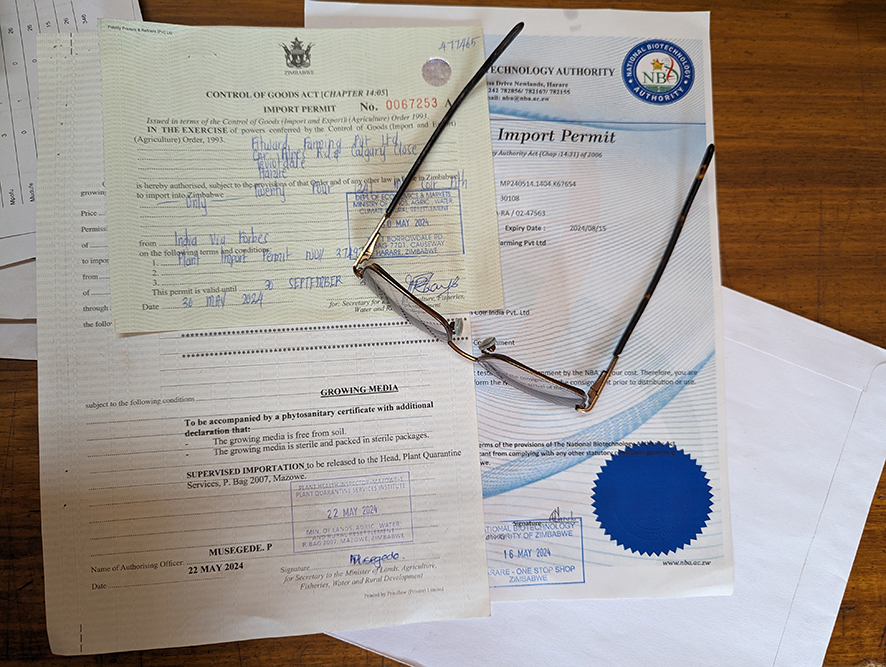
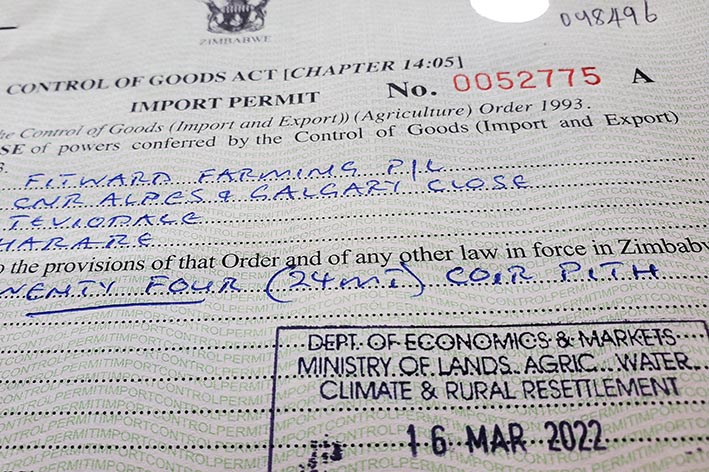
Just part of the paperwork necessary to import the coir pith essential to my business
It’s not something I look forward to but the coir pith on which my nursery depends for growing seedlings is essential for a good product. Yes, another substrate – composted pine bark – is available locally but last time I tried it some 20% of my seedlings died from the disease it carried. So about once a year I just have to grit my teeth and jump through the bureaucratic hoops. To be fair it IS becoming a bit easier as more of the government agencies involved get online and organized.
First off is the Agricultural Marketing Authority. I have no idea what they do but membership is essential and nothing else is achievable without it. Fortunately it’s doable online. Then it was on to the National Biotechnology Authority to get a permit that acknowledged the import was free of GMOs. The Indian supplier had given me a certificate stating as much and though it didn’t look very authoritative to me, it was sufficient and upon receipt of the required payment the local certificate was duly issued.
I have done the Ministry of Agriculture for the importation permits before and found it beyond tedious so sent Fabian, one of my senior staff, down there with some smaller US dollar note and instructions to “do whatever it takes” to get the first certificate. It cost him five dollars to put in the application whilst the official concerned was “on lunch break” and then all I could do was wait.
Fortunately the container was being delayed en route from Sri Lanka. I have no idea why it had to go via Colombo but I guess getting a full cargo of containers to warrant a ship going into the port of Beira in Mozambique takes some organizing. That was just as well as the first permit took two weeks, the date stamp indicated it had been sitting on an office desk for one of those weeks, and the second permit took another 10 days. That also required a sweetener of a few dollars.
By this stage I’d already paid the port and transport fees, all US dollars, and the race was on to get the local documentation to the border post near Mutare in the east of Zimbabwe before the truck from Beira got there. If we were late demurrage would be charged and I’d experienced that to my cost before. Fortunately my local shipping agent seems to know a lot of people and he got the money there just in time.
Then it was just a case of waiting for the truck to arrive and organizing a forklift to offload the pallets. It was three weeks late and in the interim I’d had to buy two pallets from another local supplier who’d marked up his prices 100% (he vehemently denied this even when I told him I new what it cost) but at least it’s over for about another year.
Now that the final accounts are in I can see that the costs were close to last year. The total for 24 tonnes of coir was US$19,650 which works out to 81.8c per kg. For some strange reason my bank needed to pay for the coir in Euros, I have no idea why but I do know that payment had to go through a South African bank. The rest was all payable in US dollars, none of the Zimbabwean kind thank you very much.
Yes, Zimbabwe is still trying to get its own currency up and running. It’s called the ZiG which is not the name of a cartoon character’s best buddy but is short for “Zimbabwe Gold”. It’s apparently linked to gold bullion of which the Reserve Bank is holding. Nobody is actually sure if this is the case but the official rate is around 13.8 to the US dollar.
When the ZiG was first introduced the obvious happened; currency traders spotted a good thing and the rate soon began to run. The government got tough and threatened a US$10,000 fine for any company or person not using the official rate – by law you have to accept either the ZiG or the US dollar if that’s how a customer wants to pay, the one exception being fuel traders who are not obliged to accept ZiG. Fortunately for my business most customers are uninterested in using local currency and choose to pay in US dollars, usually using cash. The local currency received has been entirely electronic – I’m not sure if this is by design – and I have yet to see any local notes. It is certainly not difficult to get US dollar notes out of my local bank and even small denominations are often brand new and in their 100 notes wrappers.
The country’s roads are in a disastrous state at the moment, bearing witness to years of neglect, but there’s a regional conference of the SADC (Southern African Development Community) in August so there’s been an orgy of road repair in Harare during the last few months. Construction teams have been called back to Harare from the outlying projects to concentrate on the local roads. Chaos has ensued as roads are closed and heavy traffic routed through the suburbs.
Some actions are unsurprising, others beggar belief. People living along the main route to the new Chinese-built parliament house where it’s all going to happen have been offered free water, delivered by tanker, to help make their gardens look pretty for visiting dignitaries.
The new dual carriageway to the parliament is being lined with kerb stones that make sure that there is nowhere to pull off the road if one has a breakdown. A local farmer, who lives on the route, pointed this out to one of the construction teams and was assured that it was a temporary arrangement and all the kerb stones would be removed after the conference. We’ll see.
A new bridge has gone in over a small river. They haven’t finished casting all the concrete and I’m told it takes a month to cure but the conference is in less than a month. Interesting.
An obvious question is where has the government suddenly found all the money? Are the construction companies actually being paid and what currency are they using? A friend is heavily involved in the landscaping of the new parliament and Marianne tells me she is being paid in US dollars and is doing quite well from it but rumours abound as to whether the others involved have been paid. I have heard that one company was owed some US$200 million which seems a bit much but many years ago I was told that a normal road costs US$ 1 million per kilometer to construct so perhaps it’s possible. Whatever the truth is you can bet the government will do whatever it takes to get the roads done and put up a paper-thin facade for the visiting dignitaries.
The nations hospitals would certainly like a bit of money themselves; currently several of the bigger ones are owed in excess of ZiG11 billion – a lot of money in any currency.
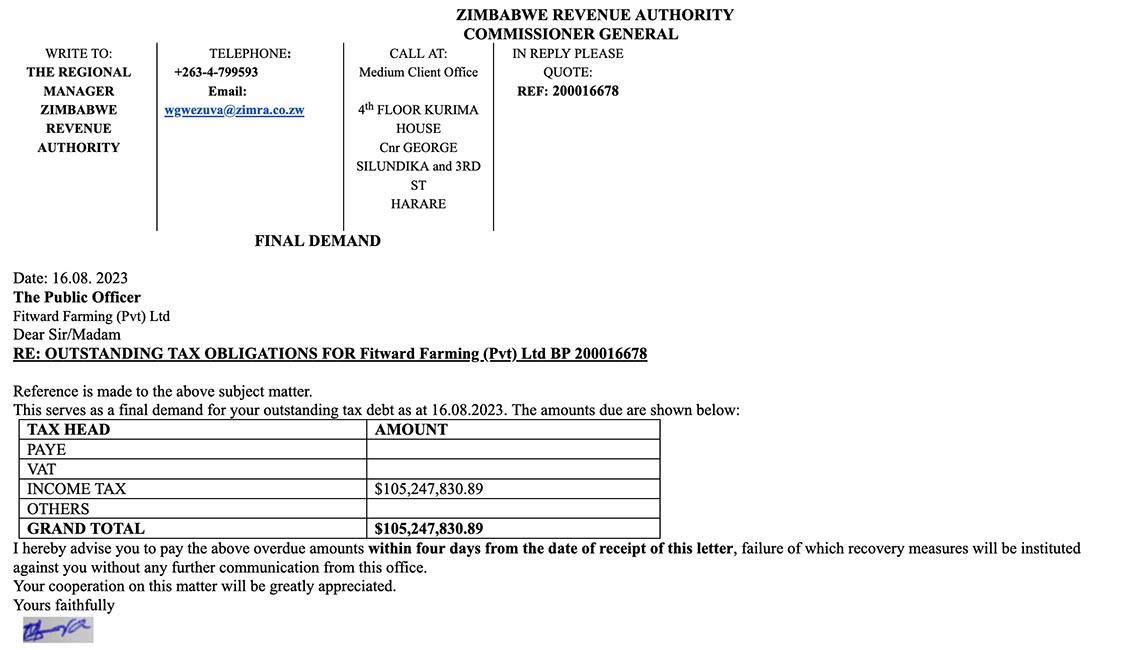
It had to be a mistake, I couldn’t possibly owe the tax department (ZIMRA – Zimbabwe Revenue Authority) that amount. Even if I converted it to US dollars it would amount to an impossible figure – about 17,500 at the unofficial rate and 23,000 at the bank rate. I checked the email address – it was from a person with whom I’ve corresponded over the years. Then there was the wording; FINAL DEMAND. Where were the other demands? I did what any sensible person would have done and contacted my bookkeeper in a state of panic.
Alison was more than a bit puzzled but told me she couldn’t do anything without seeing how they’d got the figures. “Your are entitled to see what’s going on” she said. “Ask them for the ledger”
The last part of the ledger
The ledger was duly sent and the waters immediately became a lot murkier. It stated the figures were in US dollars and the numbers, if the currency was US dollars, were impossible. I sent it on to Alison. It was a while before she came back to me by which time my imagination had run riot. What if I really did owe 105 million dollars? I would have to buy it on the open market with my US dollars and would be left with no operating capital and nothing with which to pay wages. The company would be unlikely to survive.
Alison assured me that the figures on the ledger were Zimbabwe dollars and I probably did owe the 3,835,807 listed. She had no idea where the 105 million came from. “Ask them” she said. So I did.
The reply was abrupt; the 105 million was to be ignored (RTGS is another way of saying Zimbabwe dollars). The amount on the ledger was also incorrect as it didn’t account for some US$550 that I’d paid in presumptive tax (they are called Quarterly Payment Due or just QPD) which would have reduced the amount owed close to zero.
I speculated to Marianne that it was all just a bit of psychological bullying to get me to pay attention to the outstanding amount, then two days ago I bumped into Gary whose wife had had a strikingly similar experience.
Gary works for a seed company that occasionally uses my nursery to grow seedlings for various trials. They have a trial on ART Farm which is a neighbour to my nursery and I sometimes use it access my nursery so as to avoid the appalling direct road and take in a bit of soothing farm scenery on the way. Gary was having a look at one of their trials near the road so I stopped to chat.
We discussed various things then I related my experience with the tax authority. He said that Clare, his wife who works as a bookkeeper for a local church, had received a final letter of demand for payment from ZIMRA for an impossible amount about three months ago. She replied that as a church they were not liable for tax and any money made was given away to various charities and nothing more was heard. He agreed with me that as the government was desperate for money it was likely endorsing ZIMRA’s intimidation tactics to get in whatever money they could, maybe they were even giving a commission.
On getting to work I related the story to my senior foremen. They were decidedly cynical. “They are all on the take” opined Chingedzerai. “Yes”, added Fabian, “they see the rest of the government officials stealing and think that they should have some of the pie too. They see what they can bully you into paying and then split the extra between themselves”. It was obvious that they thought I was being naïve.
Marianne had been doing some questioning of her own and posted my problem on the local community WhatsApp group. Someone had responded with a name and phone number of a senior official at ZIMRA whom he thought would be able to help. I gave him a call and related my problem and asked if it was official ZIMRA policy to send out threatening demands based on nothing much at all. His indifference was striking; I should send him a copy of all the correspondence and documents and he’d forward it to the relevant manager. I duly sent him the copies but I am not expecting a reply.
It’s no secret that Zimbabwe is in deep financial trouble. Mismanagement, corruption and incompetence have seen our GDP plunge after the Mnangagwa government took power in a coup back in 2017.
At the time it was welcomed by the majority of the population who were relieved to be rid of the much hated and feared Mugabe regime but it was not long before the new government of E D Mnangagwa revealed its true colours of repression and corruption. Chingedzerai reminded me that the current administration has never bothered to investigate the estimated US$15 billion worth of diamonds that went unaccounted for from the Chiadzwa diamond fields in the east of the country in the latter part of the Mugabe era. More recently there was the gold smuggling exposé by al Jazeera that showed how top Zimbabwean officials were, with the highest approval, smuggling gold out of Zimbabwe and laundering the resulting cash. Indeed, for a country that is struggling financially, there is an eye-opening amount of property development around town. In the past this would have attracted the attention of ZIMRA who would have demanded to see the accounts of owners of expensive properties and made to account for the development. Now it’s easier, and more personally profitable, to send out threatening letters.
I paid wages on Tuesday. We chose the date years ago when getting cash from the bank at the end of the month meant enduring long queues and not getting the desired breakdown. Chingedzerai had heard the income tax limits had been increased and asked me to check on the internet before he entered the attendance and overtime figures on the computer. I was fairly sure it was only the Zimbabwe dollar tables that had changed but checked on the US dollar tables anyway (I have been paying my staff in the latter currency since August last year).
In Zimbabwe salaries are taxed monthly and the system is known by its acronym PAYE; Pay As You Earn. The rates are iniquitous. Wages are taxed from US$100 per month upwards! Given that the minimum agricultural wage starts at US$60 before any of the required allowances, most of my staff are taxed. Some do get age exemptions but the rest of them have to endure.
Such is the government’s demand for money that it has taken to taxing money transfers at 2% per transfer. It goes without saying that most transactions are cash though it’s not always possible. The government used to tax cash withdrawals from banks but gave up when it became evident that people were simply not depositing cash in order to avoid paying the tax.
Given the high cost of living and taxation in Zimbabwe one would assume that the majority of the population would be keen for a change of government. Indeed, given that we had a general and presidential election on Wednesday, one could be forgiven for thinking it imminent. With the recent exception of Zambia, southern African is not known for changing its governments and Zimbabwe is not about to become an exception too.
My foremen and I were all in agreement on this; the incumbent ZANU-PF party, which has maintained its grip on power since 1980 by means mostly foul, will certainly cheat its way to victory; only the level of the fiddle is not known. So far it’s been “limited” to delaying delivering voting papers to polling stations in regions known to be opposition strongholds, sending voters to polling stations where they found they weren’t registered, making sure one couldn’t check the online registration database and of course blatant intimidation. Few, if any, believe the logistical problems to be anything but deliberate. We remain cynical.
The bundles of 500 notes in bank wrappers were commonly known as bricks in 2008. Now it’s 2023 and they’re back!
The senior foreman said the customer wanted to pay in Zimbabwe dollars, cash, were we going to accept them? We didn’t have much of a choice as it is legal tender so I said yes and asked how much it was. 67,000 he replied. I groaned knowing they would be in small denominations. The biggest, $50, is worth all of US2.2c so I knew there would be quite a few bundles but the majority were $20 notes. We filled a medium-sized box.
Quite a few were in bank-sealed plastic bags of 500 notes which were called “bricks” back in the hyper inflation days of 2008. We didn’t bother counting them then and didn’t bother now. Back in those days the government attempted to get around the problem by printing ever larger denomination notes (an example is in the picture). Our inflation now is not quite that bad but anyway, local currency notes have largely been superseded by electronic money. It’s very easy to add zeros onto electronic money.
The other currency in Zimbabwe that is also legal tender is the US dollar. Having nothing to do with the government it is by far the most preferred. Although the government tries to set the exchange rate and can prosecute those not using it there is an easy work-around. It goes like this: the official rate is 1,097 Zimbabwe dollars to US$1 and with a few exceptions, fuel being one of them, businesses have to quote their prices in the local currency. On the unofficial market the rate is currently around 2,200 to one US dollar depending on to whom one is talking. Businesses price their goods in the Zimbabwe dollar and then offer a fat discount if you want to pay in US dollars – this effectively brings the official rate up to the unofficial one and it’s completely legal. Many businesses don’t bother with the official rate and just quote the unofficial one. My business is one of them and so far there hasn’t been a comeback.
There is a sense on around town that the unofficial rate is running again and people are offloading their Zimbabwe dollars. I sent the driver into town the day following the above deposit to get rid of the cash. In reality it was about US$30 so didn’t go far but I managed to find a fertilizer company accepting them and topped up with a bit of electronic money in the form of a debit card we managed to get a meaningful amount of agricultural chemicals bought.
The government is of course also looking for a dependable currency and has hit on tax as the easiest way to get in US dollars. All US$ cash deposits are levied at 20% and the government reimburses the amount in Zimbabwe dollars – at the official rate! This means that in reality the recipient can be losing 10% or more of the deposit in real terms. Exporters are levied 40% of the amount remitted to their forex accounts. It gets better; 3% of all USD cash withdrawals from a bank are taxed. While one can still pay car licence fees and other government levies in the local currency the sense is that it cannot last.
The local Reserve Bank has an idea to shore up the local currency; digital tokens backed by gold. It won’t work – the population’s trust in the government has long since evaporated. There is nothing new about digital currency in Zimbabwe but my staff for one will only be interested in the greenback.
Our weather has become increasingly erratic over the last 15 years or so. I put it down to climate change. Right now we are in the middle of a relatively normal rainy season. That means that the ITCZ (Inter-Tropical Convergence Zone) moves over the country and it rains – quite a lot. Most of our rains happen from mid November to the end of March which in Harare means some 700 to 800mm. The rain can be quite intense – we had 75mm (3 inches) in several hours last week which meant all the rivers around town were up and one of the reservoirs that supplies town was spilling. As a country we’ve had good rain for the last 3 years due to the la Niña effect though it has been quite variable over the country and Harare, which is in a high rainfall area, received less than average. We are due for a drought and I see that there is a el Niño predicted later in the year which is a reliable indicator.
There’s rain around as I type this and yesterday afternoon we had quite a storm with high winds and hail and of course the power went off. It’s still off but we are geared for this eventuality and have solar panels and two lithium batteries to get us through the night. Power outages for other reasons, mainly incompetence and over-use of Lake Kariba as a hydro source, are common so everyone who can has a solar backup plan. Solar water heating makes a lot of sense in our climate so we have three solar heaters, one for us, one for the cottage tenants and one on the domestic employee’s rooms. In the cloudless, hot days of August and September the water can easily boil.
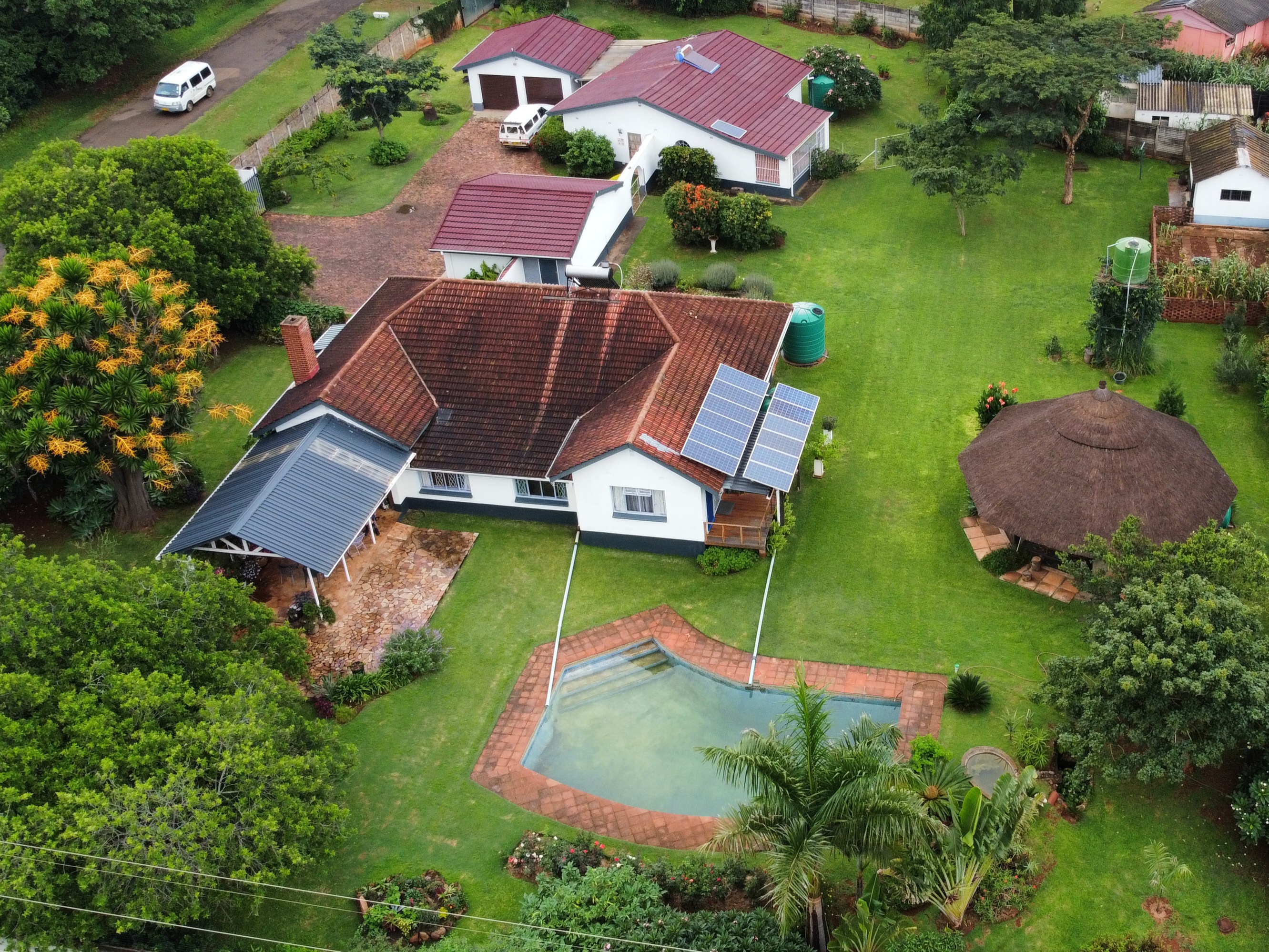
The complete Zimbabwean domestic survival system: visible are two solar water heaters, two solar panel systems and rainwater collection into tanks and a swimming pool.
I see your weather has been erratic too. Mt Washington in the north-east of the USA hit a record -70C a few days back and Europe had an unseasonably warm Christmas. It seems that California has had some heavy rains too; the default weather app on my new iPad is set to the Apple headquarters in Cupertino and they had flood warnings out recently.
Planned, and I use that word loosely, power outages are called “load shedding” in this part of the world. Towards the end of last year it was announced that Lake Kariba, which is our major source of hydro power, had got to it’s minimum level permitted for generation due to over-use by the Zimbabwe power authority and load shedding would become a daily occurrence. We have another major thermal power station at Hwange in the west of the country but it has become a byword for mismanagement and cannot take up the shortfall. We also import a lot of power from Mozambique and South Africa but have managed to get into a lot of debt so the aforementioned countries are fed-up and restricting our supply. South Africa has its own power supply issues (again due to mismanagement by the state-run utility) and is also imposing load shedding but at least it sticks to a schedule. In Zimbabwe the power generally goes off in the suburbs about 6.30 a.m. and comes back on around 10 p.m. Businesses are not exempt either and incur heavy costs due to diesel generators. It’s not unusual for some to run just on night shifts.
Our swimming pool was an early casualty of the power cuts. It’s essential to keep the filter running which the solar panels can do on a sunny day but those are rare in the rainy season so it’s more green than clear these days. Marianne was muttering about the cost of more chemicals to try and clear it. I pointed out that we could always fill it in but it wouldn’t be a cheap procedure and then we’d lose some 70,000 litres of stored water that would be very useful in a drought. We have decided to live with it being more green than not (it is covered over in winter when not in use).
The book you asked about is, I think, “The Shackled Continent” by Robert Guest who was an Africa correspondent for The Economist for a number of years. I found it fascinating and very insightful. Maybe I should read it again.
My business muddles along. I have a lot of outstanding debtors and it’s not so simple as insisting that they pay up front for their orders. I hate having to get nasty but it may eventually come to getting professional debt collectors in as I need to get the money to pay for imports of the coir “peat” raw material that we use to grow the seedlings. I obviously cannot use Zimbabwe dollars but fortunately I did invoice in US dollars which once again is becoming the currency du jour. The government is still trying desperately to keep the local dollar alive but with an official exchange rate of 740 to the US dollar compared with a “parallel”, i.e. street, rate of 1,100 to the dollar, it doesn’t have much of a chance. The local currency is still used, and has to be offered, as a payment method but most outlets make it very attractive to use the US$ by offering massive discounts . Government departments don’t do this so get paid almost entirely in local currency which means they are perpetually in financial difficulties – hence the disastrous state of the power supply, roads, rail links and anything else they are involved in. Am I making sense?
The government is also trying to stifle speculation on the currency markets by lending money at vast interest rates, 110% in November 2022, which makes doing business very difficult and one of the reasons that I use to explain why my business is so flat. The other is the proliferation of competition, often informal, which cut lots of corners allowing them to undercut my prices. Their quality is dismal but people either don’t care or see it as an acceptable consequence of the cheap prices. My prices haven’t changed in four years despite the rising costs of inputs in real (US dollar) terms. It doesn’t make for attractive business. Curiously the construction business is booming with cluster homes (small, single level apartments – several to a property) and other developments being built throughout the suburbs. Quite where the money is coming from I cannot ascertain – but in an economy as moribund as ours it’s almost certainly dirty.
Yes, us Zimbabweans are a resourceful lot and I guess in that respect Diana remained true to her heritage. My workroom/office is full of junk that I cannot throw away just in case I find a use for it in years to come. It must be a hold-over from the days when Zimbabwe was Rhodesia and under sanctions so nearly everything that could be was recycled. It’s probably an attitude of my generation rather than today’s “youngsters” – I drive past a municipal rubbish tip on the way to work and there’s never a shortage of trucks pulling in to offload. I suppose people do make a living out of recycling here though it’s not as fashionable as in the developed world. An elution plant (recycling gold from electronics) has recently been constructed at the former rubbish dump. It’s also not unusual to see carts being pushed around the suburbs and having one’s gate bell being rung by the owners looking for scrap metal.
I guess our “big” news for this year is that we’re going over to the UK in May to attend a rock concert! I’ve never been to one as standing for a long time in rowdy crowds is obviously not possible for me but this is Mike & The Mechanics who are not as popular as they used to be so seating is an option. Time to tick off the bucket list.
Then we are going to stay on the Cote d’Azur with an old girlfriend and her husband for four days. Apparently we’ll be quite close to St Tropez. Marianne is keen to go and see how the ultra-rich live but I may give it a miss. Really looking forward to it and we’re brushing up our rudimentary French in anticipation.
Well, on that positive note I’ll sign off and wish you all the best for this year. Forget the snow shoveling, go skiing and may it be exceptional.
Ciao
Andrew
Note: this is a genuine reply to a friend in Washington State U.S.A. who was a good friend to my sister Diana, and helped look after her in the terminal stage of her cancer three years ago.
Last month I finally had to throw in the towel. I called together the workers’ committee who represent the labour force and told them that I couldn’t find enough local dollars to pay them and from now on it would have to be US dollars. They tried hard not to show their delight and failed, dismally.
The government likes to claim it has stabilized the Zimbabwe dollar that had officially slumped to about 530 to one US dollar last month. They have even gone so far as to issue punitive fines on those organizations trading at unofficial rates which can be around 800:1 or higher. Indeed, local dollars can now be bought for as little as 700:1, if they can be found at all. That very little needs to be paid for in Zimbabwe dollars is no doubt preventing the local dollars gaining more. My business has steadily been taking in more and more US cash over the last 6 months to the extent that my time spent going through the bank statements at the end of the month is now only a couple of hours.
The government also displays considerable ambiguity to the currency it is supposedly supporting. Imports are taxed at a rate of 700 local dollars to the US dollar, no doubt to encourage importers to use the US currency. Export remittances paid back to Zimbabwe are “taxed” by the government which takes 40% of the hard cash and then pays the exporter back in local money at the official rate which means the exporter is losing 25% of the hard-earned forex. Internal foreign currency transactions are deducted 20% under the same system, and yes, the money I withdrew from my account shown above was taxed 3%. Curiously the small denomination notes are all issued new. I’d been hoping to get some 1s but my bank didn’t have any in stock.
Marianne and I are going to the UK on Sunday for three weeks. It’s always a bit of an exercise in anxiety in what can go wrong whilst I’m away but it’s been four years since we got to the UK and the break is needed.
Yesterday I got a call from one of the foremen saying that one of the borehole pumps wasn’t working. Fortunately there’s a business park some 10 minutes from my work that has an irrigation company and three visits later with an unnecessary purchase of a pump controller, it was determined that the motor was burned out (the pump controller should have protected it but failed to do so) and it was pulled out the ground and changed. Marianne remarked drily that “at least it didn’t happen next week”. Indeed.
A friend has the estimated wages, in US dollars of course, which he will drop off when the clerk tells him an updated breakdown. The wages package was written by me and although I’m not and exceptional programmer I do take pride in designing software that’s intuitive to use. Emergency phone numbers have been listed and fingers will be crossed. We will be taking our full currency allowance of 2,000 US dollars each with us – nobody outside Zimbabwe has use for our currency either.
“I have a suppository for you” said the nurse aid pulling on another set of gloves over those he already had on.
I eyed him suspiciously, “What’s it for?”
“Pain” he replied.
“Oh, OK” I relented. I needed a bit of alternative pain control – back surgery is a painful affair. The fentanyl had been a disaster causing me to vomit a lot and pethidine doesn’t have much effect on me. I laboriously rolled over and let him put the suppository where suppositories go.
I rolled back over and watched aghast as he reached over me with his left hand to my table on wheels. “I hope you aren’t left-handed because if you are you’ve just spread the bacterial contents of my rectum over the table” I thought.
Then he stripped off the outer pair of gloves and moved on to the next patient.
The hospital I was in is relatively new being opened in 2017. It’s not big and it only caters for surgery patients but by Zimbabwe standards it is “state-of-the-art”. The wards contain three beds which are comfortable and can be power-controlled for comfort. The food, for a hospital, is excellent. There are still pencil marks on the wall above the awnings in the small courtyard – I guess Zimbabwe’s artisans don’t look at the final details like I do.
I got chatting to one of the qualified nurses on the night shift. She told me that the hospital made use of a lot of nurse aids to keep costs down. The turnover was high as they then took their experience overseas to go caring and earn reasonable wages. She had two small children and a surveyor husband in dead-end government job so she was unlikely to hang around much longer. There were some older nurses around but not many.
Some years ago Canada had a drive to recruit Zimbabwean nurses and physiotherapists. There was a big billboard on a major road into town advertising emigration to Canada. I can only guess at how many took up the offer (a recent France 24 article puts the figure at 1,800 for last year); the weather might be dismal by our standards but the salaries far better. I saw a post on Facebook today that a junior doctor in Zimbabwe on a government salary can expect to earn ZW$35k which is less than US$100 per month.
I was let out of the hospital after six days, trailing a vacuum dressing device and with strict instructions not to go further than the bathroom for the first two weeks. I also had to get in a nursing service to administer the intravenous antibiotics for 10 days. The two nurses involved were older women, one of them very proudly told me that she got her qualification in the Rhodesian days (Rhodesia became Zimbabwe in April 1980). Her husband had retired after spending a lifetime working for the National Railways of Zimbabwe and now gets a monthly pension of ZW$30 which equates to about 7.5c in US dollars. Needless to say we paid the nursing service in USD.
For the first couple of days when Marianne went out shopping she hired another retired nurse to come and keep an eye on me. I told her the story about the suppository. Joy rolled her eyes and said for a start there was no need to double-glove except if the gloves were of suspect quality like when she’d been nursing in the 2000s when just about everything was difficult to get hold of. She’d left nursing as a profession when she could no longer put up with the declining standards.
Boredom set in quickly. It didn’t help that I couldn’t sit up for any length of time. Mike the electrician came in to repair a spike filter on the solar inverter. Themba, my seven month old Rhodesian Ridgeback barked at him from beside me on the bed despite having met him before. When Joy walked up the passage he was even more agitated and growled when he thought she was getting too close. That’s my boy! I was so proud of him (there was no danger of an attack).
Themba, having told off the electrician and nurse for getting too close.
It’s now been a month since the surgery and I am a lot more mobile. The vacuum dressing has gone and I have made the transition from crutches back to my walking sticks. The pain is under control with nothing more than paracetemol but, like all pain control, it must be anticipated. Today Marianne drove me into work so I could see the state of the nursery. All was well though business was slow. My foreman had phoned around the competition to see what their prices were and they were way below mine so I’d taken the rather painful decision to reduce my US dollar prices even though I know that my quality is superior. I didn’t bother changing the Zimbabwe dollar prices. Currently the unofficial rate, i.e. what retail outlets are charging, is around 400:1 US dollar so a minor change was not going to make much difference. In the month that I’ve been away Marianne has been in twice to change local prices. It’s easy enough. Back in 2008 we were changing prices daily so I made sure that the software, which I wrote, was intuitive in that respect.
As I was sitting in the truck with the computer a customer arrived. I have grown seedlings for him in the past but last year he chose to take his business to one of the other cheaper nurseries. Back again this year I can only assume he had a bad experience because he didn’t even blink when I told him my prices. We briefly discussed how the economic environment was affecting his business which is mostly export orientated. He admitted that the 40% export earnings retention by the government was tough (the government takes 40% of the forex earned and gives it back in local dollars at a highly disadvantageous rate for the exporter) but at least changes to the procedure meant that they were “only” losing some 25%.
Two weeks ago the president of Zimbabwe, E D Mnangagwa, announced that all banks were to stop all lending in an effort to get inflation, estimated at 96.4% for April, under control. Confusion reigned. It even made the weekly edition of The Economist which called it a “curious way to tame inflation” and also ran another article on how a Zimbabwe businessman was running a pension scheme for Zimbabweans by breeding cattle. Clients buy cattle and the offspring are the interest. At any time they are welcome to go and visually inspect their investment. It’s a clever idea as Zimbabweans have little faith in any sort of intangible currency. This extends to not depositing US cash in banks but using safe deposit boxes which are now at a premium.
Marianne interrupted our discussion to say that she’d read the loans ban had been completely dropped but we agreed that the damage had been done. Who would want to invest in a country where the government has so little understanding of economics that they might arbitrarily slap a ban on the core business of banking?
Anyone anywhere who has tried to import materiel knows that paperwork is essential. Where you are depends on how tedious it all is. In Zimbabwe three import permits are required for plant material; a Plant Import Permit, a Control of Goods Act Import Permit and a National Biocontrol Authority Import Permit. So when I need to import the coir pith (coco peat is the trade name) that we use in the nursery as a propagation medium, I am filled with a sense of dread and resignation. It can be a tedious process, really tedious.
Compounding the issue is the Covid crisis. I have had an order in with my supplier in India for eight months now. Finally he said that he could source a container but it would have to come in via Durban in South Africa, not the shorter land route via Beira in Mozambique. I have had to use this route once before in 2014 so went back through my file; the C & F (carriage and freight) price to Durban had increased 200%. I don’t know how much of this was the container but I do know that thanks to Covid prices of containers have skyrocketed. There was nothing to be done about that; the imported medium is much better quality than the local medium, so I got on with the application process.
The Ministry of Agriculture building where two of the permits are to be applied for is quite close to where I live and fortunately well out of the CBD. It’s also had quite a makeover since I was last there just over a year ago for another purpose. The gardens have been spruced up and the parking lot and entry and exit made less hazardous off the busy Borrowdale Road that passes it. I suppose it’s a small expense compared with fixing up the disastrous state of the roads and public hospitals but I do feel it shows where the interest in spending money lies.
In order to start the process I had to provide a number of other documents. Several were company registration documents and easy to get copies of them from the accounting firm where they are kept. Another was proof of membership of the Agricultural Marketing Association (AMA) and despite the name I’ve yet to ascertain exactly what it does apart from take US$350 per year off me. I did notice that they had gone some way towards making applications entirely online.
They young man in the AMA office was pleasant and chatty. He took the completed forms off me and put them through the very large scanner/copier/printer in the corner of the room. “We are making every effort to go paperless” he commented. When I pointed out that it was a very large and new printer he did admit that it was a bit ironic. He was well informed and actually did know what coir pith was and what it was used for. The actual registering online took a bit of tweaking over the phone but I’ll admit to being impressed that it actually does work even it it’s not very intuitive. Zimbabwe is progressing in very select areas!
The permit application process at the Ministry of Agriculture was also surprisingly painless. The Plant Import Permit was ready within three working days and the Control of Goods Act permit two days after that. I didn’t have to queue long either! The Biocontrol Permit needs a declaration from the coir pith supplier but that can only be had once the coir is packed in the container and ready to be shipped. Apparently I can also apply for that entirely online. We’ll see. Of course fuel prices have increased markedly in the last month which was after I got the original quote so I haven’t dared to inquire what the new transport costs from Durban will be.
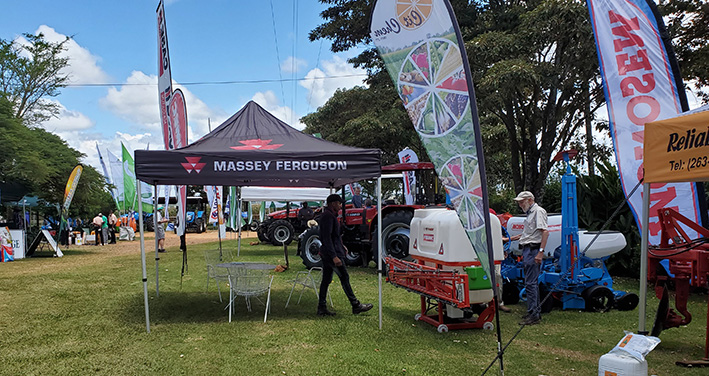
Some of the stands at the ART field day
The long reach of the Ukraine – Russia war has got to Zimbabwean agriculture. At the annual ART (Agricultural Research Trust) Farm open day, held close to my nursery, the Deputy Minister of Agriculture exhorted the audience to grow lots of wheat this coming season. It seems that we import nearly 50% of our wheat requirement, mainly from Russia. No doubt this influenced Zimbabwe’s abstention at the UN meeting on the Russian invasion, as did Russia’s support of Joshua Nkomo’s ZIPRA faction in Rhodesia/Zimbabwe’s civil war that culminated in Zimbabwe independence in 1980. It was probably not lost on the audience that we wouldn’t be so dependent on wheat imports in the first place if the government would just get on with making land tenure a reality so that farmers would have collateral against which to borrow. Banks have made it clear that loans will not be forthcoming any other way. I guess there will be a bread shortage later this year.






 Zimbabwe Absurdity
Criminal ethics
30 05 2025“Boss, come and have a look at this” Mapeno, the gardener exclaimed, clearly excited. He held up two expensive day packs. “Where did you find them?” I responded. “Over here right by the gate” came the reply. “Are you sure they don’t belong to the builders?” I asked. “No, I already checked with them”. I wasn’t surprised, they didn’t look like the sort of day packs a Zimbabwean builder could afford.
I was just about to go to work so he brought them over to my truck and we started to go through them. Diaries with copious notes on what looked like engineering projects, a wallet with South African gun licences, credit cards and no cash. Two South African passports (one full) in one pack in the name of a male and another in the second pack with a woman’s name and photo. This was obviously stolen property but why had it come over the wall into our property? And how was I going to contact the owners?
Fortunately the diaries had contact phone numbers in them albeit different ones. I tried both – one did nothing and the other was unreachable. Maybe I could contact the South African Embassy and give them the passports and then the owners would likely go there and then be able to contact me. I was on the way to work when I realized that WhatsApp works everywhere irrespective of phone number so I entered the unreachable number and called. It was quickly answered. “Is this Mr M and are you missing a couple of day packs?” I said. “Yes we are – did you find any passports?”. I answered that we’d found three and asked what they’d lost. A laptop and US$2,000 was the response. “It was just stuff, the passports are the most important things, at least we can get back home tomorrow” he added.
They had stopped for breakfast at a café at a local shopping centre and left the laptop and day packs on the back seat of the pickup in plain view. As they sat down to breakfast thieves smashed the back window, grabbed the packs and computer and got away in a waiting car.
“While this is not Jo’burg you still have to switch on. Thieves hang out in car parks just waiting for that sort of opportunity” I commented.
“Yes, we know that now” he replied. “Please send me your address so that I can come and pick up our stuff”.
I wasn’t there when they arrived but our maid phoned me to confirm who they were and wrote down the registration number of their pickup truck. I did wonder why the thieves bothered to “return” the day packs and their contents – a distinctly curious form of criminal ethics. If I were they I’d have kept the rather smart packs and dumped the contents into the nearest ditch.
Crime in Cape Town is an altogether different league. One could easily be lulled into a false sense of security by the first world shopping centres, immaculate roads and civilised driving standards (traffic lights are actually respected) contrary to Zimbabwe. Tourism is booming – the driver we used from the airport told us that in December 2024, 1.6 million tourists came through the airport – tourists we met on Table Mountain commented on how cheap Cape Town is. People are positive about their future and investing and developing in agriculture – rare attitudes in Zimbabwe.
Visiting Oaklands Estate near Wellington in the Western Cape was a case in point. David, a friend of my cousin, bought the abandoned racehorse stud in 2009 before occupying it in 2011. The derelict buildings have been renovated into tourist accommodation and the old stables will once again house a stud. Hillsides are being planted to proteas for their flowers for export. Other stables have been converted into a conference centre and come the tourist season the accommodation is full. I asked David if his positive outlook was down to living in the Western Cape. He answered “Pretty much. You can still avoid the corruption bullshit if you want to”. The Western Cape is relatively well run compared with the other provinces in South Africa. It is under the control of the Democratic Alliance with Alan Winde as the premier.
While Oaklands Estate is far enough out of Cape Town to not be overly attractive to criminals, the township of Guguletu is an epicentre of crime. The taxi driver was quite clear on this: “If you are a person of colour” – he tapped his own light brown skin – “or a white, you stay out of there” – he gestured to the left of the motorway. It was a maze of corrugated iron shacks, broken fencing, goats, rubbish and bizarrely – satellite dishes on nearly every dwelling I could see. We asked him about the white tourist who’d been killed there earlier in the year. “Actually there were two who went in there” he responded “but one survived”. “You see that road up there?” he gestured with his right hand to a road sweeping a curve over the motorway into the township. “There was traffic backed up on the other side of this road so both asked their traffic navigator apps for an alternative and it took them into Guguletu. One guy was robbed of his car and beaten up but got out to a hospital and survived. The other was a doctor and they shot him. Dead. You don’t mess with the gangs in there – they run the place.” I mused that they were probably not the type that would return high quality day packs over a suburban wall in the expectation that they would be returned to their owners.
We arrived at the airport and said goodbye to Mario. It was time to head back to Harare. I got chatting to the porter who was assisting us whilst Marianne filled in forms to get VAT back. I asked him where he lived. “Oh, Guguletu” he replied. When I asked him how he coped with the gangs and crime he shrugged “God looks after me”.
Comments : Leave a Comment »
Tags: africa, Cape Town, crime, Guguletu, South Africa, Table Mountain, travel
Categories : Agriculture, Economics, Environment, horticulture, Social commentary, Travel