Smoke. Everywhere smoke from incessant bush fires started to clear lands or smoke out bees or just plain carelessness. Every year Zimbabwe burns as does the rest of southern Africa – 760,000 sq. km in 2023.
Glowing ember sunsets and reluctant red sunrises. The latter so dull that one can, with binoculars, safely see the sunspots. Lots of photo opportunities to be had.
Dust. Everywhere dust. A patina of dust on my desk every morning. The dashboard of my truck covered in dust. Motes of dust in my home office – drifting lazily down in an afternoon sunbeam.
Wind. September is the month of wind. Driving leaves, bending trees and driving the dust. Leaves and ash swirling on the garage floor. When I sailed we always used to look forward to September for the excitement of the gusty weather. In my paragliding days we’d think of other things to do though the calmer days gave good thermic conditions.
Colours. The blazing colours of the new growth on the musasa (Brachystegia speciformis) trees. If one is lucky and catches a day of relatively little smoke it is possible to photo the spectacle. I never have. One has to drive up to the Eastern Districts to get the best displays.
Our Dendrobium orchid has been particularly impressive this year.
Cool nights and warm days. Yesterday morning on ART farm it was 5°C at 6 o’clock and 29°C by midday. My fleece jacket has been washed and hung up in the cupboard until April. I am still sleeping in the bed but October will just be hot and I’ll sleep on top.
New growth. Our roses are a blaze of colour (admittedly we have been getting professional help). Everything is growing fast in the nursery. A customer for whom we are growing cherry peppers commented that he’d never seen such good seedlings. I’ll take the credit…
Our roses are looking good this spring. Marianne has commented that we need a few more yellow ones.
Bees. It’s bee swarming season. A swarm has been in one of the catch boxes hanging under the eves of the second garage for a few weeks now. It will be collected by the Mike the bee man (he runs a commercial pollination service) and we’ll be given another jar of honey that we don’t eat. In the meantime they’ll forage in the garden and elsewhere before being taken off to work. We don’t mind being a bit of a bee holiday camp.
The Erythrina lysistemon (coral tree) trees has showy flowers too. This one was dripping nectar – literally!
Dry. Of course it’s dry and it will be desperately dry by the time the rains arrive in November. Our lawn is crisp. The flowers and vegetables get water but there isn’t enough for the lawn so it just has to wait. It will green-up soon enough when the rains start. It will get a little fertilizer help too and then it will need mowing weekly.
David Scobie, 47 years after realizing fame as a schoolboy, returns to his roots in Harare
David Scobie hit fame as a 14 year old school boy when he recorded and released a song, Gypsy Girl, that topped the charts in Rhodesia (which is Zimbabwe now). He hasn’t been seen in Zimbabwe for some 26 years so when Marianne read that he was doing a concert tour and would be in Harare for a one night show on the 29th August and suggested we get a group of friends together and go to the show it was a no-brainer. In the end only three of us went but it was a capacity crowd at the Reps Theatre in town and huge fun. He does a very good impression of Neil Diamond and the show “Neil Diamond Masterworks” was thoroughly enjoyed by the crowd whose age reflected the era of the music.
Reps Theatre is an amateur theatre society that stages all manner of plays, music and dance shows. How they manage to keep going is a minor miracle in the tough economic environment of Zimabawe. The theatre decor was showing its age but the sound system was good and the bar was humming. Support them if you can!
We grow our seedlings in compartmentalized expanded polystyrene trays. The cells are filled with a growing medium, in this case coir pith, and a seed is placed in each cell and grown out to maturity. This can take as little as four weeks in summer for tomato seed or up to four months in the case of gum tree seedlings as seen above. A seedling is deemed mature when it can be pulled from the cell and the roots hold the medium in a plug which will remain intact until it can be planted into the field. It also needs to be tall enough to be planted easily and not so tall that the leaf area will tax the roots ability to take up enough water in what, for the plant, is a stressful transition. There are other criteria that need to be met such as hardness of the leaves but that’s getting boring.
Being made of polystyrene the trays are light and rigid, which makes them easy to handle. It also makes it easy for the plant to grow its roots into the polystyrene which makes the seedling difficult to pull out of the tray. New trays have a smooth surface which is difficult for the roots to penetrate but as the trays age their surface becomes pitted and the plants’ roots can penetrate the polystyrene. To reduce this effect we dip the trays in a solution of copper oxychloride and water soluble glue. This creates a localized toxicity in the tips of the roots which stops them growing into the polystyrene and serves to sterilize the tray. Mostly it’s effective but as the tray ages and the surface becomes rough the roots grow into it anyway. The buildup of copper over many uses of the tray also causes a more general toxicity in the plant which can manifest itself as leaf discolouration and poor growth.
This general toxicity is most evident in gum seedlings as discoloured leaves and poor tip growth though in other seedlings it manifests as a general lack of vigour. I have noticed this for some years and when new trays are bought there was a noticeable “new tray effect” which I couldn’t really nail down to anything specific.
The coir pith we use is a by-product of the coir industry in India and other Asian countries. It’s the cork material that’s left over when the fiber has been extracted for ropes and mats. It has no nutrients in it so all must be added in the form of various chemical fertilizers. Organic we are not. This means that there’s little space for error and small changes in the formula can have major effects. Fortunately most of the work in this type of horticulture has been done long ago, albeit on other media, so it’s not as hit-and-miss as it may sound. Unfortunately I have a tendency to fiddle to try and get just that little bit of extra performance out of the system.
So when the gum seedlings started to become discoloured some years ago I put it down to something I’d done to the fertilizer formula. Thinking that it was a phosphate toxicity I designed a simple experiment. I bought several new trays, made sure they weren’t dipped in copper, then mixed differing quantities of single superphosphate that we normally use into the coir pith and grew out the gum seedlings. They were all good seedlings including those that should have had toxicity symptoms and those that had no single superphosphate added at all. It was that “new tray effect” and I knew it had to be the copper dip.
In Zimbabwe trash recycling is not a vibrant industry. There is a large municipal dump that I drive past on the way to work with a large warehouse building on it with “RECYCLING PLANT” painted on the front. Whether any recycling actually happens there is unknown. It’s part owned by one of the President’s sons but that’s a topic for another blog post. The old polystyrene trays we use end up on this dump site and add to the general pollution. It bothers me but the alternative is to import plastic trays from South Africa and they are very expensive and would likely not be recycled either. So I buy more of the local trays when I have to.
The gum seedling in the above photo is a good one. Though still young it has good root development, good leaf colour and good growth. It’s a product of a new tray – part of a batch that I bought earlier this year to replace older trays that were causing the copper toxicity symptoms. I have been seeing a general malaise in the tomato seedlings we are growing in old trays and should really replace them too. But there’s a problem.
I lease part of a property that supports my landlady’s ornamental nursery, another tenant’s rose nursery and the landlady’s son’s container rental business. The remainder of the property, some 10ha, is not utilized largely because we are in a bad area for sub-surface water and the three boreholes would not support irrigated cropping of any sort.
The 400ha of land on the boundary of “our” land is owned by a politically connected person whom I will call G. She acquired the land some time ago and set about building a wall around it. This is not just any wall – 3m high it has, a reinforced concrete core, a course of bricks on either side, pillars every 4m and topped with cornicing. It’s 9km long (measured on Google Earth) and is estimated to have cost US$500 – US$600 per metre. At a minimum $45 million G has clout and access to capital. So it was not without concern that we waited to see if the wall would include “our” property. It stopped either side.
My landlady’s son decided that the best way to make the property less attractive to acquisition by G and her ilk would be to develop it. Half the property was duly sold to a development company for construction of high density housing on condition that they changed the title deed to “development” rather than “agricultural” which is less attractive to the likes of G.
This development means that I will lose about a third of my current capacity and access to two boreholes that provide the bulk of my water. Remaining viable in a business that relies on large turnover on low value items/seedlings is going to be a challenge. So do I invest in new trays?
I was initially told that I would have about two years use out of the current two boreholes and that was six months ago. My landlady has had another two drilled on the remaining property but they are not very prolific. Uncertain times but to throw in the towel now on the premise that my business will fail would be defeatist. Tomorrow I will place an order for 2,000 new trays.
Storms develop south of the local microlight club where we fly model aircraft
“Nah, it’s a ZANU-PF problem, they must sort it out themselves” Fabian responded when I asked him if he was going to join today’s protest march in the centre of Harare. Fabian was a non-combatant porter in Robert Mugbe’s ZANLA army as a young man in Zimbabwe/Rhodesia’s bush war which ended in 1980. He has little time for the ZANU-PF political party that Mugabe founded.
The current Zimbabwean president, Emerson Mnangagwa, is looking to extend his presidency to a third term of five years. Zimbabwe’s constitution forbids this and protests have been planned for today which will be spearheaded by Blessed Geza who was a ZANLA veteran. Not surprisingly this has led to accusations of treason from Mnangagwa even though demonstrations are allowed under the constitution. While a lot of Zimbabweans are thoroughly fed-up with an inept and kleptocratic government the cynics are saying that it’s just a changing of the guard – a different herd of snouts to the trough.
Last week saw amoured cars and troop carriers on the streets in an attempt to intimidate would-be protestors. There were road blocks manned by police stopping traffic going into town though yesterday evening, when I came back from the airfield, the one on the main road in had packed up.
The organizers of the protest were clear in their instructions to the general public; stay out of the city centre though this may have been disinformation by the government. Schools are shut today and most businesses are closed or working with reduced staff. There was very little traffic about when we went out to walk the dogs on ART farm. My business is working on essential staff only as we really didn’t know what to expect.
There were videos on social media this morning of protestors starting to march into town. They must have been aware that the last time this happened it all turned nasty when the army opened fire killing six. This is not like Turkey at the moment where thousands of students are gathering every evening to protest the collapse of the country’s democracy. They only have to put up with tear gas.
On the way back home I stopped at a local hardware store to get a jerrycan for my paramotor fuel. “Have a nice day” the cheerful teller girl said as I was leaving. “Yes”, I replied, “and tomorrow we’ll have a new government” giving her a large wink. She giggled, “So, what are you doing here then?” was her response.
It did rain last night. In some areas the storms were violent but here it was just 14mm of rain. Enough to make us thankful for the 4×4 capability of my truck on the very sticky ART farm roads.
ZiG – the notes that never were. There were 100 and 200 denominations too and unbelievably some coins!
Zimbabwe has two official currencies, the US dollar and the local dollar. The latter is officially called the Zimbabwe Gold or ZWG. It used to be called the ZiG (also Zimbabwe Gold as apparently it’s gold backed) but that’s no longer used by the government, perhaps it sounded too much like the cartoon character that it is. The general public still use the term “ZiG”.
That both currencies are legal means that one cannot refuse payment in either. This of course brings up the sticky issue of exchange rates. A visit to the Reserve Bank of Zimbabwe’s (RBZ) webpage is instructive. A one ounce gold coin is being sold for US$2,744 or ZWG70,723 which makes the exchange rate 25.77 (it’s tightly controlled). Last week I bought ZiG/ZWG at 34 to the US dollar off an informal dealer. Why? Because my business takes in so little ZiG and I wanted a cheaper way to pay off my electricity bill and there was no way I was going to pay US dollars for that appalling service!
Officially the ZiG month-on-month inflation is 11.7% (277% annually as calculated) and the US dollar inflation is 0.09%. Given that a US$ loan will cost 9.5% per annum that is very conservative. Interestingly, the US$ annual inflation is given as 3.28% but the ZiG annual inflation is not given – too embarrassingly high perhaps? Of course Zimbabwe has had problems with currency inflation in the past so it’s hardly surprising that they don’t want to repeat the 2008 debacle. The official ZiG to US$ exchange rate is enforced by punitive fines, in US$, so it was surprising that the RBZ suggested in October that they let the exchange rate run in order to maintain the public interest in the ZiG.
In 2008 we had a bad experience with Zimbabwe dollars…
Another way of stimulating interest in the ZiG – and I use the term loosely – is forcing the public to pay a percentage of their taxes in ZiG. The government excels at imposing taxes. There’s a 2% transfer tax on most currency payments and a 3% levy on withdrawing cash. Income tax starts at US$100 per month! Company tax is payable quarterly based on estimates and there are penalties for being inaccurate.
The ZiG, despite much fanfare at it’s introduction in April this year due to the ballooning devaluation of the previous currency, has never been issued in note form. This has insured that people use the banks as little as possible and keep whatever hard currency they have “under the mattress”. It’s not without risk of course – a recent fire at one of the big local markets destroyed a lot of people’s savings.
In an effort to streamline tax collection the local tax authority has implemented a system of tax compliance for retailers and wholesalers. They are now required to register with the authority (ZIMRA) and have a system whereby they are online to the authority and every sale is registered and a QR code is printed on the invoice at the till point/checkout. Yes, it actually does work – try pointing your smartphone camera at the example below. Fortunately everything my company sells is zero VAT rated (plants for cultivation) so it’s not a requirement for us.
A QR code verifies that the purchase is registered with the tax authority
The whole tax accounting system has been overhauled and now each registered company has just one account for both company tax and income tax. In the past there were two and managing the system was complicated. Now it’s so simple that I can almost understand it but prefer my bookkeeper to handle the returns. Progress? I guess it is in a way.
We haven’t made any progress in growing the economy. The budget speech by the Minister of Finance at the end of November is best described as entertaining. I quote; “The attainment of the projected 6% economic growth in 2025, will result in Zimbabwe being one of the fastest growing economies in the region.” This is despite “… the agriculture sector, which was initially projected to contract by -21%, is, now expected to contract by -15% on account of better than anticipated output on wheat and dairy.” It seems the Minister of Finance hadn’t read the RBZ figures because he says “…prices for goods and services have relatively been stable following the introduction of Zimbabwe Gold (ZiG) in April 2024. Month-on-month ZiG inflation declined by -2.4% in May 2024, and averaged 0.0% in the second quarter of the year.” The full speech can be downloaded here.
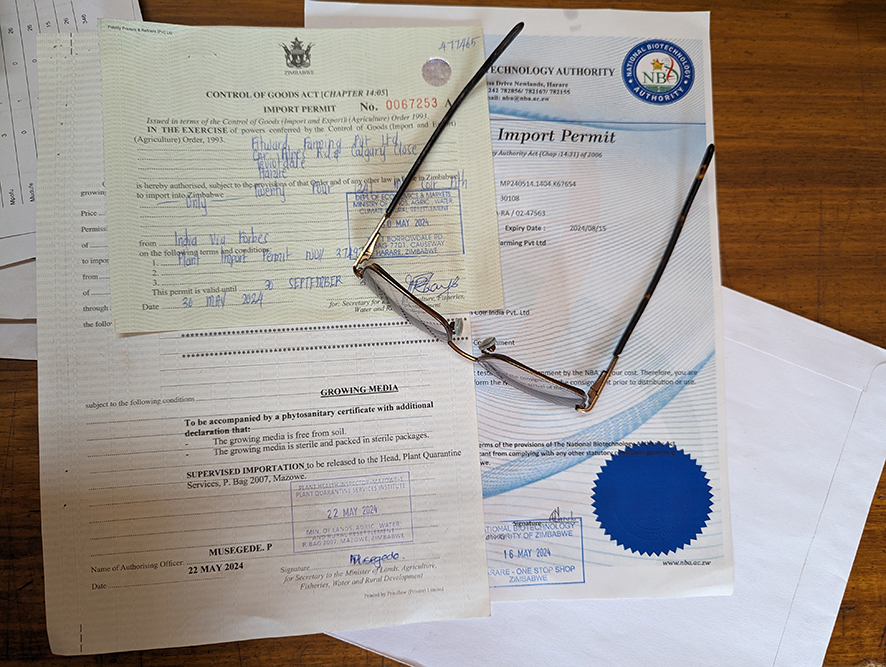
Just part of the paperwork necessary to import the coir pith essential to my business
It’s not something I look forward to but the coir pith on which my nursery depends for growing seedlings is essential for a good product. Yes, another substrate – composted pine bark – is available locally but last time I tried it some 20% of my seedlings died from the disease it carried. So about once a year I just have to grit my teeth and jump through the bureaucratic hoops. To be fair it IS becoming a bit easier as more of the government agencies involved get online and organized.
First off is the Agricultural Marketing Authority. I have no idea what they do but membership is essential and nothing else is achievable without it. Fortunately it’s doable online. Then it was on to the National Biotechnology Authority to get a permit that acknowledged the import was free of GMOs. The Indian supplier had given me a certificate stating as much and though it didn’t look very authoritative to me, it was sufficient and upon receipt of the required payment the local certificate was duly issued.
I have done the Ministry of Agriculture for the importation permits before and found it beyond tedious so sent Fabian, one of my senior staff, down there with some smaller US dollar note and instructions to “do whatever it takes” to get the first certificate. It cost him five dollars to put in the application whilst the official concerned was “on lunch break” and then all I could do was wait.
Fortunately the container was being delayed en route from Sri Lanka. I have no idea why it had to go via Colombo but I guess getting a full cargo of containers to warrant a ship going into the port of Beira in Mozambique takes some organizing. That was just as well as the first permit took two weeks, the date stamp indicated it had been sitting on an office desk for one of those weeks, and the second permit took another 10 days. That also required a sweetener of a few dollars.
By this stage I’d already paid the port and transport fees, all US dollars, and the race was on to get the local documentation to the border post near Mutare in the east of Zimbabwe before the truck from Beira got there. If we were late demurrage would be charged and I’d experienced that to my cost before. Fortunately my local shipping agent seems to know a lot of people and he got the money there just in time.
Then it was just a case of waiting for the truck to arrive and organizing a forklift to offload the pallets. It was three weeks late and in the interim I’d had to buy two pallets from another local supplier who’d marked up his prices 100% (he vehemently denied this even when I told him I new what it cost) but at least it’s over for about another year.
Now that the final accounts are in I can see that the costs were close to last year. The total for 24 tonnes of coir was US$19,650 which works out to 81.8c per kg. For some strange reason my bank needed to pay for the coir in Euros, I have no idea why but I do know that payment had to go through a South African bank. The rest was all payable in US dollars, none of the Zimbabwean kind thank you very much.
Yes, Zimbabwe is still trying to get its own currency up and running. It’s called the ZiG which is not the name of a cartoon character’s best buddy but is short for “Zimbabwe Gold”. It’s apparently linked to gold bullion of which the Reserve Bank is holding. Nobody is actually sure if this is the case but the official rate is around 13.8 to the US dollar.
When the ZiG was first introduced the obvious happened; currency traders spotted a good thing and the rate soon began to run. The government got tough and threatened a US$10,000 fine for any company or person not using the official rate – by law you have to accept either the ZiG or the US dollar if that’s how a customer wants to pay, the one exception being fuel traders who are not obliged to accept ZiG. Fortunately for my business most customers are uninterested in using local currency and choose to pay in US dollars, usually using cash. The local currency received has been entirely electronic – I’m not sure if this is by design – and I have yet to see any local notes. It is certainly not difficult to get US dollar notes out of my local bank and even small denominations are often brand new and in their 100 notes wrappers.
The country’s roads are in a disastrous state at the moment, bearing witness to years of neglect, but there’s a regional conference of the SADC (Southern African Development Community) in August so there’s been an orgy of road repair in Harare during the last few months. Construction teams have been called back to Harare from the outlying projects to concentrate on the local roads. Chaos has ensued as roads are closed and heavy traffic routed through the suburbs.
Some actions are unsurprising, others beggar belief. People living along the main route to the new Chinese-built parliament house where it’s all going to happen have been offered free water, delivered by tanker, to help make their gardens look pretty for visiting dignitaries.
The new dual carriageway to the parliament is being lined with kerb stones that make sure that there is nowhere to pull off the road if one has a breakdown. A local farmer, who lives on the route, pointed this out to one of the construction teams and was assured that it was a temporary arrangement and all the kerb stones would be removed after the conference. We’ll see.
A new bridge has gone in over a small river. They haven’t finished casting all the concrete and I’m told it takes a month to cure but the conference is in less than a month. Interesting.
An obvious question is where has the government suddenly found all the money? Are the construction companies actually being paid and what currency are they using? A friend is heavily involved in the landscaping of the new parliament and Marianne tells me she is being paid in US dollars and is doing quite well from it but rumours abound as to whether the others involved have been paid. I have heard that one company was owed some US$200 million which seems a bit much but many years ago I was told that a normal road costs US$ 1 million per kilometer to construct so perhaps it’s possible. Whatever the truth is you can bet the government will do whatever it takes to get the roads done and put up a paper-thin facade for the visiting dignitaries.
The nations hospitals would certainly like a bit of money themselves; currently several of the bigger ones are owed in excess of ZiG11 billion – a lot of money in any currency.
I am starting this while waiting for guests to arrive for lunch – my wife is an inveterate entertainer so needs little excuse to get friends around and of course today is a holiday so that’s what we are doing. Not sure when I’ll get to finish…
It’s an el Niño year so rainfall has been erratic so far; a heavy fall in October and then nothing for six weeks so crops are not looking great for those who don’t have irrigation available. There is a lot of fuss and bother in the various weather groups on various social media platforms whenever rain is forecast and then much soul searching when it doesn’t happen. People forget that forecasting is far more accurate than a few years back, even in this part of the world, and that hey, we get droughts in southern Africa! We have had 3 good years in succession and are due a drought, so all is normal in that respect.
I guess I could be cynical and say that the incompetence and corruption that we see all around us are also just about normal for this part of the world too. The road to my work is being resurfaced as we speak, and we are delighted but I fear there is an ulterior motive. The President has an interest in a housing development out beyond my business, and I think that is a prime motivation. Just by chance it goes past a big rubbish tip project that one of his sons has taken over. It looks like it’s being run properly, now we just need to get the city council to collect our garbage on a regular basis. Roads elsewhere in the city are in a dismal state and it’s not uncommon for local communities to take up the challenge and fill in the potholes on their own initiative.
I have just read in an article in The Economist that Indonesia built 300,000km of roads in the last 10 years. It is of course a vast country, bigger than the USA, but there’s an example here that our government could follow.
Zimbabwe is still in the bizarre situation of having two currencies: our own dollar and the US dollar. The local dollar is treated with contempt by all except the government who have just brought out a proposed budget with LOTS of zeros involved (the street rate for conversion is around 7,000 local dollars to the US dollar – officially it’s 6,000). Various members of parliament refused to vote for the budget to pass unless, amongst other demands, they got new 4×4 Toyota Landcruisers so that they could get over bad roads to visit their constituents. Nobody pointed out that the roads were such a mess in the first place due to the inefficiency and corruption. Fortunately, there were other bad ideas in the proposed budget that were also ditched – an annual tax on houses over a value of US$100,000 being one of them. Who was going to do the valuation was never revealed and quite how they were going to get around bribing the evaluators was not discussed either.
My business plods along. It pays the bills and that’s about all. We are charging less than we were in 2014 largely due to the proliferation of small seedling nurseries around town whose quality is dismal and who almost certainly don’t pay tax and cut a lot of other corners, but we cannot compete with their prices. I suspect a lot of people either don’t know what a quality seedling is or don’t care. Our core customers are commercial farmers and I think most of them do appreciate our commitment to quality – well that’s what one told me last week!
Of greater concern is a building project encompassing two neighboring farms in the form of a giant wall. The farms have been “acquired” by Grace Mugabe, wife of the late president, and word is she wants to have a 700-house project built on the enclosed 400ha. The wall is quite something (it has been nicknamed The Great Wall of Pomona after the area) – it’s not visible from space but is from 5,000m altitude on Google Earth. It is 3m high, has a reinforced concrete core and a course of bricks on the outside and inside. I asked a constructor what it might cost, and he suggested US$300-400 per metre. Given that the whole structure is 9km long that’s at least $27 million! The enclosed area is a rough rectangle but the property on which my business is located is a triangle jutting into the northeast corner. The big question is: what will they do when they get to the triangle, will they go around (an extra 500m), or will the wall cut the triangle off? Grace Mugabe is close to the President so wields disproportionate power and probably could just take the property if she felt like it. Perhaps she will force my landlady to sell the property, so she gets the title deeds? We will find out within the next 3 months or so when the wall will get to our boundary.
Despite the poor performance of the Zimbabwe economy the building sector is booming. Likely it’s due to money laundering. Al Jazeera TV did a documentary series (“Gold Mafia” in 4 parts) on this and explained that gold was being exported illegally, mainly to Dubai, by politically well-connected fat cats who were then bringing the cash back with the tacit approval of the President who is taking a 15% cut. The money is then invested in construction projects. Indeed, the suburbs are thick with construction projects of various descriptions – apartments, shopping centres, restaurants – which are often approved without the consent of residents. One of my cousins is in a street which is fighting the proposed construction of a Chinese restaurant. The Chinese are our friends so it’s almost a given that they will get permission.
We are cursed in this country with a wealth of minerals, especially gold. It’s just about everywhere you care to dig. My brother came out from the UK in October and as part of our travels we took a trip through the village where my mother lived after my father’s death. It was established as a gold mining area at the end of the 19th century. The commercial scale miners have long since moved on but the small-scale miners are everywhere and the place is a rubbish tip. One can only but wonder about the mercury pollution and mining safety. Health and safety are not concepts they care about.
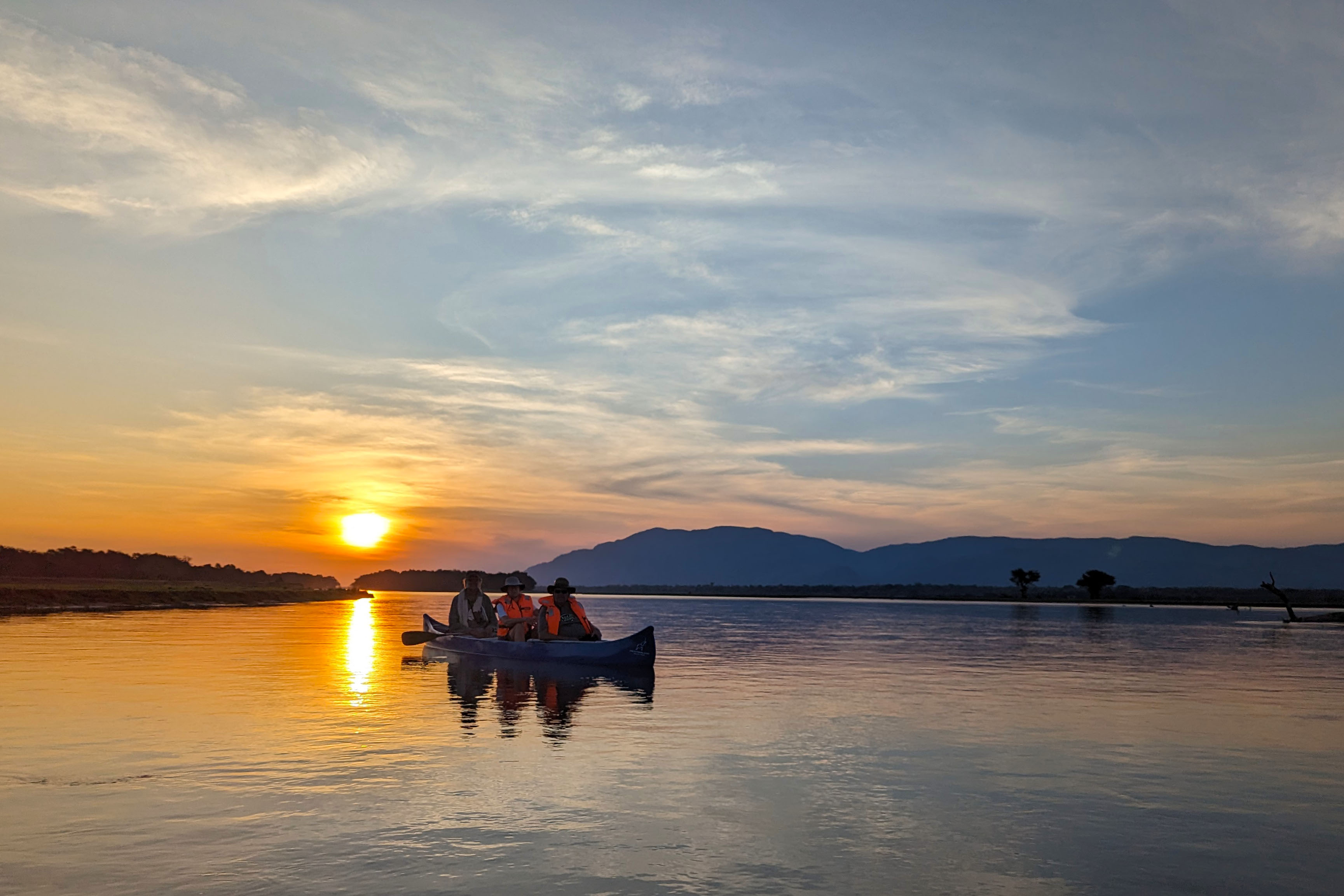
The countryside is still largely beautiful. We got invited to an old school friend’s safari camp on the Zambezi River in Mana Pools National Park. I guess it’s about 200km downstream of Kariba Dam. While the game was not as plentiful as it usually is at that time of year due to unseasonal rains, we still had a great time in a beautiful part of the country. Drifting down the Zambezi in canoes at sunset was memorable – crocs and hippos notwithstanding!
An evening drift down the Zambezi River
Earlier this year I had a bit of an “episode” early one morning. I can’t remember much about it but thought I should go to my doctor about it. She thought it was probably just what is known as Transient General Amnesia (TGA) but given my age thought it worth a spate of tests just in case it was something else. I had mentioned it to some friends of roughly my age and they both said they’d experienced it. Indeed, after much prodding, imaging and blood taking that conclusion was reached. The physician at the final consultation was impressed with the state of my health, structural issues notwithstanding, and commented; “Well, whatever kills you in the end it won’t be your heart!”. I wasn’t sure if that was good news or not – I am of the age now that how I “go” has become a subject of some importance and going quickly is the preferred option.
The degeneration of the structural issues necessitated a lower spine operation in April. It was deemed successful by the surgeon, but it necessitated 3 weeks of bed rest which have had a lasting effect on my mobility. The general anaesthetic also had a lasting effect in the form of POCD (post-operative cognitive dysfunction) which also causes episodes – a sense of disconnecting with the world which the physician said would eventually pass.
It’s New Year’s Eve now and fortunately it has stopped raining! Such is the erratic nature of the climate we find our selves in. The experts tell us it’s all symptomatic of climate change i.e. it’s becoming more extreme though I’d hesitate to attribute a few days of exceptional weather to that just yet.
So, what can we expect from the New Year? You have and election coming up, the Olympic Games are in Paris, the war will continue in Ukraine – the cynical French expression plus ca change, plus c’est la meme chose does come to mind!
Our weather has become increasingly erratic over the last 15 years or so. I put it down to climate change. Right now we are in the middle of a relatively normal rainy season. That means that the ITCZ (Inter-Tropical Convergence Zone) moves over the country and it rains – quite a lot. Most of our rains happen from mid November to the end of March which in Harare means some 700 to 800mm. The rain can be quite intense – we had 75mm (3 inches) in several hours last week which meant all the rivers around town were up and one of the reservoirs that supplies town was spilling. As a country we’ve had good rain for the last 3 years due to the la Niña effect though it has been quite variable over the country and Harare, which is in a high rainfall area, received less than average. We are due for a drought and I see that there is a el Niño predicted later in the year which is a reliable indicator.
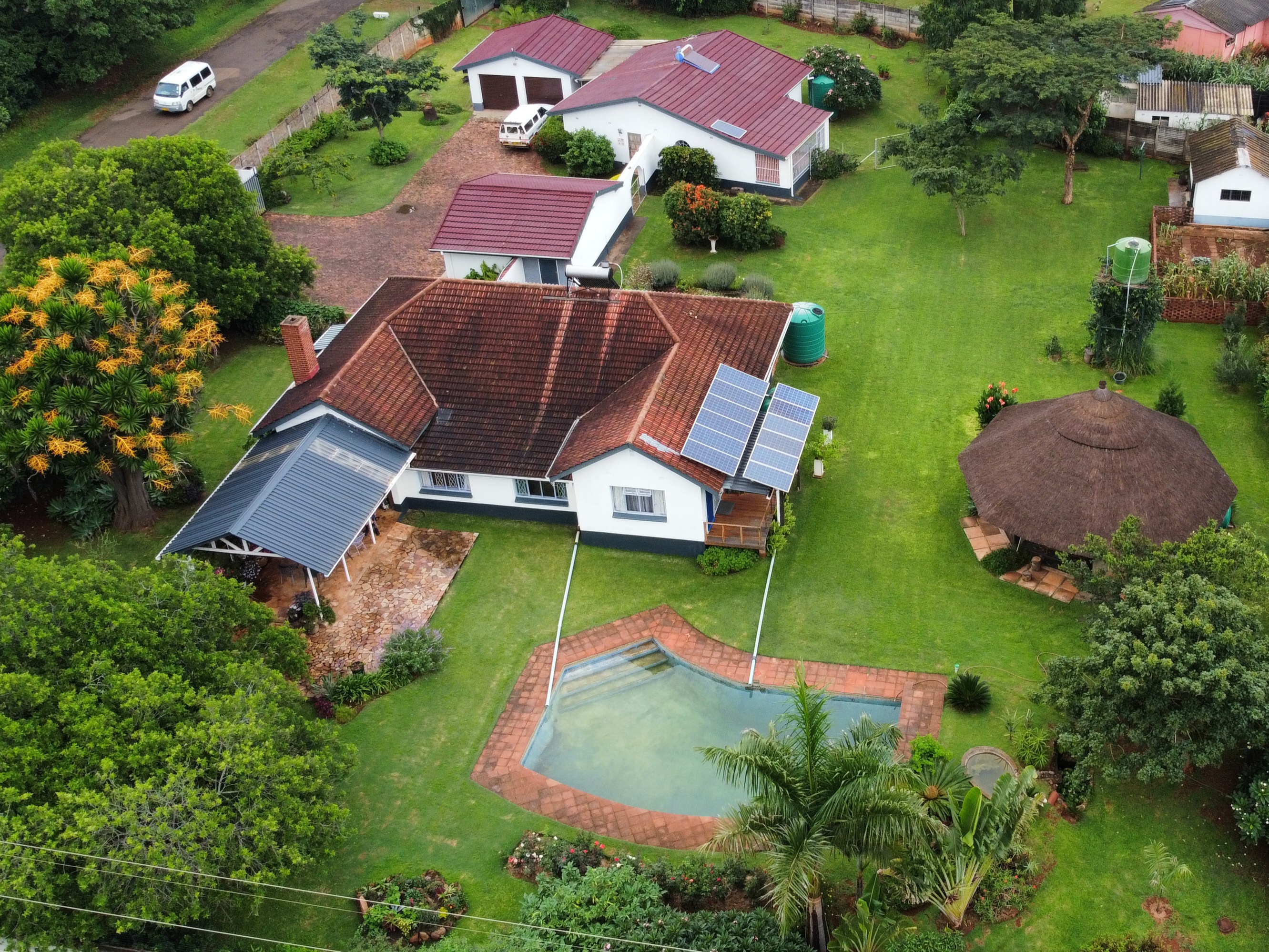
There’s rain around as I type this and yesterday afternoon we had quite a storm with high winds and hail and of course the power went off. It’s still off but we are geared for this eventuality and have solar panels and two lithium batteries to get us through the night. Power outages for other reasons, mainly incompetence and over-use of Lake Kariba as a hydro source, are common so everyone who can has a solar backup plan. Solar water heating makes a lot of sense in our climate so we have three solar heaters, one for us, one for the cottage tenants and one on the domestic employee’s rooms. In the cloudless, hot days of August and September the water can easily boil.
The complete Zimbabwean domestic survival system: visible are two solar water heaters, two solar panel systems and rainwater collection into tanks and a swimming pool.
I see your weather has been erratic too. Mt Washington in the north-east of the USA hit a record -70C a few days back and Europe had an unseasonably warm Christmas. It seems that California has had some heavy rains too; the default weather app on my new iPad is set to the Apple headquarters in Cupertino and they had flood warnings out recently.
Planned, and I use that word loosely, power outages are called “load shedding” in this part of the world. Towards the end of last year it was announced that Lake Kariba, which is our major source of hydro power, had got to it’s minimum level permitted for generation due to over-use by the Zimbabwe power authority and load shedding would become a daily occurrence. We have another major thermal power station at Hwange in the west of the country but it has become a byword for mismanagement and cannot take up the shortfall. We also import a lot of power from Mozambique and South Africa but have managed to get into a lot of debt so the aforementioned countries are fed-up and restricting our supply. South Africa has its own power supply issues (again due to mismanagement by the state-run utility) and is also imposing load shedding but at least it sticks to a schedule. In Zimbabwe the power generally goes off in the suburbs about 6.30 a.m. and comes back on around 10 p.m. Businesses are not exempt either and incur heavy costs due to diesel generators. It’s not unusual for some to run just on night shifts.
Our swimming pool was an early casualty of the power cuts. It’s essential to keep the filter running which the solar panels can do on a sunny day but those are rare in the rainy season so it’s more green than clear these days. Marianne was muttering about the cost of more chemicals to try and clear it. I pointed out that we could always fill it in but it wouldn’t be a cheap procedure and then we’d lose some 70,000 litres of stored water that would be very useful in a drought. We have decided to live with it being more green than not (it is covered over in winter when not in use).
The book you asked about is, I think, “The Shackled Continent” by Robert Guest who was an Africa correspondent for The Economist for a number of years. I found it fascinating and very insightful. Maybe I should read it again.
My business muddles along. I have a lot of outstanding debtors and it’s not so simple as insisting that they pay up front for their orders. I hate having to get nasty but it may eventually come to getting professional debt collectors in as I need to get the money to pay for imports of the coir “peat” raw material that we use to grow the seedlings. I obviously cannot use Zimbabwe dollars but fortunately I did invoice in US dollars which once again is becoming the currency du jour. The government is still trying desperately to keep the local dollar alive but with an official exchange rate of 740 to the US dollar compared with a “parallel”, i.e. street, rate of 1,100 to the dollar, it doesn’t have much of a chance. The local currency is still used, and has to be offered, as a payment method but most outlets make it very attractive to use the US$ by offering massive discounts . Government departments don’t do this so get paid almost entirely in local currency which means they are perpetually in financial difficulties – hence the disastrous state of the power supply, roads, rail links and anything else they are involved in. Am I making sense?
The government is also trying to stifle speculation on the currency markets by lending money at vast interest rates, 110% in November 2022, which makes doing business very difficult and one of the reasons that I use to explain why my business is so flat. The other is the proliferation of competition, often informal, which cut lots of corners allowing them to undercut my prices. Their quality is dismal but people either don’t care or see it as an acceptable consequence of the cheap prices. My prices haven’t changed in four years despite the rising costs of inputs in real (US dollar) terms. It doesn’t make for attractive business. Curiously the construction business is booming with cluster homes (small, single level apartments – several to a property) and other developments being built throughout the suburbs. Quite where the money is coming from I cannot ascertain – but in an economy as moribund as ours it’s almost certainly dirty.
Yes, us Zimbabweans are a resourceful lot and I guess in that respect Diana remained true to her heritage. My workroom/office is full of junk that I cannot throw away just in case I find a use for it in years to come. It must be a hold-over from the days when Zimbabwe was Rhodesia and under sanctions so nearly everything that could be was recycled. It’s probably an attitude of my generation rather than today’s “youngsters” – I drive past a municipal rubbish tip on the way to work and there’s never a shortage of trucks pulling in to offload. I suppose people do make a living out of recycling here though it’s not as fashionable as in the developed world. An elution plant (recycling gold from electronics) has recently been constructed at the former rubbish dump. It’s also not unusual to see carts being pushed around the suburbs and having one’s gate bell being rung by the owners looking for scrap metal.
I guess our “big” news for this year is that we’re going over to the UK in May to attend a rock concert! I’ve never been to one as standing for a long time in rowdy crowds is obviously not possible for me but this is Mike & The Mechanics who are not as popular as they used to be so seating is an option. Time to tick off the bucket list.
Then we are going to stay on the Cote d’Azur with an old girlfriend and her husband for four days. Apparently we’ll be quite close to St Tropez. Marianne is keen to go and see how the ultra-rich live but I may give it a miss. Really looking forward to it and we’re brushing up our rudimentary French in anticipation.
Well, on that positive note I’ll sign off and wish you all the best for this year. Forget the snow shoveling, go skiing and may it be exceptional.
Ciao
Andrew
Note: this is a genuine reply to a friend in Washington State U.S.A. who was a good friend to my sister Diana, and helped look after her in the terminal stage of her cancer three years ago.
Myself, Marianne and Themba (who photo-bombed the moment). Marianne’s wearing a cap and dark glasses because “my hair’s a mess and I haven’t got eye-shadow on”. I am wearing a cap to hide my bald spot.
On Tuesday Marianne asked me if I’d remembered it was my birthday today. I had totally forgotten about it. I won’t but that down to old age just yet but my memory isn’t great and I’ll explain that later.
I got to thinking last night that I was about to turn 63 which is 3 times 21 and what was I doing at 21 and 42? Oddly enough I have quite clear memories of my 21st.
I was in the car park at my university residence when and acquaintance by the nickname of Russian, who was actually of Polish descent, found out and asked me if I’d been kissed yet (he didn’t have to specify a woman). I made some non-committal reply whereupon his girlfriend, Colleen, stepped up and kissed me. It probably was my first kiss! Being a November baby meant that parties clashed with exams so my mother paid for a few of us to go out for dinner later in the year.
November is, of course, an historic month. Armistice Day marking the end of the First World War is on the 11th. This year I noticed a plethora of Facebook posts marking the occasion and reminding readers how we must no forget. I agree totally. Less well known in the wider world is that the Rhodesian government, led by one Ian Douglas Smith (who was a World War 2 fighter pilot in the RAF), made a Unilateral Declaration of Independence (UDI) from British rule on the 11th of November 1965 making Southern Rhodesia just Rhodesia which became Zimbabwe in 1980. International sanctions swiftly followed and we were on our own (with support from South Africa and Portugal) until 1980. Rhodesians were capable and highly industrious and for a while the country flourished.
Various Facebook sites on the 11th were swamped with ex-Rhodesians reminding me of this. They seem to have forgotten that by the end of the ensuing bush war in December 1979 we had long lost the support of Portugal and South Africa and came very close to a battle for the capital city, Salisbury (now Harare) which would have been a bloodbath. The following elections got us Robert Mugabe as a ruthless head-of-state and we all know how that eventually turned out. Thousands of people lost their lives in the bush war, my father included as an innocent civlilian, and I was partially paralysed in a military action. Really, did those who concocted the UDI not see the train wreck coming? What were they thinking? The UDI was arguably the worst decision in our history.
What was I doing 21 years ago? In 2001 the Mugabe regime was on the rampage, chasing white commercial farmers off their land, frequently destructively. Often farms were looted and abandoned of their agriculture, plunging the currency into a hyper-inflationary period that culminated in 100 trillion Zimbabwe dollar notes and inflation in October 2008 estimated at 4.3 million percent. Those who could left the country, New Zealand was particularly quick to see the potential of qualified Zimbabweans and welcomed them en masse. I do know that in 2001 I had a lot more disposable cash than I do know and I did around that time have a party for friends in a local restaurant. It was great fun. Maybe we just didn’t care about the impending financial disaster or more likely we just chose to ignore it for the night. I certainly wasn’t concerned about getting to 63 – that was far away.
Now 63 is here and I’m not impressed. But before I go down the route of losses and gains I owe an explanation of my terrible short-term memory. In April this year I had a lower back operation to repair and stabilize various vertebrae that had deteriorated as a consequence of the bullet that tore through that region in April 1979 (detailed description in Reflections on the first half). The operation was successful and the surgeon said the spine was not as messy as he was expecting but the anaesthetic has had lasting consequences on my memory. It even has a name; Post Operative Cognitive Dysfunction (POCD). While its occurrence in people my age is uncommon I appear to have been unlucky – I’ve had more than a few general anaesthetics in my life and none have had this effect. Effects range from forgetting conversations I’ve just had to full-blown bouts where I cannot control my thought processes and I cannot perceive the world around me. The POCD may last in younger people up to 6 months but in older people there can be permanent effects. Recently I decided to do something about this and give my brain some work to do.
When I first took over my business I quickly vowed to get rid of the pile of paper that accumulated on my desk at the end of each month and decided to write my own software package to deal with the administration side of the business. I duly went on a course to learn Visual Basic (VB) and got to work. It took several years but it does the job now. While these projects are never finished I more recently decided to write a wages package that my senior foreman could use and free me up from tedious and mistake ridden Excel spreadsheets. It works well but being written in an old version of VB has issues running on my relatively new laptop. So I rewrote it in a newer, and quite different version. On getting out of hospital I needed something to do whilst on bed rest so wrote a cash notes calculator for the old version. Being rather pleased with they way it worked I decided to write one in the new version, only to find to my complete amazement (and disquiet) that I’d already done it before going into hospital. I had zero recollection of writing the app or the code itself. So now I’m rewriting the original accounting software to give my brain exercise. It will be a long project.
My mobility has taken a considerable knock over the years. At university I used to cycle all around the campus and when I left I went on a cycle tour of France, Switzerland and Germany. At 42 I still cycled around the farm where I rented a cottage. This all came to an end, albeit slowly, when a South African surgeon did a less than stellar job of fixing the neck I’d fractured as a teen. Back in 2014, when I’d started tripping over my own feet, I winced mentally when the surgeon who finally fixed the mess said “Oh, that old man” when I told him who’d done the original surgery. Little did I know at the time there was a specialist orthopaedic spine unit which is part of the Vincent Pallotti Hospital in Cape Town. I have not been on a bicycle since. So the message to the reader is: if you really HAVE to go under the knife, DO YOUR HOMEWORK! When asking a local doctor for advice on who to see about the neck operation I accepted at face value what he told me. It was an expensive mistake.
So, in the last 21 years I have lost: hair (thanks to my mother’s genetics), mobility (already explained), hand and upper body strength also as part of the aforementioned, hearing (thanks to the military) for which I wear hearing aids – I love ’em and can enjoy music again and of course my eyesight is not what it used to be. I do wear bifocal glasses but only for flying a drone. I’ve had lifelong short sight for which I’ve variously worn glasses, then I had a flirtation with contact lenses and now I’m back to glasses which I take off for close work.
Gains: toys, rather a lot! Some years ago when it became apparent that paragliding was a dying sport in Zimbabwe I took up aero-modelling. It’s definitely second prize but at least I get to fly something. So now I have several drones (I took the photograph at the top of the page with one) and some fixed-wing models too. I particularly like electric gliders. For the real flight experience I have a paramotor (that’s a paraglider with a petrol driven motor) but I don’t get to fly that much as I need assistance with the setting up. Of course I’ve gained a marvelous wife which was something I never expected to happen at 21 or even 42. Nothing could have been further from my mind at 21 and well, at 42 I thought I’d be a batchelor for the rest of my days. Fortunately I was wrong.
As for the next 21 years, well, it’s best not to think about it too much. Maybe I won’t get there, after all, 84 will be getting on a bit. Perhaps the end will come like the proverbial “thief in the night”, but sadly few of us will be that lucky.
I won’t pretend the last 21 years have passed quickly but I don’t have a lot of memories to look back on. I guess that it’s time to make a few now so next May Marianne and I are going with a group of friends to a rock concert in Birmingham, U.K. It’s our first ever and hopefully it will be good. Mike & The Mechanics are by no means a current band but we still like their music.
On Tuesday after Marianne reminded me it was my birthday on the 17th she went shopping. She complained that she couldn’t find me a present; I really wasn’t concerned – I think presents should be bought when one sees them, not necessarily for an occasion. It did occur to me to get myself a present, perhaps a rescue dog from one of the over-flowing charities. But I wouldn’t have been able to choose just one and would like to have gone for an older dog. Old dogs are special so maybe I’ll sponsor one instead.
Last month I finally had to throw in the towel. I called together the workers’ committee who represent the labour force and told them that I couldn’t find enough local dollars to pay them and from now on it would have to be US dollars. They tried hard not to show their delight and failed, dismally.
The government likes to claim it has stabilized the Zimbabwe dollar that had officially slumped to about 530 to one US dollar last month. They have even gone so far as to issue punitive fines on those organizations trading at unofficial rates which can be around 800:1 or higher. Indeed, local dollars can now be bought for as little as 700:1, if they can be found at all. That very little needs to be paid for in Zimbabwe dollars is no doubt preventing the local dollars gaining more. My business has steadily been taking in more and more US cash over the last 6 months to the extent that my time spent going through the bank statements at the end of the month is now only a couple of hours.
The government also displays considerable ambiguity to the currency it is supposedly supporting. Imports are taxed at a rate of 700 local dollars to the US dollar, no doubt to encourage importers to use the US currency. Export remittances paid back to Zimbabwe are “taxed” by the government which takes 40% of the hard cash and then pays the exporter back in local money at the official rate which means the exporter is losing 25% of the hard-earned forex. Internal foreign currency transactions are deducted 20% under the same system, and yes, the money I withdrew from my account shown above was taxed 3%. Curiously the small denomination notes are all issued new. I’d been hoping to get some 1s but my bank didn’t have any in stock.
Marianne and I are going to the UK on Sunday for three weeks. It’s always a bit of an exercise in anxiety in what can go wrong whilst I’m away but it’s been four years since we got to the UK and the break is needed.
Yesterday I got a call from one of the foremen saying that one of the borehole pumps wasn’t working. Fortunately there’s a business park some 10 minutes from my work that has an irrigation company and three visits later with an unnecessary purchase of a pump controller, it was determined that the motor was burned out (the pump controller should have protected it but failed to do so) and it was pulled out the ground and changed. Marianne remarked drily that “at least it didn’t happen next week”. Indeed.
A friend has the estimated wages, in US dollars of course, which he will drop off when the clerk tells him an updated breakdown. The wages package was written by me and although I’m not and exceptional programmer I do take pride in designing software that’s intuitive to use. Emergency phone numbers have been listed and fingers will be crossed. We will be taking our full currency allowance of 2,000 US dollars each with us – nobody outside Zimbabwe has use for our currency either.







 Zimbabwe Absurdity
To buy or not
17 08 2025We grow our seedlings in compartmentalized expanded polystyrene trays. The cells are filled with a growing medium, in this case coir pith, and a seed is placed in each cell and grown out to maturity. This can take as little as four weeks in summer for tomato seed or up to four months in the case of gum tree seedlings as seen above. A seedling is deemed mature when it can be pulled from the cell and the roots hold the medium in a plug which will remain intact until it can be planted into the field. It also needs to be tall enough to be planted easily and not so tall that the leaf area will tax the roots ability to take up enough water in what, for the plant, is a stressful transition. There are other criteria that need to be met such as hardness of the leaves but that’s getting boring.
Being made of polystyrene the trays are light and rigid, which makes them easy to handle. It also makes it easy for the plant to grow its roots into the polystyrene which makes the seedling difficult to pull out of the tray. New trays have a smooth surface which is difficult for the roots to penetrate but as the trays age their surface becomes pitted and the plants’ roots can penetrate the polystyrene. To reduce this effect we dip the trays in a solution of copper oxychloride and water soluble glue. This creates a localized toxicity in the tips of the roots which stops them growing into the polystyrene and serves to sterilize the tray. Mostly it’s effective but as the tray ages and the surface becomes rough the roots grow into it anyway. The buildup of copper over many uses of the tray also causes a more general toxicity in the plant which can manifest itself as leaf discolouration and poor growth.
This general toxicity is most evident in gum seedlings as discoloured leaves and poor tip growth though in other seedlings it manifests as a general lack of vigour. I have noticed this for some years and when new trays are bought there was a noticeable “new tray effect” which I couldn’t really nail down to anything specific.
The coir pith we use is a by-product of the coir industry in India and other Asian countries. It’s the cork material that’s left over when the fiber has been extracted for ropes and mats. It has no nutrients in it so all must be added in the form of various chemical fertilizers. Organic we are not. This means that there’s little space for error and small changes in the formula can have major effects. Fortunately most of the work in this type of horticulture has been done long ago, albeit on other media, so it’s not as hit-and-miss as it may sound. Unfortunately I have a tendency to fiddle to try and get just that little bit of extra performance out of the system.
So when the gum seedlings started to become discoloured some years ago I put it down to something I’d done to the fertilizer formula. Thinking that it was a phosphate toxicity I designed a simple experiment. I bought several new trays, made sure they weren’t dipped in copper, then mixed differing quantities of single superphosphate that we normally use into the coir pith and grew out the gum seedlings. They were all good seedlings including those that should have had toxicity symptoms and those that had no single superphosphate added at all. It was that “new tray effect” and I knew it had to be the copper dip.
In Zimbabwe trash recycling is not a vibrant industry. There is a large municipal dump that I drive past on the way to work with a large warehouse building on it with “RECYCLING PLANT” painted on the front. Whether any recycling actually happens there is unknown. It’s part owned by one of the President’s sons but that’s a topic for another blog post. The old polystyrene trays we use end up on this dump site and add to the general pollution. It bothers me but the alternative is to import plastic trays from South Africa and they are very expensive and would likely not be recycled either. So I buy more of the local trays when I have to.
The gum seedling in the above photo is a good one. Though still young it has good root development, good leaf colour and good growth. It’s a product of a new tray – part of a batch that I bought earlier this year to replace older trays that were causing the copper toxicity symptoms. I have been seeing a general malaise in the tomato seedlings we are growing in old trays and should really replace them too. But there’s a problem.
I lease part of a property that supports my landlady’s ornamental nursery, another tenant’s rose nursery and the landlady’s son’s container rental business. The remainder of the property, some 10ha, is not utilized largely because we are in a bad area for sub-surface water and the three boreholes would not support irrigated cropping of any sort.
The 400ha of land on the boundary of “our” land is owned by a politically connected person whom I will call G. She acquired the land some time ago and set about building a wall around it. This is not just any wall – 3m high it has, a reinforced concrete core, a course of bricks on either side, pillars every 4m and topped with cornicing. It’s 9km long (measured on Google Earth) and is estimated to have cost US$500 – US$600 per metre. At a minimum $45 million G has clout and access to capital. So it was not without concern that we waited to see if the wall would include “our” property. It stopped either side.
My landlady’s son decided that the best way to make the property less attractive to acquisition by G and her ilk would be to develop it. Half the property was duly sold to a development company for construction of high density housing on condition that they changed the title deed to “development” rather than “agricultural” which is less attractive to the likes of G.
This development means that I will lose about a third of my current capacity and access to two boreholes that provide the bulk of my water. Remaining viable in a business that relies on large turnover on low value items/seedlings is going to be a challenge. So do I invest in new trays?
I was initially told that I would have about two years use out of the current two boreholes and that was six months ago. My landlady has had another two drilled on the remaining property but they are not very prolific. Uncertain times but to throw in the towel now on the premise that my business will fail would be defeatist. Tomorrow I will place an order for 2,000 new trays.
Comments : 2 Comments »
Tags: political clout, uncertain future, waste recycling, Zimbabwe
Categories : Agriculture, Business, Environment, horticulture, Social commentary