Normally I find going out to Mazowe to get import permits a bit of a chore but not this time. I guess I was just too pleased to get out of Harare and it’s farcical Covid lock-down. I took my time on the 20 minute drive to watch the countryside go by.
It’s desperately dry at this time of year despite being spring. The musasa tree (Brachystegia speciformis) colours were finished, they are spectacular for just a few weeks, and there was little evidence of the fire devastation normally found across the sub-region at this time of year. The image shown below indicates that other countries are ablaze as usual (that’s Zimbabwe in the middle of the image).

The image comes off the AFIS website and is worth a look as it covers most of the world and offers fire prediction services.
The Plant Protection Research Institute in the Mazowe valley was quiet and had all the usual Covid screening processes in place. The trees in the car-park were in full bloom and were in a frenzy of bird activity.
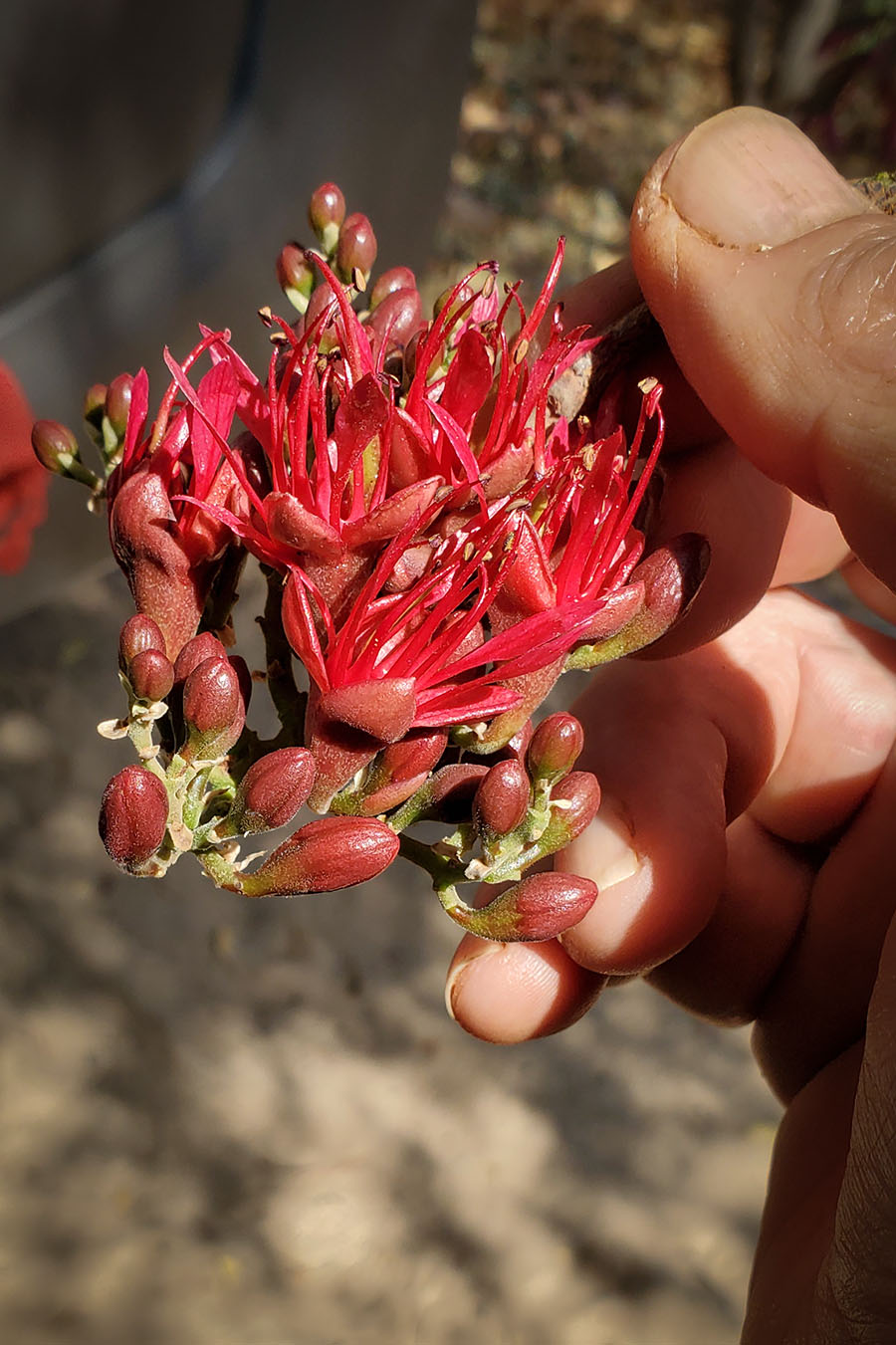
A member of staff helpfully identified the tree as a member of the Schotia genus (I found out later it was brachypetala species) which is indigenous so I stopped to have a look at the birds. There were at least 3 species of sunbird (nectar feeders) including the scarlet chested sunbird, the amethyst sunbird and the miombo double-collared sunbird and several other species I couldn’t identify. They were having a great old time with not a small bit of squabbling. The flowers were thick with bees and other nectar feeding insects too – not surprising as very little else around was in flower.
Having handed in my application for cotton seed importation from Israel (for a colleague who has business interests in the crop) I set about collecting a few seeds scattered around on the pavement. The gate guard soon came over to see what I was doing and offered to help. Curiously, the trees were in full bloom and producing seed from the previous season at the same time. The seeds have a fleshy aril (not shown) which is attractive to birds and the flowers are also eaten by monkeys. We live in a garden that has space for a few more trees so hopefully I’ll be around to see the tree seed grow out and form attractive flowering trees – apparently they grow quite quickly.

The gate guard waved a cheery goodbye with her covid mask around her chin. The indifferent police at the roadblock on the edge of Harare were similarly nonchalant – masks in various states of misalignment – along with most Zimbabweans who have shown scant regard for social distancing and frequently don’t wear masks at all. As of writing this Covid-19 has brushed us only lightly and has all but disappeared from the local news. As of 7th October there were officially 229 Covid-19 deaths. Given the disastrous state of the country’s medical health system this is almost certainly a low figure.
Earlier this week I drove past St Anne’s Hospital which was converted at not inconsiderable expense to a Covid-19 specialty hospital. There were all of 4 cars in the car park in the doctors only area and none in the visitors’ area. I’ve heard, unreliably, that there have been all of 7 cases that have gone through the hospital.
I covered possible reasons why the covid-19 impact might not be heavy in Where’s the Covid-19? post. Which aspect, if any, of this prediction might be true I’m not prepared to speculate but in the light of the lack of cases even the government has decided to relax travel restrictions.

Goodness knows the tourist industry needs all the help it can get but for many businesses it will be too late and I suspect only the most adventurous foreign tourists will travel in the absence of a proven vaccine.
The Zimbabwean economy still faces many challenges independent of a virus pandemic. It is almost entirely self-inflicted. The central bank and the Finance Minister are still trying to manipulate the laws of economics (and by extension mathematics) by controlling the exchange rate of the local dollar with the US dollar. Officially it’s around 81 of the local to 1 US$. Few if anyone is actually using that. It’s possible in theory to buy the hard currency on a government-controlled fortnightly auction (the rate is fixed) but actually getting the greenbacks is a challenge. The company my bookkeeper works for successfully bid for a tranche of US dollars but so far nothing has materialised.
It is perfectly legal to trade in US dollars or Zimbabwean dollars. The foreign ones are well circulated to the extent that they wouldn’t be acceptable in a first world country. However I’m occasionally surprised by the appearance of brand new, sequentially numbered notes.

Small denominations are, not surprisingly, difficult to find to the extent that businesses may ask one to pay the smaller amounts in local currency as they don’t have change.
The jacaranda trees that are ubiquitous in Harare are in full flower right now. They are showy, the bees love them and they care not a whit for Zimbabwe’s economy.
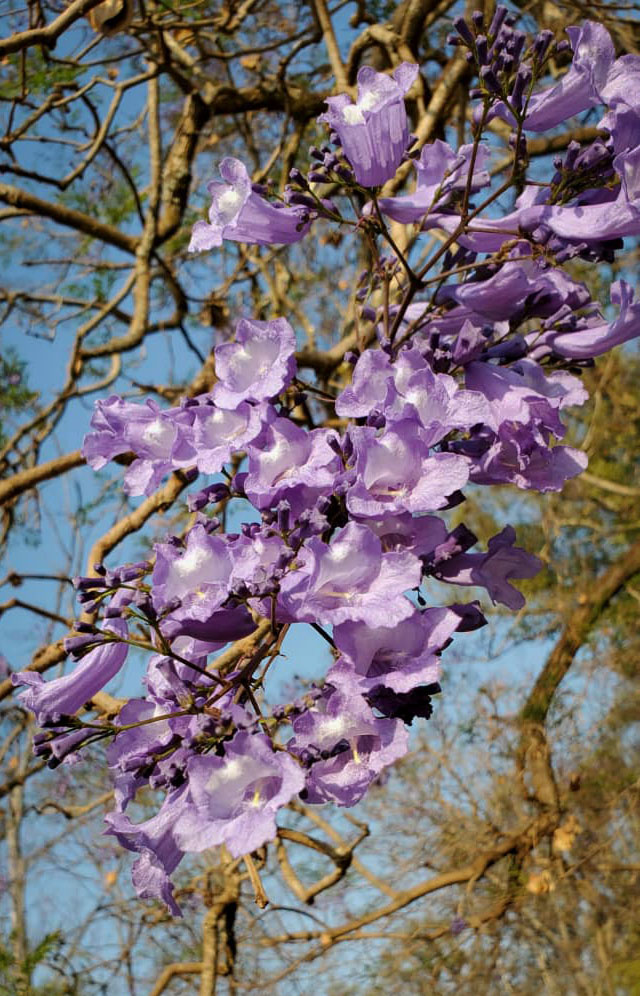
While I do have a preference for indigenous trees I don’t mind the jacaranda. It’s useful to the bees producing a mild, pale honey and is fantastic wood to work with if a bit dull. The flowers don’t do well in the rains and the roads become a carpet of mauve flowers that pop under the car wheels.
There’s rain around at the moment. It’s a bit early for the real season which starts mid November (usually) but it’s still welcome even if the early storms tend to be violent often with hail. So far it’s done a fair job of missing us.
The season ahead is looking promising.
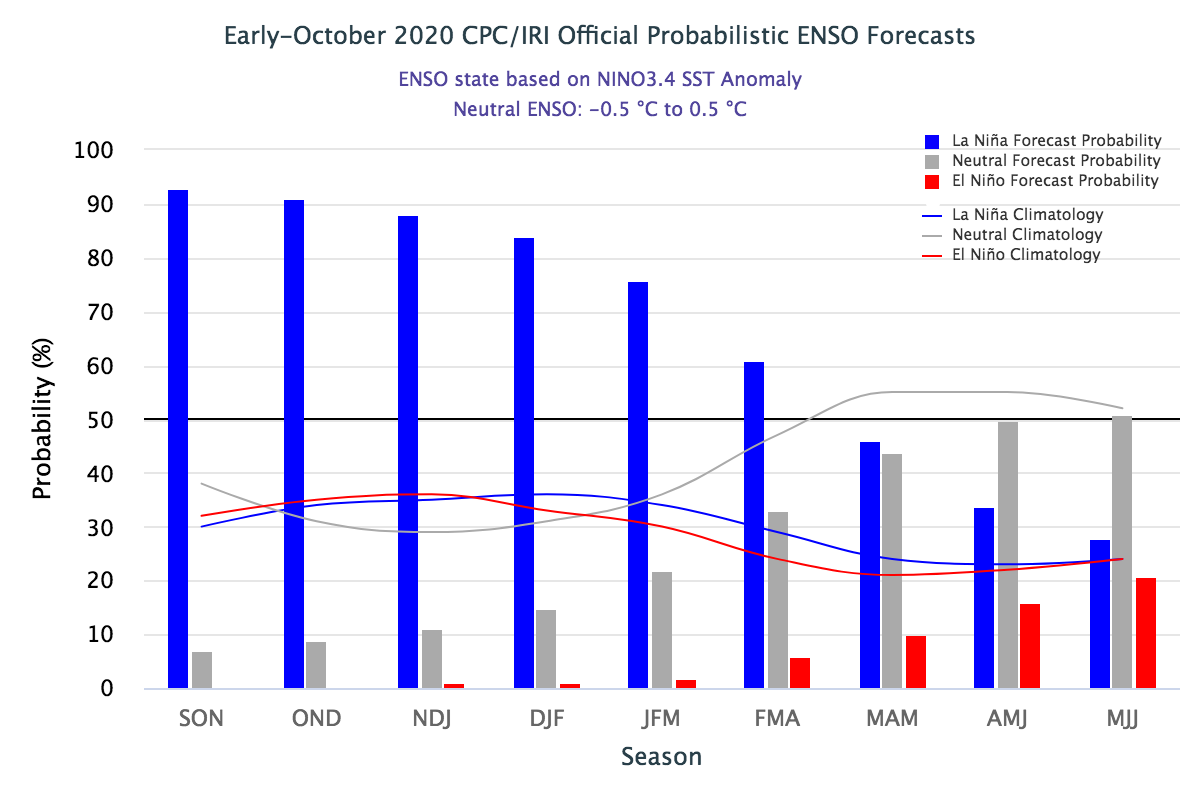
If the la Niña forecast comes to be, as is indicated above, we stand a good chance of better than average rainfall over the next 5 months. Goodness knows we need it but it’s never as simple as the charts make out. More than a few times over the past 20 years that I’ve had my nursery business it’s been a disappointment. It doesn’t make that much difference to my business – commercial horticulture in this part of the world is dependent on a good irrigation system for success. Still, we’d like to have a good season to replenish our borehole in the garden. The rain gauge is out on its stand already – here’s hoping.
(el Niño conditions are indicated by warm currents off the coast of the Galapagos Islands (eastern equatorial Pacific Ocean) and commonly cause drought in this part of the world. La Niña conditions are the opposite and indicate wetter than usual conditions – see What is el Niño?)







No Second Amendment
31 10 2020It’s quite difficult to get a firearm certificate in Zimbabwe. I am in the process of renewing mine and that has been quite demanding. Certificates have to be renewed every three years and in the past it has been relatively straightforward; fill in the form, pay the money and collect the documentation at a later date. That has now changed.
Last year I received an email from the Central Firearms Registry “encouraging” me to take in my weapons, a pistol and a shotgun, for profiling. Three rounds were to be supplied for each weapon, the police armourer would then fire the rounds and distinguishing marks photographed off the cartridge cases and, where applicable, the bullet. This would then be entered into a database to enable future identification of weapons used in crimes. As I was only being “encouraged” I ignored it. Now if one needs to renew certificates the profiling is compulsory.
My certificates are due for renewal on 1st November so three weeks ago I took my weapons and the requisite ammunition into the ballistics department of the CID (Criminal Investigation Department of the local police) in town. The weapons were duly handed over, receipted and I was asked if I could come back in one hour for the certificates. I facetiously asked the police officer if there was any in-building entertainment. I got a ghost of a smile – no, no entertainment was available. I said I’d be back the following week.
Two visits later and much misunderstanding I was in receipt of a cash payment that I shouldn’t have made at this stage and a list of requirements. I felt more than a bit daunted as I had to get the following done in two days before the current certificates expire at the beginning of November:
– a current set of fingerprints.
– two passport size photographs.
– a police inspection of the required safe.
– a letter from a doctor stating that I was in good mental health over the last three years.
– a letter from the government Agricultural, Technical and Extension (AGRITEX) agency stating I am a bona fide farmer and need the shotgun for vermin control. Curiously I didn’t need any letters for the pistol, just saying I needed it for home protection was sufficient.
At the Borrowdale police station I found the relevant department (Police Intelligence Unit) in a hot, cramped office.
Did I have the relevant fingerprint forms, two of them?
No I didn’t but was told I could find them across the road at a small shopping centre. A few minutes later I’d found the forms at a hairdresser’s which had a side business in charging phones too. I was relieved of the equivalent of US$1 for the two pages of poorly printed but legible forms. Curious to find out what the local exchange rate was I approached the money changer outside the corner of the shop. 80 local dollars in cash notes for one US dollar or 90 Ecocash (mobile banking money). Surprised at the relatively low rate I enquired as to why and was told that was what the legal rate was. I laughed and commented that I knew of hardly anyone who was using it. It’s well known that the street money changers are often employed by the fat cats in government but it’s a bit much to believe that they stick to the official rate as set by the Reserve Bank.
Back at the police station the finger prints were duly taken. The police had no transport of their own so we got into my pickup truck and I got chatting to the dour but pleasant police sergeant on the way to inspect the safe at my work. I had to ask if anyone at the police station, which has a sizeable staff, had contracted the Covid-19. Nope, nobody had. I presume that nobody had actually been tested either.
At my office the sergeant gave a cursory tug on the wall safe and pronounced it secure. Then she asked to look inside and gave it another cursory tug. I was glad she’d left it at that as it’s bolted into very soft farm bricks that wouldn’t have stood a serious inspection never mind a miscreant with a crow bar.
Back at the police station the sergeant said that the printer wasn’t working, it was out of ink cartridges and they couldn’t afford new ones. So if she sent me the file of the safe inspection to my phone could I print it out at home and bring a copy back to the police station for signing? And would I be able to help out with some bond paper (plain white A4 sheets) as they couldn’t afford those either? I reflected that things were in a serious state of affairs if the police couldn’t afford printer paper at the princely sum of US1c a sheet.
The next day, two copies of the approval letter in hand, I returned to the police station and handed over a ream of paper. The duty sergeant was delighted and very grateful. I cautioned him not to let his colleagues know as it wouldn’t last long.
The photographs were easily acquired at a local photographic shop and then I picked up the letter from my doctor stating I was of stable mind and I was into the final leg, or so I thought.
The local AGRITEX office is located at the Ministry of Agriculture where I had other business. Whilst I was waiting for another clerk a helpful security guard took my current shotgun certificate up the stairs (access restricted due to the Covid-19) to the AGRITEX office. Some time later an official appeared.
Where was the proof that I owned the land, specifically an offer letter (a letter from the government allowing the farmer a lease on the land)?
I didn’t have any – I rent the land.
Where was the proof that the farm is productive, for example delivery notes to the Grain Marketing Board?
I didn’t have any of those as I only grow and sell seedlings. I didn’t mention that I do sell seedlings to various government concerns as that likely would have necessitated a trip back to the nursery.
So how big is the farm?
10 ha. I could see the official was getting exasperated.
She shook her head and disappeared back up the stairs to reappear some 15 minutes later with the letter approving the renewal of the shotgun certificate.
The Central Firearms Registry is a short drive from the Ministry of Agriculture, I had the renewal in the bag – or so I thought. But I’d reckoned without the civil servant obsession with lunch hour. I’d forgotten the receipt for the certificate payment in my truck, yes that’s it in the photo bottom right. A whole $15 of local money that equates to about US15c. No small wonder the police cannot afford printer paper which costs about US1c a sheet if one buys a ream of 500 sheets. By the time I got back from the car with the receipt the firearms registry office had closed for lunch. There was nothing to do but wait.
Two o’clock and the clerk appeared and I was first in the rapidly growing queue. My finger prints still needed to be verified, would I be prepared to pay US$2 to get it done right away? I took that to mean that the “verification” would be a formality. I didn’t have the $2 and nobody had change so it had to go through the full process. I reflected that I didn’t have a lot of faith in the system as over the years I have given at least three sets of fingerprints to the police for various documents – why couldn’t I just get them scanned and a computer get the verification? I was tired at this stage and decided I didn’t need to labour the point. I accepted the receipt note for the application and left – I was told the documentation would be ready in two weeks or more.
In Zimbabwe there is no equivalent to the Second Amendment as in the USA. There is most certainly no right to bear arms. I am fully in favour of strict controls on firearm possession if it reduces weapons crime. I am sceptical that it will. The weapons profiling system should yield a searchable database of firearms but will it? The computers required need to be powerful and are only as good as the software on them. That is not going to be free and a police force that cannot afford paper is unlikely to afford the specialised software. Maybe it’s being funded by a foreign law enforcement agency.
There won’t be another renewal in three years time, the weapons are going to be sold. The shotgun was inherited from my father and is very old but not enough so as to be valuable. I have never used it. The pistol I bought for my mother back in 1978 when she was alone and vulnerable in a small village when the country was embroiled in civil war. I have fired it twice, at a tree, just for the hell of it. It should be easy enough to sell as it’s a good make.
Comments : 5 Comments »
Tags: Central Firearms Registry, firearms licence, firearms profiling, pistol, Second Amendment USA, shotgun
Categories : Social commentary