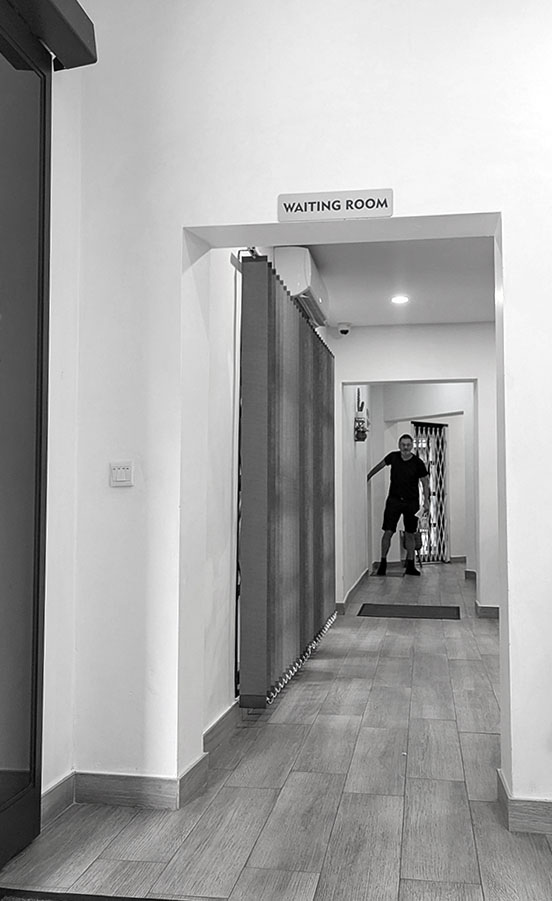
Doctor M is very definitely of the “new” school of surgeons – relatively young (late-forties perhaps) and easy to chat to. When I asked him if the second stage of the procedure to break up my kidney stone would take 15 minutes or so he smiled and said it would take a lot longer than that. “We have to make sure that the stone is broken into really small pieces that will easily pass down your ureter and that takes a while even with a laser. We have to retract the stent enough to expose the stone, insert the scope under active X-ray so we know exactly where we are and then blast the stone with the laser”.
When I was told a few weeks back that the kidney stone that was blocking my ureter could be removed by laser I was quite surprised. I’d assumed that it would be crushed and removed by a more basic endoscope but apparently we are more advanced than that in Zimbabwe. Perhaps it’s the dilapidated state of the nation that automatically primes one to expect that nearly all other aspects of life will be equally decrepit. Medicine has, to an extent, escaped this fate (if you have the means to afford it) though it is generally accepted that for advanced medical treatment it’s best to go to South Africa. Perhaps paradoxically it is often cheaper (it’s the competition thing).
The first stage of removal was to insert a JJ stent (so called for the shape of each end) past the stone which was partially blocking the ureter near my left kidney. This required day surgery and I had to report to the clinic in the Avenues area of Harare at seven a.m. I was checked in by pleasant and efficient staff, escorted up to a ward and then the waiting began.
At 10 o’clock my cellphone was taken away and I was told that I’d go to surgery “just now”. By noon I’d given up on the “just now” and dozed off. Around 3 o’clock I was loaded onto a gurney and moved off to the operating theatre where I was left outside. The paint was peeling off the passage walls opposite. The anaesthetist arrived and talked me through what she was going to be doing. She was young and chatty. She left, doctor M called past carrying a day pack and greeted me and then I was moved into the operating theatre and maneuvered onto the bed. The interior of the operating theatre was, to my untrained eye, modern though the overhead lights had different coloured elements that no-one could explain.
I was awake around 4.30 and the surgeon checked in on me at 5. Marianne picked me up at 7. A day spent waiting. Mostly.
Doctor M’s rooms are new, expansive and indicate a successful surgical practice. When I drove in this Friday past to have the consultation for the second phase of the kidney stone removal the car park was only half full. I was on time at 9.45 for the 10 o’clock appointment. I finally got to see him at 11.45 and yes, I fell asleep in the waiting room. When I left the car park and waiting room were full. Maybe I’d got off lightly.
I go back to the same clinic on Monday for the laser treatment. I won’t make the same mistake and will check up on the time I am expected though I suspect a fair bit of latitude will be built in to their answer. Unlike the last time I won’t be getting out the same day – apparently pain management will be required for at least one night. I guess that I will have to put up with it, hopefully I won’t have to wait too long for the analgesics!

 Zimbabwe Absurdity
The last day of 65
16 11 2025The watch has seen better days – it’s a lot like me in that respect. I don’t usually wear it these days. As a time piece I use my cell phone which is a bit irritating though not as bad as the watch. It swings down to the outside of my arm so I have to use my right hand to rotate it back so that I can see the time. Added to that is the need for my right hand to hold onto my walking stick – it’s easier to use the cellphone. I am wearing the watch today for nostalgic reasons – not to remind me that tomorrow I’ll be 66. I’m not looking forward to it.
Most people in the civilized world retire at the end of 65. Some are forced to, like my old boss who now lives in Australia. He’s lucky in that his wife has a successful psychology business so he’s doing the bookkeeping and is busy. My brother chose to retire at 70 from being a truck driver in the UK. Apparently he’s busier than ever though is vague on what “busy” entails. There seem to be a lot more photos on our family WhatsApp group (they are definitely improving) and we get rainfall figures to nearest 10th of a millimetre thanks to a new weather system he’s installed at his house. I don’t know anyone in Zimbabwe who’s retired at 65. I won’t be.
I took the decision earlier in the week to tell my staff that they were on notice that I would be closing my seedling company at the end of the year. It’s been losing money for quite some time now but it had finally got to the stage where I couldn’t pretend to myself that somehow it would keep going and I could stay in my comfort zone. The bank account is dangerously low, in no small part to an unwise decision to purchase a container of the coir pith that we use as a growing medium, again based on the misguided belief that somehow we could keep going for another year.
When making the announcement to the labour force my senior foreman reminded me that there were only six weeks to the end of the year and I needed to give three months notice. I told the labour that they would get paid everything owed to them but given the precarious state of the company’s finances they would just have to wait until I could sell off the coir pith and get outstanding debtor’s payments in. They were uncomfortable with the idea so I suggested we get the National Employment Council (NEC) representative, who mediates in employment issues, in to discuss the issue.
On Thursday the NEC lady arrived to talk to the labour force at exactly noon. In a previous discussion she’d advised me that she would try to get the staff to agree to a mutual settlement based on the fact that they’d been paid well over the required legal minimum wage and we’d all benefit. Not surprisingly they stuck to their guns and said they wanted the full payout.
Laying off staff in Zimbabwe is not a cheap exercise, especially if they’ve been employed for a long time as have mine. Fortunately I’d paid them off in 2004 when the Zimbabwe dollar was in meltdown and they were signed back on as contract workers for a further three years before becoming permanent employees again. This meant that the loss of employment compensation, one month’s salary per year of employment, would “only” be calculated for 18 years. Add the required gratuity, a more complex but less expensive (for me) calculation, and the amount per person would come to over US$3,000.
I told the NEC rep that there was simply no way that I could pay the approximately US$36,000 at the end of the year on top of the required three months salary per person. She emphasized that it was a legal requirement. I explained that even if I could sell off the meagre company assets it would not cover the bill and could anyway not be done in the time frame. We were at an impasse. She said she’d talk to her boss.
The next morning I came to a decision: as I was going to have to pay an extra six weeks wages at the end of the year I might as well close the company at the end of February ’26 and at least get some work out of the labour force. It would also buy me time to sell off the coir import (due to arrive in about two week’s time) and get in outstanding debts. The extra time is unlikely to make any money for the company given the record of the past few years but at least I could breathe a little easier.
So in the time left before I turn 66 I’m going to try and forget the stresses of closing down a business that I’ve run for 26 years, mostly successfully, and do things that I enjoy.
If the weather holds, it’s supposed to rain this afternoon but doesn’t look like it will happen, I’ll go to the local polo grounds to fly my FPV (first person view) drone. I’m not much good but it’s fun flying through the car park surrounded by trees. There will be other model plane fliers there if I need help. Then I’ll head back home for a late tea and a supper of salmon (yes, just about anything is available for a price in Zimbabwe).
Tomorrow morning we’ll be up at 10 to five to go walk the dogs and I will be 66.
Comments : 5 Comments »
Tags: getting old, gratuity, life, retirement, retiring
Categories : family, horticulture, News & Various, Social commentary