Progress? Well it’s all in the perspective

27 12 2024
ZiG – the notes that never were. There were 100 and 200 denominations too and unbelievably some coins!

Zimbabwe has two official currencies, the US dollar and the local dollar. The latter is officially called the Zimbabwe Gold or ZWG. It used to be called the ZiG (also Zimbabwe Gold as apparently it’s gold backed) but that’s no longer used by the government, perhaps it sounded too much like the cartoon character that it is. The general public still use the term “ZiG”.

That both currencies are legal means that one cannot refuse payment in either. This of course brings up the sticky issue of exchange rates. A visit to the Reserve Bank of Zimbabwe’s (RBZ) webpage is instructive. A one ounce gold coin is being sold for US$2,744 or ZWG70,723 which makes the exchange rate 25.77 (it’s tightly controlled). Last week I bought ZiG/ZWG at 34 to the US dollar off an informal dealer. Why? Because my business takes in so little ZiG and I wanted a cheaper way to pay off my electricity bill and there was no way I was going to pay US dollars for that appalling service!

Officially the ZiG month-on-month inflation is 11.7% (277% annually as calculated) and the US dollar inflation is 0.09%. Given that a US$ loan will cost 9.5% per annum that is very conservative. Interestingly, the US$ annual inflation is given as 3.28% but the ZiG annual inflation is not given – too embarrassingly high perhaps? Of course Zimbabwe has had problems with currency inflation in the past so it’s hardly surprising that they don’t want to repeat the 2008 debacle. The official ZiG to US$ exchange rate is enforced by punitive fines, in US$, so it was surprising that the RBZ suggested in October that they let the exchange rate run in order to maintain the public interest in the ZiG.

In 2008 we had a bad experience with Zimbabwe dollars…

Another way of stimulating interest in the ZiG – and I use the term loosely – is forcing the public to pay a percentage of their taxes in ZiG. The government excels at imposing taxes. There’s a 2% transfer tax on most currency payments and a 3% levy on withdrawing cash. Income tax starts at US$100 per month! Company tax is payable quarterly based on estimates and there are penalties for being inaccurate.

The ZiG, despite much fanfare at it’s introduction in April this year due to the ballooning devaluation of the previous currency, has never been issued in note form. This has insured that people use the banks as little as possible and keep whatever hard currency they have “under the mattress”. It’s not without risk of course – a recent fire at one of the big local markets destroyed a lot of people’s savings.

In an effort to streamline tax collection the local tax authority has implemented a system of tax compliance for retailers and wholesalers. They are now required to register with the authority (ZIMRA) and have a system whereby they are online to the authority and every sale is registered and a QR code is printed on the invoice at the till point/checkout. Yes, it actually does work – try pointing your smartphone camera at the example below. Fortunately everything my company sells is zero VAT rated (plants for cultivation) so it’s not a requirement for us.

A QR code verifies that the purchase is registered with the tax authority

The whole tax accounting system has been overhauled and now each registered company has just one account for both company tax and income tax. In the past there were two and managing the system was complicated. Now it’s so simple that I can almost understand it but prefer my bookkeeper to handle the returns. Progress? I guess it is in a way.

We haven’t made any progress in growing the economy. The budget speech by the Minister of Finance at the end of November is best described as entertaining. I quote; “The attainment of the projected 6% economic growth in 2025, will result in Zimbabwe being one of the fastest growing
economies in the region.”
This is despite “… the agriculture sector, which was initially projected to contract by -21%, is, now expected to contract by -15% on account of better than anticipated output on wheat and dairy.” It seems the Minister of Finance hadn’t read the RBZ figures because he says “…prices for goods and services have relatively been stable following the introduction of Zimbabwe Gold (ZiG) in April 2024. Month-on-month ZiG inflation declined by -2.4% in May 2024, and averaged 0.0% in the second quarter of the year.” The full speech can be downloaded here.


Getting it done

16 07 2024

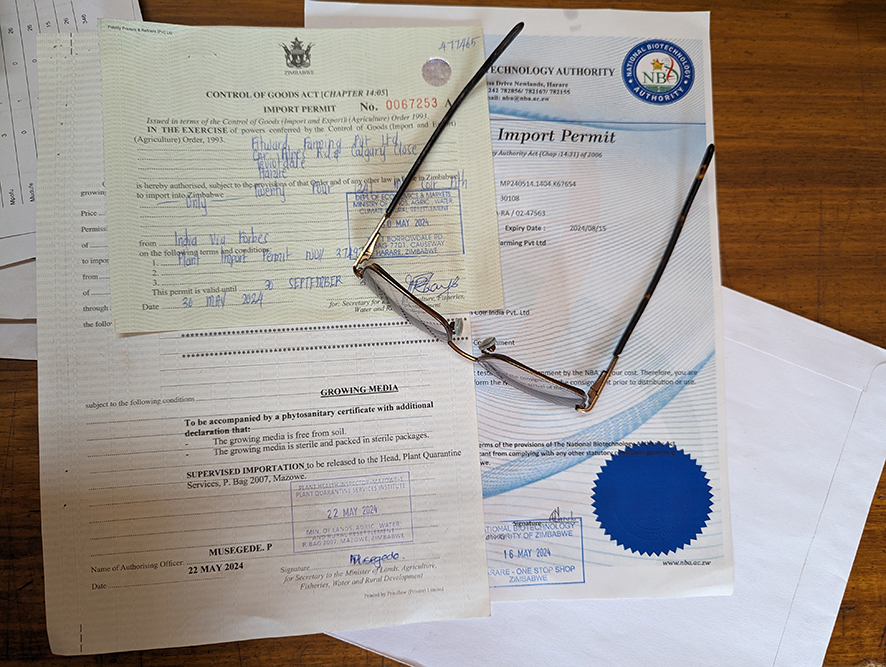
Just part of the paperwork necessary to import the coir pith essential to my business

It’s not something I look forward to but the coir pith on which my nursery depends for growing seedlings is essential for a good product. Yes, another substrate – composted pine bark – is available locally but last time I tried it some 20% of my seedlings died from the disease it carried. So about once a year I just have to grit my teeth and jump through the bureaucratic hoops. To be fair it IS becoming a bit easier as more of the government agencies involved get online and organized.

First off is the Agricultural Marketing Authority. I have no idea what they do but membership is essential and nothing else is achievable without it. Fortunately it’s doable online. Then it was on to the National Biotechnology Authority to get a permit that acknowledged the import was free of GMOs. The Indian supplier had given me a certificate stating as much and though it didn’t look very authoritative to me, it was sufficient and upon receipt of the required payment the local certificate was duly issued.

I have done the Ministry of Agriculture for the importation permits before and found it beyond tedious so sent Fabian, one of my senior staff, down there with some smaller US dollar note and instructions to “do whatever it takes” to get the first certificate. It cost him five dollars to put in the application whilst the official concerned was “on lunch break” and then all I could do was wait.

Fortunately the container was being delayed en route from Sri Lanka. I have no idea why it had to go via Colombo but I guess getting a full cargo of containers to warrant a ship going into the port of Beira in Mozambique takes some organizing. That was just as well as the first permit took two weeks, the date stamp indicated it had been sitting on an office desk for one of those weeks, and the second permit took another 10 days. That also required a sweetener of a few dollars.

By this stage I’d already paid the port and transport fees, all US dollars, and the race was on to get the local documentation to the border post near Mutare in the east of Zimbabwe before the truck from Beira got there. If we were late demurrage would be charged and I’d experienced that to my cost before. Fortunately my local shipping agent seems to know a lot of people and he got the money there just in time.

Then it was just a case of waiting for the truck to arrive and organizing a forklift to offload the pallets. It was three weeks late and in the interim I’d had to buy two pallets from another local supplier who’d marked up his prices 100% (he vehemently denied this even when I told him I new what it cost) but at least it’s over for about another year.

Now that the final accounts are in I can see that the costs were close to last year. The total for 24 tonnes of coir was US$19,650 which works out to 81.8c per kg. For some strange reason my bank needed to pay for the coir in Euros, I have no idea why but I do know that payment had to go through a South African bank. The rest was all payable in US dollars, none of the Zimbabwean kind thank you very much.

Yes, Zimbabwe is still trying to get its own currency up and running. It’s called the ZiG which is not the name of a cartoon character’s best buddy but is short for “Zimbabwe Gold”. It’s apparently linked to gold bullion of which the Reserve Bank is holding. Nobody is actually sure if this is the case but the official rate is around 13.8 to the US dollar.

When the ZiG was first introduced the obvious happened; currency traders spotted a good thing and the rate soon began to run. The government got tough and threatened a US$10,000 fine for any company or person not using the official rate – by law you have to accept either the ZiG or the US dollar if that’s how a customer wants to pay, the one exception being fuel traders who are not obliged to accept ZiG. Fortunately for my business most customers are uninterested in using local currency and choose to pay in US dollars, usually using cash. The local currency received has been entirely electronic – I’m not sure if this is by design – and I have yet to see any local notes. It is certainly not difficult to get US dollar notes out of my local bank and even small denominations are often brand new and in their 100 notes wrappers.

The country’s roads are in a disastrous state at the moment, bearing witness to years of neglect, but there’s a regional conference of the SADC (Southern African Development Community) in August so there’s been an orgy of road repair in Harare during the last few months. Construction teams have been called back to Harare from the outlying projects to concentrate on the local roads. Chaos has ensued as roads are closed and heavy traffic routed through the suburbs.

Some actions are unsurprising, others beggar belief. People living along the main route to the new Chinese-built parliament house where it’s all going to happen have been offered free water, delivered by tanker, to help make their gardens look pretty for visiting dignitaries.

The new dual carriageway to the parliament is being lined with kerb stones that make sure that there is nowhere to pull off the road if one has a breakdown. A local farmer, who lives on the route, pointed this out to one of the construction teams and was assured that it was a temporary arrangement and all the kerb stones would be removed after the conference. We’ll see.

A new bridge has gone in over a small river. They haven’t finished casting all the concrete and I’m told it takes a month to cure but the conference is in less than a month. Interesting.

An obvious question is where has the government suddenly found all the money? Are the construction companies actually being paid and what currency are they using? A friend is heavily involved in the landscaping of the new parliament and Marianne tells me she is being paid in US dollars and is doing quite well from it but rumours abound as to whether the others involved have been paid. I have heard that one company was owed some US$200 million which seems a bit much but many years ago I was told that a normal road costs US$ 1 million per kilometer to construct so perhaps it’s possible. Whatever the truth is you can bet the government will do whatever it takes to get the roads done and put up a paper-thin facade for the visiting dignitaries.

The nations hospitals would certainly like a bit of money themselves; currently several of the bigger ones are owed in excess of ZiG11 billion – a lot of money in any currency.


A short stay in Zimbabwe’s finest

18 05 2022

“I have a suppository for you” said the nurse aid pulling on another set of gloves over those he already had on.

I eyed him suspiciously, “What’s it for?”

“Pain” he replied.

“Oh, OK” I relented. I needed a bit of alternative pain control – back surgery is a painful affair. The fentanyl had been a disaster causing me to vomit a lot and pethidine doesn’t have much effect on me. I laboriously rolled over and let him put the suppository where suppositories go.

I rolled back over and watched aghast as he reached over me with his left hand to my table on wheels. “I hope you aren’t left-handed because if you are you’ve just spread the bacterial contents of my rectum over the table” I thought.

Then he stripped off the outer pair of gloves and moved on to the next patient.

The hospital I was in is relatively new being opened in 2017. It’s not big and it only caters for surgery patients but by Zimbabwe standards it is “state-of-the-art”. The wards contain three beds which are comfortable and can be power-controlled for comfort. The food, for a hospital, is excellent. There are still pencil marks on the wall above the awnings in the small courtyard – I guess Zimbabwe’s artisans don’t look at the final details like I do.

I got chatting to one of the qualified nurses on the night shift. She told me that the hospital made use of a lot of nurse aids to keep costs down. The turnover was high as they then took their experience overseas to go caring and earn reasonable wages. She had two small children and a surveyor husband in dead-end government job so she was unlikely to hang around much longer. There were some older nurses around but not many.

Some years ago Canada had a drive to recruit Zimbabwean nurses and physiotherapists. There was a big billboard on a major road into town advertising emigration to Canada. I can only guess at how many took up the offer (a recent France 24 article puts the figure at 1,800 for last year); the weather might be dismal by our standards but the salaries far better. I saw a post on Facebook today that a junior doctor in Zimbabwe on a government salary can expect to earn ZW$35k which is less than US$100 per month.

I was let out of the hospital after six days, trailing a vacuum dressing device and with strict instructions not to go further than the bathroom for the first two weeks. I also had to get in a nursing service to administer the intravenous antibiotics for 10 days. The two nurses involved were older women, one of them very proudly told me that she got her qualification in the Rhodesian days (Rhodesia became Zimbabwe in April 1980). Her husband had retired after spending a lifetime working for the National Railways of Zimbabwe and now gets a monthly pension of ZW$30 which equates to about 7.5c in US dollars. Needless to say we paid the nursing service in USD.

For the first couple of days when Marianne went out shopping she hired another retired nurse to come and keep an eye on me. I told her the story about the suppository. Joy rolled her eyes and said for a start there was no need to double-glove except if the gloves were of suspect quality like when she’d been nursing in the 2000s when just about everything was difficult to get hold of. She’d left nursing as a profession when she could no longer put up with the declining standards.

Boredom set in quickly. It didn’t help that I couldn’t sit up for any length of time. Mike the electrician came in to repair a spike filter on the solar inverter. Themba, my seven month old Rhodesian Ridgeback barked at him from beside me on the bed despite having met him before. When Joy walked up the passage he was even more agitated and growled when he thought she was getting too close. That’s my boy! I was so proud of him (there was no danger of an attack).

Themba, having told off the electrician and nurse for getting too close.

It’s now been a month since the surgery and I am a lot more mobile. The vacuum dressing has gone and I have made the transition from crutches back to my walking sticks. The pain is under control with nothing more than paracetemol but, like all pain control, it must be anticipated. Today Marianne drove me into work so I could see the state of the nursery. All was well though business was slow. My foreman had phoned around the competition to see what their prices were and they were way below mine so I’d taken the rather painful decision to reduce my US dollar prices even though I know that my quality is superior. I didn’t bother changing the Zimbabwe dollar prices. Currently the unofficial rate, i.e. what retail outlets are charging, is around 400:1 US dollar so a minor change was not going to make much difference. In the month that I’ve been away Marianne has been in twice to change local prices. It’s easy enough. Back in 2008 we were changing prices daily so I made sure that the software, which I wrote, was intuitive in that respect.

As I was sitting in the truck with the computer a customer arrived. I have grown seedlings for him in the past but last year he chose to take his business to one of the other cheaper nurseries. Back again this year I can only assume he had a bad experience because he didn’t even blink when I told him my prices. We briefly discussed how the economic environment was affecting his business which is mostly export orientated. He admitted that the 40% export earnings retention by the government was tough (the government takes 40% of the forex earned and gives it back in local dollars at a highly disadvantageous rate for the exporter) but at least changes to the procedure meant that they were “only” losing some 25%.

Two weeks ago the president of Zimbabwe, E D Mnangagwa, announced that all banks were to stop all lending in an effort to get inflation, estimated at 96.4% for April, under control. Confusion reigned. It even made the weekly edition of The Economist which called it a “curious way to tame inflation” and also ran another article on how a Zimbabwe businessman was running a pension scheme for Zimbabweans by breeding cattle. Clients buy cattle and the offspring are the interest. At any time they are welcome to go and visually inspect their investment. It’s a clever idea as Zimbabweans have little faith in any sort of intangible currency. This extends to not depositing US cash in banks but using safe deposit boxes which are now at a premium.

Marianne interrupted our discussion to say that she’d read the loans ban had been completely dropped but we agreed that the damage had been done. Who would want to invest in a country where the government has so little understanding of economics that they might arbitrarily slap a ban on the core business of banking?


Waiting for the hammer to fall

24 09 2017

A very expensive hammer – or is it?

Just a pretty average ball pein hammer with an expensive price tag. I’ve just looked on Amazon and one can get a set of three for about £10 and the most expensive one in this style, also with a genuine hickory handle, is £15. Of course we expect to pay more but nearly double? Well that’s the way of Zimbabwe at the moment, that’s right folks, inflation is back!

Zimbabwe produces little these days and imports a lot. Along with a bloated civil service whose wage bill gobbles 80% of the budget and rampant corruption we are in deep trouble. We have a three tier monetary system which in theory is all US dollars but in practice has three different values; money in the bank which is labelled US dollars but will buy the money version, referred to as “cash” at a rate of 1.6 to 1. Then there are bond notes, a local substitute for “cash” which are pegged at the same value as the “cash” but trade at around 1.2 to the dollar. These bond notes are in theory backed by a bond from the Cairo based Afrexim Bank but it was recently revealed that the bond never existed so they are valueless but preferable to having money in the bank. A case of a bird in the hand being worth more than what’s in the bank.

Most outlets have a 3 tier pricing system to reflect the various value rates. For the moment my business doesn’t but that will change tomorrow. In the time that I’ve been writing this blog (about 4 days) Harare fuel pumps have run dry. It’s not surprising as the price for diesel has been hovering around $1.20 per litre for quite a few months now – completely unrealistic considering that they have had to buy the real US$ at a premium of 1.2 during most of that time. Yes, I guess the price is controlled somewhere along the line.

I was, by chance, chatting to a farmer at an agricultural supplies outlet on Friday. He asked if I could grow him some paprika as he was looking for an export crop to stay viable. He mentioned that he’d been pricing steel that morning and by the time he’d gone back to place the order 2 hours later the price had gone up 15%. We are talking a bank transfer price of course. That evening I went to a talk on Bitcoins and how to use them and what the investment opportunities and pitfalls are. The speaker referred to the day as Black Friday in reference to the galloping exchange rate.

A while ago I called my local service manager at the bank. On asking if I could pay for an import of the coir pith we use to propagate seedlings he asked me if we exported anything. No, I replied. Had I deposited any US$ cash recently? No of course I hadn’t – was this really a serious question? Well then, he said, bring in the cash and we can do the transfer. Guaranteed? Yes, guaranteed. This raised the obvious question of how far to trust the banking system. All external payments have to go through the Reserve Bank of Zimbabwe, the very instrument who in no small way has landed us in this mess. To be fair there has been a lot of greed and incompetence driven political pressure on them to just add zeroes to the value of the currency though, with the exception of the governor, a lot of the senior staff were there for the meltdown of the Zimbabwe dollar in 2008 – 9 and one must wonder what their influence is.

It should be evident by now that the USD price tag on the handle of the hammer is not United States Dollars at all but a proxy currency probably better named (nearly) Useless Substitute Dollars and the price of 39.00 is probably quite cheap. The Zimbabwe dollar is back under another name as a lot of people feared when the bond notes were first introduced.

When I started this post on Thursday I thought the title was appropriate. After reading a WhatsApp message this morning from a friend (the full text by Matt Matigari can be read here http://source.co.zw/2017/09/opinion-currency-crisis-art-deception/) I realized that it had been looking decidedly unstable as far back as 2013. The hammer most definitely has already fallen and we have only now heard the sound of the impact.

There are going to be casualties during the course of this next meltdown. An old friend has already lost his job and has no alternative income. He and his wifer may well end up renting our cottage and hopefully renting out their house. We have advised them most definitely NOT to sell as they will likely lose a lot of money in the time it would take to find a smaller property. They have several dogs most of which will have to be euthanized. Those who can will emigrate. Those who cannot will once again be destitute. Companies that depend on imports will likely fold. Money changers will prosper and just maybe, we will pay off the bond on our house for the equivalent of a few dollars – cash. Tighten your seat-belts folks, there’s rough weather ahead.


Déjà-vu – and it’s not good

9 08 2017

NEVER throw away what might be useful

We have a habit in this country of not throwing things away “just in case they might be useful one day”. It’s not without good reason but it can be taken to extremes.

In the days when Zimbabwe was Rhodesia and the country was under blanket sanctions for it’s persistent colonial ways ingenuity ruled. Getting fuel was difficult and just about everything else close to impossible. Car spares were horded and years after we got rid of an old car I still found spares squirreled away “just in case”.

Now that Rhodesia is Zimbabwe and we still have sanctions (but this time targeted against certain odious individuals) spares are once again becoming difficult.  In this case it’s spares for a Husqvarna hedge trimmer we use to trim tobacco and gum tree seedlings – so of course I feel somewhat smug that I kept the remains of a previous hedge trimmer. Just in case.

The shortages this time around are nothing to do with the sanctions but gross incompetence and greed by the ruling regime; the nation has simply run out of money. The bond notes alluded to in other posts are proving to be exactly what everyone feared them to be – a return to the defunct Zimbabwe dollar under another guise. There was never a bond/loan backing them (the Reserve Bank governor simply lied) and now the government has announced that it wants to release another 300m of  them backed by precisely nothing.

Inflation has also made a return. I priced a gum wooden door last week that has increased 50% over the last 4 months despite being made entirely of local products. It is priced in US$ but I’m almost certain that if I asked I could get a discount for “cash” i.e. real US$ notes of around 20% (most people use debit cards or similar devices to pay for items). A potential customer asked me if he could get a discount for bond notes and was told most definitely no. He did not ask if he could get a discount for real cash – US dollars.

So tomorrow I will start making a plan (something else for which Zimbabweans are notorious) and see if I can assemble the 1½ hedge trimmers in the picture into one functioning one. After all adversity is the mother of invention and we’ve been here before. Once as Rhodesia and again in the years when the Zimbabwe dollar was real if completely useless.  It’s a sense of déjà-vu and I don’t like it one bit.

There is one positive aspect to this. In the carnage of the demise of the Zimbabwe dollar in 2008/9 when inflation was running in six figures per month, people who’d taken out housing mortgages paid them off with one note or less. Yes, that happens when the largest note is 100 trillion Zimbabwean dollars.  Now if the government floods the country with bond notes we should be able to pick them up cheaply enough by paying in real dollars to pay off our mortgage really cheaply. There will of course be collateral damage as they say – territory we visited back in 2008/9. I don’t think I want to go there at any price.

P.S. (a day later). I was called this morning by a company that sells irrigation equipment – a part that I’d ordered had arrived. On asking the cost I was told $78 “… but we are offering a discount of 25% for US$ cash or 10% for bond notes.” So apparently the bond notes, based on nothing, are actually in demand.


Celebrating 33

17 04 2013

Tomorrow Zimbabwe will be 33. And there will be celebrations. Those cynical people who have never visited this amazing country may ask what we have to celebrate. I will answer them.

  • We have 3 big South African supermarket chains with outlets that would not look amiss in South Africa – spotting the Zimbabwean produce can be a challenge though.
  • We have  plenty of fuel at competitive prices.
  • We have the biggest fertilizer company in South Africa selling  their top quality fertilizer.
  • We  have manageable inflation. Officially it is 4.5% but it may be a little higher than that in reality.
  • 10% of the population is employed!
  • We have a stable currency (not our own) in the US dollar
  • We have the world’s best climate along with Malta.
  • We have been a democracy longer than South Africa. There is a slight financial problem in funding the next general election this year but we will make a plan for the shortfall of $100 million or so.

I mean really, with all this, who needs an economy?


The day I missed being a quadrillionaire

30 07 2008

It was even on BBC radio this evening; Zimbabwe has knocked 10 zeros off its currency. As I was due to go and collect fictitious wages from the bank (I’d posted the withdrawl application on Monday) I thought it would be a good idea to find out what they knew as what we are told on local radio and what the bank are told don’t always tie up. Well, the 10 zeros (didn’t anyone tell them that currency works in thousands?) disappearing was true enough but what I didn’t know was that there is a plan afoot to use the old “real” currency until the new (without the 0’s) gets printed (probably by the Chinese as the German company that used to do it has come under pressure to stop). Colin, my bank manager, told me that today someone had come in with a box of the old currency (it pre-dates the current bearer cheques) for disposal. He suggested that he keep it. Nobody is really sure what this all means but it is possible that the old money that I have lying in my drawer is worth more than then 100 billion notes (which are now worth 1$) that I collected from the bank this afternoon. It is possible that there are people out there in the rural areas who kept hold of the old money because they missed the deadline to hand it in who are now very wealthy! I see too possible consequences; fed up with this confusion those who can are going to use a meaningful currency and in solving the problem of the zeros they are going to drive inflation to the point where today’s multimillion percent inflation will soon be a fond memory!

This morning an export company approached me to grow some seedlings urgently. Normally I’d insist on a 50% deposit up front but being something of an emergency I allowed them to bring the seed and we’d settle later. This lot are not the easiest bunch to deal with but I sensed a bit of an advantage. My book keeper knows the financial director so getting his personal number was easy. I gave him a call and mentioned that I’d had to print out the Zim dollar proforma on a laser printer that could accommodate all the zeros (it came to 88 quadrillion – 88,000,000,000,000,000) so he saw the reasoning to go for the US dollar payment of 816. It’s an offshore transfer but that’s a close second to getting it here. So I missed out on being a quadrillionaire – but just give it a few months!


The art of intimidation

17 06 2008

The ZANU-PF “meeting” I mentioned in the last post was real enough – it was still going on when I went home at 5 in the evening. I was not tempted to stop off and catch up but I did quiz my maid in the morning. It was all the usual fare; we will kill anyone who votes for the opposition and a weapon was brandished for good effect. Why it took five and a half hours to get the message across also speaks volumes. They are lying of course as they cannot know who votes for whom or where they will poll but the effect was there as now most people will not vote at all.

When the farm invasions were on numerous friends and acquaintances got death threats. They were probably bogus but can one afford not to take them seriously? The intimidators last week were dealing with a less sophisticated audience but the principle was the same; keep them guessing and they will err on the side of caution.  The art lies in just taking it to the line of credibility. I actually don’t think the outcome will be much influenced anyway. There is only one result that I can see – the ruling party has not come this far just to give in quietly and accept a result that they don’t want.

I see it this way:

  1. Mugabe wins outright.
  2. They rig the results to win.
  3. They lose and ignore the results.

1,681,835,527,909.52 – that’s the closing balance on my corporate account yesterday. I have never I think been so wealthy or poor at the same time. As to why they have kept the cents is beyond me; I am now rounding all my invoices UP eight digits LEFT of the decimal and busy modifying my software to cope with real money. Hey, I mean, I actually took in USD25.00 in sales last week!

I hear more and more that people are just offering to pay in real money as the hassle of getting anything with Zimbabwe dollars escalates almost as fast as the inflation. I make a point not to solicit, though if I am stung it probably won’t make a lot of difference (it is still illegal to accept foreign currency as payment). I wait for the customer to offer.