
Glossary of terms:
CBD – cannabidiol – the principal cannabinoid in cannabis
THC – tetrahydrocannabinol – the main psychoactive ingredient of cannabis
Cannabis – hemp, “weed”, “dope”, “grass”, “ganja”, marijuana – not all species are narcotic
GMP – Good Manufacturing Practice – certification required to export pharmaceutical quality products (in the context of this article)
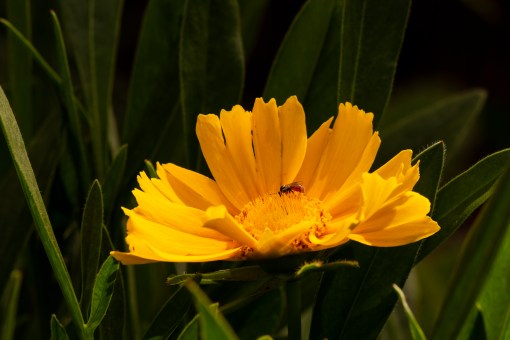
Yes, that really is “weed” on which the stinkbug is sitting. I wouldn’t recommend smoking it, the weed that is, as it’s industrial grade cannabis which is grown for the fibre content and has no narcotic effect. Stinkbugs should absolutely not be ingested – they taste as bad as they smell, which is vile.
The Zimbabwe government has been pushing the various cannabis crops (hemp fibre, CBD oil and THC) as potential export crops and Stewart and I were at the Tobacco Research Board (TRB) to see what research they’d been doing. Stewart works part time for the Commercial Farmers’ Union and was trying to persuade me to write a growing guide, I knew how little I knew and was resisting but was still interested in finding out more about the crop.
The lead researcher was a young, dynamic fellow by the name of Munyaradzi or just Munya for short. He was passionate and knowledgeable about the crop. He quickly explained that they were just looking at the industrial or hemp quality cannabis at the TRB – the CBD oil and THC varieties, which have up to 0.3% THC and more than 0.3% THC respectively required onerous security which was not feasible. Industrial cannabis merely requires a fence and lockable gate so they were interested in getting small-scale growers into growing the crop.
The TRB had imported a number of different cultivars of the industrial hemp from origins as diverse as China, France and the USA. Some were clearly not suited to the relatively short Zimbabwean days though Munya did admit that it was early days and the seed had only been sown in January. Extending the day length with lights is practiced by the growers of the CBD and THC strains which keeps the crop from flowering too early. He told us that they’d approached the CID (Criminal Investigation Department) of the police to see if they could visit areas in the west of Zimbabwe where the THC version of cannabis has been grown illegally for many years to see if they had any selections that may be useful as he felt they’d certainly be climate adapted. Apparently breeding out the THC would not be difficult and yes, the police had approved the idea in principle.
Industrial hemp is quite widely used in the automotive and other industries that required cladding but the real money, Munya said, is in the CBD oil and THC. Unsurprisingly the buyers require the product to be GMP certified which requires stringent quality controls and regular inspections by a certified inspector which Zimbabwe doesn’t have. If it’s to be used for medicinal purposes the crop also has to be grown organically. A neighbour to the TRB who is growing the CBD cultivars has had to destroy his entire product so far as he cannot get it certified. Currently there are not a lot of major players in the industry but Munya predicted that it was going to get going within a few years.
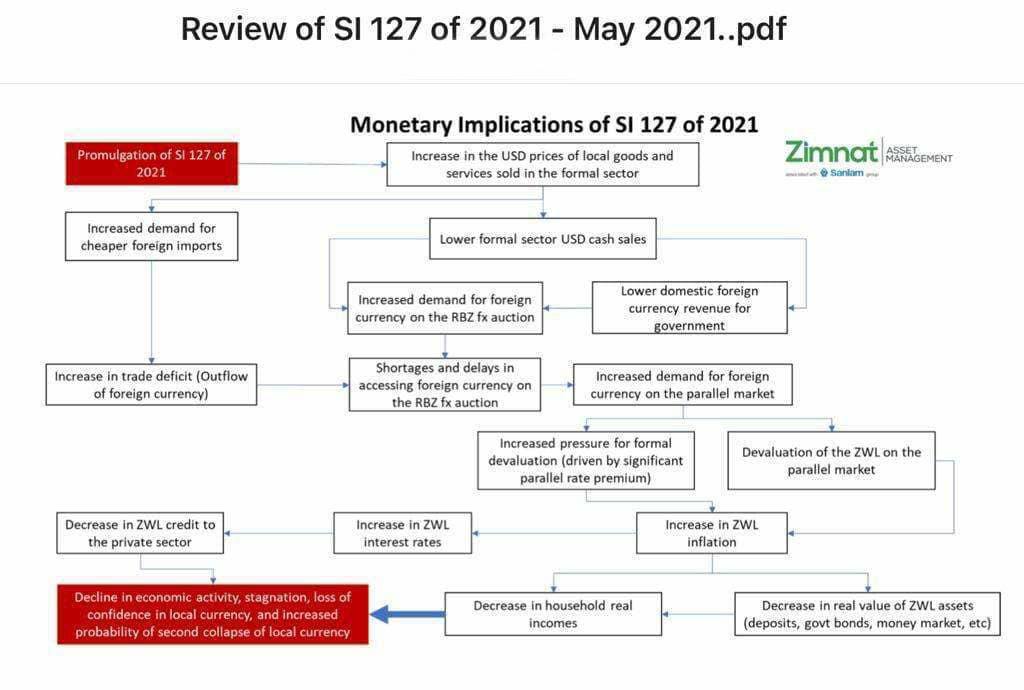
One could be forgiven for thinking that the Zimbabwe government has other ideas. On Thursday this week they introduced a bill (SI 127 of 2021) forbidding anyone from trading in Zimbabwe dollars at anything other than the official rate of 84:1. The legislation has been around for some time but was not enforced. Now apparently it will be, with punitive fines for those who choose to ignore it. Most businesses have been pricing in US dollars and then multiplying by around 125 to get the Zimbabwe dollar price. This makes it attractive to pay in US and then more imports can be sourced. There is a government “auction” in place where one can bid for US dollars but the price is fixed, so it’s not really an auction at all, and there’s no guarantee of getting the hard currency. That there has to be an “auction” at all is indicative of just how short hard currency is. Forcing businesses to trade at the official rate is only going to make goods very expensive in US dollar terms so people will use Zimbabwe dollars and imported goods (most things) will become scarce. This graphic from a local asset management company says it concisely. “Decline in economic activity, stagnation, loss of confidence in local currency, and increased probability of second collapse of local currency”. Yes, we have been here before.












Irrigation alley
21 09 2021I watched Warren closely, fascinated. He took several careful steps intently watching the mostly full water bottle balanced on his left hand. It toppled and he caught it in his right hand. He turned around, retraced his steps back behind the wall and repeated the procedure. He scuffed a mark in the dry lawn with his boot and walked off at 90 degrees then walked back over the spot. The bottle fell again. He was divining for water in our garden.
I am no believer in witchcraft but Warren backs up his dousing with some science and he’d successfully sited a borehole for me at my work, just out of town, so we’d got him in to our garden to see if he could repeat the success.
A couple of months ago one of the two boreholes that my nursery relies on, started to give problems. It has been fine for the 22 years that I have been there so I was more than a bit concerned. I knew it was a water problem because the run-dry electronic protection system kept tripping. I responded by reducing the flow of the water to a measly 1,300 litres an hour. It can run for a day but at night the security guards, who are hopefully not sleeping, report that the ammeter on the switchboard by my office keeps dropping to zero indicating the pump has turned off.
The area where my work is situated is not great for ground water and there are no streams nearby. I rent the property and the landlords sank five boreholes to around 70m each when the land was bought in the early 1980s. One is useless and I have to share the other four with the other occupants who include another nursery, a rose nursery and a small domestic property. The prospects for new siting of holes are limited. Nevertheless, Gill, my landlady agreed to finance a new hole but I would have to pay for the siting and equipment (the latter would remain mine to take with me if or when I leave). Several water diviners, or dousers as they are sometimes known, were contacted and brought in. There was no agreement on where the water may lie. Only one, Warren, used a scientific backup (a machine based on electromagnetism) to what his water bottle told him and both indicated a likely source, so we called in the borehole drilling company that he recommends.
Payment was made up front and withing a couple of days they had arrived. Watching boreholes being drilled can be a stressful experience but I wasn’t paying and it was the first one I’d seen up close. The drilling mechanism is mounted on one large truck, about seven tonnes, and the compressor that powers it is on another. There is a lot of noise and dust.
Each pipe section that makes up the drilling column is six metres in length and mounted eight to a rotating carousel. It didn’t take long to drill to the 60 m that Warren had advised and water was found at 38m, almost exactly where the chart above indicates. It was not exactly a gusher at an estimated 1,000 litres per hour.
The actual process took only three hours as 60m is not a deep hole by today’s standards. In fact the hole at our house in the suburbs only has a 40m hole which was probably standard for the 1970s and quite adequate at the time when boreholes were unusual and municipal water flowed in the pipes. It never recovered from last season’s poor rainfall and now will only pump for an hour or less before emptying. One of the other diviners who came to my work was quite garrulous and told me he’d recently found and drilled (he had his own rig, or so he said) a “gusher” at 200m. It’s the first time I’ve heard of such a deep hole in the urban areas but 100m is pretty much the norm.
The foreman for the drilling company handed over the drilling report which clearly stated that the hole was an “excellent yielder”‘ and suitable for extracting water. I was surprised that 1,000 litres per hour was considered an “excellent” yielder and gave the drilling company a call. The manager explained that for a domestic hole, which is mostly what the company does, a 1,000 litres per hour was considered good but they did tend to be conservative in order not to disappoint customers and that we should get on and use it as it could take a season of pumping for a hole to unblock all the cracks and reach its full potential. It has taken a few weeks to get all the ditches dug for the pipes and the switchgear put in a box that is reasonably theft-proof, so it will all be turned on in the next couple of days and the moment of truth will be realized.
Meanwhile Warren has submitted his report on the site he found in our garden and is reasonably positive that it’s a good site. All dousers make a point of saying on their report that it’s not an exact science and a good result is not guaranteed. Warren has more faith in his bottle than the electronics and admits that he doesn’t really know how the latter works. He keeps up to date with technology and recently contacted a European company that was advertising a machine for divining. Even at a cool 150,000 euros it was not guaranteed to find water. There just doesn’t seem to be the tech out there to find water accurately.
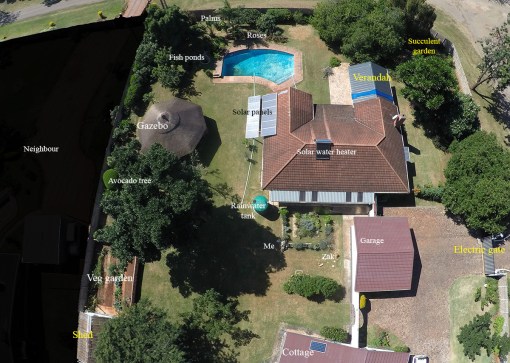
I asked the same drilling company for a quote to drill to 100m. They came back with US$4,100 which included the casing but not anything else. It’s not a small sum of money but if we find water it will substantially add to the value of the property and will take two years to cover the cost of the water we are now buying in for domestic purposes. We do occasionally get municipal water but it’s not reliable and goes into the swimming pool and then is pumped onto the garden to keep selected areas alive through the dry season. We certainly wouldn’t entertain drinking it as it comes from the heavily polluted Lake Chivero into which much of Harare’s storm water, industrial waste and sewage drains. The human excrement side of the pollution can be dealt with but not the industrial. Well, not in Zimbabwe where the water treatment works frequently runs out of cash to buy the aluminium sulphate used to settle the particles suspended in the water.
The suburb of Harare in which we live is known as Mount Pleasant. There is no “mount” of which I’m aware and the area is not known for a profusion of ground water. However the road along which I drive to work has some verdant verges that are profusely watered, so some properties do have good water. I’ve named it Irrigation Alley and it’s not unusual to see upwards of eight sprinklers (yes I did count them) watering the verges and the road. In fact this morning there were 14 working along a 1.3km stretch of road.
Marianne is on several neighbourhood WhatsApp groups that discuss these sort of things and appeals to irrigators of verges and roads to conserve water so the rest of us with marginal boreholes, or none at all, don’t have to buy so much water. Their response is “it’s my water and I’ll do as I like with it”. That’s technically true as all of us with boreholes pay an annual licence fee that allows unrestricted usage. Community spirit in this respect is in short supply.
After much dithering we have decided to go ahead with the borehole in the garden. The money has been paid and the drillers have made an inspection and think that the site is a good one. They will be back in due course and I’m not sure if I will stay around to watch. Of course it will make not a jot of difference if I do watch but there’s a lot riding on this.
At work we finished the electrics on the new borehole today and tomorrow we should be able to get the pumping gear down the hole and see if we have something useful or not. No doubt the irrigators of Irrigation Alley will be watering the road and the verges as normal.
Comments : 7 Comments »
Tags: boreholes, divining, ground water, Mount Pleasant
Categories : Blogroll, Environment, Social commentary