
“Enjoy getting the sensor off your chest” the nurse said and smirked. I didn’t share the humour and suspected this was why she said that shaving my chest before attaching the Holter ECG was unnecessary. At least she had a sense of humour.
I was strongly beginning to suspect the whole exercise was a waste of time and a not inconsiderable amount of money. The specialist physician who’d done the ECG and echo cardiogram had already said that all was normal as far as he could see and that only the MRI angiogram scheduled for the following week might show something. I left $810 poorer.
Last Friday morning at 4 a.m. I had to get up to go to the bathroom. When I got back to bed I asked Marianne what the bandage on my left ankle was for. It has been there four months for an ulcer. Not surprisingly she was concerned. The next three hours were a blank for me but apparently I repeatedly asked about the bandage and looked at my computer programming work and apparently recognized it. I have a vague recollection of asking who my doctor was and where the practice is located (which I have been visiting for years). When we visited the GP later that morning I asked Marianne to come with me just in case I missed something (not that I’d have had a choice!). We emerged 20 minutes later, blood sample taken and with a long list of tests to be done. It looked expensive.
Access to the Zimbabwe medical system requires a subscription to medical insurance and frequently quite large sums of cash as US dollars. The latter is often referred to as a “co-payment” which is another way of saying that “you pay us up front and then claim back from your medical aid/insurance company as we don’t have the patience to deal with their habitually late payments”.
First appointment was with a technician who was working out of his home with an EEG in his spare room/office. He told me that I most certainly had not experienced a Transient Ischemic Attack (TIA) otherwise known as a mini stroke and relieved me of $200. I noticed that he was fond of his dog so forgave him – mostly.
I haven’t seen the test results for the 72 hour Holter ECG yet but I guess they will arrive in due course. The record sheet that I had to fill in detailing any “out of the ordinary” experiences I left blank. There weren’t any.
Yesterday was the turn of a MRI-A (A is for angiogram) in my brain. I had to get there at 7.30 in the morning and forgoing my morning coffee – MRIs have a way of going on for a long time and I suspect the operators would have been unimpressed if I said I needed to use the toilet – I headed out early taking a big mental breath to deal with the morning traffic. It was all a non-event. I arrived early and one of the staff agreed that the traffic was unusually light. The MRI machine was new and made by Canon, the camera manufacturer. It only took 30 minutes then I was off to the Doppler ultra-sound of my neck vessels at another clinic occupied by the same company in another part of town.
They relieved me of $105 (yes, all fees were mentioned in advance and nobody mentioned the local currency – US dollars only) and then after a short wait it was into the examination room. I could just see the screen placed on the opposite wall for my convenience. The technician was not very communicative but did say he could see no problems. The machine made all the right heart noises too.
Now I have to go and see a specialist physician after the long Easter weekend. He will take $100 (he’s seen me before else he would take $200). He has a bit of a dour reputation but was also my physician for the back surgery a year ago and was very kind not charging for hospital visits once he knew I’d been injured in the Rhodesian bush war. “Because of people like you Mr Roberts, people like me got to go to medical school”.
I do have another off-shore medical aid scheme based in South Africa which will reimburse at least some of the costs. However they will only pay what the procedure or tests cost in South Africa which is often considerably less than in Zimbabwe. I’ll have to wait and see.
So what was it that I experienced? My sister-in-law Jane, who lives in the UK and is a better Googler than me, sent me this link which accurately describes it. It’s called TGA or transient global amnesia. It happens, it’s not serious and there’s nothing one can do about it.
On the way back from the gym this afternoon I drove past the local municipal clinic. Once a part of the primary medical care system designed as a first port of call for the average Zimbabwean citizen without access to medical insurance it is now nearly derelict. The gates don’t shut, there was one vehicle parked inside and not a soul to be seen. The last time it was used was for Covid vaccinations and that was sponsored by the WHO and other agencies.













 Zimbabwe Absurdity
The brick is back
7 05 2023The senior foreman said the customer wanted to pay in Zimbabwe dollars, cash, were we going to accept them? We didn’t have much of a choice as it is legal tender so I said yes and asked how much it was. 67,000 he replied. I groaned knowing they would be in small denominations. The biggest, $50, is worth all of US2.2c so I knew there would be quite a few bundles but the majority were $20 notes. We filled a medium-sized box.
Quite a few were in bank-sealed plastic bags of 500 notes which were called “bricks” back in the hyper inflation days of 2008. We didn’t bother counting them then and didn’t bother now. Back in those days the government attempted to get around the problem by printing ever larger denomination notes (an example is in the picture). Our inflation now is not quite that bad but anyway, local currency notes have largely been superseded by electronic money. It’s very easy to add zeros onto electronic money.
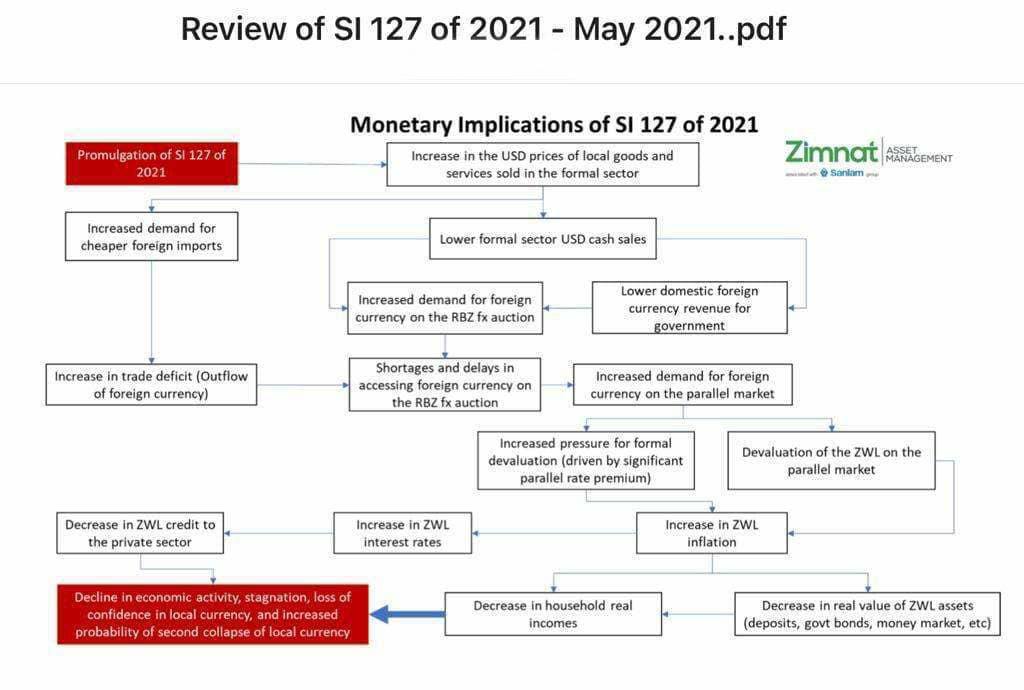
The other currency in Zimbabwe that is also legal tender is the US dollar. Having nothing to do with the government it is by far the most preferred. Although the government tries to set the exchange rate and can prosecute those not using it there is an easy work-around. It goes like this: the official rate is 1,097 Zimbabwe dollars to US$1 and with a few exceptions, fuel being one of them, businesses have to quote their prices in the local currency. On the unofficial market the rate is currently around 2,200 to one US dollar depending on to whom one is talking. Businesses price their goods in the Zimbabwe dollar and then offer a fat discount if you want to pay in US dollars – this effectively brings the official rate up to the unofficial one and it’s completely legal. Many businesses don’t bother with the official rate and just quote the unofficial one. My business is one of them and so far there hasn’t been a comeback.
There is a sense on around town that the unofficial rate is running again and people are offloading their Zimbabwe dollars. I sent the driver into town the day following the above deposit to get rid of the cash. In reality it was about US$30 so didn’t go far but I managed to find a fertilizer company accepting them and topped up with a bit of electronic money in the form of a debit card we managed to get a meaningful amount of agricultural chemicals bought.
The government is of course also looking for a dependable currency and has hit on tax as the easiest way to get in US dollars. All US$ cash deposits are levied at 20% and the government reimburses the amount in Zimbabwe dollars – at the official rate! This means that in reality the recipient can be losing 10% or more of the deposit in real terms. Exporters are levied 40% of the amount remitted to their forex accounts. It gets better; 3% of all USD cash withdrawals from a bank are taxed. While one can still pay car licence fees and other government levies in the local currency the sense is that it cannot last.
The local Reserve Bank has an idea to shore up the local currency; digital tokens backed by gold. It won’t work – the population’s trust in the government has long since evaporated. There is nothing new about digital currency in Zimbabwe but my staff for one will only be interested in the greenback.
Comments : 1 Comment »
Tags: US dollar, Zimbabwe dollar digital tokens
Categories : Economics, Social commentary