Normally I find going out to Mazowe to get import permits a bit of a chore but not this time. I guess I was just too pleased to get out of Harare and it’s farcical Covid lock-down. I took my time on the 20 minute drive to watch the countryside go by.
It’s desperately dry at this time of year despite being spring. The musasa tree (Brachystegia speciformis) colours were finished, they are spectacular for just a few weeks, and there was little evidence of the fire devastation normally found across the sub-region at this time of year. The image shown below indicates that other countries are ablaze as usual (that’s Zimbabwe in the middle of the image).

The image comes off the AFIS website and is worth a look as it covers most of the world and offers fire prediction services.
The Plant Protection Research Institute in the Mazowe valley was quiet and had all the usual Covid screening processes in place. The trees in the car-park were in full bloom and were in a frenzy of bird activity.
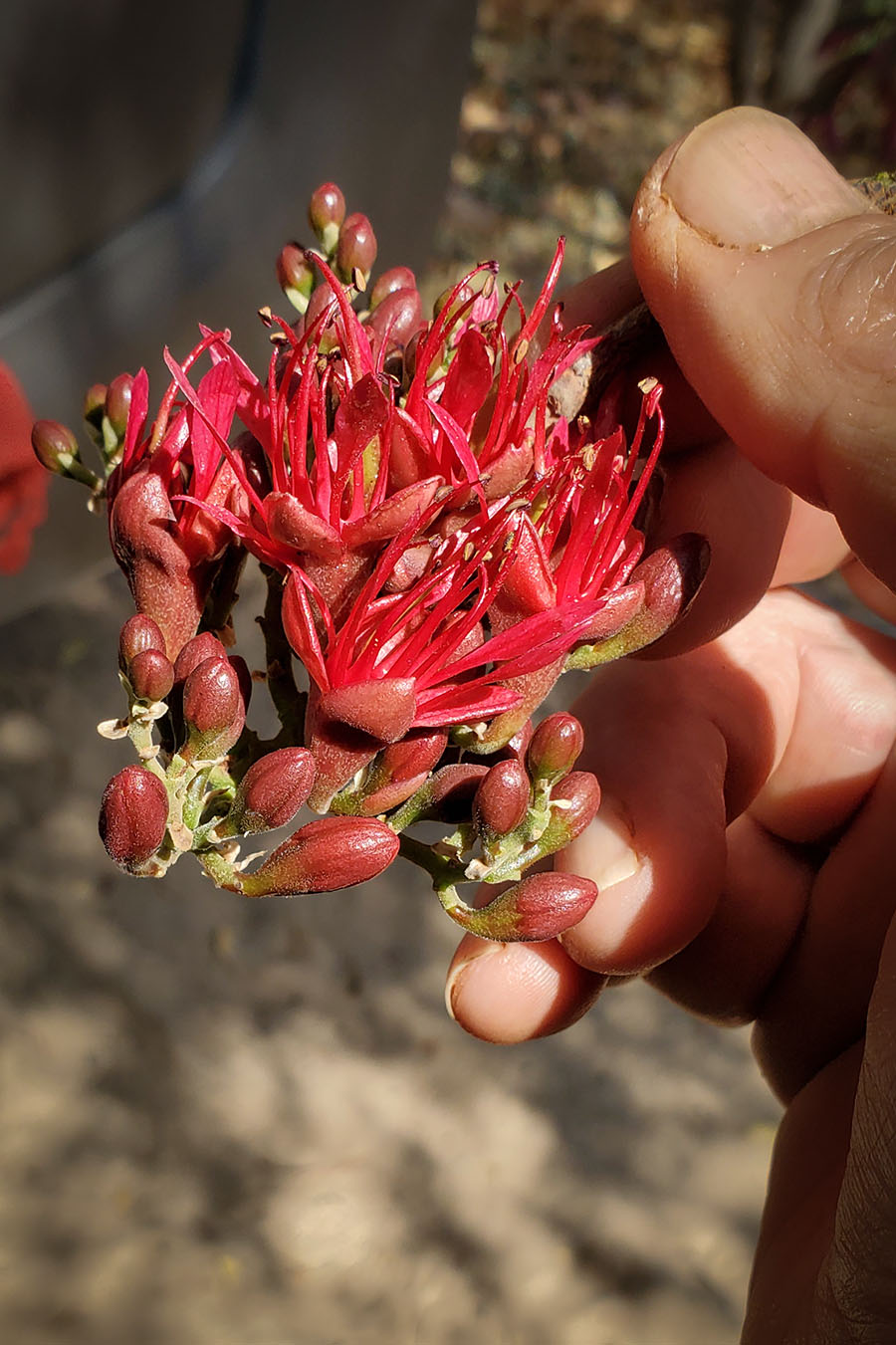
A member of staff helpfully identified the tree as a member of the Schotia genus (I found out later it was brachypetala species) which is indigenous so I stopped to have a look at the birds. There were at least 3 species of sunbird (nectar feeders) including the scarlet chested sunbird, the amethyst sunbird and the miombo double-collared sunbird and several other species I couldn’t identify. They were having a great old time with not a small bit of squabbling. The flowers were thick with bees and other nectar feeding insects too – not surprising as very little else around was in flower.
Having handed in my application for cotton seed importation from Israel (for a colleague who has business interests in the crop) I set about collecting a few seeds scattered around on the pavement. The gate guard soon came over to see what I was doing and offered to help. Curiously, the trees were in full bloom and producing seed from the previous season at the same time. The seeds have a fleshy aril (not shown) which is attractive to birds and the flowers are also eaten by monkeys. We live in a garden that has space for a few more trees so hopefully I’ll be around to see the tree seed grow out and form attractive flowering trees – apparently they grow quite quickly.

The gate guard waved a cheery goodbye with her covid mask around her chin. The indifferent police at the roadblock on the edge of Harare were similarly nonchalant – masks in various states of misalignment – along with most Zimbabweans who have shown scant regard for social distancing and frequently don’t wear masks at all. As of writing this Covid-19 has brushed us only lightly and has all but disappeared from the local news. As of 7th October there were officially 229 Covid-19 deaths. Given the disastrous state of the country’s medical health system this is almost certainly a low figure.
Earlier this week I drove past St Anne’s Hospital which was converted at not inconsiderable expense to a Covid-19 specialty hospital. There were all of 4 cars in the car park in the doctors only area and none in the visitors’ area. I’ve heard, unreliably, that there have been all of 7 cases that have gone through the hospital.
I covered possible reasons why the covid-19 impact might not be heavy in Where’s the Covid-19? post. Which aspect, if any, of this prediction might be true I’m not prepared to speculate but in the light of the lack of cases even the government has decided to relax travel restrictions.

Goodness knows the tourist industry needs all the help it can get but for many businesses it will be too late and I suspect only the most adventurous foreign tourists will travel in the absence of a proven vaccine.
The Zimbabwean economy still faces many challenges independent of a virus pandemic. It is almost entirely self-inflicted. The central bank and the Finance Minister are still trying to manipulate the laws of economics (and by extension mathematics) by controlling the exchange rate of the local dollar with the US dollar. Officially it’s around 81 of the local to 1 US$. Few if anyone is actually using that. It’s possible in theory to buy the hard currency on a government-controlled fortnightly auction (the rate is fixed) but actually getting the greenbacks is a challenge. The company my bookkeeper works for successfully bid for a tranche of US dollars but so far nothing has materialised.
It is perfectly legal to trade in US dollars or Zimbabwean dollars. The foreign ones are well circulated to the extent that they wouldn’t be acceptable in a first world country. However I’m occasionally surprised by the appearance of brand new, sequentially numbered notes.

Small denominations are, not surprisingly, difficult to find to the extent that businesses may ask one to pay the smaller amounts in local currency as they don’t have change.
The jacaranda trees that are ubiquitous in Harare are in full flower right now. They are showy, the bees love them and they care not a whit for Zimbabwe’s economy.
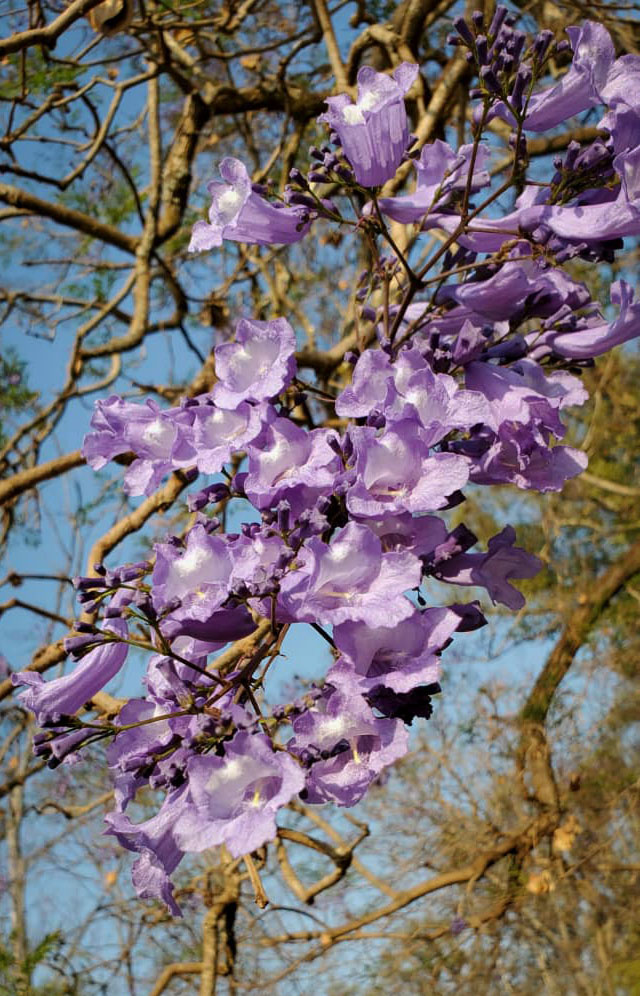
While I do have a preference for indigenous trees I don’t mind the jacaranda. It’s useful to the bees producing a mild, pale honey and is fantastic wood to work with if a bit dull. The flowers don’t do well in the rains and the roads become a carpet of mauve flowers that pop under the car wheels.
There’s rain around at the moment. It’s a bit early for the real season which starts mid November (usually) but it’s still welcome even if the early storms tend to be violent often with hail. So far it’s done a fair job of missing us.
The season ahead is looking promising.
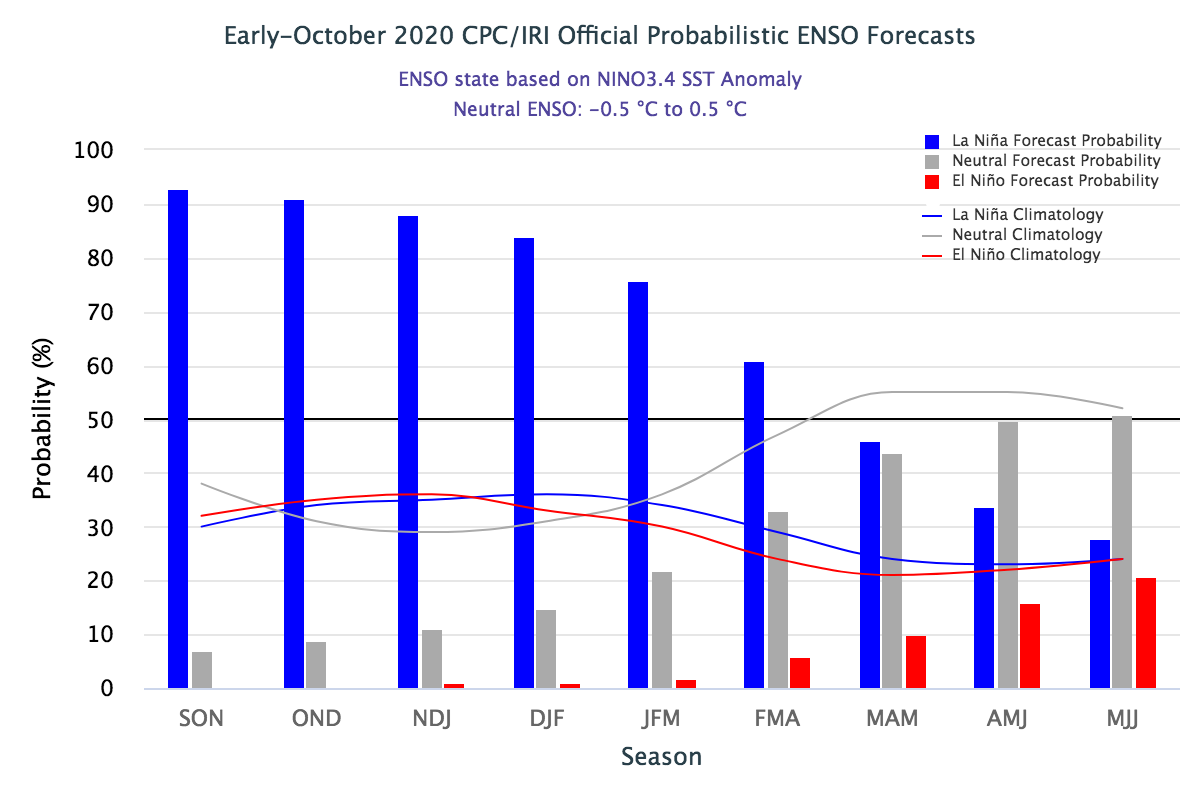
If the la Niña forecast comes to be, as is indicated above, we stand a good chance of better than average rainfall over the next 5 months. Goodness knows we need it but it’s never as simple as the charts make out. More than a few times over the past 20 years that I’ve had my nursery business it’s been a disappointment. It doesn’t make that much difference to my business – commercial horticulture in this part of the world is dependent on a good irrigation system for success. Still, we’d like to have a good season to replenish our borehole in the garden. The rain gauge is out on its stand already – here’s hoping.
(el Niño conditions are indicated by warm currents off the coast of the Galapagos Islands (eastern equatorial Pacific Ocean) and commonly cause drought in this part of the world. La Niña conditions are the opposite and indicate wetter than usual conditions – see What is el Niño?)






































 Zimbabwe Absurdity
Irrigation alley
21 09 2021I watched Warren closely, fascinated. He took several careful steps intently watching the mostly full water bottle balanced on his left hand. It toppled and he caught it in his right hand. He turned around, retraced his steps back behind the wall and repeated the procedure. He scuffed a mark in the dry lawn with his boot and walked off at 90 degrees then walked back over the spot. The bottle fell again. He was divining for water in our garden.
I am no believer in witchcraft but Warren backs up his dousing with some science and he’d successfully sited a borehole for me at my work, just out of town, so we’d got him in to our garden to see if he could repeat the success.
A couple of months ago one of the two boreholes that my nursery relies on, started to give problems. It has been fine for the 22 years that I have been there so I was more than a bit concerned. I knew it was a water problem because the run-dry electronic protection system kept tripping. I responded by reducing the flow of the water to a measly 1,300 litres an hour. It can run for a day but at night the security guards, who are hopefully not sleeping, report that the ammeter on the switchboard by my office keeps dropping to zero indicating the pump has turned off.
The area where my work is situated is not great for ground water and there are no streams nearby. I rent the property and the landlords sank five boreholes to around 70m each when the land was bought in the early 1980s. One is useless and I have to share the other four with the other occupants who include another nursery, a rose nursery and a small domestic property. The prospects for new siting of holes are limited. Nevertheless, Gill, my landlady agreed to finance a new hole but I would have to pay for the siting and equipment (the latter would remain mine to take with me if or when I leave). Several water diviners, or dousers as they are sometimes known, were contacted and brought in. There was no agreement on where the water may lie. Only one, Warren, used a scientific backup (a machine based on electromagnetism) to what his water bottle told him and both indicated a likely source, so we called in the borehole drilling company that he recommends.
Payment was made up front and withing a couple of days they had arrived. Watching boreholes being drilled can be a stressful experience but I wasn’t paying and it was the first one I’d seen up close. The drilling mechanism is mounted on one large truck, about seven tonnes, and the compressor that powers it is on another. There is a lot of noise and dust.
Each pipe section that makes up the drilling column is six metres in length and mounted eight to a rotating carousel. It didn’t take long to drill to the 60 m that Warren had advised and water was found at 38m, almost exactly where the chart above indicates. It was not exactly a gusher at an estimated 1,000 litres per hour.
The actual process took only three hours as 60m is not a deep hole by today’s standards. In fact the hole at our house in the suburbs only has a 40m hole which was probably standard for the 1970s and quite adequate at the time when boreholes were unusual and municipal water flowed in the pipes. It never recovered from last season’s poor rainfall and now will only pump for an hour or less before emptying. One of the other diviners who came to my work was quite garrulous and told me he’d recently found and drilled (he had his own rig, or so he said) a “gusher” at 200m. It’s the first time I’ve heard of such a deep hole in the urban areas but 100m is pretty much the norm.
The foreman for the drilling company handed over the drilling report which clearly stated that the hole was an “excellent yielder”‘ and suitable for extracting water. I was surprised that 1,000 litres per hour was considered an “excellent” yielder and gave the drilling company a call. The manager explained that for a domestic hole, which is mostly what the company does, a 1,000 litres per hour was considered good but they did tend to be conservative in order not to disappoint customers and that we should get on and use it as it could take a season of pumping for a hole to unblock all the cracks and reach its full potential. It has taken a few weeks to get all the ditches dug for the pipes and the switchgear put in a box that is reasonably theft-proof, so it will all be turned on in the next couple of days and the moment of truth will be realized.
Meanwhile Warren has submitted his report on the site he found in our garden and is reasonably positive that it’s a good site. All dousers make a point of saying on their report that it’s not an exact science and a good result is not guaranteed. Warren has more faith in his bottle than the electronics and admits that he doesn’t really know how the latter works. He keeps up to date with technology and recently contacted a European company that was advertising a machine for divining. Even at a cool 150,000 euros it was not guaranteed to find water. There just doesn’t seem to be the tech out there to find water accurately.
I asked the same drilling company for a quote to drill to 100m. They came back with US$4,100 which included the casing but not anything else. It’s not a small sum of money but if we find water it will substantially add to the value of the property and will take two years to cover the cost of the water we are now buying in for domestic purposes. We do occasionally get municipal water but it’s not reliable and goes into the swimming pool and then is pumped onto the garden to keep selected areas alive through the dry season. We certainly wouldn’t entertain drinking it as it comes from the heavily polluted Lake Chivero into which much of Harare’s storm water, industrial waste and sewage drains. The human excrement side of the pollution can be dealt with but not the industrial. Well, not in Zimbabwe where the water treatment works frequently runs out of cash to buy the aluminium sulphate used to settle the particles suspended in the water.
The suburb of Harare in which we live is known as Mount Pleasant. There is no “mount” of which I’m aware and the area is not known for a profusion of ground water. However the road along which I drive to work has some verdant verges that are profusely watered, so some properties do have good water. I’ve named it Irrigation Alley and it’s not unusual to see upwards of eight sprinklers (yes I did count them) watering the verges and the road. In fact this morning there were 14 working along a 1.3km stretch of road.
Marianne is on several neighbourhood WhatsApp groups that discuss these sort of things and appeals to irrigators of verges and roads to conserve water so the rest of us with marginal boreholes, or none at all, don’t have to buy so much water. Their response is “it’s my water and I’ll do as I like with it”. That’s technically true as all of us with boreholes pay an annual licence fee that allows unrestricted usage. Community spirit in this respect is in short supply.
After much dithering we have decided to go ahead with the borehole in the garden. The money has been paid and the drillers have made an inspection and think that the site is a good one. They will be back in due course and I’m not sure if I will stay around to watch. Of course it will make not a jot of difference if I do watch but there’s a lot riding on this.
At work we finished the electrics on the new borehole today and tomorrow we should be able to get the pumping gear down the hole and see if we have something useful or not. No doubt the irrigators of Irrigation Alley will be watering the road and the verges as normal.
Comments : 7 Comments »
Tags: boreholes, divining, ground water, Mount Pleasant
Categories : Blogroll, Environment, Social commentary