“Boss, come and have a look at this” Mapeno, the gardener exclaimed, clearly excited. He held up two expensive day packs. “Where did you find them?” I responded. “Over here right by the gate” came the reply. “Are you sure they don’t belong to the builders?” I asked. “No, I already checked with them”. I wasn’t surprised, they didn’t look like the sort of day packs a Zimbabwean builder could afford.
I was just about to go to work so he brought them over to my truck and we started to go through them. Diaries with copious notes on what looked like engineering projects, a wallet with South African gun licences, credit cards and no cash. Two South African passports (one full) in one pack in the name of a male and another in the second pack with a woman’s name and photo. This was obviously stolen property but why had it come over the wall into our property? And how was I going to contact the owners?
Fortunately the diaries had contact phone numbers in them albeit different ones. I tried both – one did nothing and the other was unreachable. Maybe I could contact the South African Embassy and give them the passports and then the owners would likely go there and then be able to contact me. I was on the way to work when I realized that WhatsApp works everywhere irrespective of phone number so I entered the unreachable number and called. It was quickly answered. “Is this Mr M and are you missing a couple of day packs?” I said. “Yes we are – did you find any passports?”. I answered that we’d found three and asked what they’d lost. A laptop and US$2,000 was the response. “It was just stuff, the passports are the most important things, at least we can get back home tomorrow” he added.
They had stopped for breakfast at a café at a local shopping centre and left the laptop and day packs on the back seat of the pickup in plain view. As they sat down to breakfast thieves smashed the back window, grabbed the packs and computer and got away in a waiting car.
“While this is not Jo’burg you still have to switch on. Thieves hang out in car parks just waiting for that sort of opportunity” I commented.
“Yes, we know that now” he replied. “Please send me your address so that I can come and pick up our stuff”.
I wasn’t there when they arrived but our maid phoned me to confirm who they were and wrote down the registration number of their pickup truck. I did wonder why the thieves bothered to “return” the day packs and their contents – a distinctly curious form of criminal ethics. If I were they I’d have kept the rather smart packs and dumped the contents into the nearest ditch.
Crime in Cape Town is an altogether different league. One could easily be lulled into a false sense of security by the first world shopping centres, immaculate roads and civilised driving standards (traffic lights are actually respected) contrary to Zimbabwe. Tourism is booming – the driver we used from the airport told us that in December 2024, 1.6 million tourists came through the airport – tourists we met on Table Mountain commented on how cheap Cape Town is. People are positive about their future and investing and developing in agriculture – rare attitudes in Zimbabwe.
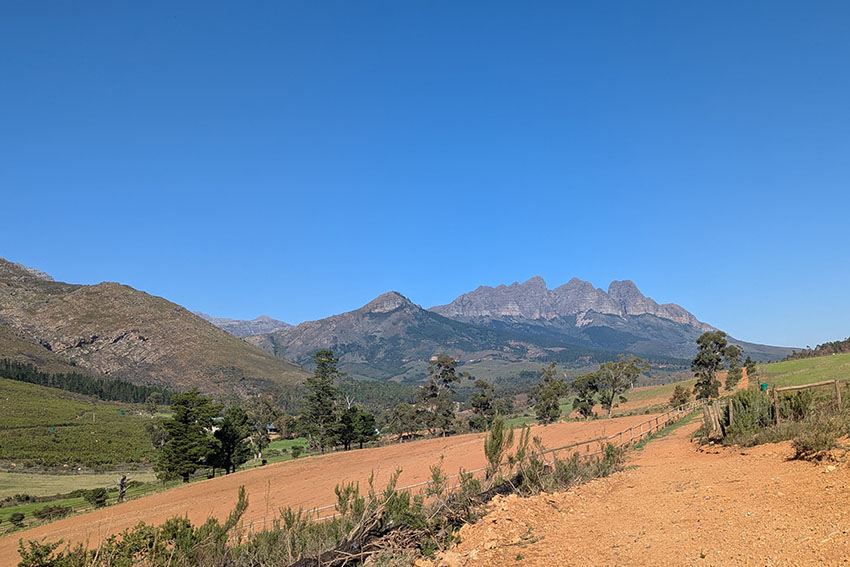
Visiting Oaklands Estate near Wellington in the Western Cape was a case in point. David, a friend of my cousin, bought the abandoned racehorse stud in 2009 before occupying it in 2011. The derelict buildings have been renovated into tourist accommodation and the old stables will once again house a stud. Hillsides are being planted to proteas for their flowers for export. Other stables have been converted into a conference centre and come the tourist season the accommodation is full. I asked David if his positive outlook was down to living in the Western Cape. He answered “Pretty much. You can still avoid the corruption bullshit if you want to”. The Western Cape is relatively well run compared with the other provinces in South Africa. It is under the control of the Democratic Alliance with Alan Winde as the premier.
While Oaklands Estate is far enough out of Cape Town to not be overly attractive to criminals, the township of Guguletu is an epicentre of crime. The taxi driver was quite clear on this: “If you are a person of colour” – he tapped his own light brown skin – “or a white, you stay out of there” – he gestured to the left of the motorway. It was a maze of corrugated iron shacks, broken fencing, goats, rubbish and bizarrely – satellite dishes on nearly every dwelling I could see. We asked him about the white tourist who’d been killed there earlier in the year. “Actually there were two who went in there” he responded “but one survived”. “You see that road up there?” he gestured with his right hand to a road sweeping a curve over the motorway into the township. “There was traffic backed up on the other side of this road so both asked their traffic navigator apps for an alternative and it took them into Guguletu. One guy was robbed of his car and beaten up but got out to a hospital and survived. The other was a doctor and they shot him. Dead. You don’t mess with the gangs in there – they run the place.” I mused that they were probably not the type that would return high quality day packs over a suburban wall in the expectation that they would be returned to their owners.
We arrived at the airport and said goodbye to Mario. It was time to head back to Harare. I got chatting to the porter who was assisting us whilst Marianne filled in forms to get VAT back. I asked him where he lived. “Oh, Guguletu” he replied. When I asked him how he coped with the gangs and crime he shrugged “God looks after me”.















 Zimbabwe Absurdity
To buy or not
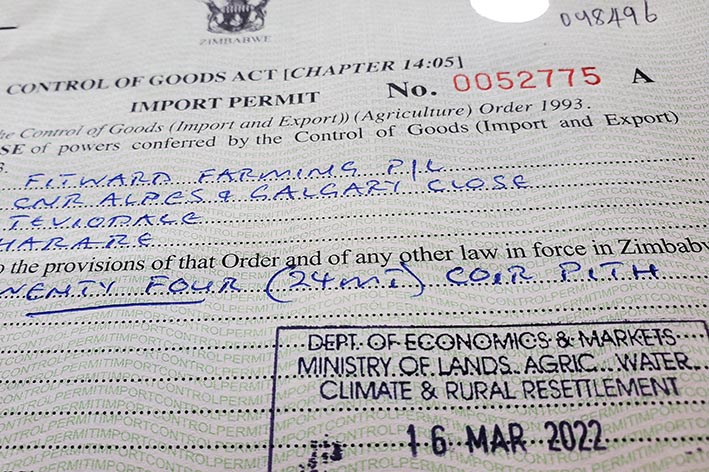
17 08 2025We grow our seedlings in compartmentalized expanded polystyrene trays. The cells are filled with a growing medium, in this case coir pith, and a seed is placed in each cell and grown out to maturity. This can take as little as four weeks in summer for tomato seed or up to four months in the case of gum tree seedlings as seen above. A seedling is deemed mature when it can be pulled from the cell and the roots hold the medium in a plug which will remain intact until it can be planted into the field. It also needs to be tall enough to be planted easily and not so tall that the leaf area will tax the roots ability to take up enough water in what, for the plant, is a stressful transition. There are other criteria that need to be met such as hardness of the leaves but that’s getting boring.
Being made of polystyrene the trays are light and rigid, which makes them easy to handle. It also makes it easy for the plant to grow its roots into the polystyrene which makes the seedling difficult to pull out of the tray. New trays have a smooth surface which is difficult for the roots to penetrate but as the trays age their surface becomes pitted and the plants’ roots can penetrate the polystyrene. To reduce this effect we dip the trays in a solution of copper oxychloride and water soluble glue. This creates a localized toxicity in the tips of the roots which stops them growing into the polystyrene and serves to sterilize the tray. Mostly it’s effective but as the tray ages and the surface becomes rough the roots grow into it anyway. The buildup of copper over many uses of the tray also causes a more general toxicity in the plant which can manifest itself as leaf discolouration and poor growth.
This general toxicity is most evident in gum seedlings as discoloured leaves and poor tip growth though in other seedlings it manifests as a general lack of vigour. I have noticed this for some years and when new trays are bought there was a noticeable “new tray effect” which I couldn’t really nail down to anything specific.
The coir pith we use is a by-product of the coir industry in India and other Asian countries. It’s the cork material that’s left over when the fiber has been extracted for ropes and mats. It has no nutrients in it so all must be added in the form of various chemical fertilizers. Organic we are not. This means that there’s little space for error and small changes in the formula can have major effects. Fortunately most of the work in this type of horticulture has been done long ago, albeit on other media, so it’s not as hit-and-miss as it may sound. Unfortunately I have a tendency to fiddle to try and get just that little bit of extra performance out of the system.
So when the gum seedlings started to become discoloured some years ago I put it down to something I’d done to the fertilizer formula. Thinking that it was a phosphate toxicity I designed a simple experiment. I bought several new trays, made sure they weren’t dipped in copper, then mixed differing quantities of single superphosphate that we normally use into the coir pith and grew out the gum seedlings. They were all good seedlings including those that should have had toxicity symptoms and those that had no single superphosphate added at all. It was that “new tray effect” and I knew it had to be the copper dip.
In Zimbabwe trash recycling is not a vibrant industry. There is a large municipal dump that I drive past on the way to work with a large warehouse building on it with “RECYCLING PLANT” painted on the front. Whether any recycling actually happens there is unknown. It’s part owned by one of the President’s sons but that’s a topic for another blog post. The old polystyrene trays we use end up on this dump site and add to the general pollution. It bothers me but the alternative is to import plastic trays from South Africa and they are very expensive and would likely not be recycled either. So I buy more of the local trays when I have to.
The gum seedling in the above photo is a good one. Though still young it has good root development, good leaf colour and good growth. It’s a product of a new tray – part of a batch that I bought earlier this year to replace older trays that were causing the copper toxicity symptoms. I have been seeing a general malaise in the tomato seedlings we are growing in old trays and should really replace them too. But there’s a problem.
I lease part of a property that supports my landlady’s ornamental nursery, another tenant’s rose nursery and the landlady’s son’s container rental business. The remainder of the property, some 10ha, is not utilized largely because we are in a bad area for sub-surface water and the three boreholes would not support irrigated cropping of any sort.
The 400ha of land on the boundary of “our” land is owned by a politically connected person whom I will call G. She acquired the land some time ago and set about building a wall around it. This is not just any wall – 3m high it has, a reinforced concrete core, a course of bricks on either side, pillars every 4m and topped with cornicing. It’s 9km long (measured on Google Earth) and is estimated to have cost US$500 – US$600 per metre. At a minimum $45 million G has clout and access to capital. So it was not without concern that we waited to see if the wall would include “our” property. It stopped either side.
My landlady’s son decided that the best way to make the property less attractive to acquisition by G and her ilk would be to develop it. Half the property was duly sold to a development company for construction of high density housing on condition that they changed the title deed to “development” rather than “agricultural” which is less attractive to the likes of G.
This development means that I will lose about a third of my current capacity and access to two boreholes that provide the bulk of my water. Remaining viable in a business that relies on large turnover on low value items/seedlings is going to be a challenge. So do I invest in new trays?
I was initially told that I would have about two years use out of the current two boreholes and that was six months ago. My landlady has had another two drilled on the remaining property but they are not very prolific. Uncertain times but to throw in the towel now on the premise that my business will fail would be defeatist. Tomorrow I will place an order for 2,000 new trays.
Comments : 2 Comments »
Tags: political clout, uncertain future, waste recycling, Zimbabwe
Categories : Agriculture, Business, Environment, horticulture, Social commentary