
Zimbabwe has two official currencies, the US dollar and the local dollar. The latter is officially called the Zimbabwe Gold or ZWG. It used to be called the ZiG (also Zimbabwe Gold as apparently it’s gold backed) but that’s no longer used by the government, perhaps it sounded too much like the cartoon character that it is. The general public still use the term “ZiG”.
That both currencies are legal means that one cannot refuse payment in either. This of course brings up the sticky issue of exchange rates. A visit to the Reserve Bank of Zimbabwe’s (RBZ) webpage is instructive. A one ounce gold coin is being sold for US$2,744 or ZWG70,723 which makes the exchange rate 25.77 (it’s tightly controlled). Last week I bought ZiG/ZWG at 34 to the US dollar off an informal dealer. Why? Because my business takes in so little ZiG and I wanted a cheaper way to pay off my electricity bill and there was no way I was going to pay US dollars for that appalling service!
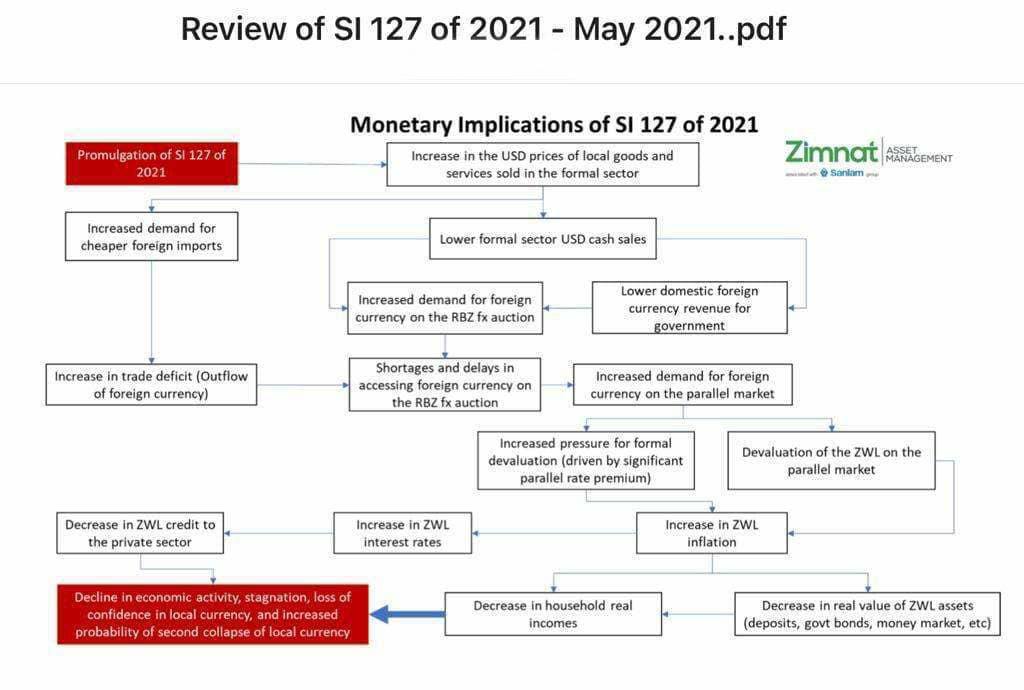
Officially the ZiG month-on-month inflation is 11.7% (277% annually as calculated) and the US dollar inflation is 0.09%. Given that a US$ loan will cost 9.5% per annum that is very conservative. Interestingly, the US$ annual inflation is given as 3.28% but the ZiG annual inflation is not given – too embarrassingly high perhaps? Of course Zimbabwe has had problems with currency inflation in the past so it’s hardly surprising that they don’t want to repeat the 2008 debacle. The official ZiG to US$ exchange rate is enforced by punitive fines, in US$, so it was surprising that the RBZ suggested in October that they let the exchange rate run in order to maintain the public interest in the ZiG.

Another way of stimulating interest in the ZiG – and I use the term loosely – is forcing the public to pay a percentage of their taxes in ZiG. The government excels at imposing taxes. There’s a 2% transfer tax on most currency payments and a 3% levy on withdrawing cash. Income tax starts at US$100 per month! Company tax is payable quarterly based on estimates and there are penalties for being inaccurate.
The ZiG, despite much fanfare at it’s introduction in April this year due to the ballooning devaluation of the previous currency, has never been issued in note form. This has insured that people use the banks as little as possible and keep whatever hard currency they have “under the mattress”. It’s not without risk of course – a recent fire at one of the big local markets destroyed a lot of people’s savings.
In an effort to streamline tax collection the local tax authority has implemented a system of tax compliance for retailers and wholesalers. They are now required to register with the authority (ZIMRA) and have a system whereby they are online to the authority and every sale is registered and a QR code is printed on the invoice at the till point/checkout. Yes, it actually does work – try pointing your smartphone camera at the example below. Fortunately everything my company sells is zero VAT rated (plants for cultivation) so it’s not a requirement for us.

The whole tax accounting system has been overhauled and now each registered company has just one account for both company tax and income tax. In the past there were two and managing the system was complicated. Now it’s so simple that I can almost understand it but prefer my bookkeeper to handle the returns. Progress? I guess it is in a way.
We haven’t made any progress in growing the economy. The budget speech by the Minister of Finance at the end of November is best described as entertaining. I quote; “The attainment of the projected 6% economic growth in 2025, will result in Zimbabwe being one of the fastest growing
economies in the region.” This is despite “… the agriculture sector, which was initially projected to contract by -21%, is, now expected to contract by -15% on account of better than anticipated output on wheat and dairy.” It seems the Minister of Finance hadn’t read the RBZ figures because he says “…prices for goods and services have relatively been stable following the introduction of Zimbabwe Gold (ZiG) in April 2024. Month-on-month ZiG inflation declined by -2.4% in May 2024, and averaged 0.0% in the second quarter of the year.” The full speech can be downloaded here.












 Zimbabwe Absurdity
A letter to America
5 02 2023Hi Robin,
Our weather has become increasingly erratic over the last 15 years or so. I put it down to climate change. Right now we are in the middle of a relatively normal rainy season. That means that the ITCZ (Inter-Tropical Convergence Zone) moves over the country and it rains – quite a lot. Most of our rains happen from mid November to the end of March which in Harare means some 700 to 800mm. The rain can be quite intense – we had 75mm (3 inches) in several hours last week which meant all the rivers around town were up and one of the reservoirs that supplies town was spilling. As a country we’ve had good rain for the last 3 years due to the la Niña effect though it has been quite variable over the country and Harare, which is in a high rainfall area, received less than average. We are due for a drought and I see that there is a el Niño predicted later in the year which is a reliable indicator.
There’s rain around as I type this and yesterday afternoon we had quite a storm with high winds and hail and of course the power went off. It’s still off but we are geared for this eventuality and have solar panels and two lithium batteries to get us through the night. Power outages for other reasons, mainly incompetence and over-use of Lake Kariba as a hydro source, are common so everyone who can has a solar backup plan. Solar water heating makes a lot of sense in our climate so we have three solar heaters, one for us, one for the cottage tenants and one on the domestic employee’s rooms. In the cloudless, hot days of August and September the water can easily boil.
I see your weather has been erratic too. Mt Washington in the north-east of the USA hit a record -70C a few days back and Europe had an unseasonably warm Christmas. It seems that California has had some heavy rains too; the default weather app on my new iPad is set to the Apple headquarters in Cupertino and they had flood warnings out recently.
Planned, and I use that word loosely, power outages are called “load shedding” in this part of the world. Towards the end of last year it was announced that Lake Kariba, which is our major source of hydro power, had got to it’s minimum level permitted for generation due to over-use by the Zimbabwe power authority and load shedding would become a daily occurrence. We have another major thermal power station at Hwange in the west of the country but it has become a byword for mismanagement and cannot take up the shortfall. We also import a lot of power from Mozambique and South Africa but have managed to get into a lot of debt so the aforementioned countries are fed-up and restricting our supply. South Africa has its own power supply issues (again due to mismanagement by the state-run utility) and is also imposing load shedding but at least it sticks to a schedule. In Zimbabwe the power generally goes off in the suburbs about 6.30 a.m. and comes back on around 10 p.m. Businesses are not exempt either and incur heavy costs due to diesel generators. It’s not unusual for some to run just on night shifts.
Our swimming pool was an early casualty of the power cuts. It’s essential to keep the filter running which the solar panels can do on a sunny day but those are rare in the rainy season so it’s more green than clear these days. Marianne was muttering about the cost of more chemicals to try and clear it. I pointed out that we could always fill it in but it wouldn’t be a cheap procedure and then we’d lose some 70,000 litres of stored water that would be very useful in a drought. We have decided to live with it being more green than not (it is covered over in winter when not in use).
The book you asked about is, I think, “The Shackled Continent” by Robert Guest who was an Africa correspondent for The Economist for a number of years. I found it fascinating and very insightful. Maybe I should read it again.
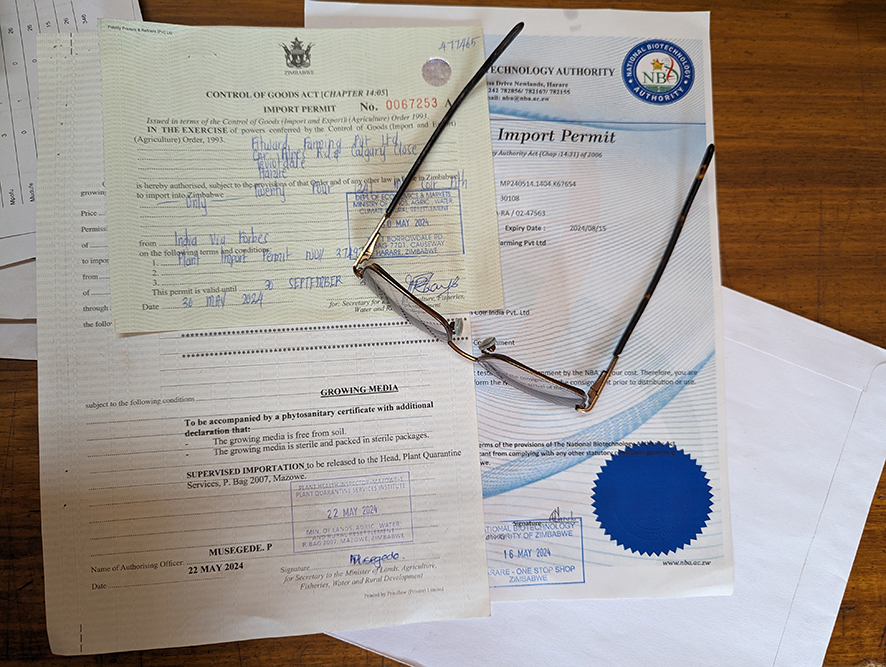
My business muddles along. I have a lot of outstanding debtors and it’s not so simple as insisting that they pay up front for their orders. I hate having to get nasty but it may eventually come to getting professional debt collectors in as I need to get the money to pay for imports of the coir “peat” raw material that we use to grow the seedlings. I obviously cannot use Zimbabwe dollars but fortunately I did invoice in US dollars which once again is becoming the currency du jour. The government is still trying desperately to keep the local dollar alive but with an official exchange rate of 740 to the US dollar compared with a “parallel”, i.e. street, rate of 1,100 to the dollar, it doesn’t have much of a chance. The local currency is still used, and has to be offered, as a payment method but most outlets make it very attractive to use the US$ by offering massive discounts . Government departments don’t do this so get paid almost entirely in local currency which means they are perpetually in financial difficulties – hence the disastrous state of the power supply, roads, rail links and anything else they are involved in. Am I making sense?
The government is also trying to stifle speculation on the currency markets by lending money at vast interest rates, 110% in November 2022, which makes doing business very difficult and one of the reasons that I use to explain why my business is so flat. The other is the proliferation of competition, often informal, which cut lots of corners allowing them to undercut my prices. Their quality is dismal but people either don’t care or see it as an acceptable consequence of the cheap prices. My prices haven’t changed in four years despite the rising costs of inputs in real (US dollar) terms. It doesn’t make for attractive business. Curiously the construction business is booming with cluster homes (small, single level apartments – several to a property) and other developments being built throughout the suburbs. Quite where the money is coming from I cannot ascertain – but in an economy as moribund as ours it’s almost certainly dirty.
Yes, us Zimbabweans are a resourceful lot and I guess in that respect Diana remained true to her heritage. My workroom/office is full of junk that I cannot throw away just in case I find a use for it in years to come. It must be a hold-over from the days when Zimbabwe was Rhodesia and under sanctions so nearly everything that could be was recycled. It’s probably an attitude of my generation rather than today’s “youngsters” – I drive past a municipal rubbish tip on the way to work and there’s never a shortage of trucks pulling in to offload. I suppose people do make a living out of recycling here though it’s not as fashionable as in the developed world. An elution plant (recycling gold from electronics) has recently been constructed at the former rubbish dump. It’s also not unusual to see carts being pushed around the suburbs and having one’s gate bell being rung by the owners looking for scrap metal.
I guess our “big” news for this year is that we’re going over to the UK in May to attend a rock concert! I’ve never been to one as standing for a long time in rowdy crowds is obviously not possible for me but this is Mike & The Mechanics who are not as popular as they used to be so seating is an option. Time to tick off the bucket list.
Then we are going to stay on the Cote d’Azur with an old girlfriend and her husband for four days. Apparently we’ll be quite close to St Tropez. Marianne is keen to go and see how the ultra-rich live but I may give it a miss. Really looking forward to it and we’re brushing up our rudimentary French in anticipation.
Well, on that positive note I’ll sign off and wish you all the best for this year. Forget the snow shoveling, go skiing and may it be exceptional.
Ciao
Andrew
Note: this is a genuine reply to a friend in Washington State U.S.A. who was a good friend to my sister Diana, and helped look after her in the terminal stage of her cancer three years ago.
Comments : 2 Comments »
Tags: el Nino, load shedding, power cuts, solar power, Zimbabwe, zimbabwe dollar
Categories : Business, Economics, Social commentary