Progress? Well it’s all in the perspective

27 12 2024
ZiG – the notes that never were. There were 100 and 200 denominations too and unbelievably some coins!

Zimbabwe has two official currencies, the US dollar and the local dollar. The latter is officially called the Zimbabwe Gold or ZWG. It used to be called the ZiG (also Zimbabwe Gold as apparently it’s gold backed) but that’s no longer used by the government, perhaps it sounded too much like the cartoon character that it is. The general public still use the term “ZiG”.

That both currencies are legal means that one cannot refuse payment in either. This of course brings up the sticky issue of exchange rates. A visit to the Reserve Bank of Zimbabwe’s (RBZ) webpage is instructive. A one ounce gold coin is being sold for US$2,744 or ZWG70,723 which makes the exchange rate 25.77 (it’s tightly controlled). Last week I bought ZiG/ZWG at 34 to the US dollar off an informal dealer. Why? Because my business takes in so little ZiG and I wanted a cheaper way to pay off my electricity bill and there was no way I was going to pay US dollars for that appalling service!

Officially the ZiG month-on-month inflation is 11.7% (277% annually as calculated) and the US dollar inflation is 0.09%. Given that a US$ loan will cost 9.5% per annum that is very conservative. Interestingly, the US$ annual inflation is given as 3.28% but the ZiG annual inflation is not given – too embarrassingly high perhaps? Of course Zimbabwe has had problems with currency inflation in the past so it’s hardly surprising that they don’t want to repeat the 2008 debacle. The official ZiG to US$ exchange rate is enforced by punitive fines, in US$, so it was surprising that the RBZ suggested in October that they let the exchange rate run in order to maintain the public interest in the ZiG.

In 2008 we had a bad experience with Zimbabwe dollars…

Another way of stimulating interest in the ZiG – and I use the term loosely – is forcing the public to pay a percentage of their taxes in ZiG. The government excels at imposing taxes. There’s a 2% transfer tax on most currency payments and a 3% levy on withdrawing cash. Income tax starts at US$100 per month! Company tax is payable quarterly based on estimates and there are penalties for being inaccurate.

The ZiG, despite much fanfare at it’s introduction in April this year due to the ballooning devaluation of the previous currency, has never been issued in note form. This has insured that people use the banks as little as possible and keep whatever hard currency they have “under the mattress”. It’s not without risk of course – a recent fire at one of the big local markets destroyed a lot of people’s savings.

In an effort to streamline tax collection the local tax authority has implemented a system of tax compliance for retailers and wholesalers. They are now required to register with the authority (ZIMRA) and have a system whereby they are online to the authority and every sale is registered and a QR code is printed on the invoice at the till point/checkout. Yes, it actually does work – try pointing your smartphone camera at the example below. Fortunately everything my company sells is zero VAT rated (plants for cultivation) so it’s not a requirement for us.

A QR code verifies that the purchase is registered with the tax authority

The whole tax accounting system has been overhauled and now each registered company has just one account for both company tax and income tax. In the past there were two and managing the system was complicated. Now it’s so simple that I can almost understand it but prefer my bookkeeper to handle the returns. Progress? I guess it is in a way.

We haven’t made any progress in growing the economy. The budget speech by the Minister of Finance at the end of November is best described as entertaining. I quote; “The attainment of the projected 6% economic growth in 2025, will result in Zimbabwe being one of the fastest growing
economies in the region.”
This is despite “… the agriculture sector, which was initially projected to contract by -21%, is, now expected to contract by -15% on account of better than anticipated output on wheat and dairy.” It seems the Minister of Finance hadn’t read the RBZ figures because he says “…prices for goods and services have relatively been stable following the introduction of Zimbabwe Gold (ZiG) in April 2024. Month-on-month ZiG inflation declined by -2.4% in May 2024, and averaged 0.0% in the second quarter of the year.” The full speech can be downloaded here.


Getting it done

16 07 2024

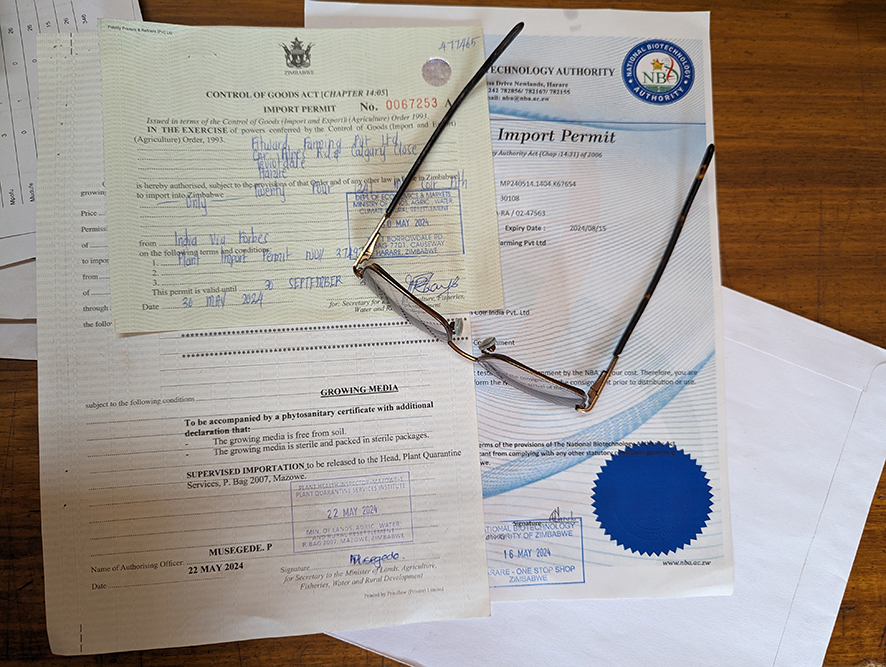
Just part of the paperwork necessary to import the coir pith essential to my business

It’s not something I look forward to but the coir pith on which my nursery depends for growing seedlings is essential for a good product. Yes, another substrate – composted pine bark – is available locally but last time I tried it some 20% of my seedlings died from the disease it carried. So about once a year I just have to grit my teeth and jump through the bureaucratic hoops. To be fair it IS becoming a bit easier as more of the government agencies involved get online and organized.

First off is the Agricultural Marketing Authority. I have no idea what they do but membership is essential and nothing else is achievable without it. Fortunately it’s doable online. Then it was on to the National Biotechnology Authority to get a permit that acknowledged the import was free of GMOs. The Indian supplier had given me a certificate stating as much and though it didn’t look very authoritative to me, it was sufficient and upon receipt of the required payment the local certificate was duly issued.

I have done the Ministry of Agriculture for the importation permits before and found it beyond tedious so sent Fabian, one of my senior staff, down there with some smaller US dollar note and instructions to “do whatever it takes” to get the first certificate. It cost him five dollars to put in the application whilst the official concerned was “on lunch break” and then all I could do was wait.

Fortunately the container was being delayed en route from Sri Lanka. I have no idea why it had to go via Colombo but I guess getting a full cargo of containers to warrant a ship going into the port of Beira in Mozambique takes some organizing. That was just as well as the first permit took two weeks, the date stamp indicated it had been sitting on an office desk for one of those weeks, and the second permit took another 10 days. That also required a sweetener of a few dollars.

By this stage I’d already paid the port and transport fees, all US dollars, and the race was on to get the local documentation to the border post near Mutare in the east of Zimbabwe before the truck from Beira got there. If we were late demurrage would be charged and I’d experienced that to my cost before. Fortunately my local shipping agent seems to know a lot of people and he got the money there just in time.

Then it was just a case of waiting for the truck to arrive and organizing a forklift to offload the pallets. It was three weeks late and in the interim I’d had to buy two pallets from another local supplier who’d marked up his prices 100% (he vehemently denied this even when I told him I new what it cost) but at least it’s over for about another year.

Now that the final accounts are in I can see that the costs were close to last year. The total for 24 tonnes of coir was US$19,650 which works out to 81.8c per kg. For some strange reason my bank needed to pay for the coir in Euros, I have no idea why but I do know that payment had to go through a South African bank. The rest was all payable in US dollars, none of the Zimbabwean kind thank you very much.

Yes, Zimbabwe is still trying to get its own currency up and running. It’s called the ZiG which is not the name of a cartoon character’s best buddy but is short for “Zimbabwe Gold”. It’s apparently linked to gold bullion of which the Reserve Bank is holding. Nobody is actually sure if this is the case but the official rate is around 13.8 to the US dollar.

When the ZiG was first introduced the obvious happened; currency traders spotted a good thing and the rate soon began to run. The government got tough and threatened a US$10,000 fine for any company or person not using the official rate – by law you have to accept either the ZiG or the US dollar if that’s how a customer wants to pay, the one exception being fuel traders who are not obliged to accept ZiG. Fortunately for my business most customers are uninterested in using local currency and choose to pay in US dollars, usually using cash. The local currency received has been entirely electronic – I’m not sure if this is by design – and I have yet to see any local notes. It is certainly not difficult to get US dollar notes out of my local bank and even small denominations are often brand new and in their 100 notes wrappers.

The country’s roads are in a disastrous state at the moment, bearing witness to years of neglect, but there’s a regional conference of the SADC (Southern African Development Community) in August so there’s been an orgy of road repair in Harare during the last few months. Construction teams have been called back to Harare from the outlying projects to concentrate on the local roads. Chaos has ensued as roads are closed and heavy traffic routed through the suburbs.

Some actions are unsurprising, others beggar belief. People living along the main route to the new Chinese-built parliament house where it’s all going to happen have been offered free water, delivered by tanker, to help make their gardens look pretty for visiting dignitaries.

The new dual carriageway to the parliament is being lined with kerb stones that make sure that there is nowhere to pull off the road if one has a breakdown. A local farmer, who lives on the route, pointed this out to one of the construction teams and was assured that it was a temporary arrangement and all the kerb stones would be removed after the conference. We’ll see.

A new bridge has gone in over a small river. They haven’t finished casting all the concrete and I’m told it takes a month to cure but the conference is in less than a month. Interesting.

An obvious question is where has the government suddenly found all the money? Are the construction companies actually being paid and what currency are they using? A friend is heavily involved in the landscaping of the new parliament and Marianne tells me she is being paid in US dollars and is doing quite well from it but rumours abound as to whether the others involved have been paid. I have heard that one company was owed some US$200 million which seems a bit much but many years ago I was told that a normal road costs US$ 1 million per kilometer to construct so perhaps it’s possible. Whatever the truth is you can bet the government will do whatever it takes to get the roads done and put up a paper-thin facade for the visiting dignitaries.

The nations hospitals would certainly like a bit of money themselves; currently several of the bigger ones are owed in excess of ZiG11 billion – a lot of money in any currency.