As I write this we actually have mains supply power. According to our neighbourhood WhatsApp group it’s because a dignitary is attending a function at a local sports club. By dignitary I mean someone with political clout. That way they can pretend that all’s well in the power supply situation when the reality is 18 hour power cuts every day. We are in this mess for several reasons, the main one being we have possibly the world’s cheapest power at US3c a unit (kWh). Until very recently it was 1c.
It wasn’t always that way. Back in the days when we were using real US$ and nothing else it was around 10-14c a unit and power was plentiful. We could import what power we needed from Mozambique and South Africa and even if the rest of the economy was a mess, which it was and still is, power was there if you needed to use it. Then in 2016 the government decided to introduce another currency called the “Bond dollar” which locals quickly nicknamed the “bollar” or “zollar”. The government insisted it was equivalent to a US dollar and was backed by a bond from the Egyptian Afreximbank and it was there to reduce the problem of small change. It was a lie. There was no bond, those who could withdrew their real dollars from the bank and those who couldn’t watched as the value of their accounts was whittled away by the informal market exchange rate. Eventually the government admitted that the bollar was not equivalent to a US dollar and pegged it at 2:1. The informal market ignored it and the rate soared to 12:1 before the government made it illegal to trade within the country in anything but bollars which were now called new Zimbabwe dollars (though we have yet to see any actual notes). The official exchange rate has now risen to around 14:1 which is why our electricity is ridiculously cheap. We were informed earlier this year that our bank accounts that had been in US dollars were now in Zimbabwe dollars – and so was our real money stolen.
We now owe US$73 million to the power utilities in Mozambique and South Africa with no real hope of paying it back and getting ourselves reconnected (not surprisingly they refuse to continue to export power to us). We need to import power because local thermal generators have been badly neglected because they have not been charging enough for the power (the government regulates power and fuel charges). This means that maintenance has not been done and our main source of hydro power, Lake Kariba, has been over-utilised beyond its design limitations. To compound the mess last season there was poor rains in the main catchment area in north-western Zambia and Angola.
The effect of lack of maintenance cannot be over-estimated. Apart from effeciency loss in old switch gear and old machinery (turbines), transmission efficiency is also affected. Insulators get covered in dust, rain turns the dust to mud which then causes shorts to the supporting structure which heats and cracks the insulator. Local losses are around 12% (I’m told the internationally accepted level is 7%).
The local power utility, ZESA, has embarked on a programme of power cuts or load shedding as it’s known locally. Alternative energy suppliers’ businesses are booming. The Reserve Bank estimates that the diesel fuel import bill has jumped 20% since the power cuts started as people and businesses buy it for their generators – money that could have been put into importing power in the first place.
It doesn’t take a huge imagination to realize what the consequences of these draconian power cuts are going to be. Some of the bigger mines import their own power directly from South Africa but the smaller ones, which apparently are given priority, have to make do. Farmers irrigate their crops in the dead of night when the power comes on, usually between 10 p.m. and 5 a.m. but this is often not long enough for a full cycle and I’ve heard of farmers abandoning their winter wheat crops which have demanding irrigation requirements. Tobacco seed sales were down 30% in April but this was as much to do with the government reneging on it’s promise to pay a proportion of the sales in hard currency as a lack of power. The early tobacco crop (tobacco is a major foreign currency earner) does require irrigating and supplementary power sources for the irrigation will likely make an expensive to produce crop excessively so.
Cell phone connectivity is now noticeably reduced as service providers have to rely more on backup power sources – usually diesel generators and the cost of airtime has gone up considerably.
We recently had six days with no power at all – just us and a neighbour across the street. Marianne went into the local ZESA offices to see whom she could get to come and have a look. A technician duly arrived and walked around the property then said he’d go and have a look at the sub-station (which supplies the suburb) and nothing happened. The next day the neighbour tried with no success. By now we were having to throw away food as our solar system couldn’t cope with running the fridge, deep freezes and other appliances and borehole pump 24 hours a day. So I went along to the offices, fully prepared to have to pay a bribe/sweetener to get something done.
I asked for the local manager with whom Marianne had spoken and introduced myself by commenting that we had more in common than he realised – we are both going bald. He laughed and I knew we were off to a good start. After explaining the problem I asked him what the future of our electricity supply was. Without saying anything he pointed to the ubiquitous portrait of the President, E D Mnangagwa, that seems obligatory in government offices. I replied “Please don’t point to that picture and tell me Zimbabwe is open for business”. The occupants of the office found it hugely funny. The slogan “Zimbabwe is open for business” was widely used by ED, as the President is known, in his election campaign.
“Are you and engineer?” I asked the manager.
“I am” he responded.
“So”, I asked him, “what happens when the water level in Kariba gets too low to be used for power?”.
“We turn it off” he replied.
“You mean the whole country?”.
“The whole country” he confirmed.
“Unless we can find some money to import some power. But that’s unlikely to happen so long as we have the world’s cheapest electricity?” I responded.
He nodded to E D’s photo without commenting.
That afternoon our power supply was restored and I hadn’t needed to part with any money – sometimes engagement is all it takes.
I don’t expect that the whole country will be turned off anytime soon. Certain areas in Harare, where we live, seem to be exempt. The grids surrounding the main hospitals and the President’s residence don’t get power cuts. A friend who lives close to the state controlled broadcaster, ZBC, never gets power cuts. Another friend who lives in a rural part of Zimbabwe in the east is on the same line as a senior ZESA executive never gets cuts either. That said I’ve told Marianne that we need to expect ever more draconian cuts – we don’t live near anyone or anything of political consequence.
Some four years ago I was living on a farm close to where I work. It was for me the perfect existence – close enough to town to be convenient but far enough away to benefit from the peaceful countryside. Whenever there was a thunderstorm the power went off and could take several days to get it fixed. I got fed up and bought a small solar system to keep the fridge and deep freeze running. I’ve always been a bit of a geek and liked the idea of a bit of independence from the grid and yes, I got a bit of a fuzzy warm feeling that I was doing something good for the environment.
The system worked well and it was upgraded by two panels when we moved into town. Then earlier this year as the load shedding was introduced the original lead-acid batteries had run their life and needed to be changed. It was evident that the power cuts were only going to get worse so we decided on another upgrade. Foolishly we bought locally manufactured batteries which only lasted 3 months but at least we could pay for them in local currency. The company that sold them to us did admit there was a problem and replaced them but we’d decided to go with an initially more expensive but much longer lasting lithium battery. Yet more photovoltaic panels were added with our closely guarded US dollars and now we have a nearly-off-the-grid system. It’s OK if we get a few hours of mains every night to charge the battery but if it gets to the stage where we’re completely cut off (no important neighbours to please) we are going to have to think of upgrading yet again. It will be money that could have been spent on a couple of really good holidays.

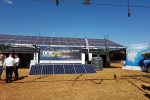
Panels are put onto the structure. Whilst I did most of the welding I had to get a specialist welder in to do the final work
The area where my nursery is has been relatively unaffected by power cuts. The research farm where I used to live is on the same grid and likes to claim some responsibility. I think it’s mostly due to the military barracks just down the road – can’t annoy those that keep the government in power now can we? Whichever it is it’s unlikely the situation will last so just before the recent slide in the local currency I invested in a solar powered borehole system whilst I had the money. Fortunately I have a young friend who has a qualification in solar systems and he helped me put it in by doing the design work whilst I did most of the welding of the structure. We did have to wait a month to get the electrics hooked up as the electrician was simply too busy doing other installations. In a rare moment of common sense the government has removed duty from solar panels and other associated equipment so those who can afford it are scrambling to install systems.
So far our system works fine, weather permitting. It cannot pump all the water we need so we are still reliant on getting at least some power to keep the water tank full and if the power goes off during the day, as it sometimes does,
there is a generator but it can go through 25 litres of diesel a day which of course is in short supply.
The price of power has recently gone up by up to 300% but it is still ridiculously cheap especially since the exchange rate with the US dollar has started to run again. There is no obvious way out of the mess.

The final wiring gets done. The system allowed for the original pump and motor to be used so required specialist knowledge























 Zimbabwe Absurdity
60 and the bottle of wine
15 12 2019A fine red wine blend
Marianne bought the bottle of South African Saronsberg Seismic 2009 red wine about 3 years ago; she had fond memories of it and thought it would be a good wine to put aside for a major celebration. The first occasion we earmarked was Mugabe’s death but when it came it seemed a bit of an anti-climax. He’d become irrelevant and it certainly didn’t create a beacon of hope. The current Zimbabwean president, ED Mnangagwa has seen to extinguishing that one before it could get going. So we moved the goalposts to the day when we would have paid off the bond on the house.
We decided to buy a house in 2016. Like anyone who’s ever rented a house long term you soon realize that you are just putting a lot of money into someone else’s pocket. There were other reasons to invest in a house. In Zimbabwe there is little if any sense in putting money into a savings account. If the government doesn’t steal it, inflation will make it worthless. Banking on the local currency crashing yet again, we decided to pool our hard-earned foreign currency savings, borrow as much as we possibly could, and buy a house. After 6 months of despondent searching we settled with a house with “potential” (a real estate euphemism for needing a lot of work) and moved into town from the farm where I’d been renting.
The asking price was US$225,000 which we considered fair as the house was filthy and needed a lot of work but had a decent 2 bed-roomed cottage on the property that we reckoned we could easily rent out and help pay off the bond. We could also move into it when a bit older and rent out the main house for retirement income. We could only get a bond for $75,000 of the asking price as both of us were over 50 and we had to pay it off over 10 years. It sounds like a lot but I was banking on the currency losing it’s value as it had in 2008 when people had paid off multi-thousand dollar bonds for the equivalent of a few US cents. I was determined not to lose out again as prior to the 2008 currency crash I’d dithered about buying a house and lost out on a bargain.
Luckily the loan contract stated that the money was valued as US dollars or the dominant local currency of the day. At the time there were a number of legal currencies in Zimbabwe including the US dollar, South African rand, British pound and the local currency called the RTGS dollar if it was in electronic format or the Bond dollar if in cash notes. The latter were officially valued at 1:1 with the US dollar but very quickly started to trade at much less on the black market. Although the bank accounts were officially valued in US dollars it was soon evident that they were valued in local dollars (the reserve bank had made off with the US dollars) and nowhere near 1:1. From the point of view of paying off the house, that suited us just fine and in September I borrowed $14,000 of local money off my own company (it was about US$1,000 at the time) and paid off the bond. Somehow it didn’t feel sufficient enough of an achievement to open the bottle of wine. So we set the new goal as my 60th birthday.
I wouldn’t say that the 10 years since I posted Reflections on the first half have passed quickly but they have been eventful. In December 2016 I married Marianne, whom I met through friends who boarded my dogs whilst I was undergoing neck surgery to stop the rot caused by 2 previous surgeries that had gone badly. We moved in together some time later and I bought her a dog to help with the bonding process. It must have worked as we celebrated our third anniversary recently.
I also bought a new pickup. That’s probably not a big deal to many people who read this but it is the first new car I have ever bought and it was a necessity. My disability had been deteriorating noticeably and on at least 2 occasions I’d missed the brake in my old Mazda pickup. I’d recovered the situation without more than damaged nerves but at some stage there were going to be tears and dents. As a physically disabled person I can import a vehicle duty free with the proviso that it is automatic and of course I had to get a letter from a medical specialist stating the nature of my disability and that I needed an automatic vehicle (some vehicles are assembled in Zimbabwe but they are all manual). I chose to go through a private importer (rather than an official Ford dealer) as they were familiar with the system. Money was paid and after a considerable delay the vehicle arrived, complete with a hand-operated foot brake to ease the drama of stopping. It certainly is a pleasure to drive though not hugely economic on fuel use.
My brother, Duncan, came out from the UK to help celebrate my 60th birthday in the middle of November. Unfortunately my sister, who lives in the north-western USA, couldn’t make it but gave me a present of 3 nights in a cottage in Nyanga in the eastern highlands of Zimbabwe. We gathered some friends, filled up some containers with diesel (it’s still critically short) and headed off for the 4 hour drive. Whilst stopped at a traffic light in the dormitory town of Ruwa some 20km out of Harare we were enveloped by a cloud of blue smoke. By the time Duncan got out to check it had dispersed but it was definitely ours. The truck computer didn’t indicate any faults but we stopped at the next town and changed the fuel filter, which was dirty. The power loss didn’t improve so in the absence of any warning lights on the dashboard we continued to Nyanga.
The cottage, named Rocky Glen, was at the end of a road in a tree plantation. It was very comfortably furnished and the staff ensured that the log fire burned all day and most of the night which irked a bit as it was not remotely cold. It did add atmosphere for the Saronsberg wine which was very good. Nope, there’s no more 2009 vintage – I have checked their website!
In good Nyanga form it rained, though not so heavily that we couldn’t get out and do things which can be an issue in the rainy season. The road to the Gairezi River was surprisingly good, not least because it has been very dry in that part of the country too. The river was low and dirty from the overnight rain but Duncan was not put off and had a ritual swim. The rest of us watched as the clouds closed in and the rain started.
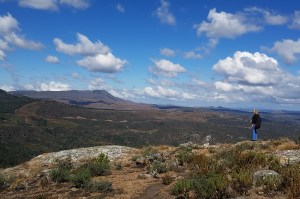
World’s View. L to R: Marianne, Maria Wilson, Duncan, self, Zak
The next day it was time to leave the quiet and solitude of the Nyanga mountains and head back to Harare and stress. First stop was the turbocharger repair workshop.
The news wasn’t good; a new turbocharger was required from South Africa and the currency was US dollars cash, and no paper trail. Whilst such deals are illegal in Zimbabwe one has to accept that for fully imported one-off items foreign currency will be required. I didn’t really have a choice as it was not a good idea to drive the vehicle and I cannot safely drive manual vehicles. A deposit was paid with precious dollars and in due course the vehicle was fixed after parting with yet more. As of writing this it hasn’t been ascertained what caused the turbocharger to fail but this particular engine is prone to having the turbo fail. Thanks Ford.
Fortunately there had been some rain whilst we were away so the swimming pool (also a makeshift reservoir for rain water collected off the roof) had risen a bit. The borehole has been failing since October and finally became useful only for drinking water in early November so the pool has been tapped for non-drinking water. Finally last Friday we had to buy in water as the pool was very low and the remaining water was more than somewhat dirty. Then the following day the rains returned and we’ve had a good week of some 140mm. The pool is back to two thirds full (about 40,000 litres) and we have 2 rain tanks totaling another 10,000 litres. We are self-sufficient for a while. Municipal water supply is erratic in Harare. We have not had municipal water since we moved in and those that do have it say it’s unusable for anything but watering plants. Lake Chivero, Harare’s main water source, is heavily polluted and the municipality has no money for water purification chemicals.
The Zimbabwe government doesn’t have much money for anything which is not surprising considering they stuff their pockets with whatever money they can lay their hands on. There has been a long running junior doctors strike that culminated in more than 400 being fired. They complained that they didn’t even get paid enough money to get to work and when they did get to work there was little if anything to work with. Those that can have left for other countries and the government has backed down and offered to reinstate the dismissed doctors no questions asked. A very wealthy Zimbabwean businessman living in South Africa has offered to top up the doctors’ salaries with the local equivalent of US$310 per month but it’s not clear how many takers there have been.
It’s not just the healthcare system in a shambles. Air traffic controllers have also been on strike over poor pay conditions and unsafe equipment. Power supplies are still heavily restricted countrywide. The latter has got to the stage where the government is reportedly considering the nuclear power option. That they are extremely complex to run doesn’t seem to bother them in the slightest – much more challenging than supplying a country with fuel at which they have proved themselves utterly incompetent. Hopefully the cost will keep an African Chernobyl at bay. In the meantime the national supply authority, ZESA, has hedged it’s bets and installed a solar power system in its head office building. Oh the irony.
So what’s it like being 60? Much the same as 59. I did get a set of hearing aids from my brother, courtesy of the National Health Service in the UK. His hearing profile is much the same as mine, though mine is a bit worse thanks to a more extended military service. He just has to pay £50 a piece to replace his “lost” ones. Do they work? Yes. I can now hear the workings of my electric toothbrush but they haven’t cured the persistent tinnitus as I hoped they might. I might be able to get them reprogrammed here but otherwise they will just have to do.
Bette Davis is credited with saying “Getting old is not for sissies”. I know 60 is the new 40 and all that but I think we need a different standard for Zimbabwe. Life here is just difficult regardless of age and of course makes one feel older. Some days I feel like I’m well into my eighth decade (I don’t like to think I’m already into my 7th). Partly it’s a structural issue – an artificial knee is giving a lot of trouble these days and it’s not helped by less than successful neck surgery in 2010 that has exacerbated my disability. Mostly it’s the dismal state of the economy which even our government has said will shrink by around 6% in 2020. The Economist, in its annual predicting the coming year supplement, has predicted it will shrink by around 23%. How can one make any plans in this sort of environment?
I asked Marianne recently if she would opt to stay in this country if we were financially secure. She said probably. I said I would seriously at moving to where I could do the things I really want to namely paragliding. I am now dependent on other people to take off – a critical part of the sport – and there’s only a few people I’d trust to do that. In fact there are about 2 and neither of them are available. One has stopped flying and the other is not interested in helping out – I am seen as baggage. Quite often there is just nobody around interested in going flying anyway – such is the dire state of the sport. France would be good, paragliding is big there and there would always be people around to help and yes, I can get by with the language. Dreams.
Most people at 60 have a retirement plan laid out. No chance of that in Zimbabwe for most people. There is a national pension scheme but the pensions don’t remotely keep pace with inflation so we are putting as much money as we can into improving the property in the hope that one day we can sell it for real money. So here we stay.
Comments : 3 Comments »
Tags: air traffic controller, dogs, Ford, hearing aids, nuclear power, Nyanga, paragliding, red wind, Saronsberg Seismic, turbocharger
Categories : Blogroll, Social commentary