We descended below the clouds some 20 minutes out of Harare airport. A bit of mental arithmetic made that some 100 km or so depending on the speed of the aircraft. I wasn’t in a window seat but had a reasonably clear view of the countryside and kept an eye open for irrigated crops, their intense green easy to spot at this time of year against the brown of the veld. Nothing. One or two old centre pivot irrigation fields were detectable by their characteristic circular pattern but now they were derelict. Plenty of dams though and they were mostly full in this, the dry season. Yes, I was definitely home.
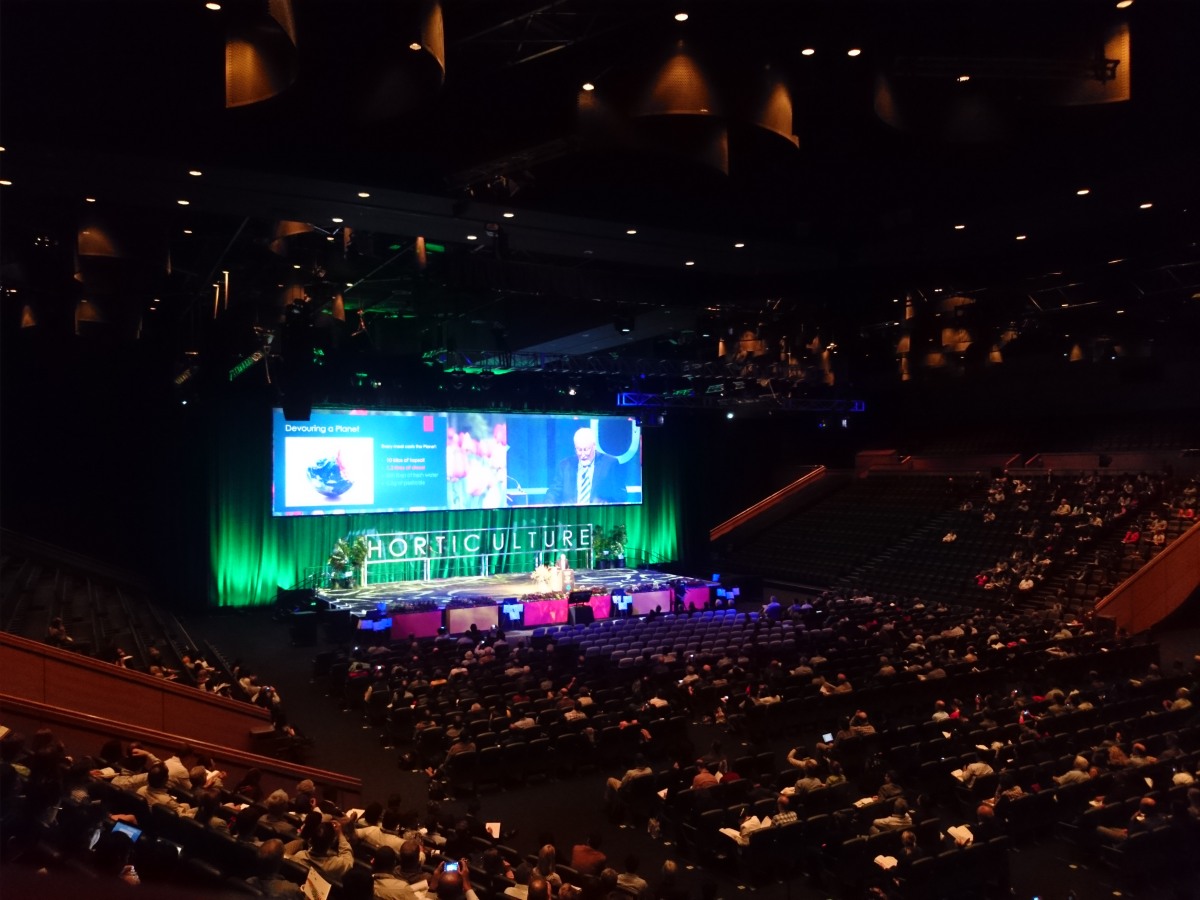
The keynote address at the first day of the International Horticultural Congress in Brisbane
The International Society of Horticultural Science holds a International Congress every 4 years in a different country.
This year it was in Brisbane, Australia and I decided it was time to go and see just where horticulture was going. It was impressively well organized in the modern conference centre on the south bank of the Brisbane River. More than 3000 delegates attended over the 5 days that it was run and the range of topics covered by the symposia necessitated a fair degree of choosiness. Presentations varied from excellent to hopelessly technical with a few mediocre thrown in for good measure. While I didn’t find anything directly relevant to my business it was worthwhile and my curiosity was well satisfied (or more precisely – saturated) by the end. The final dinner was a festive affair with a good band, dancers, magician and plenty to eat and drink. Rather depressingly I found myself to be of the average age – where was the future of horticulture which as one of the keynote speakers pointed out will be the future of feeding the world (horticulture is defined as being intensive agriculture)?
After the congress it was time to catch up with friends – some of whom I hadn’t seen for 25 years when I was last in Australia, doing the backpacker “thing”. I made some last minute changes to the itinerary and needing to book a flight to Canberra from Sydney I pulled out the smart phone in Brisbane airport and 3 hours later in Sydney got onto the plane to Canberra. Australia works. First world (not sure why I was expecting anything else but it really works). Of course first world functionality comes at a first world price and my friend Peter whom I visited in Orange (also in NSW) told me that Australia is now officially the world’s 4th most expensive country to live in. I can believe it. A small (by Harare standards) 3 bedroom house in Orange will go for some 5-600,000 Aus dollars and the gardens are miniscule! A meal for 3 of us at a good restaurant, though certainly unexceptional, in Brisbane cost $160 without alcohol. It would have been about $75 in Harare. It’s all to do with high labour costs I am told. That and the vast mining industry that powers the Australian economy.
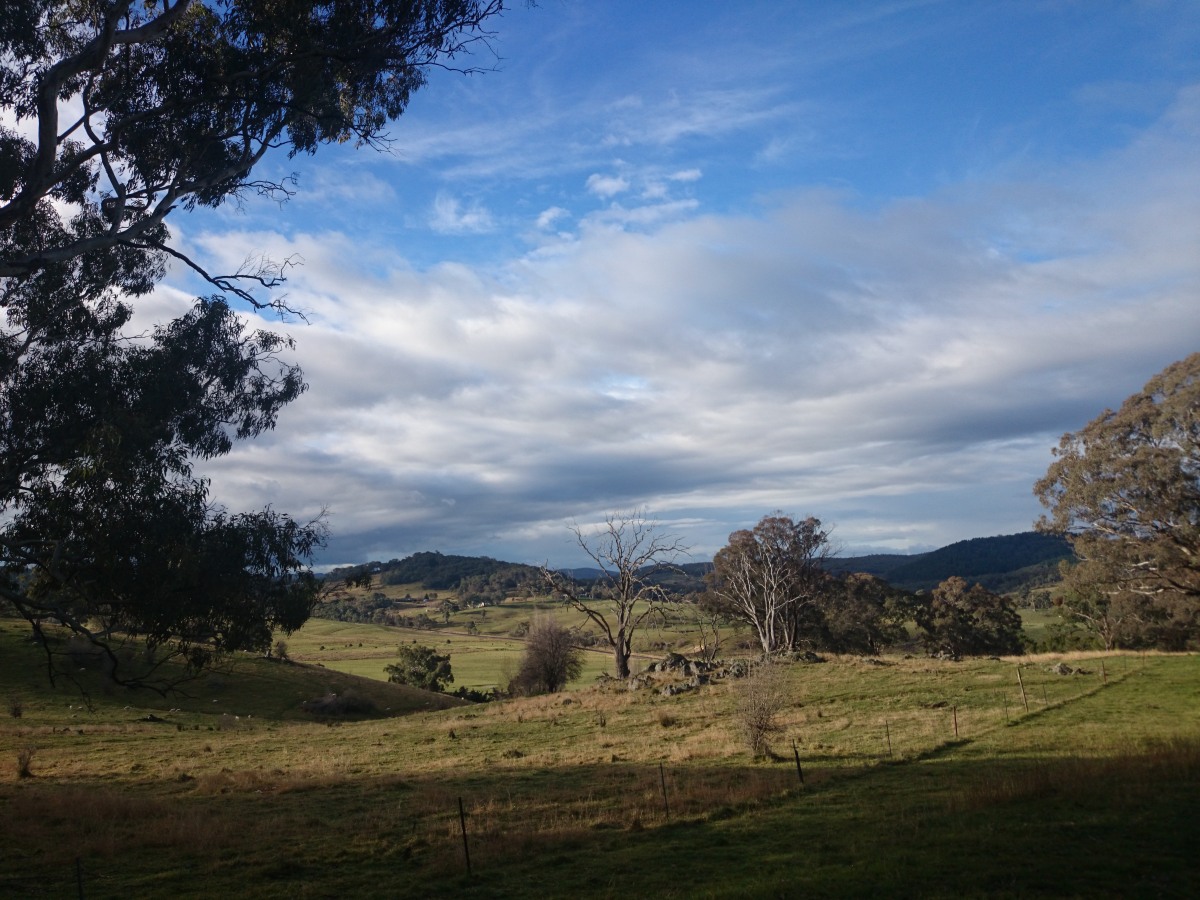
Pasture land around Orange
That is not to say that agriculture is insignificant either. Australia has some 13 million ha of wheat production, mostly for export. Zimbabwe was once self sufficient in wheat and exported maize. Now we import both. Unlike Australia where most extensive agriculture is going the corporate farming route with vast tracts of land being farmed, Zimbabwe is heavily reliant on the small scale producers. The mostly white commercial farmers were kicked off their land in the early 2000s – hence the idle dams and land that I saw coming into Harare. In Australia most extensive agriculture relies on rain whereas in Zimbabwe irrigation is essential, especially for winter/dry season production.

Canola (oilseed rape) near Orange, NSW
Oilseed rape (Canola) was abundant in the short trip we did around Orange, again mostly farmed by corporate organisations. This is not a crop we grow in Zimbabwe and unlike Zimbabwe, most states in Australia have embraced GMO crops. With labour costs that high GM farming is very attractive (most of the GM crops we saw were of the Roundup Ready® variety – i.e. weeds can be controlled by herbicide sprayed over the crop but the crop is unaffected). GMOs are banned in Zimbabwe though I know that they are imported illegally from South Africa where they are commonly grown.
Back in Queensland with another friend also called Peter we did the rounds of the farming area. The soil is much more fertile in the Darling Downs region than in most of Australia and it is used to the maximum. Again, mostly without irrigation and the maximum use of mechanization to keep labour costs down.
A few people at the congress in Brisbane asked me how many staff I employed. 14 labourers, 2 foremen and 8 contract labour. They looked stunned especially when I explained the size of the nursery. A nursery of similar size in Australia would employ perhaps 4 people. We are still third world here.
Being driven back home from the airport I couldn’t help but compare the filth of the Harare streets with the immaculate ones of Brisbane. BrizVegas, as the locals like to call it, is spotless. Like any modern, first world city, there is also lots to do there. There are two art galleries, a library that offers evening courses in, amongst other things, film making and of course lots of shows that are booked out months in advance. We don’t get much in the way of quality international entertainment here in Harare except perhaps for HIFA (Harare International Festival of the Arts) once a year and it’s relatively easy to get tickets there.

Brisbane from the river – there’s real money here!

BrisVegas from the south bank of the Brisbane River

A sculpture at the Gallery of Modern Art. I got this one, a lot was less comprehensible.
Back home the dogs were ecstatic, the lawn was dead from lack of water (it regrows in the rains), there was dust everywhere and the nursery was just fine. It had been good to get a perspective on the real world out there but it was also great to be home.




 Zimbabwe Absurdity
Counterfeit cops
24 03 2014Thursday, 11h20 and I am driving north along Golden Stairs road to go to Bob’s engineering shop to get some minor welding done on the battery bracket of my Land Cruiser. The lights on The Chase are green, I don’t need to slow down. A police marked BMW pulls out of a slip road after I pass and rolls slowly down the road behind me, holding up the traffic. I watch it in the rear view mirror and wonder how they have already managed to get only one headlight working. In nearly 40 years of driving I have always had two working headlights.
I turn left into Prices Road and slow down for the speed humps. A car tries to pass me, hooting. I ignore it. He can wait until the road is wider. He tries again so I think the twit can pass; it’s safer that way, so I ease over. He draws alongside. Hoots again and I see two policemen in the unmarked car. They tell me to pull over. I know I have done nothing wrong so am already suspicious.
“Why didn’t you pull over?” they demand.
“You are in an unmarked car and how am I supposed to see you are wearing uniforms in my rear view mirror.” I get a good look at them. One is wearing the brown police uniform with cap and yellow traffic vest. The other, with noticeably protruding teeth is in the grey uniform of a junior constable.
“You went through a red light back there”.
“No I did not” I retort as the blood pressure rises.
“We saw you go through” they reply.
“Well that is indeed surprising as the MARKED police BMW at the lights did not stop me”.
“So what colour was the light then?”
Now this is a really stupid question having just told me I went through a red light. “Green. Look, if you have a problem with this we can go and discuss it at Marlborough police station” I retort, my patience wearing thin. The effect of this challenge is immediate.
“Well, we are just letting you go with a warning then”.
What is this? A WARNING for going through a red light? I drive off slowly and remember the car registration plate; ADG3020. I recount the story to Bob when I get there and he tells me of a near identical incident he had near the Mukuvisi Woodlands game park on the way to the airport. He also stood his ground and they gave up.
On the way back to work I call in at the Marlborough police station and report the incident. The woman officer is quite excited and pleased I got down the registration number but I tell her it has almost certainly changed already.
Were they ordinary criminals in stolen police uniforms or genuine police trying their luck? Shelton told me I did well to get their number plate but cautioned against getting aggressive when I suggested I should have just run them off the road. He said one cannot be sure they wouldn’t pull a weapon out. When using the local minibuses he never gets in one unless there are other people in it or he recognizes the tout or the driver. It seems Harare is not as safe as it used to be.
Comments : 2 Comments »
Tags: Harare, minibuses, police, unmarked car, violence
Categories : Social commentary