Whither the weather?

23 03 2025
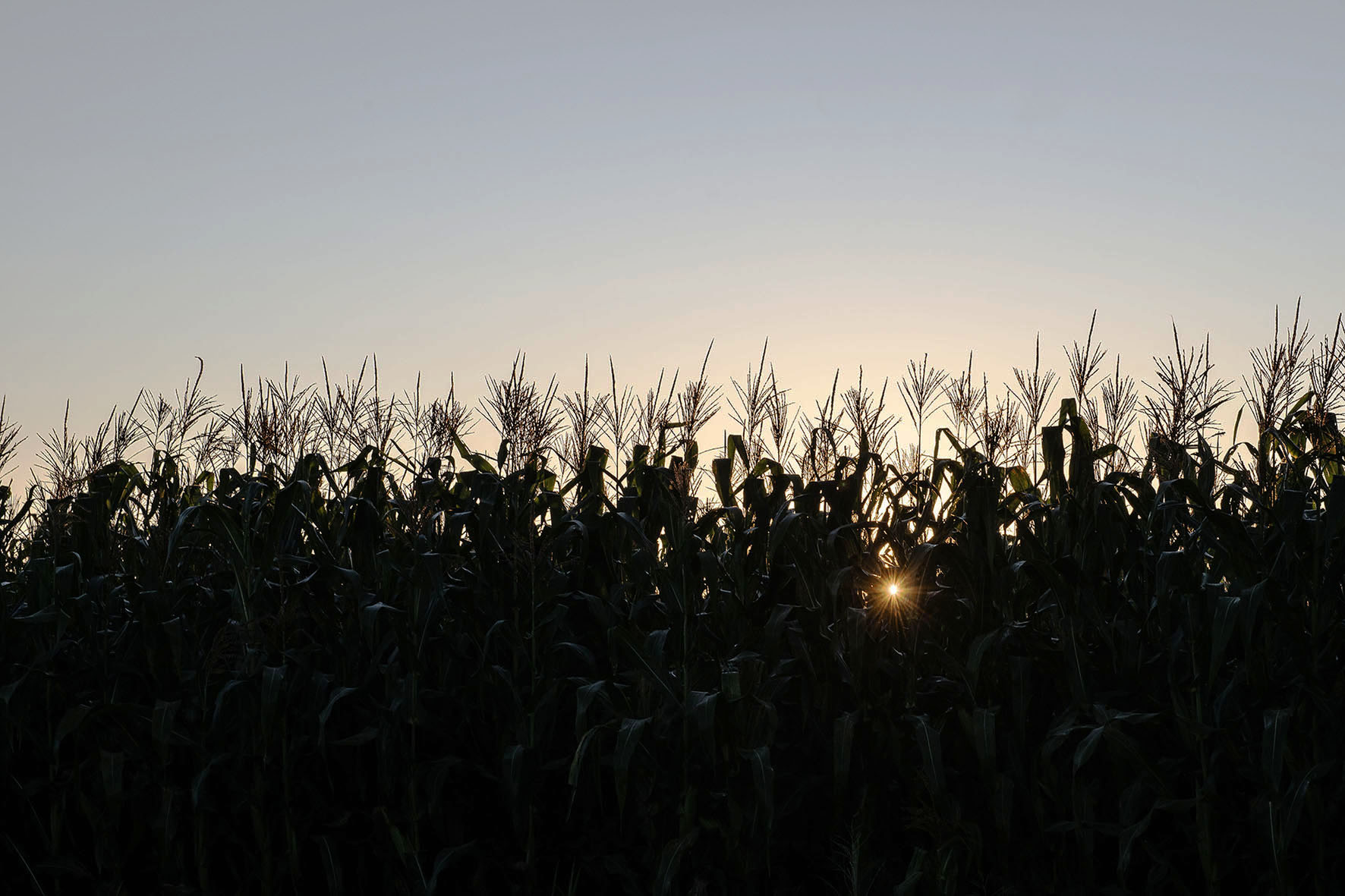
The sunrises over a decent crop of maize on ART farm. Not exceptional rains but enough.

It’s been a strange rainy season here in Zimbabwe. Our rains arrived pretty much on schedule in the middle of November but that’s about all that has been normal about them. The usually dry southern and south-western parts of the country have been inundated. The Bubye river, normally notable for it’s sand content has flooded. Lake Mutirikwe has actually spilled and the largest internal lake in the country (discounting Lake Kariba which is shared on the border with Zambia) VERY rarely spills. The Barotse Floodplain in western Zambia has lived up to its name and flooded and a Zambian-based colleague confirmed that most of that country has had good rains. That’s just as well, as it’s a major source of water for Lake Kariba which has been below generating capacity and has only been letting water downstream as part of an agreement with Mozambique on which Lake Cahora Bassa is situated.

The agricultural town of Chipinge is located in the south east of the country near the Mozambique border. Being on top of the escarpment on the edge of the Mozabique coastal plain, it gets a lot of rain. The climate is mild and the area is known for it’s avocado, banana, macadamia, coffee and other sub-tropical fruit farms. It’s also the home of the biggest tree in Zimbabwe, a red mahogany (Khaya anthotheca).

I was chatting to a potential customer from the area last week. Of course we discussed the rain. Up until December last year his farm had only received 200mm of rain. “Then it rained for three weeks solidly. Look, I’m not complaining but it was a bit intense. Now we’ve had 1,600mm!”

The rains here in Harare started pretty much as usual in mid-November but took a while to get going. The farmer on ART Farm where we walk the dogs in the morning took a chance by planting the commercial maize early but then had to keep it going with supplemental irrigation and even had to replant some lands when the irrigation couldn’t move fast enough. Elsewhere farmers were more lucky.

A decent crop of commercial maize. It’s seldom profitable and grown largely for political purposes – “Look, I’m doing my bit for the country”

The rains have been regular enough to encourage fungi growth. Mushrooms have been regularly cropping up in our garden. Were they edible? I am not at all sure. As one wag put it; “All mushrooms are edible, but some only once”. I do have a book but am not at all an expert in identifying them and I wouldn’t trust Google Lens quite that far.

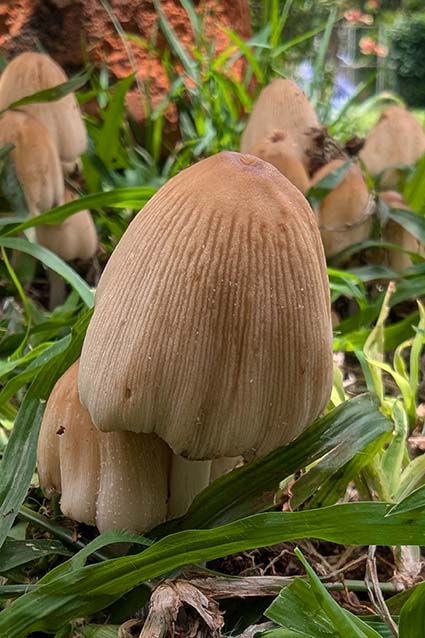
Probably not Chlorophyllum molybdites as it doesn’t have a green tinge. Bottom right is Agaricus bisporus, the common domestic mushroom, but it’s rather old.
Small and short-lived, these (unidentified fungi) regularly cropped up in the same place in the garden after a decent shower. By the next day they were gone .

Weather apps abound but they are notoriously inaccurate, at least in this part of the world. Marianne belongs to a WhatsApp group that shares rainfall information and the variations in rainfall just a few kilometers apart were often stark. Whilst it’s tempting to attribute this to inaccurate rain gauges and exaggeration tendencies, it cannot account for differences in excess of 100%. We’ve had 648mm to date, in a “normal” season we’d expect at least 750mm, whilst guests this afternoon said they’d had over 1000mm some 30km away to the east. Bill, the owner of the rain gauge that recorded this, did admit on being a bit skeptical as to its accuracy.
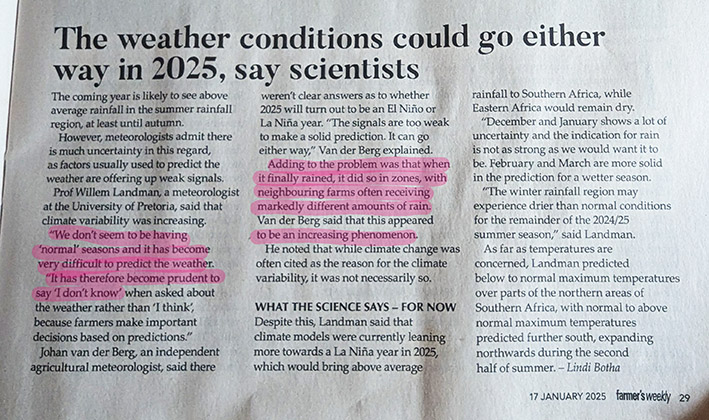
A January issue of the South African Farmer’s Weekly magazine echoes the inconsistency of rainfall over small distances and the increased difficulty in making accurate forecasts

I am not sure if the weather apps are more reliable elsewhere in the world but it wasn’t unusual to get a high probability forecast of rain to be greeted with a clear sky when it was forecasted to be raining. It did on occasion go the other way – heavy rain when the forecast was for clear skies.

The grassland flowers have been spectacular this year. Admittedly the cosmos are usually spectacular so maybe it’s just my perspective. Every year I try to capture the intensity of the displays and inevitably am disappointed. Will give it another go next year!
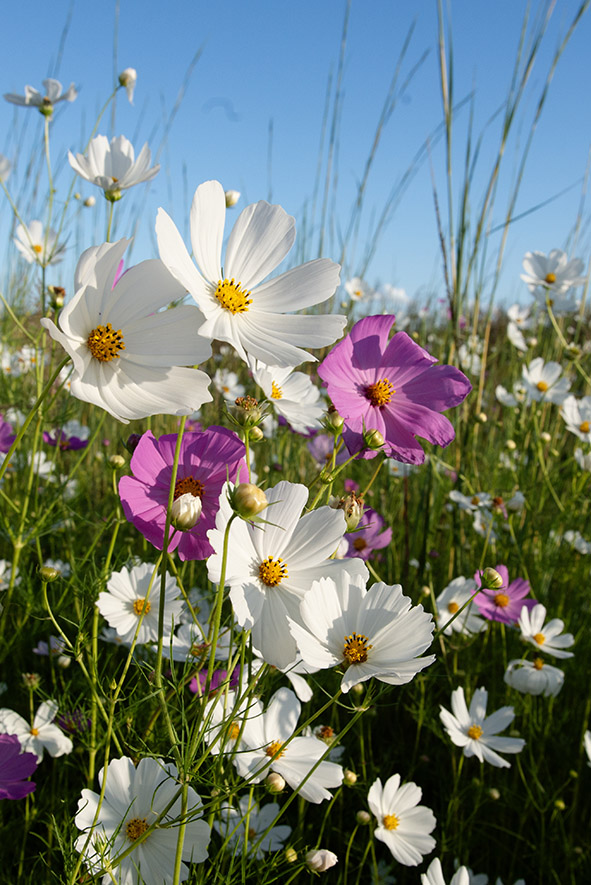
Cosmos bipinnatus – possibly introduced in horse feed from Argentina around the time of the Anglo-Boer war in South Africa.

The yellow hibiscus below is indigenous to Africa, Yemen and India (and some sources say Australia) which makes me wonder if it goes all the way back to Gondwana, the super continent that began to break up some 180 million years ago in the early Jurassic.

Whilst not as intensely showy as the cosmos, the Hibiscus panduriformis is spectacular in its own way.

There is not a lot of information on the yellow hibiscus but it seems to be mostly nocturnal. The image above was taken at 6.20 a.m. and there is already a dead flower on the stem. From observing flowers by the road on the way to my work I know that by midday all flowers are gone. Apparently it’s relatively easily propagated from seed and cuttings so I might try establishing a few in the “wild” section of our garden.

As we approach the end of March we are unlikely to get much more in the way of significant rain though in April last year there was a 42mm on the 6th. This was unusual as it is normally a month of warm days and cool nights a plenty of sunshine. What most people would call perfect weather. We like a bit of rain with it too.


Hazel

7 02 2024
Hazel

“If you come back this way, please come and stay” were Hazel’s parting words as we got into the pickup. She was clearly lonely.

Hazel has been farming by herself for the last 14 years since her husband died. It’s a dairy farm some five km south of the small farming town of Chipinge in the south-east of Zimbabwe and the warm, wet climate is ideal for growing horticultural crops such as macadamia nuts and avocados. We had driven the six hours from Harare, stopping overnight in Mutare, so that I could take part in an avocado field day on a large horticultural estate organized by my business partner. Once the field day was over, I drove back through the town to where I’d left Marianne at Hazel’s farm where we’d booked in overnight.

Hazel’s garden reflecting the lush climate

After a delicious dinner we poured more wine and got down to serious chatting. Hazel and her husband had moved onto the farm in the mid 1970s, newly married and not much to their name. They braved out the Rhodesian (as Zimbabwe was known then) bush war, surviving a rocket attack on the farmhouse. A rocket burst in the room where Hazel was sheltering and the shrapnel peppered everything around her but left her unscathed. Gradually the house grew with a young family. Hazel’s husband, “Duff”, insisted that his children learn the local Ndau language and encouraged his son to explore the local bush with his black friend Johan, who is now Hazel’s senior foreman. “They were given free reign” Hazel said “with the express understanding that whatever they shot they had to eat”.

“Duff never really told me what he did during the war years” Hazel said, “just that they made use of his knowledge of local customs and the language”. Duff had known that they were on a list of targets though, and after independence in 1980 he got a call from the local police station and was informed that they’d arrested someone who had admitted being behind the attack on Duff and Hazel’s house. Duff spoke to the captive and asked him why they were attacked and the reply was just “Hey, it was war, let’s go and have a beer together sometime”.

I asked Hazel if dairy farming was profitable. “No, not really” she replied. The area where she farms does not have a lot of surface water so irrigated pastures are not feasible which requires her to supplement grazing with stock feed which is expensive. The milk she produces goes to a nearby factory as industrial milk. The factory also tests for fat content on which the price is based and she was more than a little suspicious of price manipulation as a result.

Hazel’s farm location

Noticing that Hazel’s farm was close to a safari area and the Mozambique border I asked if she saw much game. “Yes, we are on a migration route” she replied. “Just two weeks ago a local woman was gored by a buffalo. I don’t know if she survived”. Just prior to that two lions were seen, and fearing they’d start preying on local livestock the National Parks authorities decided to have them shot. Hazel asked why they couldn’t be darted and taken back to the Save Conservancy. She was told that unfortunately once they’d learnt a route they’d continue to use it. “It was so sad, they were beautiful young males with just a beginning of a mane” she said.

The next day we left after breakfast. The town of Chipinge has little to recommend it – there are three traffic lights of which only one works and that is mostly ignored, but it did have a fuel station with a brand name we recognized so took the opportunity to fill up with diesel. Then it was onto the winding road on the escarpment that joins up with the road to Chimanimani – a village to the north – and back on the busy road to Harare. We hope Hazel will look us up on her occasional visits to Harare.

The view from the Skyline road junction on the way to Chimanimani


Cruise control and other stories

1 03 2019

Just plain hot

My business is in trouble. Commercial seedlings are no longer a specialized business thanks to the Tobacco Research Board. Some years ago they imported a large, new machine to mold expanded polystyrene into seedling trays. This was mainly for the tobacco industry that had to wean itself off methyl bromide that was traditionally used to sterilize seedbeds for growing tobacco seedlings.

The deadline was 2015 after which methyl bromide could only be used for very specific purposes under the Montreal Protocol. The idea behind the trays was to grow the tobacco seedlings in a medium such as composted pine bark and float the trays on shallow ponds of water with fertilizer mixed in. This is not new technology – I was involved in a project of this nature in 2000 – 2001 in Malawi. It works well and results in a much more even crop than the traditional seedbeds which can also be cleaned of weeds with another volatile chemical, ethylene dibromide or EDB.

Unfortunately most tobacco farmers found the lesser performing traditional seedbeds easier to cope with and the large machine was churning out seedling trays that had only a small market. So the TRB started promoting growing vegetable seedlings in the trays and supplied all the know-how to boot. Now there are numerous small nurseries around Harare and the market has been saturated. The quality is likely poor but the prices are low and that’s all that seems to count around Zimbabwe at the moment.

Grafted avocado seedlings are being sold at a premium in South Africa at the moment and there’s growing interest in Zimbabwe in producing anything for export. Both macadamias and avocados fit the bill and are very profitable so I had the idea last year of growing, grafting, and selling avocado seedlings which I can hopefully sell for real US dollars. Seed was duly sourced and sown and took rather a long time to germinate, likely due to the long and unseasonably cold spring (as low as 11°C in mid October which is just about unheard of). By Valentine’s Day some 2000 seedlings were big enough to graft so I decided to take the trip myself to an estate just south of the small agricultural town of Chipinge in the south-east of the country to collect the graft (scion) wood.

I left on the Saturday just after midday and got onto an unusually quiet road to the eastern city of Mutare, and engaged the cruise control. Since I bought the vehicle just over 2 years ago I have only ever used it for curiosity purposes – Zimbabwe traffic is just too erratic normally but since a fuel increase of 165% the roads have become much quieter. On the entire 2¾ hour trip I probably passed no more than 20 other vehicles. It was positively boring.

The fuel price increase was followed by street violence and protests, the army shot and beat people at random, the world tut-tutted, called for restraint and after a few weeks calm returned as the government knew it would. Now about a month later fuel is still short, the government has finally admitted that the local currency is not equal to a US dollar and has pegged it at 2.5 to the US dollar. It still cannot be bought in the banks and the street rate is 4:1.

Monday morning and the road to Chipinge from Mutare where I’d been staying with Gary and June was also very quiet. Gary told me it was largely due to the appalling state of the road further south and the weight restriction on Birchenough Bridge over the Save River. Once again it was cruise control time.

I haven’t been to Chipinge for perhaps 20 years so I was keen to see how much I remembered. The region is fertile, frost free and normally quite wet. Horticulture was certainly in evidence with large plantations of macadamias, avocados and bananas in evidence. It was all very dry and by the time I got to the estate just south of the town (though maybe it was small enough for village status) the drought was very evident.

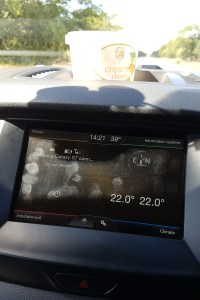
By the time I’d got the cuttings packed in the cooler boxes it was after midday and hot. I drove back into the Save Valley and watched the temperature gauge climb. A few times it peaked at 40°C but not for long enough to get a photo.

I remember the heat of the Save Valley well from my days in the Rhodesian army in the bush war in the late 1970s. Patrols became centred around when one could take another drink and how long the water in the bottles would last. For a while we were based at a small irrigation scheme at a place called Nyanyadzi. There’s nothing to mark the spot now – it was only ever a temporary camp but on the other side of the road some 2km distant is a small group of hills that I remember vividly for the second most unpleasant event of my military stint (the most unpleasant was getting shot). I stopped, opened the driver’s window to the oven-like heat and took a photo.

There’s a story in those hills

We walked out one evening under the cover of darkness, two “sticks” of four troops, lightly armed with rifles and two machine guns and climbed onto the hill in the right of the picture. We passed the day quietly and then again, after supper of tinned rations, moved out when it was dark. Our stick descended into the valley behind where the other stick set up an ambush on a path and we climbed the hill behind to set up an observation post (O.P. in military terminology) overlooking an inhabited area. We each found somewhere we could sleep, unpacked our sleeping bags and sat around talking quietly.  Fireflies started to appear and after a short while there the most anyone had seen.

Suddenly there was a muffled “kerchooonk” explosion.

“What’s that?” I hissed to the dark shapes around me.

“That’s a mortar!” replied Dos who’d been a soldier in the Mozambican army and knew exactly what a mortar sounded like from his service in the civil war there.

“Take cover” hissed corporal Nico rather unnecessarily.

There was no cover to take – the surface was hard and stony but still we tried, scraping away the best we could, hearts pounding and counting the 20 seconds or so before the mortar bomb exploded. Mortar bombs are bad news on hard surfaces  where a half sphere of shrapnel is created (they are not very effective on soft surfaces where the explosion is directed upward) and very bad news if they hit a tree branch. A sphere of shrapnel is created and is particularly lethal. We were in dense woodland.

The mortar bomb exploded in the vicinity of where we’d spent the day. Another came out the tube, and another. We counted the seconds after each launch and flattened ourselves into the ground as best we could, desperately hoping that the bombs would fall elsewhere. Finally after it became evident that we were no longer on the top of that hill the enemy put down searching fire to draw a response from us. At one point there was a huge explosion as a recoil-less rifle was fired and then a prolonged burst of machine gun fire. Then all was quiet. Some half an hour later we heard voices as the enemy walked along a path not far from where we lay. The next day, obviously compromised, we scoured the bush for souvenirs of the attack (on top of the hill to the left in the photo) and then walked back to base. It seemed likely that the guerillas had assembled their heavy weaponry to attack our base but then chanced on an easier target – us.

I rolled up the window, put the air-conditioning on high and continued back to Mutare. To this day I can never watch a firefly without remembering that terrifying hour on a nondescript cluster of hills in the Save Valley.

Note: It is standard practice in counter insurgency (COIN) warfare never to sleep near where you’ve had your last meal for just the reason described in the story above – you may have been spotted. You always move out after last light and settle elsewhere, often in a place which you may have seen earlier which can be in an ambush position on your own trail in case you are being followed.