Smoke. Everywhere smoke from incessant bush fires started to clear lands or smoke out bees or just plain carelessness. Every year Zimbabwe burns as does the rest of southern Africa – 760,000 sq. km in 2023.
Glowing ember sunsets and reluctant red sunrises. The latter so dull that one can, with binoculars, safely see the sunspots. Lots of photo opportunities to be had.
Dust. Everywhere dust. A patina of dust on my desk every morning. The dashboard of my truck covered in dust. Motes of dust in my home office – drifting lazily down in an afternoon sunbeam.
Wind. September is the month of wind. Driving leaves, bending trees and driving the dust. Leaves and ash swirling on the garage floor. When I sailed we always used to look forward to September for the excitement of the gusty weather. In my paragliding days we’d think of other things to do though the calmer days gave good thermic conditions.
Colours. The blazing colours of the new growth on the musasa (Brachystegia speciformis) trees. If one is lucky and catches a day of relatively little smoke it is possible to photo the spectacle. I never have. One has to drive up to the Eastern Districts to get the best displays.
Our Dendrobium orchid has been particularly impressive this year.
Cool nights and warm days. Yesterday morning on ART farm it was 5°C at 6 o’clock and 29°C by midday. My fleece jacket has been washed and hung up in the cupboard until April. I am still sleeping in the bed but October will just be hot and I’ll sleep on top.
New growth. Our roses are a blaze of colour (admittedly we have been getting professional help). Everything is growing fast in the nursery. A customer for whom we are growing cherry peppers commented that he’d never seen such good seedlings. I’ll take the credit…
Our roses are looking good this spring. Marianne has commented that we need a few more yellow ones.
Bees. It’s bee swarming season. A swarm has been in one of the catch boxes hanging under the eves of the second garage for a few weeks now. It will be collected by the Mike the bee man (he runs a commercial pollination service) and we’ll be given another jar of honey that we don’t eat. In the meantime they’ll forage in the garden and elsewhere before being taken off to work. We don’t mind being a bit of a bee holiday camp.
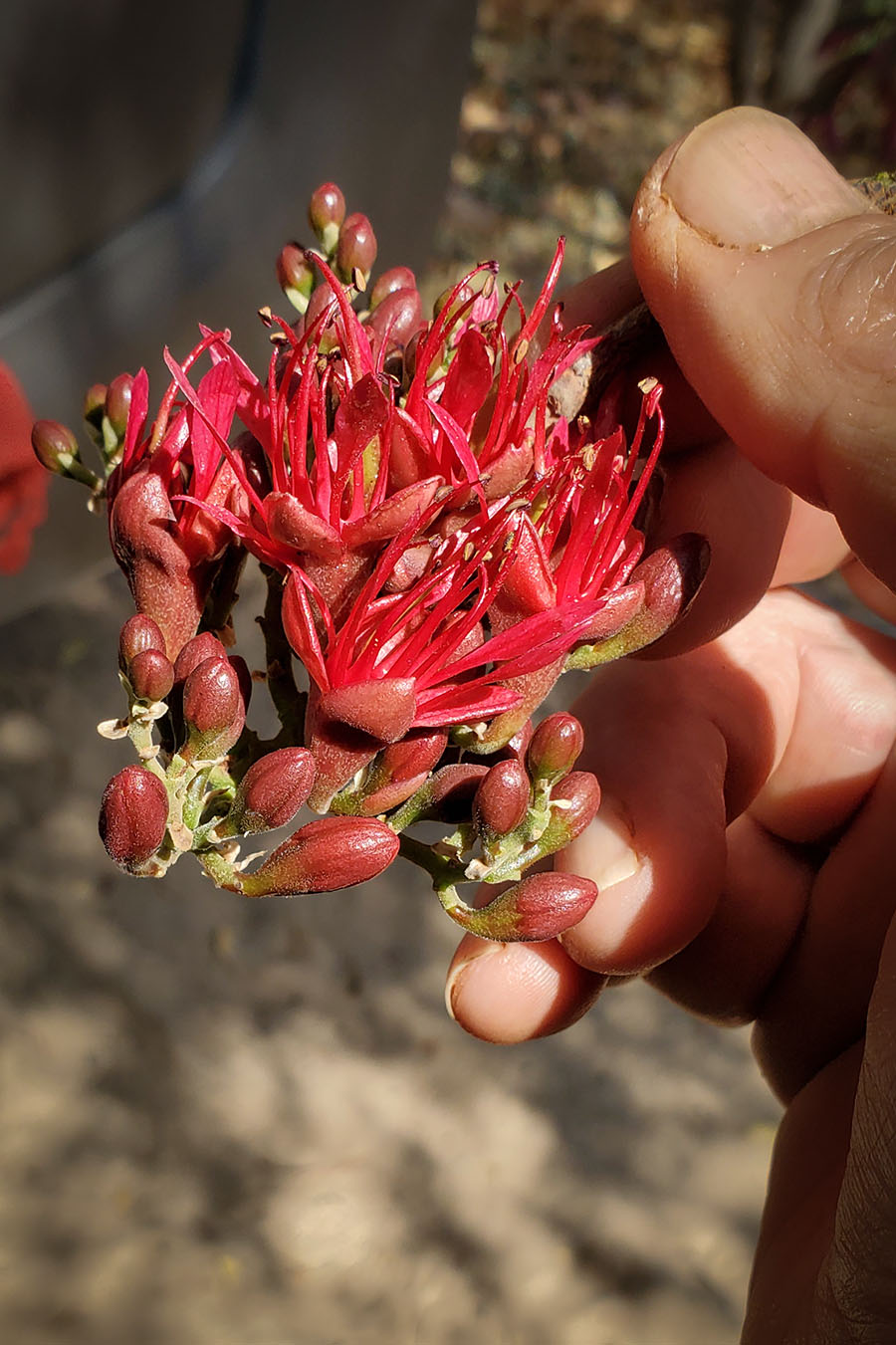
The Erythrina lysistemon (coral tree) trees has showy flowers too. This one was dripping nectar – literally!
Dry. Of course it’s dry and it will be desperately dry by the time the rains arrive in November. Our lawn is crisp. The flowers and vegetables get water but there isn’t enough for the lawn so it just has to wait. It will green-up soon enough when the rains start. It will get a little fertilizer help too and then it will need mowing weekly.
Normally I find going out to Mazowe to get import permits a bit of a chore but not this time. I guess I was just too pleased to get out of Harare and it’s farcical Covid lock-down. I took my time on the 20 minute drive to watch the countryside go by.
It’s desperately dry at this time of year despite being spring. The musasa tree (Brachystegia speciformis) colours were finished, they are spectacular for just a few weeks, and there was little evidence of the fire devastation normally found across the sub-region at this time of year. The image shown below indicates that other countries are ablaze as usual (that’s Zimbabwe in the middle of the image).
Sizeable fires in the sub-region (CSIR AFIS website)
The image comes off the AFIS website and is worth a look as it covers most of the world and offers fire prediction services.
The Plant Protection Research Institute in the Mazowe valley was quiet and had all the usual Covid screening processes in place. The trees in the car-park were in full bloom and were in a frenzy of bird activity.
A member of staff helpfully identified the tree as a member of the Schotia genus (I found out later it was brachypetala species) which is indigenous so I stopped to have a look at the birds. There were at least 3 species of sunbird (nectar feeders) including the scarlet chested sunbird, the amethyst sunbird and the miombo double-collared sunbird and several other species I couldn’t identify. They were having a great old time with not a small bit of squabbling. The flowers were thick with bees and other nectar feeding insects too – not surprising as very little else around was in flower.
Having handed in my application for cotton seed importation from Israel (for a colleague who has business interests in the crop) I set about collecting a few seeds scattered around on the pavement. The gate guard soon came over to see what I was doing and offered to help. Curiously, the trees were in full bloom and producing seed from the previous season at the same time. The seeds have a fleshy aril (not shown) which is attractive to birds and the flowers are also eaten by monkeys. We live in a garden that has space for a few more trees so hopefully I’ll be around to see the tree seed grow out and form attractive flowering trees – apparently they grow quite quickly.
Schotia brachypetala trees in bloom
The gate guard waved a cheery goodbye with her covid mask around her chin. The indifferent police at the roadblock on the edge of Harare were similarly nonchalant – masks in various states of misalignment – along with most Zimbabweans who have shown scant regard for social distancing and frequently don’t wear masks at all. As of writing this Covid-19 has brushed us only lightly and has all but disappeared from the local news. As of 7th October there were officially 229 Covid-19 deaths. Given the disastrous state of the country’s medical health system this is almost certainly a low figure.
Earlier this week I drove past St Anne’s Hospital which was converted at not inconsiderable expense to a Covid-19 specialty hospital. There were all of 4 cars in the car park in the doctors only area and none in the visitors’ area. I’ve heard, unreliably, that there have been all of 7 cases that have gone through the hospital.
I covered possible reasons why the covid-19 impact might not be heavy in Where’s the Covid-19? post. Which aspect, if any, of this prediction might be true I’m not prepared to speculate but in the light of the lack of cases even the government has decided to relax travel restrictions.
It’s not officially over but…
Goodness knows the tourist industry needs all the help it can get but for many businesses it will be too late and I suspect only the most adventurous foreign tourists will travel in the absence of a proven vaccine.
The Zimbabwean economy still faces many challenges independent of a virus pandemic. It is almost entirely self-inflicted. The central bank and the Finance Minister are still trying to manipulate the laws of economics (and by extension mathematics) by controlling the exchange rate of the local dollar with the US dollar. Officially it’s around 81 of the local to 1 US$. Few if anyone is actually using that. It’s possible in theory to buy the hard currency on a government-controlled fortnightly auction (the rate is fixed) but actually getting the greenbacks is a challenge. The company my bookkeeper works for successfully bid for a tranche of US dollars but so far nothing has materialised.
It is perfectly legal to trade in US dollars or Zimbabwean dollars. The foreign ones are well circulated to the extent that they wouldn’t be acceptable in a first world country. However I’m occasionally surprised by the appearance of brand new, sequentially numbered notes.
The real stuff and new to boot!
Small denominations are, not surprisingly, difficult to find to the extent that businesses may ask one to pay the smaller amounts in local currency as they don’t have change.
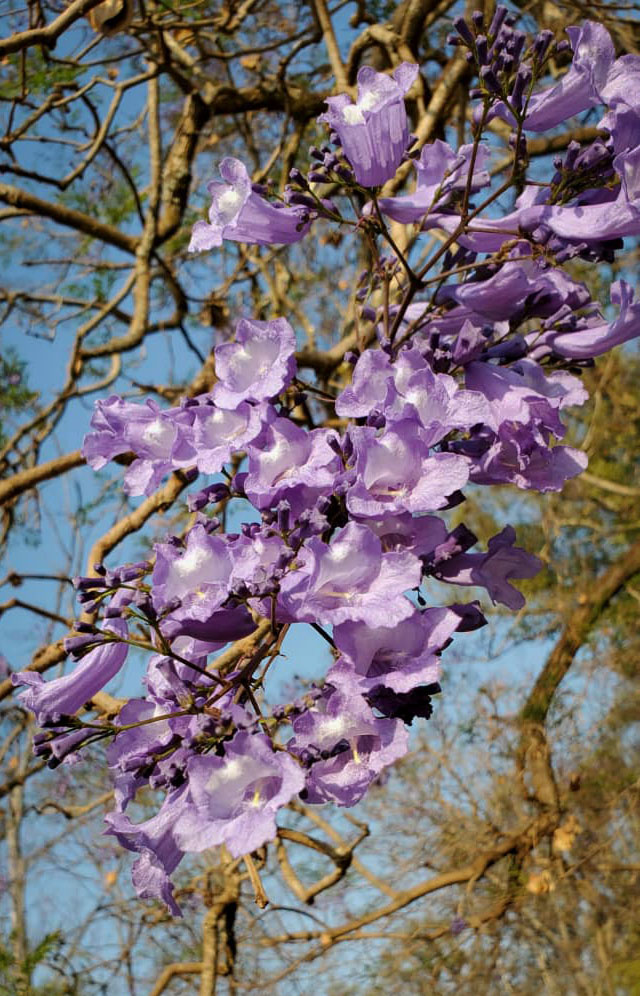
The jacaranda trees that are ubiquitous in Harare are in full flower right now. They are showy, the bees love them and they care not a whit for Zimbabwe’s economy.
Jacaranda mimosifolia in full bloom
While I do have a preference for indigenous trees I don’t mind the jacaranda. It’s useful to the bees producing a mild, pale honey and is fantastic wood to work with if a bit dull. The flowers don’t do well in the rains and the roads become a carpet of mauve flowers that pop under the car wheels.
There’s rain around at the moment. It’s a bit early for the real season which starts mid November (usually) but it’s still welcome even if the early storms tend to be violent often with hail. So far it’s done a fair job of missing us.
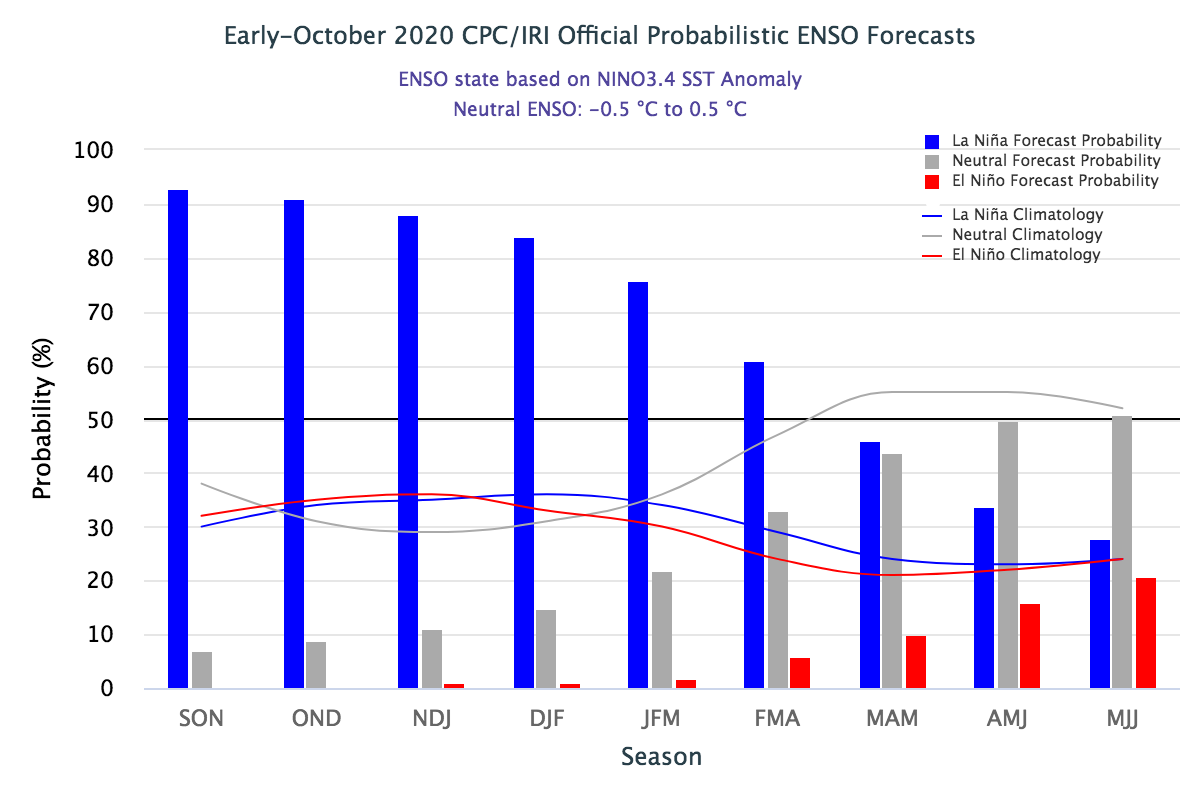
ENSO – el Niño Southern Oscillation (Columbia University)
If the la Niña forecast comes to be, as is indicated above, we stand a good chance of better than average rainfall over the next 5 months. Goodness knows we need it but it’s never as simple as the charts make out. More than a few times over the past 20 years that I’ve had my nursery business it’s been a disappointment. It doesn’t make that much difference to my business – commercial horticulture in this part of the world is dependent on a good irrigation system for success. Still, we’d like to have a good season to replenish our borehole in the garden. The rain gauge is out on its stand already – here’s hoping.
(el Niño conditions are indicated by warm currents off the coast of the Galapagos Islands (eastern equatorial Pacific Ocean) and commonly cause drought in this part of the world. La Niña conditions are the opposite and indicate wetter than usual conditions – see What is el Niño?)
Actually the bees have never left. They have been around almost continuously ever since my first post “Rats, bees & barn owls” some 9 years ago. We have pretty much tolerated each other since then but I had to do something when, a couple of months ago, they attacked the gardener and harassed the dogs and I one afternoon. Mike the bee man was called in and after two attempts the swarm in the chimney was killed. Alas it was not long before another swarm was scouting the chimney, attracted by the smell of the defunct hive. They took refuge in a nearby tree whilst making a decision. I called Mike again and he arrived with his bee handler.
The swarm – medium sized
Swarming bees are not aggressive; they have nothing to protect and that’s important as stinging for them is fatal. The ultimate sacrifice. African bees have a fearsome reputation for defending their hives when they have brood or honey. In extreme cases the whole swarm will go into a stinging frenzy and can kill humans and livestock.
Preparing for action
Somewhere I have a photo of my father as a young man holding a swarm of bees on a branch and not wearing any protective gear at all. Mike’s bee handler was not taking any chances though I noticed he was not as heavily kitted out as he would have been during the day when working with and established hive (I used to keep bees in a small way.
Smoking the bees to calm them
A few puffs of smoke and the bees were bumped into an open cardboard box and brought down to the ground. Mike and I (we were both unprotected) watched from a respectful distance. The bees buzzed a bit in the box and Mike said they would soon calm down when the queen released her pheromones. No point in wasting good workers! They soon did and the box was picked up and they were on their way.
In the box and ready to go
The next day there was a small cluster of bees on the ground nearby so I collected a catchbox (a small hive prepared with attractive prop0lis) and they duly moved in. A few days later there were MORE bees around the chimney and as I was about to go on holiday thought it would be a good idea to get another two catch boxes to try and attract them away. They day before I left the swarm moved into one of the boxes.
For the moment all is peaceful on the bee front and Mike will come and take the swarms away and put them to work in his commercial bee keeping practice. The next swarming season is in August and I will have to be prepared again.
I got in late last night from a successful day’s flying in the Zambezi Valley. 7.5 hours driving 1h40 flying, 1100m height gains but no big distance. That is a successful day for a paraglider pilot, especially one who doesn’t get much opportunity to fly these days.
It’s easy to be a celebrity in the Zambezi Valley (near Muzarabani)
Day’s end – the crowd moves off one by one
Richard and Craig offloaded the wings, commented on the bees in the dining room and left. I didn’t bother investigating further; there are often bees swarming in my chimney, especially at this time of year and they get trapped inside the lounge. No big deal, I’d get the vacuum cleaner out in the morning and suck them up.
This morning I walked into the lounge and discovered a swarm of bees had moved in during the day. There’s not a lot I can do at this stage except leave the windows open and hope they move off to a better location. In the meantime I think I’ll go somewhere else while they make up their mind!








 Zimbabwe Absurdity