Toad in the hole

4 10 2011

Well, it’s actually in the toilet but I guess that qualifies for a hole of sorts. It’s a fairly lean toad which may account for how it got there (NO I DID NOT PUT IT THERE!) – I presume it got down into the drainage system through another drain point which all have grids over them.

I went to use the toilet as one is wont to do and it looked back up at me in a pathetically toadish sort of way. So I flushed the toilet. However toads are quite strong swimmers and goodness knows, maybe there was some sort of toad-terror lurking in the pipes, so it simply bobbed around in the maelstrom kicking frantically. I came to the conclusion that it was probably just going to make it’s way back into the toilet bowl if flushed down so left it.

It was still there later looking toadishly pathetic so it was time to do something. I mean, how in good conscience can one use a toilet with a toad in it? So I flushed it again, twice (who wants to handle anything but a well flushed toad?), and got an aquarium net. Unfortunately it was a bit big for the bowl but the toad didn’t mind. In fact it saw an opportunity and as I scooped it up it wriggled under the rim of the bowl. I flushed again to no effect. I tried to dislodge it with my fingers but it clung on determindly. It was clearly not interested in going back into the bowl.

So there it remains. Or at least I think it’s still there. This morning it was certainly not in the bowl and I haven’t put my fingers back under the rim. How long does it plan on clinging under the rim of the toilet? Will it die there? I am going to have to think of something – outwitting a determined toad is more difficult than I thought!


Meals not included

28 09 2011

J and another 5 senior staff (including the owner) of the company where he works recently spent the weekend in a local suburban jail. I knew the company, which grows and exports fresh vegetables, had been having hassles recently but this was a chance to get it from the horse’s mouth.

A couple of months back the High Court had ruled that the squatters who were on the farm were there illegally and the owner had full rights to access the entire farm. This was apparently on the basis that it was not state land but peri-urban land and would be incorporated into Harare Municipality at some future date. The owner decided to test this and went with a team of assistants to recover some chemicals and equipment that had been appropriated by the squatters. Most of the equipment was successfully retrieved but in the rush some chemicals belonging to the squatters were also picked up. The error was realized but once an inventory was made the squatters decided they didn’t want the chemicals any longer. Someone saw this as a harrassment opportunity and 2 Fridays ago the senior management and owner were told to report to a local police station. They were duly locked up for the weekend.

“So how was the food?” I asked.
“Hey, you have to supply your own!” J replied. “We got people to bring in what we needed and enough to supply the other inmates too so that we were really popular!” he added. “We were allowed into the courtyard (a small fenced area) three times a day, theoretically for an hour but they initially abused that until someone send along a human rights observer and then they relented. I actually think the police were a bit embarrassed as they knew we weren’t supposed to be there but in that situation they are effectively God and do much as they please. It wasn’t too bad I suppose” he said reflectively, “At least there were no bed bugs but it did get over crowded by Sunday so we persuaded the police to open another cell that was reserved for women and take some of the men out of our cell” he continued. “It wasn’t unpleasantly hot or cold which was lucky but on Saturday a nutter came in. We didn’t realize just how mad he was until he started helping himself to the contents of the toilet which was not flushable from inside. But we soon persuaded the police to get him out”.

The following Monday at the bail hearing the lawyer for J and his colleagues commented to the magistrate that he thought the behaviour of the police in restricting the exercise time was despicable. The magistrate then asked the lawyer for the state if she would like to comment.
“Yes” she said. “I think the police should be commended on their restraint in not beating the prisoners”.

The case will got to trial early next month.


Credit crunch

25 09 2011

Friday was pay day at work. On my desk with the usual breakdown of days attended by staff, overtime worked and deductions for loans (interest free!) taken was another for loans for two members of the work force requesting $200 each to be paid back over 3 months. I have stipulated that all loans WILL be paid back over a maximum of 3 months (nobody has ever taken less than 3 months). Not that remarkable but I still asked the foreman if those requesting the loans understood that they would be paying approximately half of their gross wage back each month. Apparently they did. Quite how they will live on the balance is beyond me but there is only so far I will go in taking responsibility for managing my labour force’s money. I just remarked to myself how thankful I was that credit cards are not easily available in Zimbabwe.


What price education?

25 08 2011

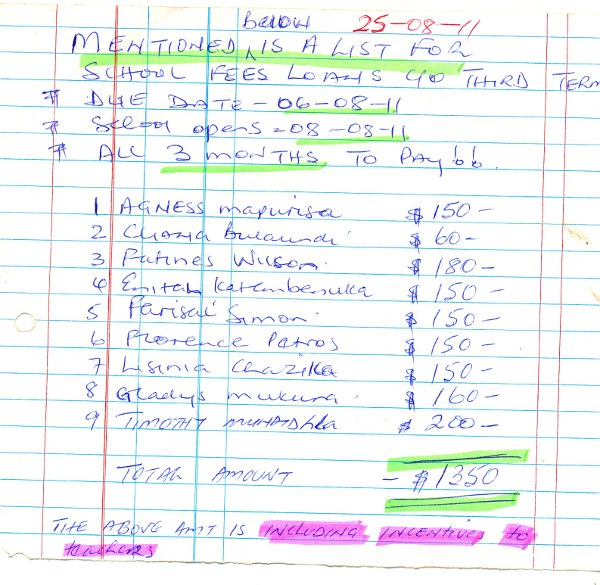
At the beginning of every school term, and there are three, I get a request for loans from my labour to pay school fees (see the picture). They get a good deal; I don’t charge interest and they get three months to pay the loan back. I do reserve the right to cap the loans to what I think is a sensible figure and this term I will cap it at $150 so they do get SOME money in the pocket. I also take the money off at source, i.e. the get the wage less the loan amount each month.This application is especially notable for the last line that I have highlighted in pink (other highlighting was done by the senior foreman). It seems that the teachers, eager to augment their admittedly meagre salaries, have hit on an “incentive” scheme to ensure that the children actually are taught something i.e. the teachers do come to class and do teach! How it is enforced I am not sure but I am sure this added income will not appear on an income tax return anywhere. It seems this last line was added to the loan application to sway my sympathies and grant the amounts asked for. As I told the foreman, I don’t care what they use the loan for and I am not going to check, so no, I was unmoved.

When Zimbabwe first got independence education and healthcare were free. It did not last – Zimbabwe was simply not in the financial situation to carry those sort of burdens. Now not only does education have to be paid for so do the teachers! The government COULD afford to pay teachers and other civil servants better – they just need to funnel income e.g. from diamonds, to the correct people. Will this be remembered when the population comes to vote as seems likely next year? Not likely.

Loan requests for the 3rd term


The Grassy Knoll and other stories

18 08 2011

Zimbabwe is fertile ground for conspiracy theorists.

Earlier this week Solomon Majuru, a former commander of the Zimbabwe Army and Robert Mugabe’s commander-in-chief from the war years died in unusual circumstances. He was apparently burnt to death in a house fire at his farm near Beatrice south of Harare. Not unusual you might say. However, his wife is one of the vice-presidents (there are two, just to be sure) and he didn’t have much of a security detail and those who were with him at the time only noticed too late and couldn’t get near the fire because it was so hot. His body was burned “beyond recognition”. It was also common knowledge that he was not in good health. So, where was his nurse?  Why was the security detail, such as it was, not close by? Those on the street wonder if he was even alive when the fire started.

Some years ago, when I had a TV, I was watching the list of heroes scrolling down the screen on Heroes’ Day. This is a public holiday to honour those who fell in the war for independence against the Rhodesian forces. It is not a bad thing to be a National Hero – for your family that is. There are substantial financial benefits to be had in the form of juicy pensions. That aside, it was striking how many heroes had died in car accidents (in those days they listed the causes). It is well known of course just how bad Zimbabwe drivers are – one only has to venture onto the local roads to find that out. Indeed, Morgan Tsvangirai, our Prime Minister in the bizarrely acronymed GNU (Government of National Unity) found out to his cost just how bad the truck drivers can be. In a convoy of several vehicles one managed to hit his car (not the first in the convoy) while travelling in the opposite direction. His wife died in the accident. At the time it was widely believed that it was not an accident but it was never proven thus.

Then some years ago, Moven Mahachi, the then Minister of Defence was killed in a vehicle accident near Nyanga village. Now I saw the result of this accident some 30 minutes after it happened (I had no idea whose vehicle it was and it was a Landrover Discovery not a Range Rover as in Wikipedia) and I don’t think it could have been anything else. But, he died and the other 5 occupants walked away. And  he’d been critical of Those On High in a country not known for tolerating criticism. A one Border Gezi also died in a car accident shortly prior to this incident. A Party significant, he had a back tyre blow out and I know from experience how dangerous that is. I just slowed carefully down but Border Gezi was known for driving fast.

Our president, the Honorable Comrade Robert Mugabe, is old. In the press he is said to be 87 at least, though there are those who claim he is much younger and his advanced age is fudged a little to garner a bit of respect. Not surprisingly there is a power struggle in the ruling ZANU-PF party to find a successor to Robert. One of them was Solomon Mujuru, the other, Emmerson Mnangagwa – another Party heavyweight. In fact I’ve heard it said that NO-ONE got anything done at a high level without Mujuru’s approval – he was that powerful. Maybe a bit too powerful. He’d also been critical of the Highest – not wise in a country intolerant of criticism.

What IS clear is that the political landscape has suddenly changed – radically. Who will step up to fill the vacuum? Meanwhile flags are at half-mast as is befitting a true National Hero of the Liberation War (or second chimurenga as it is known locally). No doubt tears will be shed, both crocodillian and genuine and the guessing game will continue, because if there really were other shots fired from the Grassy Knoll at JFK then just about anything is possible. Isn’t it?


Red taped and bound

18 08 2011

The calendar on the door is given out by the Zimbabwe Government.  I am vaguely surprised for a moment that they are splurging on calendars, then the surprise passes. The government is not known for its fiscal common sense. It is not an inspiring calendar, the logo is a large diamond whose irony is not lost on me given the plundering of the diamond fields at Marange in the east of the country. Inside the diamond are two scenes; one of a tobacco floor sale somewhere, the other of some sort of nondescript industrial production line. The diamond, at least that’s what it looks like, has far too many facets. The Zimbabwe Coat of Arms is below the diamond. It has a few similarities to the old Rhodesian one; the sable antelopes have been replaced by kudu. The red socialist star behind the Zimbabwe bird is even more ironic than the diamond. Zimbabwe dabbled with socialism in the 1980s and then discovered that it was an expensive proposition and then decided to charge for education and healthcare. The government sponsored press still refers to various dignitaries in the ruling ZANU-PF party as “Comrade” so-and-so (shortened to “Cde”) but none of the other papers do. Behind the shield is a badza (hoe) and an AK47. I am only aware of one other country that honours this ubiquitous weapon in this way and Mozambique is seriously contemplating removing it from it’s coat of arms. I move my attention back to the woman behind the desk. She is as cross-eyed as anyone I have ever seen. In fact she is spectacularly cross-eyed. I didn’t think it was possible to have TWO cross-eyes but that is the distinct impression I get. She is holding up a cell phone in front of her but neither eye is focussed on it. Another woman wanders in and plugs a laptop into the laser printer and prints off some documents. A tinny radio is playing repetitive local music. Maybe it’s a CD on the computer. Eventually Dr M comes out of his office. He is smartly dressed in a dark suit and has dark rimmed glasses. He looks very businesslike and efficient and out of context with the rest of his office.

“How can I help you?” he asks.
“I need to get authorization from you for a customer of mine who wants to export some tomato seedlings to Botswana” I  reply.
“You will need his import permit to see that we can comply with the phytosanitary requirements”.
“I have done that and Plant Protection at Mazowe say it’s not a problem but I was sent here by Ministry of Agriculture” I say holding up the note of requirements from the Ministry of Agriculture. He glances at the note looking a bit puzzled.
“But this is for seed” he says. “You are exporting seedlings. This should be straightforward. You don’t need anything from me, they are confused over there. I am sorry for your wasted time” and he is off down the corridor on other business.

A customer in Botswana was referred to me by another nursery in Bulawayo that did not have space for his order. I was rather sceptical at first as to why someone in Botswana would want to come to Harare to get seedlings but business is business and I duly verified that we could meet the phytosanitary requirements to export tomato seedlings. Now the seedlings are nearly ready to go and it’s time to get the paperwork in order.

“So what do I need to export seedlings?” I ask the bank official.
He looks a bit puzzled and gives it some thought.
“A CD1?” I prompt him. I am guessing. It’s been some 20 years since I was directly involved in exporting flowers and I don’t even know if that form still exists from then.
“No” he replies “but you will need a CD3”.  “And do you have an OSEP number?”.
I have no idea what that is and say so.

A few days later I am back at the bank without the mysterious OSEP number. This time they are better prepared and after a short wait in the office of the customer relations manager I am presented with a sheaf of papers that need to be filled in. I get back to my pickup and flip through the papers. It is a formidable list. I need amongst other things; police clearance for both directors (including two full sets of finger-prints), proof of residence for both directors, a listing of who owns what shares, a CR14 from the registrar of companies (oops, my other director died last year and I have not renewed the CR14 and appointed another director), tax clearance, certified copies of the directors’ ID documents etc. Nope, it’s definitely time to give someone who knows about this sort of thing a call.

“Hold on please, I’ll pass you over to Charles” the secretary at the freight forwading company that I have used in the past tells me.
I explain what I want to do.
“So how much is the consignment worth?” Charles asks me.
“About 600 dollars” I reply.
“Well, if it’s less than 500 the exporter does not need to fill in a CD1” he says. “All he needs is a commercial invoice. Can you not make it less than 500 dollars?”.
“I suppose I can” I reply,  thank him and hang up. This is certainly much simpler. All I need to do now is get the phytosanitary certificate (certificate of plant good health) and an export permit.

“Ah” says the helpful official at the Ministry of Agriculture where I have arrived to see about getting an export permit. “You need a phytosanitary certificate and a letter of approval from Seed Services at Research and Specialist Services”.
“But they are seedlings, not seed” I explain.
“Yes, but you still need approval” he replies.

A short while later I am Seed Services, not at all sure how much sense I will get out of them at 3 p.m. on a Friday afternoon.
“Hello” I greet the clerk, “how are you doing?”.
“Fine” he replies, “how are you?”.
I reply in the affirmative. I don’t really care how he is and I doubt if he cares how I am but it is customary to greet people in this way in Zimbabwe. Sometimes, just for entertainment, I say something like “awful” just to see if anyone notices. Often they don’t.
“How can I help?” he asks.
I tell him and he passes me forms for seed importation.
“No, I am exporting seedlings” I emphasize and he passes me forms for seed exportation.
“You need to fill them out in triplicate” he tells me. “One set for each variety”.
I look rather blankly at the two forms I have been given.
“Ah, we are short of forms so you need to have those copied” he explains, a little embarrassed.

Back at the pickup I have a closer look at the forms. It is very clear they are for seed exportation, not live plant material. A technician in a white lab coat wanders over to see what I am doing. He is munching on a mielie (corn) cob and has bits of the kernels on his chin. He is eager to help. I explain what I want to do.
“No, no, those are for exporting seed. Go and see Dr M in the next block of offices”. He takes the blank forms from me. “We are short of these” he explains.

There is a woman slouched in a chair at the reception, suckling a bottle of water. “Fill in the book” she says, pushing a register book at me. She goes back to suckling and slurping and watches as I fill it in in my worst possible handwriting. I sign with a scrawl that does not even vaguely resemble my signature. “Down the corridor, turn left to room 21” she waves vaguely.

I walk into Dr M’s office, sit in a chair near the door and contemplate the calendar on the door opposite.

On the way back home I wonder why there is so much confusion over seeds and seedlings. My staff use the same Shona word for both; mbeyu, but everyone I have spoken to this afternoon spoke good English.


Tsetsera revisted – 21 years later!

11 08 2011

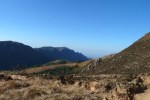
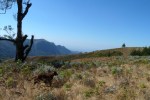
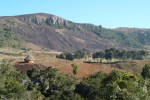
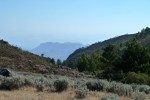
The Tsetsera mountains are between the Burma Valley and Cashel on the eastern border of Zimbabwe. One of two places registered to grow seed potatoes they rise up to 2200m so can be pretty cold in winter. Tuesday, however, was a perfect day to visit them and worth braving the appalling road. A complete abscence of anyone else remotely resembling tourists of course helped!

The valley was essentially unsettled from 1980 to 1992, there having been a Renamo perpetrated massacre of some 40 inhabitants in the the early 80s. Now there appears to be a thriving if small community. The lower reaches of the valley are well watered with gravity fed irrigation and there were some very reasonable wheat crops around. Potatoes are still grown on the top of the mountain but I have difficulty believing that they are viable given the 45km of tortuous road out to the main Mutare road.

I was last in the area in 1990 when I got a lift up with an amateur botanist. In those days there certainly was no-one living on the mountain and I recall the valley being very sparsely populated. There was talk of land mines around so we didn’t wander around too much but it seemed to be fine this time!


The mystery fly

5 08 2011

I am told this is a type of sawfly. It is tiny, about 2.5mm long and it was on the Helichrysum flowers at the front of my house. Other than that I have no idea which sawfly it is!

Sawfly


Perspective

4 08 2011

It’s official; Apple has more cash than the US government. $76.4bn vs $73.7bn. Zimbabwe has a GDP of $7.474bn.

On the way home at lunchtime I passed by a neighbour’s recently combined maize crop. The transporter must have spilt some kernels outside the fence because a man had dropped his bicycle by the road and was gathering up what he could find. I saw a dirty pile of some 3 or 4kg. I guess he didn’t really care that and American tech company has cash worth many times our GDP – his problems were far more immediate.


The New Farmer (TNF)

25 07 2011

“Have you grown cabbages before?” I asked The New Farmer.
“No”, he replied.
“Well, what type of soil will you be growing them on?”.
“Red”, replied TNF.
“Well, that’s good” I replied. “Heavy soils are much easier for hortiuclture”. “Have you taken a soil sample?” I continued hopefully. No he had not and he seemed a bit non-plussed as to what a soil sample actually was.

TNF had come into my office this morning having paid a deposit to for us to grow 35,000 cabbage seedlings for a hectare so I felt obliged to part with information, and who knows, the good word might get around and we certainly need the business right now.

“Tell me about the irrigation” he said as the “Brief Guide to Growing Cabbages” was printing from my computer.
“Right”, I thought, “this one is really clueless”, but I launched into a concise description of an over-head irrigation system. My knowledge of irrigation systems is a bit sketchy but next to his I was a veritable genius. I covered the principle of 100% overlapping patterns and touched on water replacement, emphasizing that cabbages must NEVER be stressed. I looked at TNF’s totally blank face and thought I should steer clear of Class A pans, evapotranspiration and crop factors – none of it rocket science but nevertheless necessary to grow a good crop of just about anything.

I emphasized that the 5 page guide I was giving him was just a very brief introduction and that there were BOOKS out there on the subject. TNF didn’t seem to be deterred and I didn’t want to put him off! My parting advice to him was to split the order into 2 parts 2 weeks apart so that he could get the system going a bit easier but the foreman told me later he wanted to press ahead with the full order as a one-off.

New Farmers are easily spotted in Zimbabwe. They often have town jobs so go out to the farm on the weekend in their de rigeur felt hats and twin cab pickup trucks. The farms are inevitably “acquired” from white commercial farmers and as such they don’t have to be viable straight away – they certainly aren’t paying off the banks for the land. They also seem to think that farming is easy, after all, the white commercial farmers made lots of money didn’t they? That of course is some way from the truth; a very small percentage of the whites did make good money but many did not and plenty went broke too. Nor is farming easy in Zimbabwe. Soils are not good (heavily weathered) by world standards and the climate is fickle so horticulture especially is a non-starter without a good irrigation system. The electricity supply is even more unreliable than the weather so diesel pumps are a necessity which makes the irrigation expensive. Horticulture is demanding anywhere in the world and definitely not a branch of agriculture one would want to “have a go” at. Especially in Zimbabwe!

I recommended to TNF that he go next door to the research farm and have a look at their irrigation system but he did not seem over enthusiastic. Maybe he was not the enthusiastic sort or maybe he thought he could work it out for himself. I doubt he will be back for a second crop.