Shades of déja vu

6 12 2011

It’s been a while since I deposited cheques into my bank account; they have rather fallen into disuse since the demise of the Zimbabwe dollar. Nowadays we deal almost entirely in cash and bank transfers.

“You cannot deposit both those cheques on one day” the teller said.

I took a deep breath, “Why not?”

“Because they would add up to more than $500 dollars” she replied. “And the are both from the same drawer”.

We’d last been to this territory in the Zim dollar days when they were trying to limit the amount people could pay into accounts and thus by devious means change it into real money. This could not be the case here. It WAS real money!

“Oh. Well can’t you just put them through on different days?” I asked.

“Yes, but you will have to make out another deposit slip and anyway, you have missed today’s deadline so the first one can only be entered tomorrow”.

I inwardly surrended to the absurdity of it all; I just did not have the energy to argue which would have been futile anyway. I filled in the extra form, signed off the changes on the original, handed over the two cheques and went to the swimming pool to burn off the irritation.


Back to Blend

29 11 2011

The billboard advertising Zimbabwe’s Green Fuel has been around for some time now but I did not pay it much attention. Then yesterday there was one of their fliers lying by the side of the road where I picked up my weekly milk from Helen. It seems we are revisiting the days of blended petrol.

In the 1980s and early ’90s Zimbabwe was chronically short of fuel so sugar cane derived ethanol was blended into the petrol. There were problems. Stories of plastic fuel hoses not holding up and valves sticking due to the extra dry nature of the fuel abounded. We had to put “Upper Cylinder” lubricant into the tank with every filling. I don’t recall if this had any scientific basis or was a clever marketing tactic but we did it anyway. Then fuel supplies improved and the ethanol was no longer added. Earlier this week I was filling up a container for various power equipment at the nursery and commented to the fuel pump attendant on the “Blend” label still on the petrol pump years after it had stopped becoming available. Unlike South Africa we do not have grades of petrol available at the pumps; high-octane, low octane. It was just a one-size-fits-all scenario but that has now changed.

The person behind the Green Fuel setup is one Billy Rautenbach who, to put it mildly, is controversial. It seems he is not without money and some $600 million has been invested in the venture. Their website is certainly impressive and delves heavily into the soil science of the area with some impressive jargon (I cannot think why they did this) but is curiously short on the “Meet our team” page – it seems there are only 2 people in the team! Interestingly Green Fuel has teamed up with ARDA (Agricultural Rural Development Authority) in the Middle Sabi and Chisambanje lowveld to provide the sugar cane for ethanol conversion. Years ago I had dealings with ARDA at Middle Sabi and was left more than unimpressed. A parastatal company, they were incredibly inefficient and uninterested in the project I was promoting at the time. Mr Rautenbach does not tolerate this sort of inefficiency and is famously difficult to work for at all so I would be interested in how this will turn out.

The blended petrol, containing 10% anhydrous ethanol, is now available at most filling stations and true to the website promise is about 6c cheaper than the non-blended fuel. I don’t have a petrol powered vehicle to test it out and I don’t know anyone who has tested it. Maybe it will live up to the hype. They certainly like to trumpet how much employment it has created which of course is a good thing. I do wonder how much water it will use as sugar cane is a “thirsty” crop. The upstream reservoirs of Lake Mutirikwi (Kyle) and Osborne have been underutilized for some years now but I think this will change that.


It’s in the name

29 11 2011

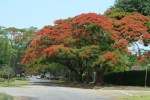
The flamboyant trees this year have been, well, flamboyant! They are not indigenous but I will tolerate that because just about any tree is better than none. No, I have not fiddled the colours!


Beetle fun

29 11 2011

Photos taken on some everlasting flowers (Helichrysum) by my drive. The bee in the first photo was not welcomed by the beetle!


“I am not the one” and other miracles

29 11 2011

I thought that the miracle heyday had passed – about 2,000 years ago. Then yesterday I think one might have occurred in my nursery because I can only credit divine influence on what happened.

On arriving at work yesterday morning the weekend’s duty foreman called my attention to some tomato seedlings that were showing quite alarming symptoms of what he thought was a nutritional deficiency. One look at them made me think otherwise; to me it looked like herbicide damage. The symptoms had appeared over the weekend which was too quick for a nutritional problem and it was highly localized. I walked around a bit and found the symptoms elsewhere including on the weeds although I was assured that they had not been sprayed with a herbicide. I asked Brian who has vast experience what he thought. He suggested heat damage but that did not gel as the timing was wrong for the heat wave we’d experienced some 2 weeks ago, and besides, we’ve had heat waves before and they have not affected the seedlings. I was still suspicious of the herbicide but could not see how anyone could have applied it, even with intent, accurately enough to only affect 8 trays of tomatoes and not the brassicas right next to them. I called on Stewart who is a herbicide expert and happened to be passing by. He agreed to call in.

On arriving back from town Tony met me with a container of clomazone (a herbicide that I was going to use on the sweet potatoes) and told me that it had been used in the nursery last Thursday. I could not believe it. I had never authorized anyone to use it for anything as I wanted to supervise the application. I asked the weekend foreman about it but he came back with the stock “I am not the one” – a reply that anyone who has ever managed anything in Zimbabwe will know well. He could see a crisis coming and was distancing himself as quickly as possible.

Stewart arrived and confirmed that the damage was typical of clomazone. When the other foreman came back from his lunch break he confirmed that he’d authorized the use of the herbicide on the weeds beneath the racks where the seedlings are grown. I asked why. “It said herbicide on the container” was the reply. I pointed out that I had not authorized its use and got the same reply. This was going nowhere. I asked how it could have got onto the tomatoes (and some other seedlings) with such accuracy and was told we’d had a strong wind the afternoon after the weeds were sprayed. I was incredulous. We certainly had a new branch of physics developing here (those pesky neutrinos from CERN taking a detour?) – or a miracle. How could herbicide that had dried on the weeds in the morning have got onto the seedlings in the afternoon? To me it seemed more like criminal negligence or even malicious intent but how to explain the localized effect? Clomazone is what is called a pre-emergent herbicide i.e. it is designed to kill plants as they emerge from the seed. It is not very effective on seedlings that have already emerged and it is not effective on all types of plants. The damage appeared to be restricted to tomatoes and lettuces of a certain age.

I know I will not get to the bottom of this and I have a better chance of bringing a case against the Divine than finding out what actually happened. In the meantime I will have to replace the damaged seedlings. Stewart thought they might recover but I cannot take the chance. The company of course will have to foot the bill.

Clomazone herbicide damage on tomato seedlings


Licence issues

28 11 2011

The police were setting up a road block on the way into town. I was not concerned as they tend to target mini buses and squeeze them for anything they can. I also noticed that ZBC (Zimbabwe Broadcasting Commission) licence inspectors were tagging along and would no doubt see who they could catch for not having a licence for their car radio. I have long since removed my car aerial and the face of the tape/radio player as I refuse to have my intelligence insulted by anyone suggesting that I might want to listen to the state controlled ZBC. Once upon a time there were actually some good radio channels but that was long ago and they are now mostly ZANU-PF (ruling party) mouthpieces. I did notice in the paper earlier this year that there were some commercial radio licences for sale but have no idea if they were bought.

In theory one has to have a licence for any radio or TV receiver. Now that cell phones have radios in them I should think that could also be applied to them which would certainly bring a quantity of cash into the ZBC. I am surprised they have not already thought of this.


It’s not about the dance

27 11 2011

It was all too much for one youngster. He came off the stage and burst into tears just in front of where I was sitting. For 5 minutes or so he’d been the star of the show and had danced his heart out. The crowd had cheered, shouted and clapped but now he was back to reality for another year. He was one of the lucky ones who could actually dance. A lot of the other kids were so badly handicapped that they could not do much more than sit in their wheelchairs and move their heads to the music. But as I said to Gail at the end of the show it was not really about the dance – it was about giving some self esteem.

The Dance Trust of Zimbabwe, of which I am a trustee, runs an outreach programme where a small group of dedicated dance instructors go out to special schools, orphanages and the like and teach dance to the children. On Saturday I attended the annual dance festival put on by the outreach programme. It was not how I would normally have chosen to spend a Saturday morning but I had to admit it was worthwhile to see the excitement and happiness on the children’s faces as they became the centre of attention for a few minutes. Quite what happens to them once they outgrow their protected environment I don’t want to think about.


Bamboo power

24 11 2011

I turned into the entrance and my misgivings rose. The property was not well cared for. There was not a blade of grass anywhere so clearly there was no money for a borehole and the house was in serious need of some repairs and maintenance. The rubbish pit was clearly visible further down the slope and cans and other detritus lay scattered around it. A tall, thin man in his seventies, who introduced himself as Mr G, greeted me and thanked me for coming over. He’d been at the nursery the previous day when I was out and when I phoned back had enquired if we could establish imported tissue cultured bamboo plantlets. I’d been intrigued and besides it was a business opportunity so had agreed to and early morning meeting. As he turned to go into the house I noticed that his trousers were in need of some repairs and maintenance too and I wondered if I would still be having to work at his age.

We made our way into a sparse office and he invited his black colleague to come and join us. They were indeed importing large quantities of a type of timber bamboo that I’d not heard of, primarily for fuel for four proposed 100MW power stations in a joint venture with what I gathered to be a South African company. The bamboo has many uses and is used in Malaysia for house contstruction too. They were also hoping to get tobacco farmers to grow it for burning to cure their crop in place of gum trees (it not surprisingly grows faster) and for live fences and a myriad of other uses. They hurridly emphasized that it was non-invasive. I asked what the plantlets would look like and was passed a folder that they’d put together. The photographs were enlarged to fit the page and so badly pixelated that I couldn’t really see what was going on. Clearly basic photo manipulation was not something they were familiar with and I momentarily thought of offering to do it for them then decided not to; there was a pervading, rather sad air of desperate hopefullness and I didn’t want to deflate it in any way.

When I asked about quantities I was told that initially they would be very small, a few thousand plantlets at most. They thought the power stations that would require some 10,000t per year of bamboo to maintain sustainability would probably do their own plant establishment but they did ask me if I could cope with up to 1 million plantlets. I thought this was probably wishful thinking on their part but did not say so.

At the intersection of Borrowdale road not far from the meeting place there was a newspaper billboard; “1 MILLION FACES STARVATION!” it blared. I thought it ironic that people were prepared to invest large amounts of money in a power generation project but not in producing food in what had to be conflicting land useage. I had been told that there were 4 power stations planned (but not where) and the 40,000ha of bamboo plantation (not just for the power stations) was unlikely to be virgin land. Now 40,000 ha could conceivably produce 200,000 tonnes or more of maize. Obviously making money is more important than feeding the population though I have to admit we are desperately short of power in Zimbabwe.


Remembrance Day

14 11 2011

And old soldier (WW2 era) and a boy scout wait for the service to start

“PARADE WILL RETIRE….   FALL OUT!” shouted the master of ceremonies and the half dozen or so black ex-soldier types standing in front of me reflexively twisted their shoulders to the right. One chuckled, a little embarrassed to be overtaken by the moment and we wandered off for tea.

I was at the Athol Evans Centre (for the aged and infirm) not far from my old Cranborne barracks for the Remembrance Day service to commemorate war dead. It was Tendai who earlier in the week had  suggested it would be interesting to see who was going to attend. He told me last year that General McIntyre had attended and I was quite keen to find out what had happened to his son Hamish, who’d been one of my officers in the RLI (Rhodesian Light Infantry), my old regiment. Us “troopies” did not fraternize with the higher ranks but I fondly remembered Hamish as being a fundamentally decent guy. In the event I did not recognize anyone I knew which I guess was not that surprising as 2 Commando was frequently under strength and the soldiers were either of the professional type who would have moved on after the unit was disbanded or of the type who would not have stayed on in the country after independence. I had chosen not to wear my old beret, mainly because it was too hot to wear a blazer which would have been a requirement. I was also a bit concerned about being identified with my old unit. In the end it would not have mattered – we were there for the ceremony which was attended by representatives of all branches of the military; both very old and current, local and foreign.

Being an atheist I did not care too much for the service though I have to admit I did like the hymns (some religious music IS good!) and was amused to realize that I still knew the words for most of them. The wreath laying ceremony was what moved me despite being a relatively small gathering for a war that had wreaked so much havoc. It was quite well attended by the local diplomats who layed wreaths on behalf of their country. Yes, I think I will be back next year. I don’t know who might attend then and anyway, I think I should lay a wreath on behalf of my old regiment, the RLI. The SAS did and I cannot think why they should continue to be the “glamour” regiment!

Wreaths in the Remembrance Garden at the Athol Evans centre


Powering down

6 11 2011

The power supply in Zimbabwe is erratic at the best of times but during the rains (which is also the storm season) it gets particularly bad. There was a storm some distance away over town yesterday afternoon and the power went off. It came back on for about 5 minutes, went off for half and hour and came back on again at a low voltage. My fridge and deep freeze have low voltage cutouts to protect the motors from such eventualities and are still off as I type this on a battery powered laptop.

Where I live we generally have quite reliable power, probably due to a military baracks on the same grid (can’t annoy them can we?), so I have not bothered with a generator or inverter and battery. My solution to the occasional power outage is decidedly low tech; I have a frozen 20 litre container of water in the deep freeze and perishables from the fridge go in there for as long as necessary.

The nursery is also on the same power grid but I don’t have voltage protection on all the motors so I dashed in this morning at 7 a.m. but all was well so the problem at my house is localized. It is unlikely to be fixed today so I will just have to live with it until tomorrow. Zimbabwe’s power situation is far more long term. I was recently sent an email circulated by the chairman of ZESA, Stuart Maasdorp. It is the first time that I have seen the issues facing the national power generating company clearly laid out. In short we are going to have major disruptions for at least the next 4 years and will just have to make a plan. In the meantime they have put power costs up some 40%. I have yet to see a statement to this effect, this was passed onto me by my landlord. That is not however an excuse not to pay into my account what I think I should be paying. The utility can still cut off the supply even though I have not seen the statement for the last 6 months! To get a clear picture of what I owe I will have to go into the ZESA office in town. Even then it is unlikely to be up to date and the meter is not read very often – they tend to rely on estimates.