Brothers in the sun

10 07 2012

“Do you have a letter?” the tax official at ZIMRA (Zimbabwe Revenue Authority) asked.

“What letter?” I replied.

“There’s a notice on the door” he waved vaguely in the direction of the entrance. “You need a letter from your company authorizing you to collect the ITF263” he continued.

“But I am the director!” I exclaimed.

“Well in that case we need to see your CR14 and your ID”.

I got up more than a little perplexed. I’d been to Kurima House in Harare to get an ITF263 (tax clearance form) and never been asked for company documents (the CR14 lists the names and addresses of a company’s directors) but I’d never won an argument with a tax official so there was not a lot to do except go and get it back at my house. I checked on the door on the way out and there was indeed a notice listing the requirement for a letter for a non-company official to collect the ITF263 but nothing else.

Arriving back at the tax office this afternoon the tax official banged on the office window as a walked past and told me to come directly inside ahead of the queue. Given the length of the queue I didn’t think that was a bad idea. I went to the next free desk and nobody there was interested in my CR14!  Just less than an hour later, with just 5 minutes left on the parking ticket that I’d bought, I was back at my truck with the precious green document and feeling more than a little pleased with myself. All the tax payments had been in order and though I had to visit a few other offices in the interim I was now clear to import raw materials for the next 6 months.

I was waiting for the traffic to move behind me so that I could reverse when the man with albinism appeared at my window. Blacks with albinism are easily spotted in this country of a black majority and while once they were shunned they have become much more accepted in the last 10 years or so. He held up a container of sunblock and said “Can you help me please sir, I need some money to buy some more of this?”

I paused a moment and then reached down into the foot well of the passenger seat and retrieved the ¾ full bottle of factor 30 sunblock that I keep in the pickup and handed to him. Fully expecting him to be disappointed at not getting cash to spend as he liked I was pleasantly taken aback at his obvious delight. I gently remonstrated him for not wearing a hat but he explained that he’d washed it that morning and it was still wet.  I’d once given my cap to an albinistic girl in the Zambezi Valley when paragliding there but unlike her this man did seem to be looking after his skin. The poor girl whom I gave my cap to was pathologically shy and was obviously taking the brunt of the teasing of the other kids.

I thought it a smart move approaching a white man who’d very likely be sympathetic and know what sunblock was. Blacks do of course get sunburnt but nothing like the extent that we whites do in this tropical climate. What the man who’d approached did not know was that I was a soft target on another front – my mother died of malignant melanoma in 1992, a high price for living in the tropics.


A fine weekend

2 07 2012

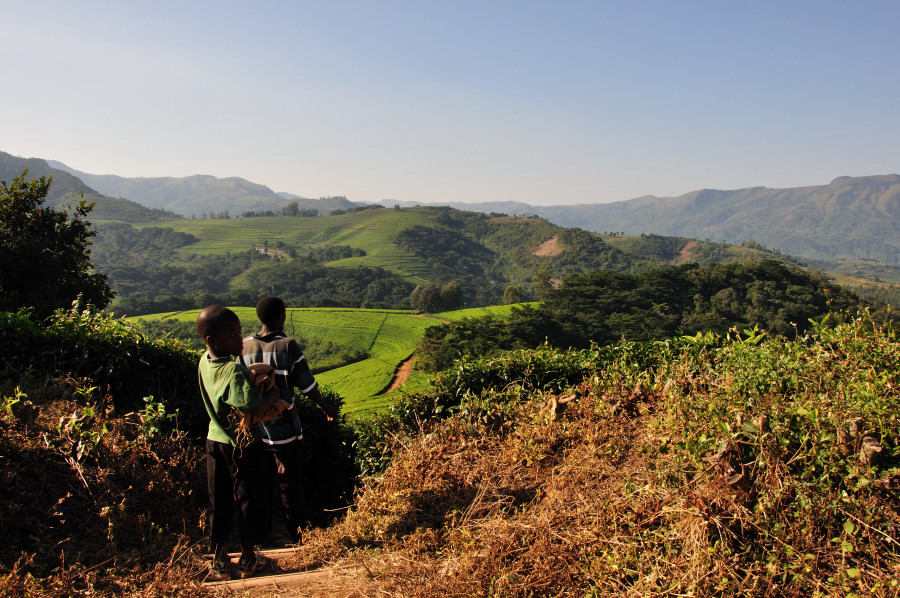
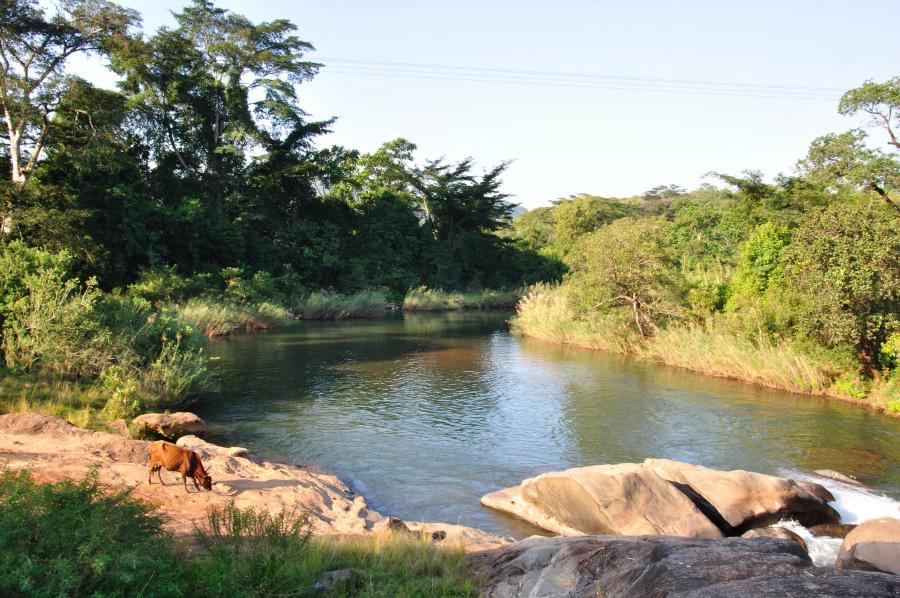
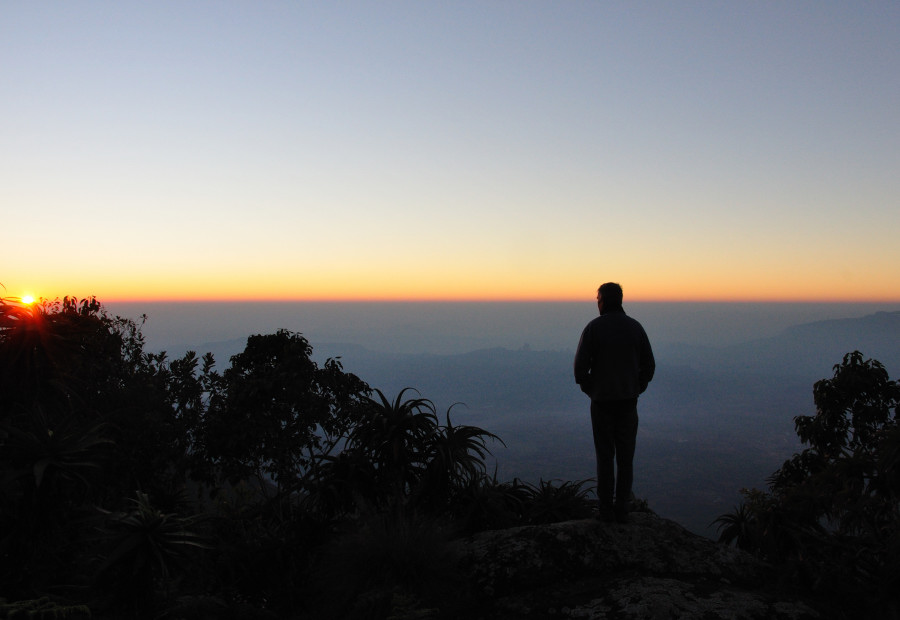
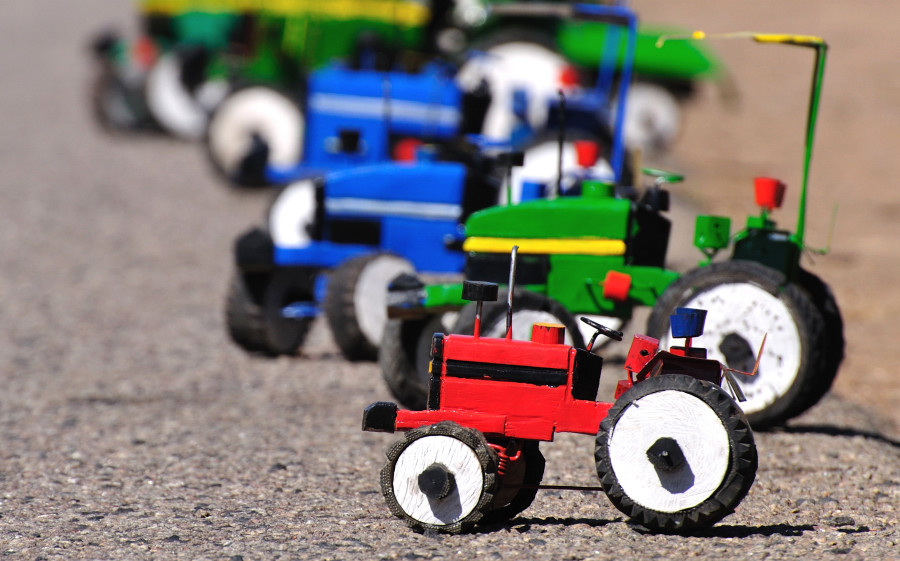
I took the weekend “off” and went to stay with Gary and June and some of their friends at Tsoka re denga on the very edge of the Honde Valley in the Eastern Highlands of Zimbabwe. It’s not a place for small children as they could easily wander over the edge which would be fatal but we are all past that age and had a great time. The weather was warm for winter and we also got in some long overdue paragliding at our Samanga takeoff (not pictured). One the way back from Mutare today I indulged myself in a slower trip and time for some photos. Such are the perks of owning one’s own business!


Where have all the skills gone?

28 06 2012

For 20 minutes I sat and watched an abortive attempt to tow a heavy steel structure across the car park of the engineering works that specialised in welding. They were using a thoroughly inadequate chain which kept breaking and it was getting boring so I decided to go and see what was happening with the coffee pot. I’d bought it at the gym coffee shop towards the end of last year because it seemed easier to use than the espresso pot that was probably older than me and, despite being very expensive, I thought it had to last a long time as it was made of stainless steel. I’d never been over-impressed with the marketing guff on the side of the box; “The Signature Collection is 100% craftsmen made because objects that are made by craftsmen resonate with emotion. Pick one up and you can sense the time and effort invested in its creation“. It felt to me distinctly machine mass-made to me but what the hell, it was a Nick Munro design (whoever he is if indeed he exists) so it had to be good. Then last week the spout began to leak and lo, with minimal effort, it came right off! Some craftsmanship this was but having paid $60 for it I thought it worth getting fixed.

They still hadn’t managed to get the gas lit so with an increasing sense of foreboding I decided to hang around and watch. Eventually things started to happen but it seemed to take an awful long time to merely re-attach a spout. The welder then made off with the pot and my concern turned distinctly nasty when a stub of a file was found and the inside of the pot attacked. I asked for it back, told the foreman I wasn’t paying and made off with the pot and my money nearly and hour after arriving.

It’s well know of course that skilled artisans are in short supply worldwide. Zimbabwe is no exception. In the dark days of the Zimbabwe dollar’s plunge in 2007/8, large numbers of professionals and artisans left for more stable and better paid jobs elsewhere. It was at that time that I had my Land Cruiser engine rebuilt at a machine shop in Harare. All seemed well but after 2000km it self-destructed and I opened the engine to find all 6 liners (hard metal sleeves in the cylinders) broken. I found out later that the original owner had sold up, emigrated to Australia and then sponsored all his best machinists to go over from Zimbabwe and join his new business. As I had done the re-assembly of the engine I was advised that I could not try to pin culpability on the machine shop even though it was obviously their error. Quite how they’d managed a blunder of that magnitude nobody could really tell me.

On a far larger scale the commercial farmers who were kicked off their farms in the land grab in this country took their hard-earned skills to the Middle East, New Zealand, Afghanistan, Iraq, West Africa and even Russia amongst other places. Zimbabwe is not an easy country to farm and we are now paying dearly for these skill losses.

As for my coffee pot I will have to see if the mess can be cleaned up (he even managed to BURN THROUGH THE SPOUT!) enough to make it useable. So it’s back to the old espresso pot (on the right in the photo) which although more fiddly to use does, in my opinion, make better coffee. Who knows, it might really have been put together by real craftsmen all those years ago when they weren’t in such short supply!


About nothing and DIY in the middle of winter

22 06 2012

I haven’t written anything for sometime now. Nothing much has happened though I’ll have a go about writing it. Actually, quite a lot of nothing has been going on in Zimbabwe. I’ve heard of at least 2 Spar supermarkets that have closed their doors recently due to lack of trade. The small sawmill that operates off the same premises as my nursery is also on the verge of closing. They had a run-in with a union some time ago so paid off all their staff and now just employ them on a day-to-day basis as and when they have work. I got them to cut 1200m of battens for the greenhouse that we are recovering with plastic. We are not that busy either so are doing the maintenance that we ignored for so long in the dying days of the Zimbabwe dollar (LONG may it stay that way!). Actually this is traditionally a quiet time for us so I am not that concerned – yet.

I know that in the developed world there are specialist greenhouse covering and maintenance companies but that is not how we do things in Zimbabwe. If there’s a problem on the farm you get on and fix it yourself. ART Farm where I live has a fully fledged workshop that does all the on farm repairs and maintenance and on occasion I do use their skills. The senior mechanic is a pleasant fellow and I have used his help on the Land Cruiser after-hours on a Saturday. Though I have to admit (with head briefly bowed) that I thought replacing the oil seals on the half shafts would best be done professionally in town this week. Then I got the bill and thought that for $580 I should have had a go myself!

Building is not my forté but what the hell I gave it a go this week. OK, I supervised the builder who did the building. It’s nothing much, just a pit toilet known as Blair toilets in this part of the world after the government laboratory that many years ago developed the standard. It’s simplicity itself; a sort of square spiral wall (work it out!) over a squat hole in a concrete slab with a roof and vent pipe. There’s even a plan in the CFU (Commercial Farmers’ Union) handbook. Pretty basic stuff but it still required me to supervise the builder for the best part of the day while he got the plans wrong. It has taken him the last 3 days to do something that a skilled builder would have done in a day. At one stage I began to think that I should have got in a skilled builder and just paid but actually his building is OK for a farm builder and the skilled builder is “not reachable” according to the cell phone service provider. Which is a pity as we have some tobacco ponds to construct and it really does need accurate building skills. A previous builder “had a go” at some ponds a few years back and when I queried about why the walls were not visually level (no spirit level required to see this) he told me that it was not the walls that weren’t level it was the water in the ponds that wasn’t level! Harsh words were exchanged and I refuse to employ him. Maybe I’ll have to give it a go myself. I know that Tony has a dumpy level and I watched the skilled builder doing it just in case I needed the knowledge.

Maybe I’ll just go and employ a builder off the wall I see being built around a property on Harare drive. It’s certainly straight and level enough. And big. It’s at least 3m high and 300m long on just the road side – they have yet to build the other 3 sides but the bricks are there. That’s certainly someone with plenty of money and no taste. It’s been painted a light pink with mauve on the top. Mind you, I saw another like it (though much shorter on the Rolf Valley road) that was painted lavender and had a mirror in the electric gate. The lavender did not last; something much less brash now though the mirror is still there.

I suppose I should also have a go at repairing the coffee plunger pot at my elbow. Stainless steel no less and not cheap the spout is in the process of coming off and there is coffee leaking onto my desk. I could be catty and say it was made in China (which it was) and what does one expect except I do still have the box and it goes on about what a quality coffee plunger thing it is but it does claim to be designed in the UK and the English is genuine. Or I could just get on and have a go at fixing it. I have no idea how to solder stainless steel but I suppose I can find someone who does though I suspect it would be cheaper to buy another coffee pot. Though I did see some “cold solder” in an auto supplies outlet yesterday…


What is wrong in this picture

6 06 2012

The view from my house

This is the view from my house some 4km north of Harare, Zimbabwe. Lucy asked me some time ago if I ever get tired of it. I didn’t hesitate; it was a unequivical “No!” But all is not what it seems.

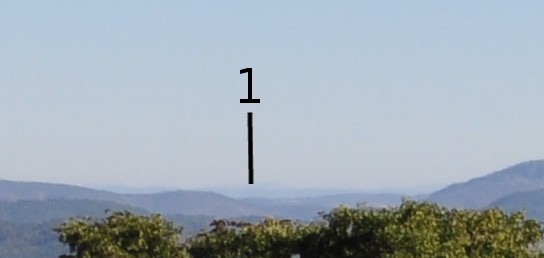
The enlargement at 1 (you will need to click on the main picture to see it clearly) shows the Great Dyke, a geological feature that runs down the centre of Zimbabwe and is the source of major mineral wealth. It is also where we paraglide, or used to in the days when there were more than 5 pilots left in a country larger than the UK! The actual launch site is not quite visible in this photo. What IS remarkable is that this feature is 60km away and reasonably clearly visible. On a clear day it is much more visible than this.I took this photo on the 5th May and as you can see there is a certain amount of smoke around already as we head into our dry winter season. A large proportion of the country WILL burn and the view will disappear (click on this AFIS link for the latest satellite imagery of fires in Southern Africa – it is quite sobering). Of course not only does the view disappear but a substantial amount of the biomass does too and soil fertility plummets. While the world faces iminent food supply issues and much is being discussed on how to solve it, a lot could be done by just implementing good farming practices in this part of the world.

The hillside pictured at 2 is all of 600m away and this too will become nearly invisible at the height of the fire season in October. When I first moved into this house some 7 years ago this hillside was considerably more forested – about as much as one can see at 4. As you can see there are few trees left. The deforestation in this area and elsewhere accelerated considerably with the collapse of the Zimbabwe dollar and the decline of the electricity generating system. At about the same time paraffin (kerosene to the Americans) was subsidised and a lot of poorer people used it for lighting and cooking. That no longer being the case they resort to cutting down trees for fuel. It is illegal but the law is not enforced and of course the wood is free. There are moves afoot by various NGOs and tobacco companies (tobacco takes considerably heating to get cured) to address this deforestation problem but there will be quite a few years before the effect becomes noticeable.

The enlarged area at 4 shows what the bush looked like at 2 when I moved into this house.

It is disappearing very fast.

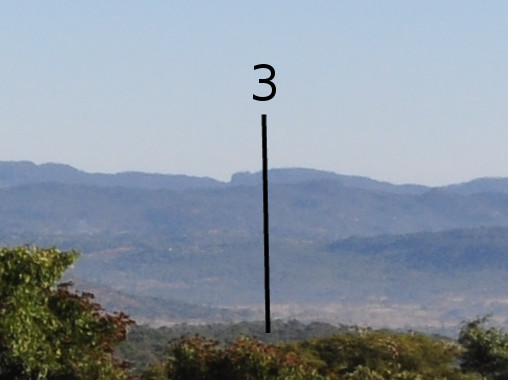
The enlargement at 3 shows what the bush must have been like before the land grab started in 2000 when the area was well maintained. The particular farmer who owned this land had game running on it – it has long all been “removed”. Paradoxically the more remote parts of the country where the commercial farms are now derelict are showing considerable bush regeneration.

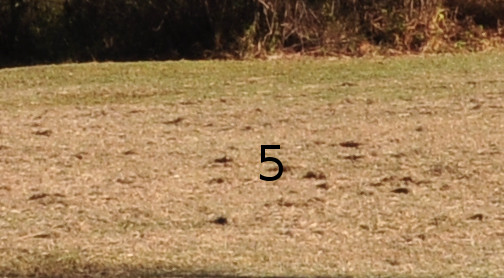
5 is my lawn – or what remains of it. By the time the rains start in mid November (hopefully, nothing is certain in this part of the world, the weather included) there will be just dust and a few very desiccated grass blades. I just don’t have access to enough water to keep it going. Driving through some of the  Harare suburbs you wouldn’t think that there is a water crisis! Sprinklers abound for those who can afford to get boreholes drilled. There is plenty of water in the municipal reservoirs but little of it actually gets into town. It requires pumping you see and of course that requires electricity which is erratic to say the least and is not going to improve any time soon. There’s no money for that because we as a nation just don’t produce much of anything these days. A lot of households rely on water to be delivered which they then store in large plastic tanks.

There has to be some good news visible in this picture and there is; a bird at 6. I have no idea what it is and I didn’t even see it until I downloaded the picture from my camera. Birds still abound in Zimbabwe and chances are if you take a photo of some scenery there will be at least one in the picture!

Yes there are many problems in our everyday lives in Zimbabwe but that goes for just about anywhere else too. At least the currency we use is reasonably stable now. It should be – it is the US dollar! And whenever I get down about the future I sit on the verandah and take in the view and no, I don’t think I ever will get tired of it!


Life can be cruel sometimes – and short

29 05 2012

The blue waxbill fledgling. One eye and no grasping reflex in the claws. Not a bright future…

Friday was Africa Day. One can only wonder what we were supposed to be celebrating, it’s not a holiday in South Africa. Coming back  home at around noon I noticed Kharma interested in something at the gate. It was a blue waxbill fledgling. “Oh well, that’s nature’s way” I thought. But after lunch curiosity got the better of me and I went out and picked it up. It was tiny; the body about the size of the last joint of my thumb. It had only one eye and the legs weren’t working too well either. I can identify with the latter problem and thought I really should give it a chance. Finding food was an issue and at first I tried ground-up sesame seeds off some biscuits but I guess they smelt a bit strong and it wouldn’t eat it.  I made a nest of shredded newspaper in a cardboard box and put a lamp against the box and left it for the night.

Saturday it was still alive so I went into town on the shopping run and stocked up on bird seed which I ground with a pestle and mortar and added a touch of water to make a paste. It still wasn’t interested. This was not looking good. Then at around 4 p.m. it started to take the paste off the end of a matchstick with gusto. This was actually looking hopeful! I put it to bed again but on Sunday morning it was dead. I don’t know what went wrong but it got full burial honours by the rose on Jenni’s grave.


Negotiating the fine

22 05 2012

“You stopped but were over the line” the traffic policeman said having pulled me over.

“What line?”, I retorted knowing full well where the line was. “If there is a line it is very badly marked” which was also true.

“Get out of the car and we will walk back and I will show you” he answered.

“I don’t walk” I said, holding up my walking stick. “But if you get in we can drive back and have a look”.

He pondered this new approach for a moment and then saw the biltong on the seat of the Landcruiser. “Ah, I am going to enjoy some chimkuyu” he commented using the Shona word for the biltong. Biltong for those who don’t live in southern Africa is a spicy dried meat cut into sticks. Gary’s son Stuart had given me some that they’d cured from a wildebees that he’d shot the previous week in the Humani Ranch area of the Save Conservancy in the Save Valley of Zimbabwe. From the policeman’s comments I now knew that the whole “fine” was open to negotiation.

“Have you got change for my $50?” he asked holding up the note. Now I knew I could likely get away with the not stopping behind the white line at the stop street on The Chase and College Road. I scratched through my stash of small notes and found the requisite amount.

“You’d better count it” I said handing it over and taking the proffered $50 note. He counted it slowly and getting to the end said “How much do you want to pay for the fine?”.

“Nothing” I replied. “Your line is very badly marked”. The line marking probably wouldn’t have stood up in court but we both knew that neither of us wanted to take it that far.

“How about some chimkuyu?” he hinted.

I reached over to the bag and extracted the smallest stick I could find.

“But there are three of us” he said, trying another angle.

“Well, cut it up then” I said as he surreptitiously pocketed it. Then he waved me on.


Memory lane

21 05 2012

I grew up on a forest estate in the Eastern Highlands of Rhodesia (now Zimbabwe) and it was an idyllic childhood. I have not seen much reason to go back to the area but this weekend I was in Mutare, a town close by, and with little to do on Saturday as June and Gary were at a wedding I decided a visit was in order.

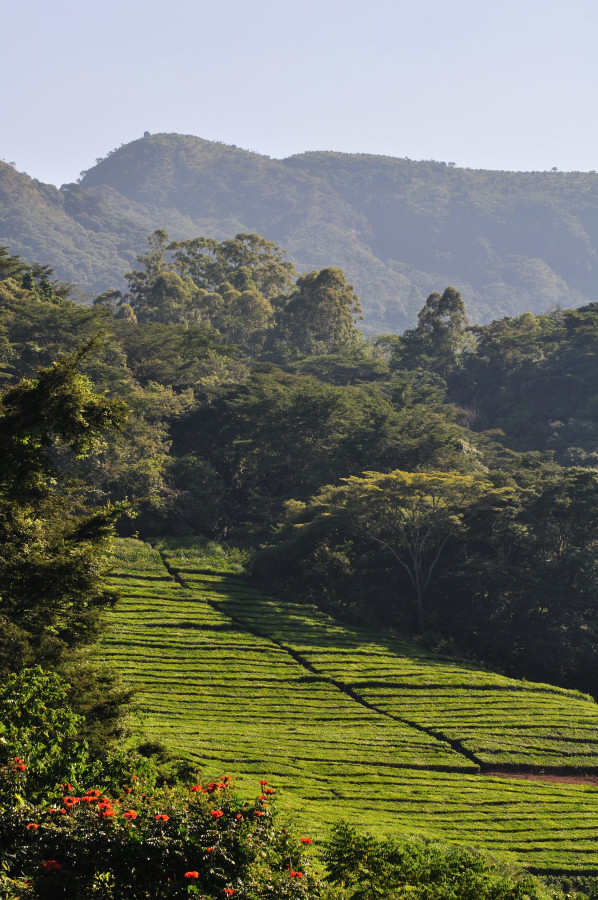
The next day we all piled into the Landcruiser for a visit to the Honde Valley some 45mins north of Mutare and the most densely populated rural area in  Zimbabwe. At the north end, in the shadow of Mt Nyangani, a lot of tea is grown. Our goal was the Aberfoyle Lodge which is now privately run though rather expensive.


A darker side of HIFA

7 05 2012

On Saturday night I left the recital hall at about 19h30 having watched The Armed Man and taken photos. Driving past the main gate to HIFA was chaos; people parked all over the place and a seething crowd. I made an easy decision to just keep going. Turning left onto 2nd Street it was a lot quieter and I stopped at the traffic lights on Herbert Chitepo. There was a small car parked to the left of me. Then there was a load pop and a hissing noise and someone walked fast between us and away to the opposite corner of the intersection. I thought, “You bastard, you’ve slashed my tyre” as the lights changed and I moved off.

The rear back tyre went flat in a matter of metres but I saw a minibus parked at a pickup point some 50m up the street with a number of people milling round and it was quite brightly lit so I pulled in there. I was immediately surrounded by people all telling me I had a puncture! I got out warily after checking that my camera bag was out of sight and expecting the worst but they were being genuinely helpful and some 20 minutes later the spare was on and I gave them $20 (Shelton, my French teacher said a dollar would have done) which was received with much delight and I was out of there.

I found out on Sunday that another of the HIFA photographers was accosted in the same manner except his tyre went down gradually and when he stopped to change the wheel on Josiah Tongagara Ave an unmarked (no licence plate) car pulled up and two men accosted him. He and his wife fought them off with a wheel spanner and fire extinguisher and luckily nothing was lost.

Was this a coincidence? I don’t think so. There are all sorts of people around at HIFA and a fair proportion of those employed to assist with parking are street kids/adults who very likely have unsavoury contacts. It would not take a lot of surveillance to see who was arriving every day with cameras and keep tabs on them. I drive a very distinctive white and maroon Landcruiser at night (it has attitude to keep ‘Benzs from cutting me up) and I have a distinct limping gait too. I have no idea if I was followed from the recital room. I was just lucky that the person who slashed the tyre misjudged the cut and it went down fast. Yesterday I used a different vehicle which is very nondescript.


HIFA 2012 – Day 6

7 05 2012

Well, HIFA has come to an end for another year and yes, it’s a bit sad in a way. I really enjoy the excitement, the activity, the BUZZ of the place! In my opinion it was one of the best HIFAs I have seen. There were some really great acts, some very imaginative ones and one that was truly original; Leo. I only saw one show that was amateurish and that was the hip hop dance; Live Vibe. For sheer virtuosity my award goes to Jazz Tap Ensemble but then it’s difficult to compare with say, Derek Gripper. I did not see much theatre so I cannot make any comments there except to say that what I did see was good though not exactly uplifting!

My last day was pretty relaxed. Ary Morais was another Cape Verdian and by the end of it everyone was clapping along to the infectious beat. Local boy Blessing stole the show a bit on the drums but the music belonged to the band.

Dr. K-Sextet played some decidedly contemporary classical music then ended with a crowd pleasing Ravel’s Bolero that had the audience asking for more but the show had started late due to a previous church service.

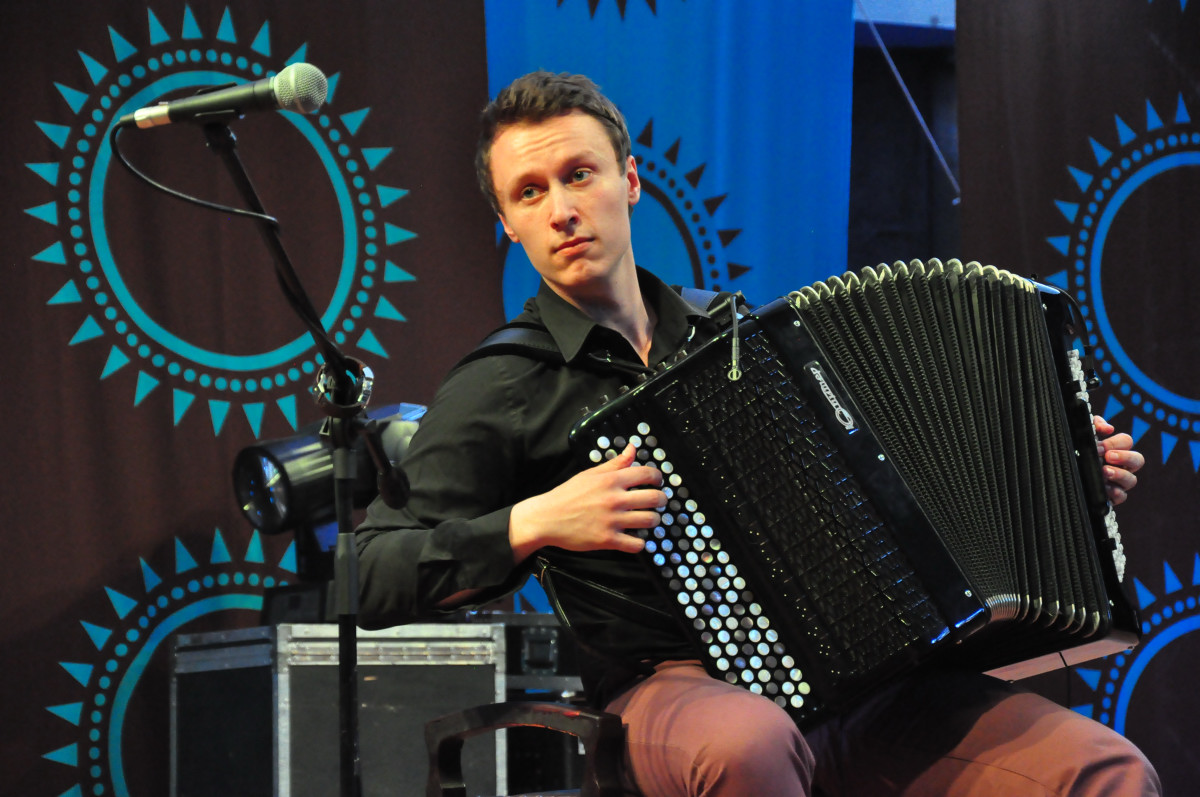
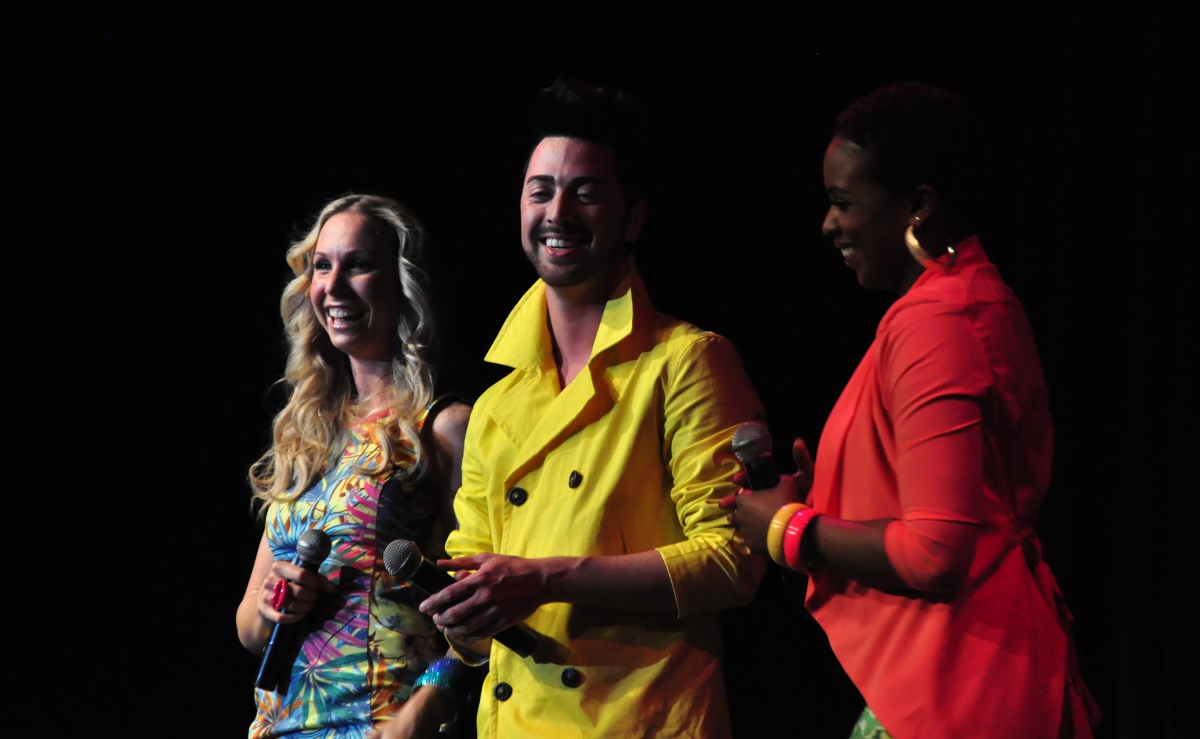
Haari Kuusijarvi gave a very relaxed show of Finnish contemporary music on the accordion thanks to the Finnish Embassy in Lusaka. The final act of the day for me was the Dutch pop band Adlicious who got the crowd on their feet at the 7 Arts theatre. They don’t normally play in theatres but clubs and their music reflected it. They also normally have a backing group but it didn’t affect their singing and they entertained in style.

Notes on the equipment I used:

Nikon D90 with 18-105 F4-5.6 zoom
Velbon monopod – flash was mostly prohibited and I don’t like using it anyway.
Kingston 16GB class 4 SDD card
I use GIMP 2 for post processing but that was limited to the occasional cropping – I did not have time for the fancy stuff.