Getting legit

16 03 2025

She didn’t smile or even try when I greeted her with my cheery best “Good morning, how are you?”. I wasn’t too surprised; working in a windowless box in a government building in a dreary part of town would also have made me dour. I vowed to at least get her to smile before the session was over.

It was only when I went to renew my British passport before a visit to Cape Town in May that I thought to check up on my Zimbabwe passport that I knew was up for renewal this year. Oops, it had already expired. A phone call to a friend, whom I knew had renewed his Zimbabwe passport recently, and I was told it wasn’t too difficult at all and older folk like us even got to use the express queue. I didn’t even have to supply passport photos as it was all done “in house”. I waited until I had no more excuses then told Fabian, my company driver, that he was taking me into town.

It’s been a long time since I’ve been into the centre of Harare and I know that it’s run-down but it was still an education. The once pristine Harare Gardens are overgrown with weeds, the grass hasn’t been cut in ages and the children’s swings and roundabouts are falling over and in need of more than a bit of maintenance. Rubbish abounds.

We got to the entrance of Makombe House where passports are renewed and issued and other government business is done. We were stopped at the entrance amongst a crowd of touts, vendors of sticky treats and drinks, and other hopefuls. Fabian explained to the official in “control” of the melee that I was disabled and needed dropping off closer to the building and we were waved through.

I wandered into the first processing area I could see and looked lost. It wasn’t long before an official told me I was in the births registration area and was directed over to the passports queue. I joined what I thought to be the correct queue and was approached by another official who, after hearing what I needed, directed me to the Emergency Passports office. “Now we’re getting somewhere” I thought.

Fabian arrived from parking the pickup truck and provided valuable assistance. He went off to another office with the form I’d filled in and it soon emerged that I’d not brought all the necessary copies of documents; strangely they wanted to see a copy of my UK passport. It used to be illegal to have dual citizenship in Zimbabwe then a few years ago someone took their case to the constitutional court and it was found that it was not forbidden. Why they needed proof my dual citizenship I’m not sure. A hasty WhatsApp to Marianne and a photo of the relevant page arrived. I was charged 3 US$ for it to be printed out! Eventually all documents were deemed correct and I was shown through to the the windowless box for photographing and fingerprinting.

After trying and failing to get the fingerprint machine to record my prints, trying another office and succeeding we were back in the original box. Another official, slightly less dour, gave me a printout of my photo and personal details – which were wrong. I don’t have brown eyes or black hair. Well what little of the latter is still there is grey, as Fabian reminded me. I looked at the photo and said, in a loud voice, “Who IS this handsome person? I don’t recognize him!”. Both officials erupted in giggles which only got stronger when I added “So what is the joke?”. Mission successful.

A mere two-and-a-half hours after arriving I was finished. I turned down the offer of an emergency passport to be ready in 48 hours for an added US$100 and turned over a mere US$175 for the week later version. No-one asked if I wanted to pay in the local Zimbabwean currency.

On the way out of the car park we passed the original passport office. A colonial era building it was looking more than a little decrepit and didn’t look like it was being used for much. Curiously it still had the old Rhodesian coat of arms molding on the fascia and it had been painted in the not too distant past. We both chuckled at the irony.

The senior foreman at my work was not impressed at the cost of the passport. “They process a least 100 passports a day – what do they do with the 17,000 dollars? Look at the state of the roads and the general filth”. It’s just another symptom of the pervasive corruption that’s endemic in this country.


Progress? Well it’s all in the perspective

27 12 2024
ZiG – the notes that never were. There were 100 and 200 denominations too and unbelievably some coins!

Zimbabwe has two official currencies, the US dollar and the local dollar. The latter is officially called the Zimbabwe Gold or ZWG. It used to be called the ZiG (also Zimbabwe Gold as apparently it’s gold backed) but that’s no longer used by the government, perhaps it sounded too much like the cartoon character that it is. The general public still use the term “ZiG”.

That both currencies are legal means that one cannot refuse payment in either. This of course brings up the sticky issue of exchange rates. A visit to the Reserve Bank of Zimbabwe’s (RBZ) webpage is instructive. A one ounce gold coin is being sold for US$2,744 or ZWG70,723 which makes the exchange rate 25.77 (it’s tightly controlled). Last week I bought ZiG/ZWG at 34 to the US dollar off an informal dealer. Why? Because my business takes in so little ZiG and I wanted a cheaper way to pay off my electricity bill and there was no way I was going to pay US dollars for that appalling service!

Officially the ZiG month-on-month inflation is 11.7% (277% annually as calculated) and the US dollar inflation is 0.09%. Given that a US$ loan will cost 9.5% per annum that is very conservative. Interestingly, the US$ annual inflation is given as 3.28% but the ZiG annual inflation is not given – too embarrassingly high perhaps? Of course Zimbabwe has had problems with currency inflation in the past so it’s hardly surprising that they don’t want to repeat the 2008 debacle. The official ZiG to US$ exchange rate is enforced by punitive fines, in US$, so it was surprising that the RBZ suggested in October that they let the exchange rate run in order to maintain the public interest in the ZiG.

In 2008 we had a bad experience with Zimbabwe dollars…

Another way of stimulating interest in the ZiG – and I use the term loosely – is forcing the public to pay a percentage of their taxes in ZiG. The government excels at imposing taxes. There’s a 2% transfer tax on most currency payments and a 3% levy on withdrawing cash. Income tax starts at US$100 per month! Company tax is payable quarterly based on estimates and there are penalties for being inaccurate.

The ZiG, despite much fanfare at it’s introduction in April this year due to the ballooning devaluation of the previous currency, has never been issued in note form. This has insured that people use the banks as little as possible and keep whatever hard currency they have “under the mattress”. It’s not without risk of course – a recent fire at one of the big local markets destroyed a lot of people’s savings.

In an effort to streamline tax collection the local tax authority has implemented a system of tax compliance for retailers and wholesalers. They are now required to register with the authority (ZIMRA) and have a system whereby they are online to the authority and every sale is registered and a QR code is printed on the invoice at the till point/checkout. Yes, it actually does work – try pointing your smartphone camera at the example below. Fortunately everything my company sells is zero VAT rated (plants for cultivation) so it’s not a requirement for us.

A QR code verifies that the purchase is registered with the tax authority

The whole tax accounting system has been overhauled and now each registered company has just one account for both company tax and income tax. In the past there were two and managing the system was complicated. Now it’s so simple that I can almost understand it but prefer my bookkeeper to handle the returns. Progress? I guess it is in a way.

We haven’t made any progress in growing the economy. The budget speech by the Minister of Finance at the end of November is best described as entertaining. I quote; “The attainment of the projected 6% economic growth in 2025, will result in Zimbabwe being one of the fastest growing
economies in the region.”
This is despite “… the agriculture sector, which was initially projected to contract by -21%, is, now expected to contract by -15% on account of better than anticipated output on wheat and dairy.” It seems the Minister of Finance hadn’t read the RBZ figures because he says “…prices for goods and services have relatively been stable following the introduction of Zimbabwe Gold (ZiG) in April 2024. Month-on-month ZiG inflation declined by -2.4% in May 2024, and averaged 0.0% in the second quarter of the year.” The full speech can be downloaded here.


No Sulpiride necessary

11 06 2023

Subscribe to continue reading

Subscribe to get access to the rest of this post and other subscriber-only content.


Not all that is gold glitters

4 08 2022
Oh these were the days back in 2008. And this was not the biggest which topped out at 100 TRILLION dollars! For a while one could buy them on the way out of the airport at US$20 or so each. Now THAT’S an effective way to make money out of inflation!

As of four days ago Zimbabwe has its very own gold bullion coins, one troy ounce, 22 carat gold. Like gold coins sold all over the world it even has its own name, Mosi-oa-Tunya, which is the name the Tonga people gave the Victoria Falls and roughly translates to “The smoke that thunders”. Unlike gold coins elsewhere nobody has any idea if it will be tradable outside the country and therein lies the catch.

The coin has been introduced to try and rescue the local Zimbabwe dollar from oblivion. Nobody wants it and on the parallel market it’s trading at 720 to one US dollar though for some reason now outlets I spoke to yesterday were using less than 760. That is actually down from 750 a week ago when I had to sell 1,000 US dollars to part-fund my staff wages. Not many retailers are using the local dollar anymore and, although they are bound by law to accept Zimbabwe dollars, they price goods so that it’s very attractive to pay in $US. Supermarkets are the lone exception and they price at the official rate of 400 or so to the US dollar. Those who can obviously pay for their groceries and consumables in the local currency.

The initial run of gold coins will number 2,000 and will be sold at around US$1,800 or so depending on the value of the metal. One can also pay in any other major currency and, here’s the kicker, Zimbabwe dollars at the official rate! Yes, this means that if you can get enough local dollars you can get yourself a gold coin or several very cheaply indeed. The government admits that this price is out of consideration for most people, so will consider minting smaller coins at a later stage.

Cynics are easily found in Zimbabwe and it’s not difficult to see why. Many have pointed out that these coins are there purely for the rich and politically connected to mop up easily and hopefully in the process rescue the local dollar (the price is way beyond the average citizen intent on daily survival). I suggested to my cousin, who is a gold smith in Cape Town, that she should see if she could get her brother, who lives in Harare, to buy her some that she could then melt down for use in her business. Gold jewellery is usually diluted with silver to around nine carats. It would be really worthwhile doing if possible. My local cousin is well-connected but probably not that well connected.

It has not of course escaped notice that Zimbabwe does not have a great reputation for fiscal responsibility and those who do buy the coins might well find out that nobody outside the country is interested in buying them. Why should they when in South Africa, our neighbour, one can buy the internationally recognized gold Krugerrand not to mention the plethora of other coins available worldwide?

It doesn’t take a huge amount of mathematical intellect to work out that gold coin sales are unlikely to make much difference to Zimbabwe’s dire financial status. Let’s have a look:

Initial minting is 2,000 coins valued at $1,800 each. That’s a grand total of $3.6 million. Not a lot to get excited about. This has not stopped the government owned newspaper The Herald from waxing lyrical and claiming that that existing stocks of the coins have already sold out. How many were available in the first place was not mentioned. Perhaps even more tellingly the article claims that the gold coins will take local currency out of circulation. Does this mean that we are reverting to using the US dollar once again?


The Rhodesian Ridgeback Centennial

10 07 2022
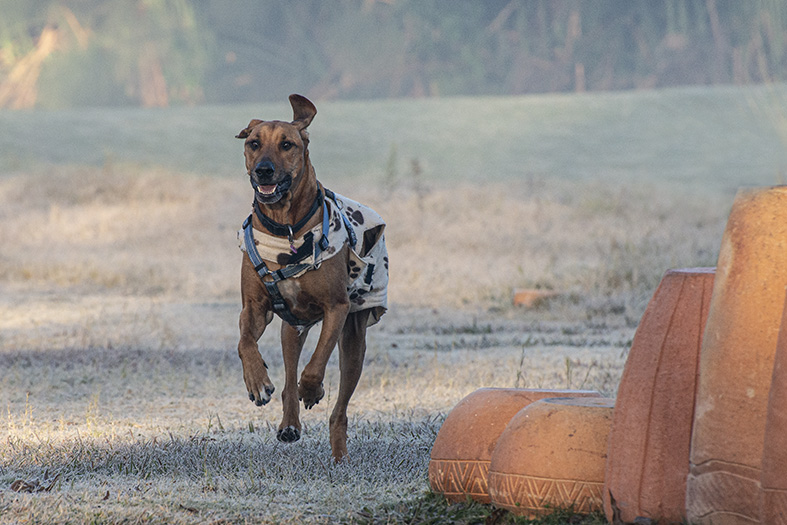
Themba on the move

This year is the centennial of the Rhodesian Ridgeback Club of Zimbabwe. For those with a bit of interest in history and geography, the southern African country once known as Rhodesia has been known as Zimbabwe since April 1980. Yes, we have our own dog breed, known as the Rhodesian Ridgeback, since 1922 when the parent club of the breed was formed in the country. Breed names don’t change with geography so the breed has kept its name.

There’s quite a bit of misinformation about the breed out there on the internet, the biggest myth being that the breed was developed in South Africa which is on our southern border. It was not and neither is it the “South African national dog”. The first Ridgebacks were bred in the Bulawayo area of southern Rhodesia in the early part of the 20th century specifically for hunting lion. They are a mix of many breeds with the distinctive ridge of reverse aligned hair on the back likely originating in the native dogs of the Cape region of South Africa. It is said that the early breeders/hunters of lion noticed that dogs with the ridge were not afraid of lion. I suspect that they were savvy enough to use this as a marketing tool though one of the early pioneers of the breed, Cornelius van Rooyen, was not particularly interested in furthering the development of the breed himself but he was an avid lion hunter. It was left to others to further the development of the breed and in 1922 Francis Barnes was instrumental in setting the breed standard (which he admitted to poaching from the Dalmatian standard) and calling a group of like-minded people to start the parent club near Bulawayo in 1922. So this year we will be celebrating the centenary of the parent club at the Wag Zone, Harare’s (and quite possibly Zimbabwe’s) only dog park.

Yesterday we had a small gathering of Ridgebacks and their owners at the Wag Zone to get the dogs used to the premises. The actual centennial gathering will be there on the 13th August in the morning from 10 a.m. My Themba (above) will be attending as will quite a number of other dogs with hopefully some from neighbouring countries.

My first Ridgeback was Kim, whom I got from a local farmer in the Chinhoyi area of Zimbabwe when I worked there in 1990. She was a companion for my Labrador Cassie and I fell in love with the breed then. Being hounds they are not easy dogs and are very independent. Training takes a lot of persistence (no, they are most certainly not stupid) and if they have a failing it’s their undivided loyalty which can be a bit much at times but for an often lonely batchelor, it was a great fit. They often don’t live very long either. Unusually for this breed Kim lived for 14 years before I had to make the decision to say goodbye. She was followed by Tina, Jenni, Kharma and Zak (Roxy was my wife’s dog). Now we have Themba who has a diary on Zak’s blog and, at 9 months of age, has firmly laid claim to our hearts and centre of the bed.

Further information on the breed is only a few clicks away on the web but for history buffs the definitive book is “Rhodesian Ridgeback Pioneers” by Linda Costa (ISBN 0-646-43501-9), which may take a bit of finding as it is no longer in print.

Themba at the airport aged 8 weeks when we picked him up


A punk spider and a cyclone called Idai

24 03 2019

This spider was tiny, about 5mm across, but what a radical punk shape!

The first golden orb spiders appeared at the beginning of this month – well that’s when I first noticed them. I have no idea what type of spider this is in the photo (it’s nothing like a golden orb spider). It was tiny and all I had was my cellphone so it had to do. I have not seen it again.

I am always pleased to see spiders as it usually means we’ve had decent rains and there are enough insects around to feed them, but this season has been distinctly unusual. It has been typically erratic as el Niño seasons are. It started well enough a week later than usual but February, instead of being the wettest month of the season, turned out dry. That was for Harare which has been better off than most of the country which has been very dry indeed. Then two weeks ago a low pressure system developed over Malawi and caused substantial flooding. It moved off into the Mozambique channel between Mozambique and Madagascar and became a full-blown cyclone and was named Idai. Moving off it brushed the big island, turned around and headed towards the Mozambican city of Beira.

Red areas indicate flooding

It made landfall last Thursday with winds of 170km/h and hammered the city (it was estimated that 90% of buildings sustained damage). American weather forecasters predicted rainfall of around 600mm which turned out to be an under-estimate.   Photographs estimate that 3000ha just inland from the city has been flooded. A friend sent me this audio recording from someone she knows in Mozambique in the town of Chimoio (WARNING: CONTAINS STRONG LANGUAGE) By Friday it had started to rain in the eastern Zimbabwe town of Chimanimani. Over the next 48 hrs they received 850mm of rain – pretty much their annual rainfall. Hillsides moved, houses were washed away and bridges disappeared under the onslaught. Power lines collapsed. The death toll is still climbing and people are unaccounted for. Further south the town of Chipinge was hit by high winds. It’s a horticulture area and damage to macadamia and avocado orchards has been extensive.

The response of ordinary Zimbabweans has been amazing. Collection centres have been set up in Harare and food, blankets, utensils, water and containers have been donated. Animal welfare organizations have also donated food and international organizations have helped out. The air force sent a helicopter which promptly broke down. Engineering companies donated equipment and expertise. Private individuals have used their helicopters, motorbike enthusiasts have gone to help find alternative routes into the cut-off areas. A photo has been circulating of an old woman who walked from her home the other side of Harare to donated cooking pots – she didn’t have enough money for the bus. For once people have been queuing to donate items instead of queuing to buy them.

Zimbabwe is heavily dependent on the port of Beira for imports and exports. It’s not clear what the damage to the port is but the ramifications are going to be extensive. It was reported that the pipeline that Zimbabwe uses to import most of its fuel had been damaged. However I know someone in the fuel business and he assures me that the pipeline is not damaged but the control station for the pumps in Beira has been devastated. Fortunately it’s run by an international company that is feverishly repairing it but the word is out that we might run out of fuel and the queues at the filling stations in Harare are long and chaotic.

Two days ago some youngsters who run a vermiculite exfoliating plant came to see me. We use the vermiculite at the nursery to dilute and stretch the supply of coir pith that we use as a medium for the seedlings. There are other locally produced media, one being composted pine bark, which is collected from sawmills where it is stripped off the logs before they are sawed so the saws don’t clog. The main source is in Chimanimani and is run by the Tobacco Research Board (TRB), mainly for use in the production of tobacco seedlings. The vermiculite company had been notified by the TRB, whom it also supplies with vermiculite, that its supplies had been badly damaged and that it would not be needing much vermiculite for this season’s crop which will be sown in June. This is very bad news for the tobacco farmers who use the pine bark/vermiculite medium to grow their seedlings (most seedlings are still grown in the traditional seedbed method). Quick to spot an opportunity they were wondering if the imported coir pith (called cocopeat by the trade) that I use would be suitable for growing tobacco and could it be blended with the expanded vermiculite that they produce. Yes, it can and I have used it successfully but we are fast running out of time. It is also cheaper to use coir pith imported from India than composted pine bark from South Africa (another option). We will see what transpires. Tobacco is a big foreign currency earner for Zimbabwe and thus is considered a strategic crop.

There was plenty of warning when and were the cyclone was going to hit. It was accurate information too. Weather forecasting has come a long wMozambique Major Hurricane Historyay since cyclone Eline hit Zimbabwe back in February 2000. Cyclones, as hurricanes are known in the southern hemisphere, rapidly lose power over the land as they need water as their power source (the water is sucked up as vapour, condenses releasing latent heat of condensation which draws up more water vapour) so they rarely get as far as Zimbabwe though they can cause significant rain as far inland as Harare. There was plenty of time for an evacuation to safer ground and when asked why the government did not effect this the reply was that the opposition MDC would have used the opportunity to accuse the army and police of using force and rape to make people move.

The opposition to the government used fake news to smear. A picture was posted of a sofa being offloaded from a helicopter claiming it was for the President to sit on when making the obligatory visit. It was an unrelated photo from Malawi (I did notice the registration on the helicopter was not from Zimbabwe, South Africa or Mozambique). The President did of course make a visit and all aerial activity had to stop whilst he was there.

The Department of Civil Protection (DCP) is the government arm tasked with disaster management. Its 2019 budget is $2.36 million (local dollars) which is less than the budget for state residence staff ($3 million). Its capital expenditure budget is all of $100,000 which might just buy a 4×4 pickup. There is a $3.4 m budget allocation for a loan scheme for chiefs to buy vehicles. Not surprising where this government’s priorities lie – politics is way ahead of looking after the people.

In a way it’s quite sad that the general public, who are only too well aware of the lack of interest for the welfare of the people, stepped up to the occasion is such spectacular fashion. It effectively lets the government off the hook and they will continue to spend money on themselves. That is not to say that they will miss an opportunity to gain political capital by handing out support to favoured sectors of the affected community. This tactic has been extensively employed in the past, especially when drought relief has been necessary, which in the grandest of ironies is going to be necessary again this year.

Here in Harare we’ve had about half the rainfall we’d expect in a normal year but elsewhere it’s been far less. There’s been widespread crop failure and the WFP estimates that about 5.3 million people are at risk this year. Droughts, erratic rains and cyclones are nothing new to us in southern Africa and can be dealt with by decent planning – something that is spectacularly absent in the current government. Just a week before cyclone Idai hit a video was widely shared on the social media of a pediatrician at a big local teaching hospital in tears because even the most basic medical supplies had run out – for want of syringes chemo-therapies had to be halted. Yet still the President, E.D. Mnangagwa, took himself and an entourage off to Dubai on business and then hired a jet to fly him back after the cyclone hit. At an estimated cost of US$200,000 it could have bought a lot of syringes. Bad as the Mugabe regime was it did not have this attitude to profligate spending. No, we don’t want the Mugabe regime back but good governance would be nice. Sadly that is a quality that is rare in African politics.


It’s all in the picture

15 01 2019

Sniffing around after the rain – there’s a longer story hiding here though.

This picture is not as boring as it might seem at first. There’s a lot of good intelligence to be gleaned from it.

The swimming pool

It’s overflowing – the result of at least 56mm of rain over lunchtime today and a failure to take the overflow pipes off the gutters that feed the rain from the roof into the pool. We need to collect the water off the roof as the borehole is not fantastically prolific – it has been tested at 900 litres/hr which is OK for domestic purposes but not enough to keep a garden attractive and a pool topped up. So the lawn, such as it is, is seasonal and only really gets growing in the rains.

The pool was most certainly not a priority when we were looking for a house to buy just over two years ago. Harare has a mellow climate; not too hot and never really cold though European friends do find the Zimbabwe winter cold as the houses are not geared for heating. The winter only lasts about two months so what’s the point? Winter is also our dry season and the skies are usually clear so it’s easy and pleasant to sit in the sun. Summers are also not very hot. This November it only got to 33° C on a few occasions and while it can be humid it’s seldom humid and hot. Pools are also expensive to maintain especially as all the chemicals are imported and Zimbabweans are famous for price gouging – but more of that later.

So we got a pool with the house, like it or not. I like it – I used to be a good swimmer until the medical fraternity botched two neck operations and I lost a lot of shoulder strength as a result. I still get in the pool when I can but serious swimming is in the past now. I’ve read that getting old is about giving up the things one likes doing – I guess it comes to us all at some stage. The pool also leaks so needs topping up often and being in the agricultural business I could buy the piping through the company, a perk of the work. Yes, I have tried to find the leak and the entire pool piping system has been dug up on several occasions to little avail. The pool is old, built (or should that be dug?) in the 1960s, when the preferred method was to dig a hole and line it with 20cm of reinforced concrete. No doubt there is a tiny crack somewhere which is nearly impossible to find. It also needs painting but that would require complete draining and a lot of confidence in the weather forecasters getting their predictions right for a good rainy season as the borehole won’t handle that volume of water – about 70m³ which is big for a domestic pool. I know the age of the pool because a friend used to come swimming here as a youngster and he tells me that his father and uncle built the house.

The rains this season (it runs from mid-November to mid-April or so) have been erratic and very patchy. That’s fairly typical for an el Niño year which this is. The first rains in this area were about a week late which is significant if you are planting a rain-dependent maize crop. There have been week-long dry spells since and what rain that has fallen has been very localized so this storm was welcome though the pool filter was not in danger of sucking air. We also collect the waste water from the back-washing of the filter and the domestic washing machine and that is used on the garden.

When we moved into the house I bought a small well pump for the purpose but 10 days ago it just stopped working for no apparent reason. It’s been left at the supplier’s workshop where I was told “It’s not expensive so it might not be worth fixing”. They didn’t have that model in stock so I inquired the price of a slightly smaller one and was told $640 (local currency) or US140 cash. Cleaning up my desk on the weekend I found the original invoice from two years ago when all we were using was US dollars – $96. Thanks for the profiteering DripTech.

The grass

Yes it hasn’t been cut for some time. The lawnmower has been making a LOT of noise recently on being started so rather than deal with a permanently dead (I know it’s a split infinitive) mower it was shipped off to the local repair shop to join the queue. Yes, we queue for everything these days. The message came back this past Friday that yes, it is repairable and would be $200 local. We gulped and then decided that it was a lot cheaper than a new mower (around $1,000 at the local hardware store) so gave the go-ahead. This morning Maianne phoned the workshop to be told that they couldn’t source the spares as it was too risky to venture into town with the current disturbances.

At midnight on Sunday fuel prices more than doubled and the president, Emmerson Mnangagwa, flew out to Russia and the far east with begging bowl in hand.  The trade union movement, ZCTU, and opposition politicians immediately called for a shutdown for three days this week to protest the nearly impossible cost of people getting to work and violent protest has ensued. Social media has reported numerous incidents of shops being looted, vehicles burnt and an unconfirmed video of a police station in flames. Mainstream media has reported that people have been shot but numbers have not been confirmed.  My foreman tells me that he’s heard of police and army personnel also threatening shops that were open and forcing them to close. Messages have been doing the rounds of WhatsApp strongly suggesting that all businesses, public transport and schools close for the time being. The language suggests that they are coming from the ZCTU but no-one is claiming ownership at this stage (it’s Tuesday as I write this). Mnangagwa has been seen getting off a privately chartered jet in Moscow which cost some US$60,000 per hour. We are talking real money here.

WhatsApp, Facebook and Twitter have been blocked but are easily circumvented with a VPN (Virtual Private Network). Curiously, while watching YouTube late last night, I received two automated phone calls – one from a private number and the other from a number I didn’t recognise – telling me that my access code to Twitter was a given six digit number. At the time I thought it was a hack and quickly put my phone onto flight mode. Maybe it was a way of bypassing the block. I’m not sure I’ll ever know now but I do know the grass is going to be uncut for a while longer.

Twitter block in place


Searching for Grandpa Lionel

28 07 2018

We finally found grandpa Lionel’s grave where the documentation said it would be; Extension 2, row I.C. grave 11.

Lionel Roberts’ grave

We’d been discussing our ancestry with cousin Pat in June 2015 when in the UK for a family reunion and holiday. She’d mentioned that grandfather Lionel had died in the Somme area in May 2018 so I’d suggested we should have another family reunion on the 100th anniversary of his death at his graveside.

On May 24th Marianne and I boarded an Ethiopian Airlines jet in Harare and flew to the UK to start the pilgrimage. It was a long flight made longer by a 5 hour stop over in Addis Ababa in the middle of the night. Compared with the quality of the aircraft and aircrew service the airport was more than a bit drab. Heathrow airport is vast and by the time we’d got to the coach station to catch the bus to cousin Pat in Harlow it was a good hour and a half after landing. Three very tedious hours later we arrived in Harlow and vowed the next time to take the train no matter how much it cost!

My brother Duncan arrived from Shropshire the next day and we set off to France. The weather was bright and sunny and after a roadside lunch in a nearly deserted picnic area it was time to turn on the Google Maps navigator for the next leg into Amiens where Duncan had booked rooms in a utilitarian hotel of the sort favoured by traveling salesmen. I was a bit disconcerted when the app told me that I would be arriving at our destination in 15 minutes and also had our booking details even though I’d had nothing to do with it. I can only presume that it had searched my phone and found that Duncan was my brother and then done a search to see what bookings he’d made for the area we were in. Not sure I like that but I guess it’s something we’ll just have to get used to.

The next day we headed some 50km north to the small town of Doullens to find Lionel’s grave. It took longer than it should have. After and hour scouring what we thought was Extension 2 of Doullens Communal Cemetery and wondering why there were no graves newer than 2017 Pat made the discovery in the registry at the gate that we were in Extension 1. A quick search on Google Earth revealed that Extension 2 was much nearer where we’d parked the car and so we quickly found Lionel’s grave right where the Commonwealth War Graves Commission (CWGC) information said it would be.

Doullens Communal Cemetery 2. Beautifully maintained by the CWGC

The cemetery is small by First World War standards and beautifully maintained by the CWGC. At some fairly recent time all the gravestones have been renewed. Some have been personalized in the form of granite, presumably by family members.

Pat laid a card from cousin Malcom on the grave together with a sprig of myrtle for Lionel’s wife Myrtle whose ashes are scattered on the grave. We sat in the cool shade of some trees, signed the register and discussed family ties.

Lionel is not our grandfather at all. My sister Diana noticed this back in 1992 when looking after my mother in the final stages of her terminal illness. Going through various documents she noticed that my father’s father’s name was not on his birth certificate. At that stage we had never met Pat and didn’t know about Lionel, who really is her grandfather, and that he’d died seven years before my father was born. My mother clammed up and that was the end of that particular conversation. My brother, sister and I were intrigued by a scandal in the family but in my mother’s era it was terribly shameful to be born out of wedlock – oh how times have changed! Pat has a friend who pastime is tracing family trees and she asked her to see if she could find out whom our real grandfather is but the trail has gone cold as anyone who would have known is now dead and Pat said she never heard the subject being discussed by her parents.

We’d known for sometime that the family name has not always been Roberts. The Roberts name used to be Metz which is of course of German origin. Lyon William Metz applied to change his name on 21st September 1917 to Lionel William Roberts, presumably as Metz would have been associated with the enemy. It was approved on 7th January 2018 and then on the 27th of May in that year Lionel was killed by his former countrymen. He died from abdominal wounds – I hope he had sufficient morphine. Three days later the hospital where Lionel spent his final hours was bombed.


<i>No. 3 Canadian Stationary Hospital at Doullens</i>

No. 3 Canadian Stationary Hospital at Doullens

I also have combat experience but in a very different war. In August 1987 when I cycled across northern France on a round trip to Zurich and Germany, I had a stark reminder of just how different. After a long day of 143 km I collapsed in a delightful campsite near Verdun, site of one of the major campaigns of the First World War. I got chatting to a Dutch man whose holiday hobby was going through the old battlefields with a metal detector. He assured me that he still had to be careful what he unearthed as there was still live ordinance buried. He showed me a clip of .303 ammunition which he said would likely still work. What he was really looking for was the double eagle cap badges the Germans had on their helmets. The next day as I tried to pull up my tent pegs I was amazed by the suction of the soil which wasn’t even very wet. I could only imagine the appalling conditions of trying to fight in really wet weather. At the battle of Passchendaele soldiers drowned in the mud. By contrast the war in which I was involved was primarily counter-insurgency warfare where “contacts” with the enemy were usually fleeting and very close range – around 30m or so. Rain was very rarely a contributing factor to the action and we were fighting in our own country.

Cap badge of the Artists’ Rifles

The regiment in which Lionel served was the Artists’ Rifles. None of us had heard of it but a little internet research turns up that it was a highly popular regiment and supplied many officers to other regiments. Established in 1859 it really was intended for artists, musicians and other creative types. Whilst it was a fighting regiment in WW1, in WW2 it was an officer training regiment and was disbanded after WW2 before being resurrected in 1947 and incorporated into the SAS as 21 SAS.

Before visiting Lionel’s grave I did wonder if I would feel any emotion, a connection perhaps with the man whose name I inherited. As a former soldier I have also experienced the terror of combat and was wounded 39 years ago and I will carry the consequences for the rest of my life.  I had to reflect as we walked back to the car that the death a 100 years ago of a man to whom I’m not related was too distant to feel emotionally connected.

We were there. A salute to all those brave men who paid the ultimate price.


Autumn

19 04 2018

A misty autumn morning

It’s been a strange rainy season. The rain has finally petered out and the mornings are crisp (9 degrees in the photo) but the clear April skies have yet to appear. Of course, here in Zimbabwe, we don’t get the autumn colours of the higher latitudes – we have a sub-tropical climate and what colours there are appear with the new leaves in spring.

The rains arrived pretty much on time in the middle of November and then we had 2 very dry months in December and January. The maize in the foreground of the photo above was starting to look stressed and the general manager of ART Farm where the photo was taken was getting distinctly stressed about the state of the soy beans. Then in February the rains came back with a vengeance and by the end we’d had an almost normal quantity. Distribution is important too and because of the prolonged dry spell yields will not be fantastic. Some parts of the country got excessive rain and others did not plant maize at all.

The economy continues to stagnate. This is not that surprising as it is after all broken and broken economies are not quickly fixed. In the case of Zimbabwe we, and presumably potential investors, are waiting for the general elections the date of which still has to be determined. If the elections are deemed to be free and fair then the money will come. We hope.

The elections have to happen before September. I don’t watch television much and local television not at all but even I have noticed a dearth of campaigning by the parties concerned. The opposition MDC alliance (the original MDC became hopelessly divided  but they seemed to have cobbled together an agreement to stand as a single party) have been holding rallies which apparently have been well attended but the governing ZANU-PF don’t seem to be doing anything. This has made people very suspicious. Either they are super confident that they don’t need to campaign or they are “up to something”. Their track record favors the latter. Newspapers have reported that the military have been dispersed to the rural areas to do the campaigning but nobody actually seems to have evidence of this.

Mary Chiwenga, the wife of the ex-general and now vice president who was key in deposing Robert Mugabe last November, has been reported as helping herself to a government owned farm recently. This seems at odds with the “new dispensation” of president Emmerson Mnangagwa who has promised compensation to commercial farmers evicted under the Mugabe regime and has appealed for the self-same farmers to come back and help rebuild the economy. This may not sit well with prospective investors who shied away for just this reason; a lack of property rights. The story has faded quickly from the local papers who have a notoriously short attention span. When I told my foreman of this latest land grab he commented that this was a “problem with older men who take younger wives that they cannot control” – a clear reference to the profligate land grabbing antics of former president Robert Mugabe’s wife, Grace.

Yesterday was a public holiday – the holiest of holy – Independence Day. In the past crowds would be bussed, sometimes under duress, into the National Sports Stadium to hear then president Robert Mugabe drone on about perceived injustices the rest of the world was inflicting on us. Sanctions was a favorite culprit for the economic mayhem he’d wreaked even though everyone knew they were targeted sanctions against ruling party (mainly) individuals. The crowd had mainly come for the high profile soccer match afterwards.

Sometimes there was a military display and fly-past by the air force. The jets used to practice their run over my workplace but this year they were absent and I’m not even sure there was any sort of celebration at the National Stadium. This did not stop the local branch of ZANU-PF asking me for a donation for their regional party. In the past there had always been an implicit threat that if I didn’t cough up there might be a consequence – farmers have long been a soft target. It says a bit for the changing political atmosphere that this year I turned them down when phoned with “not this year, I have too many financial problems to deal with”. True enough if a bit overstated; it’s been the worst first 3 months of a year for business since we adopted the US dollar as our currency back in February 2009.

We are so used to hearing about the dire state of our economy that I am often mildly surprised to hear about agricultural enterprises that are doing well. Avocados and macadamias are riding their healthy food status wave and those who can are exporting to a near insatiable Chinese market to the extent that macadamia nuts are nearly impossible to find locally. Another horticultural company that I’ve dealt with in the past exports canned cherry peppers in bulk containers and I know an export agent who is concerned about the vast area of blueberries that will come online in 5 years or so – he told me that we lack the infrastructure to export them!

Export markets are highly sort after as the foreign currency earned can be used to import goods. Unless one has a priority requirement such as medical, seed or some other “essential” service it is nearly impossible to import using local currency. A way around this is to purchase the US dollars cash on the market, take it to the bank who will then effect the importation. This is what I did last year to import the coir pith we use in the nursery as a growing medium. I paid a 40% premium at the time – apparently it is now 50%  – and landed the product cheaper from India than I can buy the local equivalent the quality of which I don’t trust.

Medical cannabis is also being grown but is very much a closed market. An email call to someone in the know got me a curt “I’ll contact you when the way forward is clear” reply. I guess I’ll just have to keep looking.


Bob’s Day

1 03 2018

Last Wednesday was officially a public holiday; The Robert Mugabe Youth Day. Up until the soft coup last year that saw Mugabe forced to resign as Zimbabwe’s president it was his official birthday but not actually a holiday. There was inevitably an extravagant bash somewhere in the country and business’s were browbeaten/intimidated into donating cash or kind (i.e. cattle) for the party. One year there was a particularly tasteless version where a sycophant donated elephant meat. This year I got a letter from the local branch of ZANU-PF on my desk asking for cash or kind for a party for the ZANU-PF Youth Wing. It went straight into the bin. I should have kept it as in a delightful twist of irony it was addressed to “Comrade Robert” and it would have enhanced this blog.  Last week I got a phone call from the author following up on why she hadn’t heard from me or received anything. I rather brusquely told her I didn’t support ZANU-PF.

In the past I might not have been so quick to dismiss her or at least been a little more polite. As a white commercial farmer I have always been a bit of a soft target for such requests – they know we feel vulnerable and easy to squeeze for cash. I rather doubt that it would have made the slightest difference – if they’d decided to evict me then they’d have just gone ahead and done so whether or not I’d supported their celebrations. Independence Day I did usually give something, the logic being that it was a national celebration. The money was still going to a function organized by ZANU-PF and quite possibly into someone’s pocket rather than the intended purpose. I was always assured that a receipt would be given though of course there are official receipts and others and who was I to know the difference. Quite frequently there were thank you letters which did rather surprise me.

I have just been watching a clip of Trevor Noah, the South African comedian, mocking the fall of Jacob Zuma – the disgraced South African president. The fall of Zuma was in no small way a result of a fiercely independent and critical press, a robust constitution and independent judiciary. We have seen a lot more of the critical press in Zimbabwe since Emmerson Mnangagwa took power in the aforementioned soft coup in November. Whilst they have not been directly critical of him there is most certainly an atmosphere of “we can say what we want” and other politicians have been heavily criticized. When Mugabe was in power this was not the case. People were jailed for criticising or mocking him even though a decision by the Constitutional Court, the highest in the land, stated that it was not illegal. Mugabe was the law. Zimbabwe has a strong constitution though it is not always followed; the soft coup being a good example!

The Harare International Festival of the Arts (HIFA) is scheduled for the last week of May. In the past they have had artistes expelled from the country for mocking the government. The South African rock group Freshly Ground didn’t even make it into the airport for making video to the song “Chicken for Change” that featured a puppet version of Mugabe. I do wonder if this year we will see acts that lampoon Mugabe as Trevor Noah was doing to Jacob Zuma. Despite his destruction of the economy, a culture of kleptocracy and non-accountability he has the national airport named after him and a national holiday. What does it take to become fully disgraced?

The official portrait of President Emmerson Mnangagwa. I think they could have done better.

In the days of the Mugabe regime it was common for offices and shops to have the official portrait of the president in plain view. It was never obligatory and there was never one in the office at my nursery and no-one, not even the politically connected, ever commented. I was rather hoping someone would complain so that I could pick an argument but alas, I was disappointed. Not surprisingly these pictures were pulled down the day after Mugabe was forced to resign; often with YouTube video clips as evidence . It hasn’t taken long for a replacement poster of Mnangagwa to appear around town. The photo of the president is not bad but it seems someone forgot the national flag in the background and a very bad Photoshop version was added. I still don’t think I will be buying one.