The sad country

3 02 2011

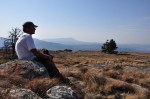
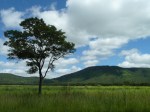
I always enjoy the drive out to Mazowe. It is undoubtedly pretty, especially at this time of year with the trees in full leaf and the bush lush and green. Yes, the photos don’t lie – it really was that green. It’s also a chance to get away from the nursery and just feast my eyes on the open spaces that I so love about this country.

I was going out to the Plant Protection Research Institute for another import permit, this time to import some coir growing medium from India as it is nearly a third the price of the pine bark we have been importing from South Africa. As usual there was precious little happening at the PPRI and the weather was perfect so I wandered outside whilst the permit was processed.

I took these photos on the way back into town, dawdling along on the mostly empty road. The once productive farmlands were also empty.


Bob has a cunning plan (apologies to Baldrick)

25 01 2011

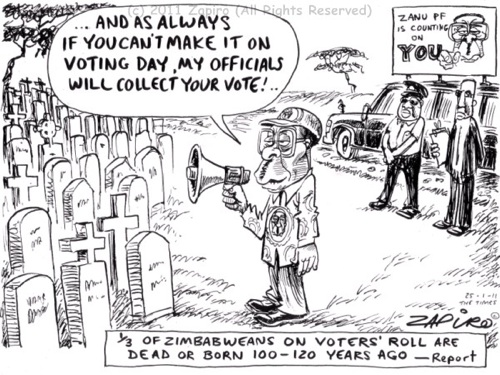
It appears that there are a lot of dead people and babies on the voters’ roll. It concerns me that this is just a smoke-screen. I mean really, it IS a bit transparent don’t you think?

© 2010 Zapiro (All rights reserved)
Printed with permission from www.zapiro.com
For more Zapiro cartoons visit www.zapiro.com


Musings on adaptability

15 01 2011

A male paradise flycatcher

A paradise flycatcher has been getting up close and personal this rainy season. They are an intra-African migrant that appear here around October or so. The male (pictured) is a quite noisy bird and I can often hear his “chwee chwau” call when I am around the house. Along with a spectacled weaver and some yellow-bellied bulbuls the flycatcher likes to come foraging for insects under the verandah light early each morning. This must be learned behaviour. I have my doubts that the birds know why the insects are there but they do know that every morning it’s worthwhile calling past to see what’s on offer. On Christmas morning the flycatcher actually came into my dining room, hovered about 2m away from me as I was writing a letter then picked and insect off the inside of the glass door and flew out. It has done it again once since then too.

A little more surprising is the behaviour of the mantids. Predators all, I have often seen them congregate near a light at night but although they are attracted to it they don’t appear to be disorientated the way other insects are. They do occasionally fly around the light but not for long. Have they “learned” like the birds that food it to be had near light sources?

We have started using the ponds at work again for speeding up the growth of some cabbage and tomato seedlings. It didn’t take the toads long at all, about 2 days, to discover the water and start spawning and croaking away though they would not do the latter when I was walking past; I had to stand still. It only took the cattle egrets another 3 days after that to discover the toads. I was surprised by this as the ponds are covered by seedling trays and not easily recognized as a water body that might harbour food. Did the egrets hear the toads? The egrets are quite used to foraging for food around human activity and are often spotted behind tractors cultivating lands and wandering cattle from where they get their name. They do wander around the nursery from time to time but I this was the first time I’d seen them actually come into the area where the seedlings are grown. While I watched one egret actually caught a toad which attracted the attention of the other egrets that tried to steal the toad. In the end the first egret dropped the hapless toad probably deciding it was too big to eat.

Two days ago I saw another opportunist making her way behind a pump house. She was a large and fluffy cat, not at all the wild type that I would have expected to see. There is a healthy rat population around the nursery so I was quite pleased to see her but I am told she has kittens which could become an issue. Cats of course are feral and can live quite easily around habitation without ever having to directly depend on us.


Déja vu

26 12 2010

Any Zimbabwean following the Côte d’Ivoire crisis must be doing so with a sense of déja vu. The incumbent, Laurent Gbagbo, has lost the election to Alassane Ouattara and is refusing to go. Gbagbo has control/backing of the army too. People are fleeing the crisis into neighbouring Liberia. Substitute Mugabe for Gbagbo, Zimbabwe for Côte d’Ivoire, their election for our last election, Morgan Tsvangirai for Alassane Ouattara and South Africa for Liberia. It’s just so familiar! About the only difference is that ECOWAS is threatening military action if Gbagbo doesn’t go. I very much doubt that our regional organisation, SADCC, would be so cohesive or decisive. With the exception of Botswana most seem to be giving Bob their tacit support in a “what goes around comes around” attitude. Though chatting to Austin at yesterday’s gathering of the clans and various others, he seemed to think that South Africa was upping the pressure a substantial amount by threatening to expel Zimbabweans who are there illegally.

Estimates of Zimbabweans illegally in South Africa vary from 3.2 to 4 million. Apparently in the last election where the results were delayed for some 4 weeks (it may have been more than that), the ruling party took the opportunity to go through the voters’ roll and see who hadn’t voted and check their names off with a vote to ZANU-PF. Most of these would have been illegal residents in South Africa. If South Africa does go ahead with its threat to expel these illegal residents by the end of this year, and now that the World Cup is over their skills are superfluous, it would create a major headache for Bob’s regime as they would be extremely unlikely to vote for him having fled his regime in the first place.


Wage woes

21 12 2010

Some definitions:
NECA – National Employment Council for Agriculture. Part of the general NEC setup in Zimbabwe that helps set minimum wages and resolves disputes involving the latter.
CFU – Commercial Farmers’ Union. Once a very powerful union representing the commercial farmers in Zimbabwe it is now a shell of its former self due to the war of attrition on the commercial farmers by the government.
ALB – Agriculture Labour Bureau. The division of the CFU that deals with labour issues.
HPC – Horticulture Promotion Council. The organisation that looks after the interests of the commercial farmers in the export market.
ZFU – Zimbabwe Farmers’ Union. The union representing the mainly small scale black farmers.
GAPWUZ – General Agricultural and Plantation Workers’ Union of Zimbabwe. The largest (?) union representing the agricultural labour in Zimbabwe. Independent.
HGAPWUZ – Horticulture and General Agricultural and Plantation Workers’ Union of Zimbabwe. The government backed “other” labour union in Zimbabwe. Headed up by one Joseph Chinotimba, government bully boy of extraordinary brutality. An unimaginative lot as can be seen by the copying of the GAPWUZ name.

In the days of the Zimbabwe dollar the NECA was instrumental in bringing together various interested parties to set minimum wages; and essential task in the multi figure inflation of the time. They were admirably neutral and I used them on a few occasions to settle issues I had with my labour force when they went on strike or go-slows over various wage issues. All farming operations had to pay a levy which is currently set at US$1 per person on the labour force contributed by the worker with the employer contributing $1 per person too. The various unions representing both labour and employers also sat on the NECA  as members. Things started to go a bit wrong when the HGAPWUZ muscled its way into the market. It has never been a registered union and it is illegal to deal with it as such but after a while the GAPWUZ recognized that it was up against the big boys and buckled and HGAPWUZ was in the market. They came around to my workplace some years ago and made all sorts of extravagant promises and signed up most of the labour force away from GAPWUZ. The representative was an odious character both literally and figuratively and was always propositioning the women for sex. I made a point of telling him he was not “my friend” and refusing to shake his hand. I have not seen him since the US dollar took over as the official currency of Zimbabwe. That has not stopped the NEC and other parties from hiking the wages over the last 2 years.

By the beginning of this year the minimum wage for horticultural labour was $50 per month plus $7.50 for various allowances. I should explain here that horticultural wages have for many years been higher than general agricultural wages. This was because “horticulture” implied the business was exporting something and getting hard currency, an obvious advantage in the days of the Zimbabwe dollar. The ludicrous part of the definition was that many farmers were both exporters and local producers so two people doing exactly the same job but in different divisions of the same farm could earn vastly different wages. The export wages were at least 40% more than the local wages. Unfortunately my business is also classified as horticulture even though we have never exported. The “advantage” of exporting has now largely fallen away with the use of the US dollar locally.

In June this year an “official” notice came from the NECA stating that the minimum wage was now $70 per month and would be reviewed at the end of September. It was probably reasonable in that there had been some minor inflation but the ALB and the HPC cried foul. The person who’d signed for the employers’ unions was not authorized to do so and it transpired that the latter had never agreed to the wage increase. But by now the horse was well out of the stable and I increased the wages accordingly and passed on the increase to the customer appropriately. The exporters were not so lucky. Unable to pass on cost increases in a time of economic turmoil externally a number of them had to close. The HPC and others took the NECA to court. But the NECA did not stop there. Last month they announced ANOTHER wage hike of 20%  (to $84) and announced it with somer pretty aggressive newspaper advertising threatening those who did not comply with legal action.

I had noticed a few months back that the NECA had seemed to have lost its impartiality. One particularly obnoxious woman at the front desk had started to spout the government line against the various employers’ unions when I went there to pay dues. I have copies of various documents from the HPC and ALB that state that the NECA’s accounting has been less than transparent (and often totally absent) and various councillors have been claiming fat payment for turning up for meetings. I can’t also help wondering if this latest wage hike has something to do with the rumoured upcoming election i.e.  persuading the labour force to vote for those who have improved their lot.

This all came up today when I payed the staff their wages before Christmas. No I was not going to pay them the “new” wage. It is still in court over the previous increase and the courts have shut for the holiday and the various employers are cancelling their membership of the NECA and proposing setting up another as yet unnamed refereeing body. Yes they would get any backpay IF it ever became legal. I can cope with that but what really got my blood pressure up was the bonus issue (the Christmas bonus has become and unfortunate expectation in Zimbabwe over the years). Despite having been told repeatedly over the years that a bonus is a privilege not a right they just cannot seem to appreciate the difference. I made a testy comment that nobody ever seemed able to say thank you and be grateful for what they got when some 90% of Zimbabweans are unemployed. Thank you came the immediate reply, but why are we not getting as much as the neighbouring businesses? Eventually the foreman who was doing the translating had to attend to a customer so I took the opportunity to wander off too.

Wage hikes are damaging other sectors of the Zimbabwe economy too. Chatting to Harry who is in the wholesale garment industry he told me that they are being threatened with a minimum wage of $185 per month. He said exactly the same sort of hike sank the South African clothing industry some years ago and manufacturers moved their factories to the neighbouring states of Botswana, Lesotho and Swaziland where wages are less. Barry is in the furniture manufacturing industry and already they cannot compete with furniture imported from the previously mentioned states. “The unions have told us that they’d rather have fewer well paid workers than more people employed in a viable industry” he told me. “They just don’t care”.



Maize mania

27 11 2010

We had some good rain (at last) on Wednesday night. Thursday morning I was driving around the industrial sites having taken the expensive pump back for some minor alterations (see previous post) and couldn’t help but notice the frenzy of planting activity on every available piece of land. By the roadside, vacant plots, anywhere that could possibly be cultivated was being cultivated. In some places sweet potatoes had already been planted but most were being prepared for maize. It happens at this time of year every year. Plots are carefully tended but seldom is fertilizer applied and yields are meagre, in no small part due to passers-by who help themselves. The grand irony is that the money and effort spent on this exercise would be better applied to just buying maize meal (mealie meal) out the shop. It is much cheaper.

B (not his real initial) came past the nursery yesterday morning. I don’t see him often. He is not a young man anymore and is quite a lot older than me but we have farming in common and he always has time for a chat. For many years he was farming in the Nyanga area of Zimbabwe growing apples, which being a long term crop, requires years of dedication. I knew that they’d lost a substantial part of their farm some time ago but didn’t know that they’d finally been kicked off in February.

“They arrived with a letter signed by Mutasa himself” B commented. “And what with the half dozen AKs that came along too we decided it was time to go”. It must have been soul destroying to have to abandon most of your life’s work. “But my cook, who seems to be the font of all knowledge”, he added with a chuckle, “tells me that they are stumping out the apple trees to plant maize” and he looked decidedly downcast. Then he brightened up and asked me “But how’s the rain been? You see we have been away for a couple of months…” and we were back on familiar, comforting territory.


The service-exchange deal

22 11 2010

Service-exchange in Zimbabwe works like this: I take along a pump (say) that is in need of repair and buy another pump of the same type for less than the price of the new because the business that repairs my pump will sell it on to someone else in the same manner. Get it?


Smart (on the left) and the pump


I took this photo this afternoon. That’s Smart on the left. He is the nursery foreman with a weakness for beer and very few teeth but he is just in the photo for a bit of scale. The pump as you can see is quite small and is a backup for when the power goes off. It is normally driven by a 6h.p. Lister diesel engine that is probably older than me but it does the job. The pump has 4 moving parts: a drive shaft, 2 bearings and an impeller (fan like thing that actually moves the water). Aside from the bearings it is wholly locally manufactured (amazing hey, we DO still make things in Zimbabwe!). My pump had got water into the bearings and they’d pretty much destroyed themselves together with the shaft and impeller.

Now about 18 months ago I had the gearbox in my Mazda pickup truck replaced (that’s it – the Mazda – in the background) also in a service-exchange deal. I would guess that the gearbox is not a lot bigger than the pump but it has LOTS of moving parts!

Guess which was the most expensive? Yes, you got it – the pump! The pump cost US$460 before VAT and the gearbox $400. Now let me explain why. The manufacturer of that brand of pump has been around a really long time so there are an awful lot of this type of pump around. He knows that most farmers who bring a pump to him for repair need it pretty urgently, especially if it’s attached to a diesel engine which is frequently being used when the power is off (also frequently). He also knows that few of us would be interested in re-arranging all the pipes to fit another make of pump as they are usually steel pipes that are not easily moved. I could probably have sourced a gearbox from a number of places.


Weekend farming in the tropics

15 11 2010

Saturday. I get to work at 07h45 when a customer wants to talk to me about buying some tobacco seedlings. We chat for a while and then I go back home to try photographing the flowers I was collecting. It doesn’t work for some reason – too much light reflection or something. I get back to work at 10h30 to find that we have dropped a phase on the electricity supply and the pumps won’t run. I am vaguely concerned as it is already hot and there was power at my house when I left home (we are on the same grid). I assume that someone will phone ZESA (the supply authority) and get on with work using one of the working phases to run the computer.

By noon the sweet potatoes are wilting and there is no sign of anything happening on the power front. I have a look across at ART Farm and can see the sprinklers working and I know they use a 3 phase-powered pump. It’s time to panic a little so I go across to the golf club which shares a transformer with us. They are also on 2 phases. I point out that their MCB (miniture circuit breaker) is tripping because the circuit is drawing too much power not because there is anything wrong with the MCB. We suspect there might be a loose fuse on the transformer, something that has happened before and phone ZESA. They promise to send someone around. I go home to wait – I need to know how long it is going to fix the problem and tell the duty foreman to give me a call when the team arrives. I cancel going into the Gallery Delta to chat about life and other issues and drink wine and eat cheese.

At 2p.m. I call ZESA. A team is definitely on the way, they have to fix another fault first. I call again at 3.30p.m. and at 5p.m. and get the same answer. The person on duty takes my cell phone number and promises to keep in touch but I am very sceptical that anything will happen before Sunday.

Sunday. I wake up with a blinding headache that even the strongest coffee and paracetemol will not cure. At 07h30 I go into work to see if by a miracle the ZESA lot have done something. They have not so I phone the faults centre and get another person who has had no contact with yesterday’s duty officer but he promises to send a team forthwith. I have a sense of deja vu but it is another hot day and I must do something about the now very wilted sweet potatoes in case nobody arrives or maybe they do and then the power goes off anyway. I instruct a supervisor to bring the small diesel pump over to an emergency water tank. The pump has not been run for some time so the supervisor checks the oil, which he has topped up, while I am checking the water suction. It looks like there might be too much oil on the dipstick but I am otherwise occupied. The engine is started and water sprays out the socket union (pipe join) and oil sprays out the top of the engine. My cell phone falls out of my shirt pocket into the mix of mud, oil and water. I flick it away in annoyance (with some bad language) and Kharma, who is standing behind me, takes offence. There is no socket spanner set in the Landcruiser to get the oil drain plug out so I have to go home to get one. I get back and we do a complete oil change anyway. I wipe down the cell phone and it is still working.

We connect a hosepipe from the pump to an irrigation riser, effectively putting the water into the system the “wrong” way, connect the drip system and start the pump. The duty foreman in the meantime has phoned ZESA again and they insist a team is on site at the transformer. They are not so the foreman goes to the golf club where he suspects they might be. Sure enough they are there so he takes them to the transformer. By the time I arrive at the transformer they have tightened the errant fuse holder and are performing a few other checks. They finish the whole operation in about 10 minutes. All electric pumps are running by 10h30 so I go home for a late breakfast and tend to the headache which is tormenting me.


Global Warming

6 11 2010

Early season storms in Zimbabwe can be ferocious; lots of lightening, wind and often hail without a lot of rain. This season’s storms have been unusually savage. Last night I was sitting on the verandah and I could hear the gust front approaching. It was not long before the power went off, came back on and then went off until around midday today.

The various global warming models have predicted that weather will become more extreme. Whether the ferocity of the recently experienced storms is anything to do with this would be very difficult to say but I cannot help but think that the appalling bush fires of the dry season are not helping the situation. Burnt veld of course is darker than grassed veld and therefore heats up a lot more.

In Zimbabwe dollar days we actually paid a carbon tax based on the size of the car engine of the vehicle we used. It had nothing to do with CO2 emissions or any sort of remedial action on the pollution – it was just another tax. It may even still exist for foreigners bringing their cars into the country but we found that the disc that had to be displayed on the windscreen as proof of payment was easily forged with a scanner and a bit of image processing so it did not last long. Maybe the Greeks could learn a thing or two about tax evasion from us!

Last weekend I took the Landcruiser up to Nyanga to get away from the heat and work. I did not give a lot of thought to the CO2 footprint I was generating. Paragliding was off the cards due to the storms around but I still managed to get a few good photos of flowers, this being the flower season. On the way back I went through the tail end of a storm near Juliasdale that had dumped a sizeable amount of hail on shade cloth covering a Hypericum crop and another near Ruwa that slowed traffic considerably.


Tobacco seedlings

16 10 2010

I have grown some tobacco seedlings on spec this year – hoping that we can sell them without and order. In days gone by we used to do quite a lot of seedlings this way but now it’s a bit chancy and we prefer to only grow to order.

It is also an opportunity to experiment with a different method of growing seedlings – we float the polystyrene trays on shallow ponds of nutrients instead of watering them from above on wire racks. The pond method is well suited to tobacco and some years ago I did work with UNDP in Malawi converting farmers to this technique so I had a good idea how it worked. It is getting much more attention in Zimbabwe now that methyl bromide used to sterilize the seed beds is on it’s way out of use. It is damaging to the ozone layer so now with the Montreal Protocol it is being phased out. Methyl bromide is an extraordinary effective fumigant and though there are others available they just don’t do the job that well and the Zimbabwe tobacco industry has become commited to the “floating tray” technique as it’s known. That should be good news for my company – or so I thought. Having sounded out a couple of tobacco company agronomists I decided to take a chance and put in 30ha worth of seedlings of two cultivars that were deemed to be popular. I am very pleased with how well the seedlings have grown and even my landlord Tony, an ex-tobacco farmer of many years was impressed with the seedling quality. Selling them has been a bit more difficult.

So when I saw a customer looking interested in the ponds this morning I moved in for the hard sell and told him he was looking at the best tobacco seedlings in the country (with a big smile to make it more humourous). We soon got chatting and it emerged that he had been let down by the Tobacco Research Board’s commercial operation so he was indeed interested. It was also obvious that he was a “new farmer” i.e. had acquired his farm without paying for it. I am uncomfortable with this sort of setup but I have to be pragmatic – I need the money. Then Mr N arrived. He is a big bear of a man and unusally for a black in this part of the world he grows a beard. He is VERY outspoken and soon assessed the situation. He introduced himself to all around and then proceeded to make a very loud comment about “those of us who don’t have political connections” while grinning at me to emphasize the point. I did an inward wince but I am used to Mr N’s comments – he said to me once; “I am 74, what are they going to do to me?”. The tobacco customer has indicated that he will be back for more seedlings next week – so just maybe we are at the start of a new successful project.

T64 tobacco seedlings grown with "float tray" method. Seedlings shown are immature.