
This year is the centennial of the Rhodesian Ridgeback Club of Zimbabwe. For those with a bit of interest in history and geography, the southern African country once known as Rhodesia has been known as Zimbabwe since April 1980. Yes, we have our own dog breed, known as the Rhodesian Ridgeback, since 1922 when the parent club of the breed was formed in the country. Breed names don’t change with geography so the breed has kept its name.
There’s quite a bit of misinformation about the breed out there on the internet, the biggest myth being that the breed was developed in South Africa which is on our southern border. It was not and neither is it the “South African national dog”. The first Ridgebacks were bred in the Bulawayo area of southern Rhodesia in the early part of the 20th century specifically for hunting lion. They are a mix of many breeds with the distinctive ridge of reverse aligned hair on the back likely originating in the native dogs of the Cape region of South Africa. It is said that the early breeders/hunters of lion noticed that dogs with the ridge were not afraid of lion. I suspect that they were savvy enough to use this as a marketing tool though one of the early pioneers of the breed, Cornelius van Rooyen, was not particularly interested in furthering the development of the breed himself but he was an avid lion hunter. It was left to others to further the development of the breed and in 1922 Francis Barnes was instrumental in setting the breed standard (which he admitted to poaching from the Dalmatian standard) and calling a group of like-minded people to start the parent club near Bulawayo in 1922. So this year we will be celebrating the centenary of the parent club at the Wag Zone, Harare’s (and quite possibly Zimbabwe’s) only dog park.
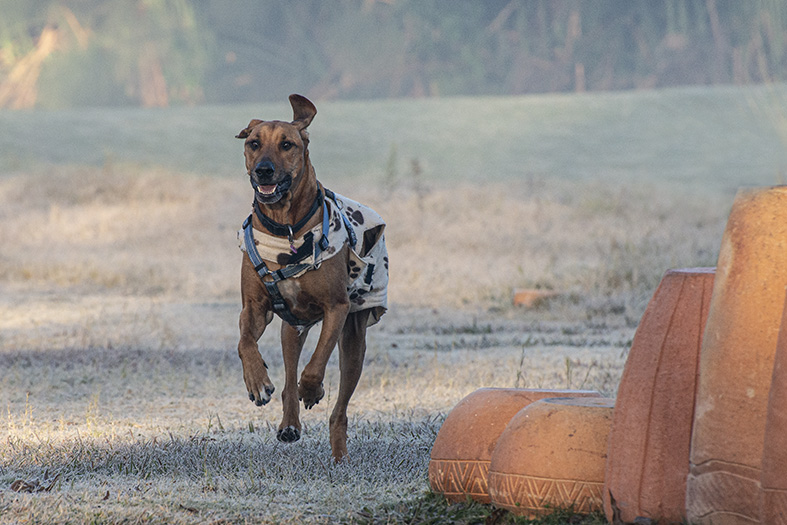
Yesterday we had a small gathering of Ridgebacks and their owners at the Wag Zone to get the dogs used to the premises. The actual centennial gathering will be there on the 13th August in the morning from 10 a.m. My Themba (above) will be attending as will quite a number of other dogs with hopefully some from neighbouring countries.

My first Ridgeback was Kim, whom I got from a local farmer in the Chinhoyi area of Zimbabwe when I worked there in 1990. She was a companion for my Labrador Cassie and I fell in love with the breed then. Being hounds they are not easy dogs and are very independent. Training takes a lot of persistence (no, they are most certainly not stupid) and if they have a failing it’s their undivided loyalty which can be a bit much at times but for an often lonely batchelor, it was a great fit. They often don’t live very long either. Unusually for this breed Kim lived for 14 years before I had to make the decision to say goodbye. She was followed by Tina, Jenni, Kharma and Zak (Roxy was my wife’s dog). Now we have Themba who has a diary on Zak’s blog and, at 9 months of age, has firmly laid claim to our hearts and centre of the bed.


Further information on the breed is only a few clicks away on the web but for history buffs the definitive book is “Rhodesian Ridgeback Pioneers” by Linda Costa (ISBN 0-646-43501-9), which may take a bit of finding as it is no longer in print.
















 Zimbabwe Absurdity
A nice idea
3 02 2015Towards the end of last year Zimbabwe was abuzz with the news that bond coins were going to be introduced. The news was not well received and, despite strong denial from the Reserve Bank, rumours abounded that it was an attempt by the government to reintroduce the Zimbabwe dollar. I had seen one or two but up until today had not actually received any as change.
Small change
Small change is in notoriously short supply in Zimbabwe. South African coins (2 RAND lower right) have been useful in that they are roughly 1/10 the value of a dollar (so the 2 RAND coin is valued at 20c) but obviously they have to be bought at least the face value plus some sort of commission. The bond coins, which are minted in South Africa, are pegged at equal to the US dollar though they have no value outside the country. They certainly cost less to produce than their face value. A nice idea and certainly preferable to receiving ball point pens or sweets as change which was the case. People receiving lots of coins, such as the mini bus drivers, can go and change the coins at the end of the day for paper money at a bank. Except, as Shelton tells me, most refuse to accept them.
Comments : 1 Comment »
Tags: bond coins, change, coins, rand, Reserve Bank, Zimbabwe, zimbabwe dollar
Categories : News & Various, Social commentary