Rumours of rain

6 11 2024
Not a massively tall termite chimney but enough to start a rumour of rain

There is a common myth that circulates Zimbabwe at this time of year; if the termites are building bigger nest chimneys than usual then the coming rains are going to be good. Apparently the logic is that they want to keep their nests dry and so need the chimney to be above the water line. It’s more than a bit flawed thinking. A lot of nests are nowhere near any flood level, historical or otherwise.

This year the chimneys are perhaps a little more noticeable than usual but that might be my appalling memory (it’s genuinely bad as a result of a medical condition but that explanation doesn’t belong here). They certainly are not big by world standards – in Australia they are really big and their primary function is cooling of the nest. Maybe they have the same function in Zimbabwe but it hasn’t been particularly hot this year.

To be a successful farmer in Zimbabwe it pays not to rely on the vagaries of the weather and use a more reliable source of water. Hence irrigation is big business. That’s not to say that all farmers have the finance or the water source to irrigate and must rely, at least to some extent, on the rains.

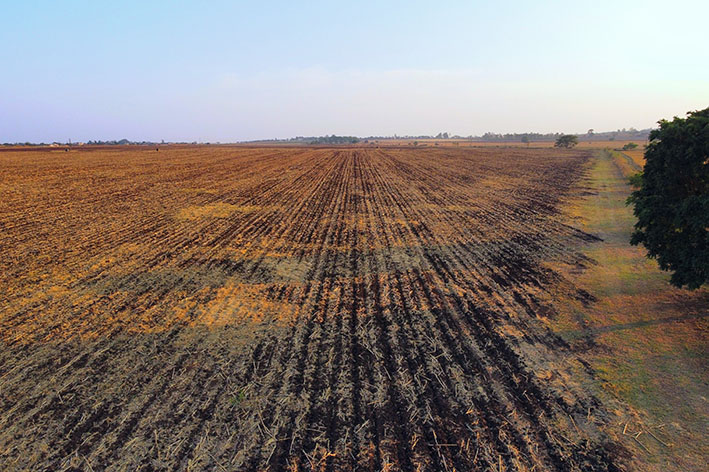
Land prepared and sown with soya beans – hopeful…

The farm where we walk the dogs prepared and sowed land some weeks back in anticipation of getting the soya bean crop off to an early start – essential in order to get a good yield. We do get some rains in October though the real season starts mid-November and whilst this year has not been an exception, not enough rain has fallen so far to get the crop germinated.

The medium-term forecast is not looking great

Last year was not a great one for rain. Crops failed, animals starved. At one point the abattoirs stopped taking any more cattle such was the desperation of poorer farmers who couldn’t afford supplemental feed over the dry season. El Niño was squarely to blame. That dissipated and was replaced by the much more favorable la Niña phenomenon which usually influences our weather to supply normal to above normal rains. Unfortunately it seems that la Niña has dissipated early and we are in for another, at best, erratic rainy season and yes, distribution can be more important than quantity. So much for the termite myth.


One degree

21 07 2024
Dawn breaking on ART farm – it was colder than it looks!

The car thermometer read 10C but I was determined to get the photograph that I’d seen on several early morning trips to walk the dogs on ART farm on the northern boundary of Harare. There was nothing for it but to just put up with the cold. Yes, it’s winter here in the southern hemisphere and we expect it to get cold, with the occasional frost in low-lying areas, but this winter has been unusually warm during the day.

We get our rains in our summer and this last season was marked by an El Niño event in the south Pacific Ocean (unusually warm temperatures) which kept the Inter-tropical Convergence Zone (ITCZ), the source of most of our summer rain, well to the north over Kenya and Tanzania. Zimbabwe went dry and consequently hungry. Most of the staple crop of maize grown in the country is rain-dependent and there was widespread crop failure. Farmers desperate to sell their cattle while they were marketable, swamped the abattoirs who eventually refused to buy any more. I’m told by my commercial farmer customers that what maize has been grown has been subject to widespread theft.

Droughts are nothing new in this part of the world – in 1992 when I was living in the east of the country we had a similar one and I took the photo below near where I was living. The next year the rains returned and the grazing recovered.

El Niño has relinquished its grip and been replaced by La Niña, which is characterized by cooling of the Pacific Ocean, which is good news for our weather pattern – we can expect a more normal rainy season this year. This unusually warm July is merely that, unusually warm due to the barrage of low pressure systems hitting the Cape in South Africa which draw warm air down from central Africa. La Niña has no effect on Zimbabwe’s winter temperatures.

From my business’ point of view I am not complaining – the warmer temperatures help us to get the seedlings through the nursery quicker and reduce costs. We really do need the prospect of a good wet season though as we rely entirely on boreholes for our water supply and despite the La Niña event of 2020 to 2022 we didn’t get the good rains the rest of the country experienced so they will need replenishing.


Celebrating 33

17 04 2013

Tomorrow Zimbabwe will be 33. And there will be celebrations. Those cynical people who have never visited this amazing country may ask what we have to celebrate. I will answer them.

  • We have 3 big South African supermarket chains with outlets that would not look amiss in South Africa – spotting the Zimbabwean produce can be a challenge though.
  • We have  plenty of fuel at competitive prices.
  • We have the biggest fertilizer company in South Africa selling  their top quality fertilizer.
  • We  have manageable inflation. Officially it is 4.5% but it may be a little higher than that in reality.
  • 10% of the population is employed!
  • We have a stable currency (not our own) in the US dollar
  • We have the world’s best climate along with Malta.
  • We have been a democracy longer than South Africa. There is a slight financial problem in funding the next general election this year but we will make a plan for the shortfall of $100 million or so.

I mean really, with all this, who needs an economy?


The art of keeping going

31 07 2012

It’s official; we have the world’s best weather (see the previous post) and at this time of year it is really predictable and dry which means it’s the season for garden art shows. The Verandah Gallery in the Emerald Hill suburb of Harare has just had its annual exhibition this past Sunday. It’s a very sociable affair with a jazz band and loads of art on display but from my point of view it’s a bit commercial – designed for the mass market and more than a bit expensive. It is all for a good cause and profits go to the nearby Emerald Hill Children’s Home for the Deaf. There will be more garden exhibitions all through to the end of September as Zimbabwe’s artists struggle to make a living in what are exceptionally hard times even by world standards. My favorite gallery is the Gallery Delta in the old house (one of the oldest houses in Harare) that belonged to Robert Paul, an eminent Zimbabwean artist. It’s run by Helen Leiros, herself a well-known artist both locally and abroad, and her husband Derek Huggins and they have monthly exhibitions that are anything but commercial. Most of the art that I have collected over the past 10 years or so has come from there. It has not been easy of late for Derek and Helen who had to sell off some of their own art just to keep going. So I support them when I can.


We have the best weather

30 07 2012

Jenny’s family left this country in the 1960s when it was called Rhodesia. The Unilateral Declaration of Independence had been declared and things were not looking good so the family settled in Australia. She now has a 16-year-old daughter who is interested in coming here for a visit. Her father (the parents are separated) has determined that Zimbabwe is too dangerous and has forbidden Jenny and Meg to come here which he can legally do until Meg turns 18. Maybe he saw the Australian government travel warning on Zimbabwe which even I have to admit is pretty impressive. I also have to admit that everything on it is true though when one compresses all the woes of just about any country onto one page it is bound to be impressive. Some of it is downright daft; “A comprehensive indemnity is often required by safari operators before they accept clients” (italics are mine) – of course it is required, you are going to come close to wild animals which are dangerous! It completely fails to mention that most Zimbabweans are law-abiding citizens, are friendly to anyone who cares to be friendly back and will go out of their way to help out. “There has recently been an increase in armed robberies, assaults and other violent crime. Security risks are heightened at night, especially on city streets, and in or near parks and the city centres”. Yes, but how does that compare with say, Jo’burg?

Then yesterday I got some spam advertising various safari options for the whole family in Zimbabwe with a mention of a survey and report by International Living on which countries are a good place to live taking into account a whole host of factors that in their opinion contribute to quality of life. The quality of life index page makes for some interesting reading. Zimbabwe is 12 from the bottom just above Haiti. Somalia is at the bottom, where it should be in my opinion.

Let’s look at the table column by column. First from the left is cost of living. Zimbabwe is quite expensive and shares indices with the Ukraine, Uruguay and Latvia. Our neighbour, Mozambique is slightly cheaper to live in. No news here; Zimbabwe got expensive after the changeover to the US dollar from the doomed Zim dollar.

Sort the Leisure and Culture column and Zimbabwe is listed there between Brazil and Chile. Scrolling to the top of the page we see that France and Switzerland top the list. France I have no doubt should be there but Switzerland? Scroll down a bit and we find Swaziland ahead of the UK! Just how objective IS this list?

Sort the economy list and not surprisingly the USA is at the top but where is Zimbabwe? Oh dear, we are right at the bottom with a score of 0. Looks like I will have to change the script below the title on this blog. I knew things were bad but THAT bad? But where’s Haiti? What, they have listed Haiti’s economy ahead (just) of Brazil’s!

Let’s move on. Environment. Zimbabwe doesn’t score well on this one either – they must have had a look at Lake Chivero recently or seen the fires on the AFIS site. Iceland is right at the top. I guess it’s been a while since a volcano erupted there.

Freedom Hmm, this is not going to be good and… no it isn’t. Well, at least we are ahead of North Korea, Somalia and Saudi Arabia. The lower rankings are depressingly shared by our fellow African countries to the north. Russia is not highly rated either. Maybe this list is reasonably objective.

Health is topped by France and Japan and Zimbabwe is a bit further down. Well, it’s actually quite a long way further down with other African nations. That has not always been the case. I know a public health doctor and she’s told me that once upon a time when had a really good health system. But that is no reason to not visit the country. The private clinics have some fine health care professionals and specialists.

Infrastructure is not a shining light for Zimbabwe. We are ahead of Mozambique though and I am on the internet on “broadband”. Our version of broadband. Not yours!

We have a quite respectable score of 57 under Risk & Safety. Just about all the other nations listed have a higher score. Except Iraq, Afghanistan and Haiti. It must be the driving but I cannot believe that anyone’s minibus drivers are worse than ours.

What about weather? Click on the weather column and there we are; right at the top with Malta! I’ll accept that ranking. I don’t suppose the Aussie government bothered to look at our weather ranking. I don’t care that much, I KNOW we have great weather here in Harare. I’m not sure that I’d want to live in the south-eastern lowveld but it is pleasant enough in winter. Summer it gets very hot and humid.