Smoke. Everywhere smoke from incessant bush fires started to clear lands or smoke out bees or just plain carelessness. Every year Zimbabwe burns as does the rest of southern Africa – 760,000 sq. km in 2023.
Glowing ember sunsets and reluctant red sunrises. The latter so dull that one can, with binoculars, safely see the sunspots. Lots of photo opportunities to be had.
Dust. Everywhere dust. A patina of dust on my desk every morning. The dashboard of my truck covered in dust. Motes of dust in my home office – drifting lazily down in an afternoon sunbeam.
Wind. September is the month of wind. Driving leaves, bending trees and driving the dust. Leaves and ash swirling on the garage floor. When I sailed we always used to look forward to September for the excitement of the gusty weather. In my paragliding days we’d think of other things to do though the calmer days gave good thermic conditions.
Colours. The blazing colours of the new growth on the musasa (Brachystegia speciformis) trees. If one is lucky and catches a day of relatively little smoke it is possible to photo the spectacle. I never have. One has to drive up to the Eastern Districts to get the best displays.
Our Dendrobium orchid has been particularly impressive this year.
Cool nights and warm days. Yesterday morning on ART farm it was 5°C at 6 o’clock and 29°C by midday. My fleece jacket has been washed and hung up in the cupboard until April. I am still sleeping in the bed but October will just be hot and I’ll sleep on top.
New growth. Our roses are a blaze of colour (admittedly we have been getting professional help). Everything is growing fast in the nursery. A customer for whom we are growing cherry peppers commented that he’d never seen such good seedlings. I’ll take the credit…
Our roses are looking good this spring. Marianne has commented that we need a few more yellow ones.
Bees. It’s bee swarming season. A swarm has been in one of the catch boxes hanging under the eves of the second garage for a few weeks now. It will be collected by the Mike the bee man (he runs a commercial pollination service) and we’ll be given another jar of honey that we don’t eat. In the meantime they’ll forage in the garden and elsewhere before being taken off to work. We don’t mind being a bit of a bee holiday camp.
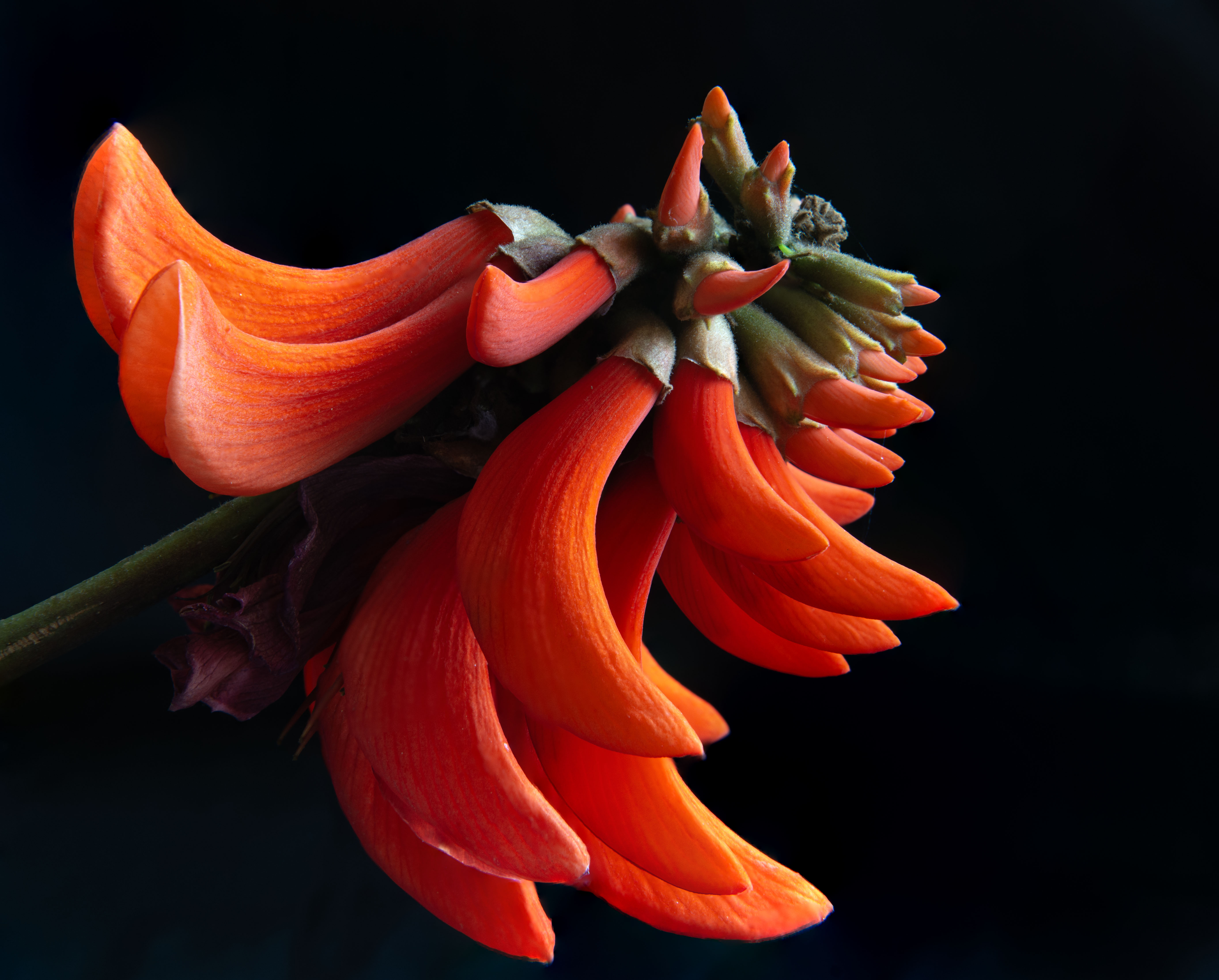
The Erythrina lysistemon (coral tree) trees has showy flowers too. This one was dripping nectar – literally!
Dry. Of course it’s dry and it will be desperately dry by the time the rains arrive in November. Our lawn is crisp. The flowers and vegetables get water but there isn’t enough for the lawn so it just has to wait. It will green-up soon enough when the rains start. It will get a little fertilizer help too and then it will need mowing weekly.
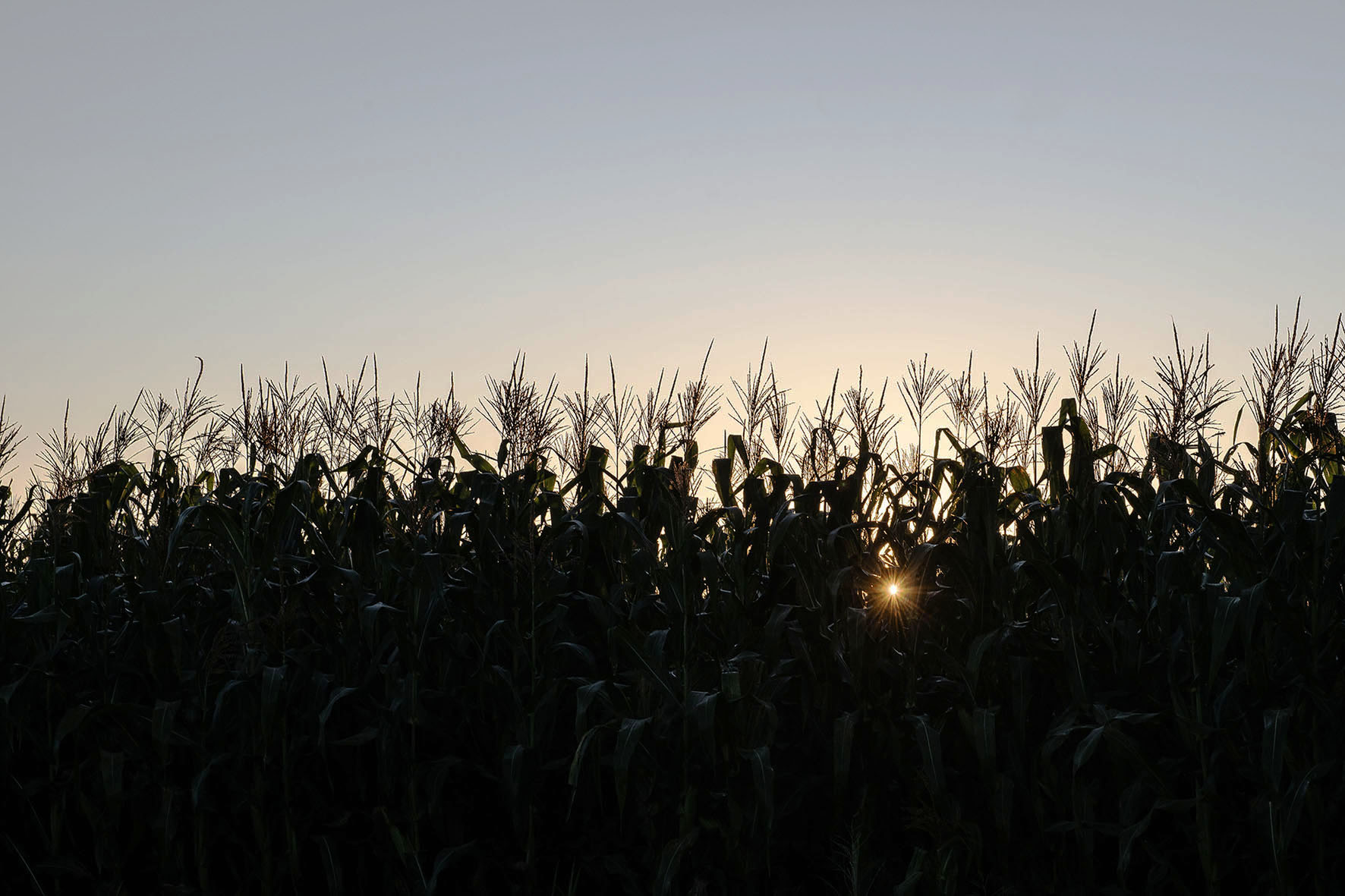
The sunrises over a decent crop of maize on ART farm. Not exceptional rains but enough.
It’s been a strange rainy season here in Zimbabwe. Our rains arrived pretty much on schedule in the middle of November but that’s about all that has been normal about them. The usually dry southern and south-western parts of the country have been inundated. The Bubye river, normally notable for it’s sand content has flooded. Lake Mutirikwe has actually spilled and the largest internal lake in the country (discounting Lake Kariba which is shared on the border with Zambia) VERY rarely spills. The Barotse Floodplain in western Zambia has lived up to its name and flooded and a Zambian-based colleague confirmed that most of that country has had good rains. That’s just as well, as it’s a major source of water for Lake Kariba which has been below generating capacity and has only been letting water downstream as part of an agreement with Mozambique on which Lake Cahora Bassa is situated.
The agricultural town of Chipinge is located in the south east of the country near the Mozambique border. Being on top of the escarpment on the edge of the Mozabique coastal plain, it gets a lot of rain. The climate is mild and the area is known for it’s avocado, banana, macadamia, coffee and other sub-tropical fruit farms. It’s also the home of the biggest tree in Zimbabwe, a red mahogany (Khaya anthotheca).
I was chatting to a potential customer from the area last week. Of course we discussed the rain. Up until December last year his farm had only received 200mm of rain. “Then it rained for three weeks solidly. Look, I’m not complaining but it was a bit intense. Now we’ve had 1,600mm!”
The rains here in Harare started pretty much as usual in mid-November but took a while to get going. The farmer on ART Farm where we walk the dogs in the morning took a chance by planting the commercial maize early but then had to keep it going with supplemental irrigation and even had to replant some lands when the irrigation couldn’t move fast enough. Elsewhere farmers were more lucky.
A decent crop of commercial maize. It’s seldom profitable and grown largely for political purposes – “Look, I’m doing my bit for the country”
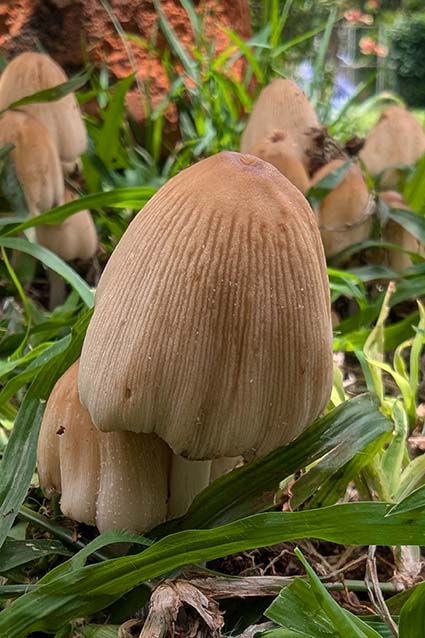
The rains have been regular enough to encourage fungi growth. Mushrooms have been regularly cropping up in our garden. Were they edible? I am not at all sure. As one wag put it; “All mushrooms are edible, but some only once”. I do have a book but am not at all an expert in identifying them and I wouldn’t trust Google Lens quite that far.
Probably not Chlorophyllum molybdites as it doesn’t have a green tinge. Bottom right is Agaricus bisporus, the common domestic mushroom, but it’s rather old.Small and short-lived, these (unidentified fungi) regularly cropped up in the same place in the garden after a decent shower. By the next day they were gone .
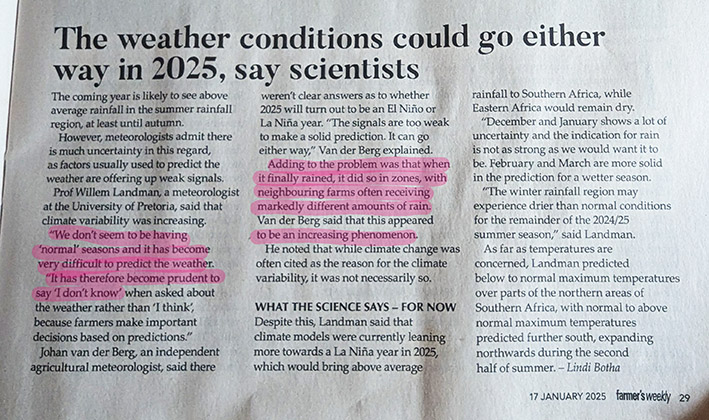
Weather apps abound but they are notoriously inaccurate, at least in this part of the world. Marianne belongs to a WhatsApp group that shares rainfall information and the variations in rainfall just a few kilometers apart were often stark. Whilst it’s tempting to attribute this to inaccurate rain gauges and exaggeration tendencies, it cannot account for differences in excess of 100%. We’ve had 648mm to date, in a “normal” season we’d expect at least 750mm, whilst guests this afternoon said they’d had over 1000mm some 30km away to the east. Bill, the owner of the rain gauge that recorded this, did admit on being a bit skeptical as to its accuracy.
A January issue of the South African Farmer’s Weekly magazine echoes the inconsistency of rainfall over small distances and the increased difficulty in making accurate forecasts
I am not sure if the weather apps are more reliable elsewhere in the world but it wasn’t unusual to get a high probability forecast of rain to be greeted with a clear sky when it was forecasted to be raining. It did on occasion go the other way – heavy rain when the forecast was for clear skies.
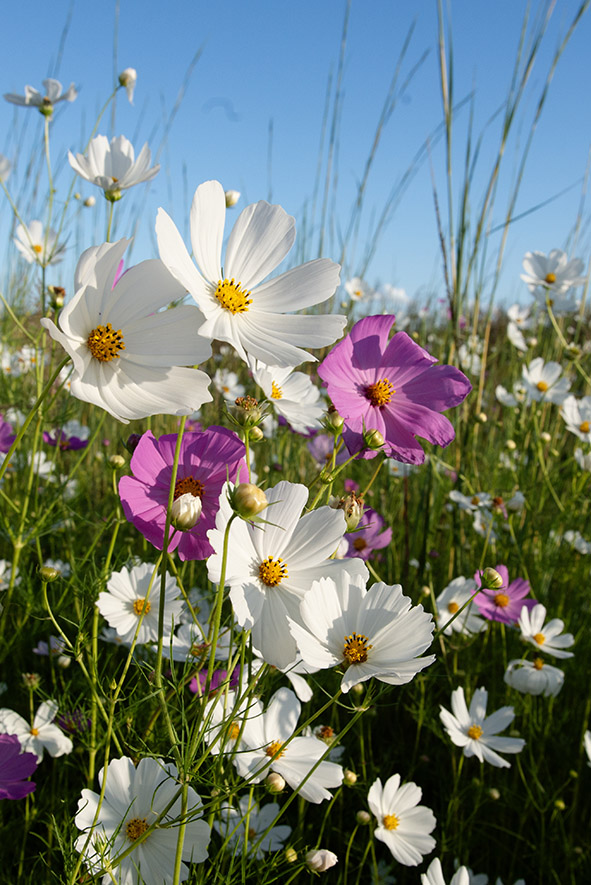
The grassland flowers have been spectacular this year. Admittedly the cosmos are usually spectacular so maybe it’s just my perspective. Every year I try to capture the intensity of the displays and inevitably am disappointed. Will give it another go next year!
Cosmos bipinnatus – possibly introduced in horse feed from Argentina around the time of the Anglo-Boer war in South Africa.
The yellow hibiscus below is indigenous to Africa, Yemen and India (and some sources say Australia) which makes me wonder if it goes all the way back to Gondwana, the super continent that began to break up some 180 million years ago in the early Jurassic.
Whilst not as intensely showy as the cosmos, the Hibiscus panduriformis is spectacular in its own way.
There is not a lot of information on the yellow hibiscus but it seems to be mostly nocturnal. The image above was taken at 6.20 a.m. and there is already a dead flower on the stem. From observing flowers by the road on the way to my work I know that by midday all flowers are gone. Apparently it’s relatively easily propagated from seed and cuttings so I might try establishing a few in the “wild” section of our garden.
As we approach the end of March we are unlikely to get much more in the way of significant rain though in April last year there was a 42mm on the 6th. This was unusual as it is normally a month of warm days and cool nights a plenty of sunshine. What most people would call perfect weather. We like a bit of rain with it too.
The Hippo Pools wilderness area is in the Umfurudzi National Park some 140km north east of Harare. Located on the banks of the Mazowe River it is hot and humid in summer. That did not deter my brother and I and apparently enough other people to ensure the lodges and chalets were full (I would guess the camp site was one third full) so we managed to book a permanent tent and settled for “glamping”. It suited our purposes fine and we followed the standard practice of game drives in the early morning and evening and just dozing during the heat of the day.
The road from Harare is fine until the mining town of Shamva then has some very bad stretches until the turnoff into the park at Madziwa Mine which appears derelict. Then one has to slow down. It’s still passable to passenger cars but once in the wilderness area the roads preclude low clearance vehicle. For the energetic that’s not an issue as the area has no dangerous animals (apart from crocodiles and hippos) and walking and cycling is encouraged. At this time of year the horse flies are a problem to the extent that we had the windows up and air-conditioning on to keep them out but once we got out the blood-letting started. They were absent from the camp region.
We enjoyed our time there even though I feel certain areas could be improved. For the hard core game watcher there are better parks but they are further away from Harare so this one is convenient. Would I go back? Probably, but not in summer.
Glamping = glamorous camping
Impala batchelors. Herds consist of several males who hang out together until they can displace a dominant male and take over his herd of females.
There’s nothing like a “road closed” sign to tempt the explorer! Actually the sign was for those not in 4×4 vehicles when the road was wet. It was dry and easily passable though other roads were challenging even for my 4×4 pickup
The chalet and camping area was green and well tree covered. Each chalet and lodge had exclusive river views.
Our glamp site. Perfectly adequate. Bathroom en suite, a double bed and 2 bunk beds
There are worse ways to pass the heat of the day than in a hammock in the shade of massive trees.
The bar and dining area. Self catering is also an option. The menu was a bit limited but adequate considering the remoteness of the camp.
Love me tender… A liana provides what might be a deadly embrace to a tree.
The Mazowe River from the bar/swimming pool area. The dirty colour is as much a result of mining upstream as the recent rains.
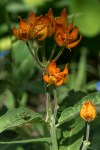
Orange flower and cricket. Nope, maybe someone else knows what the flower is called.
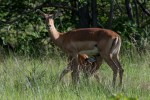
Impala spoor. A mother and likely her newborn calf.
Wildebees. The bush is not conducive to game viewing so what is encountered is often very close and as a result they are skittish. My brother claimed the one with the blonde forelock on the left was likely a rebellious teenager.
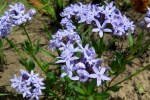
A fascinating blue flower. I’ve never seen anything quite like it.
A purple flame lily. The national flower – most usually a vibrant red though also exist in the yellow.
There were lots of young impala. They are at the bottom of the antelope food chain and breed prolifically. The wilderness area has only one leopard that anyone knows of and no other predators. What the National Parks will do to control the population is not clear at this stage.
One very prickly character.
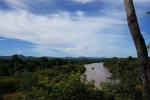
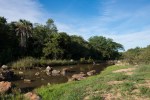
A tributary of the Mazowe River. No people, no cellphone signal, no plastic. Bliss.
The epitome of patience.
The dawn sky from our camp site. Tourists love the African sunsets which are often spectacular but for me the dawn skies are worth getting up early for. Watching the colours change and listening to the bush come awake is magical.
Agriculture is not an exact science and sometimes things go wrong. The tobacco seedlings we’d sent to a customer near Headlands, an hour and a half to the east of Harare, had been well received until he informed me that we were some 160,000 seedlings short out of a total of some 500,000. I was more than a touch bemused. This warranted a visit to try and ascertain what had happened.
Leaving early this morning before the traffic had got going I arrived at 8h30 after a rough 20km south of the main Harare-Mutare road. The lands were impressive and well farmed in contrast to the derelict farms I passed along the way.
Not a lot happening
The farmer, young by my standards, had recently been allocated the farm by the government meaning that sometime in the past another farmer had been kicked off it though there was no evidence that I could see of habitation. I had to give the new farmer his due – he’d worked hard to get his project going starting pretty much from scratch and had got a substantial loan from a Chinese farming company that wanted his tobacco. The company has apparently been in the area for about the last 10 years. Of the missing seedlings there was no sign. Whilst we have absolutely no legal obligation to seedlings once they leave the nursery I did feel bound to meet him half way on the cost as I’m pretty sure he’ll be back next year. I made it clear that I expected him to check the quantities when they arrived (he admitted they hadn’t) and I made clear that this was not going to happen again.
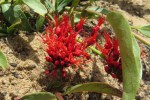
On the way back I noticed a small burnt area near the main road and stopped to take some photos of the flowers that had bloomed after a recent fire. They didn’t need a loan to make the most of life; just a fire!
Flowers after a fire
Bells of St Mary’s – always looks good from far but difficult to photograph
I only noticed the ant top left when editing the photo!
It was quite a “culture” shock getting back from Cape Town on Friday. Back to the dirty streets, potholes, melies growing on the verge and plastic bags and polystyrene lunch boxes EVERYWHERE! Cape Town is still clean and well run. To be sure the crime is a serious problem but after 2 weeks of unwinding I was thoroughly relaxed. The weather was good as one would expect at this time of year though the wind got a bit tedious it lived up to it’s more pleasant moniker (Cape of Storms being the other one).
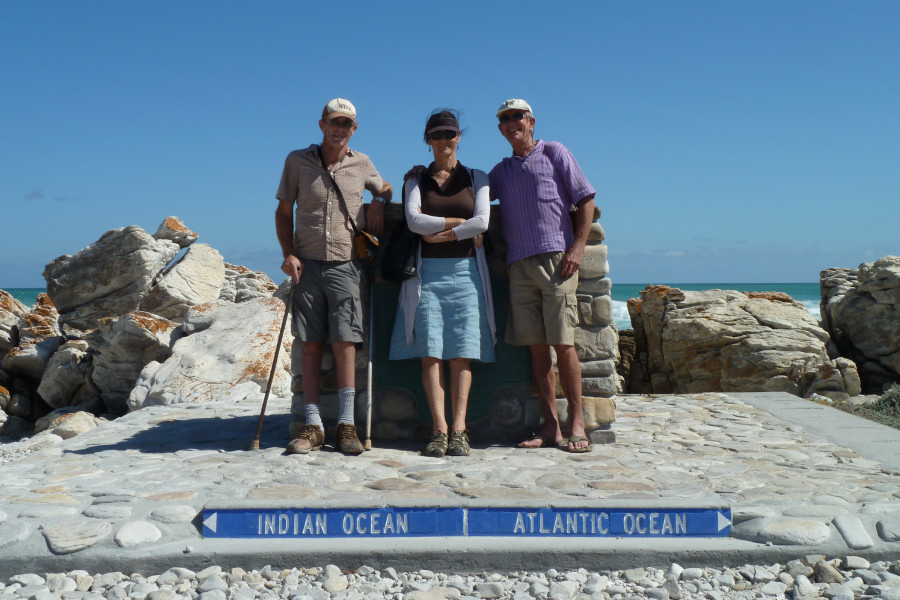
Cape Agulhas. Not nearly as dramatic as Cape Point but it IS the southernmost point of the African continent. L to R: self, June, Gary.
There are lots of old, windblown trees on the peninsula. This old cyprus somehow escaped the exotic eradication policy of the park. There are some indigenous trees around though we did not see them. Curiously there does not seem to be a policy of propagation and replacement of the indigenous trees. That’s Cape Point in the background.
That’s it! Cape Point. It does not get much more dramatic than this. Pity you cannot smell the guano.
The fairest capes. Cape McClear in the foreground and Cape of Good Hope in the sea mist behind.
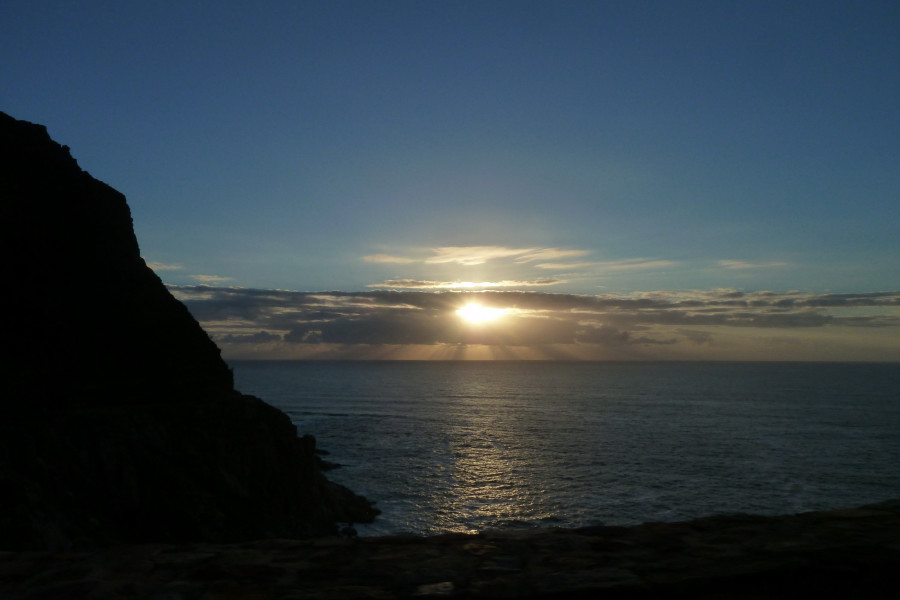
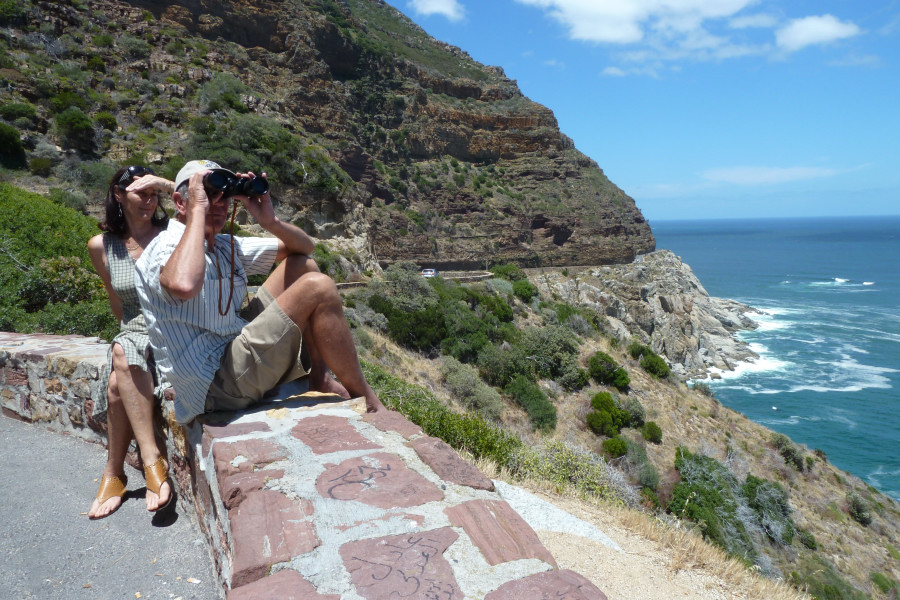
Sunset on Chapman’s Peak Road. This road on the west coast of the peninsular was closed for a number of years due to dangerous rock falls. It has since re-opened with steel catch fences but I don’t think they would stop anything sizeable.
Chapman’s Peak road
I do know the name of this one! It’s an erica (all part of the fynbos – which is fine bush to those who don’t speak Afrikaans)
Lots of flowers!
More flowers
I guess I should get a book to identify the flowers next time. The Cape is know for its flowers in summer.
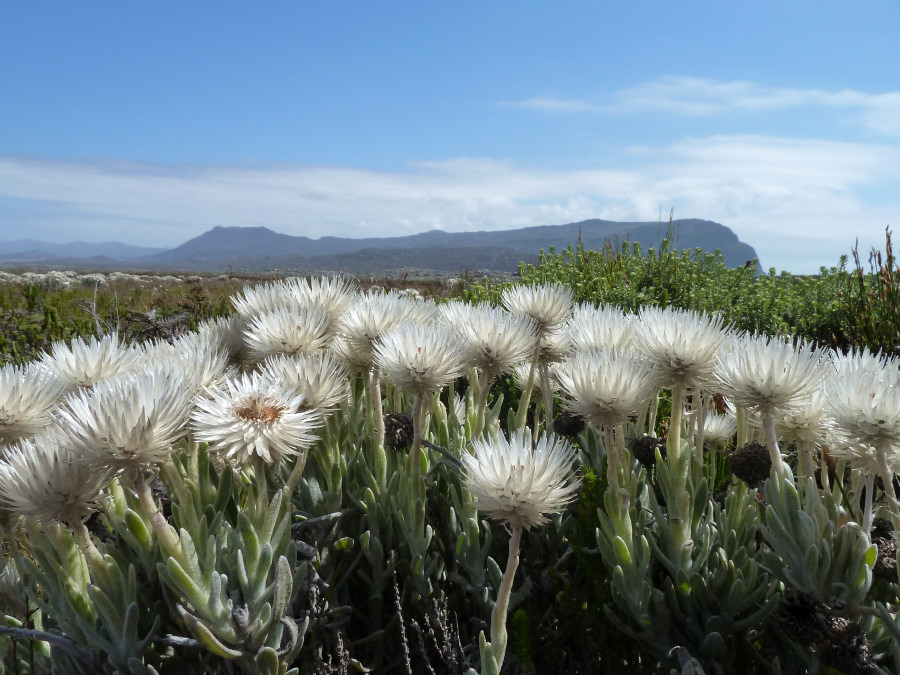
These small flowers were all over Cape Point.
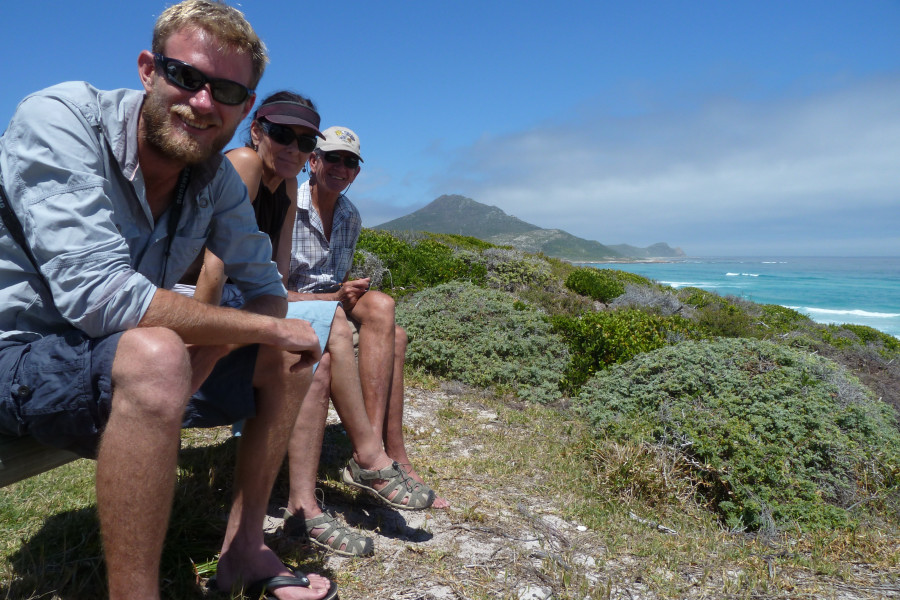
3/4 of the Family Goss. Stuart works in Liberia (that’s him on the left) and he managed to join us after 5 days. June and Gary L to R.
Hout Bay from Chapman’s Peak Road
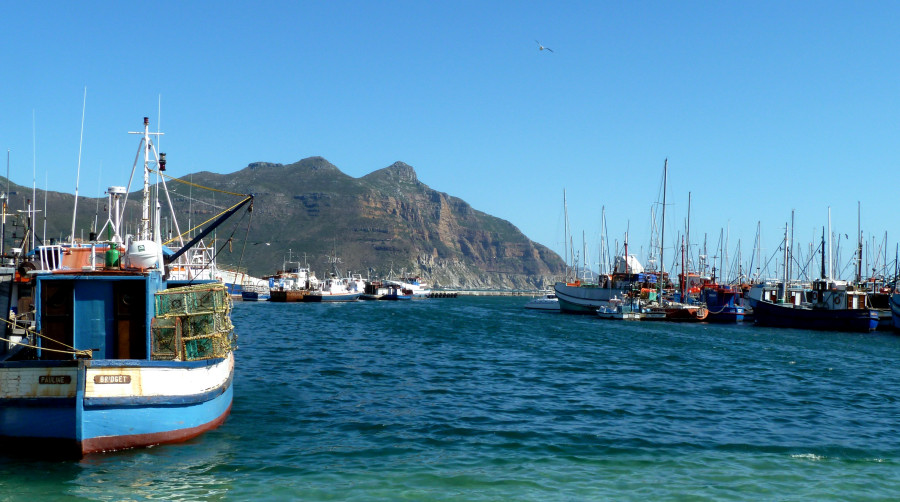
Hout Bary Harbour looking south (Hout Bay is on the west coast of the peninsular)
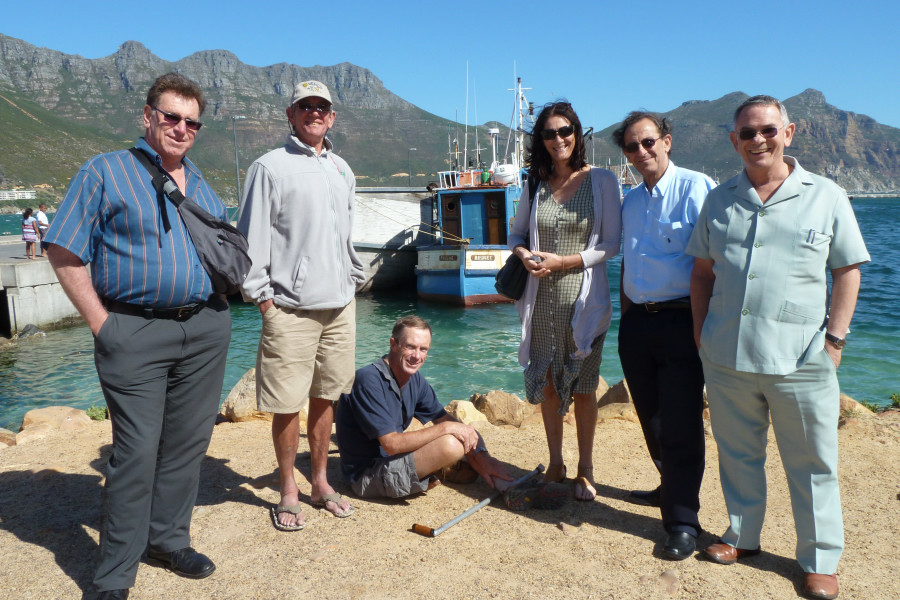
Hout Bay for lunch. Zimbos are everywhere! We met (from L) Leslie, Gary, self, June, Peter and Simon for lunch at the Hout Bay harbour.
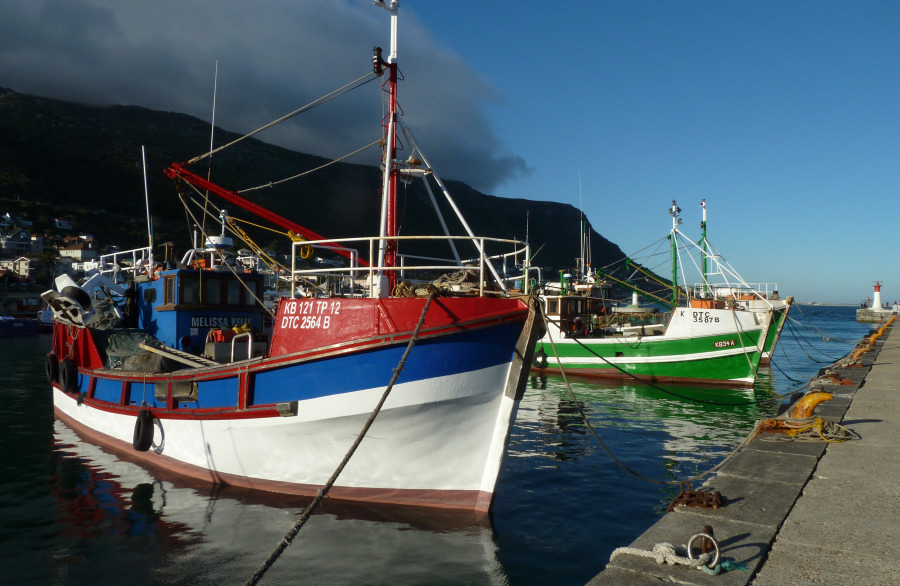
Kalk Bay Harbour is a favourite of tourists and very picturesque. I suspect the boats are kept looking pretty to keep the tourists coming. Some good cafes there too.
More Kalk Bay boats
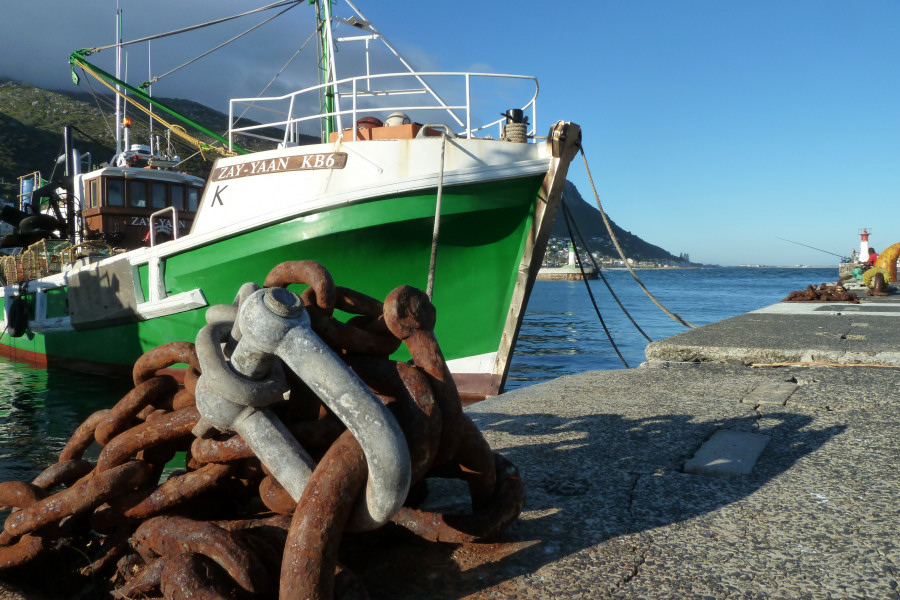
Another Kalk Bay fishing boat
Kalk Bay fishing boat
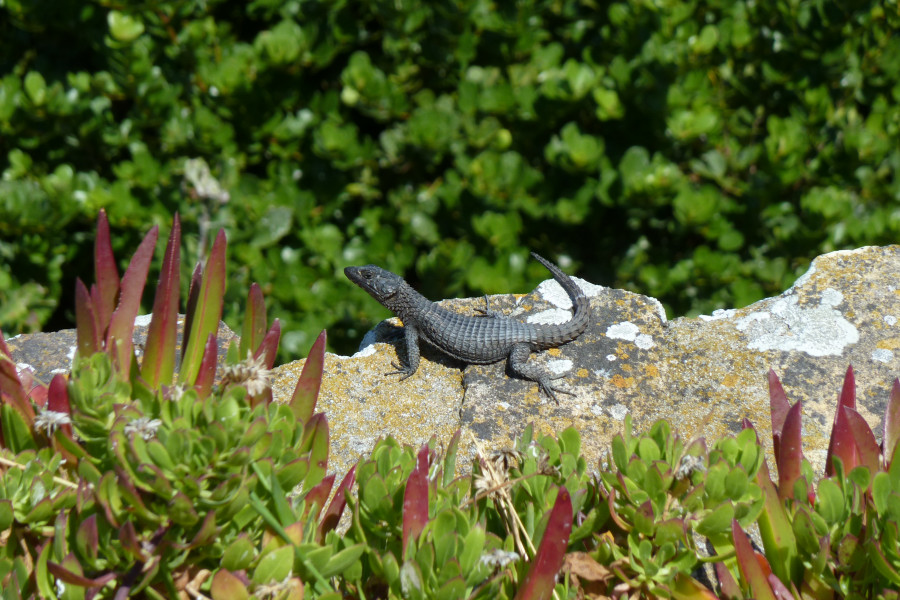
Lizard. There is other wildlife in the Table Mountain National Park. Baboons abound and are a nuisance at the picnic sites where they are kept at bay by game guards. NEVER feed them – it only makes them more aggressive.
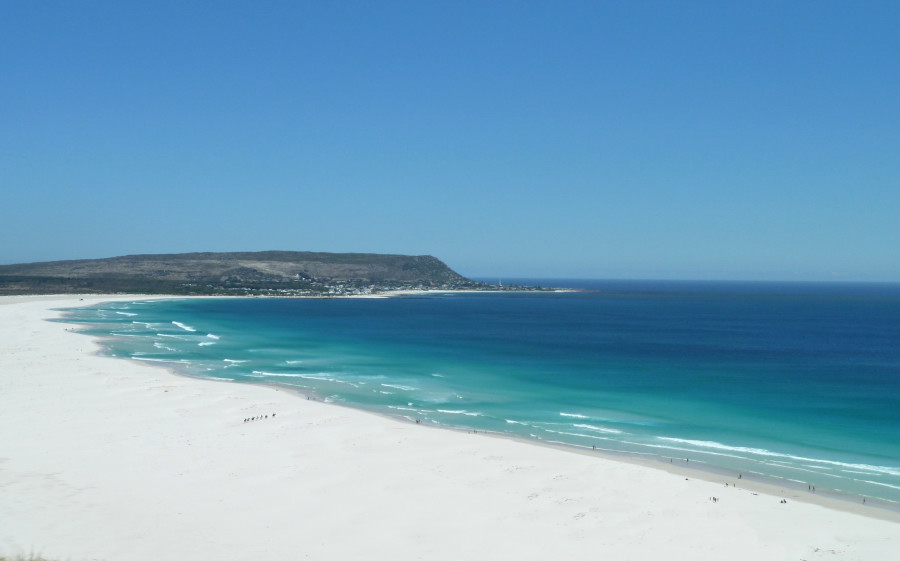
The appropriately named Long Beach on the west coast of the peninsular. Those are horses in the centre of the photo.
Muizenburg is on the north coast of False Bay and a favourite of surfers.
Proteas are everywhere on the Cape Peninsular – no wonder they are the national flower. It’s all part of the fynbos (fine bush) which in the region is home to some 1100 species of plant. Tha’s one of the highest densities of species per area anywhere on the planet.
Looking north from Simon’s Town. View from the flat we rented looking north to Kalk Bay, Fish Hoek and Muizenburg.
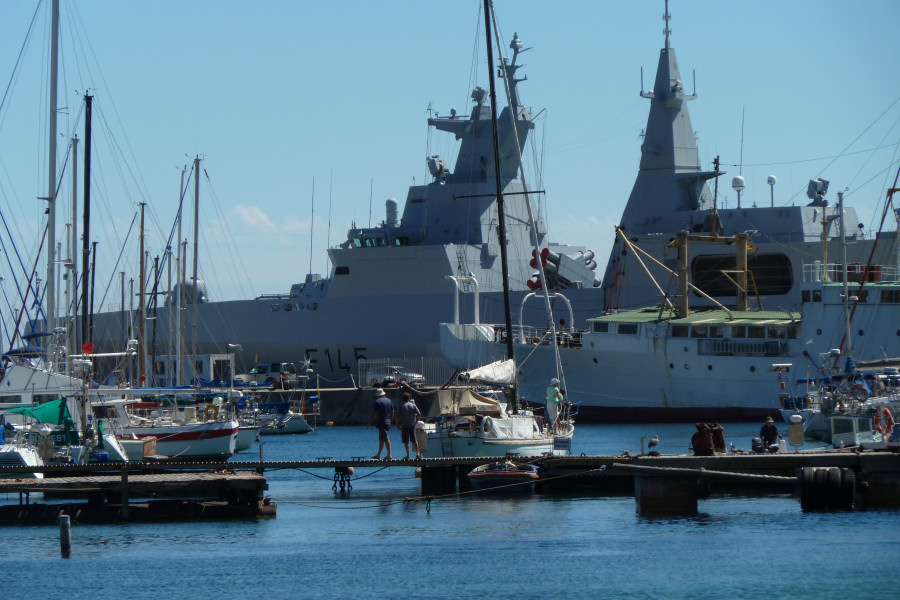
Simon’s Town naval base. Home of the South African Navy.
Simon’s Town looking south – it is located on the west coast of False Bay. That’s the South African Navy (frigates) in the harbour.
Wreck at Cape Agulhas. The Cape Peninsular is littered with wrecks. You can even do a “wreck tour”.
All photos taken with Panasonic Lumix TZ8 compact camera.
























 Zimbabwe Absurdity