Brain waves – literally

28 09 2025
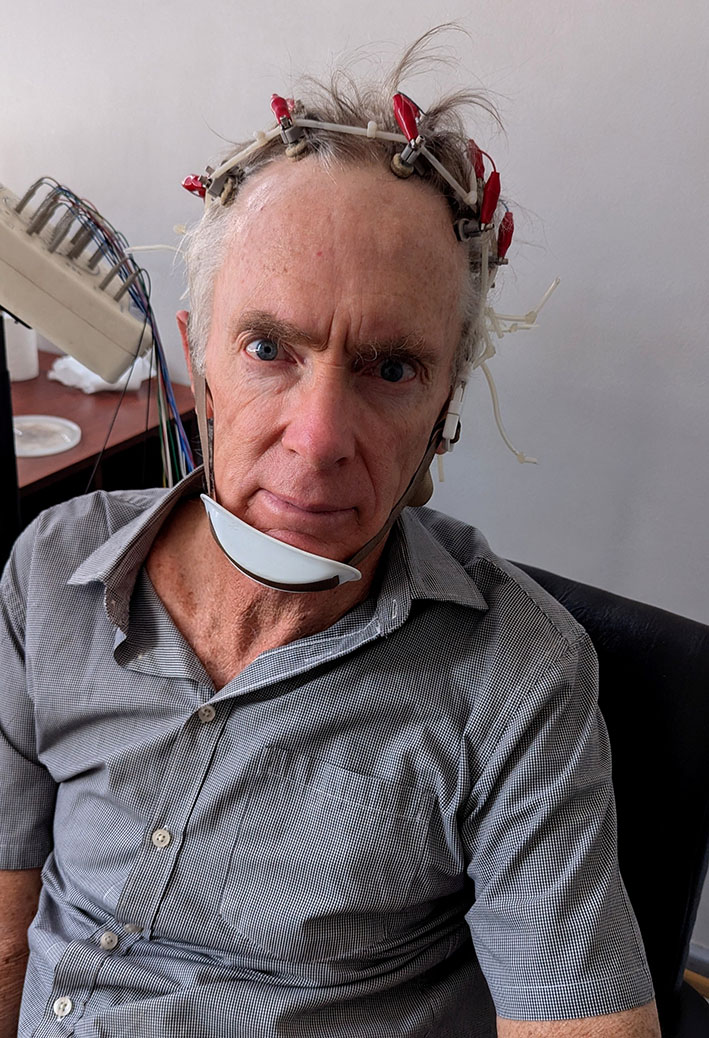
The author – all wired up

I have to marvel at the irony: there was I, having just had the electrical output of my brain recorded by EEG and there was no electricity to operate the lifts to take me back down the three floors to the building’s exit. Of course there were stairs but as a disabled person I find them a challenge. Some challenges I enjoy – others just have to be endured – so ignoring a staff member’s suggestion that I wait out the outage, which could be minutes but more likely will be hours, I start down the stairs.

The drive into town is remarkable by it’s ordinariness – no stupid overtaking or creating extra turning lanes at the lights. It’s moderately heavy but flowing. I have memorized the route – it’s not difficult, King George Avenue through Avondale, over what was North Avenue (I couldn’t be bothered with learning the Mugabe era name changes) then second left into Baines Avenue and look for number 60.

Baines Avenue is about as grubby as expected with street vendors, dust and rubbish. I take in the Canadian Embassy across the street (most other embassies are further out of town) but don’t have time to do more than glance before a self-appointed parking attendant asks me where I want to go and waves me into an empty parking bay some 30m from my destination. He is missing teeth, untidy but pleasant. I ask his name and forget it but know that he’ll be there when I come out, hoping for a tip.

It’s a short walk past the vendors’ wares of fruit in season, toilet paper bundles and sticky drinks. There are pineapples and papaya (pawpaw in the local parlance) and bags of ready-to-go peas in the pod with a chili pepper in each bag. The foyer of number 60 is clean and I ask my way to the lifts. Arriving on the third floor I have to pay attention to the PVC tiles that have lifted and are loose. The doctor’s rooms are clean and well-maintained.

Doctor G the neurologist, is a pleasant, very slender, small man in his 50s. We discuss my epilepsy which was initially diagnosed as POCD (post operative cognitive dysfunction) after a lower spine operation some three-and-a-half years ago. The diagnosis was changed to temporal lobe epilepsy when the seizures continued after the two year limit. I decided to see a consultant physician with an interest in epilepsy who starts me on a course of lamotrigine which is the medication of choice for this type of seizure – focal onset aware (or simple partial). An EEG was done which the physician assured me indicated that the medication was working. The seizures became focal onset impaired awareness (or complex partial) and the medication was increased. The seizures changed their nature again. They were the typical “petit mal” seizure, which are preceded by an aura where I can sense a strange taste or smell or hear a woman talking following which I go into a state of “absence”, where I am aware of my surroundings but cannot remember what they are. Now they become a partial complex seizure which last longer. A full suite of tests is ordered. All are normal save for the MRI which shows that the right temporal lobe of my brain is smaller than the left. It’s not progressive. The medication dose is upped again. The seizures, such as they are, change again.

One day at work I cannot remember how to walk down the stairs from my office which is a major problem for me as a disabled person who has to think about every step. Dr G is fascinated and tells me what it’s called (no I cannot remember that either!). These seizures or episodes are no longer momentary – this one lasts several hours and I’m only aware that there’s been a problem when I stand up from the table on the verandah and realize my mind is clear. I mention that I am making a lot of silly errors in the programming that I do for my work software. Dr G misunderstands and thinks that I have taught myself programming recently (I learnt at university) and comments: “At least you can still learn something new – I have never learnt to swim. Years ago my son said to me – Dad it’s easy, you just have to float. My reply was – if it’s so easy why do so many people drown?”. I like this man.

Dr G comments that the lamotrigine is not working as it should but before changing the medication he recommends doing another EEG. I remark that it sounds a lot better than the neurosurgeon who referred me to him whose parting words to me were – “of course the only permanent solution is surgery”. I tell this to Dr G, he smiles and says “that procedure requires very precise measurements”.

The EEG technician is available so we do the EEG right away. I am required to keep my eyes shut for most of the hour. I don’t fall asleep because the chair is so uncomfortable. I ask him how long it will take to analyse the results. “A while” he replies. “There are 360 pages to go through”.

The staircase takes a while to negotiate. Fortunately someone offers to help and I ask her to take one of my walking sticks down so I can use one hand on the railing.

The informal parking attendant is hovering near my pickup truck. Next to my truck a person has his laptop out on the boot of a car and is listening to a smartly dressed gent in a black suit talking intently on his cellphone. The car-watcher reminds me as I get into my truck that he’s hungry. It’s not very subtle but I don’t mind and give him $2.

The drive back home is as uneventful as the one into town.


Getting old

25 03 2024

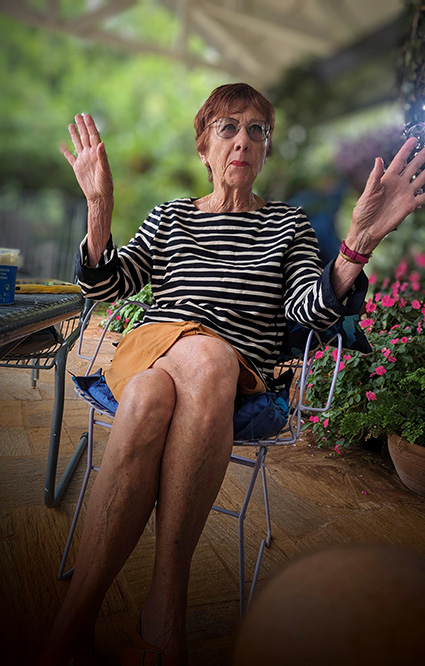
This is Claire. Claire is 78 and still teaching ballet. I am approaching 65 and not remotely as able as she is. Of course I have a few extra physical problems being a paraplegic that make me wonder just what life will be like when I get to 78. I am not looking forward to it though that’s easy to say from the safety of my age. 13 years ago 65 was too far away to be of much concern; that’s not to say I didn’t think about it, I just wasn’t able to envisage what life would be like.

Getting old in Zimbabwe is especially problematic. Nobody is going to look after you if you don’t have the money or children and that’s not a given. The state certainly won’t help. You’d better have made a plan and Marianne and I don’t really have one. We do have a two bedroom cottage in the garden which we rent out and when the time comes we’ll move in there and rent out our house. If, or when (if I live long enough), Marianne or I need care we are going to have to make an uncomfortable decision. I am sort of hoping that I will not live that long but talking about one’s death is easy until it actually looms. Given the state of the driving in Zimbabwe it might well happen sooner rather than later. This afternoon on the way to a function we had to take evasive action after an oncoming pickup truck decided to overtake into our lane.

Marianne went this week to see a potential customer for the medical insurance she sells. An elderly lady with glaucoma, she lives in a rented flat in a nearby retirement complex. The management had told her that she would have to give up her accommodation and move into the frail care section. She was incensed and in the end decided to move to her children in South Africa. At least she had the option.

Old age has a checkered relationship with my family. My father was murdered in the Rhodesian war at 52 (he broke the rules and paid the ultimate price) and my mother died at 67 from a misdiagnosed melanoma. My sister died at 62 but my aunt (mother’s sister) turns 95 next month and is bright as a button and still lives in her own house 25 minutes away with a couple of domestic servants to help her. Her oldest brother lived to be 94 and, while still mentally active, ended his days miserable in a care home in the UK. Her other brother died of cancer in his 70s.

Last year after a series of “seizures” I underwent a battery of medical tests. They showed nothing untoward and the physician held up my results of the neck scans on my blood vessels and remarked; “Well, whatever eventually kills you it won’t be your heart – you have the vascular system of a teenager!”. I wasn’t sure if I was pleased or not. A number of friends over the years have succumbed to heart disease and from what I have heard it’s not a bad way to go. Here one moment, gone the next. Dementia and it’s variations; now that DOES scare me! The seizures, episodes of confusion and disorientation, were eventually put down to post-operative cognitive dysfunction (POCD) which was likely caused by the heavy general anaesthetic I’d received whilst undergoing lower back surgery, as a result of the original war injury, two years ago. The physician told me it could last up to two years.

The two years is up next month and the seizures have continued unabated. They come in clusters every six or eight weeks and can be very worrying. After a particularly intense one where I asked Marianne what the name of one of our dogs was and then couldn’t remember where a computer shop was near a bank I use, I decided it was time to go back to the physician. He listened to my account of the seizures, asked questions, and then said “That sounds a lot like temporal lobe epilepsy and, given the fact that last year’s scans showed up no abnormalities, I don’t have any idea what could have caused it”. I have been prescribed medication but it will take some time to work up to the full dose and then see if it works. Worldwide there are an estimated 50 million sufferers of the condition.

My mobility is dismal. After university I cycled across France, Switzerland and Germany then back to the UK (see Reflections on the first half). Then I went traveling around the world. I needed a walking stick and I could carry my own backpack and was independent. Now I need two walking sticks and if I fall over I struggle to get up again without help. I am very glad I went traveling whilst I could. I have come to accept that I am going to need a wheelchair in the near future. I customer did send me some photos of an electric golf cart which he thought might be useful for me to get around in at work but I thought it over the top.

I was never very concerned about falling over until Karole came to visit me at work recently. She was in the St Giles rehabilitation centre at the same time I was – she’d fallen off a horse and sustained spinal injuries that left her with a disability similar to mine. Having spurned walking sticks for years she now uses one and recounted how getting into her car recently she’d fallen over and fractured a hip. She showed me the X-ray, it was spectacular. It’s made me much more cautious to the point of paranoia which is not helpful.

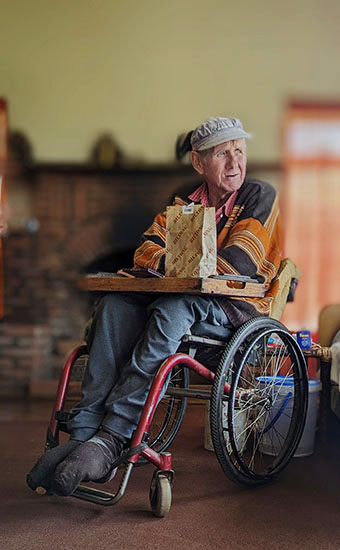
I also met Terry in St Giles. He’d been paralysed in a military parachuting accident and, unlike me, had totally lost the use of his legs. We became good friends and he used to tease me and say that I was just a “weekend para”.

Terry – my paraplegic friend

Also unlike Terry, I don’t suffer constant pain. Some days are bad though and I do remember the pain-free days, but in general I don’t have major issues. I do go to the gym four days a week, two under the supervision of a physiotherapist cum trainer, to try and slow down the rot but that’s all it does. For the moment I will rely on my dog Themba to keep me a bit younger.

The young and the old