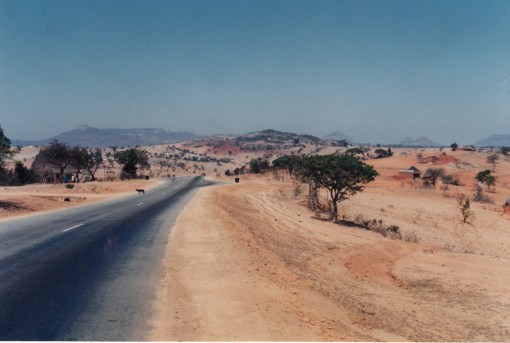
Watsomba area of eastern Zimbabwe 1992
Zimbabweans have a curious attitude to the rainy season; they almost think it’s a right and are somewhat puzzled or even hurt when I say no, I don’t think the rains are going to come this year. Of course we will get some rain but it’s almost certain there will be a drought.
In 1992 we had a drought. At the time I was working in Penhalonga in the high rainfall eastern area of Zimbabwe. I was doing freelance programming; there was plenty of work but it did not pay well as people were not convinced of the value of it so I left and in 1995 (another drought year) started an agricultural job near Harare.
The photo above was taken north of Mutare in a high rainfall area called Watsomba. I don’t recall the actual date but you can see there is hardly a blade of grass to be seen. In those days Zimbabwe still had a vibrant agricultural sector and despite the ravages of the drought nobody went hungry because the commercial farmers (mostly white) knew how to use their resources well and besides, drought is endemic to southern Africa so there was plenty of stored water to irrigate crops.
This year a drought is likely but there’s a major difference; there are very few capable farmers left. Most were driven off their land by the Mugabe government in 2000 – 2002. Many of the former commercial farms lie derelict and ironically, the dams (reservoirs) that ensured plentiful crops and established Zimbabwe as a regional food exporter are still mostly full. There are two reasons for this – there are few farmers to use the water and those who can prefer to pump the water for more profitable crops than the staple maize. Pumping is also expensive these days as most of the country is enduring long power cuts so diesel pumps have to be used. One of my customers told me that he gets up at midnight, when the power comes on, to irrigate his tomatoes. “You can get quite a lot of irrigation done in four hours before they turn it off again but the labour force is not very keen” he added.
The electricity situation is only going to get worse. Lake Kariba, which normally supplies most of the country’s hydro power is critically low so the turbines are running below capacity. The lake is low due to poor rains in the catchment area of central west Zambia and eastern Angola and this inflow only occurs around April. The Zambians have also over developed the north bank power station and the lake simply cannot keep up. Zimbabwe also has a large thermal power station at Hwange in the west of the country but generating capacity is down due to lack of maintenance and capital development (the government is broke) and despite being right on top of a large very high quality coal deposit they just can’t seem to get it together.
Money was borrowed from Namibia to fund electricity development in Zimbabwe but now the local utility, ZESA, has taken out another loan and we have to export more power to Namibia to pay it back.
The internet did not exist in Zimbabwe in 1992 so there was not a lot of opportunity to research the causes of drought. Now the current el Niño is well covered both locally and worldwide. Looking back at the history, this year’s temperature rise that defines the phenomenon looks to be very similar to that of 1992 (1995 was not quite as strong though we were saved in this part of the country by cyclone Bonita that savaged the eastern districts) but perhaps a bit stronger. That’s not good news at all.
I don’t have a photo of the same area taken in 1993 but I do recall that the area recovered very well. That’s cold comfort right now (it’s blazing hot as I write this with temperatures in the mid 30 degrees and few clouds to be seen) as we still have to get through another 12 months before we can hope for a normal season.
In the meantime I am installing a solar powered system capable of running all electrics in the house bar the water heaters (it’s not my house otherwise I’d install solar water heaters too). I actually am connected to a reasonably reliable grid due to the proximity of a military baracks but I just like the idea of being independent and, yes, I’m a bit of a geek too.


 Zimbabwe Absurdity
The drought of ’92
10 12 2015Watsomba area of eastern Zimbabwe 1992
Zimbabweans have a curious attitude to the rainy season; they almost think it’s a right and are somewhat puzzled or even hurt when I say no, I don’t think the rains are going to come this year. Of course we will get some rain but it’s almost certain there will be a drought.
In 1992 we had a drought. At the time I was working in Penhalonga in the high rainfall eastern area of Zimbabwe. I was doing freelance programming; there was plenty of work but it did not pay well as people were not convinced of the value of it so I left and in 1995 (another drought year) started an agricultural job near Harare.
The photo above was taken north of Mutare in a high rainfall area called Watsomba. I don’t recall the actual date but you can see there is hardly a blade of grass to be seen. In those days Zimbabwe still had a vibrant agricultural sector and despite the ravages of the drought nobody went hungry because the commercial farmers (mostly white) knew how to use their resources well and besides, drought is endemic to southern Africa so there was plenty of stored water to irrigate crops.
This year a drought is likely but there’s a major difference; there are very few capable farmers left. Most were driven off their land by the Mugabe government in 2000 – 2002. Many of the former commercial farms lie derelict and ironically, the dams (reservoirs) that ensured plentiful crops and established Zimbabwe as a regional food exporter are still mostly full. There are two reasons for this – there are few farmers to use the water and those who can prefer to pump the water for more profitable crops than the staple maize. Pumping is also expensive these days as most of the country is enduring long power cuts so diesel pumps have to be used. One of my customers told me that he gets up at midnight, when the power comes on, to irrigate his tomatoes. “You can get quite a lot of irrigation done in four hours before they turn it off again but the labour force is not very keen” he added.
The electricity situation is only going to get worse. Lake Kariba, which normally supplies most of the country’s hydro power is critically low so the turbines are running below capacity. The lake is low due to poor rains in the catchment area of central west Zambia and eastern Angola and this inflow only occurs around April. The Zambians have also over developed the north bank power station and the lake simply cannot keep up. Zimbabwe also has a large thermal power station at Hwange in the west of the country but generating capacity is down due to lack of maintenance and capital development (the government is broke) and despite being right on top of a large very high quality coal deposit they just can’t seem to get it together.
Money was borrowed from Namibia to fund electricity development in Zimbabwe but now the local utility, ZESA, has taken out another loan and we have to export more power to Namibia to pay it back.
The internet did not exist in Zimbabwe in 1992 so there was not a lot of opportunity to research the causes of drought. Now the current el Niño is well covered both locally and worldwide. Looking back at the history, this year’s temperature rise that defines the phenomenon looks to be very similar to that of 1992 (1995 was not quite as strong though we were saved in this part of the country by cyclone Bonita that savaged the eastern districts) but perhaps a bit stronger. That’s not good news at all.
I don’t have a photo of the same area taken in 1993 but I do recall that the area recovered very well. That’s cold comfort right now (it’s blazing hot as I write this with temperatures in the mid 30 degrees and few clouds to be seen) as we still have to get through another 12 months before we can hope for a normal season.
In the meantime I am installing a solar powered system capable of running all electrics in the house bar the water heaters (it’s not my house otherwise I’d install solar water heaters too). I actually am connected to a reasonably reliable grid due to the proximity of a military baracks but I just like the idea of being independent and, yes, I’m a bit of a geek too.
Comments : 3 Comments »
Tags: drought, el Nino, Kariba, solar power, ZESA
Categories : Environment, News & Various, Social commentary