Zimbabwe is expensive. This is largely due to us producing little of anything so most goods are imported through and from South Africa by road. It is also due to the Zimbabwe business attitude which can roughly be summarized; “If at first you don’t sell anything, raise your prices”. It was against this background that I went looking for polystyrene seedling trays in which to sow tobacco seed for a customer who decided at the last-minute he actually did want me to grow his entire tobacco crop!
“Phone me back in an hour” said the responsible person at the Tobacco Research Board which usually manufactures expanded polystyrene trays for tobacco seedlings. This I duly did and was told that they had plenty at the princely price of $2.75 each. Expensive but I didn’t have much choice. The only other outlet in town is just as expensive and the quality of their trays is dismal. I went and got the cash and drove out to the TRB near the airport.
“We don’t have any” I was told on arrival at the TRB that afternoon.
I explained that I had transport hired by the hour and that I’d got the cash specially. A few phone calls later and some trays had “appeared” and I was told that I could get them at the warehouse.
“We have no trays!” the warehouse manager told me. “Have a look”. There were no trays. The injection moulding machine had broken down 2 weeks previously and the South African technician had yet to arrive. I explained that I HAD already paid for the trays, and I HAD got transport waiting and WAS being charged for it. “Let me make a phone call” the manager replied.
It seemed there were some trays available on farm and I was directed over to the seedling production area. It was an education. There were indeed trays to be had there and they were new. The ponds were set up and looked quite presentable. But over the fenced area was an old crop of commercial tobacco – a clear violation of plant quarantine. Oh dear, what has happened to the premier tobacco research facility in the country that was once world-renowned?
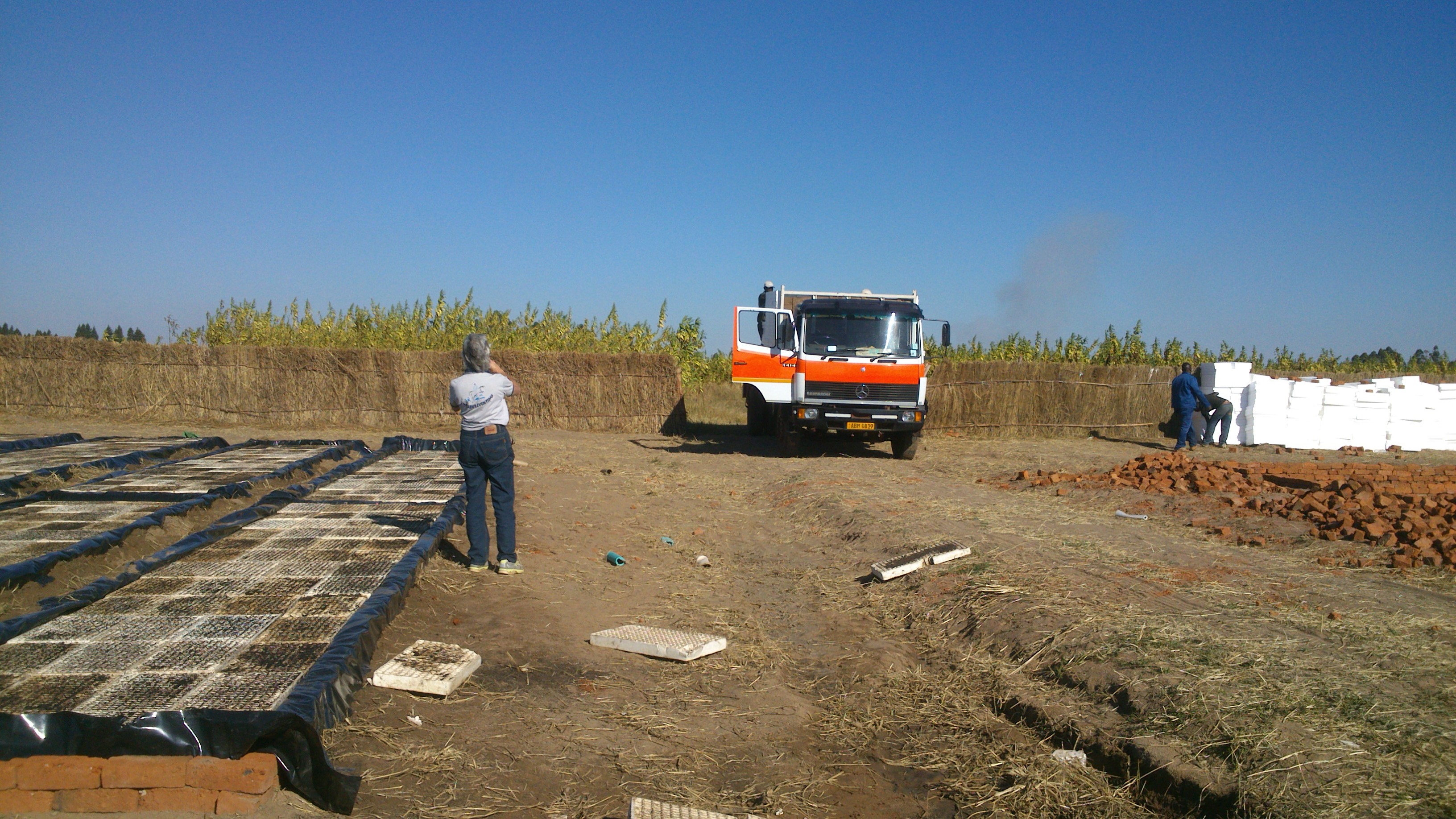
Loading seedling trays, old tobacco in the background.
Prior to this little escapade I had ascertained that seedling trays of good quality (we’d used them before) were available from Johannesburg. The catch of course was the transport – expanded polystyrene is mostly air which makes it expensive to move. However, even factoring in the transport and other costs, I could get them landed at my business for 75% of the cost of locally produced trays. And the return load was empty – another sign of the state of the economy – making the transport doubly expensive. It took a while to find a transporter who had the right sort of trailer to move a bulky load such as this but eventually one was found and the trays have now arrived.

Offloading the seedling trays from Johannesburg
As a Zimbabwean I am willing to support my local businesses but the product has to be of comparable quality and price to the imported option. Our local economy is in a dismal state and of course there are many factors outside of our direct control (read politics here) that are making it difficult to do business but really, Zimbabweans need to wake up when it comes to being competitive.


No nukes please – local ones excepted!
5 07 2026Earlier this year the Zimbabwe government decided to update the list of goods that required an import licence when brought into the country for commercial purposes. There is a fair bit of latitude on goods imported for personal use. The resulting document is the Control of Goods (Import and Export) (Commerce) (Amendment) Regulations, 2026 (No.15). The rationale behind the update is to put it simply trade protection, stimulation of local businesses and the saving of foreign currencies (they could start on the latter by not stealing so much themselves). There is a condensation of the rationale here but for those who insist on reading the original document you can download it here.
The document is mostly mundane but there are a few items that are quite unusual. Let’s start with the toilet paper.
Yes, we are protecting the local toilet paper industry. I cannot say I’ve had much in the way of first hand experience of using local toilet paper but I strongly suspect that the occasional roll of single ply that I’ve experienced in toilets attached to customers’ waiting rooms has been the local stuff. In this household it’s strictly multi ply.
Most serious toilet paper is double ply though I have come across triple ply. Single ply is in its own league. Whilst not useless there are challenges involved. Using it single is not an option for obvious reasons so it is sensible to double it up. Even that is risky so fold again to get four layers – economising is not wise. By now you might have realized that it would be cheaper to have used regular double ply in the first place. Will local manufacturers step up to the plate and produce decent quality now that they are protected? We’ll see.
Then we come to the nukes. Yes, you read that correctly.
I have to admit I have no idea what they mean by this. We have no locally produced nuclear reactors and no money to import one either. The government is heavily in debt and looking to China to help us out with our “$34 billion infrastructure challenge” in exchange for mineral deals. So I guess we won’t be needing import licences for “Parts of nuclear reactors” either.
Then we go from the absurd to vague – “other”.
Other what? Again this is more than a bit vague and gives the customs officials overseeing the import more than a bit of latitude. It appears in a few other places in the document as well. That could be intentional.
Some of it is quite reasonable – no importation of second-hand underwear at all. Not sure why anyone would want to wear used undies even if they had been washed. What will hurt is the importation of bales of second-hand clothes that is big business. It’s all very well encouraging people to “buy Zimbabwean” but if they cannot afford new clothes, as is evidently the case, what are their options?
The document is by no means an exhaustive list of items requiring an import licence. Last year I imported coir pith, from Sri Lanka, that we used in the nursery as a medium in which the seedlings are grown. It required in import licence and the requirements for that were onerous but I’ve done it for 11 years so it was tedious but expected. I do have to wonder how many people will not be familiar with the import requirements and will arrive at the border posts with items in commercial quantities that now require a licence only to have them impounded. I am fairly certain that nuclear reactors, tariff code 8401.10.00, won’t be among them.
Comments : 1 Comment »
Tags: blog, Business, import licences, life, nuclear reactors, second hand clothes, support local business
Categories : Blogroll, Business, Social commentary