Return of the Zimbabwe dollar

6 05 2016

There was a demonstration against the rule of Robert Mugabe recently. That’s not news by most country’s standards but it most certainly is news here. It was small, about 2000 participants, but noisy and although the police originally refused permission the High Court granted permission. So what exactly is happening here? Is this the beginning of the end of the Mugabe regime?

I was in town for my French lesson with Shelton. He was late, comme d’habitude, as he has to rely on the notoriously erratic minibuses. While I was waiting a call came through from an unknown number.

“Hello, is that Mr Roberts?”

“Yes it is”.

“I am name given from  ZANU-PF Gomba District at your office. I am requesting a donation for Monday”.

“What’s happening on Monday?”

“It’s Independence Day”.

I’d genuinely forgotten this most sacred of Zimbabwean holidays. There aren’t a lot of reasons to remember it. After 36 years we have steadily regressed to the point where currency restrictions are being reimposed because our balance of trade is so heavily skewed towards imports that we are once again running out of money. No, we cannot just print some more as we did with the Zimbabwe dollar; we are now using the US dollar. We don’t even have a currency of our own. Well so I thought.

Shelton told me that for 3 days this week he’d been translating at a feminist conference in town. It wasn’t just feminists, the whole spectrum of LGBTIQ (I had to ask what the last 2 letters meant) were there and it was quite an experience for him. No holds barred; there were tears, shouting and bad language aplenty but as he said just that it happened at all was remarkable. It would have been unthinkable just a few years back. Progress perhaps?

Bond coins - not enough for this cup of coffee!

Bond coins – not enough for this cup of coffee!

Then today I was on the way to do some company shopping in the industrial sites when I saw the newspaper placards advertising that the Reserve Bank is introducing bond notes. Bond notes? Really? We already have bond coins that are useful only in Zimbabwe and are on parity with the US dollar which is our de facto currency, but bond notes? Is this the start of the return of the Zimbabwe dollar as was suspected when the coins were introduced? Those fears were unfounded – it was just a means to alleviate the chronic shortage of small change – but it only gained acceptance when the South African rand plunged in value. We’d been using the rand coins, which fortuitously were one tenth the value of the US dollar, but when the rand started to run the bond coins became acceptable. Rand paper money also became unacceptable and the US dollar now rules supreme representing 95% of the currency in circulation. I decided to see where the public opinion lay.

Newspaper vendors on Coventry Road in the industrial sites were my first target.

“Can I pay for your newspapers with bond notes?”

“Yes” (no, I can’t – they haven’t been released yet)

“The Zimbabwe dollar is back!”

Nervous giggles – clearly I was not going to get a response here.

I stopped at the Zimbabwe Fertilizer Company yard to buy some gypsum. Despite my best provocations the clerk who served me would not be drawn to any sort of opinion on the matter. I was more blunt with the labourers who loaded the fertilizer. They were so bored with the lack of business that even those not involved wandered over.

“Pamberi ne ZANU-PF” (forward with the ruling party) I shouted and gave a clenched fist salute. Laughter.

“Pamberi ne Zimbabwe dollar” elicited a similar response. Nobody showed much interest in a debate.

My campaign reached it’s finale at the accounting office where I had to sign my companies’ annual returns (to indicate they were still active). The clerk’s response to my provocation was simply; “Ah, but what can we do?”. Protest perhaps?

Getting onto the internet at home was instructive. A statement from the Reserve Bank governor was circulating that was instructive and entertaining. The bond notes are going to be issued in $20, $10 $5 and $2 denominations and will be equivalent to their US cousins. They will be backed by a bond (hence the name) of $200 million from the Africa Export-Import Bank though they will be released as necessary (the $50m that backed the release of the bond coins last year has not all been used). But why are we in this mess?

  • as the economy has declined our balance of trade deficit has ballooned. There is less money around to buy the cash we need. It’s going into importing goods.
  • the cash we need has dwindled because it has become a commodity in itself. People are hoarding it because they don’t trust the banking system that let them down so badly in the past. The Reserve Bank estimates that some $3b – $7b is circulating in the informal sector and never goes through banks.
  • the countries around us with more volatile currencies are eager to get hold of US dollars and are mopping it up any way they can.
  • the cash is being illegally exported. Who is responsible? In the words of a teller at a bank I deal with  – “The big men are stealing it all”. Also the Chinese. One was caught recently at Harare airport leaving with a large amount of cash.

So the elastoplast fix is multi-faceted. Heavy restrictions on imports especially luxury items. Raw materials, medicines and fuels are unrestricted. Paying for students overseas is restricted. Cash withdrawals are limited to $1000 per day. This should make paying wages for the big companies interesting. There are heavy restrictions on taking cash out the country but I saw nothing about using local Visa cards outside the country. Use of plastic money is going to be heavily encouraged and in some cases laughable; “To this end, every business in all geographical areas and sectors of the economy must have a point of sale per till machine or purchase point” in the words of the Reserve Bank governor. Really? That rural bottle store in the Honde Valley must get a POS machine?

So will it work? No, as I said earlier it’s not addressing the source of the problem – the gravely ill economy. Luxury goods will of course be available at a hugely inflated price (better stock up on wine now!) as those who can circumvent restrictions. Local producers will lack competition and hike prices. Cash is already being sold at a 10% markup and really, what will $200m do? Real $100 and $50 notes will be hoarded and smuggled even faster than before and the run on the banks that started some time ago will not stop as people fear the worst. It’s a self-fulfilling prophecy.

So is this the return of the Zimbabwe dollar? Whilst the Reserve Bank has stated it has no plans to reintroduce the Zimbabwe dollar I don’t know anyone who actually believes that – apart from maybe itself.



Scam humour

13 03 2016

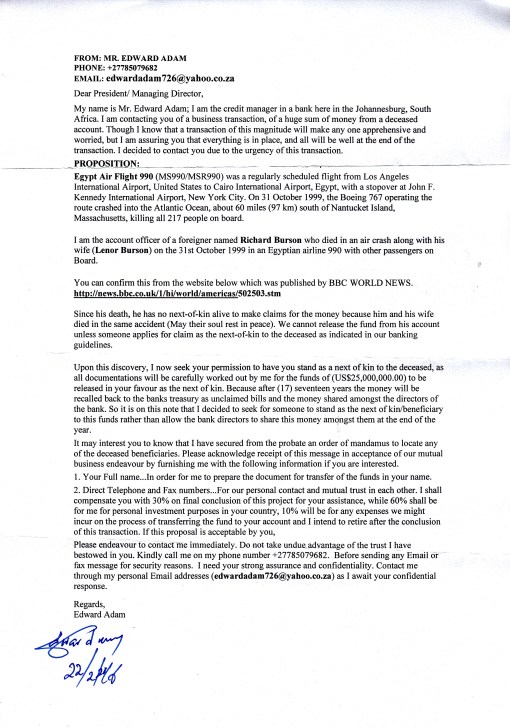
scam letterI don’t often get snail mail letters from South Africa and thinking it may be for my landlord who’s company is also called Emerald Seedlings I opened it to find out whom it was for (very unlikely to be personal). It wasn’t.

scam letter_0001Now I’m sure that most of you have received this sort of scam letter before, by email. I should think I get about one a month.  They are deleted, often without being read (NEVER reply to these by the way). I’m told they are of Nigerian origin, usually. That this one came from South Africa, where there are lots of Nigerians, was a first as was the method of sending. It follows a fairly standard formula; a deceased estate that the sender has authority over which in a fit of huge generosity he wants to get rid of for what seems like very minor personal gain and somehow evade a bank audit in the process. Quaint English too. But what really is a give away in this letter is the sentence that states “…60% shall be for me for personal investment purposes in your country…”. I mean seriously, someone wants to invest in Zimbabwe?


Bitten by lightening

23 02 2016

The power went off on Sunday afternoon as it often does when there’s a storm nearby. We didn’t mind – it was a small price to pay for a respite from the incessant heat and the smell of damp earth was just wonderful. There was even a bit of hail which is very unusual for this time of year. I have also recently finished installing the solar panels and inverter so I was actually feeling a bit smug, secure in the knowledge that the fridge, freezer and of course the WiFi were going to function as normal.

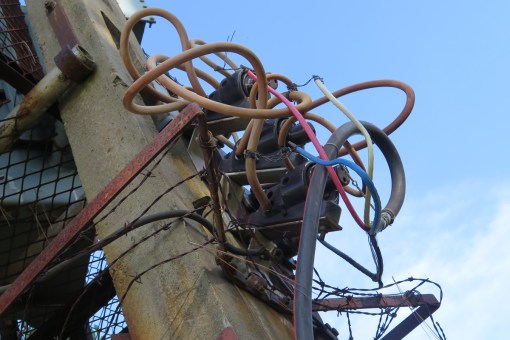
The power was still off yesterday morning when I got to work and the foreman suggested I go and look at the transformer which in his opinion had been “bitten by the lightening”.

Unconventional wiring I think

Unconventional wiring I think

I could see his point – it was unlike any wiring I have ever seen on a transformer. Now we have had a lot of problems in the past with the wiring and the fuses (in those black, cylindrical things) often get loose and burn the contacts and as the original fuses are no longer available  the power utility technicians insert washers, bits of copper wire and generally anything that will do the job.

wiring closeup

The fuses have been completely bypassed

I could see the fuse holders had been bypassed entirely with some not so thick copper wiring that was completely open to the elements and the unwary and all of 2m off the ground. It is “only” 220 volts on this side of the transformer but that is enough to be lethal.

The other problem we’ve had in the past is theft of the transformer cooling oil (for what purpose I’m not sure) which resulted in the transformer core burning out. A cage was made around the new transformer to keep would-be thieves away but I reckon this new wiring setup is just as effective and quite Darwinian too boot.

I told the foreman that as far as I could see the problem of lack of power was not at our transformer and sure enough later in the day it did come back on. But I did recommend he have a look – just for educational purposes.


A tree of many uses

11 02 2016
new seed

Natal Mahogany – Trichilia emetica

Pleased to see you Mr Roberts he said. Of course he was pleased to see me; the car park only had one car in it and it was theirs. Yes, I was making an order for more advertising banners but it was only a small one but these days you cannot be fussy – it’s money or nothing!

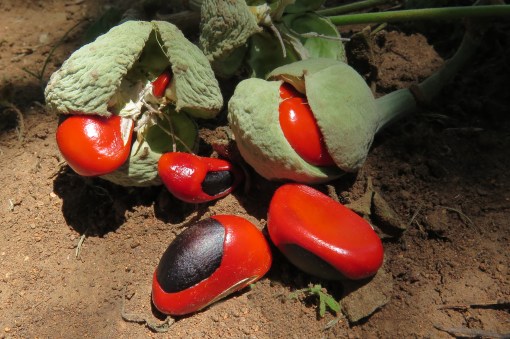
More of interest to me was the tree I’d parked under – a Natal Mahogany or Trichilia emetica to use its botanical name. It was in full fruit and there were a myriad of old seeds on the tarmac, squashed mostly, the evidence of their high oil content smeared around. The oil is valuable and used in cosmetics and is also edible but the seeds are notoriously difficult to germinate, especially when not fresh, so here was a challenge the horticulturist in me could not refuse. They are beautiful indigenous tress of medium size with dark green evergreen foliage and I always know when the one next door is in fruit – there’s a constant stream of hornbills flapping in to feast on the fruit!

scale

Fruit to scale

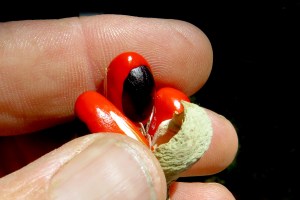
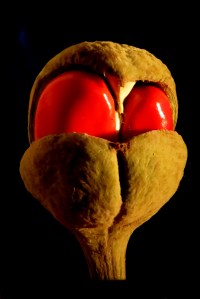
The seeds really are this intense red as in the photos. I have no idea if the black mark serves a purpose – it is not visible in the seed shell. Despite the literature saying the seeds are edible I am not tempted; one of the myriad of uses in traditional medicine is to make an emetic (it induces vomiting) from the bark!

Looks like an alien?

Looks like an alien?


The Zimbabwe Visa Business Programme

8 02 2016
On the road to cheaper climes

On the road to cheaper climes

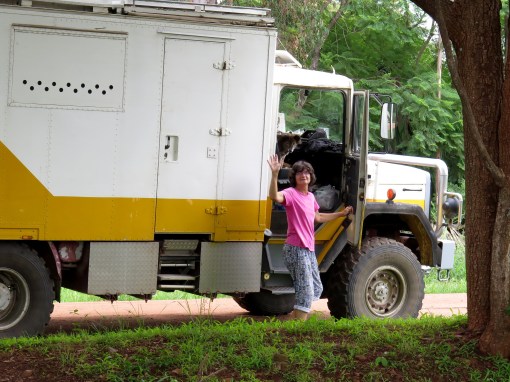
My German friends love southern Africa. They spend up to 9 months a year in the region traveling around in their large, well-equipped, overland vehicle. This time they only spent 2 weeks with me. Florian is a handy man and helped install the solar panels and power system while he was here.

Last Monday they borrowed a smaller vehicle from me and went into town to extend their tourist visa. They took the opportunity to inquire about visa costs and conditions.

A single entry visa is US$30 extendable for 6 months but only in 30 day periods. The first 2 periods of 30 days are covered by the initial fee thereafter it costs $20 per 30 days. Each renewal starts on the day it’s renewed i.e. one cannot renew in advance and it has to be done in person. After 6 months one has to spend at least 6 months outside the country. There are not, apparently, any concessions for pensioners.

For the road bound tourist there are more costs. A “carbon tax” and road fees are $30 for 2 months (depending on the size of the vehicle), all the usual insurance costs, a border-crossing fee of $10 and then a road tax of $10 per 100km.

Lots of countries have these sort of restrictions on tourist visas; apparently to discourage illegal employment. In Zimbabwe this ironic – we have 90% of the population lacking formal employment and a government that is broke by any definition and yet we are discouraging tourists from staying to spend their money!

Permanent residence costs a $100,000 investment and a local partner has to be involved. In the past the local partner had to hold at least 51% of the shares (seriously!) but this was not mentioned by the government official involved. Maybe she didn’t know if this was still the case (it seems to change on a monthly basis depending on which government official is being quoted) or maybe she was too embarrassed to say.

A pensioner visa exists for South Africa; $50 for 4 years! South Africa is also a lot cheaper in Zimbabwe at the moment. It’s not entirely due to their weak currency but also due to it being just, well, cheaper! So Ute and Florian and their little dog Tiga left this morning for an extended South African tour.

The local press is replete with reports of the drought and how local Zimbabweans are suffering. In masterstroke of irony, last week I received a request from the local branch of ZANU-PF (the ruling party) soliciting funds for Robert Mugabe’s birthday party later this month. That he should be having a massive birthday bash in the middle of a drought, that he has declared a national emergency, has not escaped the local press. Yes, suggestions have been made that the funds for the bash go to those who’d just like one square meal a day. Whether this comes to pass remains to be seen. It’s the first time I’ve had this request but in the past urban businesses have been squeezed – heavily.


Pencil – Digital

18 01 2016
Tools of yesteryear

Tools of yesteryear


Everything you see in this photo was bought in Zimbabwe in the past three months. They have changed little since I was a child, new at school, in 1966.

eraserThe eraser (rubber in this part of the world) is the one item that has changed a bit. The early ones that I remember were made of a softish rubber that was adept at smudging the pencil marks and destroying the paper. Some were truly appalling and broke and crumbled very easily. They made effective missiles when the teacher was out and more than a few got bitten in half just to see the teeth marks. This one is made of a soft plastic and is very effective. I cannot remember when this type appeared, possibly in the mid 1970s.

sharpenerThe sharpener I  bought yesterday in a local supermarket. It has not changed in my memory. The originals were metal like this one and then they became plastic. This is a genuine Faber-Castell but made in India. There is nothing quite a satisfying as a well-sharpened pencil. A pen knife works of course and when the teacher was out we used to sneak to the front of the class and use her hand cranked sharpener which to us was very high tech and risky behaviour too!

pencilsAh yes, the humble pencil. How I desired these genuine Staedtler HBs as a child. Black and red – definitely boys’ colours (most pencils are apparently yellow in the USA). Of course they had German quality in what was definitely an era of “Japanese Junk” (how that has changed).

The first wood cased graphite pencils probably originated in England around 1564. Nuremberg, Germany was the birthplace of the first mass-produced pencils in 1662 and is still the home of Staedtler, Faber-Castell and Lyra. Now of course, graphite has found new fame as a source of graphene – a layer of carbon one atom thick. It has all sorts of interesting properties in the field of electronics and is easily made. Anyone who has used a graphite pencil (lead is a misnomer these days though the originals were made of lead) had made graphene.

Paper. Amazing stuff. Paper as we know it dates back to around 105 A.D. in China though papyrus, from which the word is derived, dates back to the third millennium BC in Egypt. Mostly we write on it in ballpoint pen though even that is under threat and nowhere more so than at my local ZIMRA tax office. I am not surprised; they must have collected container loads of the stuff in the course of a year and now it’s all gone digital. Or that’s the plan. Every year one has to get tax clearance to import or export goods. In the past this has meant standing in long queues at this time of year and finally getting the all important ITF263 meaning one’s tax payments are in order and debtors don’t need to deduct 10% of their payment if one doesn’t have it. This 10% is then remitted directly to the tax office – in theory. It can then be deducted from tax owed.

I dread this time of the year but my book keeper told me that it had to be done online. I tried to register and got a message “We’ve had a technical problem but don’t worry, we still have your details…”. Right. Then I couldn’t re-register, or login or do anything. So after much pondering I used another email, my passport as an ID (we normally use ID cards for these purposes) and I was in. A quick visit to the ZIMRA tax office in town and I had my one off password valid for 24 hours. I took a deep breath, mustered up some negativity and applied for the ITF263. An hour later there it was, all ready to be downloaded and printed. The paperless office was a little closer.

I know that a few years ago the local branch of the International School announced it was going paperless. Whether this has actually happened I don’t know. What it means for the ancient art of writing is anyone’s guess. Are they really going to produce generations of students who cannot write? And will they know when they pick up the stylus of their digital device they are actually picking up the ancient Roman originator of the humble wooden pencil? It will be in effect a true digital pencil!


Checking the box

13 01 2016

I went and saw the latest Star Wars movie last night (I have already forgotten the full title). It was a box checking exercise and besides, I had to see what the hype was about. Ok, I also need to admit it was the first Star Wars movie I’d seen. Yes, ever! I think the first one came out when I was at university and even then I was only vaguely interested despite the ground breaking special effects of the day. It was probably well after the release of the movie elsewhere in the world – those being the days of apartheid in South Africa where I was studying at the time. Well, there were no sanctions on films one just had to accept you were not going to be the first to see anything!

Last night was, I think, the last night of showing at the local cinemas. This run had started a month ago and I had a sneaking suspicion that it was about to end. Hey, do the maths, pretty good huh? We started showing it on the 14th December last year which must have been pretty close to the worldwide release. Unlike South Africa all those years ago Zimbabwe (contrary to what our politicians liked to claim until very recently) is not under any sort of sanctions. Maybe it’s also due to us using the US dollar so we can actually pay for things if we have the money, something most people in this country are struggling to find these days.

Well last night there was no shortage of money in evidence. I mean I actually had to walk some 200m from where I’d parked to the cinemas (last time I went I got a park as close as one could possibly park). The place was buzzing. I’d rather hoped with schools just starting their new term the place would be quiet. Nope, no chance of that. It was teeming with the youth. There are pubs, restaurants and a supermarket at that end of Borrowdale village shopping centre (yes, the supermarket was open at 7.30 p.m. – how times have changed) and of course I bumped into someone I knew. Harare is like that. A city by name but an oversize town by nature. Debbi from the gym had just been to see another movie with her family. Her eldest son Mike has just finished his medical degree in Johannesburg and is waiting for a placement for his internship. As he is not South African he has to wait for a placement; they have one for him but they don’t know where.

The movie theatres are pretty modern. Actually they have only been open about a year so one should expect this but in Zimbabwe one should not expect anything of this nature given the state of the economy (a lot of government employees were only paid for December end of last week). There are six small ones in the modern format. The ticket cost $5 (half price Tuesday) and the 3D glasses $1. Ok, another admission – this was my first 3D movie! I settled into my seat a few minutes into the movie and put on the glasses.

Two hours later I was not entirely sure that all the hype had been justified. The special effects had been good but then I’d been expecting that. The bizarre characters were certainly imaginative but there are some things that were bothersome. I mean, they had light speed capable craft right? That is serious tech (even if impossible by Einstein’s theory) but they still managed to miss most of the time in the dog fights. I don’t know what they were shooting at each other (balls of light things) but they only seemed to go in straight lines. The one set of missiles that did actually track the goodies also missed! And they actually had non-robotic/computer pilots. Not very good. The main character, the kick-ass chick (and boy could she kick) looked like she could have done with a few visits to the gym before hand. I WAS pleased that she was not drop-dead gorgeous but just sort of normal in a Hollywood sense. There were lots of characters from the original movie there too. Harrison Ford was looking his age as was Princess Leia (whoever she is). The former got stuck with a light sabre which is a truly stupid piece of high tech for waging hand to hand combat (get the contradiction?) so we won’t be seeing him again. The rest of it was of course left wide open for yet another sequel/prequel/something-quel. We left with Luke Skywalker (in a hoodie – I bet he has tatts he’s hiding) looking decidedly uncomfortable about accepting his old light sabre from the kick-ass chick. No doubt he was thinking he’s in for another epic.

And the 3D? Well on one occasion I took my glasses off to see if they were clean because background lights in the movie were more than a bit fuzzy but all was clean. So I think tech has a way to go on that one though I do admit that a couple of times I almost ducked as fighters “flew overhead” so I’ll keep the 3D glasses for another occasion. I’m not at all sure it will be for the next issue of Star Wars though. Been there, done that, checked the box.

The rain had reduced to a light shower by the time I walked out and the carpark was quiet. It seems that Zimbabweans go to bed early during the week. My evening’s entertainment had cost $6 plus a bit of fuel. Not bad – about a day’s wage for the average horticultural labourer in Zimbabwe. Well, for those lucky enough to be employed.


The drought of ’92

10 12 2015
Watsomba area of eastern Zimbabwe 1992

Watsomba area of eastern Zimbabwe 1992

Zimbabweans have a curious attitude to the rainy season; they almost think it’s a right and are somewhat puzzled or even hurt when I say no, I don’t think the rains are going to come this year. Of course we will get some rain but it’s almost certain there will be a drought.

In 1992 we had a drought. At the time I was working in Penhalonga in the high rainfall eastern area of Zimbabwe. I was doing freelance programming; there was plenty of work but it did not pay well as people were not convinced of the value of it so I left and in 1995 (another drought year) started an agricultural job near Harare.

The photo above was taken north of Mutare in a high rainfall area called Watsomba. I don’t recall the actual date but you can see there is hardly a blade of grass to  be seen. In those days Zimbabwe still had a vibrant agricultural sector and despite the ravages of the drought nobody went hungry because the commercial farmers (mostly white) knew how to use their resources well and besides, drought is endemic to southern Africa so there was plenty of stored water to irrigate crops.

This year a drought is likely but there’s a major difference; there are very few capable farmers left. Most were driven off their land by the Mugabe government in 2000 – 2002. Many of the former commercial farms lie derelict and ironically, the dams (reservoirs) that ensured plentiful crops and established Zimbabwe as a regional food exporter are still mostly full. There are two reasons for this – there are few farmers to use the water and those who can prefer to pump the water for more profitable crops than the staple maize. Pumping is also expensive these days as most of the country is enduring long power cuts so diesel pumps have to be used. One of my customers told me that he gets up at midnight, when the power comes on, to irrigate his tomatoes. “You can get quite a lot of irrigation done in four hours before they turn it off again but the labour force is not very keen” he added.

The electricity situation is only going to get worse. Lake Kariba, which normally supplies most of the country’s hydro power is critically low so the turbines are running below capacity. The lake is low due to poor rains in the catchment area of central west Zambia and eastern Angola and this inflow only occurs around April. The Zambians have also over developed the north bank power station and the lake simply cannot keep up. Zimbabwe also has a large thermal power station at Hwange in the west of the country but generating capacity is down due to lack of maintenance and capital development (the government is broke) and despite being right on top of a large very high quality coal deposit they just can’t seem to get it together.

Money was borrowed from Namibia to fund electricity development in Zimbabwe but now the local utility, ZESA, has taken out another loan and we have to export more power to Namibia to pay it back.

The internet did not exist in Zimbabwe in 1992 so there was not a lot of opportunity to research the causes of drought. Now the current el Niño is well covered both locally and worldwide. Looking back at the history, this year’s temperature rise that defines the phenomenon looks to be very similar to that of 1992 (1995 was not quite as strong though we were saved in this part of the country by cyclone Bonita that savaged the eastern districts) but perhaps a bit stronger. That’s not good news at all.

I don’t have a photo of the same area taken in 1993 but I do recall that the area recovered very well. That’s cold comfort right now (it’s blazing hot as I write this with temperatures in the mid 30 degrees and few clouds to be seen) as we still have to get through another 12 months before we can hope for a normal season.

In the meantime I am installing a solar powered system capable of running all electrics in the house bar the water heaters (it’s not my house otherwise I’d install solar water heaters too).  I actually am connected to a reasonably reliable grid due to the proximity of a military baracks but I just like the idea of being independent and, yes, I’m a bit of a geek too.


Double standards

15 11 2015

I usually only buy the newspaper when I need newsprint. It’s useful for mopping up excess oil after frying fish and Marianne had bought some calamari rings for Friday supper.

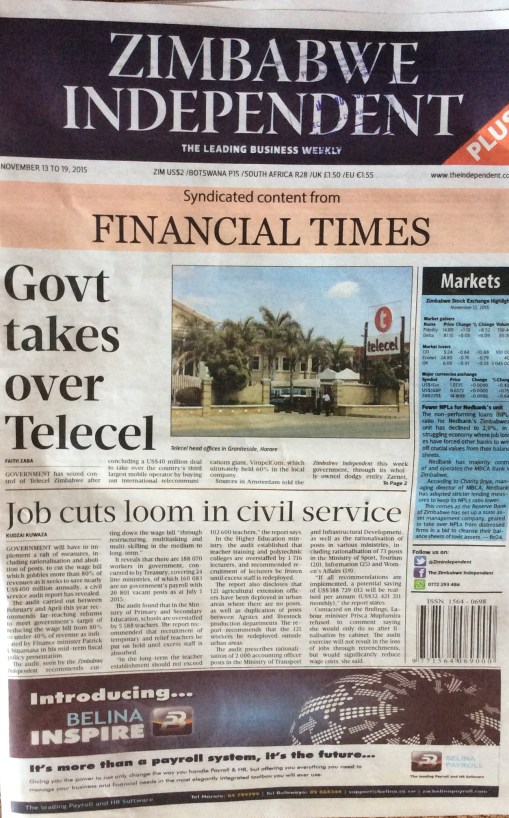
The Zimbabwe Independent is actually not a bad paper and insofar as I can tell gives a reasonably balanced opinion on the local political situation.

image

It’s no secret that the Zimbabwe Government is broke so I was more than a bit surprised to see that it had made a substantial bid for a majority shareholding in a local mobile phone company that was going to cost some US$40 million. A bit further down the page one can also read that a civil service audit report has recommended substantial reductions in the wage bill which gobbles some 80% of revenue.

Perhaps the government thinks spending $40 million that it doesn’t have is going to earn enough to avoid laying off large numbers of its supporters. This is unlikely given the appalling record of the government to do anything well except line the pockets of the faithful.

The 11th November came and went with little fanfare in the papers about remembering Armistice Day. In this part of the world it is also known as the anniversary of Ian Smith’s Unilateral Declaration of Independence (UDI) that broke Rhodesia (as Zimbabwe was known) away from British colonial rule. Most years it passes with little if any comment but this year was the 50th anniversary. I must admit I’d forgotten about this until I saw it in the social media.

The state controlled press in the form of The Herald newspaper wasted no time in reporting that “unrepentant Rhodies” in other parts of the world had been celebrating this anniversary (Rhodie is a derogatory term for ex-Rhodesians). One ZANU-PF (ruling party) spokesman, Cde Simon Khaya Moyo (Cde is the abbreviation for “comrade” that only the party faithful and state press use) went so far as to reiterate that “Zimbabwe will never be a colony again”. He was apparently referring to social media posts in Australia advertising celebrations for the 50th UDI anniversary. Quite why he felt threatened by people having a party half the world away is not made clear.

Why anyone would want to celebrate the UDI is beyond me too. I was nearly 6 at the time and almost certainly looking forward to what my parents promised to be my last birthday party in 6 days time. The UDI culminated in a bush war that took my father’s life and very nearly took mine. I most certainly don’t look back on Ian Smith with any fondness even if he was right that the Mugabe regime would ruin the country. He was most certainly wrong to declare UDI but I don’t lose any sleep over it; I have more important things to consider like my birthday in 2 days time and just making ends meet.


After the fire

23 10 2015

Agriculture is not an exact science and sometimes things go wrong. The tobacco seedlings we’d sent to a customer near Headlands, an hour and a half to the east of Harare, had been well received until he informed me that we were some 160,000 seedlings short out of a total of some 500,000. I was more than a touch bemused. This warranted a visit to try and ascertain what had happened.

Leaving early this morning before the traffic had got going I arrived at 8h30 after a rough 20km south of the main Harare-Mutare road. The lands were impressive and well farmed in contrast to the derelict farms I passed along the way.

Not a lot happening

Not a lot happening

The farmer, young by my standards, had recently been allocated the farm by the government meaning that sometime in the past another farmer had been kicked off it though there was no evidence that I could see of habitation. I had to give the new farmer his due – he’d worked hard to get his project going starting pretty much from scratch and had got a substantial loan from a Chinese farming company that wanted his tobacco. The company has apparently been in the area for about the last 10 years. Of the missing seedlings there was no sign. Whilst we have absolutely no legal obligation to seedlings once they leave the nursery I did feel bound to meet him half way on the cost as I’m pretty sure he’ll be back next year. I made it clear that I expected him to check the quantities when they arrived (he admitted they hadn’t) and I made clear that this was not going to happen again.

On the way back I noticed a small burnt area near the main road and stopped to take some photos of the flowers that had bloomed after a recent fire. They didn’t need a loan to make the most of life; just a fire!