A good season (for rain)

16 02 2017

It’s been a good rainy season and nowhere more so than Nyanga in the eastern highlands of Zimbabwe.

worldsview

Pretty view but no flying

Home to Mt Nyangani, Zimbabwe’s highest mountain, it is a magnet for rain. In the season of 1980 I was a patient at Tsanga Lodge military rehabilitation centre and there was much delight when the season’s total topped 2000mm. I have no idea what it has been this season but it was certainly too wet over the past 3 days to try any paragliding. We did manage to get around a bit and there were flowers out and cattle that got a bit close for Zak’s liking.

zakandjune

Zak snuggles up


zaktop

Hmm, do those cattle need chasing?

pinkflower

Pink flower

Blue flower

Blue flower


Loadsa funny money

1 02 2017
Funny money and the real stuff

Funny money and the real stuff


Ok,  I wasn’t quite truthful, there’s not LOTS of funny money – there’s just more than we’ve had in the past.

Once upon a time there was just Zimbabwe dollars and we got by. Then they crashed, and people were sad, so we got US dollars because that’s how economics works and everyone was happy again. Now there are not so many US dollars (as notes but there’s plenty in accounts which we can’t use to import anything) because lots, really lots, have been stolen.

So when things started to change again the Zimbabwe Reserve Bank in its unfathomable wisdom saw fit to introduce Bond Notes and everyone panicked and withdrew their cash and mobile (phone) cash became king, dominated by one Ecocash who saw fit to charge extortionate fees so banks saw fit to introduce their version of mobile cash. These are debit cards that can be managed on phones and we got a swipe card machine and people were happy again (but only sort of).

Not many bond notes came across my desk and I was happy too (again only sort of). I did get lots of text messages on my cellphone confirming that people had used their cards to pay direct to my bank so I don’t check messages that much and miss the important ones. Now the funny money (top of the pile in the photo) is coming across my desk in much larger quantities as people try to get rid of it, pass the hot potato if you like. The government has decided to tax potatoes, before they can even get hot, and other basic foodstuffs too so everyone is unhappy again. But nobody is going to do anything about it.

Banks have said that if we deposit cash (the real thing in the photo – not the funny money) then we can import stuff to keep going but I haven’t found out if my cash, assuming I have it, is going to be flown to India to buy more raw materials or it’s just a ruse by the Reserve Bank, that in it’s wisdom (again), wants to mop up all the real money for the government to spend on paying employees or, more likely, on itself (which some people might be suspicious of).

It’s not looking good. Not at all.


Moving on

31 01 2017
final-view

Probably the best view near Harare

We moved, my wife and I, at the end of December into suburbia. It was not a move for me born of desire but one borne of necessity. The house where I’d been living for the past 14 years was not for sale and even if it were there was no guarantee that it would have been a solid investment situated as it is on a farm outside of Harare which will eventually be incorporated into Zimbabwe’s capital city.  Water supply might have been an issue. Currently it comes from further down ART Farm nearly 1,500m away so a source on the property would have had to be found.

I’d been happy there planting 15 indigenous trees on a property of around 1ha (yes that is a measure of contentment to my mind) but I knew that eventually I’d have to invest in a more solid property in town. So when Marianne became a permanent fixture in my life I suggested that we pool funds and look for a house. With the Zimbabwe economy sliding to a near comatose state we reckoned, and were told, that house prices were in a buyer’s market and the time was ripe to start looking. It has been a slow process – some 8 months to be exact.

Area was a concern as my work is to the north of the city and of course we were hoping to find somewhere easily accessible for exercising the dogs. We got on the internet and started looking. We were not flush with money and I insisted that we borrow as much as possible as we didn’t want to leave ourselves destitute should Zimbabwe totally collapse and we needed to find refuge elsewhere. Yes the loan would be expensive at 16% interest but worthwhile to risk someone else’s money rather than our own.

Having ascertained that we could get a loan for $75,000 we started the search. There were not a lot of houses on the market and what was there was often in very poor repair and over-priced. With the increasingly dire water shortage in the city a borehole was a prerequisite so any properties that didn’t have one didn’t merit a visit. The list of potential properties shrank and then became zero. Finally we saw a property that had some potential, or so Marianne thought. I was less enthusiastic but there was nothing else. The law had changed recently so that owners living outside the country could no longer repatriate their money from a house sale so were deciding to keep their properties – or so we were told. We paid the deposit, signed the agreement of sale and started looking for contractors to start the renovations.

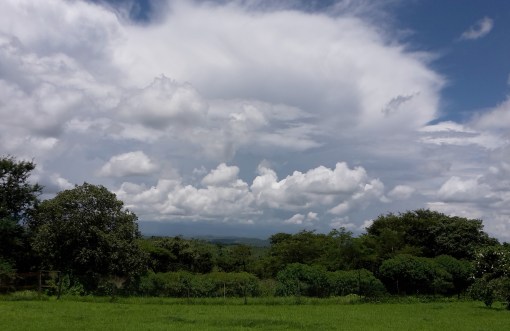
By the time we started the move we were hopelessly over budget and of the firm opinion that artisans were in very short supply in Harare. And the rains had started on time (that’s a big storm in the photograph) and I’d got a policeman to admit that the new bond notes weren’t real money and didn’t make good toilet paper. Now 3 weeks later the rains have not let up, the contractors are still clattering around, we are even further over budget and my dear sweet Ridgeback, Kharma, has developed full-blown bone cancer and doesn’t have long to live. Yes, welcome to the suburbs.

This was only predicted to be a mild la Nina season but so far it’s been anything but. ART Farm where I used to live has already had more than its average annual rainfall with the wettest month, February, still to come. Major rivers in the east of the country are in flood and Lake Chivero,  Harare’s main water supply, is spilling. The roads are dreadful – it’s no longer possible to dodge all the potholes so one just has to slow down and accept that it’s necessary to drive through some. The tobacco crop will not be great quality – with all the rain the leaf becomes thin and light once cured. The maize (the staple diet) is at risk from poor pollination as it is wind pollinated and needs to be dry for that.

And the policeman. Yes, that was different. A removal company did the major moving but there were still pot plants and other assorted items collected over the years to move so I borrowed a trailer and made many trips without incident past an illegal roadblock of 2 policeman (there have to be 3 or more) who couldn’t have looked more bored. Then one day there was an altogether more professional bunch there complete with patrol car.

“I am <name given> of the Highway Patrol, this is our car” he added pointing to a small, newish police car with POLICE in 20cm high letters on the side. “You have not got a light on the number plate of the trailer”.

“Oh, really?” I replied knowing full well that I didn’t have one.

“I can show you if you like”.

“No that won’t be necessary. How much is the fine?”

“$20”. Right, $20 for no number plate light. Ridiculous but I’ve researched this before and had no intention of arguing the point.

“So you will accept bond notes even thought they are like toilet paper?” I countered instead.

“Ah, but you must embrace them” he said  parroting the official line.

I looked in my wallet and to my horror noticed that I had only a $50 note and a few $1. “If I give you real money I want real money change”.

He laughed, took the proffered note and counted out my change in US dollars and green bond notes. On handing me the US notes I asked “So this is the real money?”.

“Yes” he admitted.

“So you are admitting then that the bond notes are like toilet paper. Have you ever tried them for that purpose?”.

“Yes, but they were too hard!” he joked.

Well, at least he had a sense of humour.

We had a big storm last night and on the way to work there was grass caught on the railings of the bridge over the Gwebi River, near it’s source on the Borrowdale vlei. It had been over the road in the night. The nursery had received 80mm of rain but speaking to others it emerged that the eastern suburbs of Harare had received nearly double that. Despite the fact that this is a neutral el Niño/la Nina year we are having exceptional rains. Or maybe it’s just a normal rainy season like I remember from my youth.

The renovations to the house are almost complete and we’ll all breathe more easily once the contractors finally clear out. We still find badly painted doors, taps not centred over the bath, tiles with HUGE  gaps behind them and of course a monster pile of rubble and trash to dispose of. The swimming pools is clogged with leaves (we should have drained it but were worried about being able to refill it) and we had to replace a burnt-out motor on the filter.

One day it will all be sorted but poor Kharma will not be around to see it. She did not cope well with the move and still panics a bit when she cannot find me. Her leg that was healing so well with the assistance of a dog physio took a turn for the the worse just as we moved. We called in the physio again but she could find nothing wrong then last Sunday she stopped eating. Panic. Thinking it might be biliary (a fatal tick-borne disease) I rushed her to the vet but he could find nothing wrong and asked that I take her back the next day for X-rays and blood tests. The results were bad; the cancer had proliferated in her leg and had also moved to her lungs. When she’d broken the leg last year the vet had been suspicious but could find no sign of cancer but now there is no doubt; she’s on borrowed time. The anti-inflammatories are helping control the pain and yesterday I found someone who could supply cannabis “oil” which has certainly brightened her mood (yes, the supplier said, it really did have THC in it as she’d tried it) and she eats with gusto and is pleased to see me but I know that each day is a bonus. Poor girl, she’s been such a good friend and companion and I dread the day she tells me she’s had enough.

Today I received a copy of a new Statutory Instrument from my ZIMRA (tax authority) account manager. The government has put VAT on basic foodstuffs; meat, fish, rice and maize meal. They really are desperate and it should provoke a riot but it won’t.




Health and safety Zimbabwe style

12 12 2016
A new style in eye protection

A new style in eye protection

James is a house renovator’s dream. He gets the job done and he will go the extra distance to do it. He also spent some 7 years working in the USA and Canada so he has a clear idea of what health and safety is about. In the end he had is immigration application turned down so ended back in Zimbabwe.

“This PVC piping on the outside of the building is not up to standard” James said. “We’ll have to replace it with copper at some stage”.

I fixed him with my most concerned expression “Yes, James, and what country are we in James?”.

He gave me a wry smile “Zimbabwe”.

I confirmed with the electrician that the reason for the copper piping was to provide an earth for the house. “We’ll put in an earth spike” he said.

A few days later whilst checking up on progress I noticed the welder was hard at work on the gate in the fence to keep the dogs away from the electric gate. His eye protection was um, innovative to say the least.  Curiously he did not have arc-eye (an excruciating condition similar to snow blindness) the next day. Maybe sunglasses are more effective welding gear than I’d expected!

Yes, we have no earth protection

Yes, we have no earth protection

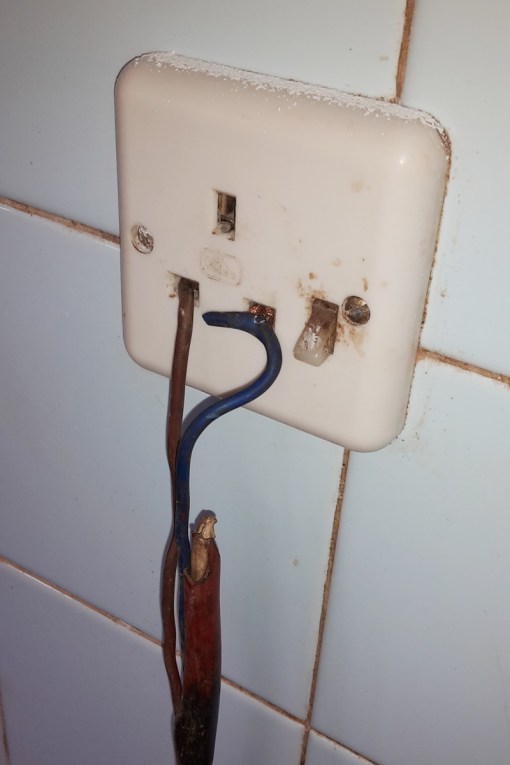
At the same time they were welding the fence gate another artisan was constructing a simple gate for the kitchen wall. His angle grinder was plugged into the kitchen socket, line and neutral wires the wrong way around and the earth left dangling. There was a light rain falling and he had no eye protection whatsoever!

Ah, Zimbabweans, always making a plan…


It’s all legal tender

9 12 2016
New notes and a coin. All real, apparently...

New notes and a coin. All real, apparently…

Earlier this year we decided to take the plunge and buy a house. We reasoned that with the economy in tatters there would be lots of cheap, good value houses on the market. Well, yes and no.

There were lots of houses on the market but most were unrealistically priced and the owners were inflexible on the prices. Seven months later we agreed on a house, circa 1960, that needed substantial refurbishing but was solid and had a good quality 2 bedroom cottage in the garden which made the asking price a lot more palatable.

Some $10,000 later it’s almost habitable and we are due to move in 2 weeks time. The rubble pile has grown substantially and the old parquet flooring (original 1960s teak) was clogging the garage. Then on Tuesday this week a buyer arrived in the afternoon as I was preparing to leave. Of course I insisted on cash and then the bargaining started, or so I thought it would. It seemed I’d come across the only Zimbabwean who didn’t know how to negotiate. Eventually I asked him how much he was prepared to pay and agreed to his offer of $250 – I had things to do. That evening he arrived back with the money bought at the Roadport in town, where all manner of buses and taxis congregate and devious deals are done, with the required amount in old $10 bills. I thought it odd that there were no larger denomination notes available but it was real money. The old parquet tiles were piled into the back of a pickup, the passenger seat of the pickup, a Honda Vitz and a Nissan 1/2 tonne pickup.

Yesterday my senior foreman asked if I could find some small change, even the much reviled bond notes would do. I managed to find some $1 bond coins at a hardware store and the clerk was happy to give them to me as change. My bank was also happy to oblige but the teller misheard me and said I could have my day’s allocation of $175 of which only $25 could be bond coins or notes. I opted for the coins and was more than a bit taken aback to get 6 brand new, sequentially numbered US$20 notes. Are we not in the middle of a full fiscal meltdown with US dollars being plundered at a frantic rate and the dreaded bond money taking over and doomed to follow the Zimbabwe dollar into oblivion? Well, most likely that is the case but where did the new $20 come from? Were they bought recently? By whom? Or had they been stored in a bank vault somewhere? Is this an attempt to emulate India whose government, in an attempt to curb rampant corruption, recently ruled that the larger denomination notes were no longer legal tender? That would be wishful thinking indeed. The larger denomination US$ notes have already fled the country.


A Brexit. If only…

12 11 2016

Saturday midday we like to gather at the Gallery Delta in town. It’s Robert Paul’s old house, one of the oldest still standing in Harare and thus is listed. It also has good contemporary art but we like to sit and discuss politics, finance and generally anything of interest. Interesting people come through – it can attract diplomats and others but today it was the turn of local financial wiz Melissa. Married to a local Zimbabwean she has consulted to all manner of financial institutions both local and international and always has something of interest to contribute. The conversation inevitably turned towards Zimbabwe’s impending financial implosion and, of course, bond notes.

Background
In October 2008 the Zimbabwe dollar became worthless. Having been revalued three times and had 18 zeros removed over the period of 18 months (not of course in linear fashion) it really was worth less than toilet paper and also less effective. In the previous month my company went broke despite being  busy and after much soul-searching I brought in US$2000 of my own money which covered my expenses for the following month when customers started to ask if they could pay in US dollars.  The Zimbabwe dollar was officially abandoned at the beginning of February 2009 and the US dollar became the de facto currency in this part of the country. In the southern regions the South African rand and Botswana pula became more accepted due to the proximity of these countries. Change was initially an issue and supermarkets gave out sweets and ballpoint pens in lieu but come 2013 -2014 the South African rand was valued at close to 10 to the US dollar (2013 – 2014) so it made for useful change. We also had our first brush with bond coins (valued in USc but not exchangeable outside the country). Initially ridiculed they gained acceptance once the rand drifted above 11 to the US dollar. Currently there are a number of currencies that are officially trade-able; UK pound, US dollar, Australian dollar, euro, yen, Chinese yuan, Botswana pula and of course the rand.

As Melissa explained adapting the US dollar was a mistake. Zimbabwe became a magnet for criminals and money launderers the world over as there was little control over the use of hard cash – if you had it in the bank you could withdraw it as cash. Millions of dollars in cash were taken out through our extremely porous borders. The start of the rot was nearly instantaneous.

The rest of us were too enamoured with the new freedom to do just about anything we liked with our money to notice. You could travel unfettered by the need for endless currency applications; real VISA cards worked anywhere! South African supermarkets moved into the country and bought out the local chains and imported goods flooded the shelves at vastly inflated prices. But hey, we had choice.

The economy expanded due largely to the mining sector and high prices of gold and other minerals. Agriculture, once the mainstay of the economy, continued to flounder on the back of the land redistribution exercise though there were a few years when tobacco enjoyed a resurgence, driven by buoyant prices. Attempts to get external investors interested were hamstrung by the contradictory message; invest with us but the majority of the shares must be held by a Zimbabwean.

Corruption and nepotism have gone from strength to strength. Perhaps a new word should be coined here – nepotist + kleptocrat = neptokrat. Readers are welcome to make suggestions. It seems that every day there are new revelations of squandered, stolen and diverted funds. The most famous is the fifteen billion dollars that was unaccounted for from the Chiadzwa diamond fields in the east of the country, alluded to by none other than President Mugabe himself. Now $15bn is a lot of money for a small country like Zimbabwe, a bit more than the GDP in 2014, which could have wiped out our external debts and left a sizeable chunk to get things going again but nothing appears to have happened to those responsible.

As the economy founders so the tax base shrinks and there is little wonder that lower ranking civil servants have not been paid for months (civil service salaries gobble 97% of the cash budget). The military of course do get paid – the police have been told to raise their own wages and do so by the myriad road blocks and spot fines throughout the country that have left them thoroughly discredited and despised.

It’s all about trust
In May this year the Reserve Bank of Zimbabwe (RBZ) governor announced the introduction of the bond notes and the run on the banks began. The proposal was to ensure the value of the bond notes at an equivalent to the US dollar but they would be for internal use only so no good to those who would seek to externalize them. The public saw it as a ruse to bring back the Zimbabwe dollar in another guise. The restrictions on withdrawing cash soon followed and served to fuel the panic. It didn’t help that the bond from the Afreximbank that serves to support the value of the bond notes is veiled in secrecy and ignorance. Unexplained delays in releasing the notes and the refusal of a German company to print them haven’t helped.  Some banks are allowing more cash to be withdrawn than others but reports abound of clients queuing overnight to withdraw as little as $20 a day.

Zimbabwe has been slow to adapt to the plastic money found elsewhere. ATM and debit cards have been around for years and mobile banking has seen a major increase with the rise of smart phones which are ubiquitous even among the poor. The RBZ has been pushing the plastic money hard and most outlets now have POS (swipe card machines as they are known locally) machines and accept mobile banking. While unemployment is difficult to quantify (there haven’t been any recent surveys) it is undoubtedly high and a substantial proportion are informal traders who have to pay for the goods they bring across the South African border in hard cash. No small wonder they are suspicious of bond notes and local plastic money.

Cash is now commanding a premium of some 15% and I’m told traders abound at the local Roadport (bus terminus) in town and they have lots of $100 notes that cannot be found in banks. Likely they are in the employ of the neptokrats. I can now only buy the low sulphur diesel for my pickup with cash and some filling stations restrict the amount of fuel that can be bought with a card. Most businesses will give a discount for cash.

Legal challenges to the introduction of the bond notes have followed but on the 1st November Robert Mugabe signed the notes into law. Fait accompli.

Imports and nostro accounts
Nostro accounts (the money banks use to pay for imports) are heavily depleted due to our massive trade deficit. A friend who imports agrochemicals cannot pay his external suppliers despite having the money in the bank. VISA cards, which also depend on nostro accounts, work anywhere in the world for the moment and the crippling power shedding of last year and earlier this year have not reappeared largely due to the pay-as-you-go metering installed by the national power provider but I for one don’t expect this to continue. Greenhouse plastic, considered an essential import, is no longer available and this week when buying some basic pharmaceuticals I was informed that the calcium tablets had to be paid for in cash!

Smoke and mirrors
The people behind the bond note issue are not stupid – they must have known what the reaction would be. Why did they do it? I think it’s all a red herring to force us into the digital money arena where zeros are easily added with a few computer key strokes. After all, only $75m bond notes will initially be introduced in the form of $5 and $2 denominations. This is very small money though few actually believe that the neptokrats will be able to resist printing more, which may or may not be backed by a bond. The bulk of the cash in circulation is in US$100 and US$50 notes so the bond notes will have minimal effect on the nation’s liquidity. The various protest movements that sprung up this year, over various other social issues, including #thisFlag and #tajamuka were instrumental in sparking the riots that rocked Harare and Bulawayo, the second city, in July and August this year but it’s been quiet over the last 2 months as people’s attention is diverted into getting their cash out of the banks. Was this intentional or just fortuitous from the authorities’ point of view?

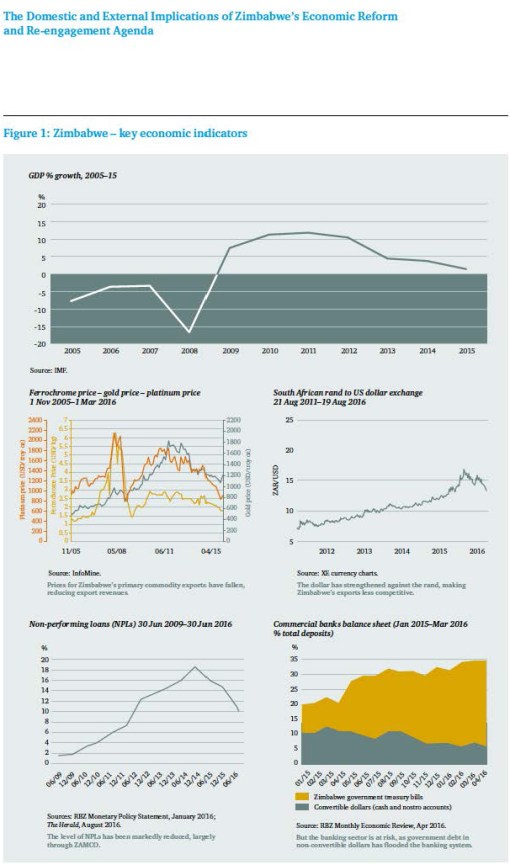
It's not looking good (Chatham House report)

It’s not looking good (Chatham House report)

We may yet be bailed out by the IMF Melissa suggested. Mozambique is also in dire financial straights as are Angola and Malawi. Zimbabwe imploding might well drag down the whole sub-region –  propping up the current regime would be preferable. Zimbabwe has cleared its debt with the IMF so this is possible.

And last but not least
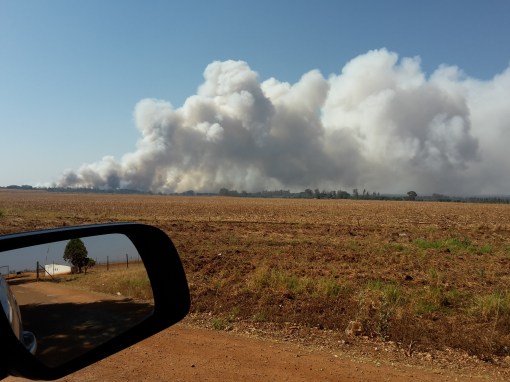
As with any crisis of this proportion there are those who will find the humorous angle. “With the tumble of the English pound, the waver of the US dollar, the volatility of the rand at least the bond notes are stable” is a popular social network joke. When Harare’s main rubbish tip mysteriously caught alight a week ago, and dumped noxious fumes over the northern suburbs, there were those who postulated it was being fueled by bond notes!

20161107_082741

Pomona rubbish tip burning – bond notes the fuel?

Ah the Brexit, if only our problems were so small.


A country on the brink of disaster

1 11 2016

We in Zimbabwe are apparently teetering on the brink of disaster. The much-dreaded bond notes alluded to in the previous post have been signed into law by President Mugabe (yup, Bob notes are real guys!) and it’s all down hill from here. We are still not sure where they are coming from as the German company behind the printing of the now defunct Zimbabwe dollar refused to print these. Never fear, someone will step up to the plate where there’s money to be made.

Marondera air day. Fun in the name of fund raising

Marondera air day. Fun in the name of fund raising

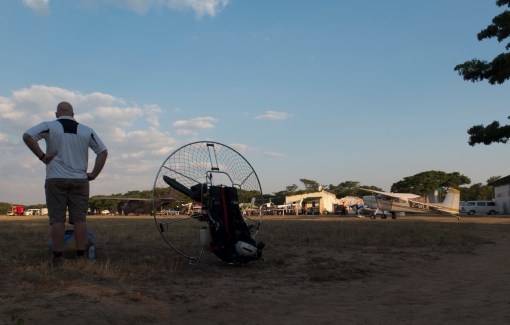
Going out to an air day organised for charity at Marondera, a small agricultural town 3/4 hour from Harare, on Saturday there was little sign of impending disaster. Vehicles clogged the road and drivers drove badly. There were no queues at filling stations but I’d had to search out low sulphur diesel the previous day as my regular supplier didn’t seem to have it anymore. When we arrived at Marondera aerodrome there was a fair collection of aircraft  both ancient (see the Cessna 182 in the foreground) and brand new – a 2 seat helicopter. I guess it was all small fry compared with a similar event in the civilized world but hey, it was actually happening! The Air Force had even been roped in (camouflage aircraft back left) to supply parachutists for entertainment and paid rides for the public. The parachutists certainly were entertaining with some spectacularly hard landings and bad approaches through trees to the LZ. And yes, I mean THROUGH trees! The inevitable party after the show was over was not well attended and the music was not great either but hey, we could still buy imported beer.

The man in charged of the local parachute school said he was still very busy though it seemed that paramotoring, which is why we were there, is not so attractive as we didn’t have any inquiries. The next day the wind was too strong for us to fly so we packed up, had a late breakfast with our host the other side of town and headed home along a busy road.

Today I am breaking news to my employees that they will no longer be paid in cash and like the rest of us will have to get themselves a debit card. It’s not going to be a popular move but they were warned 2 months ago that this was coming. Cash can now be bought for as much as a 15% premium which can make for a useful bargaining tool when buying. My partner and I have decided to embrace the crisis and have bought a house in a suburb that needs considerable refurbishing before we move in. Surprisingly not all the companies we’ve got quotes from are that interested in cash and only offer a 5% discount but with the bond notes now inevitable that might change. Who knows, we might be able to pay off the mortgage with a few bond notes and actually save a lot of money as they rapidly become worthless. (People who had mortgages in the Zim dollar days were often able to pay them off for a few notes as they became completely worthless.)


“Bob” notes

14 10 2016
Any currency will do (almost)

Any currency will do (almost)

Here in Zimbabwe we have no currency of our own. It was finally discarded in February 2009 along with all 12 zeros that were commonly attached. Notes are now collected by curious collectors. The US dollar is the currency of choice but even that is running out, hoarded away from banks by a public terrified of the introduction of Bob notes. Oops, I meant BOND notes.

Bond notes you ask? Yup, notes with a US dollar value printed on them but no actual value outside Zimbabwe. An awful lot of people think that they will not have any value inside Zimbabwe too so are hoarding the real currency away from the banks.

So whose bright idea was this? Well, maybe I should explain what a Bob note, sorry it just seems to slip out, I mean BOND note, actually is. Earlier this year, as it became apparent that the government was running out of cash to pay its employees (some 80% of the budget goes on paying wages – the rest is siphoned by other means but maybe the figures are the wrong way around), the Reserve Bank of Zimbabwe (RBZ) came up with this workaround. They would get a bond of $200 million from a reputable external bank and print notes amounting to the same value for use solely in Zimbabwe. They were at pains to point out the last condition. After all, we already had bond coins which had been initially rejected by the public but had become accepted as a means of supplying change once the South African rand had ceased to have a convenient exchange rate of 10:1 to the US dollar. So why not have bond NOTES? Surely the public would understand and anyway, with parity to the dollar and no mention of bond notes being deposited into one’s account the cash crisis would be solved?

Right. Like there is any trust at all for anything this government suggests. Panic ensued. There was a run on the banks which was exacerbated by the restrictions that were imposed on drawing cash and promises from sources that it was NOT a reintroduction of the Zimbabwe dollar just made things worse. Riots ensued and now diesel is short. Point-of-sale (card swipe) machine supplies ran dry and banks couldn’t install what stocks they had fast enough. Predictions of food shortages proved false (well not in the supermarkets) and cash money now commands a premium of up to 15% over transfers and card swipes.

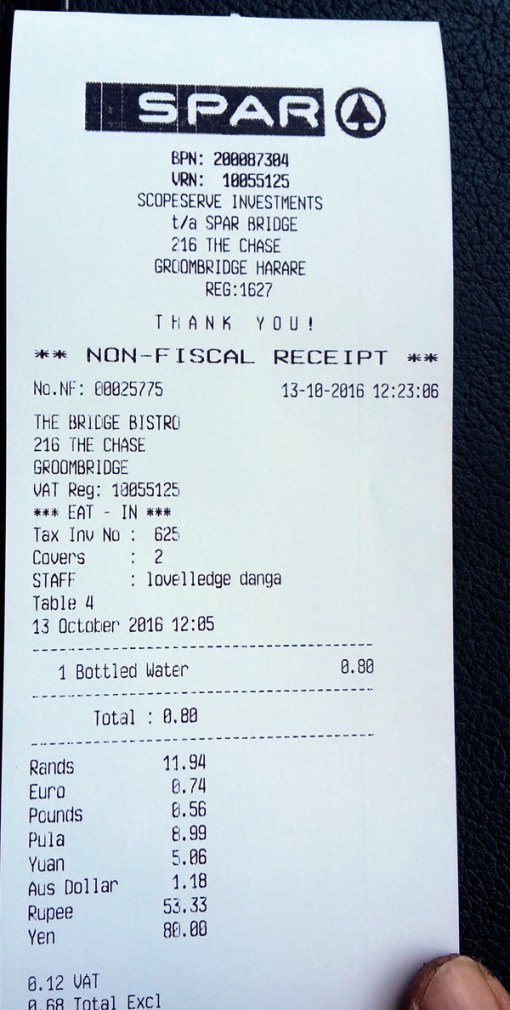
So we’ll accept just about any currency. The bond notes were due to be introduced this month but have now been deferred to next month. Maybe it will be added to the list on the bottom of the till slip but I’m willing to be there will be a few zeros too. Oh, I paid in cash. US dollars.

The term Bob note is a reference to the name of the Zimbabwean president – Robert Mugabe. It’s not my creation but has appeared on the social media recently.


Urban wildlife

23 09 2016

wildlife-urbanWhile out running the dogs this morning we spotted these two reed buck (a type of antelope). While there are only two in this picture another three were lying nearby, apparently unconcerned about our presence. And yes, that’s the outskirts of Harare in the background – to the south.

When I first moved onto this farm 12 years ago there were an estimated 70 reed buck on the property. We saw a total of eight this morning. Of course there will be others but certainly not close to the 70 of not so long ago. The rest? They’ve been poached.

The fence around the farm, once electrified, is now rather porous. Depending on the route we take we bump into a school boy off to school on his bicycle. Where exactly the school is I don’t know but he gets to the fence, climbs through, and then pulls his bicycle after him. Nope, it’s certainly not electrified now!

On the right of the photo are some houses which now extend all up the western boundary of ART Farm. A lot are incomplete but nevertheless they have inhabitants and they’d be unlikely to pass up an opportunity for a bit of fresh meat. On the eastern boundary is another farm once inhabited by a good customer of mine. He was kicked off by a Connected Person (about as connected as one can get in this country) some four or five years ago. At the time his farm was replete with duiker (another smaller antelope than the one pictured) to the extent he was getting fed up with them eating his cabbages. Well, that’s what he said but I could tell he was also rather fond of them. At the time his electric fence worked well so the duiker had a great excuse not to go anywhere else and so they proliferated. The fence most likely doesn’t work now and I haven’t seen a duiker for a long time (though they’re mostly nocturnal I did see them occasionally during the day).

So the reed buck can only go north now. That’s a problem because there are a lot of mesh fences to the north which are supposed to protect the research section of ART (that’s Agricultural Research Trust), and while certainly not impenetrable, they are a definite obstacle. From the food aspect they don’t need to go anywhere for the moment. There are a number of cattle on the farm and they have plenty to eat so by extension so do the buck but the encroachment of Harare, pretty much stalled as a result of the appalling economic environment, is inevitable and then their future will be questionable.

A bit more flexible are the two jackal we occasionally see. They are usually on the boundary of the grassy vlei (wetland) area where they most likely have a den. Zak likes to chase them but they see him coming a long way off and are much more nimble and cunning – the fox of Africa. They are hugely adaptable. There is one that has lived on a nearby golf course for some time now. Again it is conveniently trapped by an electric fence but the course is bounded by a rubbish tip so there is no shortage of rats and other vermin for it to eat. The club gate is just a boom gate so it could, if it wanted to, get out.

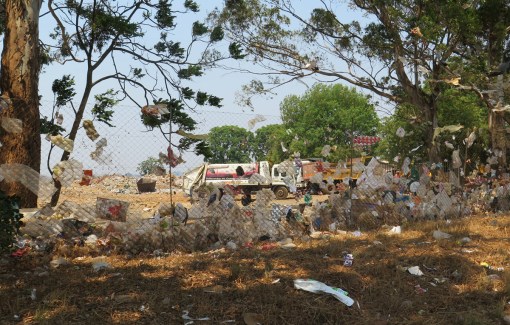
rubbishThe rubbish tip is itself a supporter of wildlife. Apart from the obvious rats there are crows, egrets and maribou storks. The latter can often be spotted in huge wheeling flocks soaring majestically amidst plastic bags lifted in the thermals generated by the rotting garbage. I don’t suspect they mind to much but to me the tip is a hideous eyesore that I pass everyday. And that’s before it rains and the whole area smells like vomit.

The maribous are scavengers and attracted to whatever they can find – there was once a sack of offal spilt at the traffic lights on Harare drive and Alpes Road on the way to the tip, so I guess there’s plenty of other pickings to attract them.

And where there’s vermin there are predators. Snakes, long-crested eagles and others. I know the incidents of cobra bites on dogs has gone way up over the past years as uncollected garbage in the suburbs attracts all manner of opportunists.

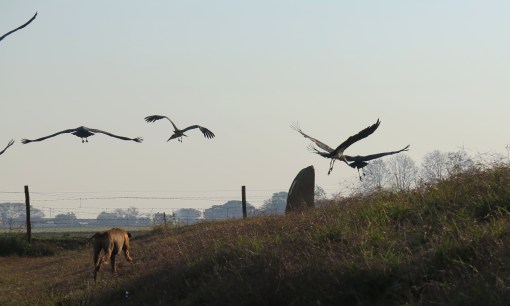
Zak sees off the local maribou storks

Zak sees off the local maribou storks

I have to admit the maribou stork is not the prettiest bird around but they are master pilots and I love to stop and watch them soar. So, in a way, rubbish can be a benefit but I do wish they’d move the tip somewhere else!


Farming

5 09 2016

Farming in Zimbabwe is pretty challenging but Zimbabweans are adept (some would say notorious) at “making a plan”. Let me give you an example.

led lampThat circled object in the photo above is a LED light mounted on the railing outside my office. It was temporary you must understand; a necessity of circumstance, the best I can do at that moment to provide some security lighting.

Last Tuesday (10 days ago at the time of writing) the electricity cables that supply my business and several properties in the area were stolen. I was getting into the shower as the power went off – I don’t live at my work but the house is on the same grid. It was 10.30 p.m. Of course I didn’t know at the time the cause of the power cut but the next day I received a SMS from the foreman saying the lines had been cut. I thought he meant broken as when a tree falls across a power line as it had been windy. No, he really did mean cut. I had a look when I got to work and was surprised to see the wire cables were made of copper. They were certainly old – all the line I’ve ever seen have been an aluminium alloy. There is a strong demand for scrap copper and once it’s been melted down there is little chance of being caught.

ZESA, the electricity supply utility, came and had a look and by the next day was on the job. I chatted to the foreman on the way out and he said not to worry, they’d have us back on-line that evening. I asked if they were going to replace the other copper line before it was also stolen. No, they weren’t. But he did think the thieves would be back for the rest. Apparently he found this funny. I thought I’d better look into buying a heavier duty generator as the one we had was only for standby situations and not suitable for long periods of use. I asked him how they’d stolen the live cable without getting electrocuted. Must have  been experts he opined. I didn’t add that I thought they were probably ZESA employees or certainly had been.

On Thursday I bought an 11kVA generator, big enough to run all the essential equipment; 3 borehole pumps, 2 irrigation pumps and security lights. It cost $5750 and is a prime power generator meaning it can be run continuously if necessary. There was not a huge choice in the range that I could afford and as I couldn’t wait for the bank transfer to go through I paid a cash deposit and the generator was delivered “first thing” on Friday which turned out to be 2 p.m. Power came back that evening as did the thieves and another 400m of cable was stolen. By Tuesday morning the generator already needed its first service – it had clocked up just over 50 hours and paid for itself. Seedlings really cannot run out of water.

On Monday it was evident that one of the borehole pumps was not running properly. I had changed it on Thursday from a 3 phase to single phase motor, so it could run on the old generator, and the control box was tripping the power supply off. Pumps use more power when pumping more water so once the pipe was full it would draw less and settle down. The pipe (all 400m or more of it) should have been staying full but it seemed that none of the non-return valves that should have prevented the back flow were working. So my landlord set about replacing them.

I engaged the services of an electrician to install the change-over switches to allow us to switch between the generator supply and the ZESA mains supply. Normally I would have tackled this as it’s well within my understanding of electrical wiring but he was in the area so I thought I’d take the easier route. It was just as well that I didn’t feel like doing it as he spotted a major problem in the switch box that would have ruined the generator. The generator ran all weekend while we set about trying to solve why the one borehole kept switching off. By Monday I’d had enough and went to the irrigation supplier who told me that it was a voltage problem. My thought was that it was just too sophisticated for Zimbabwean conditions so I bought a basic one that just ran the pump with no power checking. A risk but I was fed up with the tinkering.

Tuesday and the linemen were back again and working quickly they were finished by Wednesday evening. I have an important (politically speaking) neighbour who could not possibly be inconvenienced. That morning I’d been to the local ZESA office to see what I could do about getting the transformer connected and was fully prepared to pay an “incentive”. I was brushed off with “we will get to you”. The next morning they were working on the transformer but it was not by my efforts. My landlord’s son had made contact with the “correct” person and paid him $100. The next day we were finally back on the grid and the generator could take a rest having used some 200 litres of diesel. One phase was not working but we’d become adept at moving wires on the switchboard to deal with that sort of inconvenience.

It had taken 10 days to get the power back and I’d learned a lot more than I’d ever intended to about electrical wiring. I’d only got one shock and no equipment had burned out. One has to be adaptable to farm in Zimbabwe.