Bitten by lightening

23 02 2016

The power went off on Sunday afternoon as it often does when there’s a storm nearby. We didn’t mind – it was a small price to pay for a respite from the incessant heat and the smell of damp earth was just wonderful. There was even a bit of hail which is very unusual for this time of year. I have also recently finished installing the solar panels and inverter so I was actually feeling a bit smug, secure in the knowledge that the fridge, freezer and of course the WiFi were going to function as normal.

The power was still off yesterday morning when I got to work and the foreman suggested I go and look at the transformer which in his opinion had been “bitten by the lightening”.

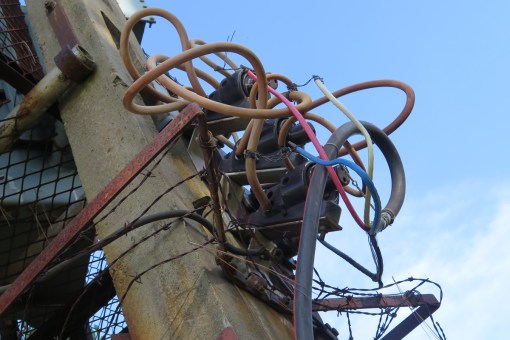
Unconventional wiring I think

Unconventional wiring I think

I could see his point – it was unlike any wiring I have ever seen on a transformer. Now we have had a lot of problems in the past with the wiring and the fuses (in those black, cylindrical things) often get loose and burn the contacts and as the original fuses are no longer available  the power utility technicians insert washers, bits of copper wire and generally anything that will do the job.

wiring closeup

The fuses have been completely bypassed

I could see the fuse holders had been bypassed entirely with some not so thick copper wiring that was completely open to the elements and the unwary and all of 2m off the ground. It is “only” 220 volts on this side of the transformer but that is enough to be lethal.

The other problem we’ve had in the past is theft of the transformer cooling oil (for what purpose I’m not sure) which resulted in the transformer core burning out. A cage was made around the new transformer to keep would-be thieves away but I reckon this new wiring setup is just as effective and quite Darwinian too boot.

I told the foreman that as far as I could see the problem of lack of power was not at our transformer and sure enough later in the day it did come back on. But I did recommend he have a look – just for educational purposes.


Checking the box

13 01 2016

I went and saw the latest Star Wars movie last night (I have already forgotten the full title). It was a box checking exercise and besides, I had to see what the hype was about. Ok, I also need to admit it was the first Star Wars movie I’d seen. Yes, ever! I think the first one came out when I was at university and even then I was only vaguely interested despite the ground breaking special effects of the day. It was probably well after the release of the movie elsewhere in the world – those being the days of apartheid in South Africa where I was studying at the time. Well, there were no sanctions on films one just had to accept you were not going to be the first to see anything!

Last night was, I think, the last night of showing at the local cinemas. This run had started a month ago and I had a sneaking suspicion that it was about to end. Hey, do the maths, pretty good huh? We started showing it on the 14th December last year which must have been pretty close to the worldwide release. Unlike South Africa all those years ago Zimbabwe (contrary to what our politicians liked to claim until very recently) is not under any sort of sanctions. Maybe it’s also due to us using the US dollar so we can actually pay for things if we have the money, something most people in this country are struggling to find these days.

Well last night there was no shortage of money in evidence. I mean I actually had to walk some 200m from where I’d parked to the cinemas (last time I went I got a park as close as one could possibly park). The place was buzzing. I’d rather hoped with schools just starting their new term the place would be quiet. Nope, no chance of that. It was teeming with the youth. There are pubs, restaurants and a supermarket at that end of Borrowdale village shopping centre (yes, the supermarket was open at 7.30 p.m. – how times have changed) and of course I bumped into someone I knew. Harare is like that. A city by name but an oversize town by nature. Debbi from the gym had just been to see another movie with her family. Her eldest son Mike has just finished his medical degree in Johannesburg and is waiting for a placement for his internship. As he is not South African he has to wait for a placement; they have one for him but they don’t know where.

The movie theatres are pretty modern. Actually they have only been open about a year so one should expect this but in Zimbabwe one should not expect anything of this nature given the state of the economy (a lot of government employees were only paid for December end of last week). There are six small ones in the modern format. The ticket cost $5 (half price Tuesday) and the 3D glasses $1. Ok, another admission – this was my first 3D movie! I settled into my seat a few minutes into the movie and put on the glasses.

Two hours later I was not entirely sure that all the hype had been justified. The special effects had been good but then I’d been expecting that. The bizarre characters were certainly imaginative but there are some things that were bothersome. I mean, they had light speed capable craft right? That is serious tech (even if impossible by Einstein’s theory) but they still managed to miss most of the time in the dog fights. I don’t know what they were shooting at each other (balls of light things) but they only seemed to go in straight lines. The one set of missiles that did actually track the goodies also missed! And they actually had non-robotic/computer pilots. Not very good. The main character, the kick-ass chick (and boy could she kick) looked like she could have done with a few visits to the gym before hand. I WAS pleased that she was not drop-dead gorgeous but just sort of normal in a Hollywood sense. There were lots of characters from the original movie there too. Harrison Ford was looking his age as was Princess Leia (whoever she is). The former got stuck with a light sabre which is a truly stupid piece of high tech for waging hand to hand combat (get the contradiction?) so we won’t be seeing him again. The rest of it was of course left wide open for yet another sequel/prequel/something-quel. We left with Luke Skywalker (in a hoodie – I bet he has tatts he’s hiding) looking decidedly uncomfortable about accepting his old light sabre from the kick-ass chick. No doubt he was thinking he’s in for another epic.

And the 3D? Well on one occasion I took my glasses off to see if they were clean because background lights in the movie were more than a bit fuzzy but all was clean. So I think tech has a way to go on that one though I do admit that a couple of times I almost ducked as fighters “flew overhead” so I’ll keep the 3D glasses for another occasion. I’m not at all sure it will be for the next issue of Star Wars though. Been there, done that, checked the box.

The rain had reduced to a light shower by the time I walked out and the carpark was quiet. It seems that Zimbabweans go to bed early during the week. My evening’s entertainment had cost $6 plus a bit of fuel. Not bad – about a day’s wage for the average horticultural labourer in Zimbabwe. Well, for those lucky enough to be employed.


The drought of ’92

10 12 2015
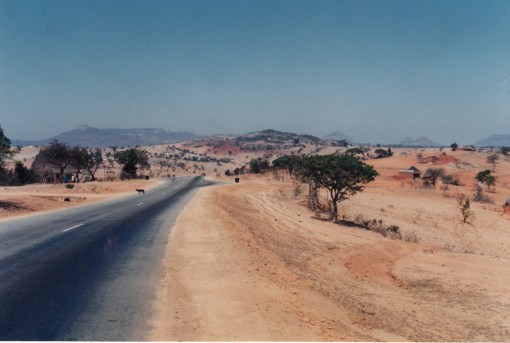
Watsomba area of eastern Zimbabwe 1992

Watsomba area of eastern Zimbabwe 1992

Zimbabweans have a curious attitude to the rainy season; they almost think it’s a right and are somewhat puzzled or even hurt when I say no, I don’t think the rains are going to come this year. Of course we will get some rain but it’s almost certain there will be a drought.

In 1992 we had a drought. At the time I was working in Penhalonga in the high rainfall eastern area of Zimbabwe. I was doing freelance programming; there was plenty of work but it did not pay well as people were not convinced of the value of it so I left and in 1995 (another drought year) started an agricultural job near Harare.

The photo above was taken north of Mutare in a high rainfall area called Watsomba. I don’t recall the actual date but you can see there is hardly a blade of grass to  be seen. In those days Zimbabwe still had a vibrant agricultural sector and despite the ravages of the drought nobody went hungry because the commercial farmers (mostly white) knew how to use their resources well and besides, drought is endemic to southern Africa so there was plenty of stored water to irrigate crops.

This year a drought is likely but there’s a major difference; there are very few capable farmers left. Most were driven off their land by the Mugabe government in 2000 – 2002. Many of the former commercial farms lie derelict and ironically, the dams (reservoirs) that ensured plentiful crops and established Zimbabwe as a regional food exporter are still mostly full. There are two reasons for this – there are few farmers to use the water and those who can prefer to pump the water for more profitable crops than the staple maize. Pumping is also expensive these days as most of the country is enduring long power cuts so diesel pumps have to be used. One of my customers told me that he gets up at midnight, when the power comes on, to irrigate his tomatoes. “You can get quite a lot of irrigation done in four hours before they turn it off again but the labour force is not very keen” he added.

The electricity situation is only going to get worse. Lake Kariba, which normally supplies most of the country’s hydro power is critically low so the turbines are running below capacity. The lake is low due to poor rains in the catchment area of central west Zambia and eastern Angola and this inflow only occurs around April. The Zambians have also over developed the north bank power station and the lake simply cannot keep up. Zimbabwe also has a large thermal power station at Hwange in the west of the country but generating capacity is down due to lack of maintenance and capital development (the government is broke) and despite being right on top of a large very high quality coal deposit they just can’t seem to get it together.

Money was borrowed from Namibia to fund electricity development in Zimbabwe but now the local utility, ZESA, has taken out another loan and we have to export more power to Namibia to pay it back.

The internet did not exist in Zimbabwe in 1992 so there was not a lot of opportunity to research the causes of drought. Now the current el Niño is well covered both locally and worldwide. Looking back at the history, this year’s temperature rise that defines the phenomenon looks to be very similar to that of 1992 (1995 was not quite as strong though we were saved in this part of the country by cyclone Bonita that savaged the eastern districts) but perhaps a bit stronger. That’s not good news at all.

I don’t have a photo of the same area taken in 1993 but I do recall that the area recovered very well. That’s cold comfort right now (it’s blazing hot as I write this with temperatures in the mid 30 degrees and few clouds to be seen) as we still have to get through another 12 months before we can hope for a normal season.

In the meantime I am installing a solar powered system capable of running all electrics in the house bar the water heaters (it’s not my house otherwise I’d install solar water heaters too).  I actually am connected to a reasonably reliable grid due to the proximity of a military baracks but I just like the idea of being independent and, yes, I’m a bit of a geek too.


Double standards

15 11 2015

I usually only buy the newspaper when I need newsprint. It’s useful for mopping up excess oil after frying fish and Marianne had bought some calamari rings for Friday supper.

The Zimbabwe Independent is actually not a bad paper and insofar as I can tell gives a reasonably balanced opinion on the local political situation.

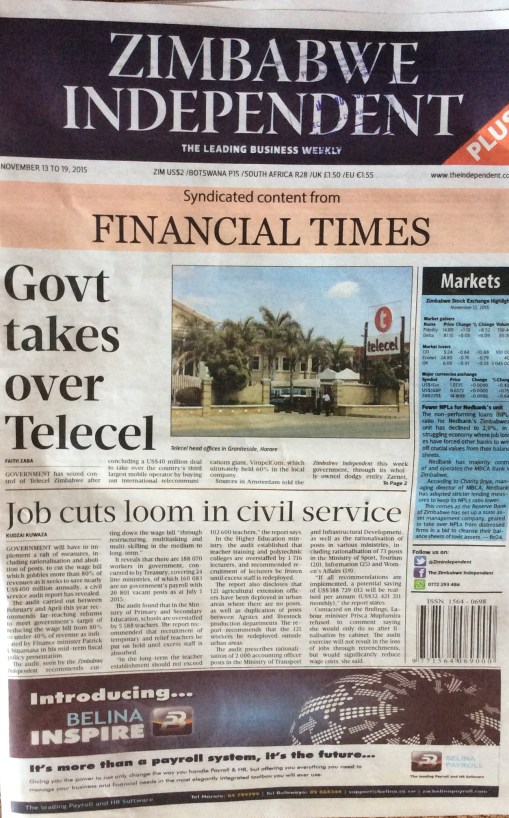
image

It’s no secret that the Zimbabwe Government is broke so I was more than a bit surprised to see that it had made a substantial bid for a majority shareholding in a local mobile phone company that was going to cost some US$40 million. A bit further down the page one can also read that a civil service audit report has recommended substantial reductions in the wage bill which gobbles some 80% of revenue.

Perhaps the government thinks spending $40 million that it doesn’t have is going to earn enough to avoid laying off large numbers of its supporters. This is unlikely given the appalling record of the government to do anything well except line the pockets of the faithful.

The 11th November came and went with little fanfare in the papers about remembering Armistice Day. In this part of the world it is also known as the anniversary of Ian Smith’s Unilateral Declaration of Independence (UDI) that broke Rhodesia (as Zimbabwe was known) away from British colonial rule. Most years it passes with little if any comment but this year was the 50th anniversary. I must admit I’d forgotten about this until I saw it in the social media.

The state controlled press in the form of The Herald newspaper wasted no time in reporting that “unrepentant Rhodies” in other parts of the world had been celebrating this anniversary (Rhodie is a derogatory term for ex-Rhodesians). One ZANU-PF (ruling party) spokesman, Cde Simon Khaya Moyo (Cde is the abbreviation for “comrade” that only the party faithful and state press use) went so far as to reiterate that “Zimbabwe will never be a colony again”. He was apparently referring to social media posts in Australia advertising celebrations for the 50th UDI anniversary. Quite why he felt threatened by people having a party half the world away is not made clear.

Why anyone would want to celebrate the UDI is beyond me too. I was nearly 6 at the time and almost certainly looking forward to what my parents promised to be my last birthday party in 6 days time. The UDI culminated in a bush war that took my father’s life and very nearly took mine. I most certainly don’t look back on Ian Smith with any fondness even if he was right that the Mugabe regime would ruin the country. He was most certainly wrong to declare UDI but I don’t lose any sleep over it; I have more important things to consider like my birthday in 2 days time and just making ends meet.


Getting more for less (or preferably nothing at all)

22 10 2015

The workers’ committee representing my labour force requested a meeting yesterday. They were asking for a wage increase. That most of Zimbabwe is unemployed swayed them not a bit. Neither did the fact that most prices are not going up and rents are, in some cases, going down. The pharmacist where I most frequently get scripts has taken a 20% reduction in salary and is struggling to pay her children’s school fees. That I would have to increase prices to offset the wage increase and probably drive customers elsewhere also failed to move them. So in the end I just said no, it was not going to happen (I already pay substantially more than I am required to by law). They were more than a little bemused but at least they are actually working for a living unlike a lot of the “haves” in our society.

Currently there is a bit of a fuss in the press over a Zimbabwe born doctor who works in the UK. Dr Sylvester Nyatsuro is after a farm owned by a white farmer in the Centenary area in the north of Zimbabwe. Dr Nyatsuro is by all accounts successful in the UK, running a weight loss clinic in Nottingham – he does not need a farm in Zimbabwe. Even his UK lawyers seem to think he is entitled to grab the farm under Zimbabwe law. Note that he is not going to pay for it despite the fact that it is heavily cropped so I can only think he must be well connected. And what will happen to the farm in the hands of a doctor who probably knows little about farming? Well, he could if he is sensible employ someone who does know about farming but more likely it will suffer the fate of the farm just down the road from my business.

The farm to which I’m referring was once was highly productive. Some 3 years ago the owner was kicked off. Very little happens there now. There have been 2 disastrous crops of potatoes this year and last year there was an extraordinarily bad crop of seed maize that looked like it had been grown almost entirely without fertilizer. There is ample water supply to farm most of the land through the dry winter and ironically, unlike a lot of Zimbabwe, it has reasonably reliable power to pump the water. It is not clear whom is actually in charge of the land but the manager is reasonably capable so I can only think the “owner” is bleeding it dry.

Earlier this month, hot on the heels of Cecil the Lion saga, a magnificent bull elephant was shot by a trophy hunter near the Ghona-re-Zhou game reserve in the south east of Zimbabwe. It was a completely legal hunt but already the social media knives are out having so successfully lynched the American dentist who shot Cecil the Lion and has been exonerated of committing a crime (the professional hunter who led the hunt may or may not have something to answer for).

The German hunter who apparently shot the elephant paid a reported $60,000 for the right to shoot an elephant. That’s a lot of money for most people and in Zimbabwe professional hunting does bring in much needed cash and supports a lot of people. The hunting fraternity also argue that the controlled hunting areas would become a free-for-all poaching areas if hunting were to stop i.e. they are conservationists too. Whilst a lot of people find trophy hunting repugnant it would be difficult to argue that a poached animal that often dies in agony over several days has a cleaner death than one shot (elephant poachers have taken to using tranquilizer guns on their prey because they are silent – the tusks are then hacked off whilst the animal is still conscious) in a professional hunt. In Zimbabwe we don’t have the luxury of being able to leave land idle – it must all earn its keep. Sadly, allocating hunting areas to photo tourism won’t work either. Our already underfunded national parks are themselves being poached and in many cases the general public is helping to keep them going. Friends of Hwange are active in providing water to the animals in the country’s premier national park – a task that in normal countries would fall to the government. This government is always pleading poverty and prefers to let well-wishers help out whilst they spend supposedly non-existent funds on military vehicles.

Just yesterday I received an email from some local microlight pilots who have started a trust to provide aircraft free of cost to assist with anti-poaching patrols in the National Parks. The National Parks people are reportedly delighted as I guess so too are the government.

Now that most parts of the country are suffering massive power cuts of up to 18 hours, those of us who can are looking to “make a plan”. Whilst I am not in an area too badly affected I am not sitting idle and am looking at the solar option. A diesel generator would be cheaper but I am not convinced that diesel will always be available. Sunlight will be. So I guess I am as guilty as anyone of not standing up to the corruption, mismanagement and poor governance that blights this special country. But at least I am working for my money.


Panic attack

1 09 2015
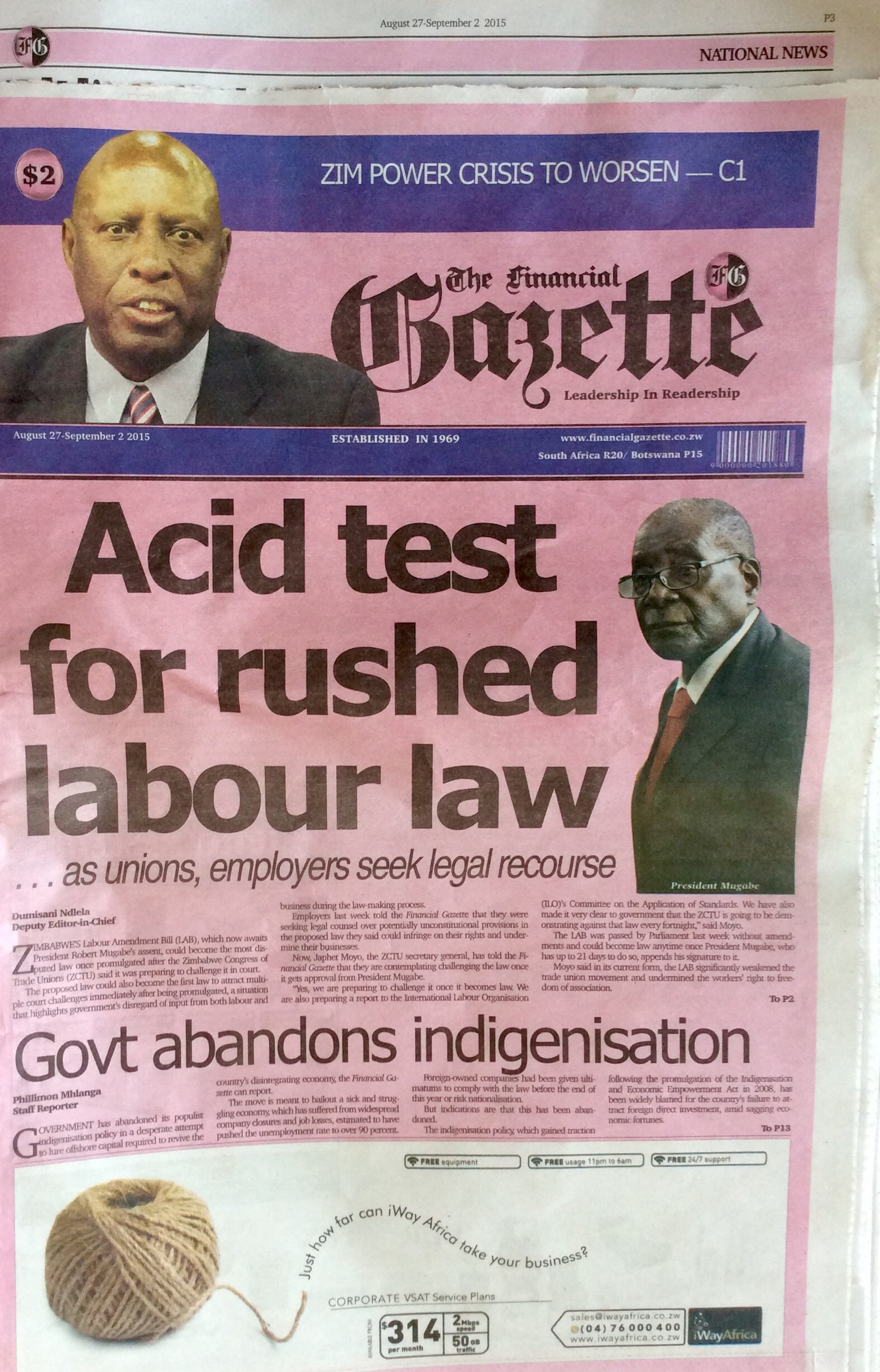
FinGaz front page

FinGaz front page

This is the Financial Gazette front page from last Thursday. It represents a major shift of attitude in the government.

Up until now it has been very difficult to get rid of staff without paying a massive (read punitive from the employer’s point of view) retrenchment package. For example, if I were to lay off any staff it would have cost me 6 months notice, 2 months payment for every year employed and one month re-location package. Scenarios for a layoff would have included a takeover of my business by anyone with the correct contacts. As I only rent the premises and have little in the way of assets it would have effectively wiped out the company.

The labour law to which the paper refers changes a lot of that. Now it is only necessary to give 3 months notice. While I have not read the new legislation it is fairly obvious why it has come about. The government wants to lay off a lot of the civil servants which it can no longer afford to pay. Already a substantial number from the state controlled ZBC (Zimbabwe Broadcasting Company) have gone. Rather than simply not pay them and get lumped with the bill later it has changed the law to suit itself. Interestingly there are a number of parties involved who are ready to challenge the legislation. Good luck to them! It is more than a little ironic that this is the government that introduced the heavily workforce biased legislation in the first place to gain the support of the working class.

The labour legislation, as it was, was deeply unattractive to would-be investors. Also unattractive is the current indigenisation policy, embedded in law, whereby companies must be at least 51% owned by indigenous Zimbabweans. While it was never completely clear what indigenous meant I knew that as a Zimbabwe born white I was not included. The reality was that the government (and those with the correct contacts) were after the bigger more profitable companies.  So does the second tier title on the front page of the paper represent an about-turn by the government? Well, if one cares to read a bit further the answer is not quite so obvious as the title implies. Elsewhere in the international press there does seem to bit a bit of a charm offensive by the President, Robert Mugabe, to woo investors from the West. This really does represent a huge change of attitude.

Up until now the West has been the cause of a lot of our problems, according to the government owned media. Our biggest creditor at the moment is China who has been very generous with loans. When things really started to go pear-shaped last year the finance minister went begging to them but came back empty-handed. So to go begging to our former nemesis, on whom our woes were blamed for imposing sanctions, really is a change of attitude. It shows just how deep the financial crisis is.

It is well known that the police have been told to go out and collect their own wages so we are used to being endlessly stopped for both real and imagined traffic violations but last week it really was a frenzy. Even the ZBC got in on the act stopping vehicles to check if they had valid radio receiver licences. Perhaps it was a fear of being laid off under the new legislation or perhaps they were actually getting their notice payments. This week has so far been eerily quiet. Maybe it will all start again towards the end of the month when pay day looms.


The bees are back

10 05 2015

Actually the bees have never left. They have been around almost continuously ever since my first post “Rats, bees & barn owls” some 9 years ago. We have pretty much tolerated each other since then but I had to do something when, a couple of months ago, they attacked the gardener and harassed the dogs and I one afternoon. Mike the bee man was called in and after two attempts the swarm in the chimney was killed. Alas it was not long before another swarm was scouting the chimney, attracted by the smell of the defunct hive. They took refuge in a nearby tree whilst making a decision. I called Mike again and he arrived with his bee handler.

The swarm -  medium sized

The swarm – medium sized


Swarming bees are not aggressive; they have nothing to protect and that’s important as stinging for them is fatal. The ultimate sacrifice. African bees have a fearsome reputation for defending their hives when they have brood or honey. In extreme cases the whole swarm will go into a stinging frenzy and can kill humans and livestock.

Preparing for action

Preparing for action

Somewhere I have a photo of my father as a young man holding a swarm of bees on a branch and not wearing any protective gear at all. Mike’s bee handler was not taking any chances though I noticed he was not as heavily kitted out as he would have been during the day when working with and established hive (I used to keep bees in a small way.

Smoking the bees to calm them

Smoking the bees to calm them

A few puffs of smoke and the bees were bumped into an open cardboard box and brought down to the ground. Mike and I (we were both unprotected) watched from a respectful distance. The bees buzzed a bit in the box and Mike said they would soon calm down when the queen released her pheromones. No point in wasting good workers! They soon did and the box was picked up and they were on their way.

In the box and ready to go

In the box and ready to go

The next day there was a small cluster of bees on the ground nearby so I collected a catchbox (a small hive prepared with attractive prop0lis) and they duly moved in. A few days later there were MORE bees around the chimney and as I was about to go on holiday thought it would be a good idea to get another two catch boxes to try and attract them away. They day before I left the swarm moved into one of the boxes.

For the moment all is peaceful on the bee front and Mike will come and take the swarms away and put them to work in his commercial bee keeping practice. The next swarming season is in August and I will have to be prepared again.


Still looking good

31 03 2015
Still going well...

Still going well…

I came across this grand old lady in a supermarket car park recently. The owner was only too pleased to chat – one can be sure when this amount of work has gone into a car it will be very special! It turns out she’s a ’68 model, has done 300,000 miles (500,000 km) and is on the first engine rebuild. The owner couldn’t get the right sized pistons and liners so he upgraded it to a 1600 cm³. Yes it has been resprayed too.

Some German friends whom I showed the photo to commented that it was the first model that did not have a split windscreen. And yes, she really did purr (in as much as Beetles ever did) out of the car park!


The advantages of differently-abled

25 02 2015

Some years back, whilst working in the U.K., I noticed that the word “disabled” was out of fashion. One, and that included me, was “differently-abled”. Hopelessly PC of course and complete nonsense. Differently abled implies that the person afflicted has abilities that others might desire. Right. Hands up all those who might want to fall over more easily. But that’s in the real world. Zimbabwe of course is in another world where these rules don’t always apply and having a disability CAN actually be advantageous.

My Zimbabwe passport expires in April and I’d been procrastinating getting it renewed. It’s been 10 years since I’d jumped through hoops and endured the queues at Makombe Building but things have slowed down a bit at work, my presence is not constantly required there and really I’d run out of excuses. All attempts to download the renewal form on the internet had failed (I’d enlisted the help of others too) and noting that they were open on Saturdays and also having heard that Saturdays were not that chaotic, decided to give it a go. It was inauspicious.

Parking on the street and getting the usual “I’ll look after your car boss” from a hawker of passport folders, I walked in. Having ascertained that Room 3 was the place to buy an application form I discovered that there was no queue. I also discovered that I couldn’t in fact buy a form ($3) until I’d had all my other identification documents certified (birth certificate and National ID) and those offices were closed on a Saturday. I’d have to wait until Monday and come back or get the form from a sub-office in Mount Pleasant (a suburb closer to where I live).

Monday found me at the sub-office in Mount Pleasant. Unfortunately I needed the original of my birth certificate and my ID to purchase the renewal form. Yes, if the internet download site had been working I could have done it for free without any documents! But nobody could tell me why it was not working. I returned later in the week and got the form but ascertained that I needed a new computerised birth certificate and that would require a visit to Market Square in the CBD of Harare. Now I have driven past Market Square and it is straight out of Dante’s Inferno, but with Zimbabwean flavour. Rubbish, touts and endless queues dominate the scenery. I shuddered, was there perhaps another way? Of course there was! An official offered for the princely some of $20 to acquire it for me. It was a no-brainer as the Americans call it. I paid and collected later the next day.

Back to the Makombe building later the next week I mentally fortified myself for long queues and delays. I was pleasantly disappointed. Fast tracked through the first queue due to my disability and not actually finding any other queues to jump, I soon found myself back at Room 3. No, I did not need to buy an application form. But how much did I want to pay for the passport? What, I have a choice? Of course there is a choice; $50 for 6 weeks, $250 for 3 days or $350 for the same day! No, 2 weeks is not an option. Not at all stupid are the Registrar General’s office. They know which option most people are going to opt for and yes, I paid the $250. After only an hour in the Makombe building I walked out assured that my passport would be ready on Monday.

I told the story to Shelton (en Francais). He was more than a bit cynical and told me he knew someone who paid the $250 and it took 4 weeks. In fact another friend who’d paid the $53 ($3 for the form) got it in 2 weeks. I settled down to wait but with a bit of hope as I’d been pleasantly surprised at how well things had gone. It had not been the Makombe building of old.

Yesterday I got a SMS – my passport was ready! Fortuitously I needed to go into town so enlisted the use of a driver from the National Ballet office – parking can be chaotic in that part of town. The parking was easy, the queue formidable and no officials around to fast track me. I guess I will go back this Saturday.


A nice idea

3 02 2015

Towards the end of last year Zimbabwe was abuzz with the news that bond coins were going to be introduced. The news was not well received and, despite strong denial from the Reserve Bank, rumours abounded that it was an attempt by the government to reintroduce the Zimbabwe dollar. I had seen one or two but up until today had not actually received any as change.

Small change

Small change

Small change is in notoriously short supply in Zimbabwe. South African coins (2 RAND lower right) have been useful in that they are roughly 1/10 the value of a dollar (so the 2 RAND coin is valued at 20c) but obviously they have to be bought at least the face value plus some sort of commission. The bond coins, which are minted in South Africa, are pegged at equal to the US dollar though they have no value outside the country. They certainly cost less to produce than their face value. A nice idea and certainly preferable to receiving ball point pens or sweets as change which was the case. People receiving lots of coins, such as the mini bus drivers, can go and change the coins at the end of the day for paper money at a bank. Except, as Shelton tells me, most refuse to accept them.