Appropriate technology

24 08 2013

Freightliner truckThis is a Freightliner truck. An American brand they are popular in Zim ever since a number were imported from the Middle East quite a few years ago. This one arrived at work yesterday to take a modified container to Hwange in the South West (the landlord’s son converts them into liveable cabins). I got chatting to the driver. He admitted there were rather a lot of electrics that had once stopped him on a weigh-bridge because of a faulty oil pressure sensor. They’d also disconnected the automatic greasing facility – trust Zimbabweans to “make a plan” to get around inappropriate technology.

Growing up on a forestry estate in the Eastern Highlands of Zimbabwe my father had a Peugeot 404 pickup truck. It was definitely more comfortable than the Land Rover it repaced and it lasted well on the less than perfect roads – not least because my father maintained the roads AND the pickup! I haven’t seen a Peugeot 404 for some time now but they were made to last – appropriate technology at its best. They were followed by the Peugeot 504 which was definitely more luxurious by the day’s standard and didn’t last as well.

Other appropriate tech cars included the Renault 5 with the gear stick on the dashboard and yes, you do still see a few around. A physiotherapist friend and her twin sister had one when I was at the St Giles rehabilitation centre in 1979 which they had to hire from their father who happened to be the managing director of Anglo-American in this country (Anglo-American is a VERY big company in Africa!). Somewhat thrifty was Mr Carey-Smith!

I own a seedling nursery business that is definitely appropriate technology orientated. Nearly everything is manual with a few exceptions, one of them being the clipping of the tobacco seedlings for which we use a Husqvana hedge clipper. It works really well for the purpose and requires little maintenance. Unfortunately it does require 2-stroke oil to be put into the petrol so when the operator came to me yesterday and said the machine had just stopped I had a pretty good idea what had gone wrong. Now I’d really like someone to come up with foolproof technology but maybe that’s a contradiction in terms.


The price of business – part 2

18 07 2013

Zimbabwe is expensive. This is largely due to us producing little of anything so most goods are imported through and from South Africa by road. It is also due to the Zimbabwe business attitude which can roughly be summarized; “If at first you don’t sell anything, raise your prices”. It was against this background that I went looking for polystyrene seedling trays in which to sow tobacco seed for a customer who decided at the last-minute he actually did want me to grow his entire tobacco crop!

“Phone me back in an hour” said the responsible person at the Tobacco Research Board which usually manufactures expanded polystyrene trays for tobacco seedlings. This I duly did and was told that they had plenty at the princely price of $2.75 each. Expensive but I didn’t have much choice. The only other outlet in town is just as expensive and the quality of their trays is dismal. I went and got the cash and drove out to the TRB near the airport.

“We don’t have any” I was told on arrival at the TRB that afternoon.

I explained that I had transport hired by the hour and that I’d got the cash specially. A few phone calls later and some trays had “appeared” and  I was told that I could get them at the warehouse.

“We have no trays!” the warehouse manager told me. “Have a look”. There were no trays. The injection moulding machine had broken down 2 weeks previously and the South African technician had yet to arrive. I explained that I HAD already paid for the trays, and I HAD got transport waiting and WAS being charged for it. “Let me make a phone call” the manager replied.

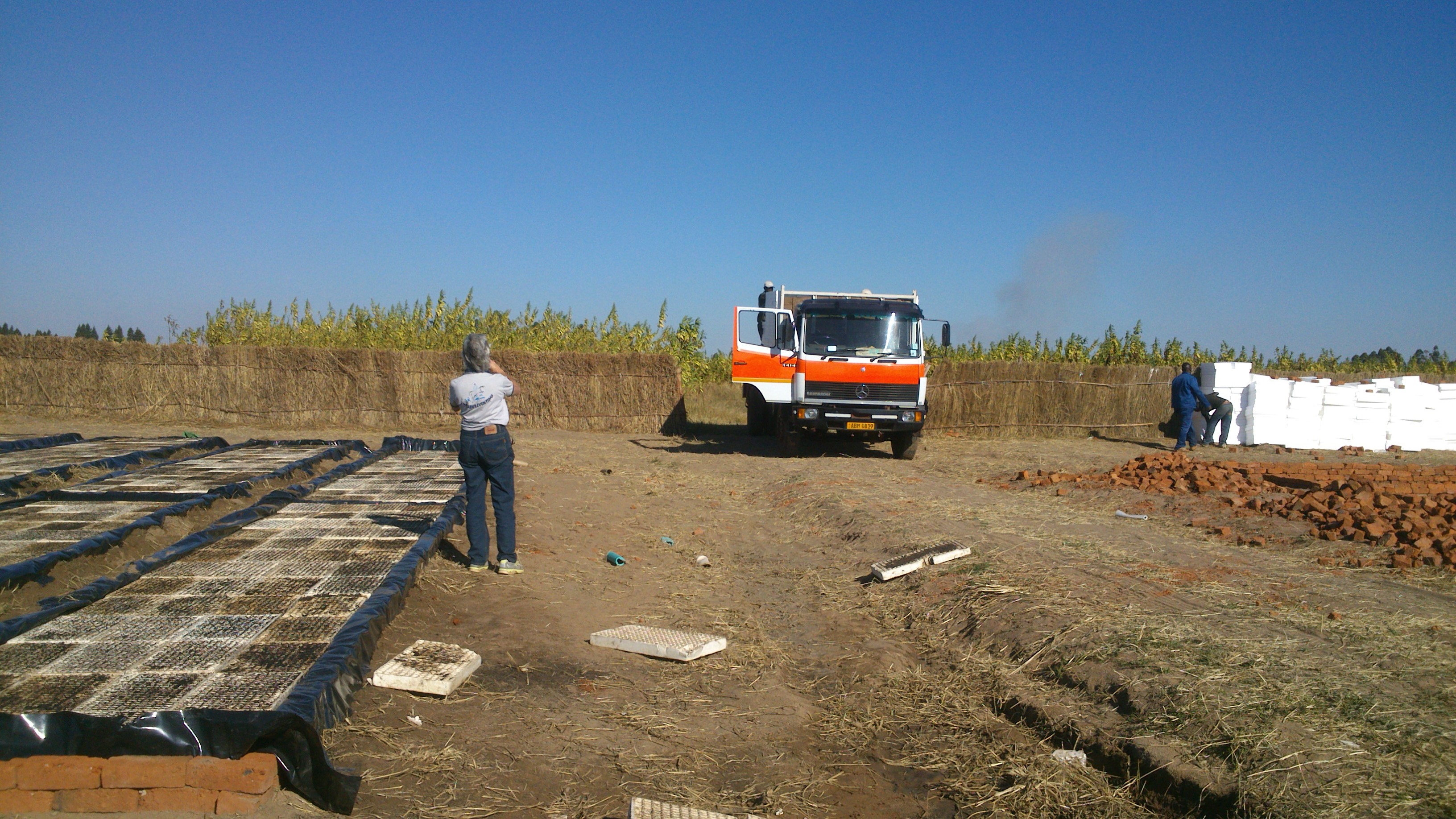
It seemed there were some trays available on farm and I was directed over to the seedling production area. It was an education. There were indeed trays to be had there and they were new. The ponds were set up and looked quite presentable. But over the fenced area was an old crop of commercial tobacco – a clear violation of plant quarantine. Oh dear, what has happened to the premier tobacco research facility in the country that was once world-renowned?

Loading seedling trays, old tobacco in the background.

Loading seedling trays, old tobacco in the background.

Prior to this little escapade I had ascertained that seedling trays of good quality (we’d used them before) were available from Johannesburg. The catch of course was the transport – expanded polystyrene is mostly air which makes it expensive to move. However, even factoring in the transport and  other costs, I could get them landed at my business for 75% of the cost of locally produced trays. And the return load was empty – another sign of the state of the economy – making the transport doubly expensive. It took a while to find a transporter who had the right sort of trailer to move a bulky load such as this but eventually one was found and the trays have now arrived.

Trays arriving

Offloading the seedling trays from Johannesburg

As a Zimbabwean I am willing to support my local businesses but the product has to be of comparable quality and price to the imported option. Our local economy is in a dismal state and of course there are many factors outside of our direct control (read politics here) that are making it difficult to do business but really, Zimbabweans need to wake up when it comes to being competitive.


The perfect cup of coffee

22 06 2013

This is my Moka Express coffee maker.

Made to last - a VERY long time!

Made to last – a VERY long time!

It has been around as long as I can remember. As a child I was forever lifting the lid to see if the coffee was coming out of the central spout. I also remember that my parents didn’t seem to use it very much, perhaps it didn’t make enough coffee so it was replaced by a percolator which made a lot more and was also interesting for a six year-old as it made interesting noises and splashed coffee against a clear glass top. And made awful coffee.

My little, very old espresso “machine” (can it be a real machine without moving parts?) to my mind makes very good coffee. No, it probably isn’t perfect, and in the morning I don’t have time for making the perfect cup but it is important that I have good coffee to start the day. NO, INSTANT WILL NOT DO and we do still have one good brand of local coffee called Farfell produced here which I keep well stocked up.

Anyway, the filter thingy that holds the coffee was looking like it had come to the end of it’s life, the gasket I’d replaced with a silicone one of my own imperfect design and the handle – well, nothing one couldn’t fix with a bit of epoxy and a paper clip!

We are famous for making do in Zimbabwe but now it’s the era of the internet so I set about seeing if spares were to be had. Oh delight! They still have spares for my 6 cup (I get just one mug out of it) Moka Express made by the original Bialetti company! Yes, there a loads of new designs in stainless steel and different colours to boot but my old aluminium version is still there.

For some reason Amazon won’t ship direct to Zim but my long-suffering postal master in the UK (brother and sister-in-law) divert the package to me and the Moka Express is almost back to new (wrong handle).

And the coffee tastes just as good as ever!


Relics – an old tractor and the CFU

13 02 2013

Agriculture House is situated on Marlborough Drive in the suburb of the same name on the north-west of Harare. It was once the home of the Commercial Farmers’ Union (CFU), the union that in its day represented the majority of commercial farmers in Zimbabwe. It was a powerful organisation that was a thorn in the side of the government for many years. But that was a long time ago and today my footsteps echoed in the large, silent entrance hall where I’d come on anything but agricultural business. I walked around the tractor on the plinth and up the stairs to a long, dark corridor.

Yes, that is 1917 on the front of this old Fordson tractor!

Yes, that is 1917 on the front of this old Fordson tractor!

Finding the door I needed I knocked and entered. I’d come to collect a tripod mount that I’d ordered from the UK through a small company based in the building. I got chatting to the woman who’d served me. It seemed that the CFU had sold the building some months previously and now it was now administered by a government company that let out offices to anyone who had need of them. This was not a new development – the CFU had the same practice when it was there but it had been busy and bustling then.

Once the farm invasions had started the CFU membership dried up and it became a relic of its former glory. I’d been a member through my company but got fed-up with the lack of service and did not bother to renew my membership some 8 years ago. At one stage it had a very good technology section that in itself made membership worthwhile but when I phoned the Agricultural Labour Bureau up with a labour problem and was referred to the National Employment Council (a refereeing body between employer and employee) I realized it was time to go.

Walking out of the sprawling complex I wondered why the tractor had not been taken. It has 1917 on the front so it might be worth something. Now it was also just a relic of a bygone era when Zimbabwe’s agriculture industry had held the region’s respect for its farming skills and exports.


Rural visit

7 02 2013

“They didn’t pay their electricity bill” Archie replied to my question as to why the Mhangura mine had closed. I thought there may be a bit more to it than that but there was no doubt as to the impact the collapse of this copper mine in northern Zimbabwe had on the town of the same name. I’d picked up my guide, Archie, at the local GMB (Grain Marketing Board depot) for the trip into the surrounding farming area to see a customer who had problems with some seedlings he’d collected.  The GMB, once a cornerstone of the nation’s agricultural economy, was now very run down and the signpost was a hand-painted piece of metal propped up by stones at the side of the road.

It had been a long trip out of Harare on the road north-west of the capital towards Lake Kariba but I’d been interested to take a trip back to the area where I’d worked on returning from my travels abroad in 1990. Turning off at the township and GMB depot of Lions’ Den (yes, there really were lots of lions here in the early part of the 20th century!) I got onto the very quiet Mhangura road and put my foot down – there was little to miss apart from the occasional herd of cattle being driven along the side of the road. The rains had been late coming to this part of the country but the crops were still dismal – small, yellow and very uneven. This was a far cry from the area I’d known 20 years ago when the area was populated by mainly white commercial farmers.

I wasn't going fast when I took this - promise!

Long, straight and uncongested – I wasn’t going fast when I took this – promise!

Having picked up Archie we made our way east towards the Raffingora area and got chatting. Of Zambian descent he’d grown up in Harare and worked for a while as a farm manager for a number of black farmers but got fed up being given half the inputs he needed and then told to “make a plan” so he’d set himself up as a commodity broker. He didn’t go back to Zambia much but said if things got much worse in Zimbabwe he might have to.  We bumped and crashed along a truly appalling road that had clearly not seen any official maintenance for quite some time. The countryside was still beautiful despite the collapsed tobacco barns, power cables lying in the fields and the dismal maize crops clearly not suited to being grown in an area once famed for its tobacco.

It took the better part of an hour to do the 20 or so km to the customer’s farm. I dropped off Archie at the rather decrepit farm workshop area (clearly there was protocol involved here as he was definitely not invited to accompany us) and went with the farmer to the lands. Also of Zambian extraction he was an engineer by training but preferred to be a farmer. The cabbages were not in good condition, largely due to unsuitable soils so I dispensed what advice I could before collecting Archie and making our way back to Mhangura.

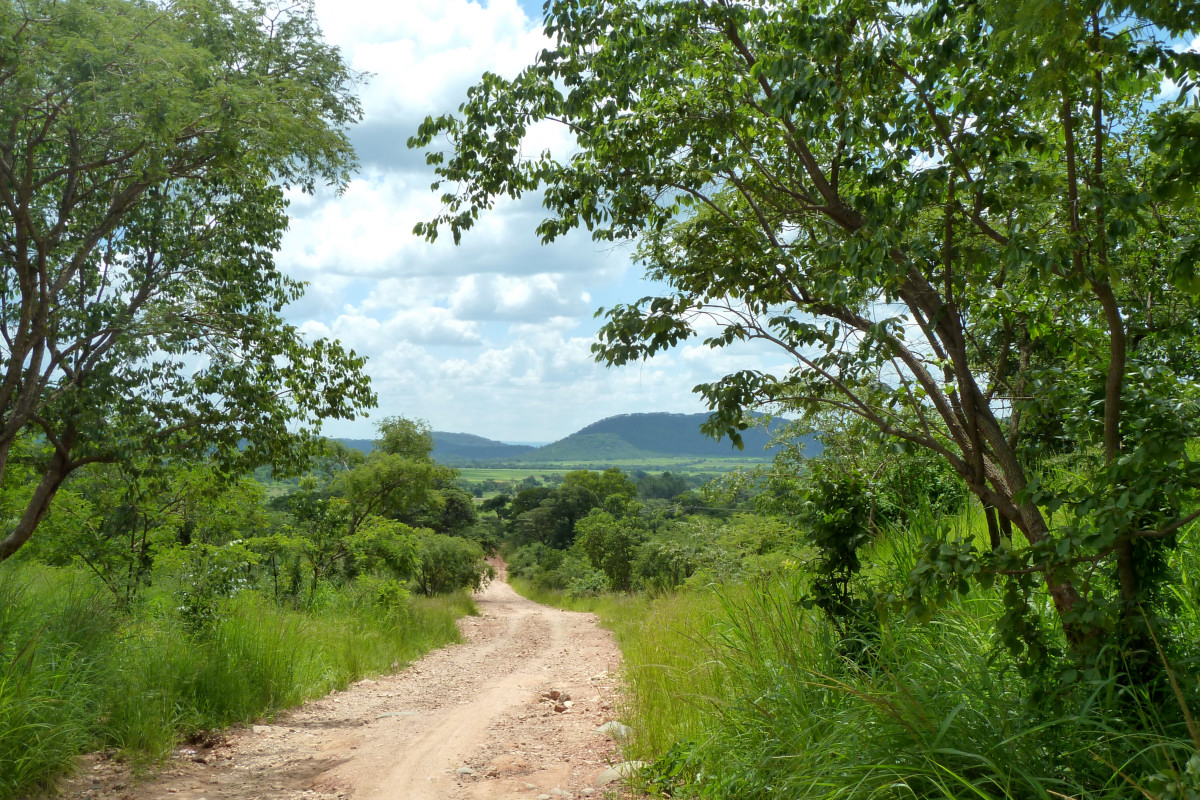
The bush was looking good, much better than the road!

The bush was looking good, much better than the road!

It was a long slow drive back to Harare along the congested Kariba road but I’d fuelled up with biltong from the renowned Lions’ Den Butchery which was just as good as I remembered from 20 years back. Getting back home I noticed a missed call on my cellphone from the farmer; he was just checking to see I’d got home safely. Clearly I’d made a good impression!