Farewell irony

10 12 2006

I attended a farewell party yesterday afternoon. Farewells are depressingly common in Zimbabwe at the moment. But this one is worth mentioning as the departing couple are actually desperate to stay in Zimbabwe.

Terry and Suzanne are Canadian citizens who have been here for about 5 years; Terry was a senior diplomat with the Canadian Embassy here. He has just retired and envisaged supplementing his pension as a political risk assessor for companies wishing to invest in Zimbabwe, using the considerable political contacts he made during the course of his work. You could have been forgiven for thinking that his (and Suzanne’s) application for a work permit, after all it could only help improve Zimbabwe’s dire economic situation. He was turned down flat.

It is seldom that simple in Zimbabwe. We have to go back a few months in looking for a possible influence on the negative outcome of this application. When the  United Nations General Assembly was on, the Zim delegation was flying in from the UK and asked Canada for permission to overfly that nation. They were turned down and had to make an expensive detour. On the plane was the senior immigration officer.  The work permit application procedure require the applicant to be out the country while his/her application is being processed. This usually takes a couple of weeks but Terry had been out for two days when his application was turned down. At the time I thought it ominous but I did not express this to Terry and Suzanne who were still optimistic. Their appeal was also turned down and no reason given though an official did say to Terry that if the government were to change his application would be favourably received.

I could not help thinking yesterday how ironic this all was. Here were a couple who were desperate to stay in a country that they’d come to love, (a lot of Zimbabweans are desperate to leave) and here was I needing to leave the country that I love. I’m not sure if I have touched on this elsewhere but I should explain; I don’t WANT to go. I HAVE to go. Zimbabwe and Africa are not good places to be if you have health problems as I do. Yes, I am reasonably fit but in future years I will probably end up in a wheelchair and with no family and no properties I must go somewhere where I will be looked after. If I want to stay in Zim I need to put aside AT LEAST US$1000 per month for the next 20 years and that does not allow for emergencies, assuming that I want to retire at the normal age. That is not going to happen.  Yes, if one can earn real money and live in Zim that is first prize; but few have that option. The other option is to make a LOT of local money but agriculture, in which I am involved, is not a growth industry at the moment.

Erratum. Speaking to the better connected yesterday, I was informed that the figure of US$300m embezzled in the diamond scam was way over-inflated. Whatever, mabe it was 30m. It was still a LOT of money and you can be certain it was embezzled!


Gold Miners

7 12 2006

The illegal camp of gold panners on the boundary was moved on the other day. I reported on this blog that they hadn’t all moved off and some had made an attempt at rebuilding their shacks. No more. The police moved in on Monday and set up their camp, a smartish looking military style tent. All the shacks and inhabitants thereof were moved off. It seems that the Reserve Bank was fed up with the gold panners selling their gold on the open market at whatever price they could get which you can bet would be at least eight times the official rate (the bank rate for buying US$ is ZW$250, the black market rate is ZW$3000). My foreman tells me that the police are camped throughout the Mazowe valley below my house to enforce the issue. Methinks that the Reserve Bank should concentrate on solving the US$300m diamond embezzlement reported last week instead of chasing petty “thieves”. Curiously, the bigger the scam the less likely it is to be solved.

The Zimbabwe government has a curious desire to cut off its head to spite the body. To wit: yesterday I was buying some calcium nitrate fertilizer (amongst others) that we use to raise the seedlings in my nursery business. It is wholly imported so the price is a direct conversion to local currency using the black market rate of the day. As I was in the process of updating my costings I asked the sales clerk for all the prices on the fertilizers and chemicals that we use. Ammonium nitrate was conspicuously absent. I asked why. Oh, we are not allowed to import that one he said. I think he meant that they were not going to import a fertilizer on which the sale price is dictated by government as being sub-economic. A surprisingly large number of products have their prices set in this manner, especially those considered to be essential. Ammonium nitrate is used extensively in the growing of the maize staple crop so comes under the “essential” heading. Not surprisingly therefore, it is extremely difficult to find at the official price though it can magically appear if one indicates willingness to pay a premium. So, it seems that it is better to have no ammonium nitrate available at the official price than to have some available at any price (at least where the peasant population is concerned).


Bookish

7 12 2006

Good books are hard to come by and all books are expensive in Zimbabwe. I have spurned the temptation of satellite TV (not difficult due to the cost and repetition factor) and prefer instead to spend my evenings reading, computer programming or when the mood grabs me, gemstone faceting. Mostly I rely on a loose network of other book enthusiasts to garner good reads and when I go out the country a visit to a good bookstore is a childish must and deadly to the credit card. Good quality writing is as important as the story, and yes, I do like a good novel. That’s not to say that non-fiction does not get a look-in, it just requires a bit more research to find what I want. So, taking advantage of this internet usable connection I have through a neighbour’s business, I decided to treat myself to a birthday and Christmas present of some quality science writing. I relied heavily on the book reviews in the Scientific American to which I subscribe and it has proved a sound basis.

Yesterday I received (I could have used “got” but we were always taught to avoid it in English language classes; it was classed as being ugly though not as ugly as “gotten”) a parcel slip from the post office and was delighted today to find out that it was the books I’d ordered only two weeks ago from Amazon. Two are by Richard Dawkins; The God Delusion and The Blind Watchmaker, and the other two are The First Human by Ann Gibbons (no pun intended) and Walking Zero by Chet Raymo. Dawkins has created waves recently with his take no prisoner approach to eviscerating religion in The God Delusion and I’m already nearly 60 pages into it despite it being a slow reading type of book. I’ve also succumbed to temptation with The First Human, an account of the paleoanthropological search into the origins of humankind. Some discipline is required here as I’m already reading Evolution: The Triumph of an Idea which I must add I’ve read twice before but is an incredible book. Again, it requires slow, concentrated reading even though it is so well written that anyone sans a scientific background would understand and enjoy it.

I like to think that I live in awe of no-one. I really don’t want to meet any movie stars or chat to glitterati. I do however admire some people. I am fascinated by the artistic/creative process that allows artists and artistes to be creative in ways I could never imagine. I also admire those who commit to a cause, especially where there is little financial reward – the likes of MSF come to mind. And I would dearly love to be able to craft the written word as well as the authors of the books I have just bought!

I find it incredible that the book format has not changed significantly since Caxton’s day though I do believe that “e-books” are becoming a bit more popular. No doubt they will get more convenient; as many texts as you like on one device. But will they get them to smell the same? There is something about the smell of a new book that is so enticing!


Battles and Wars

1 12 2006

The good news: the ZANU-PF Youth League “official” was a mere driver, and after the police were contacted and then they consulted with the higher powers, he was booted out of the house he’d commandeered on the farm where I live. That battle is won but the war is far from over. Now we wait for the next fatter cat to have a go.

The not so good news: “US$300m feared lost in diamonds scam” is the front page headline on today’s Zimbabwe Independent. It has emerged that the Minerals Marketing Corporation of Zimbabwe, the sole legal trader of gems and minerals in the  country and a government body to boot, has been selling off packages of stones at around 9% of market value. The claims actually belong to a UK listed company, Africa Consolidated Resources, and are some 60km south of the border city of Mutare in the Marange area. Of course there has been other leakage in what has become a good old fashioned scramble since the government sponsored “invasion” of the claims. The senior foreman at my work comes from that area and says it is just a cholera outbreak waiting to happen. I assume it has not happened in part at least due to the late rains.

I mentioned the figure of the missing US$300m (it could buy about 6 months worth of fuel for the nation) and his response was “Do you think it was individuals or the government?” He missed my point entirely. Why was he not outraged? I was.  Have become so shell shocked as a nation that we accept the pillage of vast quantities of diamonds as the norm – just another jigsaw piece in the grand pillage puzzle? There seems to be an acceptance of the “What’s In It For Me” attitude that is so pervasive. Where have all the statesmen gone, if indeed they were ever around? Africa is haemorrhaging, and it is not at all interested in applying a tourniquet.

Yesterday the police burnt down a small squatters’ kraal (village) in the bush adjoining the entrance to the farm. Apparently it was part of a clear up of illegal gold miners operating in the Mazowe valley. There were pathetic piles of possessions outside the  blackened remains of the pole and daga structures this afternoon. A few roofs had gone back on despite the threat of a beating from the police if the people stayed there. I wonder if they know about the illegal diamond rush in Marange?

The Zimbabwe Independent is not a bad paper. One of the few “NGO” papers around (most are government controlled) it is a weekly that I quite regularly buy. No, it is not even close to the standard of the Saturday papers in the UK, but the English is sound and the reporting interesting. Paging through it this evening I noticed that we have a Women’s Affairs, Gender & Community Development minister. Now I did know that Zimbabwe has the world’s biggest cabinet so I suppose this should not have come as a surprise.  Even less of a surprise was the totally non-eventful budget presentation by the Finance Minister blaming Zimbabwe’s woes on amongst other things; “deliberate efforts to undermine our economic turnaround initiatives” – the nasty West was imposing sanctions again. Government spending of course was up.  (see www.theindependent.co.zw for further mind bending logic)


Is it for the birds?

29 11 2006

In the African summer, the best time of day is the golden hour after sunrise. It is often cool and calm and worth savouring if you can get up early enough. Actually it is not that early at all. Sunrise is 05h15 at the moment and we don’t have daylight saving (which my brother thinks is nonsense – “Just learn to get up earlier”). Anyway, yesterday I was sitting on the verandah enjoying my early morning cup of coffee and admiring the view and wondering why I want to leave Zimbabwe.

Everywhere there was avian activity, and if I couldn’t see it I could certainly hear it. A pin tailed whydah twittered and fluttered with ridiculous optimism in the corner of the garden, desperately trying to impress a future member of his harem. I could hear a crested barbet trilling away incessantly in the neighbour’s garden to my left. Every year they nest in an old gatepost on the fence surrounding a coffee trial plot. Last year there was a pathetic and sad corpse of a fledgling at the base of the post; it had tried to fly too early.

Bulbuls squabbled in a small tree and I could hear a flapper lark wacking his wings together to attract a mate. I have heard them do that for hours on end and it does not appear to damage the wings. It does not seem to work attracting mates either. Sporadic flurries of activity emanated from the mulberry tree in the corner of the garden, even though the fruit have long since gone. Cicadas were starting to whirr in the msasa trees beyond the fence. There has been a paradise flycatcher in the garden; a deep orange bird with a blue head and long tail. They build a nest that is about the size of an egg cup and is camouflaged with lichen. Mango trees are favoured.

A flock of quelias might pass through later. Pretty and small they are nevertheless voracious seed eaters and can ravish a wheat crop when they descend in their millions, but these ones are innocuous. They pick hopefully through the dregs of my lawn, infinitely tired by the dry winter. They have done it before. They will do it again.

In Africa (well, I speak for Zimbabwe) there are always birds to be seen or heard. Later in the day once the thermals kick off, the raptors and scavengers start to soar and one can always see something flying. On the road into Borrowdale there is a municipal rubbish tip that is frequented by the marabou storks. They are not pretty birds; scavengers by nature, they have a wingspan of nearly 3m and I occasionally see them perched incongruously on my neighbour’s centre pivot irrigation system, huddled like a line of depressed accountants. Oh, but you should see them in the air! They soar gloriously, inspired by the welling air currents, wheeling, curving with divine grace, primary feathers feeling for the subtle air currents.

I was in New Zealand in 2003, doing a compulsory visit to keep my residence visa alive. While in the South Island I did a 2 day canoe trip with Kevin, a computer programmer who’d passed through Zimbabwe a few years earlier on his way to NZ. I was struck by the silence on Lake Wanaka. No birds, just the splash of our paddles. It was rather sad.

So why do I want to leave Zimbabwe? Actually I don’t. I need to though. The spinal injury that I had all those years ago in my teens has decided to collect its dues and the old age that I knew was coming has arrived rather earlier than anticipated. I always knew there would be a payback but I never anticipated that it would be this soon. The health services in Zim are OK for someone in good health but not for the likes of me. Yes, for the moment I get by but that will not always be the case and then I must be somewhere where I will be looked after. I have no property to my name, no immediate family here, just my dog Jenni. Much though I love her she cannot support me in the years to come when I will need care of some sort. So I must go. Somehow leaving is proving difficult.

Acacia sunset November 28, 2006.


Acacia sunset


Bush

27 11 2006

Nothing to do with G.W. Just a photo I took in September on the way back to Bulawayo from Vic Falls. To me there are two types of bush in Zimbabwe. This is one of them.

Falls Road

Mopane veld at its best. There had been good rains in the Matabeleland area so the bush was spectacular and rivers all the way up to the Falls still had water in them this late!

Picnic Of course no Zimbabwean trip is complete without a picnic beside the road. This was taken some 2 hours out of Bulawayo on the Falls road. It is a Forestry Commission forest and it too was looking stunning!


Birds of a feather

23 11 2006

Zimbabwe DOES have a few friends left. Our esteemed president has been in Iran, rattling up support and no doubt some much needed fuel supplies. We certainly got some moral support if the government owned The Herald newspaper is to be believed. Yesterday’s banner headline “Iran slams Zimbabwe Sanctions” crowed that the Iranian president fully backed Zimbabwe’s land reform programme and condemned various western nations for being so nasty to us. We are also friends with Venezuela’s Hugo Chavez who likes to poke his finger in George Bush’s eye on occasion. I suppose I have to give him points for that. The sanctions issue is a favourite scapegoat for the Herald. It likes to intimate that a large proportion of Zimbabwe’s economic woes are due to “sanctions”. Yes, there are sanctions imposed but they are targeted at specific individuals, not the economy.

If you have the money you can buy just about anything in Zimbabwe. New Zealand kiwifruit (not great), a new Benz or several, even diesel! I have not seen Toblerone recently and of course our local milk supplies have dried up but I covered that in a previous posting. The Reserve Bank has even splashed out on some very nice new Italian made tractors, for various government farming enterprises. Sanctions? Certainly not economic ones!

I can only speculate what is probably the world’s fastest shrinking economy might have to offer Iran. I wonder if president Ahmadinejad has heard about Zimbabwe’s credit rating? It is non-existent but I’m sure the various comrade dignitaries with President Mugabe have gilt edged tongues that can smooth over any silly stories propagated by the Western media! Comrades? Yes, the abbreviation is “Cde” as in Cde Dr Joseph Made who has presided over the land redistribution programme. Redistributing the poverty, as a Malawian once commented to me. Wow, imagine that one in your CV!

That reminds me; there is a particularly anarchic computer game called Grand Theft Auto. I have never played it but one goes around stealing cars and getting into fights. There is another called SimCity where the object is to build up and successfully run a city. There are variations such as SimIsle I think but they all centre on successfully running a local economy and coping with various challenges; traffic clogging the city, flooding etc. Now, you saw this here first… I am proposing a hybrid of the two, call it “Anarchy” though “Loot” would be equally apt. The idea is to trash a country. A third world country, we won’t give it a name. One buys one’s position in the “order of things”. The more you pay the more power you have and the more influential friends “in positions” you have. You want to be top dog? You pay BIG MONEY! You can be a nobody and it costs nothing but you have no friends and no power. Or you can come in anywhere else on the scale. Limits have to be set on how far down the economy can go before the game is over and the winner is the one who ends up with the most offshore assets (local assets are worthless). Which is the best strategy? Trash quickly and grab while you can or stretch it out over a longer period and milk more slowly? It would be an online game. Economists would have to be sought and economic models used in the programming but it could work. The possibilities are enormous! Other limits would have to be set of course; how many times money can be reprinted for example. It would be quite challenging to define the end of the game, how does one define just how dismal an economy is? Inflation? Absence of GDP? Shortages of commodities? Food for thought – oops, food’s short too!


Bug season

21 11 2006

Nights in the bush in Zimbabwe are never quiet. There is always a cricket chirruping somewhere and in the summer after the first rains the noise grows substantially. Right now there is a cricket somewhere in my kitchen. I don’t mind, in fact I rather enjoy the company! Some years ago family friends who’d emigrated to the UK smuggled a cricket back to their house in Oxford because they missed the sound so much. It lived for some months at the base of a pot plant and performed dutifully every evening.

It’s not just the crickets of course that advertise themselves at the beginning of the rains. All manner of bugs (really beetles) teem around the lights at night, crunch underfoot, land in the milk and eat the rose bushes. On a good night they can really shred a large rose bush. That I DO mind! Later in the rains the another set of insects arrives; the mantids. Some are truly extraordinary in their beauty and I had one nymph living for about 6 weeks in a rose bush outside my bedroom. It only lives in flowers that match its pink colouration and ambushes insects that come the the flower. I used to feed this one the occasional bee until one day it disappeared, probably eaten by a passing bird. It really did not deserve to pass on its genes as the roses had come to an end and it did not have the sense to move on. Still, I did miss it.

Mantis nymphPseudocreobotra whalbergi nymph (wingless) and adult Adult mantis

The rose beetles as is their common name, are small (about 5mm long) and roundish and a light brown. They get into a few unexpected places too and can give a respectable nip. Beware those who like to sleep au naturel! A few days ago I woke up and needing some asthma medication shook my inhaler, and, as per instructions took a deep breath while pressing the cartridge down. And inhaled a rose beetle. Fortunately it just bounced off the back of my throat and was duly spat out but it could have been a deal more unpleasant.

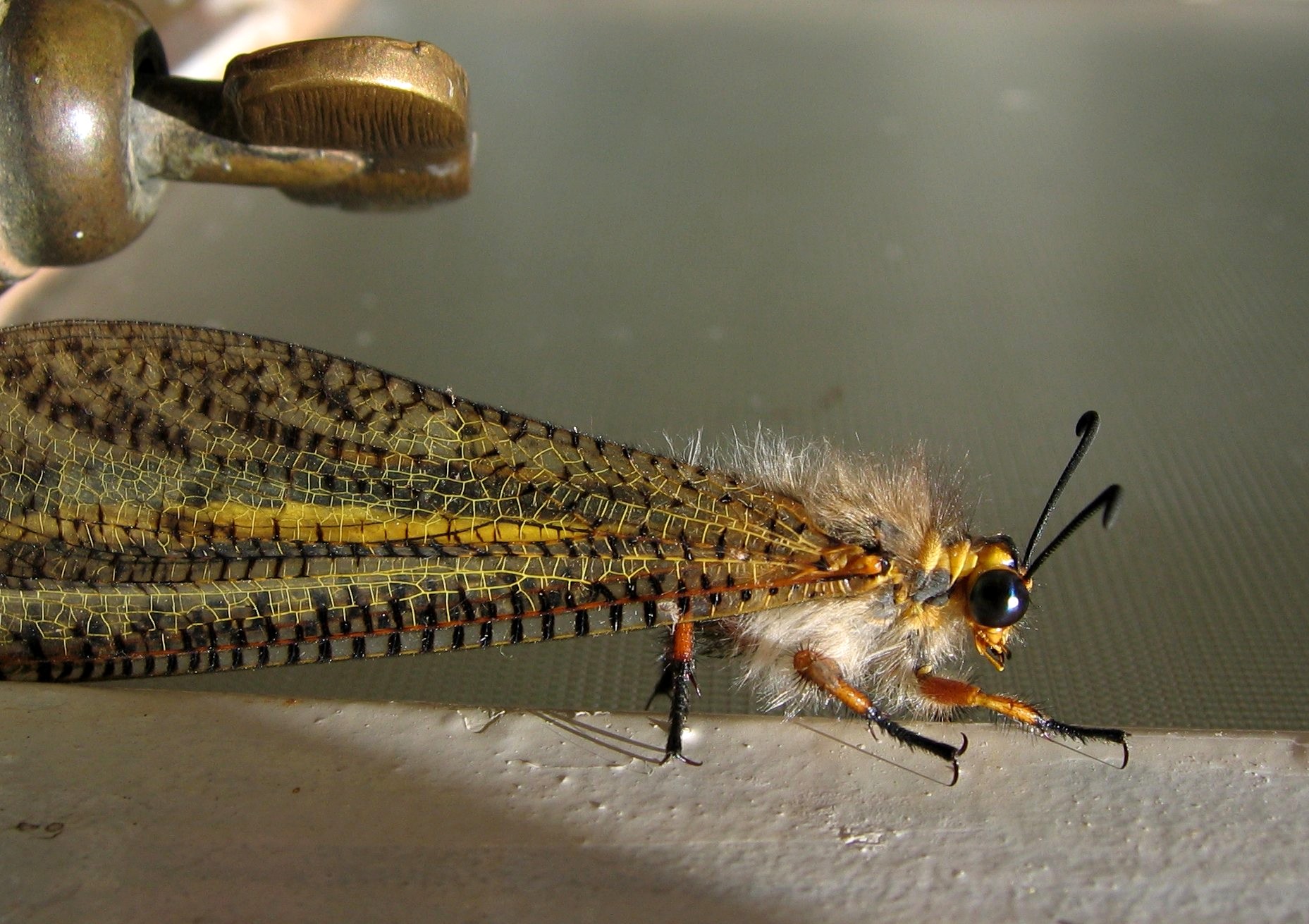
Antlion adult This is a picture of an antlion adult that I took earlier this year. It is Palpares sobrinus; isn’t she a beauty? The photo should be vertical but it fits better on the screen this way. It spent the entire day on my bathroom window patiently being photographed. My camera is a Canon Ixus 500 (5 M pixel pocket type) and it has an extraordinary macro facility for such a small camera. Yes, I did use a Unilock tripod that has independently moving legs that allow one to put the camera just about anywhere.

Now I’m just waiting to see what this rainy season brings!


Reflections on fate

20 11 2006

I have just got back from exercising Jenni on the farm where I live. It was a beautiful evening, typical for summer. Large cumulus clouds were building in the east, lit up by the setting sun. Irrigation sprinklers were gently “tufting” completely out of sync. There was no indication that anything is wrong in Zimbabwe. It all seemed completely normal.

Earlier in the afternoon I’d been to visit Peter, an ex-farmer on whose farm I’d lived when working for a vegetable export business. It was also idyllic and I enjoyed many an evening’s walk with my two dogs over the huge granite “kopjes” on the northern boundary of the farm. It’s all gone now (no, the granite will be there forever of course); the last I saw there was a small cleared patch near one of the dams and the rest was just weeds. I have not been back there for some time.

Peter, however, was not just a farmer. He had a substantial share in the vegetable export business and fingers in a number of other pies around town. He’s a sharp businessman and it shows in the property he’s bought and put a not insubstantial amount of effort and money into renovating. I did not ask him why he still lives here as I thought it obvious – he could not have this lifestyle anywhere else.

Dave is another ex-farmer from the Raffingora area some 120km north of Harare. Like Peter he had an idyllic farm, nestled in kopjes and msasa groves in which leopards lurked and much to his delight took the occasional calf. Dave also lost his farm but managed to get a few implements and equipment off. It’s all been sold now and he works as a caretaker at a local private school. He enjoys his job; he is a perfectionist and played cricket at national level so can still indulge in preparing the perfect pitch, but it’s not like living in the bush and between him and his wife they can make ends meet.

Gary is a big man in every way. He still farms though he lost most of his farm to A2 farmers (medium scale often “weekend” farmers who want to “have a go”). The remainder of the farm is too small to be economic but he hangs in there for the lifestyle which includes guiding canoe trips on the Zambezi, acting as a foster parent for neglected community children, producing the Christmas pantomime and his animals. Long a national polo player they have dozens of polo ponies and a giraffe called Rebecca. Rebecca is drop dead gorgeous with legs that go on forever and eyelashes to die for. She had a calf but it was killed by “war vets”*. Oh, did I mention the pack of Rhodesian Ridgebacks, the pack of Dachshunds (turbo rats as I call them), the parrot, the guinea pigs, the hornbill the crowned crane the…. When I worked in the area I knew Gary to be the easiest going man around. Sadly that is not the case anymore and I don’t think he’s very happy farming at all. He is continually being threatened to help out various A2 farmers or else. It is very stressful.

Other Gary is my best friend, though I don’t see him that much, and he lives in Mozambique. He also lost his farm in Penhalonga which is on the eastern border of Zim and suffered the indignity of watching US$65000 worth of hard wood being stolen in front of him. The local police watched too. I had already helped him get various implements off the farm by the “back” route. Gary is the least materialistic person I know, so long as he has enough money for a beer or two and his paraglider then he is happy. It drives his wife June, scatty. June works as a local headmistress while Gary works for an NGO in Mozambique. Between them they make ends meet and fund their youngest son’s university education. It has not done their marriage much good but they are holding on.

The people above have all survived. They are relatively lucky. A lot are not coping and stories abound of suicides, abandoned children and broken marriages. They are also all whites (though I know there have been casualties amongst the black commercial farmers who don’t have the right “connections”).

There is the absurd optimism amongst a lot of people in this country that “it has to come right sometime”. When I ask them why they cannot give me a reason, maybe they think we are tossing a fate coin here and it must eventually come up heads. I don’t share that mindless optimism (I’m all for optimism, I just find the mindless sort irritating). A lot of people with the right connections are making a lot of money and it is not in their interest to change the status quo. Peter Godwin was correct when he stated in a National Geographic article that the old style, large scale, hyper efficient (and many were just that) commercial farms are gone forever. So are most of the commercial farmers and their skills have not been transferred and many of their farms are derelict. For an agricultural economy such as Zimbabwe’s that can only mean disaster.

The landscape was deceiving me.

* war vet – often derogatory term for those claiming to be ex-combatants on the side of Joshua Nkomo’s ZIPRA or Robert Mugabe’s ZANLA during the civil war here. Many are far too young to have participated.


Auspicious Day

17 11 2006

Hey y’all, it’s my birthday today! But hold the cards, it’s not a big one; the decade is not changing!

My morning habit includes a compulsory juicing up. That’s the slang term for a bit of electricity. I have a small box of electronics that I attach to my left quadriceps muscle with electrodes in an effort to get it to build up quicker after the knee op in February. It certainly stimulates the muscle – the contraction is impossible to resist and I do believe it’s working although I have only been using it regularly for about 3 weeks.

Anyway, I was lying on the bed listening to the satellite radio and pondering not my advancing age but trees. There is an acacia about 20m away in the garden that I planted when I first moved into this house about 3.4 years ago (it’s weird how thought trains work, I was reading about parsecs last night which are a unit of astronomical measurement and one is the equivalent of 3.26 light years – never mind) and it must be close to 3m high already. I have a mild obsession with planting trees; I must have inherited it from my mother. I’m always picking up tree seeds and germinating them and then looking for places to plant the trees. This garden is pretty much full up; I think I have planted 9 since I have been here!

I regard the number of trees planted as a contentment indicator. I have moved 3 times in the past 7 years that I have lived in the Harare environs and this is the first garden that I have felt the planting compulsion. Yes, I certainly like living here. The view on a clear day is a good 70km to the Great Dyke where we often (used) to paraglide and there are no other houses clearly visible. It is the best of both worlds; close enough to town (8km to Borrowdale) to be convenient and far enough to be in the country. It is also only 2km to my business. There is a cloud on the horizon though. This farm where I live, ART Farm (Agricultural Research Trust) was set up in the 80’s (I think) as a research farm to serve the mainly commercial farming interest. As such it is theoretically not under threat from the land redistribution policies of the government. That does not mean much as we found out 3 weeks ago when an “official” from the ZANU PF Youth League decided he wanted some property and promptly moved into a house at the other end of the farm. The ART employee spent a very uncomfortable night and then moved out. ART Farm is an amalgamation of several title deeds and the one in question has had a Section 8 (intent to acquire) on it for some years though it is a house, some sheds and a small piece of land. One does have a right to challenge the Section 8, which was duly done, but that means little. The mood amongst the management is pessimistic and with good reason. Past experience shows that this is the thin end of the wedge and the greed factor will soon set in.

But for the moment it’s a special day. It’s also a beautiful day so maybe I’ll plant a tree – my little bit of immortality. Now where to plant it?