Mother Hubbard’s cupboard is bare

4 07 2009

Andrew is a maize breeder and a director in his own seed company which is based just down the road from my house. I was chatting to him this morning about maize yields and why the USA can achieve higher yields than Zimbabwe. He was of the opinion it was mainly due to a longer day length and better research (maize research has been largely neglected in Zimbabwe in the last 20 years) which has resulted in cultivars that perform well at very high populations. I mentioned that the article (Google UNDERSTANDING AND MANAGING CORN YIELD POTENTIAL) that I’d read on the subject indicated that highest maize yields in the USA occurred on rain-fed crops. This would never occur in Zimbabwe where the rainfall is often erratic and best yields always occur on irrigated crops.

Irrigated agriculture is de rigeur in southern Africa especially when an el Nino strikes as seems highly likely this year. This was not usually too much of a problem as up until the mid 1990’s commercial agriculture was strong and farmers were encouraged to build dams (called reservoirs elsewhere) to cope with the endemic droughts and a system of water rights for irrigation was tightly controlled. The commercial farmers are now largely gone, forcefully evicted from their farms, though the dams are still there and unused as anyone who takes a daytime flight in or out of the country can easily see. Coupled with possibly the worst maize harvest on record despite a generally good rainy season (Andrew reckoned that rural yields might reach a dismal 200kg/ha – he spends a lot of time in the rural areas) the old nursery rhyme is likely to ring starkly true.

As is usual in Zimbabwean conversation he enquired how my business was going; OK I replied, but we were not very busy largely because there was so little money out there. He commented that his company still had hundreds of tonnes of various seed with contract growers and no-one had the money to buy it. What with the government ever more desperate to grab from the pool (see previous post) the situation is unlikely to improve.

So in typical ostrich fashion I went off to the open day at Komani Microlight Club where we fly models and snapped this photo!

Boys and their toys

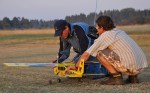
Boys and their toys


Desperate times

2 07 2009

It seems that the government, desperate for some revenue, has hiked the price of fuel with a 20% tax! Nothing quite like creating a bit of “real currency” inflation and give the economy a good kick in the teeth while it’s down!


Taken on trust

29 06 2009

Phil is a banker so of course I had to ask him how it was going with CABS, his employer. He admitted that very slowly things were improving but a policy change could wreck everything. I knew what he meant; I have been banking some, but definitely not all, my cash takings. I mentioned that so far I’d had no problems withdrawing whatever I needed, but yes, I was a bit apprehensive.

In the past the Reserve Bank has put limits on the amount of cash we were allowed to withdraw and on at least 2 occaisions have raided the FCAs (foreign currency accounts) of companies with failed promises to reimburse the victims. While we all have FCAs these days (well, US dollar accounts anyway) there is no guarantee that they will not raid them again – so just one minor bit of silliness from the government and the trust that keeps the banks in business would be gone – permanently!


In the pipeline

18 06 2009

Fuel is short again; specifically diesel.

The vast majority of Zimbabwe’s fuel requirements are imported by the state controlled NOCZIM (National Oil Company of Zimbabwe) whose incompetence/corruption is breathtaking. The fuel comes via pipeline from the Mozambican port of Beira (pronounced Bay-rah) some 460km away. I am not sure of the diameter of the pipeline but it must be at least 50cm or more. Whatever, there’s a lot of fuel in it at any one time. It can be a “mix” of types, separated by a device called a “pig”.

It seems that NOCZIM does not have the money to put any more fuel in at the Beira end of the pipe, so what is in the pipe cannot come out the Harare end. Why they should not have the money is open to question as the various individual importers have pre-paid for their fuel. This makes it sound suspiciously like a Ponzi Scheme (your investment is financing the previous person’s investment – just hope that someone will finance yours!).

In the past various individuals or companies have bailed NOCZIM out. We will have to wait and see if this will happen again.


This fragile life

16 06 2009

Patsy Short was the most cheerful, optimistic person I have ever met. She was passionate about animals and loved Jenni. I always enjoyed my visits to the ART Farm office where she worked as the bookkeeper and would sometimes just call in for a chat. I last saw her just before she went off to the UK to see her daughter and she was thoroughly looking forward to it.

Patsy died suddenly last week in the UK of a CVA (cerebral vascular accident). I will miss her exuberant waving every morning from her dark green Mazda as we passed on the way to our respective work.


Economic Recovery – Zimbabwe style

16 06 2009

I supposed I was not that surprised – they had only put up the price of used seedling trays 200% in a year (real money terms). I most certainly WAS annoyed! I tried everything including an impromptu economics lesson on getting higher turnover by lowering prices supermarket style and moving more stock but it was to no avail. I needed the trays and that was the price the Tobacco Research Board was charging. The sales clerk even said that these days you had to get what you could when you could; what was the point in planning for tomorrow?

On the way out I went past the propagation area just to check that the trays were indeed there. They were; scattered and piled around together with some left over tobacco plants in close proximity to the newly germinating seed.


Possibility and reality

12 06 2009

We got a pleasant surprise this week in the form of a 300000 tobacco seedling order to be sown as soon as possible. It means that I will have to get some more trays from the Tobacco Research Board but only once the deposit comes through.

Driving off to the bank to check if anything had happened I began to ponder the possibilities. Another customer was also talking about some very big orders of tomatoes and the Zimbabwe Tobacco Seed Association was wanting a sizeable order too so I was going to have to give the irrigation some thought. We have had pretty good power up until now but that could easily change and a couple more 5000 litre emergency tanks would be in order (there is a small diesel pump for them). There is an ancient but reliable Lister diesel pump at the main 125000 litre tank but it struggles to provide pressure to the far end of the nursery which we might well have to use. Maybe another Lister type engine to go the other end of the irrigation system and feed back from the emergency tanks? Then of course we have to get the water out of the ground and that would mean parking a generator right next to the borehole (some 200m from the office so the voltage drop from there would be too high) or getting a much bigger generator at the office block. Seedling medium in the form of composted pine bark is becoming a problem; the tobacco growers are also using it at this time of the year for their seedlings (methyl bromide which was being used to sterilize tobacco seed beds will not be available from next year) and supply from the one and only supplier is short. This was all quite exciting (and challenging)!

Then I got to the bank. None of the promised transfers had come through.


The long-term perspective

10 06 2009

My foreman was astounded that I was not that keen on a potentially massive order of cauliflower seedlings. I pointed out that if the said customer really went ahead with the order he would most certainly crash the market (assuming that the seedlings got to maturity). If I gave him advice to reduce the order to something more sensible he might remember that I’d given him good advice, tell his friends and come back for more regular business. My other customers growing the same crops would also appreciate me reigning him in and, though I would not go and tell them that I’d done so, they might well find out if I did not!

This “grab it now and worry about the future when it arrives” policy is all too familiar in Zimbabwe and presumably in the rest of Africa to a differing degree. Here its most insidious form is in the continuing land grabs which have largely contributed to the trashing of the economy and have left large swathes of once productive land derelict as the new “owners” discover that farming in southern Africa is a demanding occupation.

A couple of weeks ago I encountered one of the latter; a “politically connected” youngster who was looking at farming in the north of the country. He was astoundingly clueless and knew nothing of rotation, land conservation, soil sampling or even various types of tillage that once made Zimbabwe a net exporter of food. He had no idea of the whereabouts of any potential markets or crop timing to meet market demands or continuity of supply. I suggested that he go and do some market research and then I would be in  a position to offer advice. I don’t expect to see him back and I did not ask the name of the farm which he was intending to crop. How he came to be on it was obvious.


Just a town

7 06 2009

Harare is the capital city of Zimbabwe but in reality it is just an oversized town, which has its advantages – it’s really easy to get away from! My favorite getaway is the Komani Microlight Club, some 8 km out of town along the Mazowe road. As the name suggests it is the centre for microlights in the country but us poor cousins who fly models get to use a small area just off the main runway. It’s a great socializing centre too but this weekend we were just flying and chilling!


It does not take much

4 06 2009

There were 8 bags of maize (corn to the Americans) standing next to the shed. It was about 400kg belonging to Stan, one of my landlord’s labourers. Knowing that Tony, the landlord, kept immaculate records I asked him for the figures (he had cutlivated a number of plots for his labourers, supplied the seed, fertilizer and chemicals).

Each plot was 0.1 ha which would give a yield of 4t/ha which is about average for a commercial crop of rain fed maize though with a bit of attention it can go considerably higher.
Everything had cost $50
It would easily last Stan and his wife and child the year with a fair bit to spare (maize is the staple diet of Zimbabwe but is has a lower protein content than wheat so requires supplementation). 

Stan earns some $50 a month before overtime and does not pay income tax (this has not always been the case – the lowest tax bracket used to start at LESS than a dollar a day!).  Yes, he will have to pay the $50 back but considering that it will keep him going for a year it’s not a lot. But Stan is the exception in that he has a regular income. Some 80% of Zimbabweans are unemployed and most will require food assistance and the bulk of Zimbabwe’s estimated requirement of 1.8 million tonnes of maize for human consumption will have to be imported.