We descended below the clouds some 20 minutes out of Harare airport. A bit of mental arithmetic made that some 100 km or so depending on the speed of the aircraft. I wasn’t in a window seat but had a reasonably clear view of the countryside and kept an eye open for irrigated crops, their intense green easy to spot at this time of year against the brown of the veld. Nothing. One or two old centre pivot irrigation fields were detectable by their characteristic circular pattern but now they were derelict. Plenty of dams though and they were mostly full in this, the dry season. Yes, I was definitely home.
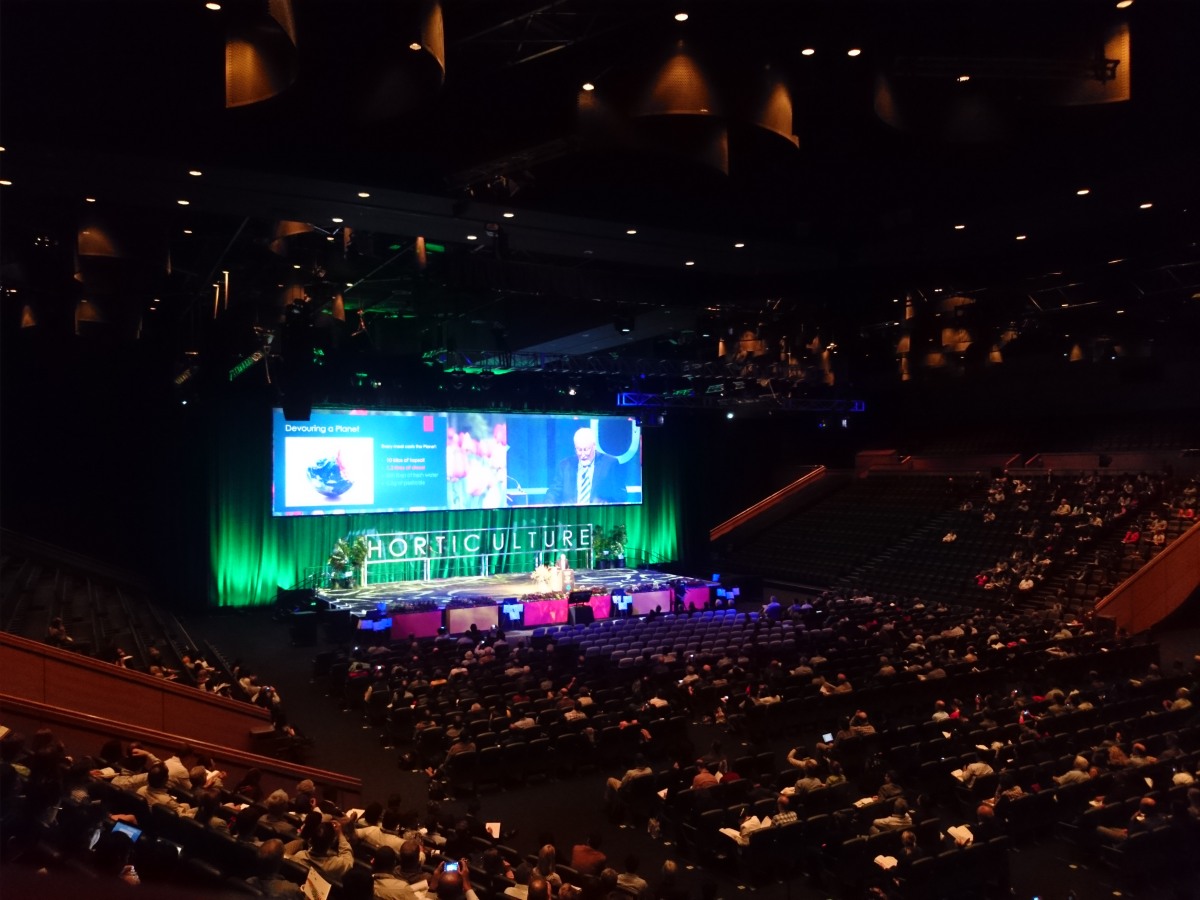
The keynote address at the first day of the International Horticultural Congress in Brisbane
The International Society of Horticultural Science holds a International Congress every 4 years in a different country.
This year it was in Brisbane, Australia and I decided it was time to go and see just where horticulture was going. It was impressively well organized in the modern conference centre on the south bank of the Brisbane River. More than 3000 delegates attended over the 5 days that it was run and the range of topics covered by the symposia necessitated a fair degree of choosiness. Presentations varied from excellent to hopelessly technical with a few mediocre thrown in for good measure. While I didn’t find anything directly relevant to my business it was worthwhile and my curiosity was well satisfied (or more precisely – saturated) by the end. The final dinner was a festive affair with a good band, dancers, magician and plenty to eat and drink. Rather depressingly I found myself to be of the average age – where was the future of horticulture which as one of the keynote speakers pointed out will be the future of feeding the world (horticulture is defined as being intensive agriculture)?
After the congress it was time to catch up with friends – some of whom I hadn’t seen for 25 years when I was last in Australia, doing the backpacker “thing”. I made some last minute changes to the itinerary and needing to book a flight to Canberra from Sydney I pulled out the smart phone in Brisbane airport and 3 hours later in Sydney got onto the plane to Canberra. Australia works. First world (not sure why I was expecting anything else but it really works). Of course first world functionality comes at a first world price and my friend Peter whom I visited in Orange (also in NSW) told me that Australia is now officially the world’s 4th most expensive country to live in. I can believe it. A small (by Harare standards) 3 bedroom house in Orange will go for some 5-600,000 Aus dollars and the gardens are miniscule! A meal for 3 of us at a good restaurant, though certainly unexceptional, in Brisbane cost $160 without alcohol. It would have been about $75 in Harare. It’s all to do with high labour costs I am told. That and the vast mining industry that powers the Australian economy.
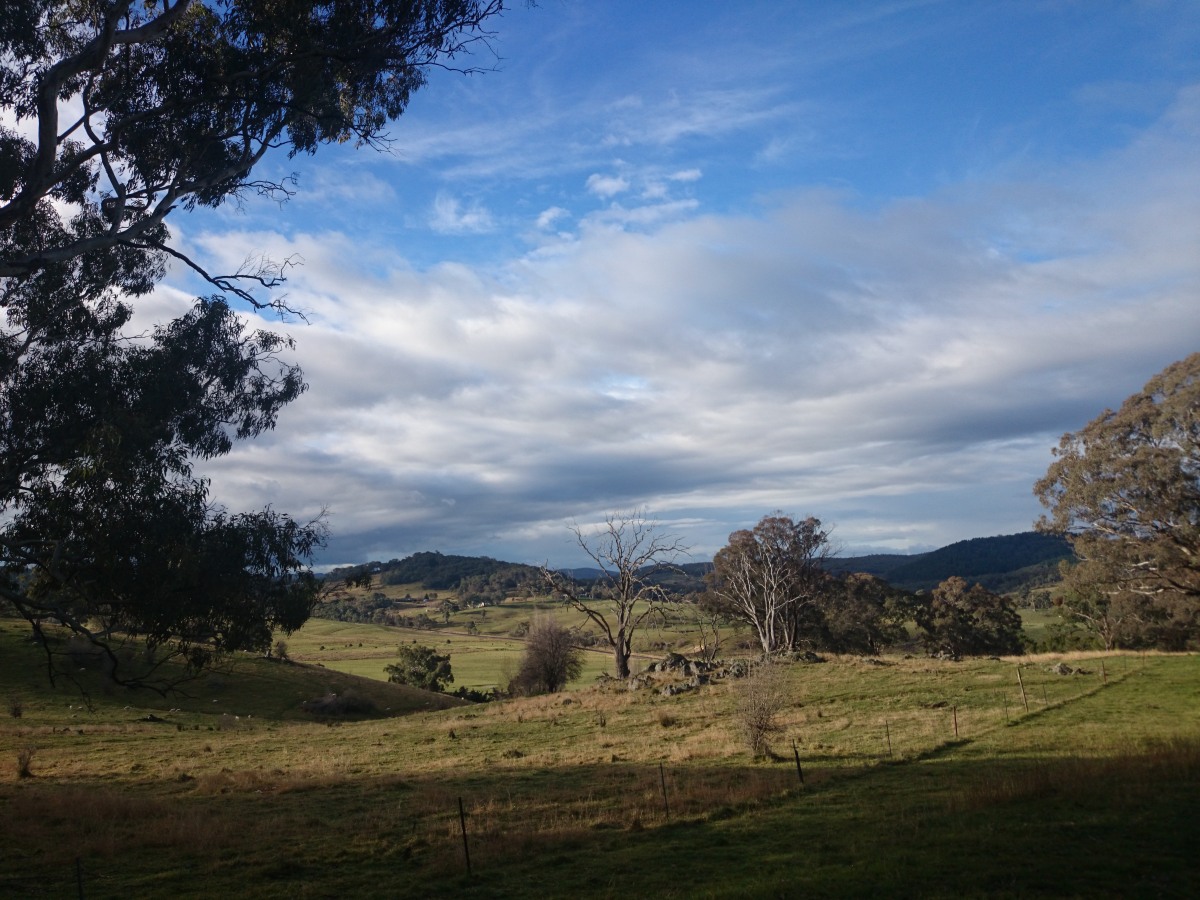
Pasture land around Orange
That is not to say that agriculture is insignificant either. Australia has some 13 million ha of wheat production, mostly for export. Zimbabwe was once self sufficient in wheat and exported maize. Now we import both. Unlike Australia where most extensive agriculture is going the corporate farming route with vast tracts of land being farmed, Zimbabwe is heavily reliant on the small scale producers. The mostly white commercial farmers were kicked off their land in the early 2000s – hence the idle dams and land that I saw coming into Harare. In Australia most extensive agriculture relies on rain whereas in Zimbabwe irrigation is essential, especially for winter/dry season production.

Canola (oilseed rape) near Orange, NSW
Oilseed rape (Canola) was abundant in the short trip we did around Orange, again mostly farmed by corporate organisations. This is not a crop we grow in Zimbabwe and unlike Zimbabwe, most states in Australia have embraced GMO crops. With labour costs that high GM farming is very attractive (most of the GM crops we saw were of the Roundup Ready® variety – i.e. weeds can be controlled by herbicide sprayed over the crop but the crop is unaffected). GMOs are banned in Zimbabwe though I know that they are imported illegally from South Africa where they are commonly grown.
Back in Queensland with another friend also called Peter we did the rounds of the farming area. The soil is much more fertile in the Darling Downs region than in most of Australia and it is used to the maximum. Again, mostly without irrigation and the maximum use of mechanization to keep labour costs down.
A few people at the congress in Brisbane asked me how many staff I employed. 14 labourers, 2 foremen and 8 contract labour. They looked stunned especially when I explained the size of the nursery. A nursery of similar size in Australia would employ perhaps 4 people. We are still third world here.
Being driven back home from the airport I couldn’t help but compare the filth of the Harare streets with the immaculate ones of Brisbane. BrizVegas, as the locals like to call it, is spotless. Like any modern, first world city, there is also lots to do there. There are two art galleries, a library that offers evening courses in, amongst other things, film making and of course lots of shows that are booked out months in advance. We don’t get much in the way of quality international entertainment here in Harare except perhaps for HIFA (Harare International Festival of the Arts) once a year and it’s relatively easy to get tickets there.

Brisbane from the river – there’s real money here!

BrisVegas from the south bank of the Brisbane River

A sculpture at the Gallery of Modern Art. I got this one, a lot was less comprehensible.
Back home the dogs were ecstatic, the lawn was dead from lack of water (it regrows in the rains), there was dust everywhere and the nursery was just fine. It had been good to get a perspective on the real world out there but it was also great to be home.


































First Street
24 09 2014Once upon a time the First Street shopping mall was a very fashionable part of town. Youngsters would go there and parade – boys strutting, talking and laughing loudly to impress the girls. It was quite the place to shop too; the place to be to sell fashion, or shoes, or hi-fi or furniture. That was long ago.
Now it is dirty with buckled pavements and old water bottles lying around. Tops are missing of street drains and the holes must be circumnavigated with care. Luxury shopping? Not if you want cheap Chinese fake leather belts, car cellphone chargers or no name brand long toed shoes. Or any of the other bric-a-brac commonly being sold on the streets of Harare.
The local idiot stopped washing a car with a tub of filthy water from the gutter and tried to sell me the cheap Chinese watch pinned to his trousers. I pointed out that I had a very good Swiss watch that was much better than his Chinese one. The argument only ended when the parking meter attendant agreed that Swiss watches were always better than Chinese ones.
Negotiating my way down the pavement past the vendors tables I crossed the First Street mall and smiled inwardly at the controversy that had been caused by paving it in to make it possibly Harare’s first pedestrian mall. So far as I could see the glamour shops were gone, the wares in the current outlets looking tired and lonely supplanting quality with quantity. Perhaps that was an ice cream stain near the pile of bricks in the middle, a child dropping its long dreamed of Saturday treat. Perhaps it was just spilt white paint.
The Agricultural Marketing Authority (AMA) was on the 3rd floor of a bank building opposite where I’d parked. The offices were plush and had a lot of chrome and granite in evidence for a government office. The lady at the Min of Ag (Ministry of Agriculture) building had said that now I had to be a member of the AMA to import coir for my nursery, just about $100 for a year she’d said. It turned out to be $500 and it was not exactly clear what I’d get for it. Well, the bureaucrat I spoke to certainly was eating some pretty impressive food but she claimed it was just leftovers from the board meeting currently in full swing. Having paid the $500 to the finance division I went back to get my membership. No, I was emphatically told, I had to go back on the 1st of October as it was only valid from then. I tried to reason that I could just have an invalid membership until then met with blind unreasonableness. No, and that was it.
The local idiot was back smearing filthy water over a slightly more dirty car. Negotiating the traffic I had to do a U turn at the end of first street were it was blocked of for “traffic works”. It will take a lot more than that to restore the pedestrian mall to a shade of its former glory.
Comments : 1 Comment »
Tags: Agricultural Marketing Authority, AMA, First Street, Harare, ice cream, Swiss watch
Categories : Social commentary