
Chivilila Falls on the Save River
It’s been nearly a month since we took 4 nights off and headed down to the south-east lowveld of Zimbabwe to Chilo Gorge, an up-market lodge, set above the banks of the Save River which is the biggest river inside the country. Normally it’s well out of our price range but they had a special on for Zimbabweans so when June and Gary Goss suggested we head down there for a couple of nights we decided to give it a try.
Picking up Gary and June in the eastern city of Mutare where I went to school we headed south into the lowveld of Zimbabwe. The road was fine for the first 140km or so and then got bad, really bad. My old Land Cruiser is tough but not the most comfortable of vehicles so at times we were down to second gear – on the main tar road (or rather what was left of it) past the sugar cane growing area of Middle Save. The alluvial soils of the Save River that flows through the area are fertile and in years gone by multiple crops were grown; cotton, wheat, maize and a variety of horticultural crops. After Robert Mugabe’s eviction of mainly white commercial farmers the area was under-utilized for a while but is now a major sugar cane growing area for an ethanol plant nearby. Fortunately Gary has worked in the area a lot, speaks the local language, and managed to persuade the security guards on the estate to let us use the good gravel road that bypasses a lot of the poor tar road.

Any time is dance time!
January is not a popular time to go to the lowveld of Zimbabwe. It’s hot and humid and the Chilo Gorge lodge is close to the lowest point in the country (162m) just downstream where the Save meets the Runde River, so it’s exceptionally hot. It was scorching by the time we turned of the tar road and headed along a gravel road to the lodge. Not far from the lodge was a maroon Mazda pickup truck stopped with the bonnet up. We stopped to see if we could help though as the pickup had a South African registration Gary was suspicious; “Nah, he’s come here to smuggle gold and diamonds”. Despite a rather strong South African accent he was a local man come to visit his family and had run out of diesel. A short drive to a nearby cluster of huts sourced a pipe and we gave him 5 litres of diesel (not difficult to get out of an old Land Cruiser). A small crowd of children soon gathered and entertained us with impromptu dancing to our rather good sound system though Madonna was the best I could find and not really what they’d be used to hearing!
It had just rained a few days before we arrived so the river was flowing and not cross-able except by boat so we had to use the lodge’s guided tour. It wasn’t free but well, we hadn’t come all this way to sit around and I was curious to see how Gonarezhou National Park on the other side of the Save River had fared since I’d last been here in the 1990’s. In that time the Zimbabwe National Parks has teamed up with the Frankfurt Zoological Society to form a trust to run the park.
The game guide, Lionel, was young, knowledgeable and entertaining and he took us very close to elephants and the Ghonarezhou elephants are known to be intimidating. As Lionel explained, they have been poached and don’t much care for humans. Fortunately he knew how to read their mood and there were no issues, just a few tense moments.
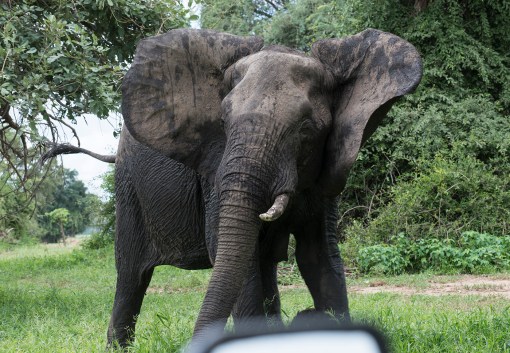
Getting rather close!
The first heard of elephants we encountered were making a determined walk for the Save River and were heading into the CAMPFIRE (Communal Areas Management Programme for Indigenous Resources) area across the river for the night’s browsing. There are simply too many elephants for the Park to sustain so they have to find food outside its boundaries. Whilst the CAMPFIRE area benefits from the presence of game conflicts will certainly arise elsewhere. Lionel told us that the Great Elephant Census estimated the Park’s elephant population at around 11,000 in an area of 5,000 square km. The Park can sustain about 2,500 which leaves the dilemma of what to do with the excess.
In years gone by elephant populations were kept in check by culling but that is very unlikely to happen now. It is nasty, dirty and dangerous and certainly no professional hunter would take part; witness the firestorm of popular anger on the social media after the shooting of Cecil the lion. No hunter would risk his reputation. National Parks lack the staff with the necessary experience.
Contraception of elephant cows has been successfully practised in the smaller South African parks but remains controversial in the likes of the Kruger National Park which is vast and unfeasible due to cost. Elephant population is apparently stable in the Kruger; fences have been removed, artificial water holes dismantled and the elephants made to move more and natural selection pressures allowed to take their toll.
We noticed that a number of baobab trees in the Park had wire mesh tightly wrapped and nailed to their trunks. I asked Clive Stockil, owner of the Chilo Gorge lodge and lifetime resident in the area, for more details. He explained it was to keep the elephants from destroying the trees. When I asked him why there were no younger trees growing up he responded; “Because everything from warthogs, baboons, buck, mongooses to elephants and in between eats them. They have a root like a big, white, tasty carrot – I ate plenty as a child. By protecting the existing trees we are buying time until a solution can be found to get the seedlings to maturity. Otherwise the mature trees will go extinct in the Park”. Baobabs can be “adopted” for protection here.
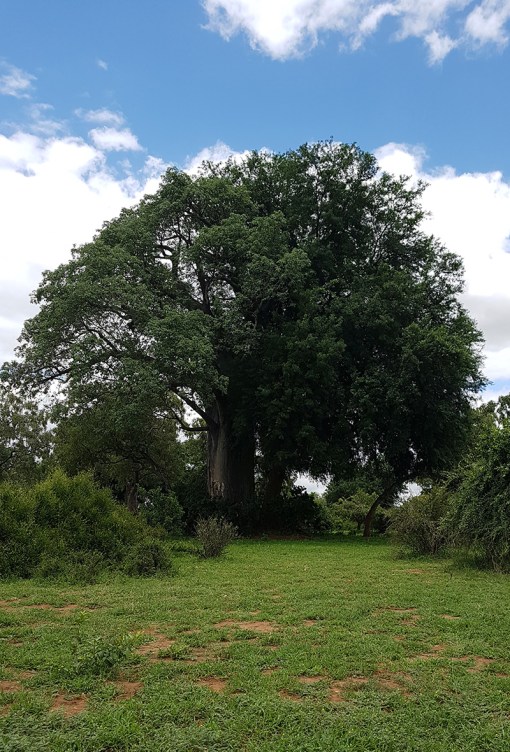
Looking for a sponsor – an unprotected baobab. Some damage to the trunk can be seen on the left.
The following day we took a short trip upstream from Chilo Gorge to the Chivilila Falls. Whilst not in full spate (the river was already dropping) it was worthwhile imagining it in flood – I commented to Marianne that it was not unlike listening to the surf pounding on coast.
The weather had cooled down considerably by now after a cold front had moved in and while not great for photography it was comfortable to be out and about so in the afternoon we opted to go and find a particularly large baobab in the conservancy area around Chilo Gorge lodge. It is part of the CAMPFIRE Organisation that Clive Stockil was instrumental in starting and promotes sustainable utilisation of natural resources for local communities. In return for assistance in policing wildlife areas communities also receive funding from safari and hunting companies and are preferentially employed – Chilo Gorge lodge sources a lot of its staff from the local community.

Passing time pleasantly; on the deck at Chilo Gorge lodge.
Our little expedition was cut short after Gary drove over a mopani tree stump which punctured a tyre. Lionel and a colleague happened to pass by and made us feel old by changing the wheel in a few minutes. Mildly chastened we retired to the deck overlooking the Save River and admired the wildlife on the far bank whilst sipping sun-downers. The highlight was a very young hippo calf – it still had shiny skin – that Clive estimated to be about 2 weeks old. It slept blissfully whilst its mother grazed on the river bank. A number of nyala came down to drink but were too nervous of crocodiles and went off elsewhere to find water from the recent rains.

Brothers; a group of very shy kudu bulls.
The following morning we went off on another game drive with Lionel once again the guide. Lots of elephant were seen, giraffe for those with good binoculars, kudu, zebra, eland, impala, two bachelor buffalo, numerous birds and of course some crocodiles.
After lunch it was time to say goodbye and head back north to Mutare to stay with June and Gary before heading home to Harare. For those thinking of making the trip from Harare; the road through Zaka is apparently much better!
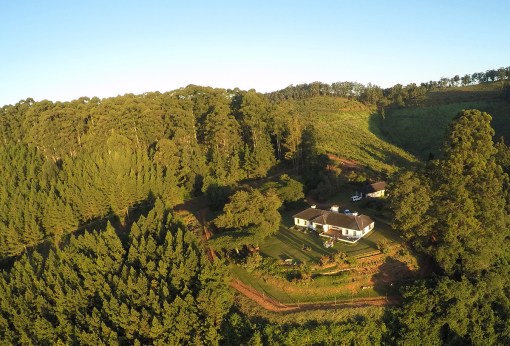
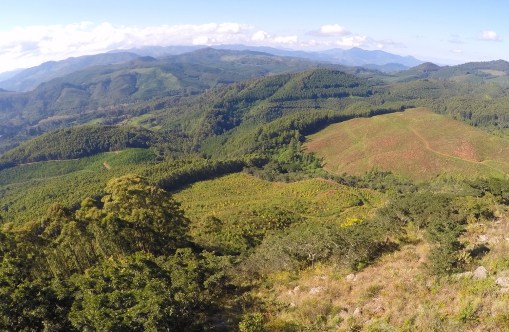






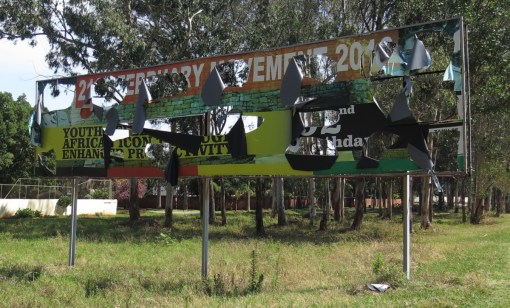


Hopeful signs?
29 03 2018Last week I attended the ART (Agricultural Research Trust) annual open day with the senior foreman at the nursery to keep our name recognisable (it’s Emerald Seedlings if you need to know). We’ve been feeling the pinch a bit this year – it’s been the slowest start to a year since Zimbabwe adopted the US dollar as its main currency back in February 2009.
ART is the last agricultural research centre in the country where any significant research actually happens (the other government farms are broke and little if any research is done on them) and they too have fallen on hard times now that the commercial farmers on whom they depended for tariffs are largely gone.
It was evident that there were quite a few more exhibitors than last year (we pay for space) and there were more than 250 visitors. That’s not a lot by agricultural show standards but most likely had some sort of connection to agriculture. There is a bigger agricultural equipment show later in the year but it’s open to anyone.
So was this good turnout symptomatic of a renewed enthusiasm for agriculture and the future of the country in general? It’s difficult to say. The new president, E D Mnangagwa has certainly been making all the right noises, including asking evicted white commercial farmer to return to help feed the nation. Few are likely to take up the plea. Most are now too old to start over or are established elsewhere – Zambia profited handsomely from the influx of farmers displaced by former president Mugabe’s disastrous land redistribution policy. The economy remains moribund but at least the government has resisted the temptation to print more of the infamous bond notes that curiously command a premium of 20% over cashless transactions in many parts of the economy.
Last week there was much anticipation over the name and shame list, published by the government, of people and organizations that had externalized money over the years. Names and quantities of money (to the dollar) were listed making me think that it was simply a lack of paperwork by the central Reserve Bank, after all who would export money through official channels if they knew it was illegal? Tellingly is was only a name and “shame” list, not a name and prosecute list and there were no current members of the ruling ZANU-PF party listed. Anticipation quickly became cynicism.
Last week my staff workers’ committee asked for a meeting. Cash was hard to come by; would I consider paying them more if there was no cash available for their wages because they could get a 20% discount for cash (which I do pass on as and when I get it). I don’t think they honestly expected me to say yes so I did not surprise them. Zimbabwe remains expensive and prices of imported goods (one has to wonder how grapes from Holland get a green light to be imported) continue to escalate. I did tell them that nothing was going to change before the elections scheduled later this year and even then it was only going to be incremental. I’m not sure they understood or even cared.
Yours for a cool $175,000. Comes with GPS enabled steering, air conditioning and enough lights to keep going all night. Requires an operator (drivers need not apply)
Zimbabwe ingenuity – a battery powered knapsack sprayer mounted on wheels with a spray boom adjustable in height for various crops
A storm on the way from Harare city. Trial plots line the road down the centre of the farm
ART field day looking north-east
Comments : 3 Comments »
Tags: Agricultural Research Trust, E D Mnangagwa, Robert Mugabe, Zambia
Categories : Agriculture, Social commentary