There was a demonstration against the rule of Robert Mugabe recently. That’s not news by most country’s standards but it most certainly is news here. It was small, about 2000 participants, but noisy and although the police originally refused permission the High Court granted permission. So what exactly is happening here? Is this the beginning of the end of the Mugabe regime?
I was in town for my French lesson with Shelton. He was late, comme d’habitude, as he has to rely on the notoriously erratic minibuses. While I was waiting a call came through from an unknown number.
“Hello, is that Mr Roberts?”
“Yes it is”.
“I am name given from ZANU-PF Gomba District at your office. I am requesting a donation for Monday”.
“What’s happening on Monday?”
“It’s Independence Day”.
I’d genuinely forgotten this most sacred of Zimbabwean holidays. There aren’t a lot of reasons to remember it. After 36 years we have steadily regressed to the point where currency restrictions are being reimposed because our balance of trade is so heavily skewed towards imports that we are once again running out of money. No, we cannot just print some more as we did with the Zimbabwe dollar; we are now using the US dollar. We don’t even have a currency of our own. Well so I thought.
Shelton told me that for 3 days this week he’d been translating at a feminist conference in town. It wasn’t just feminists, the whole spectrum of LGBTIQ (I had to ask what the last 2 letters meant) were there and it was quite an experience for him. No holds barred; there were tears, shouting and bad language aplenty but as he said just that it happened at all was remarkable. It would have been unthinkable just a few years back. Progress perhaps?

Bond coins – not enough for this cup of coffee!
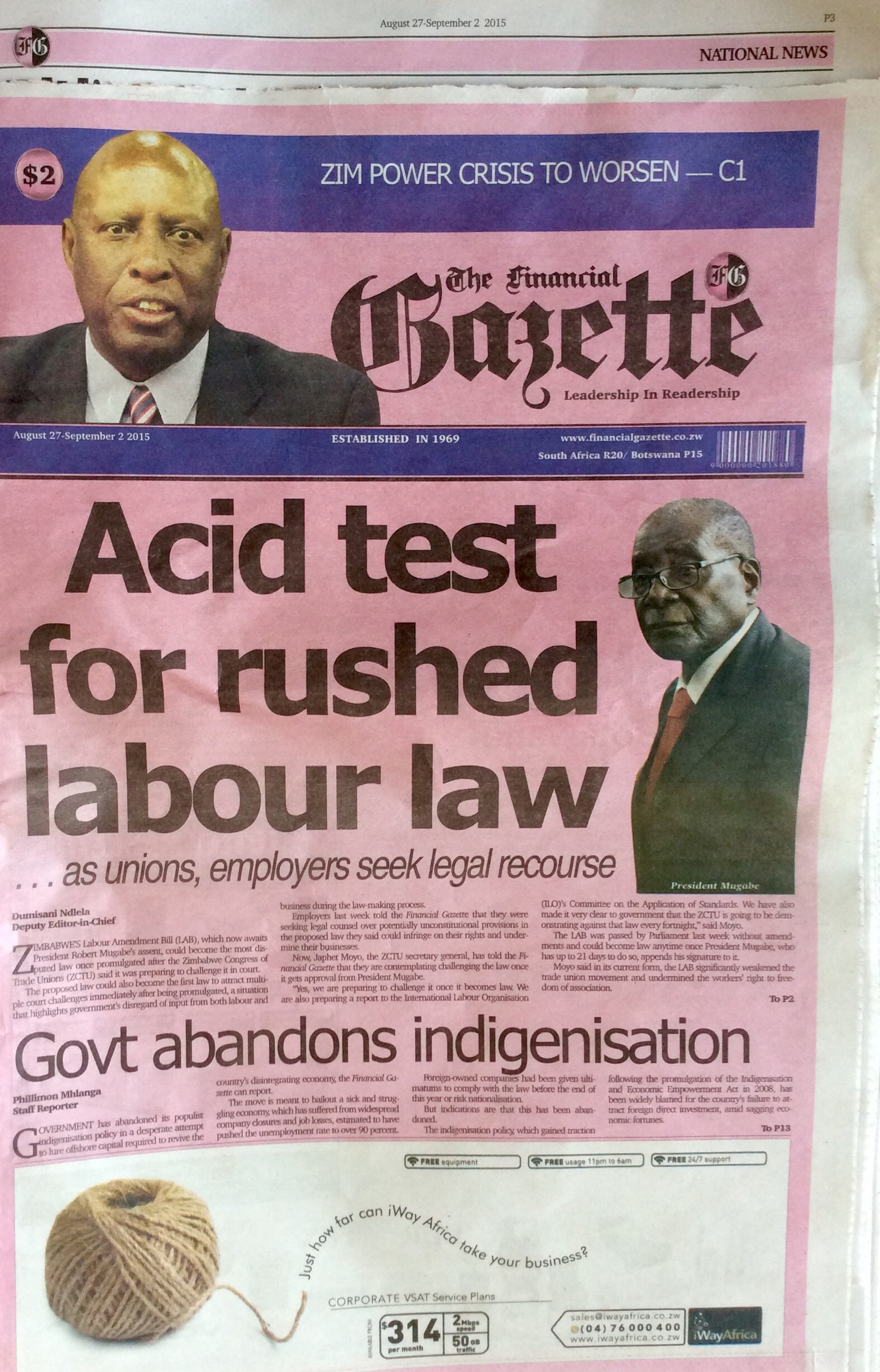
Then today I was on the way to do some company shopping in the industrial sites when I saw the newspaper placards advertising that the Reserve Bank is introducing bond notes. Bond notes? Really? We already have bond coins that are useful only in Zimbabwe and are on parity with the US dollar which is our de facto currency, but bond notes? Is this the start of the return of the Zimbabwe dollar as was suspected when the coins were introduced? Those fears were unfounded – it was just a means to alleviate the chronic shortage of small change – but it only gained acceptance when the South African rand plunged in value. We’d been using the rand coins, which fortuitously were one tenth the value of the US dollar, but when the rand started to run the bond coins became acceptable. Rand paper money also became unacceptable and the US dollar now rules supreme representing 95% of the currency in circulation. I decided to see where the public opinion lay.
Newspaper vendors on Coventry Road in the industrial sites were my first target.
“Can I pay for your newspapers with bond notes?”
“Yes” (no, I can’t – they haven’t been released yet)
“The Zimbabwe dollar is back!”
Nervous giggles – clearly I was not going to get a response here.
I stopped at the Zimbabwe Fertilizer Company yard to buy some gypsum. Despite my best provocations the clerk who served me would not be drawn to any sort of opinion on the matter. I was more blunt with the labourers who loaded the fertilizer. They were so bored with the lack of business that even those not involved wandered over.
“Pamberi ne ZANU-PF” (forward with the ruling party) I shouted and gave a clenched fist salute. Laughter.
“Pamberi ne Zimbabwe dollar” elicited a similar response. Nobody showed much interest in a debate.
My campaign reached it’s finale at the accounting office where I had to sign my companies’ annual returns (to indicate they were still active). The clerk’s response to my provocation was simply; “Ah, but what can we do?”. Protest perhaps?
Getting onto the internet at home was instructive. A statement from the Reserve Bank governor was circulating that was instructive and entertaining. The bond notes are going to be issued in $20, $10 $5 and $2 denominations and will be equivalent to their US cousins. They will be backed by a bond (hence the name) of $200 million from the Africa Export-Import Bank though they will be released as necessary (the $50m that backed the release of the bond coins last year has not all been used). But why are we in this mess?
- as the economy has declined our balance of trade deficit has ballooned. There is less money around to buy the cash we need. It’s going into importing goods.
- the cash we need has dwindled because it has become a commodity in itself. People are hoarding it because they don’t trust the banking system that let them down so badly in the past. The Reserve Bank estimates that some $3b – $7b is circulating in the informal sector and never goes through banks.
- the countries around us with more volatile currencies are eager to get hold of US dollars and are mopping it up any way they can.
- the cash is being illegally exported. Who is responsible? In the words of a teller at a bank I deal with – “The big men are stealing it all”. Also the Chinese. One was caught recently at Harare airport leaving with a large amount of cash.
So the elastoplast fix is multi-faceted. Heavy restrictions on imports especially luxury items. Raw materials, medicines and fuels are unrestricted. Paying for students overseas is restricted. Cash withdrawals are limited to $1000 per day. This should make paying wages for the big companies interesting. There are heavy restrictions on taking cash out the country but I saw nothing about using local Visa cards outside the country. Use of plastic money is going to be heavily encouraged and in some cases laughable; “To this end, every business in all geographical areas and sectors of the economy must have a point of sale per till machine or purchase point” in the words of the Reserve Bank governor. Really? That rural bottle store in the Honde Valley must get a POS machine?
So will it work? No, as I said earlier it’s not addressing the source of the problem – the gravely ill economy. Luxury goods will of course be available at a hugely inflated price (better stock up on wine now!) as those who can circumvent restrictions. Local producers will lack competition and hike prices. Cash is already being sold at a 10% markup and really, what will $200m do? Real $100 and $50 notes will be hoarded and smuggled even faster than before and the run on the banks that started some time ago will not stop as people fear the worst. It’s a self-fulfilling prophecy.
So is this the return of the Zimbabwe dollar? Whilst the Reserve Bank has stated it has no plans to reintroduce the Zimbabwe dollar I don’t know anyone who actually believes that – apart from maybe itself.












Return of the Zimbabwe dollar
6 05 2016There was a demonstration against the rule of Robert Mugabe recently. That’s not news by most country’s standards but it most certainly is news here. It was small, about 2000 participants, but noisy and although the police originally refused permission the High Court granted permission. So what exactly is happening here? Is this the beginning of the end of the Mugabe regime?
I was in town for my French lesson with Shelton. He was late, comme d’habitude, as he has to rely on the notoriously erratic minibuses. While I was waiting a call came through from an unknown number.
“Hello, is that Mr Roberts?”
“Yes it is”.
“I am name given from ZANU-PF Gomba District at your office. I am requesting a donation for Monday”.
“What’s happening on Monday?”
“It’s Independence Day”.
I’d genuinely forgotten this most sacred of Zimbabwean holidays. There aren’t a lot of reasons to remember it. After 36 years we have steadily regressed to the point where currency restrictions are being reimposed because our balance of trade is so heavily skewed towards imports that we are once again running out of money. No, we cannot just print some more as we did with the Zimbabwe dollar; we are now using the US dollar. We don’t even have a currency of our own. Well so I thought.
Shelton told me that for 3 days this week he’d been translating at a feminist conference in town. It wasn’t just feminists, the whole spectrum of LGBTIQ (I had to ask what the last 2 letters meant) were there and it was quite an experience for him. No holds barred; there were tears, shouting and bad language aplenty but as he said just that it happened at all was remarkable. It would have been unthinkable just a few years back. Progress perhaps?
Bond coins – not enough for this cup of coffee!
Then today I was on the way to do some company shopping in the industrial sites when I saw the newspaper placards advertising that the Reserve Bank is introducing bond notes. Bond notes? Really? We already have bond coins that are useful only in Zimbabwe and are on parity with the US dollar which is our de facto currency, but bond notes? Is this the start of the return of the Zimbabwe dollar as was suspected when the coins were introduced? Those fears were unfounded – it was just a means to alleviate the chronic shortage of small change – but it only gained acceptance when the South African rand plunged in value. We’d been using the rand coins, which fortuitously were one tenth the value of the US dollar, but when the rand started to run the bond coins became acceptable. Rand paper money also became unacceptable and the US dollar now rules supreme representing 95% of the currency in circulation. I decided to see where the public opinion lay.
Newspaper vendors on Coventry Road in the industrial sites were my first target.
“Can I pay for your newspapers with bond notes?”
“Yes” (no, I can’t – they haven’t been released yet)
“The Zimbabwe dollar is back!”
Nervous giggles – clearly I was not going to get a response here.
I stopped at the Zimbabwe Fertilizer Company yard to buy some gypsum. Despite my best provocations the clerk who served me would not be drawn to any sort of opinion on the matter. I was more blunt with the labourers who loaded the fertilizer. They were so bored with the lack of business that even those not involved wandered over.
“Pamberi ne ZANU-PF” (forward with the ruling party) I shouted and gave a clenched fist salute. Laughter.
“Pamberi ne Zimbabwe dollar” elicited a similar response. Nobody showed much interest in a debate.
My campaign reached it’s finale at the accounting office where I had to sign my companies’ annual returns (to indicate they were still active). The clerk’s response to my provocation was simply; “Ah, but what can we do?”. Protest perhaps?
Getting onto the internet at home was instructive. A statement from the Reserve Bank governor was circulating that was instructive and entertaining. The bond notes are going to be issued in $20, $10 $5 and $2 denominations and will be equivalent to their US cousins. They will be backed by a bond (hence the name) of $200 million from the Africa Export-Import Bank though they will be released as necessary (the $50m that backed the release of the bond coins last year has not all been used). But why are we in this mess?
So the elastoplast fix is multi-faceted. Heavy restrictions on imports especially luxury items. Raw materials, medicines and fuels are unrestricted. Paying for students overseas is restricted. Cash withdrawals are limited to $1000 per day. This should make paying wages for the big companies interesting. There are heavy restrictions on taking cash out the country but I saw nothing about using local Visa cards outside the country. Use of plastic money is going to be heavily encouraged and in some cases laughable; “To this end, every business in all geographical areas and sectors of the economy must have a point of sale per till machine or purchase point” in the words of the Reserve Bank governor. Really? That rural bottle store in the Honde Valley must get a POS machine?
So will it work? No, as I said earlier it’s not addressing the source of the problem – the gravely ill economy. Luxury goods will of course be available at a hugely inflated price (better stock up on wine now!) as those who can circumvent restrictions. Local producers will lack competition and hike prices. Cash is already being sold at a 10% markup and really, what will $200m do? Real $100 and $50 notes will be hoarded and smuggled even faster than before and the run on the banks that started some time ago will not stop as people fear the worst. It’s a self-fulfilling prophecy.
So is this the return of the Zimbabwe dollar? Whilst the Reserve Bank has stated it has no plans to reintroduce the Zimbabwe dollar I don’t know anyone who actually believes that – apart from maybe itself.
Comments : 2 Comments »
Tags: bond coins, bond dollars, Mugabe, Reserve Bank of Zimbabwe, zimbabwe dollar
Categories : Business, Social commentary