Saturday midday we like to gather at the Gallery Delta in town. It’s Robert Paul’s old house, one of the oldest still standing in Harare and thus is listed. It also has good contemporary art but we like to sit and discuss politics, finance and generally anything of interest. Interesting people come through – it can attract diplomats and others but today it was the turn of local financial wiz Melissa. Married to a local Zimbabwean she has consulted to all manner of financial institutions both local and international and always has something of interest to contribute. The conversation inevitably turned towards Zimbabwe’s impending financial implosion and, of course, bond notes.
Background
In October 2008 the Zimbabwe dollar became worthless. Having been revalued three times and had 18 zeros removed over the period of 18 months (not of course in linear fashion) it really was worth less than toilet paper and also less effective. In the previous month my company went broke despite being busy and after much soul-searching I brought in US$2000 of my own money which covered my expenses for the following month when customers started to ask if they could pay in US dollars. The Zimbabwe dollar was officially abandoned at the beginning of February 2009 and the US dollar became the de facto currency in this part of the country. In the southern regions the South African rand and Botswana pula became more accepted due to the proximity of these countries. Change was initially an issue and supermarkets gave out sweets and ballpoint pens in lieu but come 2013 -2014 the South African rand was valued at close to 10 to the US dollar (2013 – 2014) so it made for useful change. We also had our first brush with bond coins (valued in USc but not exchangeable outside the country). Initially ridiculed they gained acceptance once the rand drifted above 11 to the US dollar. Currently there are a number of currencies that are officially trade-able; UK pound, US dollar, Australian dollar, euro, yen, Chinese yuan, Botswana pula and of course the rand.
As Melissa explained adapting the US dollar was a mistake. Zimbabwe became a magnet for criminals and money launderers the world over as there was little control over the use of hard cash – if you had it in the bank you could withdraw it as cash. Millions of dollars in cash were taken out through our extremely porous borders. The start of the rot was nearly instantaneous.
The rest of us were too enamoured with the new freedom to do just about anything we liked with our money to notice. You could travel unfettered by the need for endless currency applications; real VISA cards worked anywhere! South African supermarkets moved into the country and bought out the local chains and imported goods flooded the shelves at vastly inflated prices. But hey, we had choice.
The economy expanded due largely to the mining sector and high prices of gold and other minerals. Agriculture, once the mainstay of the economy, continued to flounder on the back of the land redistribution exercise though there were a few years when tobacco enjoyed a resurgence, driven by buoyant prices. Attempts to get external investors interested were hamstrung by the contradictory message; invest with us but the majority of the shares must be held by a Zimbabwean.
Corruption and nepotism have gone from strength to strength. Perhaps a new word should be coined here – nepotist + kleptocrat = neptokrat. Readers are welcome to make suggestions. It seems that every day there are new revelations of squandered, stolen and diverted funds. The most famous is the fifteen billion dollars that was unaccounted for from the Chiadzwa diamond fields in the east of the country, alluded to by none other than President Mugabe himself. Now $15bn is a lot of money for a small country like Zimbabwe, a bit more than the GDP in 2014, which could have wiped out our external debts and left a sizeable chunk to get things going again but nothing appears to have happened to those responsible.
As the economy founders so the tax base shrinks and there is little wonder that lower ranking civil servants have not been paid for months (civil service salaries gobble 97% of the cash budget). The military of course do get paid – the police have been told to raise their own wages and do so by the myriad road blocks and spot fines throughout the country that have left them thoroughly discredited and despised.
It’s all about trust
In May this year the Reserve Bank of Zimbabwe (RBZ) governor announced the introduction of the bond notes and the run on the banks began. The proposal was to ensure the value of the bond notes at an equivalent to the US dollar but they would be for internal use only so no good to those who would seek to externalize them. The public saw it as a ruse to bring back the Zimbabwe dollar in another guise. The restrictions on withdrawing cash soon followed and served to fuel the panic. It didn’t help that the bond from the Afreximbank that serves to support the value of the bond notes is veiled in secrecy and ignorance. Unexplained delays in releasing the notes and the refusal of a German company to print them haven’t helped. Some banks are allowing more cash to be withdrawn than others but reports abound of clients queuing overnight to withdraw as little as $20 a day.
Zimbabwe has been slow to adapt to the plastic money found elsewhere. ATM and debit cards have been around for years and mobile banking has seen a major increase with the rise of smart phones which are ubiquitous even among the poor. The RBZ has been pushing the plastic money hard and most outlets now have POS (swipe card machines as they are known locally) machines and accept mobile banking. While unemployment is difficult to quantify (there haven’t been any recent surveys) it is undoubtedly high and a substantial proportion are informal traders who have to pay for the goods they bring across the South African border in hard cash. No small wonder they are suspicious of bond notes and local plastic money.
Cash is now commanding a premium of some 15% and I’m told traders abound at the local Roadport (bus terminus) in town and they have lots of $100 notes that cannot be found in banks. Likely they are in the employ of the neptokrats. I can now only buy the low sulphur diesel for my pickup with cash and some filling stations restrict the amount of fuel that can be bought with a card. Most businesses will give a discount for cash.
Legal challenges to the introduction of the bond notes have followed but on the 1st November Robert Mugabe signed the notes into law. Fait accompli.
Imports and nostro accounts
Nostro accounts (the money banks use to pay for imports) are heavily depleted due to our massive trade deficit. A friend who imports agrochemicals cannot pay his external suppliers despite having the money in the bank. VISA cards, which also depend on nostro accounts, work anywhere in the world for the moment and the crippling power shedding of last year and earlier this year have not reappeared largely due to the pay-as-you-go metering installed by the national power provider but I for one don’t expect this to continue. Greenhouse plastic, considered an essential import, is no longer available and this week when buying some basic pharmaceuticals I was informed that the calcium tablets had to be paid for in cash!
Smoke and mirrors
The people behind the bond note issue are not stupid – they must have known what the reaction would be. Why did they do it? I think it’s all a red herring to force us into the digital money arena where zeros are easily added with a few computer key strokes. After all, only $75m bond notes will initially be introduced in the form of $5 and $2 denominations. This is very small money though few actually believe that the neptokrats will be able to resist printing more, which may or may not be backed by a bond. The bulk of the cash in circulation is in US$100 and US$50 notes so the bond notes will have minimal effect on the nation’s liquidity. The various protest movements that sprung up this year, over various other social issues, including #thisFlag and #tajamuka were instrumental in sparking the riots that rocked Harare and Bulawayo, the second city, in July and August this year but it’s been quiet over the last 2 months as people’s attention is diverted into getting their cash out of the banks. Was this intentional or just fortuitous from the authorities’ point of view?
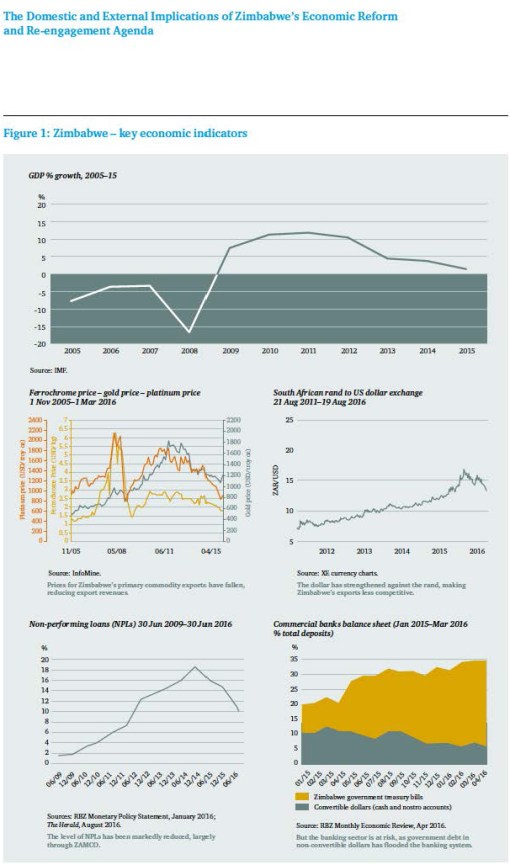
It’s not looking good (Chatham House report)
We may yet be bailed out by the IMF Melissa suggested. Mozambique is also in dire financial straights as are Angola and Malawi. Zimbabwe imploding might well drag down the whole sub-region – propping up the current regime would be preferable. Zimbabwe has cleared its debt with the IMF so this is possible.
And last but not least
As with any crisis of this proportion there are those who will find the humorous angle. “With the tumble of the English pound, the waver of the US dollar, the volatility of the rand at least the bond notes are stable” is a popular social network joke. When Harare’s main rubbish tip mysteriously caught alight a week ago, and dumped noxious fumes over the northern suburbs, there were those who postulated it was being fueled by bond notes!
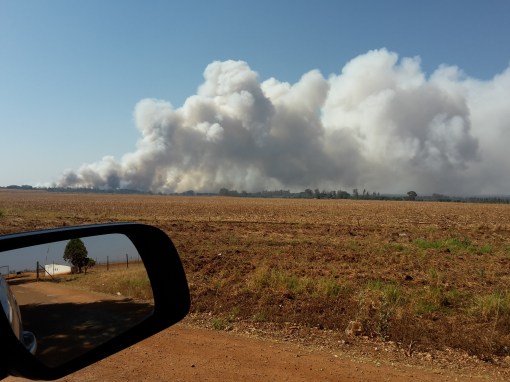
Pomona rubbish tip burning – bond notes the fuel?
Ah the Brexit, if only our problems were so small.
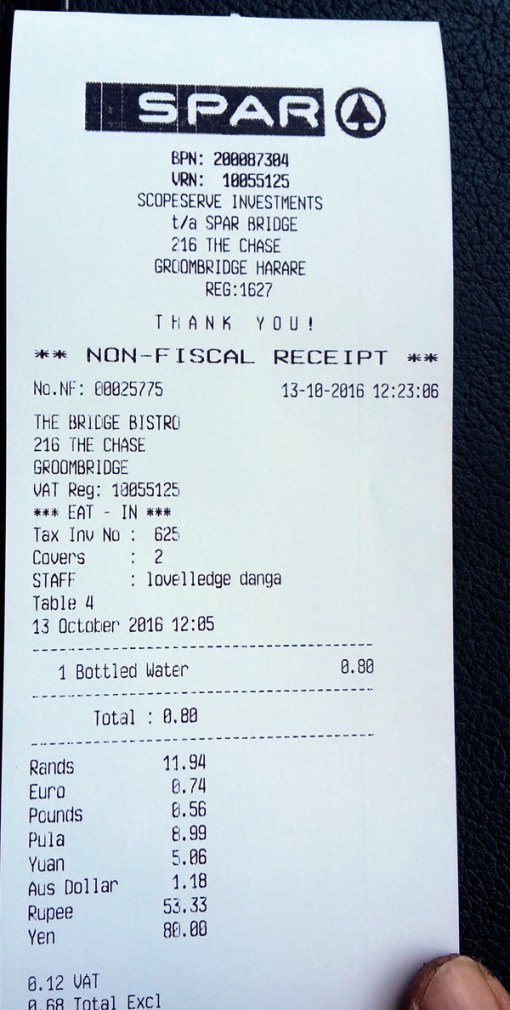

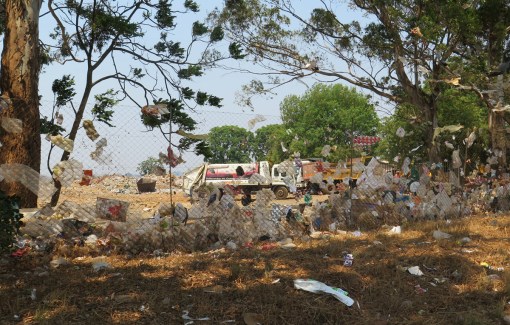





 Zimbabwe Absurdity
A country on the brink of disaster
1 11 2016We in Zimbabwe are apparently teetering on the brink of disaster. The much-dreaded bond notes alluded to in the previous post have been signed into law by President Mugabe (yup, Bob notes are real guys!) and it’s all down hill from here. We are still not sure where they are coming from as the German company behind the printing of the now defunct Zimbabwe dollar refused to print these. Never fear, someone will step up to the plate where there’s money to be made.
Marondera air day. Fun in the name of fund raising
Going out to an air day organised for charity at Marondera, a small agricultural town 3/4 hour from Harare, on Saturday there was little sign of impending disaster. Vehicles clogged the road and drivers drove badly. There were no queues at filling stations but I’d had to search out low sulphur diesel the previous day as my regular supplier didn’t seem to have it anymore. When we arrived at Marondera aerodrome there was a fair collection of aircraft both ancient (see the Cessna 182 in the foreground) and brand new – a 2 seat helicopter. I guess it was all small fry compared with a similar event in the civilized world but hey, it was actually happening! The Air Force had even been roped in (camouflage aircraft back left) to supply parachutists for entertainment and paid rides for the public. The parachutists certainly were entertaining with some spectacularly hard landings and bad approaches through trees to the LZ. And yes, I mean THROUGH trees! The inevitable party after the show was over was not well attended and the music was not great either but hey, we could still buy imported beer.
The man in charged of the local parachute school said he was still very busy though it seemed that paramotoring, which is why we were there, is not so attractive as we didn’t have any inquiries. The next day the wind was too strong for us to fly so we packed up, had a late breakfast with our host the other side of town and headed home along a busy road.
Today I am breaking news to my employees that they will no longer be paid in cash and like the rest of us will have to get themselves a debit card. It’s not going to be a popular move but they were warned 2 months ago that this was coming. Cash can now be bought for as much as a 15% premium which can make for a useful bargaining tool when buying. My partner and I have decided to embrace the crisis and have bought a house in a suburb that needs considerable refurbishing before we move in. Surprisingly not all the companies we’ve got quotes from are that interested in cash and only offer a 5% discount but with the bond notes now inevitable that might change. Who knows, we might be able to pay off the mortgage with a few bond notes and actually save a lot of money as they rapidly become worthless. (People who had mortgages in the Zim dollar days were often able to pay them off for a few notes as they became completely worthless.)
Comments : 4 Comments »
Tags: aircraft, bond notes, charity, Marondera, paramotoring, Robert Mugabe
Categories : News & Various, Social commentary, Sport